How to Protect Assets from IRS: A Practical Playbook
Learn how to protect assets from IRS enforcement with a step-by-step legal playbook covering liens, levies, exemptions, trusts, retirement accounts, and when

In this article
- What IRS Asset Protection Actually Means
- Three rules control the outcome
- How IRS Collection Actually Works
- Legal Tools That Shield Specific Property
- Start with exemptions
- Separate business exposure properly
- Use retirement planning carefully
- Treat trusts as long-horizon planning
- Procedural Moves That Stop Collection Fast
- Collection Due Process
- Offer in Compromise
- Currently Not Collectible
- Bankruptcy
- Special Situations Including Foreign and Digital Assets
- Foreign accounts need compliant reporting
- Digital income requires clean records
- Red Flags That Turn Protection Into a Crime
- Transactions that should stop you
- Your 90 Day Plan and When to Call a Tax Attorney
- The first two weeks
- Weeks three through six
- Weeks seven through ten
- Weeks eleven and twelve
The most popular advice about how to protect assets from the IRS is often the advice most likely to make your situation worse. Moving money into a shell company, transferring a vehicle to a relative, or opening an undisclosed foreign account doesn't erase a tax assessment. It can add fraudulent-transfer, evasion, or false-statement problems to an already serious collection case.
The workable strategy is less dramatic and more effective. You preserve appeal rights, use exemptions that the law provides, document hardship, and choose a collection alternative before the IRS starts taking cash from your bank account, wages, or receivables. Federal tax liens and levies remain the IRS's core collection tools, and recent enforcement data shows renewed activity after the pandemic-era decline, including 214,099 Notices of Federal Tax Lien in FY2025, compared with 157,323 in FY2022. IRS collection trend data also records third-party levy notices rising from 273,286 in FY2022 to 339,137 in FY2025.
What IRS Asset Protection Actually Means
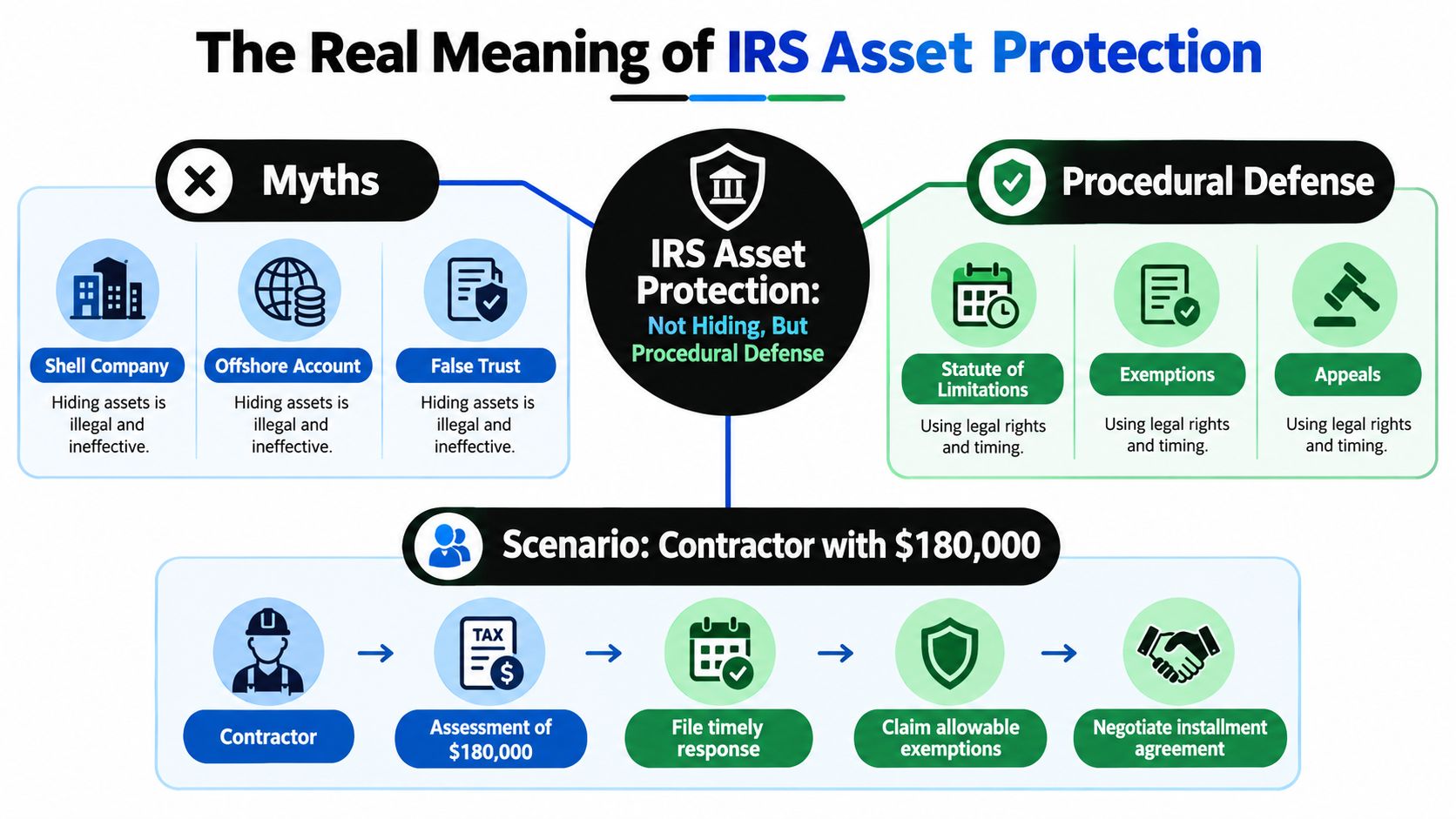
Asset protection from the IRS does not mean making property disappear. It means using lawful procedure before the government narrows your options.
A contractor with a $180,000 payroll-tax bill learned that lesson the hard way. A week before a levy arrived, he put the title to his work truck in his cousin's name without fair value. He kept driving the truck, kept paying its expenses, and kept running the business. The IRS can attack that transfer, treat it as concealment, and pursue the underlying taxpayer. He may lose the truck anyway, while also creating a second legal problem.
The IRS assesses tax against the taxpayer, but a federal lien can reach a broad range of the taxpayer's property and rights to property. That includes more than cash sitting in a checking account. Depending on ownership, exemptions, and the collection step being used, the risk can extend to business equipment, receivables, investment accounts, and property interests. Business owners should not assume that only immediately available cash is exposed.
Three rules control the outcome
- The IRS must follow its collection procedures. A notice gives you a chance to challenge the case, appeal, or propose an alternative.
- Exemptions come from statute. You do not talk the IRS into inventing one. You identify whether the property fits an exemption recognized by Congress or applicable state law.
- Timing matters. A transfer made before a known liability, for fair value and a real business purpose, is different from a last-minute transfer meant to defeat collection.
The history matters too. The Government Accountability Office's enforcement history describes extensive use of liens, levies, and seizures in earlier periods, while later enforcement relied more heavily on liens and levies than on physical seizures. Low seizure numbers do not make a lien harmless. A lien can cloud title, complicate refinancing, and make a business sale harder long before anyone shows up to take property.
Practical rule: Protection means using legal tools before collection accelerates, not hiding assets after a notice arrives.
How IRS Collection Actually Works
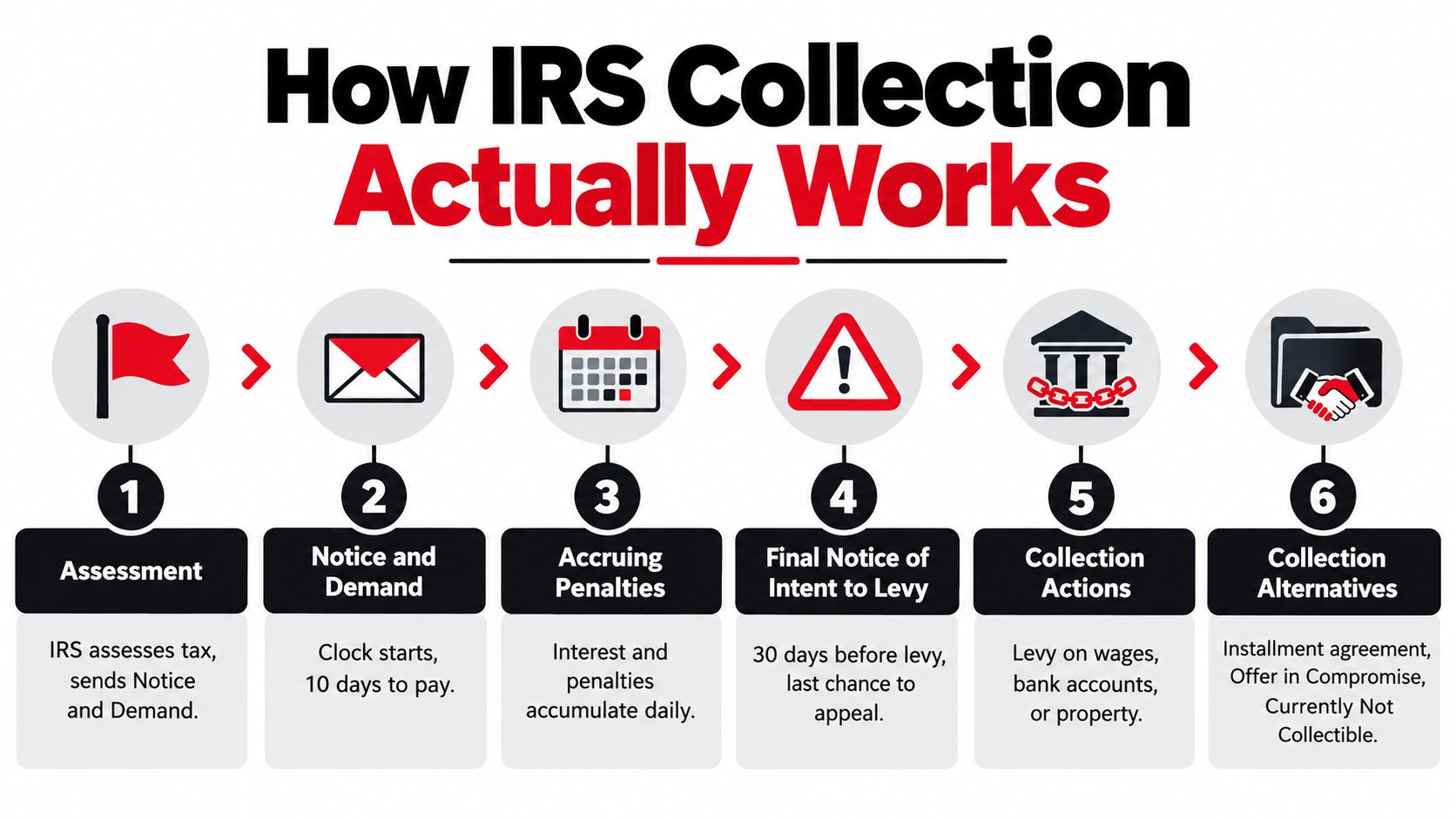
IRS collection moves in stages, and each stage gives you a different opening. If you wait until the IRS has already taken action, your options shrink fast.
Assessment and demand. The IRS assesses the tax and sends a Notice and Demand for Payment. From there, the collection statute generally runs for 10 years from assessment, unless something suspends or extends it. Guidance on IRS tax-debt asset protection explains why the assessment date controls the clock.
Federal tax lien. Once assessment and demand are in place and the debt goes unpaid, the statutory lien attaches. A recorded Notice of Federal Tax Lien puts the government's claim in the public record and clouds title. It secures the debt against property, but it does not seize anything.
Collection pressure. Notices start stacking up, penalties and interest keep running, and the IRS may demand financial information. Installment agreements, Offers in Compromise, or currently not collectible status come into play if the facts support them.
Final notice and levy risk. A Final Notice of Intent to Levy and Notice of Your Right to a Hearing usually gives you a 30-day window to request a Collection Due Process hearing. IRS Publication 594 says taxpayers generally use Form 12153 by the deadline in the notice to preserve review rights. The IRS collection process and levy stages are explained in this overview of levy and garnishment.
Levy. A levy takes property or rights to property under IRC 6331. It can reach wages, bank funds, and accounts receivable. A bank levy freezes money in the account. A wage levy keeps taking a slice of future paychecks until the IRS releases it.
Seizure and alternatives. Physical seizure is the blunt end of the process, but smart defense starts earlier. The right move is usually an appeal, a collection alternative, a release request, or a hardship showing before the IRS takes the asset.
IRS's current collection data shows that third-party levy notices can increase materially as cases move into active enforcement. For a business, that can mean frozen operating cash, diverted customer payments, or a payroll problem that hits on Friday. Do not treat the collection statute as a waiting game. If you stop filing, ignore notices, or fail to propose a real alternative, you give the IRS more room and yourself fewer tools.
Legal Tools That Shield Specific Property
Structural planning has a place, but it must be done before the liability becomes a collection emergency. The right question is not whether an entity or trust sounds protective. The question is whether the arrangement has a legitimate purpose, respects ownership rules, and survives the IRS's lien rights.
Start with exemptions
Federal law provides exemptions for categories of property, including certain personal property and tools of a trade under IRC § 6334. State law may also protect some home equity or household property. In bankruptcy, a wildcard or homestead-equity exemption may matter, but the available protection depends on the jurisdiction and the case.
A Texas sole proprietor with a six-figure tax liability may have a defensible position for keeping necessary equipment used directly in the trade, subject to the applicable exemption rules. That doesn't mean every item in the shop is protected. A rarely used luxury vehicle isn't the same as equipment needed to produce income.
Separate business exposure properly
An LLC or S corporation can separate business and personal exposure when the entity is properly formed and maintained. The company needs its own accounts, records, contracts, payroll process, and commercial purpose. A single-member LLC with commingled funds and personal payment of business expenses won't reliably create the separation the owner expects.
Payroll taxes require special care. A responsible person can face personal exposure for unpaid trust fund taxes even when the business operates through a corporation or LLC. Entity planning doesn't excuse payroll compliance.
Use retirement planning carefully
Qualified retirement accounts may receive strong protection under ERISA and applicable law. IRAs and Roth IRAs can receive protection under federal and state rules, but the exact protection depends on the account, jurisdiction, and collection facts. Taxable brokerage accounts generally don't receive the same protection merely because they're used for long-term investing.
Retirement protection also doesn't mean the IRS can never reach an account. Account type, ownership, distributions, and the taxpayer's broader collection posture all matter. This guide to IRS rights involving 401(k) accounts explains why account classification should be reviewed before assuming a balance is untouchable.
Treat trusts as long-horizon planning
A domestic asset protection trust can be considered for legitimate, long-term planning, but it isn't an emergency shelter. Transferring property into a trust after receiving collection notices, while insolvent or for inadequate consideration, can invite a fraudulent-transfer challenge.
| Tool | What It Shields | IRS Collection Reach | Key Caution |
|---|---|---|---|
| Statutory exemptions | Qualifying personal property, tools, or home equity | The IRS can challenge whether the asset qualifies | Exemptions are limited and fact-specific |
| LLC or S corporation | Properly separated business activity | The IRS can collect from the taxpayer and pursue responsible-person liabilities | Commingling destroys credibility |
| ERISA retirement plan | Qualifying plan assets | Exceptions and account-specific rules apply | Don't confuse plan protection with immunity |
| IRA or Roth IRA | Protection available under applicable law | The IRS may still analyze ownership and levy authority | State law and account type matter |
| Domestic asset protection trust | Long-horizon trust-held property | Transfers can be attacked if made to defeat known creditors | Timing and fair consideration control legality |
A lawful structure is designed before distress, funded for a legitimate reason, and documented. Moving assets after a liability is known is not planning. It's evidence.
Procedural Moves That Stop Collection Fast
The fastest way to protect an asset is often to stop the collection action that would reach it. These tools don't all fit every taxpayer, and none excuses filing obligations, but each can change the government's next move.
Collection Due Process
A taxpayer who receives a qualifying Notice of Intent to Levy or Notice of Federal Tax Lien generally has 30 days to request a Collection Due Process hearing with Form 12153. IRS Publication 594 states that a late request generally results in an Equivalent Hearing instead, which doesn't preserve the same judicial review rights. The IRS's procedural guidance on collection alternatives also reports that CDP appeals can produce a different outcome from the proposed lien or levy, while many collection actions are upheld when taxpayers haven't filed required returns or otherwise fail to qualify for relief.
A contractor facing a threatened wage levy may use the CDP process to dispute the action, propose an installment agreement, or present financial hardship. The deadline printed on the notice controls. Don't assume a phone call to the IRS preserves the hearing right.
Offer in Compromise
An Offer in Compromise, generally submitted with Form 656, can resolve qualifying tax debt for less than the full amount. The grounds include doubt as to liability, doubt as to collectibility, and effective tax administration. The IRS reviews income, expenses, equity, and future ability to pay. A taxpayer who hasn't filed required returns or who proposes an amount disconnected from the financial records is not presenting a serious offer.
For a retired taxpayer whose income and assets cannot support full payment, an offer based on collectibility may be appropriate. For a taxpayer who disputes the assessment, the liability must be analyzed first rather than buried inside a settlement package.
Currently Not Collectible
Currently Not Collectible status can pause active collection when paying would prevent the taxpayer from meeting basic living expenses. It doesn't erase the debt. The IRS may review the taxpayer's finances later, and the collection statute continues to matter.
A family whose only available cash covers housing, food, utilities, and necessary medical costs may have a hardship argument. The argument must be documented with accurate financial information, not asserted as a slogan.
Bankruptcy
Chapter 7 or Chapter 13 may discharge certain income tax liabilities if the debt satisfies the bankruptcy timing and legal requirements. Payroll trust fund taxes and other categories receive different treatment. Bankruptcy also triggers complex rules involving liens, secured property, priority claims, and the treatment of tax debt under provisions including 11 U.S.C. § 507 and § 1322.
A business owner considering bankruptcy should analyze the tax characterization before filing. This discussion of IRS bank-account levies explains why stopping a levy and eliminating the underlying lien are separate questions.
| Tool | Trigger / Form | Effect on Collection | Typical Timeline | Best Use Case |
|---|---|---|---|---|
| CDP hearing | Notice deadline, Form 12153 | Challenges or pauses the proposed action | Deadline-driven | Preserving appeal rights |
| Offer in Compromise | Form 656 and financial disclosure | May settle qualifying debt | Financial review required | Debt exceeds realistic ability to pay |
| Currently Not Collectible | Financial hardship documentation | Suspends active collection | Subject to later review | Basic expenses cannot be met |
| Bankruptcy | Chapter 7 or Chapter 13 petition | May stay collection and discharge qualifying tax debt | Case-specific | Tax debt fits discharge rules |
The mistake is choosing a tool because its name sounds familiar. Choose it because the facts support it, then file the right form before the deadline.
Special Situations Including Foreign and Digital Assets
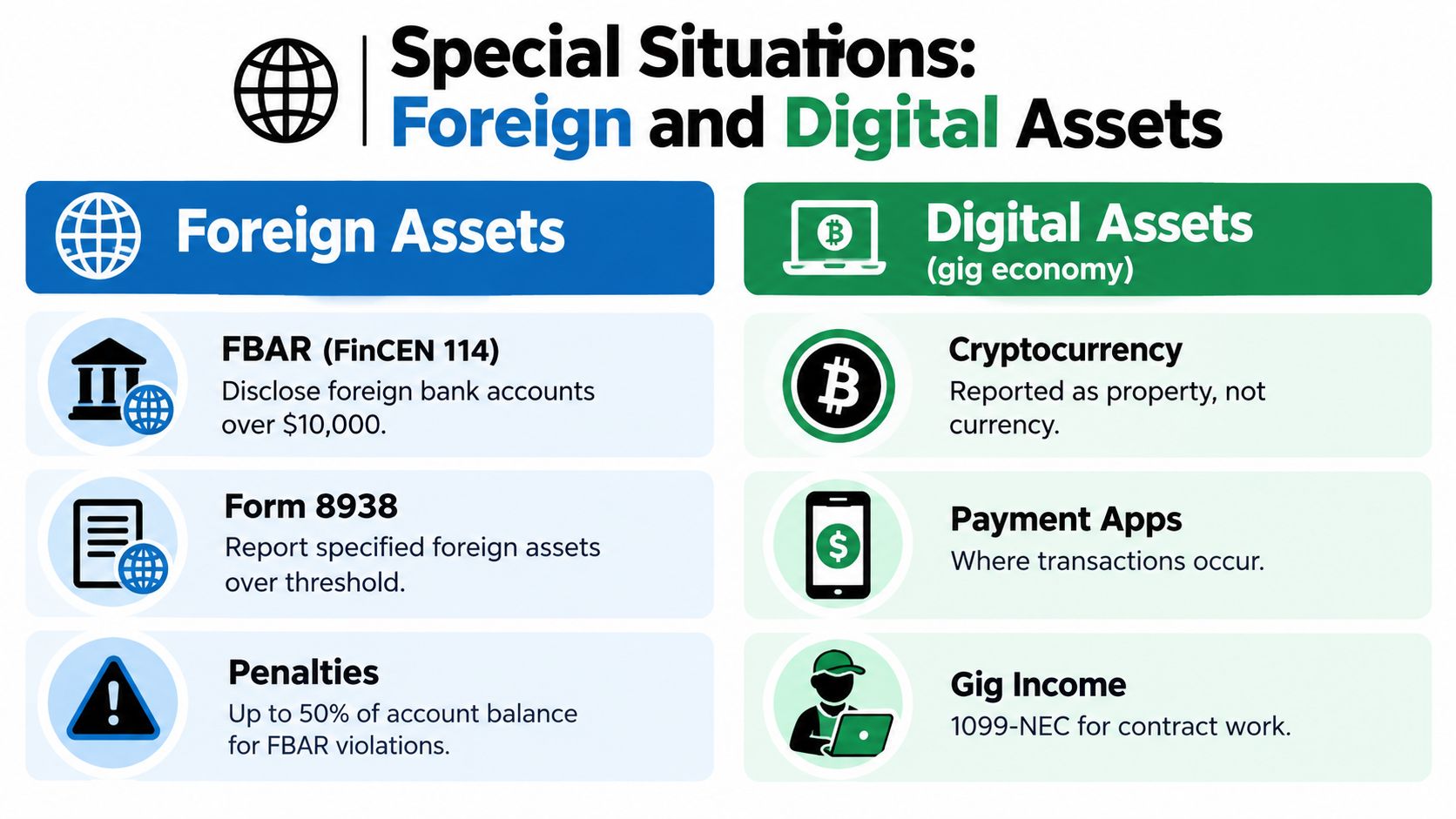
Foreign and digital assets create reporting problems before they create collection problems. A taxpayer who reports everything accurately gives an adviser room to solve the liability. A taxpayer who treats foreign or digital property as invisible may turn a civil collection issue into a broader compliance case.
Foreign accounts need compliant reporting
Foreign financial accounts may require an FBAR, filed through FinCEN Form 114, and specified foreign financial assets may require Form 8938. The foreign-account disclosure guidance is a useful starting point for identifying reporting obligations and assembling account records.
Foreign ownership doesn't remove the IRS's ability to assess U.S. tax. Information exchange, financial institution reporting, and records from foreign banks can make undisclosed accounts discoverable. Foreign retirement arrangements also don't automatically receive the same treatment as a domestic 401(k) or IRA. The governing agreement, treaty position, account classification, and reporting history all matter.
A U.S. citizen with rental property and bank accounts in Costa Rica may believe the property is outside practical reach. The more immediate danger may be unreported income, missing information returns, and incomplete basis records. Foreign doesn't mean invisible, and moving funds offshore after a liability arises is especially difficult to defend.
Digital income requires clean records
Gig work, creator revenue, cryptocurrency transactions, and payment-app receipts can create several reporting obligations. Depending on the transaction, records may feed into forms such as 1099-K, 1099-NEC, Form 8949, or other reporting schedules. Keep invoices, platform statements, wallet histories, fees, basis records, and business expenses together.
For companies building compliant custody or transaction systems, regulatory blockchain solutions by Blocsys offers relevant background on regulatory-ready digital-asset infrastructure. That kind of compliance thinking matters to individuals too. The recordkeeping system should make it possible to explain where money came from, what was sold, and how the tax result was calculated.
Joint ownership adds another layer. Property held by spouses may receive different treatment depending on the state, the form of title, and whether the state follows community-property rules. Don't transfer jointly held property casually. Review the ownership documents and the tax liability together.
Red Flags That Turn Protection Into a Crime
The line between planning and concealment is not mysterious. It turns on intent, accuracy, consideration, and timing.
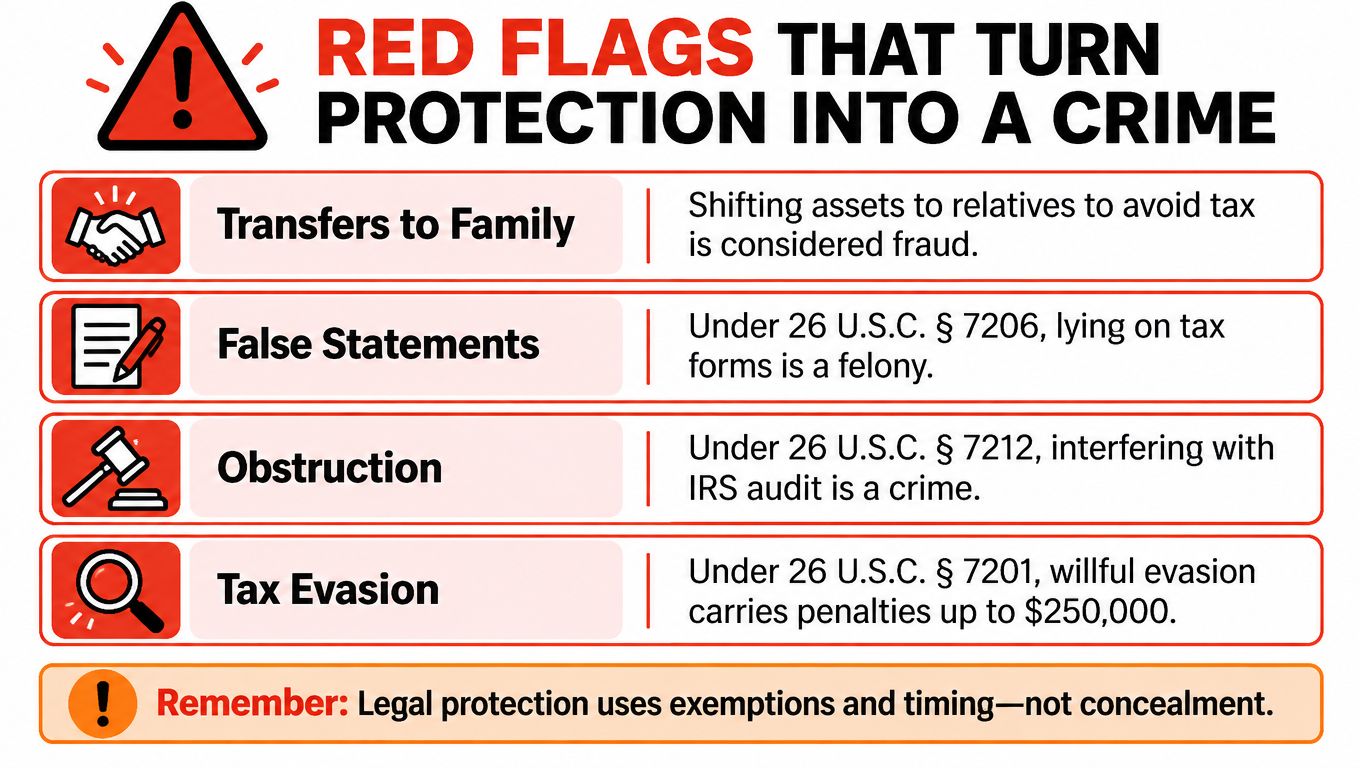
A transfer to a family member while tax debt is accruing deserves immediate scrutiny. If the taxpayer remains in control, receives little or nothing of equivalent value, or makes the transfer after receiving collection notices, the transaction can look like an attempt to defeat the government. Federal lien law and applicable state fraudulent-transfer rules can support recovery against the transferred property.
False statements create a separate hazard. Signing a return that omits income, understates assets, or misrepresents ownership can expose the taxpayer under 26 U.S.C. § 7206. Willful attempts to evade tax fall under 26 U.S.C. § 7201, and interference with IRS administration can create obstruction exposure under 26 U.S.C. § 7212.
Transactions that should stop you
- Family transfers: Don't retitle vehicles, homes, equipment, or accounts to relatives without documented consideration and a legitimate reason.
- Sham entities: An LLC with no independent operations, records, or capitalization won't become credible because it has a filing certificate.
- Promoter schemes: Offshore packages, sham trusts, and aggressive captive-insurance arrangements marketed as secret IRS-proof shelters can create more exposure than protection.
- False financial disclosure: An Offer in Compromise or collection statement must be complete and accurate. Omitting an account undermines the application and your credibility.
- Late CDP requests: IRS Publication 594 says a late Form 12153 generally leaves only an Equivalent Hearing, with the loss of the same judicial review rights available after a timely request.
The safest defense is a documented legal position you can explain to an IRS officer, an appeals officer, and a judge.
If prior reporting is incomplete, voluntary correction is usually safer than waiting for an audit or levy. Programs such as the IRS Filing Compliance Procedures may be relevant for eligible taxpayers with international reporting problems, but eligibility and filing requirements must be checked carefully. Don't take advice from a promoter who promises secrecy.
Your 90 Day Plan and When to Call a Tax Attorney
You don't need a complicated strategy on the first day. You need an accurate file, a deadline calendar, and a decision about which collection tool fits the facts.
The first two weeks
Pull IRS account transcripts, wage and income information, notices, filed returns, payroll records, bank statements, loan documents, and ownership records. Confirm the assessment dates, the periods involved, whether a federal lien was filed, and whether a levy notice is pending. Build an asset inventory that includes business equipment, vehicles, receivables, retirement accounts, digital wallets, foreign accounts, and jointly owned property.
Weeks three through six
File any missing returns before presenting most collection alternatives. If a CDP deadline is open, prepare and submit Form 12153 rather than relying on an informal phone call. At the same time, compare an installment agreement, an Offer in Compromise, hardship status, and bankruptcy treatment.
Weeks seven through ten
Implement only changes that have a legitimate purpose and can withstand review. That may include correcting entity records, separating business and personal accounts, documenting retirement contributions, or addressing a lien that is blocking a refinance or sale. Don't move existing assets because a deadline is approaching.
Weeks eleven and twelve
Audit the plan for fraudulent-transfer risk, inconsistent statements, missing filings, and unsupported valuations. Keep a written record of every payment, submission, conversation, and agreement. If the IRS has already filed a lien, started a levy, asserted payroll trust fund liability, or the balance is substantial, DIY work becomes dangerous quickly. A notice with a deadline under 30 days also deserves prompt professional review, as does any matter involving bankruptcy or disputed ownership.
A competent tax attorney should ask for the notices, transcripts, returns, financial records, and ownership documents before promising an outcome. Ask what specific form or appeal will be filed, what deadline applies, what facts could make the strategy fail, and whether the proposed fee covers representation before the IRS Office of Appeals or only preparation. Be wary of pressure to pay a large retainer before anyone has completed a factual tax-debt analysis.
Representation changes the conversation when the case reaches Appeals or Tax Court because the issue becomes more than payment. The attorney must preserve rights, challenge the government's position where appropriate, and present a collection alternative the IRS can approve.
Tax Attorney Stephen A Weisberg evaluates IRS tax debt, levies, liens, audits, and business collection exposure through a Tax Debt Analysis before recommending a course of action. Visit Tax Attorney Stephen A Weisberg to review your deadlines, asset exposure, and lawful options before the IRS takes the next step.


