How to Pay State Taxes in Indiana: A Complete Guide
Learn how to pay state taxes in Indiana with our guide. We cover deadlines, online payments via INTIME, payment plans, and what to do if you face tax debt.
In this article
- Navigating Your Indiana Tax Obligations
- Who actually needs to pay attention
- Why Indiana feels easier than it is
- The core mindset that keeps you out of trouble
- Your Primary Tool The INTIME Portal
- Guest payment works for simple situations
- Create an account if you pay Indiana more than once
- The entries that decide whether your payment is applied correctly
- Where INTIME earns its keep
- A Breakdown of Indiana Tax Payment Methods
- The practical comparison
- My recommendation for most taxpayers
- Credit cards are convenient, not efficient
- Mailing a check still works, but it’s not my first choice
- When bank payment is clearly superior
- Choosing based on your actual risk
- Managing Estimated and Withholding Tax Payments
- Who should be making estimated payments
- A practical system for quarterly payments
- Withholding tax is a separate obligation
- The cheapest habit is segregation
- What to Do When You Cannot Pay Your Taxes
- Early action matters because Indiana collection changes by stage
- Stage one with the Department of Revenue
- Stage two with the County Sheriff
- Stage three with a private collection agency
- What to do right now if you’re behind
- When this moves beyond DIY territory
- Your Path to Indiana Tax Compliance
- Frequently Asked Questions About Indiana Tax Payments
- How do part-year residents or nonresidents pay Indiana income tax
- How can I confirm Indiana received my payment
- Should I pay by mail or online
- What if I made a payment but it was applied incorrectly
- Can I amend a return after I already paid
- What if I can’t tell whether my problem is simple or serious
You log into your bookkeeping software, see a state balance due, and realize Indiana taxes aren’t just a once-a-year filing chore. If you’re self-employed, running a small business, or getting income that doesn’t come through regular payroll withholding, you need a payment system, not last-minute scrambling.
That’s where the mistake often lies: focusing on filing and treating paying as an afterthought. Indiana makes payment fairly straightforward, but only if you understand the moving parts early: the state rate, the county tax layer, the deadlines, the payment portal, and what happens if you miss the window and the account goes into collection.
If you’re trying to figure out how to pay state taxes in Indiana, the good news is that the process is manageable. The bad news is that waiting too long turns a manageable problem into a collection problem fast.
Navigating Your Indiana Tax Obligations
A lot of Indiana taxpayers assume state tax means one simple payment at filing time. That’s true for some wage earners. It’s not true for many freelancers, sole proprietors, LLC owners, S corporation owners, and anyone with income that doesn’t have enough withholding.
Indiana’s system is simpler than many states, but you still need to respect it. For the 2024 tax year, Indiana uses a flat state income tax rate of 3.05%, and local county income taxes can range from 0.5% to 3%, paid with the state return according to Indiana state and local tax rules summarized by Symmetry. That same source notes that returns are due by April 15, and quarterly estimated payments are due on April 15, June 15, September 15, and January 15.
Who actually needs to pay attention
If you fall into any of these groups, you should assume Indiana tax payments matter throughout the year, not just in April:
- Independent contractors who receive non-wage income
- Sole proprietors paying from business profits
- Single-member and multi-member LLC owners with pass-through income
- S corporation owners with income beyond payroll withholding
- Part-year residents and nonresidents with Indiana-source income
- Small business owners with employees who also have withholding responsibilities
The state doesn’t care whether you feel like a “real business.” If you’re earning taxable income, Indiana expects the money on time.
Why Indiana feels easier than it is
Indiana does one thing right. It funnels much of the process through one state-administered system instead of forcing taxpayers through a maze of separate local filings for county income tax. That reduces clerical confusion.
But simple doesn’t mean forgiving.
Practical rule: If you know you’ll owe, act before the due date. Indiana tax problems are cheapest to solve when they’re still ordinary payment issues, not collection cases.
The core mindset that keeps you out of trouble
Treat Indiana taxes like a recurring operating expense. Don’t treat them like an annual surprise. If you’re a business owner, this belongs on the same planning list as rent, payroll, insurance, and vendor bills.
That approach matters because most tax messes start with a basic mistake. The taxpayer had income. The taxpayer knew tax would be due. The taxpayer waited anyway.
Your Primary Tool The INTIME Portal
You finish your return at 9:30 p.m. on the due date, authorize the payment, and assume the problem is solved. Then a notice shows up because the payment was entered under the wrong tax type or period. That is how small INTIME mistakes turn into real tax trouble.
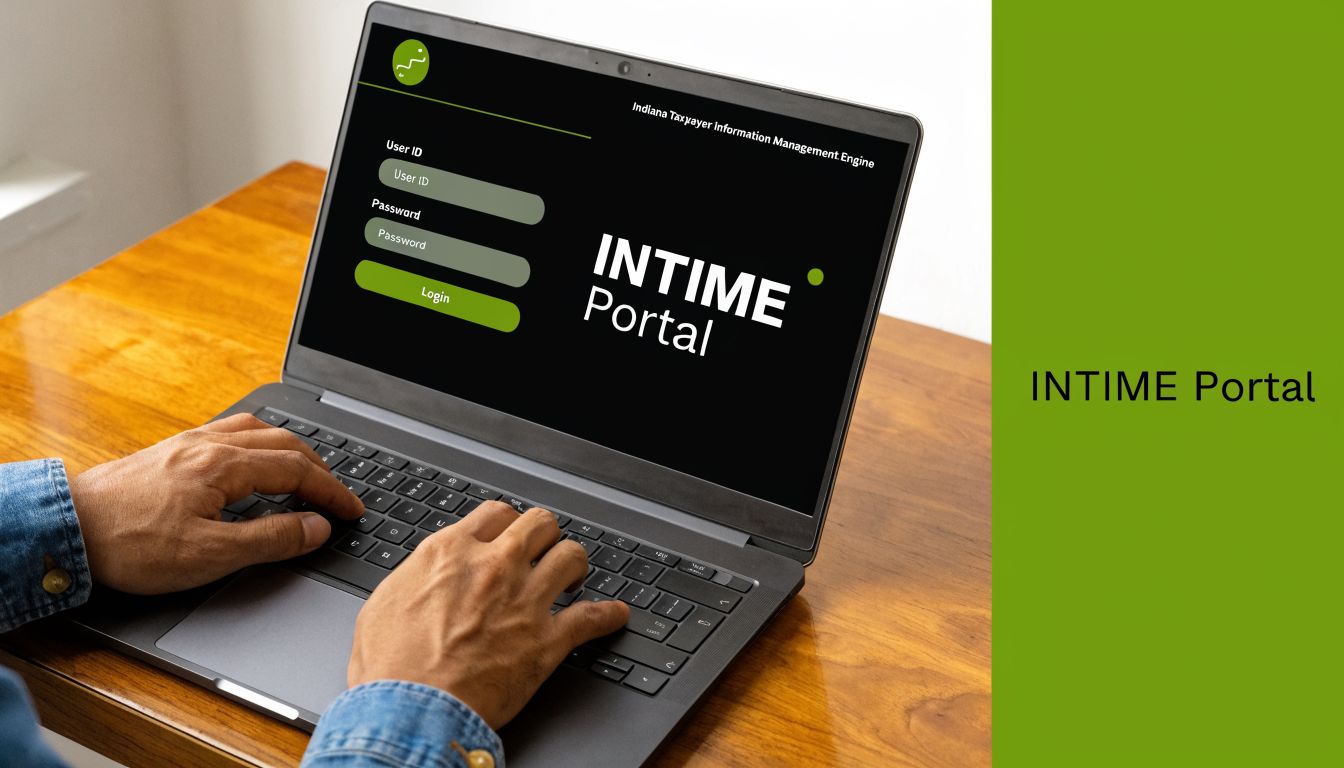
INTIME is Indiana’s main online tax system. Use it early, not for the first time under deadline pressure. If Indiana taxes are part of your life more than once a year, learn the portal before you owe money.
Guest payment works for simple situations
Indiana lets many taxpayers make a payment through INTIME without creating a full account. That is useful when the job is straightforward and you already know exactly what you are paying.
Guest payment makes sense for:
- A one-time balance due on an individual return
- An estimated tax payment when you know the correct period
- A same-day deadline payment when speed matters and account setup would slow you down
Use guest payment for clean, simple transactions. Do not use it as your long-term recordkeeping system.
Create an account if you pay Indiana more than once
Business owners, landlords, self-employed taxpayers, and anyone with recurring estimates should register for the full account. The value is not convenience. The value is proof.
A full INTIME account lets you review payment history, track notices, and confirm how Indiana applied your money. That matters if the state later claims you missed a payment. It matters even more if an unpaid balance starts moving through Indiana’s collection pipeline, from Department of Revenue action to sheriff involvement to an outside collection agency. By that stage, bad records become expensive records.
My recommendation is simple. If you expect to deal with Indiana taxes again, create the account now and keep your documentation in one place.
The entries that decide whether your payment is applied correctly
INTIME problems usually come from data-entry errors, not technology failures. The money leaves your bank account, but Indiana applies it somewhere you did not intend.
Slow down and verify these items:
Taxpayer identification
Enter the correct SSN, ITIN, or business tax identifier. Owners with multiple entities need to confirm they are paying under the right legal account.Payment type
A balance-due payment is different from an estimated payment. A withholding payment is different from an income tax payment. Choose the wrong one and you create work you did not need.Filing period Quarterly filers often face issues with the filing period. Confirm the correct year and quarter before you submit.
County information
Indiana county tax details affect individual filings. Enter the residence information the system asks for, and make sure it matches the return.Confirmation record
Save the receipt immediately. Keep a PDF copy. Email it to your bookkeeper, controller, or preparer the same day.
Where INTIME earns its keep
INTIME is strongest when your tax life is not simple. That includes taxpayers with multiple income streams, business owners managing several obligations, and anyone trying to avoid current payments being confused with older balances.
| Situation | Why INTIME matters |
|---|---|
| You owe with a filed return | You get immediate confirmation and a dated record of payment |
| You make recurring estimated payments | You can monitor whether each payment hit the intended period |
| You received a notice | You can compare the notice to your payment history before calling the state |
| You run a business with more than one tax account | You can verify which account and liability you are paying |
Use INTIME as your default control center. It is the best way to reduce avoidable mistakes before they become penalties, notices, and collection problems.
A Breakdown of Indiana Tax Payment Methods
Indiana gives you several ways to pay. They are not equal. Some are cheaper, some are slower, and some create more room for error than others.
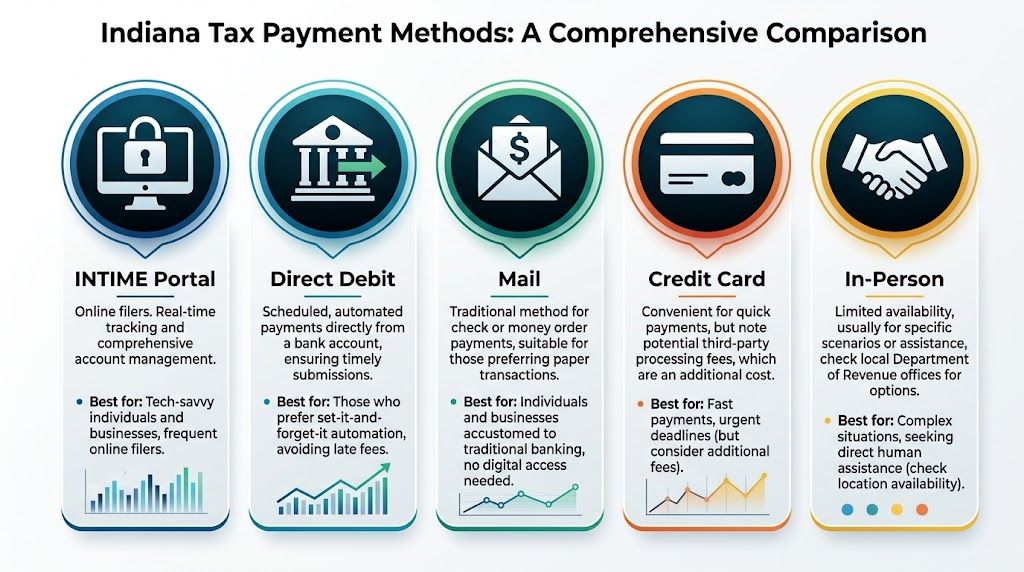
My opinion is simple. Bank payment through INTIME should be your default choice unless you have a specific reason to do something else. It’s usually the cleanest combination of cost control, speed, and documentation.
The practical comparison
| Method | Best use | Main advantage | Main drawback |
|---|---|---|---|
| INTIME bank payment | Most individuals and business owners | Fee-free ACH option | You still have to enter the details correctly |
| Credit or debit card | Fast payment when cash flow timing matters | Convenient and immediate | Processing charges can be expensive |
| Mailing a check | Taxpayers who prefer paper records | Familiar process | Slower, easier to misapply, easier to miss deadlines |
| EFT-style business payment methods | Some businesses with structured payment processes | Can fit internal accounting systems | More setup and less practical for many individuals |
| Limited in-person help | Special situations | Human assistance | Not the primary payment path for most taxpayers |
My recommendation for most taxpayers
Use INTIME bank payment if you can. It is the best fit for most return payments and estimated tax payments because it avoids unnecessary transaction costs and gives you immediate confirmation.
That cost issue matters more than many taxpayers realize. The Indiana payment options discussion at Kristel’s Tax & Accounting notes that INTIME bank payments are fee-free, while credit or debit card payments through a third-party processor can bring meaningful convenience charges. For self-employed taxpayers making quarterly estimates, those charges can add up to hundreds of dollars annually, making ACH the more economical option.
Credit cards are convenient, not efficient
I understand why people use cards. Cash flow is tight. Rewards are tempting. The due date is today. But paying state tax by card often means paying extra just to move money from one pocket to another.
That’s not a financing strategy. It’s a convenience purchase.
If you use a card once in an emergency, fine. If you use it every quarter out of habit, you’re probably burning money for no good reason.
A tax payment method should solve the tax bill, not create a second bill in processing charges.
Mailing a check still works, but it’s not my first choice
Paper payment is still available. Some taxpayers prefer a physical check and a mailing trail. That’s workable if you’re organized.
But mailing introduces friction:
- Delivery delay can turn a timely intention into a late payment problem
- Manual processing increases the risk of application errors
- Missing identifiers can cause crediting problems
- No instant confirmation leaves you waiting when you should be certain
If you mail a payment, include the identifying information the state expects so the payment gets credited correctly. Don’t assume a check with the right amount is enough by itself.
When bank payment is clearly superior
For these taxpayers, ACH through the state system is the obvious choice:
- Freelancers making quarterly estimates
- Small business owners paying regularly
- Taxpayers who want same-day proof of payment
- Anyone trying to avoid card processing costs
- People who already handle tax records digitally
Choosing based on your actual risk
The right payment method depends less on personality and more on risk.
If your biggest risk is forgetting, use the method that gets done fastest and leaves a clear receipt. If your biggest risk is overspending, avoid card fees. If your biggest risk is administrative sloppiness, avoid paper unless you’re meticulous.
That’s the better way to think about how to pay state taxes in Indiana. Don’t ask which method feels comfortable. Ask which method gives you the highest chance of paying the right amount, to the right place, on time, with proof.
Managing Estimated and Withholding Tax Payments
A common Indiana tax mess starts the same way. Income comes in all year, no one sets money aside, and April turns into a scramble for cash plus penalties.
Estimated payments are how you stop that problem before it starts. If you earn income without enough withholding, pay Indiana during the year instead of waiting for the annual return. As noted earlier, the state expects quarterly payments on the usual schedule. Miss that rhythm and you risk underpayment penalties and interest that make a manageable tax bill more expensive.
Who should be making estimated payments
Pay attention to this if your income is not covered by regular wage withholding.
That usually means:
- Freelancers and consultants paid on 1099s
- Independent contractors with uneven income
- Business owners taking profit distributions
- Landlords and investors earning taxable income outside payroll
- People with side income that creates state tax with no withholding attached
If that describes you, set a quarterly review date now. Waiting until return preparation is lazy tax management, and it usually costs more.
A practical system for quarterly payments
You do not need perfect projections. You need a repeatable process and enough discipline to use it.
Use this approach:
- Review year-to-date income near the end of each quarter.
- Estimate Indiana tax due, including any local exposure that applies to you.
- Compare that amount with withholding and earlier estimates already paid.
- Pay the gap before the deadline.
Taxpayers with uneven income should check monthly, not just quarterly. That is how you avoid a large catch-up payment in the fourth quarter, when cash is often tighter and mistakes are harder to fix.
For a clean reminder system, keep a reference to these quarterly tax payment deadlines. Put them in your calendar, accounting software, and task manager. Memory is not a compliance system.
Withholding tax is a separate obligation
Business owners often focus on their own estimated tax and ignore employee withholding. That is a serious mistake.
Money withheld from employee pay is not working capital. It is tax money you are holding temporarily for the government. If you run payroll, understand your payroll liabilities well enough to separate them from operating cash every single pay period. Using withheld funds to cover short-term expenses is how a cash flow problem turns into a collection problem.
This matters even more in Indiana because tax debt does not stay in one place forever. If withholding balances go unpaid, the collection process can escalate through the Department of Revenue, then the Sheriff, then an outside collection agency. That progression gets uglier and less flexible each step of the way. Smart owners prevent that by staying current before the debt starts moving.
The cheapest habit is segregation
Open a separate tax savings account and move the tax portion there as revenue comes in.
That one habit solves more payment problems than any app or reminder tool. It also makes method choice easier. Quarterly filers who pay electronically on a recurring basis should usually favor bank draft over card payments because card convenience can come with processing costs that add up fast over a year. If you file and pay often, those hidden transaction costs deserve attention.
Competent taxpayers do not leave tax cash mixed into general spending money. They separate it, review it, and pay on schedule. That is how estimated and withholding payments stay routine instead of becoming the start of an Indiana collection case.
What to Do When You Cannot Pay Your Taxes
If you can’t pay your Indiana tax bill in full, your first move is not to hide from it. Your first move is to file on time anyway and start dealing with the balance before it gets worse.
That point matters because many taxpayers make the most expensive mistake first. They skip the return because they can’t afford the payment. That usually gives the state more room to assess, collect, and escalate.
Early action matters because Indiana collection changes by stage
Indiana tax debt does not sit in one bucket forever. It moves. And the payment options become less flexible as it moves.
The Indiana collection-stage explanation from Dutton Legal Group highlights a critical fact many generic payment guides ignore: Indiana collection can unfold in three distinct stages. At the Department of Revenue stage, a payment plan may run up to 36 months. If the debt escalates to the County Sheriff, terms may shrink to 6 months or even immediate full payment.
That is the most important collection fact in this article. Delay reduces options.
Stage one with the Department of Revenue
Here, you still have an advantage. Not an unlimited advantage, but a real advantage.
If your account is still with the DOR, act quickly:
- File all missing returns
- Confirm the actual balance owed
- Make current-year payments on time
- Ask about payment arrangements before the account escalates
- Keep records of every contact and payment
This is the stage where taxpayers often still have room to stabilize the problem without a full-blown enforcement situation.
Stage two with the County Sheriff
Many people are often caught off guard.
They assume the flexible payment terms they could have requested earlier will still be there later. Often they won’t be. Sheriff collection can bring much tighter terms and much more pressure. If you waited because you thought you were “buying time,” you may have done the opposite.
Waiting rarely improves a tax debt case. Usually it just changes who is collecting and how hard they press.
Stage three with a private collection agency
By the time a tax debt reaches outside collection, the taxpayer is usually reacting instead of planning. Communication gets more stressful. Settlement expectations often get less realistic. Documentation problems become more painful.
At that point, the central questions are no longer “How do I make a payment?” They become:
- Is the balance accurate?
- Are all returns filed?
- Has the debt been assigned or escalated?
- Is a payment plan still realistic?
- Do garnishment or other enforced collection steps need to be addressed?
If you’re already facing aggressive enforcement concerns, this guide on how to stop state tax garnishment is a useful starting point.
What to do right now if you’re behind
If you owe Indiana and can’t pay in full, do these in order:
File the return
Get the filing done even if payment is partial or delayed.Verify the number
Don’t negotiate around a balance you haven’t checked.Pay something if you can
Partial payment won’t solve everything, but it can reduce the growing problem.Respond to notices quickly
Silence is read as noncooperation.Protect current compliance
Old debt is bad. Old debt plus new missed payments is worse.
When this moves beyond DIY territory
If you have multiple years due, business tax debt, sheriff involvement, collection agency contact, payroll exposure, or uncertainty about whether the assessed balance is even right, get professional help.
Not every Indiana tax debt case needs a lawyer. But some definitely do. The taxpayers who get the best outcomes are usually the ones who seek help before the collection stage hardens against them.
Your Path to Indiana Tax Compliance
Indiana tax compliance isn’t complicated in theory. It’s about discipline in practice.
Use INTIME as your main payment tool. Choose the fee-free bank option when possible instead of paying unnecessary card charges. If you have non-wage income, build your year around estimated payments rather than hoping April will somehow work itself out. If you receive a balance due notice and can’t pay in full, act early while the debt is still with the Department of Revenue.
That last point is the one commonly overlooked. Payment problems are far easier to manage before they escalate into a collection-stage problem with fewer options and more pressure.
For business owners, tax compliance also sits inside a bigger operating system. If you’re tightening internal processes, broader business compliance habits can help reduce the bookkeeping and workflow failures that often lead to missed tax obligations in the first place.
If your Indiana issue overlaps with federal debt, don’t make the mistake of treating them as completely separate strategy questions. Federal payment planning often affects state planning and vice versa. This overview of how to set up a payment plan with the IRS is useful when you’re coordinating both sides at once.
The bottom line is simple. Pay early, document everything, and don’t let a payment issue become a collection problem.
Frequently Asked Questions About Indiana Tax Payments
How do part-year residents or nonresidents pay Indiana income tax
Part-year residents and nonresidents generally still need to deal with Indiana filing and payment if they had Indiana-source income. The key is making sure the correct return type is used and that payments are applied to the right taxpayer and period. If your living situation changed during the year, don’t guess. Match the filing position to where you lived and where the income was earned.
How can I confirm Indiana received my payment
The cleanest way is to use your online payment confirmation and account records. If you paid through INTIME, keep the confirmation email or printable receipt and compare it against your account history once the payment posts. If you mailed a check, keep copies of the check, voucher, and proof of mailing.
Should I pay by mail or online
Online is usually better. It’s faster, easier to document, and less vulnerable to mailing delays or manual posting issues. Mail still works for taxpayers who are organized and prefer paper, but it creates more friction than necessary for many.
What if I made a payment but it was applied incorrectly
Act quickly. Gather the payment confirmation, the date, the amount, the tax period you intended to pay, and any notice you received. Most payment application problems become easier to fix when you catch them early and have clear records.
Can I amend a return after I already paid
Yes, you may need to amend if the original return was wrong. The practical issue is not just filing the amendment. It’s making sure the state correctly adjusts the account balance after the amendment is processed. Keep every version of the return and every payment record together.
What if I can’t tell whether my problem is simple or serious
That’s common. Some Indiana tax issues are routine payment matters. Others involve collection escalation, business exposure, or overlapping federal problems. If you’re not sure which kind of case you have, start by reviewing common taxpayer questions and issue types in the Weisberg Tax FAQ.
If you’re dealing with Indiana tax debt, missed payments, notices, or a business tax issue that’s starting to interfere with cash flow or major life decisions, Attorney Stephen A Weisberg offers a free Tax Debt Analysis. He has over 10 years of experience representing individuals, businesses, and business owners in tax debt matters involving the IRS and state authorities, and the analysis is designed to tell you whether he can help and what the path forward looks like before you’re asked to pay for representation.