How to Pay Quarterly Taxes Self Employed: A Practical Guide
Discover how to pay quarterly taxes self employed with a simple, step-by-step approach, deadlines, forms, and deductions you can confidently handle.
In this article
- Understanding Your Self-Employed Tax Obligations
- Why Quarterly Payments Are Necessary
- The Financial Realities of Self-Employment
- Breaking Down the Self-Employment Tax
- How to Accurately Calculate Your Estimated Tax Payments
- Start with Your Net Earnings
- Calculating Your Self-Employment Tax
- Estimating Your Federal Income Tax
- Putting It All Together: A Real-World Example
- A Practical Guide to Making IRS Tax Payments
- The Best Digital Payment Options
- Other Ways to Pay Your Taxes
- How to Avoid Underpayment Penalties with Safe Harbor Rules
- The 90% Rule: Paying As You Go
- The 100% Rule: Using Last Year's Tax
- What Happens If You Underpay?
- Juggling State Taxes and Building Smart Financial Habits
- Don't Forget About Your State
- Your Secret Weapon: A Tax-Proof Bookkeeping System
- Make Saving for Taxes Automatic
- What to Do When Your Tax Situation Gets Complicated
- Red Flags: When to Stop DIY-ing Your Taxes
- Why You Might Need a Tax Resolution Specialist
- Common Questions (and Straight Answers) About Quarterly Taxes
- What Happens If I Miss a Deadline?
- Do I Have to Pay if My Business Isn’t Making Money?
- Can't I Just Settle Up With the IRS in April?
When you're self-employed, paying your taxes involves a "pay-as-you-go" approach. The basic idea is to estimate your total tax bill for the year—covering both income tax and self-employment tax—then divide that figure by four. You'll send those four payments to the IRS by their quarterly deadlines, using methods like IRS Direct Pay, the Electronic Federal Tax Payment System (EFTPS), or just mailing a check with Form 1040-ES.
Understanding Your Self-Employed Tax Obligations
Welcome to the world of self-employment! You’re the boss, the creative genius, and, yes, your own payroll department. The single biggest financial shift from a traditional job is that no one is withholding taxes from your paycheck anymore. That responsibility now falls squarely on your shoulders.
You'll handle this through quarterly estimated tax payments. These payments cover two different taxes you owe:
- Income Tax: This works just like the tax you’d pay on a W-2 salary, but it’s based on your business profits.
- Self-Employment (SE) Tax: This is your contribution to Social Security and Medicare. It’s a flat 15.3% on your initial net earnings.
Why Quarterly Payments Are Necessary
The U.S. operates on a "pay-as-you-go" tax system. When you work for a company, this is taken care of for you through automatic payroll withholding. But for freelancers, contractors, and small business owners, quarterly payments are how you meet that obligation.
If you don't make these regular payments, you can get hit with an underpayment penalty—even if you pay the full amount you owe by the April filing deadline. The key is to think of it as paying taxes as you earn, not just once a year. The main tool for this process is Form 1040-ES, Estimated Tax for Individuals, which includes the worksheets you need to figure out your payments.
The Financial Realities of Self-Employment
The freedom that comes with self-employment can be incredibly rewarding, but it also raises the stakes for smart tax planning. A fascinating analysis of IRS data by the Minneapolis Fed found that between 2000 and 2015, self-employed workers had a 60% higher average annual income by age 55 compared to their W-2 peers.
That higher earning potential makes mastering quarterly taxes absolutely critical. As your income grows, your tax liability grows right along with it, and a simple miscalculation can turn into a costly mistake. For a more detailed breakdown, this self-employed tax guide is a great resource.
From my experience, one of the best habits a freelancer can adopt is to set aside 25-30% of every single payment for taxes. It creates a dedicated cash buffer and ensures you’re never scrambling when a quarterly deadline hits.
Breaking Down the Self-Employment Tax
That 15.3% SE tax rate can feel intimidating, but it's helpful to know what it covers. It’s actually made up of two parts:
- 12.4% for Social Security on your earnings up to the annual limit ($168,600 for 2024).
- 2.9% for Medicare, which applies to all of your net earnings with no income cap.
In a traditional job, your employer pays half of this (7.65%), and you pay the other half. When you're self-employed, you're responsible for both sides. But there is a silver lining: you get to deduct one-half of your self-employment tax when you calculate your adjusted gross income (AGI). This deduction is a big help because it lowers your total income tax bill.
How to Accurately Calculate Your Estimated Tax Payments
Alright, let's move past the theory and get our hands dirty. Figuring out what you owe in estimated taxes can feel intimidating, but it’s a manageable process once you understand the moving parts. Getting this right is your best defense against a surprise tax bill come April.
The entire calculation hinges on one key number: your net earnings from self-employment. This is simply your gross income minus all your legitimate business expenses. Trust me, solid bookkeeping is your absolute best friend here.
Start with Your Net Earnings
Before you can even think about taxes, you need to know your profit. Tally up every dollar you’ve earned and subtract every dollar you’ve spent to keep the business running.
- Gross Income: This is the easy part—all the money clients paid you.
- Business Expenses: Think software subscriptions, a portion of your home office, marketing costs, client coffees, and professional development courses. Every little bit counts.
Once you have that net profit figure, you can start tackling the actual tax calculations. We'll break this down into two main components: self-employment tax and your regular federal income tax.
Calculating Your Self-Employment Tax
First up is the self-employment (SE) tax. This is how you pay into Social Security and Medicare, just like employees do through FICA taxes.
The SE tax rate is a flat 15.3%, but here’s a crucial detail: you don't pay it on your entire net profit. Instead, it’s only applied to 92.35% of your net earnings. Why the discount? This little adjustment accounts for the fact that traditional employers pay half of their employees' FICA taxes, and since you're both the employer and employee, the IRS gives you a break.
The math looks like this: Net Earnings x 0.9235 x 0.153 = Your SE Tax.
Here's a pro tip that many freelancers miss: you get to deduct one-half of what you pay in self-employment tax. This deduction lowers your adjusted gross income (AGI), which in turn reduces how much you owe in federal income tax. It’s the tax code’s way of putting self-employed folks on more equal footing with W-2 employees.
It's also worth noting that not everyone is required to make these payments. The rules can vary, and it's always a good idea to double-check the criteria. For a different perspective, you can see this guide on understanding when estimated tax payments are required, which looks at a similar system in the UK.
Estimating Your Federal Income Tax
With your SE tax figured out, it's time to estimate your regular income tax. This part is a bit more personal, as it depends on your overall financial picture.
First, find your Adjusted Gross Income (AGI). Start with your projected net business earnings for the year, and then subtract that awesome deduction for one-half of your SE tax.
Next, apply your other deductions. This will either be the standard deduction for your filing status (single, married, etc.) or your itemized deductions if they add up to more.
Finally, use the official IRS tax brackets for the current year to calculate the tax on your remaining taxable income. Add this number to your SE tax, and you've got your total estimated tax for the year!
Putting It All Together: A Real-World Example
Let's see how this plays out for a freelance graphic designer who projects $90,000 in net earnings for the year.
First, the self-employment tax. We calculate 92.35% of their $90,000 profit, which comes to $83,115. Applying the 15.3% SE tax rate to that amount gives us a total of roughly $12,726 in SE tax.
Next, the federal income tax. After taking the deduction for half of their SE tax and other potential deductions, let's say they land in the 22% tax bracket as a single filer. That could add another $6,942 to their tax bill.
Add them together: $12,726 (SE Tax) + $6,942 (Income Tax) = $19,668 (Total Estimated Tax).
To get the quarterly payment, just divide that total by four. That comes out to $4,917 due each quarter.
Now that you have your number, you need to know when to pay it. The IRS doesn't break the year into four neat, three-month chunks. The deadlines can be a little quirky.
IRS Quarterly Tax Payment Deadlines
This table shows the income periods and their corresponding due dates. Remember, if a due date lands on a weekend or holiday, your payment is due on the next business day.
| Payment Period | Income Earned | Due Date |
|---|---|---|
| First Quarter | January 1 – March 31 | April 15 |
| Second Quarter | April 1 – May 31 | June 15 |
| Third Quarter | June 1 – August 31 | September 15 |
| Fourth Quarter | September 1 – December 31 | January 15 of next year |
As you can see, the second and third "quarters" are actually just two months long. Mark these dates on your calendar! You can find a more detailed breakdown in our estimated tax payment schedule.
A Practical Guide to Making IRS Tax Payments
You’ve done the hard part—you’ve crunched the numbers and figured out what you owe. Now, how do you actually get that money to the IRS?
Thankfully, we’ve come a long way from just mailing a paper check. The IRS has several secure, digital options that make paying your quarterly taxes pretty painless. Your choice really boils down to personal preference, but a couple of methods definitely stand out for their convenience and record-keeping features.
Let's walk through the best ways to pay.
The Best Digital Payment Options
For most freelancers and business owners I work with, paying online is the clear winner. It's fast, reliable, and you get an instant confirmation that the IRS received your money. Two platforms are the go-to choices for millions of taxpayers.
IRS Direct Pay: This is probably the simplest way to make a quick, one-off payment directly from your bank account. It’s a free service right on the IRS website, and you don't even need to create an account. Just plug in your tax info, payment amount, and bank details, and you're done. It's perfect if you just want to get in, pay, and get out.
Electronic Federal Tax Payment System (EFTPS): Think of EFTPS as the more robust, full-featured payment portal. It’s also a free government service, but it does require you to enroll and set up an account ahead of time. The huge advantage here is control—you can schedule payments up to 365 days in advance, see your entire payment history, and manage payments for all sorts of federal taxes. If you’re a planner, EFTPS is hands-down the best tool for the job.
A Quick Word of Caution: No matter which platform you use, always make sure you select "Estimated Tax" (or the form code 1040-ES) as the reason for your payment. Also, double-check that you're applying it to the correct tax year. A simple misclick can lead to processing headaches and confusing IRS notices down the road.
If you want to dig deeper into every single option available, our guide on IRS Payment Options breaks them all down.
Other Ways to Pay Your Taxes
While paying directly from your bank is what I usually recommend, it’s not your only choice. You can still use a card or go the old-school paper route if that’s more your style.
The flowchart below gives you a bird's-eye view of how your payment amount is calculated, starting from your gross income and working down to the final tax figure.
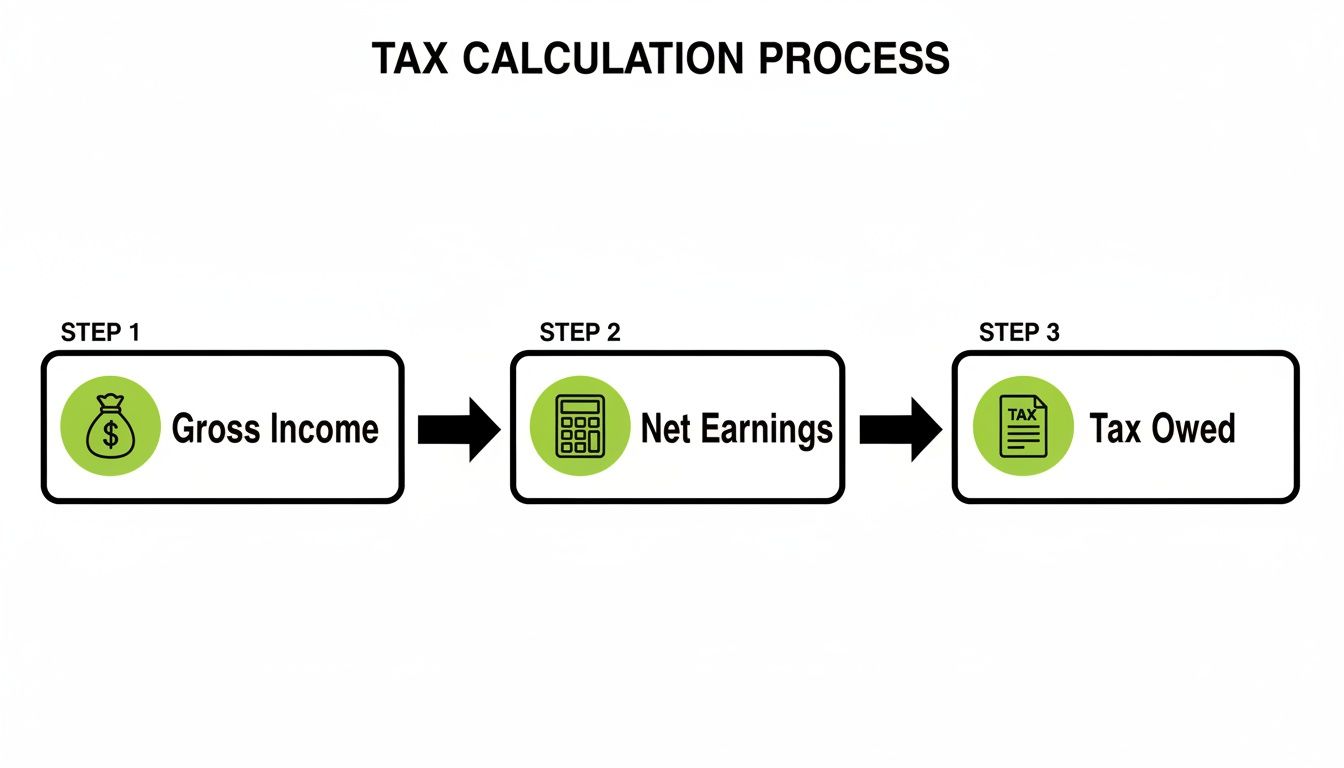
This process shows how your business's gross income is reduced by expenses to determine the net earnings used for your final tax calculation.
Paying by Debit or Credit Card
The IRS lets you pay with a debit card, credit card, or digital wallet through approved third-party payment processors. This can be tempting, especially if you’re trying to rack up credit card reward points. But there’s a catch: processing fees.
These fees aren't charged by the IRS; they come from the payment company. You can expect to pay around 1.85% to 1.98% of your tax bill for credit cards or a small flat fee for debit cards. You’ll have to do the math to see if the rewards you earn outweigh the cost of the fee.
Mailing a Check or Money Order
If you’re just more comfortable with a paper trail, you can absolutely mail in your payment. You'll need to fill out the right Form 1040-ES payment voucher for the quarter you're paying.
Then, make your check or money order payable to the "U.S. Treasury." A few critical things to remember:
- Never send cash through the mail.
- Write your Social Security number and the tax year on the check's memo line (e.g., "2024 Form 1040-ES"). This is crucial for making sure your payment gets credited to the right account.
- Mail it to the address listed in the Form 1040-ES instructions for your state, and be sure it gets postmarked by the deadline.
How to Avoid Underpayment Penalties with Safe Harbor Rules
The fear of an underpayment penalty is one of the biggest anxieties I see with self-employed clients. It’s a legitimate concern—the IRS wants its money as you earn it, not in a lump sum next April.
The good news? The system isn’t designed to trip you up. The IRS provides clear guidelines, known as safe harbor rules, that act as your shield against these penalties.
Think of these rules as your safety net. If you meet just one of the safe harbor conditions, you generally won't owe an underpayment penalty, even if you still have a balance due when you file your annual return. Mastering these rules is a game-changer for managing your cash flow and killing tax-season stress.
There are two main ways to stay in the safe harbor. You only need to hit one of them.
The 90% Rule: Paying As You Go
The first safe harbor rule is pretty straightforward: pay at least 90% of the tax you’ll owe for the current year.
This method works best for freelancers and business owners whose income is relatively stable and predictable. If you have a good handle on your projected income, you can aim to pay in at least 90% of your total expected tax liability through your four quarterly payments.
For example, let's say you calculate that your total tax bill for 2024 will be $20,000. To meet this rule, you must pay at least $18,000 ($20,000 x 0.90) through your estimated payments. That means sending in at least $4,500 each quarter.
The 100% Rule: Using Last Year's Tax
This second rule is often the most valuable, especially if your income fluctuates or is growing quickly. The rule is simple: avoid a penalty by paying 100% of the total tax you owed for the previous tax year.
There's one crucial catch: if your Adjusted Gross Income (AGI) last year was over $150,000 (or $75,000 if married filing separately), the bar is higher. You must pay 110% of last year's tax liability to qualify for this safe harbor.
Real-World Scenario: Imagine you're a consultant. In 2023, you had a decent year and your total tax was $12,000. In 2024, you land a massive project and your income doubles. Instead of scrambling to estimate a much higher, uncertain tax bill, you can just use the 100% rule.
You would simply pay $12,000 in estimated taxes for 2024 (split into four payments of $3,000). Even though you'll owe a lot more when you file your 2024 return, you won't face an underpayment penalty because you met the safe harbor.
This prior-year rule provides incredible peace of mind during growth phases. It lets you focus on your business without constantly re-running complex tax projections. Our comprehensive playbook on avoiding tax penalties offers more strategies for staying compliant.
What Happens If You Underpay?
So, what are the stakes? The IRS requires estimated payments if you expect to owe $1,000 or more when you file your return. Many freelancers accidentally underpay and get hit with penalties that can range from 5-8% plus interest.
A smart habit is to set aside at least 30% of your net income for taxes. This is a solid starting point to cover your self-employment tax and federal/state obligations. For more details, you can find great quarterly tax guidelines on Found.com.
The penalty isn't a flat fee. It’s calculated based on how much you underpaid and for how long. The IRS essentially treats the underpayment like a loan you took from the government and charges you interest on it. That interest rate can even change from quarter to quarter.
It’s also calculated separately for each payment period. This means if you miss the first quarter's payment but catch up in the second, you'll still owe a penalty for the time you were behind in that first quarter. You can't just overpay a later installment to wipe out an earlier penalty. Consistency is key.
Juggling State Taxes and Building Smart Financial Habits

Getting a handle on your federal quarterly payments is a huge win. But don't pop the champagne just yet—your tax duties probably don't stop with Uncle Sam.
Most states have their own income tax systems, and nearly all of them follow the same pay-as-you-go model. That means you likely have a whole separate set of estimated tax payments to make. Ignoring them can land you in the same hot water with penalties and a nasty surprise bill.
Don't Forget About Your State
Here’s the most important thing to remember: state tax rules are not a carbon copy of the federal ones. Each state treasurer's office has its own deadlines, payment thresholds, and calculation methods.
For example, you might have the federal due dates of April 15, June 15, September 15, and January 15 burned into your brain. But your state could follow a totally different rhythm. Some line up perfectly with the IRS, while others seem to pick dates out of a hat.
The only way to know for sure is to head straight to your state's department of revenue website. Search for "estimated tax" or "quarterly tax" for individuals or small businesses. That’s where you’ll find the real-deal forms, payment portals, and deadlines you need to follow.
Your Secret Weapon: A Tax-Proof Bookkeeping System
Beyond just making payments, the key to a stress-free tax life is building solid financial habits from the very beginning. Good bookkeeping isn't just about checking a box for the government; it's about having a crystal-clear, real-time view of your business’s financial health.
When your books are a mess, calculating your estimated tax becomes a frantic hunt through bank statements and crumpled receipts. A clean, organized system turns it into a routine, predictable task.
Start with these foundational habits:
Open a Separate Business Bank Account. This is non-negotiable. Mixing business and personal money is the fastest path to a bookkeeping nightmare. A dedicated account makes it a thousand times easier to track income and every single deductible expense.
Track Everything, All the Time. Whether you use accounting software like QuickBooks Self-Employed or a detailed spreadsheet, consistency is everything. Log transactions as they happen, not months later when the details are fuzzy.
Go Digital with Receipts. Paper receipts fade, get lost, and generally cause headaches. Snap a picture of every business receipt with your phone and save it to a dedicated cloud folder. You’ll thank yourself later for creating a bulletproof record of your deductions.
I've seen countless clients succeed with the 'Profit First' method. It's brilliant in its simplicity. Every time you get paid, you immediately move a set percentage into different bank accounts for profit, operating expenses, your own salary, and—most importantly—taxes. It automates saving so you never accidentally spend the money you owe the IRS.
Make Saving for Taxes Automatic
Automating your tax savings is the ultimate hack for financial discipline. By treating tax money like it was never yours to begin with, you kill the temptation to dip into it for other expenses.
It’s easy to set up. Open a separate, high-yield savings account just for your tax payments. Then, create an automatic transfer. Every time you deposit a client payment, immediately sweep 25-35% of it into that tax account. When the due date rolls around, the money is just sitting there, ready to go.
These habits do more than just make tax time easier. Pairing them with other strong financial practices, like implementing strategies for increasing cash flow, gives you the clarity and confidence to not just survive, but truly grow your business.
What to Do When Your Tax Situation Gets Complicated
Let's be honest: even with the best intentions, sometimes things go sideways. Maybe you missed a quarterly payment or two, or a sudden dip in business revenue left you unable to cover what you owe. When that happens, the first step is to take a deep breath. The second is to act.
Ignoring a tax problem is the absolute worst thing you can do. It won't disappear—it will only get bigger and more expensive. The IRS is a formidable collections agency, but it also has established programs to help people get back on solid ground. Knowing when to call in a professional is key.
Red Flags: When to Stop DIY-ing Your Taxes
At a certain point, you’re no longer just figuring out quarterly payments; you’re managing a serious financial problem. That's when it's time to hire an expert.
Look out for these clear warning signs:
- You receive an audit notice in the mail. This is an official examination of your tax returns, and you'll want an expert to guide you through it.
- The IRS sends a notice of intent to levy. This is a serious threat, meaning they are preparing to seize your assets—including cash directly from your bank account.
- Your tax debt is snowballing. If penalties and interest are piling up faster than you can possibly pay, you need a new game plan, and you need it now.
Why You Might Need a Tax Resolution Specialist
When you're in deep water with the IRS, a regular accountant might not be enough. You need a tax resolution specialist. These pros are usually tax attorneys or Enrolled Agents who specialize in one thing: negotiating with the IRS on behalf of taxpayers.
A lot of people think the IRS is completely inflexible, but that’s not true. They have programs specifically for taxpayers who genuinely can't pay their full tax bill. A specialist’s job is to build a compelling case to get you into one of those programs.
For instance, they can help you determine if you qualify for an Offer in Compromise (OIC), which could allow you to settle your tax debt for less than you originally owed. Another common solution is a formal installment agreement, which sets up a predictable, long-term payment plan you can actually afford.
Hiring a professional isn't a sign of failure. It's a smart business decision. It stops a bad situation from spiraling into a financial catastrophe, letting you finally resolve the issue and get back to what you do best—running your business.
Common Questions (and Straight Answers) About Quarterly Taxes
Even the most organized freelancer runs into questions. Let's tackle some of the most common ones that come up when you're navigating the quarterly tax maze.
What Happens If I Miss a Deadline?
First, don't panic. It happens. But you do need to act fast.
The moment you realize you've missed a payment, send what you owe to the IRS. The penalty for underpayment is calculated based on two things: how much you underpaid and for how long. By making the payment, you stop that clock from running.
If you wait until the next quarterly deadline, you’ll just rack up more penalties and interest.
The big takeaway here? Don't let perfect be the enemy of good. Even if you can't pay the full amount, pay whatever you can as soon as possible. It will absolutely minimize the financial hit.
Do I Have to Pay if My Business Isn’t Making Money?
This is a great question. Generally, you only need to make estimated tax payments if you expect to owe at least $1,000 in tax for the entire year. So, if your business is running at a loss and you have no other income, you probably won't owe anything and don't need to pay.
However, it's rarely that simple. Many freelancers also have a part-time W-2 job, some investment income, or another side gig. If that's you, you might still need to make quarterly payments to cover the tax on that other income, even while your primary business is still in the red. It's all about your total income picture.
Can't I Just Settle Up With the IRS in April?
I hear this a lot, and it's one of the most expensive mistakes a freelancer can make. The U.S. has a "pay-as-you-go" tax system. This means the IRS expects you to pay tax on your income as you earn it, not all at once a year later.
Waiting until your annual April filing to pay your entire tax bill is a surefire way to get hit with an underpayment penalty.
Think of quarterly payments as the self-employed version of tax withholding. For W-2 employees, it’s taken out of every paycheck automatically. For us, it’s our job to send it in four times a year.
Navigating IRS issues can feel overwhelming, but you don't have to do it alone. At Attorney Stephen A Weisberg, I start with a FREE Tax Debt Analysis to find out if and how I can help before you're ever charged a fee. If you're facing tax debt or complications, get expert help to find the best possible outcome. Learn more about getting a free tax analysis.


