How to pay quarterly taxes: A Clear Guide for Freelancers
Learn how to pay quarterly taxes with a simple, actionable plan for freelancers and small businesses to avoid penalties and stay compliant.
In this article
- Do You Really Need to Pay Quarterly Taxes?
- Who Is Required to Pay?
- Understanding the Financial Stakes
- Standard Quarterly Tax Due Dates
- How to Accurately Calculate What You Owe
- The Self-Employment Tax Factor
- A Practical Calculation Example
- What If Your Income Fluctuates
- Using the Safe Harbor Rule to Avoid Penalties
- Your Two Paths to Penalty Protection
- A Real-World Safe Harbor Example
- Why This Matters for Small Businesses
- Making Your Payment to the IRS
- IRS Direct Pay: The Quick and Simple Option
- EFTPS: The Planner's Choice
- Mail a Check: The Traditional Method
- Comparison of IRS Payment Methods
- Don't Forget State Taxes and Good Recordkeeping
- Why Your Documentation is Your Best Friend
- What Exactly Should You Keep?
- When It's Time to Call in a Tax Pro
- Red Flags That You've Outgrown DIY Taxes
- CPA vs. Tax Attorney: Who Do You Call?
- A Few Lingering Questions About Quarterly Taxes
- "I Missed a Payment Deadline! What Now?"
- "Can I Just Pay My Quarterly Taxes With a Credit Card?"
- "My Business Just Launched Mid-Year. How Do I Figure Out My Payments?"
Paying quarterly taxes means estimating what you'll owe for the year, breaking it into four chunks, and sending those payments to the IRS on time. If you're a freelancer, consultant, or small business owner and expect your tax bill to be at least $1,000, this pay-as-you-go system isn't optional—it's a requirement.
Do You Really Need to Pay Quarterly Taxes?
When you have a traditional W-2 job, your employer handles withholding taxes from every paycheck. It's a clean, simple process. But once you start working for yourself, you're wearing both hats: the employee and the employer.
The IRS expects its cut as you earn your income, not all at once next April. That’s the whole point of the quarterly tax system. It keeps you from facing a huge, potentially unmanageable tax bill and ensures the government has a steady stream of revenue to operate.
This applies to more than just your main freelance business. You have to look at your entire income picture for any money that doesn't have taxes automatically withheld.
Who Is Required to Pay?
Several types of income can put you on the hook for estimated tax payments. If your earnings from these sources will likely lead to a tax liability of over $1,000, you need to be paying quarterly.
Common triggers include:
- Self-Employment and Freelance Work: This is the big one. If your clients send you 1099-NEC forms instead of W-2s, you're in this boat.
- Side Hustle and Gig Economy Income: That money you make driving for Uber, delivering for DoorDash, or selling on Etsy? It all counts.
- Investment Earnings: Significant income from interest, dividends, or capital gains often isn't subject to withholding.
- Rental Property Income: Profits from your rental properties also fall squarely into this category.
For a great walkthrough of the whole process from start to finish, you can find a detailed guide on how to file quarterly taxes. It's a solid resource for figuring out exactly who needs to pay and how to do it.
The rule of thumb is simple: if no one is withholding taxes for you, the responsibility to pay the government throughout the year is yours. Waiting until Tax Day can be a painful and expensive mistake.
Understanding the Financial Stakes
Ignoring your quarterly tax obligations gets expensive, fast. Let’s say you’re a self-employed graphic designer like my client, Stephanie, who brings in $85,000 a year after business expenses. The IRS rule is clear: if you expect to owe $1,000 or more in tax as a sole proprietor, you must make estimated payments to avoid penalties. For businesses filing as corporations, that threshold is even lower at just $500.
This system keeps the government's cash flow steady. Think about it: early in the tax season, the IRS processed 101.4 million returns and issued refunds averaging $3,116. That money often comes from W-2 employees who overpaid through their withholdings.
For the 30 million-plus self-employed people in the U.S., the tables are turned. Getting this wrong means underpayment penalties and interest can pile up quickly. For a deeper dive into all your obligations as a freelancer, check out our complete self-employed tax guide.
The IRS doesn't mess around with its deadlines, so it's critical to know when your payments are due.
Standard Quarterly Tax Due Dates
Here's a quick-reference table showing the standard IRS deadlines for each payment period. It's a good idea to put these dates on your calendar right now.
| For Income Earned During | Payment Is Due On |
|---|---|
| January 1 – March 31 | April 15 |
| April 1 – May 31 | June 15 |
| June 1 – August 31 | September 15 |
| September 1 – December 31 | January 15 (next year) |
Remember, if a due date falls on a weekend or a holiday, the deadline shifts to the next business day. But it's always safest to just stick to the 15th as your target.
How to Accurately Calculate What You Owe
Figuring out what you owe the IRS doesn't have to be a shot in the dark. The trick is to get a solid, reasonable estimate of your income for the year and then apply the right tax rates. Honestly, the best starting point is the official worksheet in IRS Form 1040-ES, Estimated Tax for Individuals. It's designed to walk you through this exact process.
First up, you’ll need to project your Adjusted Gross Income (AGI) for the entire year. Think of AGI as your total expected income minus certain specific deductions—what the IRS calls "above-the-line" deductions. Common examples are contributions to a traditional IRA or, importantly for freelancers, one-half of your self-employment taxes.
Once you have a good handle on your estimated AGI, you'll subtract either the standard deduction for the year or your itemized deductions (like mortgage interest and state taxes). The number you're left with is your estimated taxable income. That’s the figure that actually gets taxed.
This simple visual breaks down who usually gets roped into making these payments.
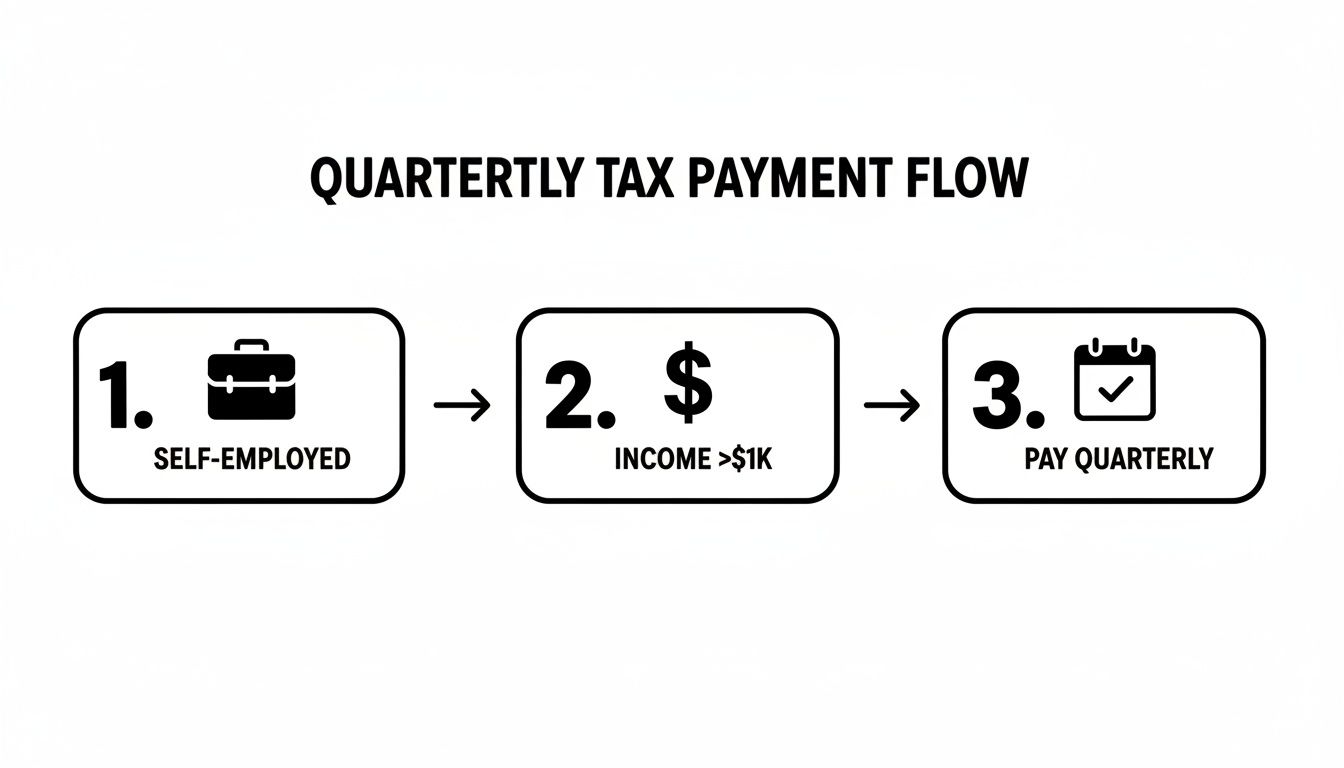
As you can see, being self-employed and expecting to owe at least $1,000 in tax for the year are the two main triggers that put you on the quarterly payment plan.
The Self-Employment Tax Factor
For anyone running their own business, income tax is only half the story. You also have to pay self-employment tax, which is your way of contributing to Social Security and Medicare. This is a huge part of the calculation, and it's where a lot of people accidentally underpay.
The self-employment tax rate is a flat 15.3% on your net business earnings. It’s made up of two parts:
- 12.4% for Social Security, but only up to an annual income cap ($168,600 for 2024).
- 2.9% for Medicare, which applies to all of your net earnings with no limit.
It helps to remember that when you were an employee, your employer paid half of this for you. Now, you’re on the hook for the whole thing. The one silver lining is that you get to deduct one-half of your self-employment tax bill when you calculate your AGI.
To keep your income projections grounded in reality, using a reliable bank statement converter software can be a game-changer. It helps you pull and organize your financial data accurately, so your estimates aren't just wishful thinking.
A Practical Calculation Example
Let's walk through a quick, simplified scenario. Say you're a freelance writer and you expect your net earnings for the year to be $70,000.
- Calculate Self-Employment Tax: This tax applies to 92.35% of your net earnings. So, we start with $70,000 x 0.9235 = $64,645. The tax is 15.3% of that, which comes to $9,891.
- Find Your Deductions: You get to deduct half of that SE tax ($4,945.50). Let's also say you put $6,000 into a traditional IRA. Your total adjustments are $10,945.50.
- Determine Your AGI: Subtract those adjustments from your income: $70,000 - $10,945.50 = $59,054.50.
- Figure Out Taxable Income: Now, subtract the standard deduction. For a single filer in 2024, that's $14,600. So, $59,054.50 - $14,600 = $44,454.50 in taxable income.
- Estimate Your Income Tax: Based on the 2024 tax brackets, the income tax on that amount is roughly $5,349.
- Get Your Total Tax Bill: Add your income tax and self-employment tax: $5,349 + $9,891 = $15,240.
- Calculate the Quarterly Payment: Just divide that total by four. You'll need to send in $3,810 each quarter.
Key Takeaway: Don't just estimate your income tax. Forgetting to add the 15.3% self-employment tax is one of the most common and costly mistakes a new freelancer can make. This tax often represents a significant portion of your total liability.
What If Your Income Fluctuates
The example above is great if your income is steady, but what if it isn't? Maybe you're a photographer with a packed wedding season in the summer and dead-silent winters. Making four equal payments could leave you strapped for cash during those lean months.
This is where a strategy called the annualized income installment method can be a lifesaver.
This approach lets you calculate your tax payment at the end of each quarter based on the income you've actually earned up to that point. It's definitely more work—you have to fill out Form 2210 with your tax return—but it’s an incredible tool for managing cash flow when your earnings are lumpy. It aligns your tax payments with when you actually get paid.
If this sounds like your situation, you can learn more in our detailed guide on the estimated tax payment schedule. It can save you from a lot of unnecessary financial stress.
Using the Safe Harbor Rule to Avoid Penalties
Trying to nail your exact income for the year ahead is a bit like trying to predict the weather six months from now. It’s mostly guesswork. The IRS gets this, which is why they created the safe harbor rule.
Frankly, this rule is your best friend when it comes to avoiding the dreaded underpayment penalty.
Think of it as a safety net. As long as you follow one of its simple conditions, the IRS generally won't hit you with a penalty, even if you still owe a bit more when you file your annual return in April. It’s all about giving you peace of mind and, just as importantly, some financial predictability.
The safe harbor rule gives you two main ways to stay compliant. You can pick whichever one makes the most sense for your business and financial situation.
Your Two Paths to Penalty Protection
The two options boil down to comparing your estimated payments to either this year's tax bill or last year's. Both are designed to make sure you’re paying a reasonable chunk of what you owe as you earn it.
You’re generally in the clear—no penalty—if you pay:
- At least 90% of the tax you owe for the current year, OR
- At least 100% of the tax you owed for the previous year.
For most freelancers and small business owners I work with, that second option is the clear winner. Paying based on last year's tax liability takes all the complicated forecasting out of the equation.
Expert Tip: That 100% rule is a game-changer. You can literally pull out last year's tax return, find one number, and set four equal, predictable payments for the entire year. It doesn't matter if your income skyrockets; you're covered.
Now, there is one key exception. If your Adjusted Gross Income (AGI) last year was over $150,000 (or $75,000 if you're married filing separately), the bar is a little higher. You'll need to pay 110% of last year's tax liability to qualify for the safe harbor.
A Real-World Safe Harbor Example
Let's see how this works in practice. Imagine you're a consultant, and last year your final tax bill on your Form 1040 was $20,000. Your AGI was $120,000, so you're not in that high-income bracket.
To use the safe harbor rule, you just focus on that $20,000 figure.
- Total Tax to Pay for Safe Harbor: $20,000
- Divide by Four Quarters: $5,000
You’d set up four quarterly payments of $5,000 each. Done. Even if you have a fantastic year and your income doubles, pushing your actual tax liability to $40,000, you won't face an underpayment penalty. You’ll just pay the remaining balance when you file your return.
Let's flip the script. If your AGI last year was $180,000, you'd fall under the 110% rule. Your calculation would be $20,000 x 1.10 = $22,000. That means your four quarterly payments would need to be $5,500 each to stay safe.
Why This Matters for Small Businesses
For most of us running our own businesses, quarterly estimated taxes aren't optional. They are a critical part of staying financially healthy and avoiding the IRS's underpayment interest, which can add up surprisingly fast.
Consider this: the IRS recently processed over 100 million returns early in the filing season, with many W-2 employees getting refunds averaging over $3,000. This tells you that traditional employees often overpay through withholding. As a self-employed person, you're on the other side of that coin, constantly at risk of underpaying without a solid quarterly plan. You can dig into the numbers yourself in the latest IRS filing season statistics.
The safe harbor rule gives you a clear, IRS-approved roadmap to sidestep that risk entirely. It transforms a complex estimation process into simple arithmetic based on a number you already have from last year's return.
Making Your Payment to the IRS
You’ve done the hard part—figuring out what you owe. Now it's time to actually get that money to the IRS. Luckily, paying is a lot more straightforward than the calculation. You've got a few solid options, ranging from quick online payments to the old-school paper check.
Which one is right for you? It really just boils down to personal preference. Do you want speed and convenience, or do you prefer to schedule things far in advance? Let's walk through the three main ways you can send in your quarterly payments.

IRS Direct Pay: The Quick and Simple Option
For a fast, no-strings-attached payment, IRS Direct Pay is tough to beat. It’s a free and secure way to pay directly from your bank account without having to create an account or remember yet another password.
You just hop onto the IRS website, verify who you are using some info from a past tax return, and authorize the withdrawal. Simple as that. You get an immediate confirmation number for your records, which gives you instant peace of mind. The only real catch is its simplicity—you can't schedule payments way out in the future or see a detailed payment history. It's built for paying what you owe, right now.
EFTPS: The Planner's Choice
If you're the type who likes to "set it and forget it," you'll want to get acquainted with the Electronic Federal Tax Payment System (EFTPS). Think of it as your personal tax payment command center. It’s a separate, secure government site that does require a one-time enrollment. The setup takes a few days because they actually mail you a PIN for security, but the payoff is huge for anyone juggling ongoing tax payments.
Once you're in, you can:
- Schedule all four of your estimated tax payments for the entire year in one sitting.
- Set up payments up to 365 days ahead of time.
- Look back at your complete federal tax payment history for the last 16 months.
- Handle other federal taxes, like payroll, if you eventually hire employees.
This is the system for serious business owners who need to manage cash flow and want a clear, accessible record of every cent sent to the IRS.
My Take: I always tell clients to think of it this way: Direct Pay is like sending a digital check today. EFTPS is your personal tax scheduling hub. Taking 15 minutes to enroll in EFTPS is one of the smartest administrative moves a new freelancer or business owner can make.
Mail a Check: The Traditional Method
Of course, the classic paper check is still an option. If you prefer to pay by mail, you'll need to send your check or money order along with a payment voucher from Form 1040-ES, Estimated Tax for Individuals.
A word of caution: make sure you use the correct voucher for the quarter. There’s a specific one for each payment period (Voucher 1 for the April deadline, Voucher 2 for June, and so on). Make the check payable to the "U.S. Treasury" and, crucially, write your Social Security number and the tax year on the memo line (e.g., "2024 Form 1040-ES"). This is your best defense against the IRS misapplying your payment.
This method works, but it's slow and comes with the risk of your payment getting lost in the mail. If you must mail it, I strongly recommend sending it via certified mail with a return receipt. That little green card is your proof that you mailed it on time.
To make the choice easier, here's a direct comparison of how the most popular payment methods stack up.
Comparison of IRS Payment Methods
This table breaks down the key differences between IRS Direct Pay, EFTPS, and mailing a voucher, helping you choose the best fit for your workflow.
| Feature | IRS Direct Pay | EFTPS | Mail-in Voucher |
|---|---|---|---|
| Account Required | No | Yes (one-time enrollment) | No |
| Payment Scheduling | Up to 30 days in advance | Up to 365 days in advance | N/A (depends on mail time) |
| Payment History | Limited to recent payments | Yes (up to 16 months) | No (must keep own records) |
| Confirmation | Instant email | Instant email | Canceled check is your proof |
| Best For | Quick, one-off payments | Proactive planning & records | Those who prefer paper checks |
Ultimately, it doesn't matter which method you choose as long as you pay on time. Getting the money in by the deadline is what protects you from penalties. If you're ever unsure about the dates, bookmark this guide to the quarterly tax payment deadlines to stay on track.
Don't Forget State Taxes and Good Recordkeeping
Making your federal payments is a huge accomplishment, but your tax journey isn't quite over. A common blind spot for freelancers and business owners is forgetting that most states with an income tax have their own pay-as-you-go system. Overlooking this can lead to a nasty surprise tax bill and a penalty notice from your state's department of revenue.
This means you’ll likely be juggling a separate set of rules, forms, and due dates. While many states conveniently align their quarterly deadlines with the IRS schedule (April 15, June 15, September 15, and January 15), some march to the beat of their own drum. It is absolutely essential to check your state's tax agency website to get the specifics on their estimated tax requirements.
Why Your Documentation is Your Best Friend
Beyond just sending the money, keeping meticulous records is your best defense and a non-negotiable business habit. When you sit down to file your annual return, you'll need to report the total amount of federal and state estimated taxes you paid all year. Without a clear paper trail, you're just guessing, and that can really complicate your filing.
Good documentation is more than just a smart habit; it’s your proof. If the IRS or a state agency ever questions whether a payment was made or if it was on time, your records are your first and only line of defense. A simple confirmation number can shut down a dispute in minutes.
Your records are the financial story of your year. They provide hard evidence of your compliance, protect you from simple errors, and turn your annual tax filing into a smooth, verifiable process instead of a stressful scramble.
Staying organized also makes it infinitely easier to calculate your quarterly taxes for the next year, especially if you plan on using the safe harbor rule based on your prior year’s tax liability.
What Exactly Should You Keep?
Getting organized doesn't have to be a massive undertaking. The secret is consistency. For every single estimated tax payment you make—both federal and state—make sure you save the following items in a dedicated digital or physical folder.
- Your Calculation Worksheets: Always hang on to the Form 1040-ES worksheet (or your own spreadsheet) that shows how you landed on your payment amount. This is especially vital if you're using the annualized income method, where your income fluctuates.
- Payment Confirmation: This is non-negotiable. Whether it's an email receipt from IRS Direct Pay, a reference number from EFTPS, or a copy of a canceled check, you need concrete proof the money was sent and received.
- The Date of Payment: Jot down the exact date you submitted the payment. This is crucial for proving you met the deadline if it ever comes into question.
- The Amount Paid: Keep a clear, running tally of the specific dollar amount for each separate quarterly payment.
For a deeper dive into what to save and how to organize it, our guide on how to track business expenses offers practical systems you can put into place right away. This kind of discipline pays for itself, transforming tax season from a chaotic mess into a straightforward review of your excellent records.
When It's Time to Call in a Tax Pro
Figuring out how to pay quarterly taxes is a massive step toward mastering your business finances. But let’s be real—even the most organized entrepreneur can hit a wall. There are some tax situations that are just too complex or carry too much risk to handle on your own.
Recognizing when to call for backup isn't admitting defeat; it's a savvy business move. Managing your own estimated payments works great... until it doesn't. And trust me, the cost of one big mistake can easily dwarf the fee for professional advice.

Red Flags That You've Outgrown DIY Taxes
If your tax situation feels less like a straight road and more like a plate of spaghetti, that’s your cue. Don't wait for a small headache to turn into a full-blown IRS migraine.
Here are a few clear signs it's time to get an expert on the phone:
- Your Business Structure Isn't Simple Anymore: If you’re running an S-corp or a partnership with multiple members, the rules get way more complicated than they are for a sole proprietor.
- Your Income Is All Over the Place: When your earnings swing wildly from one quarter to the next, both the standard and annualized income methods can feel like a shot in the dark. A pro can help you project more accurately, keeping penalties at bay without strangling your cash flow.
- You're Already Behind: Have you missed a payment or two? Are those official-looking envelopes from the IRS starting to pile up? This is a critical moment. Trying to dig yourself out of that hole alone can often just make it deeper.
- You've Had a Big Change: Major events—like selling a large business asset, hiring your first W-2 employee, or expanding your operations to another state—bring a whole new set of tax implications that are incredibly easy to get wrong.
Think of hiring a tax pro not as an expense, but as an investment. A good one pays for themselves by saving you money, yes, but more importantly, they save you time, stress, and sleepless nights.
CPA vs. Tax Attorney: Who Do You Call?
Knowing who to call is just as important as knowing when. While both CPAs and tax attorneys are financial wizards, they play very different roles.
A Certified Public Accountant (CPA) is your go-to for tax planning, preparation, and keeping everything compliant. They're the ones you work with to make sure your business is structured for maximum tax efficiency, to find every deduction you're entitled to, and to keep your quarterly calculations on the straight and narrow. Think of them as your financial quarterback.
A tax attorney, however, is who you need when you're in trouble. If you're facing an audit, dealing with a mountain of tax debt, or facing collection actions like liens and levies, an attorney is your best defense. They specialize in tax law, represent you in front of the IRS, and can protect your rights in ways a CPA legally can't.
At the end of the day, learning to manage your quarterly taxes is empowering. But knowing your own limits? That’s what ensures your business thrives for the long haul.
A Few Lingering Questions About Quarterly Taxes
Even when you have a good handle on the basics, a few specific questions always seem to come up. Let’s clear the air on some of the most common ones I hear from clients.
"I Missed a Payment Deadline! What Now?"
First, don't panic. Missing a deadline isn't the end of the world, but you do need to act fast. The most important thing is to make the payment as soon as you realize the oversight.
The IRS underpayment penalty isn't just a one-time slap on the wrist. It’s calculated quarterly and accrues interest, so the longer you wait, the more it costs you. By paying immediately, you stop the clock on those accumulating fees and minimize the damage.
"Can I Just Pay My Quarterly Taxes With a Credit Card?"
You certainly can. The IRS works with a few third-party payment processors that allow you to pay your estimated taxes with a credit or debit card. It's a convenient option if you need it.
But there’s a catch: it’s not free. These services charge a processing fee, usually a percentage of your tax payment. While paying with a card can be a decent backup plan if you're in a cash crunch, it's almost always more expensive than free methods like IRS Direct Pay or EFTPS.
For a payment of a few thousand dollars, that processing fee can really add up. I always advise clients to think of it as a last resort, not the go-to method.
"My Business Just Launched Mid-Year. How Do I Figure Out My Payments?"
This is a great question. If you started earning self-employment income partway through the year, you're off the hook for the quarters that have already passed. Your tax obligation begins the moment your business does.
You’ll make your first payment for the quarter in which you started earning that income. When you calculate what you owe, you only need to project your income and deductions for the rest of the year, not the full 12 months. The annualized income method is perfect for this, as it prevents you from overpaying based on a full-year income you won't actually have.
Facing a complex tax situation or received a notice from the IRS? At Attorney Stephen A Weisberg, we specialize in resolving tax issues for individuals and businesses. Start with a FREE Tax Debt Analysis to understand your options before you ever pay a fee.


