How to Get IRS Debt Forgiven: An Attorney's Guide (2026)
Learn how to get IRS debt forgiven with a practical guide from a tax attorney. Explore options like Offer in Compromise, eligibility, and how to apply.

In this article
- Facing IRS Debt You Have More Options Than You Think
- Forgiveness is real, but it’s not automatic
- What works and what doesn’t
- Your Pre-Application Checklist
- File everything first
- Know your collection clock
- Consider Currently Not Collectible status
- Get your financial story into IRS format
- Exploring Your Primary IRS Forgiveness Options
- Offer in Compromise
- Currently Not Collectible
- Penalty abatement
- A side-by-side view
- What about installment agreements and bankruptcy
- Navigating Unique Debt Situations
- Innocent spouse cases
- Payroll tax debt and the Trust Fund Recovery Penalty
- The corporate veil won’t save you by itself
- How to Prepare a Winning Forgiveness Application
- Know what the IRS requires
- Use the pre-qualifier as reconnaissance
- Build the file before you file the forms
- The mistakes I see most often
- Do the analysis before paying the fee
- What to Do After Your Application Is Approved or Denied
- If the IRS approves your request
- If the IRS denies your request
- When to bring in a tax attorney
- The honest roadmap
The envelope arrives, or the IRS notice hits your online account, and the first reaction is usually the same. Tight chest. Racing thoughts. A quick mental inventory of every bank account, every paycheck, every business receivable, every mistake.
That panic is understandable. It’s also a point where a lot of bad decisions begin.
People who owe the IRS are often targeted by companies that sell certainty before they’ve done any real analysis. They lead with fear, ask for a large retainer, and promise “fresh start” relief as if every taxpayer qualifies for forgiveness. That’s not how this works. The IRS does forgive some tax debt, but it does so through defined programs with strict standards, heavy documentation, and real trade-offs.
The good news is that tax debt usually isn’t a dead end. There are legitimate paths that can reduce it, pause collection, or in some cases eliminate what remains when the legal collection window closes. The hard part isn’t finding a catchy program name. It’s choosing the right strategy, at the right time, with the right facts.
If you’re trying to understand how to get irs debt forgiven, start with one principle. Hope is not a strategy. Analysis is.
Facing IRS Debt You Have More Options Than You Think
For many taxpayers, the problem starts long before they call a lawyer. A business had a cash flow crunch and skipped payroll deposits to keep employees paid. A self-employed person had a strong year, didn’t set aside enough for estimated taxes, and then fell behind. A divorce exposed joint return problems one spouse never knew about. Someone got sick, stopped opening mail, and the balance snowballed.
The emotional pattern is predictable. People assume the IRS will take everything, immediately, and that there’s no meaningful way to resolve the debt unless they can pay in full.
That assumption is often wrong.

Forgiveness is real, but it’s not automatic
The IRS has established relief mechanisms for taxpayers in hardship. Some are true compromise programs. Some are collection holds. Some depend on timing. None of them work well when the taxpayer is guessing, hiding information, or filing paperwork that doesn’t match reality.
That’s why broad promises are dangerous. If someone tells you in the first call that they can “settle for pennies” without reviewing transcripts, compliance history, assets, income, and business structure, they’re selling a script.
An ethical review looks different. It asks:
- Are all returns filed: If not, most relief paths are blocked at the starting line.
- Is the debt even collectible right now: Sometimes the IRS has an advantage. Sometimes it doesn’t.
- Are you dealing with individual income tax, payroll tax, or both: Those are very different cases.
- Would an aggressive application help, or just pause the wrong clock: Timing matters more than most taxpayers realize.
I’ve seen taxpayers spend money pursuing the wrong resolution because nobody explained the alternatives in plain English. If you want a practical overview of those alternatives, this guide to tax debt relief options is a useful starting point.
What works and what doesn’t
Some things help quickly. Filing missing returns. Pulling IRS transcripts. Identifying whether the account is assigned for active collection. Separating payroll tax issues from income tax issues. Building a truthful financial picture before submitting anything.
Other things usually make the case worse.
Practical rule: Don’t send the IRS an application just because you’re scared. Send one because the facts support it.
What works is strategy. What doesn’t is buying confidence from a salesperson.
Your Pre-Application Checklist
Before you think about forgiveness, settlement, or hardship status, deal with the threshold issues. A large number of failed cases don’t fail because the taxpayer was hopeless. They fail because the taxpayer skipped the basics.
File everything first
If returns are missing, the IRS will usually treat that as a compliance problem before it treats your situation as a hardship problem. That applies to individuals and businesses.
Many people lose time here. They focus on the dollar amount they owe, but the IRS is often focused first on whether you’ve met your filing obligations. If you haven’t, the case isn’t ready.
Your checklist should start here:
- File past-due returns: Estimated numbers, half-finished books, and “I’ll get to it later” aren’t enough.
- Make current required deposits or payments: This matters especially for businesses with payroll issues.
- Confirm you’re not in open bankruptcy: That can affect what relief is available and when.
- Wait for the right posture: In many cases, you need an assessed balance and active IRS billing before a settlement application makes sense.
Know your collection clock
One of the most important concepts in tax resolution is the Collection Statute Expiration Date, often called the CSED. The IRS generally has 10 years to collect assessed tax debt, and if the balance remains uncollected when that period expires, it’s forgiven. The clock starts on assessment and can be paused by events like bankruptcy filings or offers in compromise. In fiscal year 2023, over $10 billion in tax debt was written off because the collection statute expired, as reported in this CBS News summary of IRS debt forgiveness and CSED expiration.
That single rule changes strategy.
A taxpayer with many years left on the collection statute may need a very different plan from someone whose oldest liabilities are near expiration. Filing the wrong application can buy time for the IRS by pausing the clock. Sometimes that’s acceptable. Sometimes it’s a costly mistake.
Why timing changes everything
If your account is close to expiration, an aggressive compromise application may be less attractive than a defensive collection strategy. If your account is early in the collection period, waiting without a plan can be dangerous.
That’s why transcript review matters. You need to know the assessment dates, not just the tax years.
Don’t confuse the tax year with the collection deadline. The IRS collects from the assessment date, not the year printed on the return.
Consider Currently Not Collectible status
Currently Not Collectible, or CNC, isn’t the same as forgiveness. It’s a status the IRS may grant when collection would create hardship because your allowable living expenses leave no money to pay the debt.
That can be powerful. It can stop levies and other collection pressure while your finances remain strained. In some cases, CNC functions as a bridge. If the account stays uncollectible long enough, the collection statute may expire before the IRS ever gets paid in full.
That doesn’t mean everyone should pursue CNC first. It means you should evaluate it carefully, especially if your income is unstable, your business has stalled, or your household is already struggling with essentials.
Get your financial story into IRS format
Taxpayers often know their finances. They just don’t know them in the format the IRS uses.
The IRS looks at income, assets, equity, and allowable expenses through standardized forms and categories. If you’re heading toward hardship relief or an Offer in Compromise, it helps to understand that framework before you file. A good place to review that structure is this guide to IRS Form 433-A OIC.
Here’s the short version of the pre-application checklist:
| Item | Why it matters |
|---|---|
| All returns filed | Most resolution paths depend on current filing compliance |
| Current taxes handled | Ongoing noncompliance can derail relief |
| Transcripts reviewed | You need assessment dates and account status |
| Debt type identified | Income tax, payroll tax, and TFRP cases require different strategy |
| Financials organized | The IRS decides cases from documents, not explanations alone |
If you skip this stage, you’re not applying strategically. You’re applying blindly.
Exploring Your Primary IRS Forgiveness Options
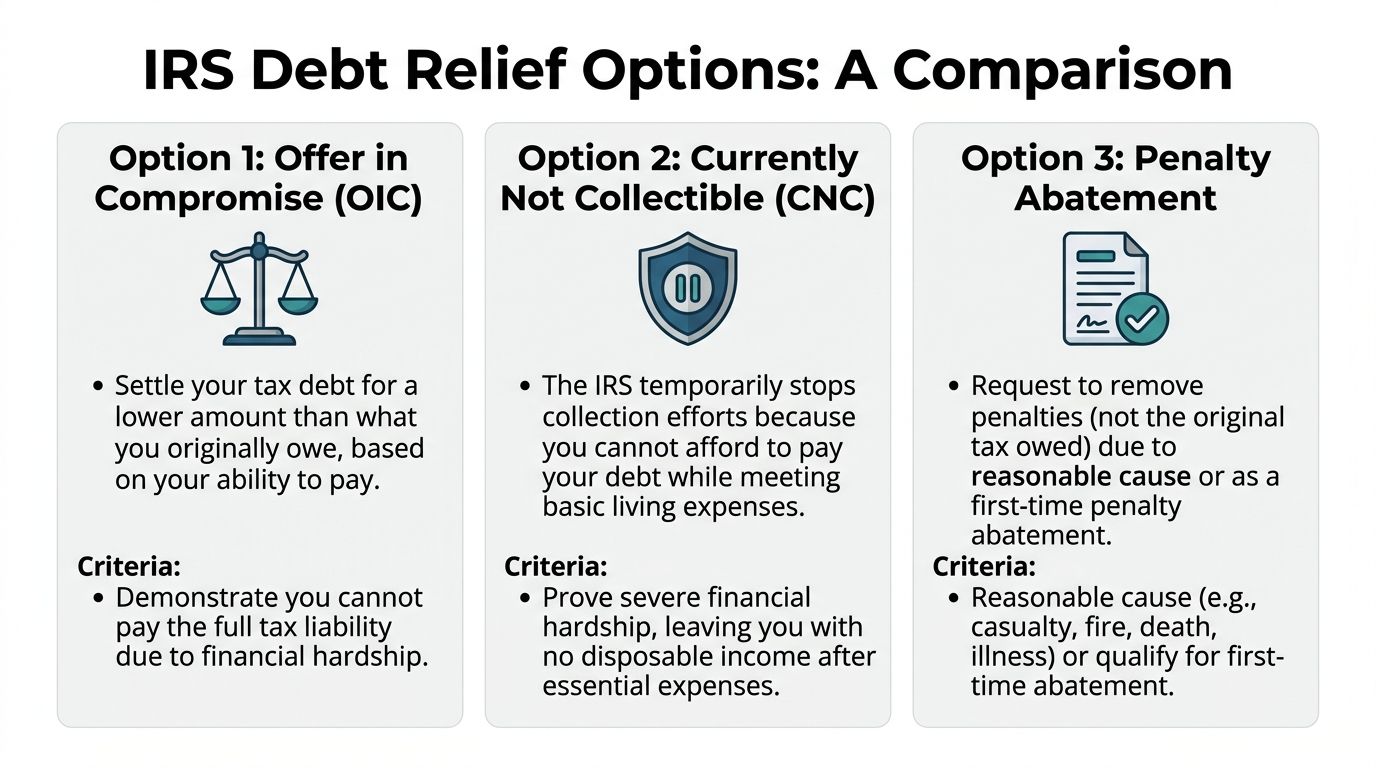
When people ask how to get irs debt forgiven, they usually mean one of three things. They want the debt settled for less. They want the IRS to stop collection because they can’t pay. Or they want penalties removed so the balance becomes manageable.
Those are different paths with different standards.
Offer in Compromise
An Offer in Compromise, or OIC, is a widely recognized program. It allows some taxpayers to settle for less than the full balance when they can prove the IRS is unlikely to collect the full amount.
It’s legitimate. It’s also difficult.
The IRS has historically accepted only about 25 to 40 percent of OIC applications annually. In fiscal year 2022, it accepted roughly 25,000 of the 68,000 applications it received. The average accepted offer was about $48,000, and accepted settlements are often just 5 to 20 percent of the total debt for taxpayers with minimal assets, according to the IRS Offer in Compromise program page.
That data matters because it cuts through two myths at once. First, OIC is real. Second, it is not easy.
When OIC makes sense
OIC is strongest when the taxpayer has limited equity, limited disposable income, and a clear hardship case. It can also make sense where future earning capacity is weak, the debt is large, and full payment is unrealistic.
It is much weaker when the taxpayer has meaningful equity, inconsistent disclosures, or a business that appears capable of recovery.
Currently Not Collectible
CNC is often underrated because it doesn’t sound dramatic. There’s no “forgiveness” headline. But for the right taxpayer, it can be the safest immediate relief.
If the IRS agrees that collecting would prevent you from covering necessary living expenses, it may pause active collection. That can stop the immediate bleeding while you stabilize your finances.
CNC tends to fit cases where:
- Income is low or unstable: The taxpayer can barely cover basics.
- Assets are limited: There isn’t meaningful equity the IRS can expect to reach.
- The collection timeline matters: Holding the account in hardship status may preserve a better long-term outcome than forcing a weak OIC.
Penalty abatement
Penalty abatement doesn’t erase the underlying tax. It targets penalties.
That distinction matters. Some taxpayers don’t need a dramatic settlement. They need the balance reduced enough to become payable. If penalties drove the account upward after illness, death in the family, records loss, or another reasonable-cause event, abatement may be the cleaner path.
This option is also sometimes useful where full debt “forgiveness” isn’t realistic, but reducing the account can support an installment agreement or a broader resolution strategy.
A side-by-side view
| Option | What it does | Best fit | Main caution |
|---|---|---|---|
| Offer in Compromise | Settles for less than full balance | Long-term inability to pay | Heavy documentation and close scrutiny |
| Currently Not Collectible | Pauses collection for hardship | No disposable income right now | It’s not a final settlement |
| Penalty Abatement | Removes qualifying penalties | Strong reason for noncompliance or eligible history | Tax principal usually remains |
A good resolution plan doesn’t start by asking, “What program sounds best?” It starts by asking, “What will the IRS believe after reviewing the file?”
What about installment agreements and bankruptcy
An installment agreement is often a useful tool, but it isn’t forgiveness. It’s a payment arrangement. Sometimes that’s the right answer. Sometimes it only delays a deeper problem.
Bankruptcy can also overlap with tax debt strategy in limited situations, and the answer depends heavily on the type of tax, the age of the debt, and the procedural history. If you’re weighing that possibility, this article on whether bankruptcy can clear tax debt provides a helpful overview.
For taxpayers considering OIC specifically, this more detailed guide to the IRS Offer in Compromise process can help frame what the IRS will examine.
Navigating Unique Debt Situations
Generic tax debt articles usually assume one fact pattern. A person owes individual income tax, has modest assets, and wants a settlement.
Real cases are messier.
Innocent spouse cases
Some joint return liabilities belong on paper to both spouses, but not in fairness. That happens when one spouse signed returns without knowing income was omitted, deductions were fabricated, or payroll and business tax issues were concealed during the marriage.
In those situations, Innocent Spouse Relief may matter more than an Offer in Compromise. The legal and factual analysis is very different. You’re not just showing inability to pay. You’re showing why the liability shouldn’t be enforced against you in the first place.
That often comes up in divorce, separation, or abusive financial-control situations. The record has to show more than regret. It has to show lack of knowledge, unfairness, or a basis for equitable relief under the applicable rules.
For taxpayers dealing with that problem, this resource on Innocent Spouse Relief is the better starting point than a general settlement guide.
Payroll tax debt and the Trust Fund Recovery Penalty
Business owners often make the same mistaken assumption. They believe the corporation or LLC owes the payroll taxes, so their personal exposure is limited.
That can be disastrously wrong.
When payroll taxes aren’t paid over, the IRS can assess the Trust Fund Recovery Penalty, or TFRP, against individuals it considers “responsible persons.” That can include owners, officers, managers, bookkeepers, and others with enough control over financial decisions. IRS data shows over $1 billion is collected through TFRP annually, and OIC approval rates involving TFRP are under 25 percent, according to this discussion of IRS debt forgiveness and TFRP issues.
Why these cases are so hard
TFRP cases are hard for two reasons.
First, the IRS treats withheld employee taxes as especially serious because the business was holding money that belonged to the government. Second, the agency looks closely at willfulness. If it believes a responsible person chose to pay others instead of the IRS, it will push hard.
That’s why boilerplate “tax relief” applications perform poorly in these cases.
A proper TFRP defense may require analysis of:
- Who controlled disbursements: Titles matter less than real authority.
- Who knew the taxes were unpaid: Knowledge can develop over time.
- What happened during the cash crisis: Some cases involve lender control, frozen accounts, or severe operational distress.
- Whether the business kept current later: Ongoing payroll compliance is often critical.
Business payroll tax debt is not just a bigger version of personal income tax debt. It is a different legal problem.
The corporate veil won’t save you by itself
Owners of S corporations, LLCs, and closely held companies often rely too heavily on the entity structure. Entity protection matters in many areas of law. It does not prevent a TFRP investigation from reaching people behind the business.
That’s where experienced review matters. The key issue is not just what the company owes. It’s who the IRS can legally tie that debt to, and what evidence exists on responsibility and willfulness.
How to Prepare a Winning Forgiveness Application
A strong IRS forgiveness application is built, not assembled. The forms matter, but the file behind the forms matters more.
Taxpayers get into trouble when they treat the application like a simple questionnaire. It isn’t. It’s an evidence package that tells the IRS what it can expect to collect from you.

Know what the IRS requires
To apply for an Offer in Compromise, you generally submit Form 433-A for individuals or Form 433-B for businesses, Form 656, a $205 application fee, and an initial payment. The IRS review process typically takes 6 to 24 months, focuses on reasonable collection potential, and incomplete documentation is a major reason for rejection in over 50 percent of failed cases, according to this Jackson Hewitt overview of applying for IRS tax debt relief.
That timeline alone should change how you prepare. If your case will be under review for that long, your numbers must be accurate and sustainable.
Use the pre-qualifier as reconnaissance
The IRS OIC Pre-Qualifier can be useful, but only if you treat it as a rough screening tool. It does not replace legal judgment. It does help you test whether your income, expenses, and asset profile are even in the range where compromise might be realistic.
The mistake is relying on it blindly.
If your records are incomplete, your business debt is mixed with personal spending, or your expenses exceed what the IRS typically allows, the pre-qualifier can create false confidence. The IRS will still do its own full review.
Build the file before you file the forms
A strong package usually includes organized backup for every material number. That means statements, pay records, proof of expenses, loan balances, ownership records, and a clear explanation where the paper trail could otherwise confuse the reviewer.
I often suggest taxpayers think in layers:
Core forms Complete the required forms carefully and consistently.
Financial proof Match income, balances, and expenses to documents the IRS can verify.
Narrative context Explain irregularities before the IRS assumes the worst.
Compliance support Show current filings and current deposits where required.
If you use a professional, finding the right team matters. In some cases that means a tax controversy attorney. In others it may involve a tax accountant helping clean up books and reconcile business records so the submission is internally consistent.
The mistakes I see most often
A weak application usually fails in familiar ways.
- Taxpayers understate equity: They ignore vehicles, receivables, cash value, or business interests the IRS can still count.
- They overstate expenses: The IRS uses allowable standards in many categories, not whatever the household currently spends.
- They file before becoming compliant: A good hardship story won’t fix missing returns or current payroll noncompliance.
- They change their facts midstream: If the numbers shift without explanation, credibility drops fast.
- They forget the review period is long: New noncompliance during review can sink an otherwise viable case.
The IRS can forgive tax debt, but it rarely forgives sloppy preparation.
Do the analysis before paying the fee
At this point, taxpayers should slow down. The fee is nonrefundable in many cases, the initial payment is nonrefundable, and the application can affect collection timing. That makes front-end analysis valuable.
One option some taxpayers use is a preliminary attorney-led review before deciding whether to apply. Attorney Stephen A Weisberg offers a free Tax Debt Analysis to evaluate whether a taxpayer appears to qualify for relief and which path may fit before moving into paid representation.
That kind of screening isn’t magic. It just reflects the right sequence. Analyze first. Apply second.
What to Do After Your Application Is Approved or Denied
The IRS response is not the end of the case. It’s the start of the next phase.
A lot of taxpayers focus so intensely on getting an answer that they don’t prepare for what follows. That’s a mistake, because approval and denial both require immediate decisions.
If the IRS approves your request
Approval is a major step, but it comes with obligations. If you’ve received an Offer in Compromise, the resolution only works if you honor the terms and stay compliant going forward.
That means filing future returns on time and paying future taxes as they come due. The IRS expects continued compliance after the settlement. If you default, the compromise can unravel and the old liability can come roaring back into the discussion.
What approved taxpayers should do next
- Calendar every filing deadline: Don’t rely on memory.
- Adjust withholding or estimated payments: Many post-approval defaults come from repeating the same underpayment pattern.
- Separate business and personal cash flow: This is especially important for self-employed taxpayers and closely held businesses.
- Keep proof of compliance: If there’s ever a dispute, records matter.
If your approval involved a business, tighten internal controls immediately. Payroll tax problems almost never stay isolated. They tend to signal a larger cash management issue that has to be fixed.
If the IRS denies your request
A denial is disappointing. It is not always the final answer.
The first question is why the IRS denied the application. Sometimes the issue is procedural. Sometimes the reviewer calculated reasonable collection potential more aggressively than expected. Sometimes the facts changed during review. Sometimes the case should never have been submitted as an OIC in the first place.
Read the denial like a roadmap
A denial can point you toward the better strategy.
| Denial reason | What it may mean |
|---|---|
| Insufficient documentation | The case may be fixable with a stronger file |
| Ability to pay found | CNC or installment options may fit better |
| Noncompliance | You need to cure filing or payment problems first |
| Valuation dispute | Asset equity or income projections may need challenge |
In many cases, an appeal is worth considering. In others, the smarter move is to stop fighting the wrong battle and pivot to a different resolution path.
Some of the best outcomes begin with an OIC denial, because the denial finally forces an honest review of what the IRS will and won’t accept.
When to bring in a tax attorney
Not every tax debt case requires an attorney. Some straightforward matters can be handled directly by the taxpayer or with help from an experienced CPA or enrolled agent.
The need for legal representation rises when any of these are true:
- You have payroll tax debt or TFRP exposure
- You’re dealing with an appeal
- There are missing returns, audits, or conflicting IRS positions
- You’re in divorce, innocent spouse, or asset ownership disputes
- You feel pressured by a resolution company that won’t explain the numbers
The true value of counsel is often not form preparation. It’s judgment. Someone needs to tell you when to push, when to wait, when to document more, and when a “forgiveness” strategy is harming your case.
The honest roadmap
If you’ve made it this far, the practical roadmap is simple.
First, get compliant. Second, get transcripts and understand the timing. Third, identify the debt type and your real collection risk. Fourth, choose the resolution that fits the facts, not the one with the best marketing.
That’s how taxpayers and advisors make sound decisions in this area. Not by chasing slogans, but by building a record the IRS can accept.
If you need a clear, attorney-level assessment of your IRS debt situation, Attorney Stephen A Weisberg works directly with individuals, business owners, and professional advisors to evaluate collection exposure, settlement options, hardship status, payroll tax issues, and other IRS problems before recommending a resolution path.


