How to Get a Business Audited by the IRS
Learn how to get a business audited, what triggers IRS attention, and the exact steps to prepare, respond, and resolve findings with expert guidance.
In this article
- Why Business Owners Ask About Getting Audited
- The real concern behind the search
- IRS Tax Audits Versus CPA Financial Statement Audits
- The difference in scope
- What Actually Triggers an IRS Business Audit
- Patterns that deserve attention
- Audit Risk by Business Type and Income Level
- IRS audit rates by income level
- A practical risk review
- How to Prepare Your Business for an Audit
- Build the audit file
- Find weaknesses before the examiner does
- What to Do When an Audit Is Initiated
- Control the communication
- When to Engage a Tax Attorney and Next Steps
- Choose representation carefully
Most advice about how to get a business audited starts from the wrong premise. A business owner usually isn't looking for a way to invite the IRS into the company. They want to know why a return attracted attention, whether a notice is serious, or what the agency is likely to examine. Trying to provoke an audit is a poor strategy. Understanding how the IRS identifies unusual returns is useful. The difference affects your records, your response, and potentially your personal exposure.
The IRS generally doesn't choose business returns at random. Its systems score returns, compare reported information with third-party data, and identify patterns that may justify examination. That means the practical question isn't how to get audited. It's why would this return look anomalous to the IRS, and could the business defend every material position?
Why Business Owners Ask About Getting Audited
People search this question for several different reasons. Some suspect that a competitor, former partner, or disgruntled employee reported the business. Others have received an IRS notice and are trying to determine whether it signals a full examination. Some want to understand what attracts scrutiny before filing a return with losses, substantial deductions, or income that varies sharply from prior years.
The common assumption is that an audit is mainly a matter of luck. It isn't. The IRS uses computer scoring and matching systems to identify returns with higher audit potential, including systems associated with DIF and UIDIF scores, information matching, and related examinations involving business partners or investors. IRS guidance also generally limits audit candidates to returns filed within the last three years, which creates a practical window for selection and examination. These selection mechanics are discussed in this analysis of IRS audit selection.
The real concern behind the search
A business owner asking how to get a business audited may really be asking one of these questions:
- Did I make a mistake? The concern is often an unsupported deduction, an omitted form, or an income figure that doesn't reconcile.
- What does the IRS already know? W-2s, 1099s, and other third-party forms give the agency data to compare against the return.
- Should I correct something now? Preparation can reveal an error before an examiner does.
- Will an audit damage the business? The answer depends on the records, the issue's scope, and how the taxpayer communicates.
That uncertainty creates anxiety, but fear doesn't improve an audit result. A disciplined review does. If your business needs broader tax planning, filing support, or help organizing the reporting process before problems arise, Wisely's tax services can be a useful resource.
Practical rule: Don't try to attract an audit. Make the return coherent, supportable, and consistent with the business's actual records.
The best defense begins before the notice arrives. Keep source documents, reconcile reported income, document the business purpose of expenses, and address unusual results in the workpapers. If the IRS never examines the return, those habits still protect the business. If it does, they prevent a manageable question from becoming a broader investigation.
IRS Tax Audits Versus CPA Financial Statement Audits
An IRS tax audit and a CPA financial statement audit may both involve accountants, documents, and detailed questions, but they serve different purposes. Confusing them causes businesses to prepare the wrong records and sometimes hire the wrong professional.
An IRS tax audit tests whether a filed tax return correctly reports taxable income, deductions, credits, basis, payroll items, and other tax positions. The IRS initiates it through a notice or examiner contact. The examination may take place by correspondence, at an IRS office, or at the business or representative's office. The possible result is no change, an agreed adjustment, or a proposed adjustment that the taxpayer disputes.
A CPA financial statement audit evaluates whether financial statements fairly present the company's financial position and results under the applicable accounting framework. A lender, investor, regulator, owner, or governing agreement may require it. The CPA isn't acting as an IRS examiner, and a clean financial statement opinion doesn't automatically establish that every tax position is correct.
The difference in scope
Consider a construction company seeking financing. Its CPA may test revenue recognition, receivables, inventory, liabilities, and internal controls for financial reporting. The IRS may instead ask whether payments reported on Forms 1099 were included in gross receipts, whether vehicle expenses were business-related, or whether worker classifications and payroll filings are accurate.
The document requests overlap, but the questions don't. A CPA audit may require evidence supporting financial statement assertions across the company. An IRS examination generally focuses on the items listed in the notice, although additional issues can arise if the examination expands.
| Feature | IRS tax audit | CPA financial statement audit |
|---|---|---|
| Who initiates it | The IRS | A lender, investor, regulator, owner, or agreement |
| Primary purpose | Test tax-return accuracy and compliance | Provide assurance about financial statements |
| Key records | Returns, forms, ledgers, invoices, receipts, bank records, asset files | Financial statements, ledgers, controls, confirmations, supporting schedules |
| Possible result | No change, agreed adjustment, proposed adjustment, appeal | Audit opinion or report on financial statements |
| Best advisor | Tax controversy attorney, CPA, or enrolled agent | Independent CPA audit team |
A business handling both engagements needs a controlled document process. CPA teams often benefit from PDF workflow software for CPAs when organizing and routing financial records, but workflow technology doesn't replace legal judgment during an IRS controversy.
The first step is simple. Read the notice and identify the issuing agency, tax period, requested items, response deadline, and examination format. Don't assume that because a CPA prepared the financial statements, the IRS matter is already covered.
What Actually Triggers an IRS Business Audit
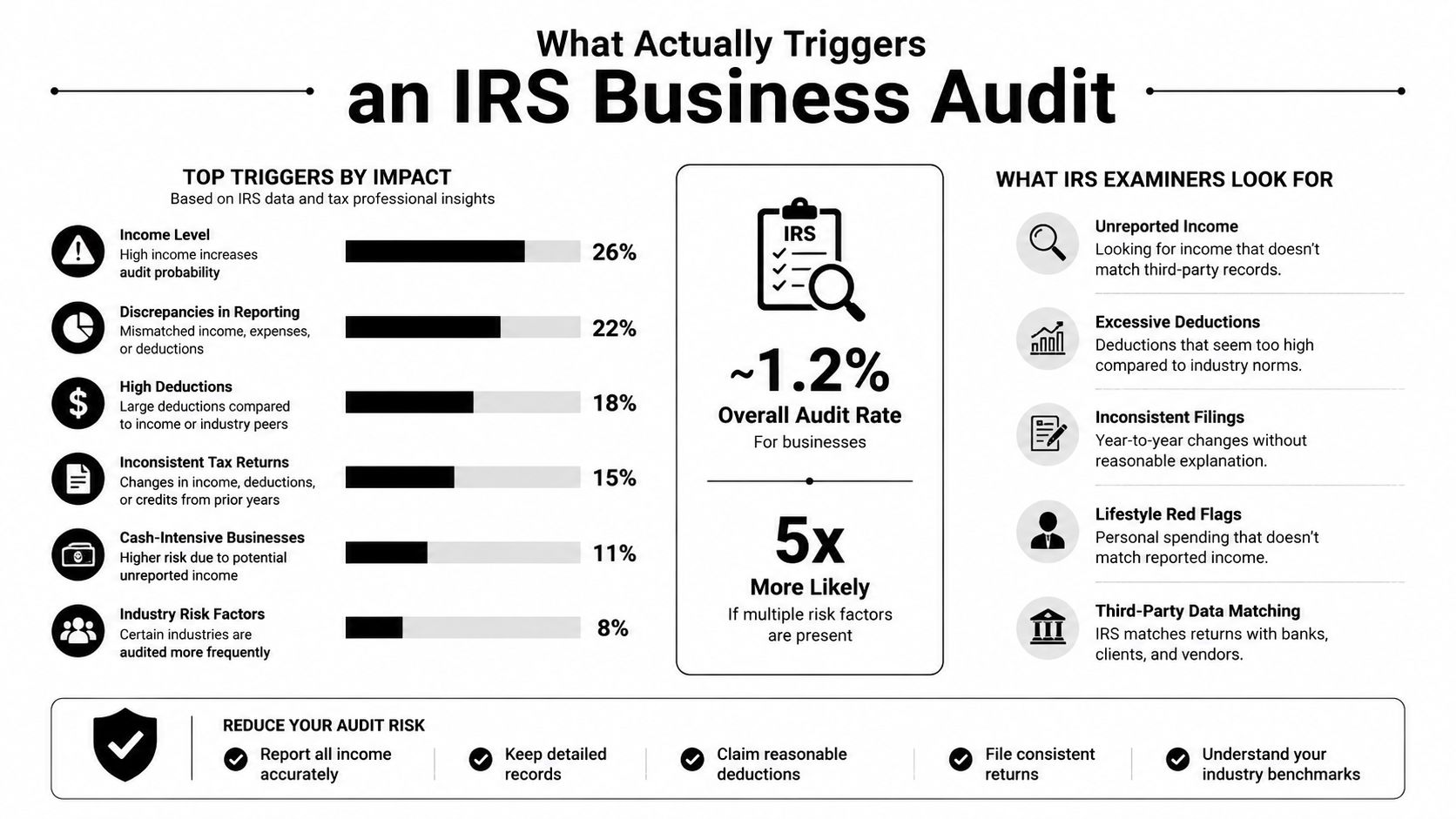
The IRS doesn't need a dramatic mistake to select a return. It looks for a return whose data, deductions, income profile, or relationships create an unusual pattern when compared with information available to the agency.
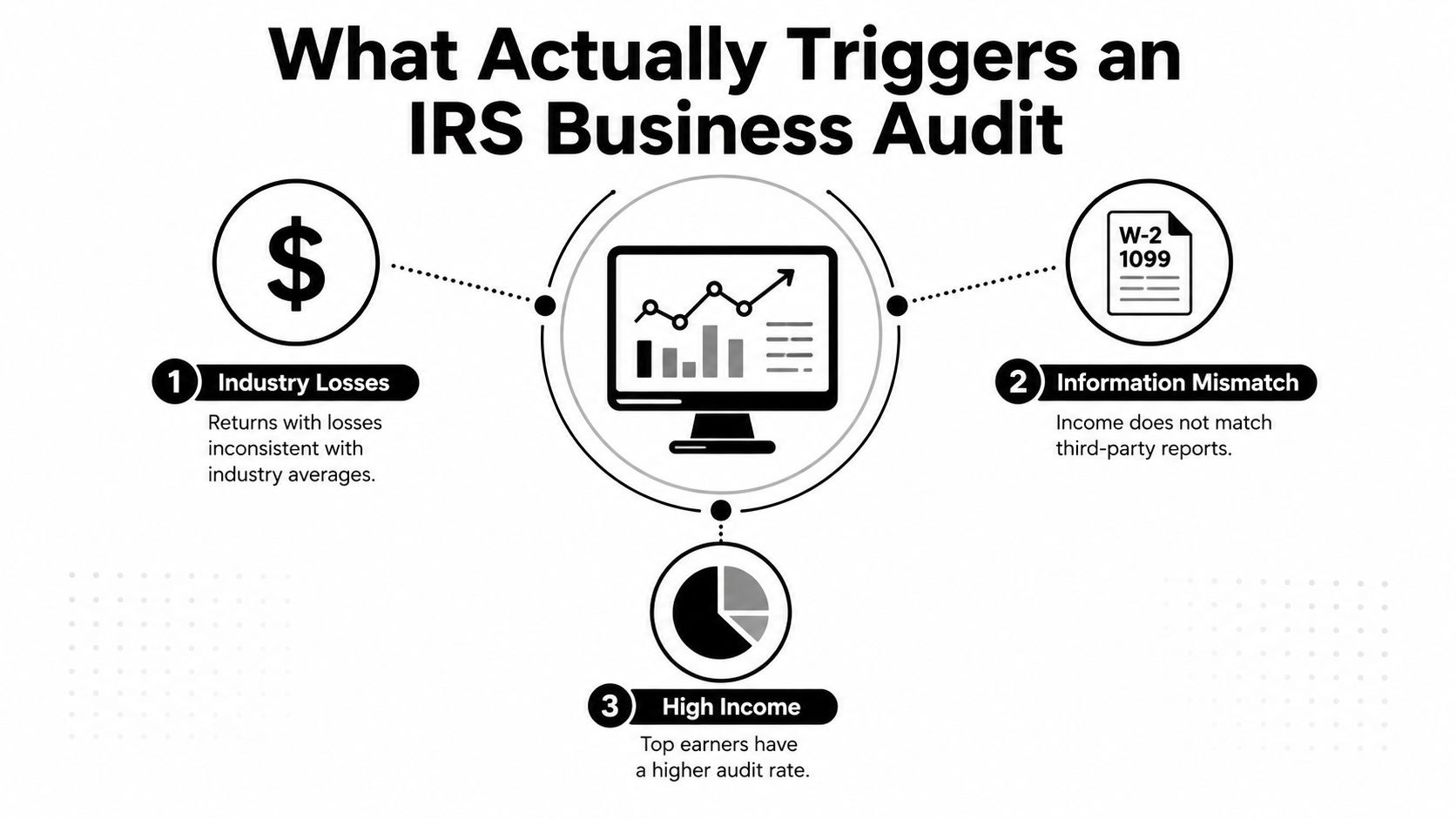
Computer scoring systems, including DIF and UIDIF, help identify returns with higher examination potential. The agency also matches reported figures against third-party forms such as W-2s and 1099s. A mismatch can be straightforward, such as a business reporting less income than payers reported, or more complicated, such as income appearing on one schedule but not flowing consistently through the return.
Patterns that deserve attention
The most important signals are usually combinations, not isolated deductions.
- Unusual losses: A loss may be legitimate, but repeated or unusually large losses deserve clear business-purpose documentation and an explanation tied to the underlying records.
- Income mismatches: Reconcile Forms 1099, payment processor reports, bank deposits, invoices, and the filed return. A bookkeeping omission can look like intentional underreporting.
- Expenses that don't fit the business: Large vehicle, travel, home-office, meals, or contractor deductions need records showing who incurred the cost, when, why, and how it relates to the business.
- Inconsistent line items: A return should tell one consistent story. Revenue, gross margin, wages, inventory, depreciation, and owner distributions shouldn't contradict the general ledger or prior filings without an explanation.
- Cash-heavy operations: Cash businesses face a documentation challenge because the IRS must test whether reported receipts capture the actual activity. Strong daily records, deposit reconciliations, and point-of-sale controls matter.
Audit rates aren't uniform. The Tax Policy Center notes that audit rates are generally highest for taxpayers with high income, business income, large corporations, and earned income tax credit claims. A practical guide to tax-audit triggers can help owners review the specific return characteristics that require closer attention.
The key mistake is treating one “trigger” as a magic formula. Modern selection is better understood as a risk profile. An expense may be ordinary for one business and anomalous for another. A loss may be expected during a startup period, but difficult to defend when the books show substantial personal spending or no credible operating activity.
The IRS isn't judging whether a business looks ordinary. It is testing whether the return's story matches the data.
In FY 2025, the IRS closed 497,621 return audits and recommended $26.8 billion in additional tax, with roughly 80% conducted by mail, according to the cited audit coverage. Those figures reinforce a practical point: many examinations begin with documents, not an agent arriving at the office. Respond to the specific request, preserve the surrounding records, and don't volunteer unrelated explanations before understanding the scope.
Audit Risk by Business Type and Income Level
Business owners need a realistic risk assessment, not a slogan such as “small businesses never get audited.” Audit coverage has declined overall, but exposure still varies by entity type, income level, and the way the business earns and reports money.
One tax-policy analysis reported 497,541 audits in a recent year, less than 30% of the annual total seen from 2010 through 2012, when audits averaged about 1.7 million per year. Separate audit statistics report that partnership and S-corporation returns were audited at rates under 0.05%, or roughly 2 to 3 audits per 10,000 returns filed. These figures come from IRS audit statistics reporting.
That low rate doesn't mean an owner can ignore preparation. A return with unusual losses, mismatched forms, significant cash activity, or related-party complexity can still draw attention. Small business audits also remain a meaningful part of field examinations, particularly where cash intensity creates a higher risk of unreported receipts.
IRS audit rates by income level
| Income range | Audit rate | Risk level |
|---|---|---|
| Lower-income returns | Roughly 0.2% to 0.4% | Lower overall exposure |
| $1 million to $5 million | About 1.1% | Elevated |
| $5 million to $10 million | About 3.1% | High |
| Above $10 million | About 4.0% | Very high |
The income figures in the table are reported in a secondary summary of IRS data cited by the available audit-risk material. The same source notes that the rate increases with income, while the Tax Policy Center identifies high-income taxpayers and taxpayers with business income as groups that generally face greater audit attention. The lesson isn't that every high-income return is defective. It is that the IRS has more reason to examine complex, high-dollar filings where an adjustment could materially affect tax.
A practical risk review
Start with the entity. A sole proprietor reports business activity directly on an individual return, while a partnership or S corporation adds allocation, basis, distribution, and owner-reporting issues. Then assess the income profile, cash exposure, related entities, and any major changes from prior years.
Finally, inspect the return for internal consistency. A low statistical audit rate doesn't protect a return that can't explain its own numbers. Keep the preparation file, reconciliation schedules, contracts, invoices, bank statements, payroll records, and asset support together by tax year. That organization is useful whether the IRS sends a correspondence notice or schedules a field examination.
How to Prepare Your Business for an Audit
Preparation should begin with the filed return, not the IRS notice. Pull the complete return and supporting workpapers, then build a separate audit file for each tax year at issue. Don't send a random box of documents. Give the reviewer a controlled record set that answers the notice and supports each disputed item.
Build the audit file
Organize records into categories that mirror the return:
- Income verification: Gather sales reports, invoices, merchant processor statements, Forms 1099, deposit records, and the general ledger. Reconcile them so you can explain differences rather than merely produce documents.
- Expense substantiation: Match significant expenses to receipts, invoices, canceled checks, card statements, and written business-purpose notes. For travel, meals, vehicles, and home-office deductions, retain the details that show business connection.
- Assets and depreciation: Collect purchase documents, placed-in-service information, depreciation schedules, dispositions, and proof of payment. Basis errors often surface when records are scattered across software and bank accounts.
- Business structure records: Keep formation documents, operating agreements, shareholder or partner records, payroll filings, loan agreements, owner contributions, and distribution schedules together.
- Prior filings and communications: Include amended returns, extensions, notices, replies, and correspondence with the IRS or state taxing agency.
A digital folder system can work well, provided files are named consistently and access is restricted. Accounting platforms such as QuickBooks Online can preserve transaction detail, while document tools can connect receipts to expenses. Technology helps only if someone reviews the records and fixes unreconciled items.
Find weaknesses before the examiner does
Review the return line by line. Mark every item that lacks direct support, every number that doesn't reconcile to the books, and every position that depends on facts nobody documented at the time. Missing records don't automatically defeat a legitimate deduction, but reconstruction must be credible and transparent.
If a bank statement is missing, request it from the bank. If a receipt can't be recovered, look for the invoice, payment record, contract, calendar entry, or contemporaneous email. Don't fabricate a receipt or backdate a memo. A reconstructed record should explain what happened and identify the evidence supporting it.
For a detailed preparation checklist, use this guide to preparing for an IRS audit. If you discover a material error, stop before making statements to the IRS. Have a tax professional evaluate whether an amended return, disclosure, or other corrective action is appropriate.
What to Do When an Audit Is Initiated
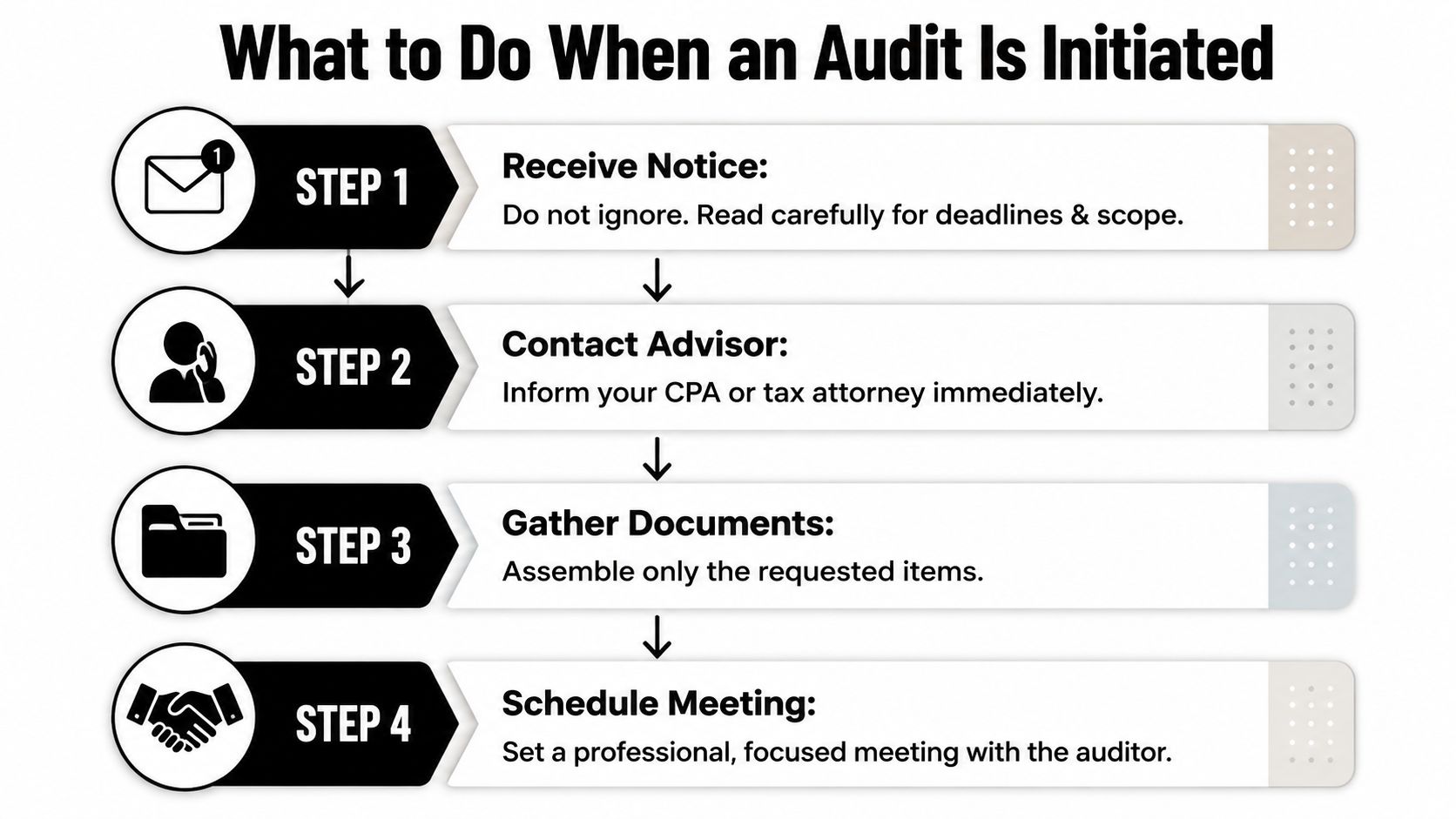
The first response should be controlled, not conversational. Verify that the notice is genuine, identify the tax year and issues, calendar the response deadline, and send it to the CPA, enrolled agent, or tax attorney who handles controversy matters. Don't call the examiner unprepared just to say you received the letter.
The IRS conducts many examinations by mail, while field audits involve more direct review of the business and its records. In FY 2025, roughly 80% of audits were conducted by mail, according to the available IRS audit coverage. A correspondence audit may look narrower, but a careless reply can create follow-up questions or cause the IRS to treat unsupported items as unsubstantiated.
Control the communication
Use a written response that tracks the notice. Provide the requested documents in an indexed package, explain genuine discrepancies briefly, and keep copies of everything submitted. Never answer a question by guessing. “I need to verify that” is safer and more accurate than an off-the-cuff explanation that later conflicts with the records.
Representation is especially important when the notice involves more than a single matching issue. A representative can communicate with the IRS under a power of attorney, help define the response, protect attorney-client communications where applicable, and prevent the taxpayer from turning a document request into an unnecessary interview.
Self-representation may be reasonable when the issue is narrow, the records are complete, and the taxpayer understands the return. It becomes risky when:
- The return contains several unresolved discrepancies.
- The IRS asks about cash receipts, owner transactions, or related entities.
- The business has multiple tax years under review.
- The examiner raises accuracy-related penalties or possible fraud issues.
- The owner's personal and business records overlap.
Don't treat an IRS interview like a bookkeeping conversation. Every answer becomes part of the examination record.
An audit notice is not a final assessment. If the IRS proposes an adjustment, review the report, dispute unsupported conclusions, and observe the applicable administrative deadlines. This explanation of what happens during an IRS audit provides useful context for the stages that follow the initial notice.
When to Engage a Tax Attorney and Next Steps
Not every audit requires a tax attorney. A narrow correspondence examination involving a clean information mismatch may be manageable with a competent tax preparer. Professional representation becomes much more valuable when the facts are complicated, the proposed adjustment is significant, or the IRS's questions could expose the owner personally.
Call a tax attorney early when the case involves a complex partnership, S corporation, or multi-entity structure; several tax years; payroll tax concerns; related-party transactions; large proposed adjustments; unreported income; or allegations that suggest negligence or fraud. The same applies when business and personal assets, accounts, or expenses are difficult to separate.
A CPA may be the right professional for accounting reconstruction, amended returns, and technical tax computations. A tax attorney focuses on controversy strategy, IRS communications, privilege issues, appeals, collection consequences, and the legal risks created by admissions or inconsistent explanations. Some cases need both professionals, with the CPA supporting the numbers and the attorney controlling the dispute.
Choose representation carefully
Ask whether the professional regularly handles IRS examinations, who will personally work on the case, how the scope and fee are defined, and what happens if the matter moves from examination to appeals or collection. A free initial consultation should produce a practical assessment of the notice, records, deadlines, likely issues, and immediate risks. It shouldn't be a pressure session built around a large upfront payment.
If an audit creates additional liability, possible paths can include payment arrangements, an offer in compromise where the taxpayer qualifies, or an appeal of the proposed assessment. The right option depends on collectibility, available assets, filing compliance, and the procedural stage. Don't choose a resolution method before reviewing the complete financial and tax picture.
Use this guide on when to hire a tax attorney to evaluate the decision. The practical action plan is straightforward: preserve the notice, secure the records, stop unsupported explanations, appoint the right advisor, and meet every deadline. An audit is a review of the return, but the consequences can reach owners, partners, payroll accounts, and future collection decisions.
Tax Attorney Stephen A Weisberg represents individuals, business owners, and companies in IRS audits, tax debt matters, and related disputes, including representation through a power of attorney and a free Tax Debt Analysis to determine whether and how he can help. Visit Tax Attorney Stephen A Weisberg to discuss your audit notice, documentation problems, or proposed IRS assessment before you respond.


