How to Check for Tax Liens A Guide to Protecting Your Finances
Learn how to check for tax liens with our guide. We cover federal, state, and county searches to help you uncover hidden liens and protect your assets.

In this article
- Why You Need to Proactively Check for Tax Liens
- The Stakes Are Getting Higher
- Know What You're Looking For
- How to Uncover Federal Tax Liens from the IRS
- Use Your IRS Account Transcript
- Filing Form 4506-T for Official Records
- Where to Search for Different Types of Tax Liens
- How to Find Property Tax Liens
- How to Uncover State Income and Sales Tax Liens
- So You Found a Lien. Now What? How to Read the Results
- Decoding the Details on a Lien Notice
- Lien vs. Levy: It's Not the Same Thing
- Common Traps When Reading Search Results
- What to Do After You Find a Tax Lien
- Developing Your Resolution Strategy
- When to Call a Tax Attorney Immediately
- Common Questions About Checking for Tax Liens
- How Long Does a Tax Lien Stay on Your Record?
- Does a Tax Lien Affect Your Credit Score?
- What Is the Difference Between a Lien and a Levy?
Finding out about a tax lien at the last minute can completely derail your plans, whether you're trying to sell a house or get a business loan. It’s a gut-punch discovery nobody wants. This guide cuts through the noise and shows you exactly how to find out if the IRS, state, or county has filed a claim against your assets.
Why You Need to Proactively Check for Tax Liens

Think of checking for tax liens as a critical financial health screening. An undiscovered lien is a silent roadblock, and you usually find it at the worst possible time. For a homeowner, it can stop a sale or refinance dead in its tracks. For a business, it can lead to frozen bank accounts, bringing your entire operation to a standstill.
A tax lien is simply a legal claim a government agency places on your property because of unpaid taxes. It's not a seizure, but it does secure the government's interest, making it almost impossible to sell or borrow against that asset until the debt is cleared.
The Stakes Are Getting Higher
Staying on top of this isn't just good advice; it's becoming a necessity. Tax delinquencies have been climbing. Back in 2024, national property tax delinquencies were at 4.5%, but by 2026, that figure had jumped to 5.1%. That trend means more properties are at risk of having liens filed against them every year.
I've seen this play out too many times. A small business owner tries to refinance their home to get some working capital. Everything is going smoothly until the lender’s title search uncovers an old, forgotten state sales tax lien. Just like that, the loan is denied. It's a common and costly surprise that a quick search could have prevented.
Know What You're Looking For
Before you start digging, it's crucial to understand just how far-reaching a lien can be. To get the full picture of why this is so important, you first need to understand what a tax lien is and the power it holds.
A single lien can have a ripple effect, impacting:
- Your Property: It puts a "cloud" on the title, which blocks you from being able to sell or refinance.
- Your Business: The lien can attach to all your business assets, including equipment and even the money customers owe you (accounts receivable).
- Your Credit: While liens don't appear on standard credit reports anymore, they are public records. Lenders and creditors still find them during their due diligence, which can absolutely affect your ability to get new credit.
The good news is that you can get ahead of this. We’ll lay out a clear roadmap for searching federal, state, and local records, so you can either get peace of mind or an early warning to start fixing the problem.
How to Uncover Federal Tax Liens from the IRS
If you’re worried about a federal tax lien, your first stop should always be the source: the IRS itself. A federal tax lien is the government's legal claim on everything you own—and everything you will own—when you have an unpaid tax debt. Finding one on your own terms is always better than being blindsided when you’re trying to buy a house or get a business loan.
The fastest way to get a snapshot of your standing with the IRS is through your personal online account. It’s a free service, and while it doesn't have a giant "You Have a Lien" button, seeing a significant outstanding balance is a massive red flag. It often means a lien either already exists or is just around the corner.
Use Your IRS Account Transcript
For the definitive proof, you need to pull an account transcript. This is the document that tells the whole story of your account for a specific tax year, and you can get it right from your IRS online portal. You're looking for a very specific line item: "Notice of Federal Tax Lien filed."
Getting the transcript online is the quickest method. On the IRS "Get Transcript" page, you can choose to view it immediately after a quick identity verification process.
A federal tax lien gives the IRS a powerful claim on all your assets—property, vehicles, and financial accounts—until the debt is paid. The lien technically arises automatically once the IRS assesses the tax, sends you a bill (the Notice and Demand for Payment), and you don't pay. The public filing of a Notice of Federal Tax Lien (NFTL) is what makes it visible to banks, lenders, and the public.
Filing Form 4506-T for Official Records
Sometimes you need an official paper copy of the NFTL, perhaps for a lender who requires it, or you simply can’t get through the online verification. In that case, you’ll need to file Form 4506-T, Request for Transcript of Tax Return.
On the form, make sure you check box 8 for "Record of Account." This gets you the most comprehensive transcript available, which will show any lien filings. It’s free, but be prepared to wait—receiving it by mail can take several weeks.
Real-World Scenario: I once had an S-Corp client who was completely blindsided by a $42,000 payroll tax debt. The owner went to pay a vendor one morning and discovered the business bank account was completely frozen. A lien had been filed months prior—and a levy notice sent to the bank—but he’d missed the mail. It's a perfect example of how quickly a lien can shut down your operations.
Discovering a lien can feel overwhelming, but don't panic. The key is to understand what you're up against. Our guide on the Notice of Federal Tax Lien is a great next step, as it breaks down exactly what the notice means for you and your assets.
While everyone worries about a tax lien from the IRS, it’s often the state and local liens that cause the most headaches. They’re far more common, and frankly, much trickier to track down.
The problem is the lack of a single, unified system. Unlike a federal lien search, which has a relatively clear path, state and local searches are a maze. Each jurisdiction plays by its own rules.
This flowchart shows the process for checking a federal lien. It's a structured journey, whether you're using the IRS online portal or digging into public records.
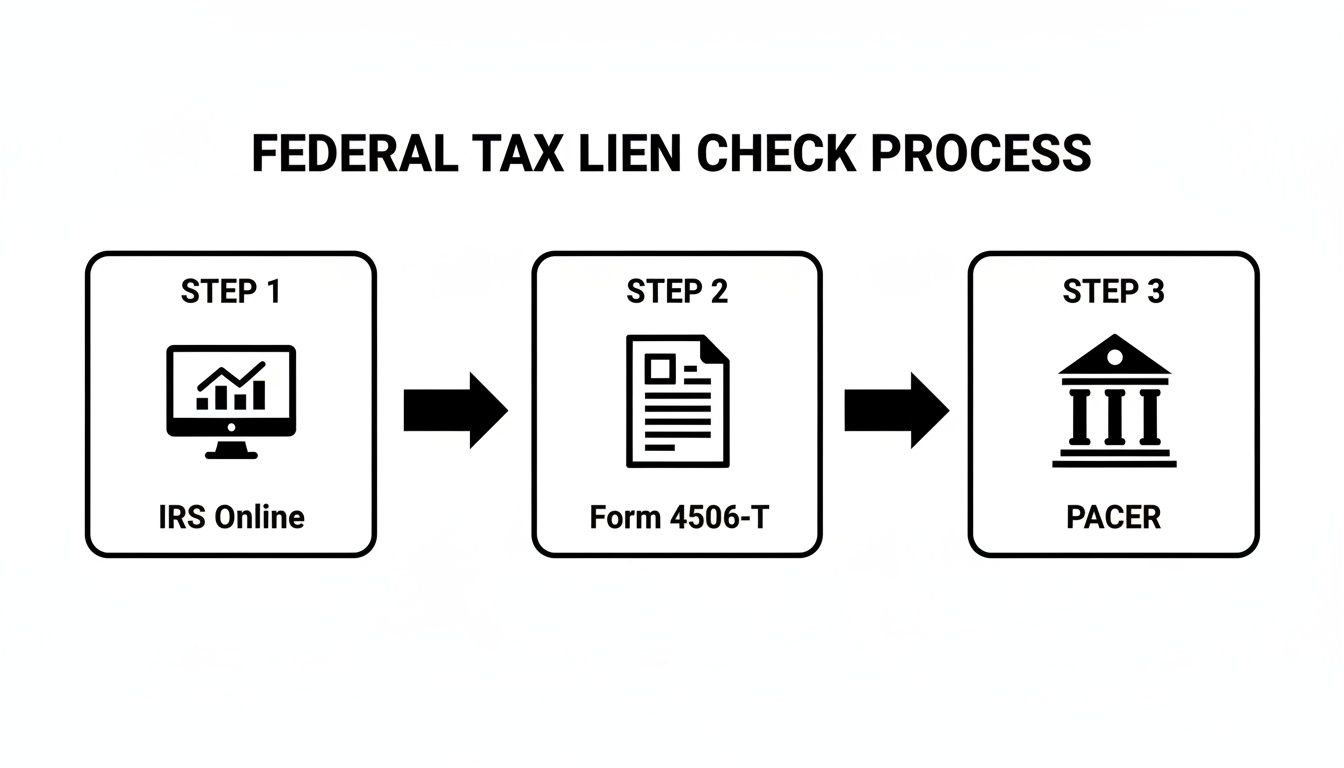
As you can see, there's a defined process from the IRS to PACER. Now, let's dive into the more fragmented world of state and local liens.
To help clarify where to begin your search, here's a quick reference table.
Where to Search for Different Types of Tax Liens
| Lien Type | Primary Search Location | Secondary Search Location | Typical Cost |
|---|---|---|---|
| Federal (IRS) | County Recorder of Deeds | Federal Lien Registry (online) | Free to $15 per search |
| State (Income/Sales) | State Department of Revenue | Secretary of State (UCC Filings) | Free to $25 per search |
| Local (Property) | County Tax Assessor/Collector | County Recorder of Deeds | Free to $10 per record |
This table gives you a starting point, but remember that specific procedures can vary significantly from one state or county to the next.
How to Find Property Tax Liens
If a tax debt is tied to unpaid property taxes, your search begins at the county level. These liens are attached directly to the real estate itself, so you have to go to the source: the office that manages property records.
Your first stop should be the website for the county recorder, clerk, or tax assessor. Many counties have excellent online databases that let you search by:
- Property owner’s name
- Physical property address
- Assessor’s Parcel Number (APN)
But don't assume everything is just a click away. In many places, technology lags behind, and you might have to visit the county office in person or mail in a formal request to get the documents you need.
A Pro Tip From Experience: Always search for variations of a name. I've seen liens missed because the search was for "John Smith," while the lien was filed under "John A. Smith" or even "J. Smith." A thorough search checks all possible variations.
How to Uncover State Income and Sales Tax Liens
Now for state-level debts, like unpaid income or sales taxes. These are a different beast entirely. Instead of being tied to a specific piece of real estate, they often attach to a person's broader assets or a company's business property.
Start your search on your Secretary of State's website. For business-related debts, these liens are frequently filed as UCC (Uniform Commercial Code) liens. These are public records and are usually searchable online.
Next, head over to the state’s Department of Revenue (or whatever it's called in your state, like the Franchise Tax Board in California). Some states offer a public online lien registry, which is incredibly helpful. If they don't, you'll likely need to file a public records request.
I once had a client whose business loan was about to fall apart at the last minute. The lender had discovered a surprise $15,000 state sales tax lien filed against his company. The client thought the issue was resolved years ago, but the lien was still active as a UCC filing. Because it attached to all his business assets, the new lender couldn't secure its own position.
That one oversight nearly cost him the funding he needed to expand. It's a perfect example of why you can't afford to ignore state-level searches. For more insights on navigating these complexities, our newsletter regularly covers important State and Local Tax (SALT) issues.
So You Found a Lien. Now What? How to Read the Results
Finding a document with your name on it next to the word "lien" is enough to make anyone's stomach drop. But before you jump to conclusions, take a deep breath. The document itself holds all the clues you need to understand the situation.
Your first job is to play detective. Look for the filing date, the specific tax period it covers, and of course, the total amount owed. These three pieces of information will tell you when the lien was recorded, which tax year is the source of the problem, and the scale of the debt you're facing. Getting these details straight is the absolute first step.
Decoding the Details on a Lien Notice
When you're staring at a potential lien document, you need to zero in on a few critical details to confirm it's actually yours and to grasp what it really means.
- Taxpayer Name and Address: Does the name match yours exactly? I’m talking middle initials, suffixes like Jr. or Sr., everything. It's surprisingly common for a lien to belong to someone with a nearly identical name.
- Tax Type and Period: Is this for your 2022 income tax, or is it for property taxes from the first half of 2023? Knowing this helps you match the lien to your own records (or lack thereof).
- Assessed Amount: This is the original tax debt. Keep in mind, the current balance is almost certainly higher once you factor in the accrued penalties and interest.
- Filing Location: The document will tell you which county or state office recorded it. This confirms which government body has a claim against you.
Understanding these documents correctly is more important than ever. We've seen total tax lien sale dollars skyrocket from $3.8 billion in 2021 to a staggering $5.02 billion in 2024. This shows just how many more properties are falling into the delinquency pipeline.
Lien vs. Levy: It's Not the Same Thing
One of the most crucial distinctions people need to understand is the difference between a lien and a levy. They are not interchangeable.
A tax lien is simply a legal claim against your property to secure a debt. It doesn't mean the government is taking anything yet. A levy, on the other hand, is the actual seizure of property to pay what you owe. Think of the IRS freezing your bank account or garnishing your wages—that's a levy.
Real-World Example: I once had a client who was about to walk away from their dream home after a title search uncovered a lien. After we took a closer look, we found the lien was for the previous owner, who just happened to have a very similar name. A little bit of careful verification saved the entire deal and prevented a huge mistake.
Common Traps When Reading Search Results
Even when you have the right documents in hand, it's easy to get tripped up. The legal jargon can be dense, and new tools using AI document analysis are emerging to help sort through the complexity more effectively.
Another common mistake is misinterpreting a "released" lien. A released lien means the debt has been fully paid and the claim is no longer active. However, the record of that release might still pop up in public searches for years. Always look for specific language on the document, like "Certificate of Release," to confirm it's no longer a threat. You can even sell your home even with an active IRS lien, but you have to know exactly what you're dealing with first.
What to Do After You Find a Tax Lien

Okay, so you've confirmed a tax lien is real—and it has your name on it. It’s a heavy moment, no doubt. But take a deep breath. A tax lien is a serious financial hurdle, but it is not an insurmountable one. This is a solvable problem, and what you do next is absolutely critical.
Your immediate priority is to verify the debt itself. Before you can map out a strategy, you have to be 100% sure the amount the government claims you owe is accurate. Pull together your tax records, any proof of payments, and all correspondence for the tax year in question. Mistakes do happen, and the last thing you want is to solve a problem based on a government error.
Developing Your Resolution Strategy
Once you've confirmed the debt is legitimate, you have several strategic paths forward. The right option for you will depend entirely on your financial situation, the total amount you owe, and what you're trying to accomplish—like selling a home or getting a business loan.
Here are the main resolution options you can explore with the IRS or your state tax agency:
- Pay the Debt in Full: This is the most straightforward route. Paying the entire balance, including all penalties and interest, will get the lien released. It’s clean and simple.
- Installment Agreement (IA): If paying in full isn't an option, an IA allows you to make manageable monthly payments. The lien usually stays in place until you're paid off, but an approved IA shows you're actively resolving the debt, which is a big step in the right direction.
- Offer in Compromise (OIC): This is for taxpayers in significant financial hardship. An OIC lets you resolve your tax liability for less than the full amount owed, but be warned: the qualification process is extremely rigorous.
Let's be clear: an Offer in Compromise isn't a simple negotiation. The IRS performs a deep dive into your entire financial life—analyzing your ability to pay, income, expenses, and asset equity. It’s a powerful tool, but it's reserved for very specific circumstances.
What if the lien is holding up a major transaction? You have a couple of specialized options. A lien subordination doesn't remove the lien, but it lets another creditor (like a mortgage lender) jump ahead of the IRS in line. This can make it possible to refinance. A lien withdrawal, on the other hand, removes the public Notice of Federal Tax Lien, making it appear as if it was never filed, which can be a huge help for your credit.
When to Call a Tax Attorney Immediately
While you can handle some minor tax issues on your own, certain situations demand professional legal help. Trying to navigate these complex scenarios by yourself can make a bad situation much, much worse. For a closer look at the removal process, our guide on how to remove a tax lien offers more detailed context.
You should contact a tax attorney immediately if:
- The tax debt is substantial (e.g., in the six figures or more).
- A lien is actively blocking the sale of your home or a critical business deal.
- You're dealing with complex business or payroll tax debts, like the Trust Fund Recovery Penalty.
- You believe the lien was filed in error or the amount the government says you owe is flat-out wrong.
An experienced tax attorney can analyze your specific situation, protect your rights, and negotiate with the tax authorities for you. Their job isn't just to resolve the debt; it's to find the most effective and affordable path forward while protecting your financial future.
Common Questions About Checking for Tax Liens
When you start digging into tax liens, a lot of questions pop up. It’s a confusing topic, for sure. Getting straight answers is the first step to feeling in control. Let's tackle some of the most frequent questions I hear from clients.
How Long Does a Tax Lien Stay on Your Record?
A federal tax lien won't simply vanish over time. The IRS has a 10-year window, known as the statute of limitations, to collect the tax debt from the date it was assessed. This is the period during which the lien is legally active.
But even after you pay off the debt, the lien's public record can stick around. Once the debt is settled, the IRS is required to issue a "Certificate of Release of Federal Tax Lien" within 30 days. The problem is, it’s not always automatic from there. It's on the county recording office to actually update their public database, and that process can drag on, leaving a ghost of the lien on your record.
Does a Tax Lien Affect Your Credit Score?
This is a major point of confusion for many people. Since 2018, the big three credit bureaus—Equifax, Experian, and TransUnion—no longer include tax lien information on standard consumer credit reports. Because of this change, a tax lien will not directly lower your FICO or VantageScore.
Don't let that give you a false sense of security, though. Tax liens are public records. While they won't show up on your credit report, anyone doing a thorough background check, especially a mortgage lender or business loan officer, will almost certainly find it during their public record and title searches. Uncovering a lien can absolutely derail a loan application.
The bottom line: Even though a tax lien is off your credit report, it remains a serious red flag for creditors and can significantly damage your ability to secure financing.
What Is the Difference Between a Lien and a Levy?
It’s absolutely critical to understand the distinction here. People use these terms interchangeably, but they represent two very different actions by the government, with one being far more severe.
- A Tax Lien: This is the government's legal claim against your property. It’s essentially a public notice telling other creditors, "We get paid first." It secures the government’s interest in your assets but doesn't actually take them.
- A Tax Levy: This is the government's actual seizure of your property to pay the tax debt. A levy isn't a claim; it's the forceful action of taking your assets—like garnishing your wages or clearing out your bank account.
Here’s a simple way to think about it: a lien is like the government putting a boot on your car’s wheel. You still own the car, but you can’t sell it. A levy is when they show up with a tow truck and haul the car away.
At Attorney Stephen A Weisberg, we know how stressful it is to find out you have a tax lien. Instead of demanding a large retainer, we start with a FREE Tax Debt Analysis to determine exactly how we can help resolve your issues with the IRS or state. If you’re facing a tax lien, find your path to resolution by visiting us at https://weisberg.tax.


