How Much Does Tax Resolution Services Cost Explained
Wondering how much does tax resolution services cost? See real fee ranges, pricing models and what drives your total cost before you hire.

In this article
- Introduction What You Will Actually Pay for Tax Resolution Help
- Why the first quote can be misleading
- How Tax Resolution Pricing Models Work
- Flat-fee pricing
- Staged retainers
- Hourly billing
- Typical Cost Ranges by Service and Resolution Path
- Estimated Professional Fees by Resolution Path
- What Drives Your Final Price Up or Down
- The major cost drivers
- Real World Cost Examples for Common Tax Debt Scenarios
- A self-employed taxpayer seeking a payment plan
- A small business with payroll tax debt
- An individual pursuing an Offer in Compromise
- Why the debt amount doesn't settle the question
- How to Vet Providers and Spot Costly Red Flags
- Five questions that protect your budget
- Making a Smart Cost Benefit Decision and Getting Your Accurate Quote
- Prepare for a meaningful Tax Debt Analysis
Investigation fees for tax resolution often run from a few hundred dollars to more than $1,500, while resolution work commonly adds $1,000 to $10,000 or more. Average cases are often around $3,500 to $5,500 for individuals and $5,000 to $7,000 for businesses, with some providers charging about 10% to 15% of the tax debt.
You may be holding an IRS notice, staring at a balance you can't pay, and searching for one number that tells you what professional help will cost. The difficulty is that tax resolution isn't one service. A simple payment arrangement, an Offer in Compromise, missing tax returns, and unpaid payroll taxes each require different work.
The tax debt amount matters, but it often isn't the best first predictor of your bill. The resolution path, the condition of your records, the number of tax years involved, and whether the IRS has started collection action can matter more. A taxpayer with a smaller balance may pay more than someone with a larger balance if the smaller case requires extensive cleanup and financial documentation.
This guide separates the initial investigation from the work that follows, explains the common pricing structures, and shows how to compare proposals without mistaking a low starting fee for a low total cost. If you're also weighing debt-management support, a plain-language overview of how credit counseling works and costs can help you distinguish general financial guidance from tax representation.
Introduction What You Will Actually Pay for Tax Resolution Help
Suppose Maria is self-employed and receives an IRS collection notice. She searches for help and finds one company advertising a low initial fee, another quoting several thousand dollars, and a third promising to settle everything for a percentage of her balance. None of those prices can be evaluated fairly until she knows what each provider is agreeing to do.
One firm may be offering only a transcript review and eligibility assessment. Another may be pricing the complete preparation, filing, negotiation, and follow-up process. A third may use a percentage-based quote that sounds straightforward but still separates investigation from resolution. The first question isn't merely, "How much is my tax debt?" It is, "What work does my situation require?"
Why the first quote can be misleading
Many providers divide the engagement into two phases. The first phase investigates the IRS account, reviews transcripts, identifies missing filings, and evaluates possible remedies. The second phase handles the selected remedy, such as an installment agreement, penalty abatement request, or Offer in Compromise.
That structure explains why an advertised starting price can look dramatically lower than the eventual engagement. A few hundred dollars paid for an initial review may be reasonable if it produces useful analysis, but it isn't automatically the total price. Ask whether the initial payment is credited toward later work, and ask what happens if the review shows that the provider can't offer a realistic solution.
The market commonly uses investigation fees from a few hundred dollars to more than $1,500, followed by resolution fees ranging from $1,000 to $10,000 or more for complex cases, as summarized by CBS News' tax relief cost guide. Some providers also quote approximately 10% to 15% of the tax debt, which can make a large balance expensive even when the underlying remedy is relatively straightforward.
Practical rule: Never compare a starter fee from one provider with an all-in quote from another. Put both proposals into the same categories, investigation, preparation, negotiation, follow-up, and extra work.
The useful outcome of an initial review is clarity. You should leave knowing which resolution path appears realistic, what documents are missing, what the provider will do, and how much you may pay before the IRS makes a decision.
How Tax Resolution Pricing Models Work
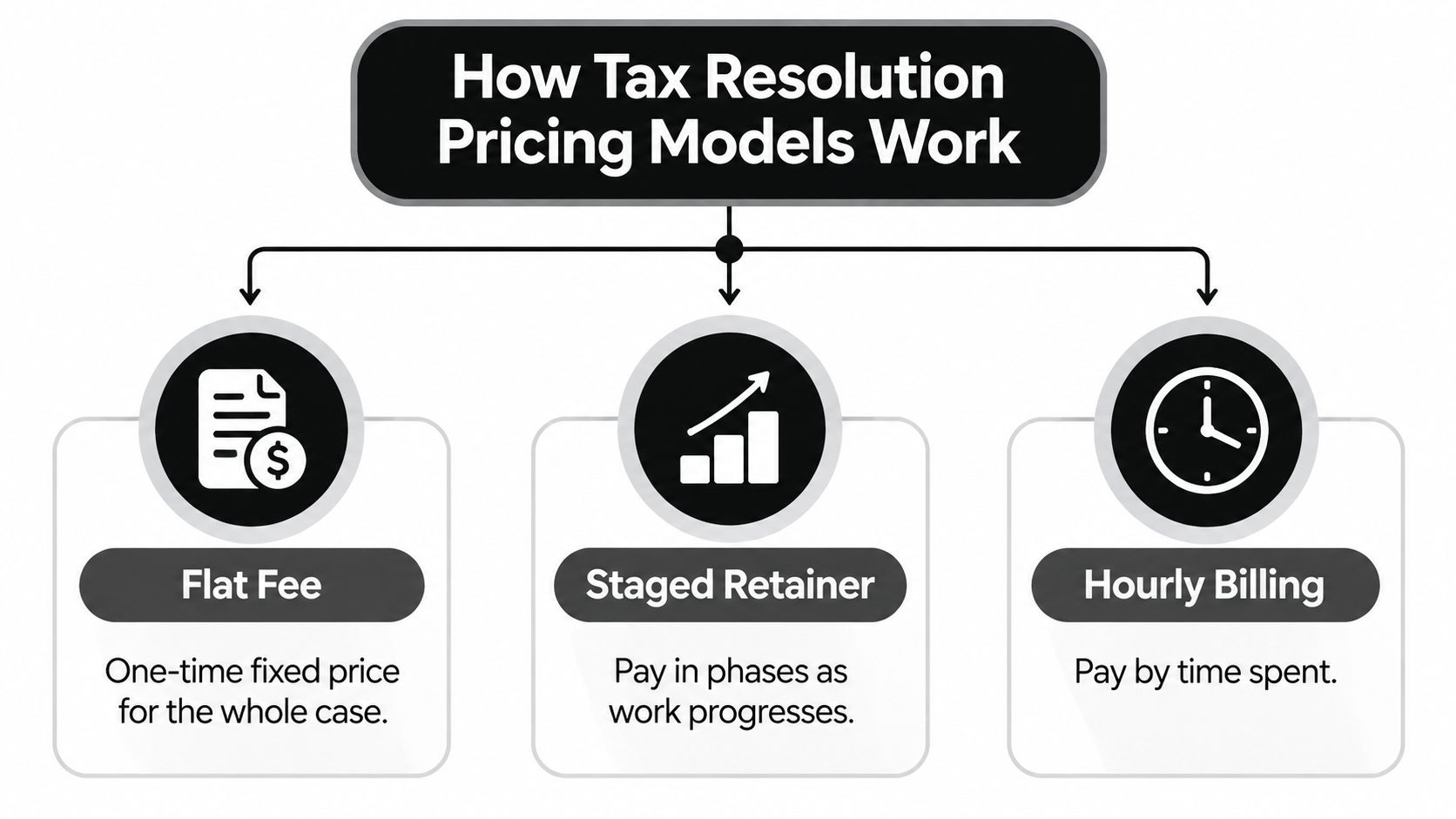
Tax resolution pricing resembles hiring a contractor to repair a complicated property. The contractor may charge for an inspection before estimating the repair, or may quote one fixed project price, or may bill for time and materials. Tax professionals use similar approaches because they can't know the full workload until they understand the IRS account and your financial records.
Flat-fee pricing
A flat fee covers a defined scope of work for a stated price. The agreement might include transcript analysis, preparation of specified forms, submission of a request, and a defined amount of IRS follow-up. This model gives you the clearest budget, but only if the scope is precise.
Ask whether the fee includes all tax years, amended or missing returns, financial statement preparation, IRS correspondence, appeals, and work after a rejection. A flat fee isn't a promise to solve every possible issue. It's a price for the tasks written into the engagement agreement.
Staged retainers
A staged retainer divides payment into phases. You might pay for investigation first, then pay additional amounts for financial disclosure, proposal preparation, negotiation, and later follow-up. Industry pricing guides report that national tax relief companies commonly request staged retainers of $4,000 to $10,000 upfront in some engagements, as described in Solvable's tax resolution fees guide.
The important question is not just how much each stage costs. Ask whether the first stage is credited toward the next stage, whether unused funds are refundable, and whether the provider can stop after investigation if no viable remedy exists.
Hourly billing
Under hourly billing, you pay for the time the attorney, enrolled agent, accountant, or staff spends on your matter. Reported attorney rates commonly fall around $300 to $650 per hour, while broader industry reporting places some providers between $200 and $1,000 per hour, depending on the professional and case type, according to Total IRS Relief's cost guide.
Hourly billing can work for a narrowly defined issue. It becomes harder to budget when the IRS creates new deadlines, requests more records, or adds collection actions. Request a written estimate of total hours and a notice before the provider exceeds it.
A proposal should also identify who performs the work. A senior tax attorney may supervise tasks completed by other staff, and each role may have a different rate. The same transparency principle applies when comparing professional services generally, including how much bookkeepers charge. You need to know whether you're paying for analysis, administration, or direct representation.
Typical Cost Ranges by Service and Resolution Path
The remedy you need usually provides a better price anchor than the balance alone. A straightforward installment agreement may involve limited analysis and routine correspondence. An Offer in Compromise requires a deeper financial review, substantiation, and negotiation. Payroll tax matters can involve business records, responsible-person questions, and urgent collection concerns.
Independent pricing guides commonly place average individual tax resolution cases around $3,500 to $5,500, while business cases often fall around $5,000 to $7,000 or more, according to Comprehensive Tax Resolution's pricing explanation. Those are broad market anchors, not guaranteed prices for a particular taxpayer.
Estimated Professional Fees by Resolution Path
| Resolution Path | Typical Professional Fee Range | Why Cost Varies |
|---|---|---|
| Simple installment agreement | A few hundred to a few thousand dollars | The provider may need limited transcript review, payment-capacity analysis, and routine IRS communication |
| Penalty abatement | A few hundred to a few thousand dollars | The work depends on the penalty history, supporting explanation, and documentation required |
| Offer in Compromise | About $3,500 to $7,500 or more | The process generally requires detailed financial disclosure, substantiation, forms, and negotiation |
| Payroll tax resolution | Mid- to high-four-figure range | Payroll records, business finances, filing problems, and potential responsible-person issues add work |
| Trust Fund Recovery Penalty defense | Mid- to high-four-figure range | The professional may need to analyze business roles, payroll records, payments, and individual liability |
| Complex multi-year collection matter | $10,000 or more in some cases | Audits, levies, missing returns, multiple IRS actions, and repeated negotiations expand the scope |
These ranges describe professional fees, not necessarily the underlying tax, penalties, interest, IRS filing fees, or payment amount. An Offer in Compromise may also involve an IRS filing fee, although low-income taxpayers may qualify for a waiver, as noted in this tax resolution options guide.
A low starting fee can still lead to a higher total if the provider treats each phase as a separate engagement. Before signing, request an all-in estimate for the likely remedy and a list of events that would trigger extra charges. For settlement-related education, taxpayers can also review tax debt settlement options, but they should distinguish general information from advice based on their own financial records.
What Drives Your Final Price Up or Down
Two taxpayers can owe similar amounts and receive very different professional quotes. One may have filed every return, kept organized records, and need only a payment arrangement. The other may have unfiled returns, unpaid payroll taxes, incomplete books, and a levy deadline. The IRS balance doesn't reveal that difference.
The major cost drivers
Number of tax years: Each additional year can require separate transcripts, returns, supporting documents, and IRS review. A case spanning several years creates more deadlines and more opportunities for inconsistent information.
Missing or inaccurate returns: A provider may need to reconstruct income and expenses before discussing a resolution. Filing compliance often comes before collection relief, so return preparation can become a separate workstream.
Type of tax: Individual income tax and business payroll tax don't carry the same administrative burden. Payroll tax cases may require employee records, payment histories, business-account analysis, and examination of who controlled payroll decisions.
Collection activity: A levy, lien, notice of intent to levy, or active enforcement deadline can require faster document collection and more immediate communication with the IRS. Urgency doesn't automatically justify a higher fee, but it can increase the amount of coordinated work.
Financial disclosure: Offers in Compromise and some other remedies require detailed information about income, expenses, assets, equity, and household finances. Missing documentation means more follow-up and more preparation time.
Negotiation and litigation: Routine correspondence is different from repeated negotiations, appeals, or court-related work. If the matter becomes adversarial, hourly time and specialist involvement can rise quickly.
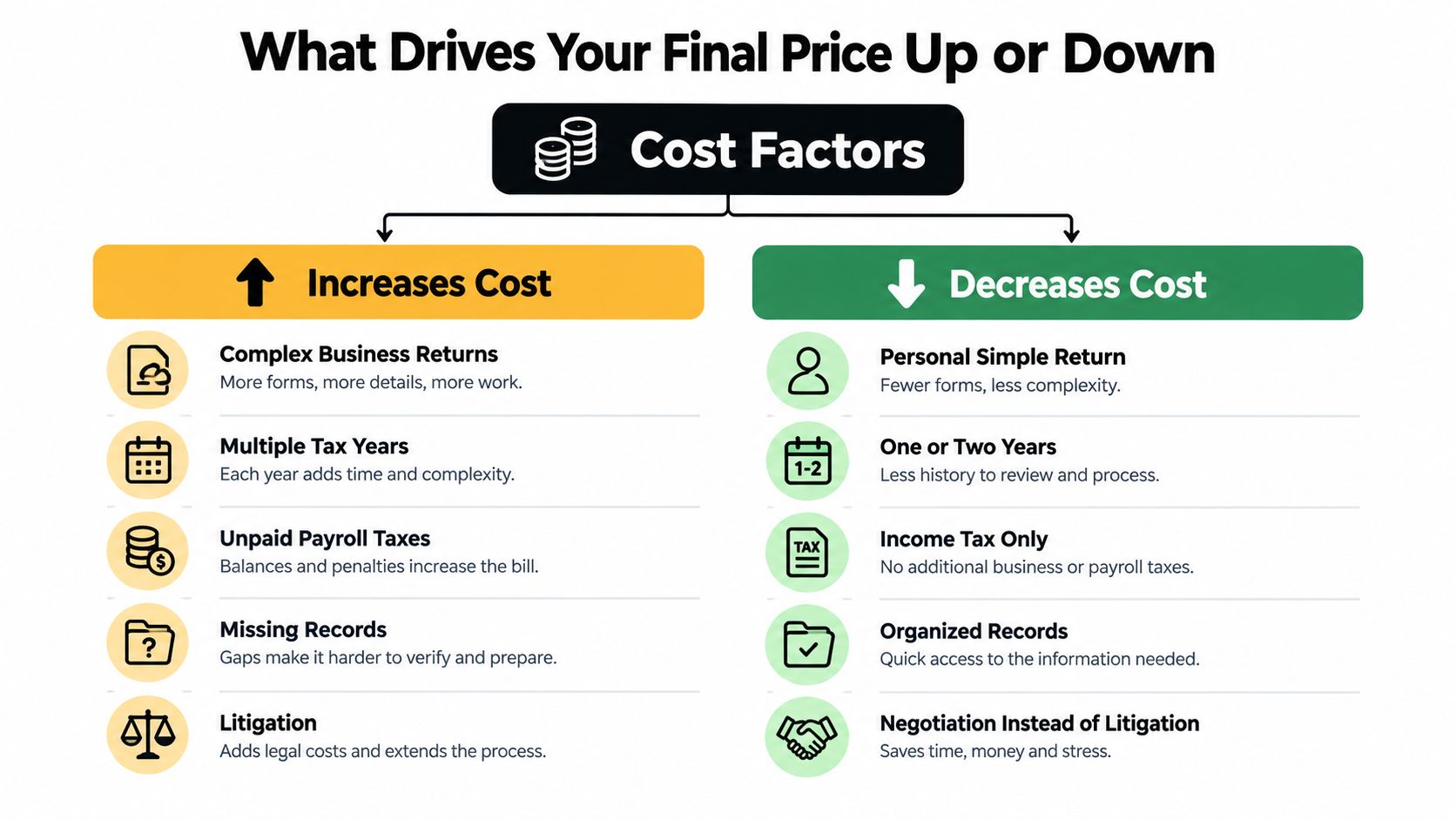
A useful consultation should address each driver directly. Don't describe your situation only by saying, “I owe the IRS.” Explain the tax years, the kind of tax, whether every return was filed, whether the IRS has threatened collection, and what records you have available.
The most accurate quote comes after the professional understands the workstream, not merely the balance.
A Trust Fund Recovery Penalty can make a business payroll problem personal for the people the IRS determines were responsible for collecting or paying withholding taxes. Read about the issue in this explanation of the Trust Fund Recovery Penalty, then ask any provider whether that risk is part of the quoted scope.
Real World Cost Examples for Common Tax Debt Scenarios
Consider three taxpayers with different remedy paths. The examples below use the market ranges already discussed, not promises about what a specific provider will charge.

A self-employed taxpayer seeking a payment plan
A self-employed person has filed the relevant returns, has a stable income pattern, and can document ordinary household and business expenses. The likely path may be an installment agreement, with work focused on transcript review, financial capacity, and IRS correspondence.
If the records are organized and no audit or levy issue complicates the matter, the fee may stay in the few-hundred to low-thousands range. The quote should state whether preparing new returns, correcting prior filings, or responding to future notices is excluded.
A small business with payroll tax debt
A small business has unpaid payroll taxes and incomplete records. The provider may need to review payroll filings, bank activity, payments, ownership and management responsibilities, and the business's ability to remain current.
This type of engagement commonly moves into the mid- to high-four-figure range because several workstreams operate at once. The business owner should ask whether the quote includes only business collection negotiations or also defense against individual Trust Fund Recovery Penalty assessment.
An individual pursuing an Offer in Compromise
An individual has multiple years of tax problems and believes the IRS may accept less than the full balance. The professional must first determine whether the person qualifies under the applicable financial standards, then assemble a complete disclosure package and support the proposed offer.
Professional fees commonly fall around $3,500 to $7,500 or more for this path, based on the market guidance cited earlier. The IRS filing fee, if applicable, may be separate, and low-income taxpayers may qualify for a waiver. A provider shouldn't describe an Offer in Compromise as automatic or guaranteed.
Why the debt amount doesn't settle the question
A smaller liability with missing returns, disorganized records, and an urgent levy can require more work than a larger liability supported by complete records. The practical comparison is not “small debt versus large debt.” It's simple remedy versus complex remedy, with timing and documentation included in the calculation.
How to Vet Providers and Spot Costly Red Flags
A professional fee becomes easier to judge when the provider explains exactly what you receive for it. Start with the written engagement agreement, not the sales call. The document should identify the taxpayer, tax periods, agencies involved, services included, payment schedule, exclusions, and process for adding work.
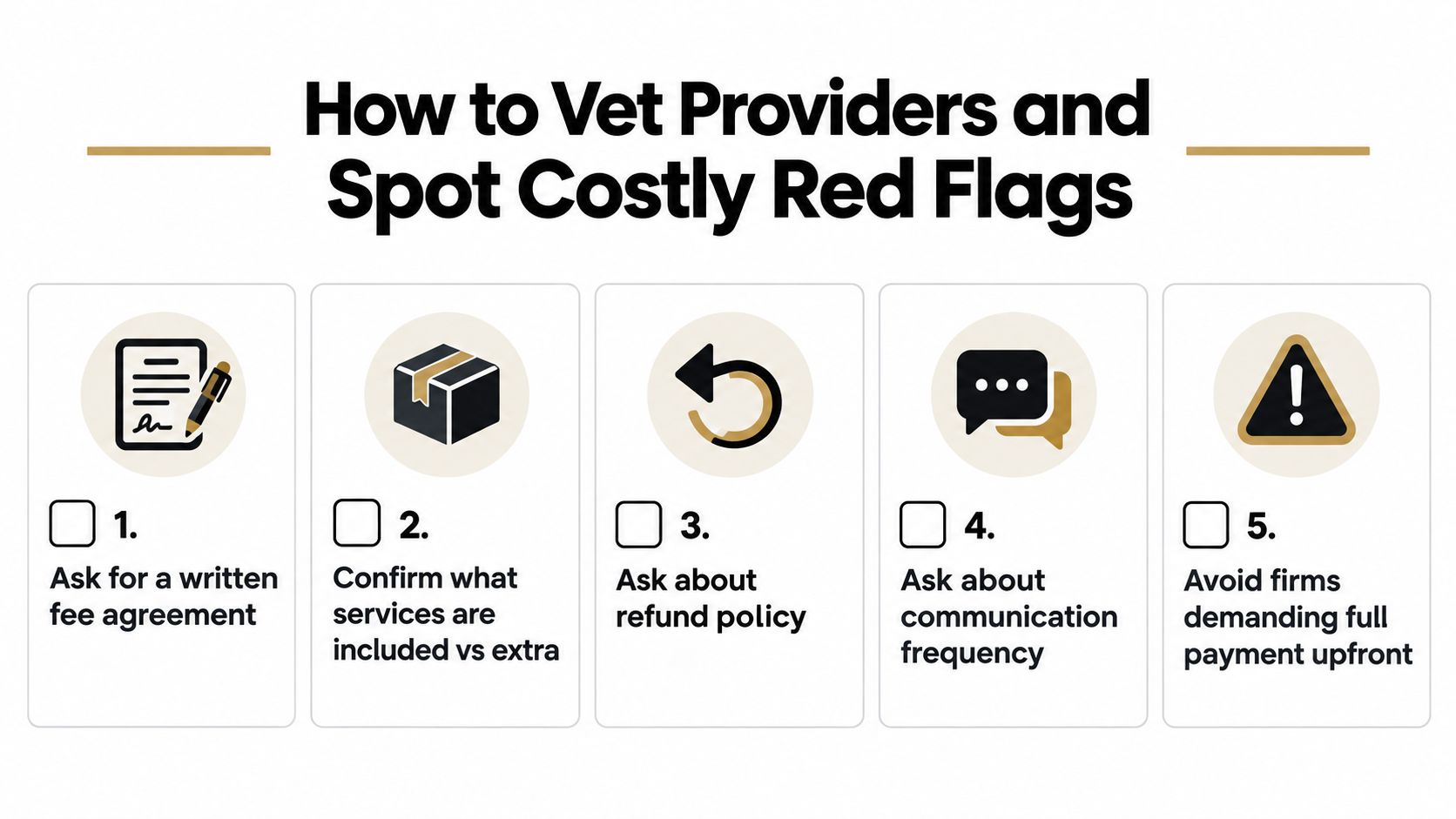
Five questions that protect your budget
Ask for a written fee agreement. The contract should distinguish investigation, preparation, negotiation, and follow-up. It should also explain whether the initial fee is credited toward later services.
Confirm included and extra services. Ask whether return preparation, transcript retrieval, financial statements, IRS calls, appeals, and responses to new notices are part of the price. A provider may reasonably exclude some services, but the exclusion should be visible before payment.
Ask about refunds and unused funds. Find out what happens if the investigation shows that no viable remedy exists, if you end the engagement, or if the provider completes the defined work under budget.
Set communication expectations. Identify your direct contact, expected update frequency, response process, and who makes strategic decisions. Silence creates both stress and avoidable delays.
Be cautious with full upfront payment demands. Large staged retainers can exist in the market, but you should understand what work happens before each payment and whether the structure matches the case.
Promises deserve scrutiny. No legitimate professional can guarantee that the IRS will accept a settlement, remove every penalty, or stop all collection activity before reviewing the facts. A sales representative who pressures you to transfer a large amount immediately, refuses to explain the scope, or treats a low initial price as the complete cost is making comparison harder.
Use a simple proposal checklist:
- Scope: Which tax years and agencies are covered?
- Path: Which remedy is being evaluated or pursued?
- Fees: What is due now, later, and only if extra work arises?
- Credit: Does the investigation payment reduce the resolution fee?
- Outcome: What happens if the proposed remedy is unavailable or rejected?
For broader guidance on comparing firms, review this tax debt relief companies guide. The right provider isn't necessarily the one with the lowest advertised entry fee. It's the one whose scope and pricing let you understand your likely total exposure.
Making a Smart Cost Benefit Decision and Getting Your Accurate Quote
Professional help costs money, but doing nothing can also carry financial consequences. Penalties, interest, collection actions, missed deadlines, and continued filing problems can make the tax account harder to manage. The relevant comparison isn't just the professional fee against the tax balance. Compare the fee with the cost of delay, the complexity of the remedy, and your ability to complete the work accurately under pressure.
DIY may be reasonable when your returns are filed, the balance is clear, the IRS offers a straightforward payment option, and you can meet the requirements without negotiation. Professional representation becomes more useful when you face missing returns, disputed liability, payroll taxes, an Offer in Compromise, a levy deadline, multiple tax years, or uncertainty about what the IRS records show.
Prepare for a meaningful Tax Debt Analysis
Gather your IRS notices, tax returns, account transcripts if available, wage and income information, bank and investment statements, loan documents, payroll records, and a list of assets and monthly expenses. Don't wait for perfect organization. A provider can tell you which missing documents matter most.
A useful initial analysis should identify the tax periods, filing status, balance composition, collection posture, realistic remedy options, and expected work. It should also explain the fee structure before you commit. The purpose is not to sell a generic program. It's to determine whether professional help fits the facts and what the work should cost.
When comparing professionals, focus on relevant IRS experience, communication, scope, and fee transparency. This guide to finding a good tax attorney can help you evaluate qualifications alongside price.
Tax Attorney Stephen A Weisberg offers a free Tax Debt Analysis before charging clients to resolve their IRS or state tax issues. His practice works with individuals, businesses, and business owners on tax debt, audits, payroll tax matters, and related IRS problems, with fees discussed after the situation and likely work are evaluated.
Tax Attorney Stephen A Weisberg can review your notices, tax history, and financial situation through a free Tax Debt Analysis, then explain which resolution path may fit and what the engagement could cost. Visit Tax Attorney Stephen A Weisberg to request an assessment before committing to a tax resolution fee.


