How Much Can a Bank Levy Take? A Clear Guide to Protections
how much can a bank levy take? Learn what funds are exempt and steps to protect your assets from the IRS and creditors.

In this article
- Breaking Down How a Bank Levy Actually Works
- The Critical 21-Day Holding Period for IRS Levies
- Bank Levy at a Glance: Key Factors and Limits
- Understanding Which Funds Are Off-Limits to Creditors
- Automatic Protection for Federal Benefits
- Other Exemptions You Have to Claim Yourself
- Special Rules for Retirement and Commingled Funds
- How State-Specific Exemptions Protect Your Money
- The Wildly Different Landscape of State Protections
- Sample State Bank Levy Exemption Amounts
- Navigating Out-of-State Judgments
- Why Knowing Your Local Laws Is Non-Negotiable
- The Bank Levy Timeline from Notice to Seizure
- The First Warning Shot: The Final Notice
- The Account Freeze and the 21-Day Hold
- The Final Step: Funds Are Sent to the IRS
- How to Stop a Bank Levy and Get Your Money Back
- Proving Economic Hardship
- Negotiate a Resolution to Stop the Bleeding
- Filing a Claim of Exemption for State Levies
- When You Need a Tax Attorney for a Bank Levy
- The Debt Is Large or You Disagree With It
- Your Financial Situation Is Complicated
- Common Questions About Bank Levies
- Can the IRS Seize a Joint Account if Only One of Us Owes?
- Will a Bank Levy Tank My Credit Score?
- What’s the Difference Between a Levy and a Garnishment?
When you get hit with a bank levy, the first thought that races through your mind is probably, "How much are they going to take?" It's a scary question, and the answer isn't a neat and tidy percentage. A creditor has the legal right to freeze and seize funds in your account up to the full amount you owe, plus any court costs or fees. They essentially take a snapshot of your balance on the day the levy hits your bank.
Breaking Down How a Bank Levy Actually Works

A bank levy is one of the most aggressive collection tools in a creditor's arsenal, but it's important to know it doesn't just happen randomly. It’s the end of a long road, usually after countless notices and other collection efforts have gone unanswered. Think of it less like a slow, continuous drain on your account and more like a sudden, one-time grab of whatever cash is sitting there at that exact moment.
As soon as the levy notice lands at your bank, the institution is legally required to freeze your funds. For business owners, this can be absolutely crippling, instantly stopping your ability to pay employees, suppliers, or keep the lights on. Your account is effectively on lockdown, and you're cut off from your own money.
The Critical 21-Day Holding Period for IRS Levies
There's a huge difference between a levy from a regular creditor (like a credit card company) and one from the IRS. While rules for a standard judgment creditor can differ from state to state, an IRS bank levy operates under strict federal guidelines, including a mandated holding period.
An IRS bank levy is a powerful wake-up call, especially for self-employed individuals and small businesses struggling with back taxes. But even the IRS has to play by the rules, which include built-in timeframes designed to give you a chance to avoid financial disaster.
When the IRS levies your bank account, the bank is required to freeze your available funds for a mandatory 21-day hold. This isn't just a courtesy; it's a window of opportunity baked into the law. It gives you a final chance to sort things out with the IRS before your money is gone for good.
This 21-day period is your last line of defense. During this time, you can:
- Negotiate a solution: This could mean setting up a payment plan (Installment Agreement) or settling for a lower amount (Offer in Compromise).
- Prove financial hardship: If you can show that the levy will prevent you from affording basic necessities like food and housing, the IRS might agree to release it.
- Challenge the levy: If you think the levy was a mistake or the debt isn't valid, you can file an appeal.
To help you quickly see the differences, here’s a table that breaks down the key factors for both IRS and other creditor levies.
Bank Levy at a Glance: Key Factors and Limits
| Factor | IRS Levy | State/Judgment Creditor Levy |
|---|---|---|
| Authority | Federal law (Internal Revenue Code) | State law, requires a court judgment |
| Amount Seized | Up to the full tax debt, penalties, and interest | The judgment amount plus court costs and fees |
| Holding Period | Mandatory 21-day hold by the bank | Varies by state; can be immediate or have a shorter hold |
| Exempt Funds | Certain federal benefits are protected (e.g., Social Security) | Exemptions vary widely by state law |
| Notice | Final Notice of Intent to Levy must be sent 30 days prior | Notice requirements depend on state court procedures |
This table shows just how different the process can be depending on who is levying your account. The federally mandated holding period for an IRS levy is a crucial distinction.
Understanding this timeline is everything. Once those 21 days are up, the bank sends the frozen money straight to the U.S. Treasury, and getting it back is next to impossible. If you've received an IRS notice, you need to act fast. To dive deeper into the specifics, you can learn more about how the IRS levies bank accounts in our comprehensive guide. Being proactive is the single best way to protect your money.
Understanding Which Funds Are Off-Limits to Creditors

When you find out your bank account has been levied, it's natural to panic and assume every last cent is gone. Thankfully, that's not how it works. Both federal and state laws have put a crucial safety net in place, designating certain types of funds as exempt. This means creditors—even the IRS—are legally forbidden from touching them.
Think of these exemptions as a protective shield around your most critical income. The whole point is to ensure that a bank levy doesn't leave you completely unable to pay for rent, food, and other basic necessities. Understanding which of your funds fall into this protected category is your first line of defense.
Automatic Protection for Federal Benefits
The strongest protection you have is a federal rule that automatically shields certain government benefits that are directly deposited into your account. As soon as a bank gets a levy order, its first job is to look back at the last two months of your account history to spot any of these qualifying federal payments.
If the bank finds them, it must automatically protect an amount equal to two months' worth of those benefits, or your current balance if it's lower. The best part? This happens on its own, without you having to lift a finger or file any paperwork.
Here are some of the most common federal benefits that get this automatic protection:
- Social Security Benefits (including retirement, survivor, and disability)
- Supplemental Security Income (SSI)
- Veterans’ Benefits
- Federal Railroad Retirement Benefits
- Federal Employee Retirement System Payments
This “lookback” period is a powerful, immediate defense. Just remember, it only applies to direct deposits. If you deposit a paper check, the protection isn't automatic, and any amount over that two-month threshold could still be frozen.
Other Exemptions You Have to Claim Yourself
Beyond those automatically protected benefits, a whole host of other funds are also safe from seizure. The catch? You have to claim these exemptions yourself. The bank won’t do it for you. This means you need to file the right paperwork with the court or notify the creditor to get your money released.
A levy can feel overwhelming, but knowing your rights is your best defense. Certain deposits are fully off-limits, including child or spousal support, personal injury settlements, public assistance, unemployment benefits, and veterans' benefits, provided you can prove their source. These crucial protections are the result of legal reforms designed to prevent abusive levies that once left debtors with nothing. You can learn more about the statutes that protect families and injured workers in New York.
The burden of proof is on you to show where the money came from. This is where good record-keeping really pays off, as you’ll need to trace the origins of your deposits.
Special Rules for Retirement and Commingled Funds
Retirement accounts usually get special consideration. Money held in an ERISA-qualified plan, like a 401(k) or a pension, is generally safe from regular judgment creditors. The IRS is a different story—they can levy these accounts, but it’s usually a measure of last resort. You can learn more about the specifics in our guide on whether the IRS can take your 401(k) and what your rights are.
Things get tricky when you mix exempt money with non-exempt money in the same account. This is known as commingling. Let's say you deposit your Social Security check into the same account where you deposit earnings from a side hustle. It suddenly becomes much harder to prove which dollars are protected and which aren't.
This is exactly why many experts recommend keeping your exempt funds in a separate, dedicated bank account. If your funds are already commingled, you’ll need to have meticulous bank statements and records to trace the exempt deposits and argue for their release.
How State-Specific Exemptions Protect Your Money
Beyond the automatic federal safety net for Social Security and other benefits, your home state provides another critical layer of defense against a bank levy. This is where things can get tricky, though. State laws are a real patchwork of different rules, and the amount of money you can shield from creditors varies wildly from one state to another.
What’s considered safe in one state might be completely up for grabs just across the border. This geographic lottery can literally be the deciding factor between keeping your head above water and financial ruin after a levy hits. Knowing your local rules isn't just a good idea—it's absolutely essential.
For instance, some states offer what's called a "wildcard" exemption. This lets you protect a certain amount of cash in the bank, no matter where it came from. For a small business owner, that wildcard could be the lifeline that protects just enough cash to make payroll or pay a key supplier after their main account gets frozen.
The Wildly Different Landscape of State Protections
The differences between state exemptions can be truly staggering. Some states have built robust protections to help people maintain a basic standard of living, while others offer very little, leaving their residents far more vulnerable. This creates a confusing landscape, especially for freelancers with clients all over the country or businesses that operate across state lines.
Across the U.S., these state-specific exemptions can mean the difference between keeping a few hundred dollars and over $13,000. To give you a concrete example, in creditor-friendly Alabama, you can shield up to $13,021. Meanwhile, both Maryland and Nebraska protect $10,000, with laws that explicitly cover cash in a bank account for basic living expenses. You can find more insights about these crucial state-level protections and how they safeguard funds from being swept away by creditors.
The table below gives you a quick snapshot of just how different these protections can be.
Sample State Bank Levy Exemption Amounts
This table showcases the wide variation in bank account protection amounts across different states, helping you understand your local rights.
| State | Protected Amount | Notes |
|---|---|---|
| Maryland | $10,000 | A strong "wildcard" exemption that can be applied to cash in a bank account. |
| Nebraska | $10,000 | Explicitly protects funds in a bank account needed for basic living expenses. |
| Alabama | Up to $13,021 | A significant personal property exemption that can be used to protect bank funds. |
| New York | $2,850 - $3,400 | Amount varies by county and is indexed to the federal poverty line. |
As you can see, someone living in Maryland has far more protection than a person facing the exact same levy in New York. This is why knowing your local rules is so important.
Navigating Out-of-State Judgments
The situation gets even more complicated if the creditor who sued you is from another state. If a creditor gets a judgment against you in their home state, they can often "domesticate" it in your state. This essentially makes it a local judgment, giving them the power to use local collection tools, including a bank levy.
When an out-of-state judgment is involved, the critical question becomes: which state’s exemption laws apply? Generally, the exemption laws of the state where the bank account is located will govern. This means your protection is tied to your home state's rules, regardless of where the debt originated.
This rule can be a double-edged sword. If you live in a state with strong protections, you get the benefit of those laws even if the creditor is from a state with weak ones. But the reverse is also true—if your state offers little protection, you're vulnerable even if the judgment came from a more debtor-friendly state.
Why Knowing Your Local Laws Is Non-Negotiable
Simply put, ignorance is not bliss when it comes to state exemptions. It’s a costly mistake. You might assume more of your money is safe than it really is, or you could fail to claim an exemption that would have saved you thousands of dollars.
Here’s what you need to do:
- Identify Your State's Exemptions: Start researching the specific dollar amounts and types of property your state protects from creditors. Search for terms like "personal property exemption," "cash exemption," or "wildcard exemption" for your state.
- Understand How to Claim Them: Unlike the automatic federal protections, state exemptions are rarely automatic. You typically have to file a "claim of exemption" form with the court after the levy happens, officially asserting your right to protect those funds.
- Act Quickly: You are on the clock. There are strict deadlines for filing these claims. If you miss that window, you usually lose your right to protect the money, and the bank will have no choice but to hand it over to the creditor.
At the end of the day, your state's laws are your second—and sometimes most powerful—shield. Taking the time to learn the rules where you live can make all the difference in the world.
The Bank Levy Timeline from Notice to Seizure
A bank levy doesn't just happen overnight. It’s the final, predictable step in a process that starts long before your account is ever touched. Understanding this timeline isn't just academic; it shows you exactly where the critical moments are to step in and protect your money.
Let’s walk through the entire journey, from the first warning shot to the day the funds are actually seized. This isn't just a series of legal procedures—it’s a countdown, and every day counts.
The First Warning Shot: The Final Notice
The whole thing gets serious when the IRS mails you a "Final Notice of Intent to Levy and Notice of Your Right to a Hearing." This is not just another letter from the government; it's the most critical piece of mail you can get from them. It’s a direct warning: resolve your tax debt, or we will start taking your assets, beginning with the cash in your bank account.
This notice is everything because it starts a 30-day clock. During this window, you have the legal right to appeal by requesting a Collection Due Process (CDP) hearing. Filing for a CDP hearing immediately stops the levy in its tracks, giving you precious time to work out a solution like an installment agreement or prove the levy would create a severe financial hardship. Ignoring this notice is like letting the shot clock run out on your best defense. You can learn more about what to do when this document arrives by reading about a levy notice and your rights.
The Account Freeze and the 21-Day Hold
If you don’t act within that initial 30-day period, the IRS gets the green light to contact your bank. The moment your bank receives the levy order, they are legally required to freeze the funds in your account, up to the total amount you owe. From that instant, the money is locked down. You can’t make withdrawals, pay bills, or transfer it out.
But here’s the crucial part: the money doesn't go to the IRS immediately. Federal law provides a mandatory 21-day holding period. This is your last-ditch, final grace period to fix the situation before your money is gone for good.
The 21-day hold isn't a courtesy from the bank; it's a legally required pause. This window is built into the system to give you one last chance to contact the IRS and get the levy released—whether through negotiation or by proving the funds are exempt—before the bank hands over the cash.
During these three critical weeks, your mission is to urgently:
- Negotiate a payment plan or another collection alternative.
- Prove economic hardship to get the levy lifted.
- Show that the funds are exempt (like Social Security or disability payments).
This timeline shows you exactly how the process unfolds and where your chances to act are.
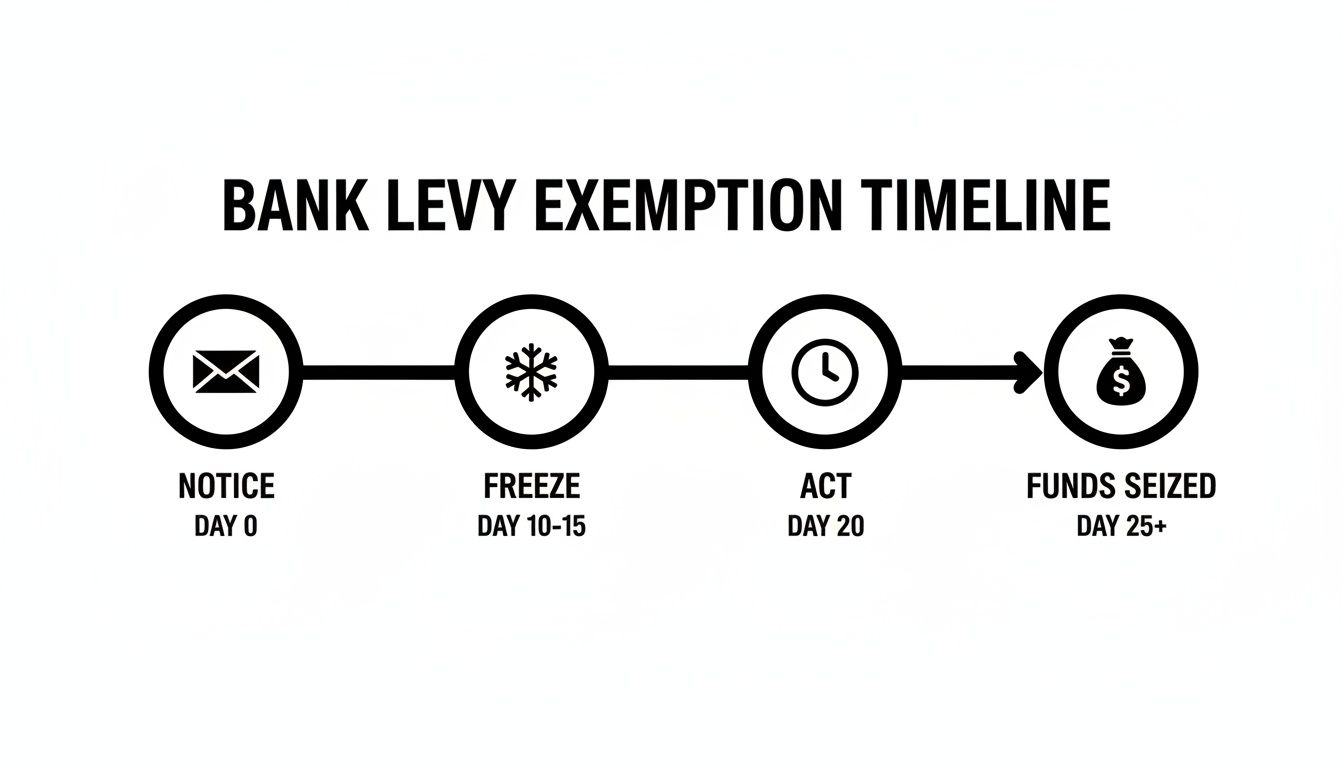
As you can see, all the power is on the front end—before and during the freeze. Once the money is gone, your options shrink dramatically.
The Final Step: Funds Are Sent to the IRS
If that 21-day holding period ends and you haven’t managed to get the levy released, the process hits its final stage. On day 22, your bank has no choice but to send the frozen funds directly to the IRS.
Once that transfer is made, getting your money back is incredibly difficult, if not impossible. Prevention is always the best strategy. By understanding this timeline—from the 30-day notice to the 21-day freeze—you can pinpoint your opportunities to act. Moving quickly and decisively within these windows is the key to keeping your assets safe.
How to Stop a Bank Levy and Get Your Money Back
That moment you realize your bank account is frozen is gut-wrenching. It can feel like you’ve hit a dead end, but a bank levy isn't the final word. While the situation is serious, you have very real, concrete options for fighting back. The most important thing is to act fast, especially during the critical 21-day hold period the IRS gives your bank.
When you get that notice, it's time to shift into high gear. For a business owner, this is about more than just personal finances; getting a levy released quickly can mean the difference between making payroll and closing your doors. Every single day matters, so let's walk through your game plan.
Proving Economic Hardship
One of the most direct ways to get an IRS levy lifted is to show that it’s creating an immediate economic hardship. The IRS isn't out to make you destitute; they just want to collect what's owed. If you can clearly demonstrate that the levy is preventing you from covering basic, necessary living expenses, they will often release it.
Making this case requires proof. You can't just say it's a hardship; you have to show it. This means:
- Filling out an IRS Form 433-A (Collection Information Statement).
- Pulling together documents like recent pay stubs, bank statements, and copies of essential bills—think rent, utilities, and medical expenses.
- Being ready to explain exactly how the levy is stopping you from paying for these necessities.
You'll need to get on the phone with an IRS agent and be prepared to lay out your financial situation. Clearly articulating that the levy is causing severe and immediate harm is your fastest path to getting those funds unfrozen.
Negotiate a Resolution to Stop the Bleeding
Proving hardship might get the current levy released, but it’s a temporary fix. It doesn't make the underlying tax debt disappear. To prevent future levies, you have to get into a formal agreement with the IRS. The good news is that as soon as you do, they generally have to halt all aggressive collection actions.
Think of an IRS resolution as a cease-fire. Once you're officially in a payment plan, the agency backs off on aggressive tactics like bank levies. This gives you the breathing room you need to get your finances in order and pay off the debt over time.
Your main resolution options are:
- Installment Agreement (IA): This is just a formal payment plan. It lets you pay off your tax debt in monthly chunks, often over as long as 72 months. If you owe less than $50,000, setting one up is usually pretty straightforward.
- Offer in Compromise (OIC): An OIC is an agreement to settle your tax debt for less than you actually owe. It’s designed for people in serious financial trouble, and you have to meet very strict criteria to qualify.
- Currently Not Collectible (CNC) Status: If you can prove that you don't even have enough money to cover your basic living expenses, let alone pay taxes, the IRS might place your account in CNC status. This pauses all collection activity until your financial situation improves.
For a deeper dive into these strategies, our guide on how to stop an IRS levy breaks down each of these powerful options.
Filing a Claim of Exemption for State Levies
What if the levy isn't from the IRS? If it’s from a state tax agency or another creditor who won a lawsuit against you, your go-to defense is often filing a Claim of Exemption. This is a legal form you file with the court and send to the creditor, officially declaring that the funds in your account are protected by law.
As we covered earlier, state exemption laws are all over the map, protecting anywhere from a few thousand dollars to over $10,000. But here's the critical part: these protections aren't automatic. You have a very short, strict deadline to file the claim. If you miss that window, you lose your right to protect that money. This piece of paper is your tool for telling the creditor, "You can't touch this." Check your state's specific forms and deadlines right away—acting quickly is everything.
When You Need a Tax Attorney for a Bank Levy
Trying to deal with an IRS bank levy on your own can feel like you're lost in a maze without a flashlight. While some simple cases can be sorted out directly with the IRS, certain situations are giant red flags telling you it's time to bring in a professional. Going it alone is incredibly risky when the stakes are high, and one wrong move could have devastating financial results.
Knowing when you're in over your head is the single most important part of this process. If your situation feels complicated, getting expert help isn't giving up—it's the smartest move you can make to protect your finances.
The Debt Is Large or You Disagree With It
One of the most obvious signs you need a lawyer is the size of the tax bill itself. When you owe a lot of money, the IRS tends to be much more aggressive and a lot less willing to bend. Negotiations get more intense, and the paperwork needed for a resolution like an Offer in Compromise becomes incredibly complicated.
Likewise, if you don't agree with the amount the IRS says you owe—or you believe you don't owe anything at all—you need professional backup. Disputing a tax debt means building a legal argument, gathering evidence, and navigating the formal appeals system. That's not a path you want to walk alone.
Your Financial Situation Is Complicated
Some scenarios have extra layers of legal complexity that are nearly impossible for a layperson to sort through. These are immediate signs that you should find a good tax attorney.
- Commingled Funds: Is the frozen account a mix of protected money (like Social Security) and regular income? Proving which funds are exempt can be a bureaucratic nightmare. An attorney understands how to trace the money and make a clear argument to the IRS for its release.
- Payroll Tax Issues: This is a big one for business owners. A levy for unpaid payroll taxes can lead to the Trust Fund Recovery Penalty (TFRP), which means the IRS can come after you personally for the business's debt. An attorney is absolutely essential in this high-stakes scenario.
- Joint Accounts: When a levy hits a joint account but the tax debt belongs to only one owner, untangling who owns what requires a specific legal approach.
An experienced tax attorney does a lot more than just call the IRS for you. They act as your advocate, build your case, protect your rights, and negotiate a resolution you likely couldn't get on your own. Their expertise can be the difference between a manageable problem and a complete financial disaster.
An attorney can also help with critical legal documents, like a Power of Attorney, which might be necessary to let someone else manage your financial affairs or act on your behalf. At the end of the day, if your situation is anything more than a simple, undisputed tax bill, investing in professional help is the safest and most effective way forward.
Common Questions About Bank Levies
When your bank account is suddenly frozen, you're bound to have a lot of urgent questions. Let's tackle some of the most common ones to give you a clearer picture of what's happening and what you can do.
Can the IRS Seize a Joint Account if Only One of Us Owes?
Yes, they absolutely can. The IRS operates under the assumption that if your name is on a joint account, you have full access to 100% of the funds inside it, even if the tax debt belongs solely to you and not the other account holder.
This can feel incredibly unfair to the innocent co-owner. Their only recourse is to file a wrongful levy claim with the IRS. To get their money back, they’ll have to provide rock-solid proof—like bank statements and pay stubs—showing exactly which funds in the account were theirs.
Will a Bank Levy Tank My Credit Score?
Not directly, but it's a bit of a trick question. The bank levy itself isn't reported to Experian, Equifax, or TransUnion. You won't see a line item that says "bank levy."
The real damage comes from the events that led to the levy. The public record of a tax lien or a court judgment against you can seriously hurt your credit. A frozen account can also cause a cascade of bounced checks or missed payments, which will definitely show up on your report.
What’s the Difference Between a Levy and a Garnishment?
The key difference is timing. Think of a bank levy as a one-time snapshot. The IRS or a creditor seizes whatever is in your account at that exact moment, and that's it. If more money comes in the next day, it's safe (for now).
A wage garnishment, on the other hand, is a continuous, ongoing seizure. It's an order sent to your employer telling them to take a piece of your paycheck every single pay period and send it to your creditor. A levy is a single grab; a garnishment keeps grabbing until the debt is paid off.
If you're facing a bank levy and need expert guidance, Attorney Stephen A Weisberg can help. Start with a FREE Tax Debt Analysis to understand your options before you pay anything. Learn how to protect your assets and resolve your tax issues by visiting weisberg.tax.


