How Long to Pay Off Tax Debt: Real Timelines Explained
Learn how long to pay off tax debt with realistic timelines, IRS payment options, and sample calculations. Cut years and thousands off your payoff.
In this article
- How Long You Actually Have to Pay Off Tax Debt: The 72-Month Standard vs. the 10-Year CSED Ceiling
- Start with the assessment date
- Different Kinds of Tax Debt Have Different Timelines
- Use the account, not the sales pitch
- How Interest and Penalties Stretch the Payoff Window
- What the math must include
- Ask for an account-specific schedule
- IRS Payment Options and Their Real Payoff Horizons
- Match the option to your cash flow
- Sample Payoff Calculations for Common Situations
- Example one, an individual balance
- Example two, a business owner with mixed exposure
- Example three, a trust fund assessment
- Strategies to Shorten Your Payoff Timeline
- Rank the decisions
- Red Flags That Put Your Payoff Plan at Risk
- Watch the account before the IRS reacts
- When to Get Professional Help Paying Off Tax Debt
- Pay for analysis when the analysis can change the result
Most IRS payment plans run up to 6 years, or 72 months, on a standard installment agreement, but the actual ceiling is the 10-year Collection Statute Expiration Date from the date of assessment, and interest plus penalties keep accruing the entire time you owe. The question isn't only how long the IRS will let you pay. It's how long your specific balance can survive before the statute, ongoing accruals, compliance failures, or a default changes the outcome.
You may be looking at an IRS notice on the kitchen table, a business account that never recovered after a slow year, or several tax years that seem to have merged into one impossible balance. The common advice is to accept the smallest payment the IRS offers and move on. That advice can be expensive. A low payment may preserve cash today while leaving you with a repayment schedule that doesn't fit the remaining collection period.
How Long You Actually Have to Pay Off Tax Debt: The 72-Month Standard vs. the 10-Year CSED Ceiling
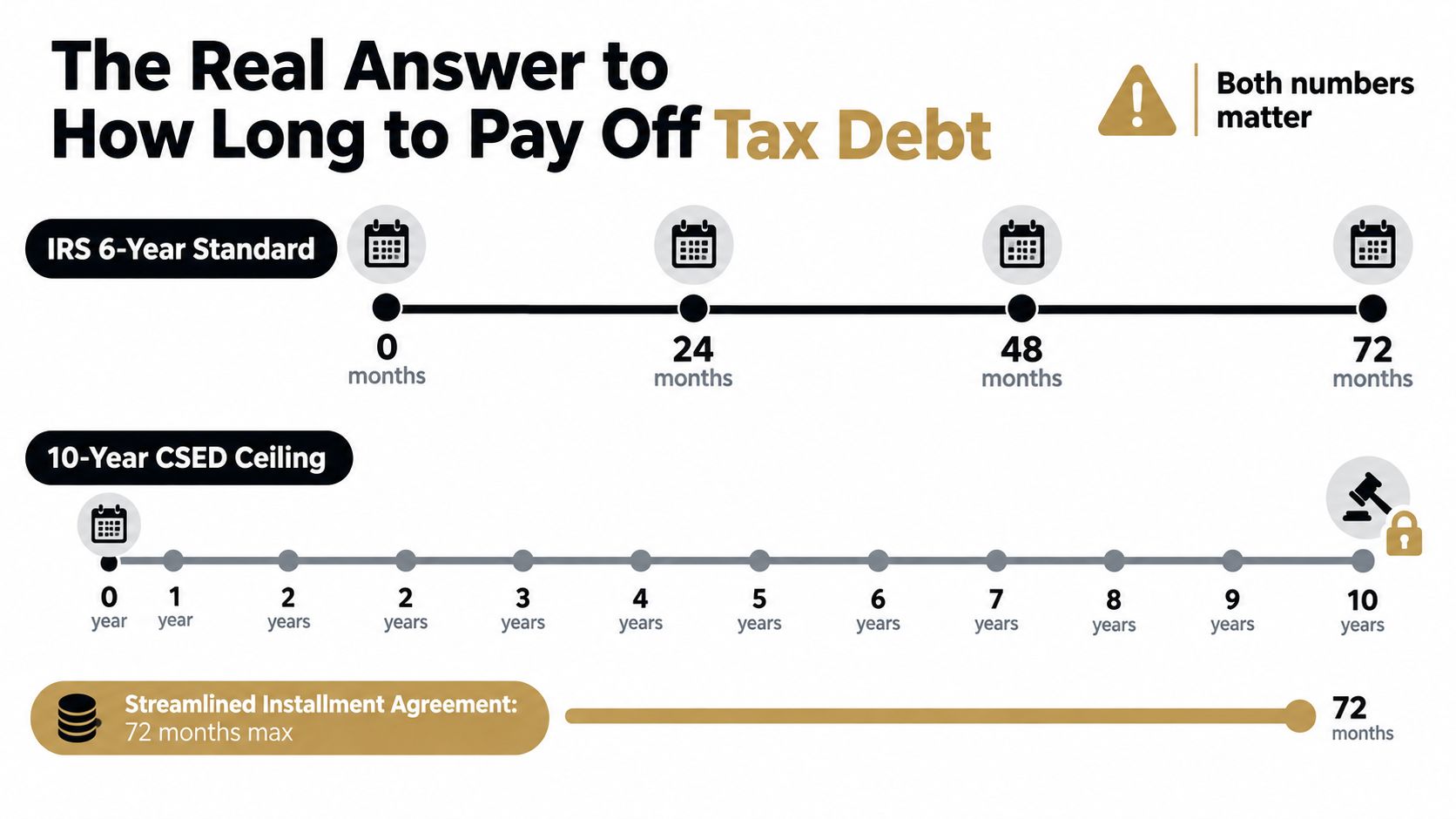
Your payoff window is controlled by the earlier of the IRS's 72-month payment benchmark and your Collection Statute Expiration Date, or CSED. The IRS generally treats a long-term installment agreement as a monthly payment plan for taxpayers who owe $50,000 or less in combined tax, penalties, and interest. These arrangements can run for up to 72 months, as explained in the IRS guidance on payment plans and installment agreements.
The six-year period is a practical standard, not a guaranteed term. The IRS must structure the agreement so the liability is paid before the CSED. That deadline is generally 10 years from assessment, although the account history and legally recognized suspension periods can change the precise date. Tax Topic 202 explains how installment agreements interact with the collection period and the CSED.
Start with the assessment date
Find the assessment date for every tax year before accepting a payment schedule. The oldest notice may not identify the oldest enforceable liability, and the date you entered an installment agreement does not start the collection clock. If a CSED is approaching, your available payoff period may be shorter than 72 months.
The monthly payment must amortize the balance before that deadline. If the proposed amount cannot do that, the IRS may reject it, require a different resolution, or determine whether another collection option fits the facts.
Form 9465 reflects the long-standing 72-month benchmark. Its instructions state that, when no monthly amount is proposed, the IRS may calculate a payment by dividing the balance due by 72 months. The Form 9465 instructions clarify the mechanics, but they do not replace a CSED review.
Interest and penalties generally continue while the balance remains unpaid, subject to the rules governing the account. Your actual timeline therefore depends on the assessment date, monthly payment, filing compliance, and type of resolution. Review those facts first. Paying too much out of fear wastes cash, while setting a payment too low can leave the debt unresolved before the collection deadline.
Different Kinds of Tax Debt Have Different Timelines
Before choosing a payment strategy, identify what the IRS says you owe. A balance from an individual income tax return isn't automatically handled the same way as a business liability or an assessment connected to employment taxes. The account transcripts, notices, filed returns, and assessment records matter more than the label a collection salesperson uses.
Use the account, not the sales pitch
Individual income tax debt often gives a taxpayer more room to evaluate payment arrangements, penalty relief, settlement possibilities, and other legal options. Business-related balances can involve multiple taxpayers, multiple filing obligations, and liability that needs to be traced to the correct entity or individual. Employment tax issues require especially careful review because the assessment may involve amounts connected to payroll withholding and responsible persons.
That doesn't mean every individual balance qualifies for settlement or every business balance requires immediate liquidation. It means the legal character of the debt controls the available strategy. A representative who treats every balance as a standard installment agreement may miss an issue that changes the payoff horizon entirely.
| Tax Debt Types and Collection Differences | Form | Collection Priority | Bankruptcy Discharge | OIC Acceptance Rate |
|---|---|---|---|---|
| Individual income tax | Often tied to an individual income tax return | Depends on the account and collection status | Fact-specific legal analysis required | No rate stated in the verified data |
| Business income tax | May arise from a business return or pass-through reporting | Depends on entity, assessment, and responsible-party issues | Fact-specific legal analysis required | No rate stated in the verified data |
| Trust fund or payroll-related debt | May involve employment tax filings and a personal assessment | Requires prompt review of the assessment and collection record | Fact-specific legal analysis required | No rate stated in the verified data |
The OIC Acceptance Rate column cannot be filled with a generic percentage. Acceptance depends on the taxpayer's financial information, equity, future income, compliance, and the IRS's calculation of reasonable collection potential. Anyone promising a settlement before reviewing those records is selling certainty they don't possess.
If your notice references a trust fund recovery penalty, start by understanding the concept through this explanation of the trust fund recovery penalty, then obtain a transcript-based review. Don't fold that assessment into ordinary income-tax advice without checking how it was calculated and against whom it was assessed.
How Interest and Penalties Stretch the Payoff Window
A long payment term costs more because the unpaid balance remains exposed to ongoing accruals. The IRS expressly warns that longer terms produce more interest, penalties, and fees, as described in its online payment agreement guidance.
I won't manufacture a clean payoff illustration using a supposedly current interest rate when the rate can change and the verified information here doesn't establish a rate for a particular period. I also won't promise that a sample $30,000 balance will add a specific number of dollars. The correct calculation depends on the dates, tax type, penalty assessments, payments, and applicable interest rates for the account.
What the math must include
A useful payoff analysis starts with the current balance and then separates:
- Accrued tax: The underlying assessed liability that remains unpaid.
- Penalty amounts: Charges already assessed and any additional amounts permitted under the account's rules.
- Interest accrual: The amount added while the liability remains outstanding.
- Monthly reduction: The portion of each payment that reduces principal and accumulated charges.
- Remaining CSED: The time available before the collection period expires.
A payment that barely exceeds ongoing accruals may leave the balance declining slowly. A payment that materially reduces principal shortens both the payoff period and the time during which new charges can accumulate. That is why comparing only the monthly payment is a mistake.
| Sample Accrual on a $30,000 IRS Balance | Monthly Payment | Payoff Term | Total Interest Paid | Total Amount Paid |
|---|---|---|---|---|
| Illustrative structure | Must be calculated from the account | Depends on the payment and CSED | Must be calculated from applicable rates and dates | Principal plus actual accruals |
Ask for an account-specific schedule
Use the IRS balance, not the original assessment, and request a schedule that shows the projected payoff month. Then run a second schedule using a higher payment. The difference tells you what acceleration may save. If a professional gives you a payoff table without stating the assumptions, ask for the assumptions before relying on it.
Penalty relief can change the starting point, but it doesn't happen merely because a taxpayer asks. Review whether penalty abatement may apply, and distinguish a legal basis for relief from a sales promise that “the penalties can probably be removed.”
IRS Payment Options and Their Real Payoff Horizons
The IRS payment option you choose determines whether the balance disappears quickly, follows you for years, or remains unresolved until collection rights expire. A short-term arrangement handles a temporary cash shortage. A long-term installment agreement spreads payments over time. A partial-pay arrangement reflects an inability to pay the full liability within the available collection period. An offer in compromise seeks an accepted settlement, while currently not collectible status addresses present hardship without erasing the debt.
Match the option to your cash flow
A short-term payment plan can run for 180 days or less. It fits a taxpayer who expects money soon and can clear the balance before years of interest and penalties accumulate. If the cash will not arrive, choosing this option only delays the problem.
A long-term arrangement commonly uses the 72-month benchmark for eligible taxpayers with balances of $50,000 or less. The IRS online application rules determine eligibility and the information required. Do not assume simplified approval means inexpensive. It reduces documentation requirements in defined situations, not the cost of carrying tax debt.
A partial-pay installment agreement works differently. The taxpayer pays what the financial information supports while the IRS reviews the account under its collection rules. The payment is not a magic number, and the IRS may require periodic financial reviews. The practical payoff window depends on the approved payment and the remaining CSED, not on a standard term selected for convenience.
An offer in compromise is not a basic payment plan with a longer term. The IRS must accept the proposed settlement under its rules, and the taxpayer must fund it as agreed. Currently not collectible status can pause active collection while financial hardship continues. Interest and the CSED continue to matter, so a pause is not the same as a payoff.
| IRS Payment Options: Term Limits and Typical Payoff Windows | Max Balance | Max Term | Interest Accrues | Typical Payoff Window |
|---|---|---|---|---|
| Short-term payment plan | Depends on IRS eligibility rules | 180 days or less | Yes | Up to 180 days |
| Standard long-term installment agreement (simplified approval) | $50,000 or less in the general IRS description | Up to 72 months | Yes | Commonly up to 72 months |
| Partial-pay installment agreement | Determined through financial review | Limited by the collection period | Yes | Based on ability to pay and remaining CSED |
| Offer in compromise | Depends on qualification and IRS rules | Funding terms depend on the accepted offer | The liability is resolved under the accepted terms | Depends on the accepted offer |
| Currently not collectible | Based on demonstrated hardship | No fixed payoff term | Yes | Collection may pause while hardship continues |
Use the Fresh Start program information as a starting point, then review the actual account. A payment that looks manageable can still leave you paying until the CSED if it fails to reduce the balance fast enough. Choose the option that fits both current cash flow and the time remaining on the collection period.
Sample Payoff Calculations for Common Situations
A payoff calculation is only as reliable as its inputs. The balance, assessment date, applicable accruals, compliance status, and proposed payment must all be verified. The following examples show how to think about the problem without pretending that unsupported rates or totals apply to every taxpayer.
Example one, an individual balance
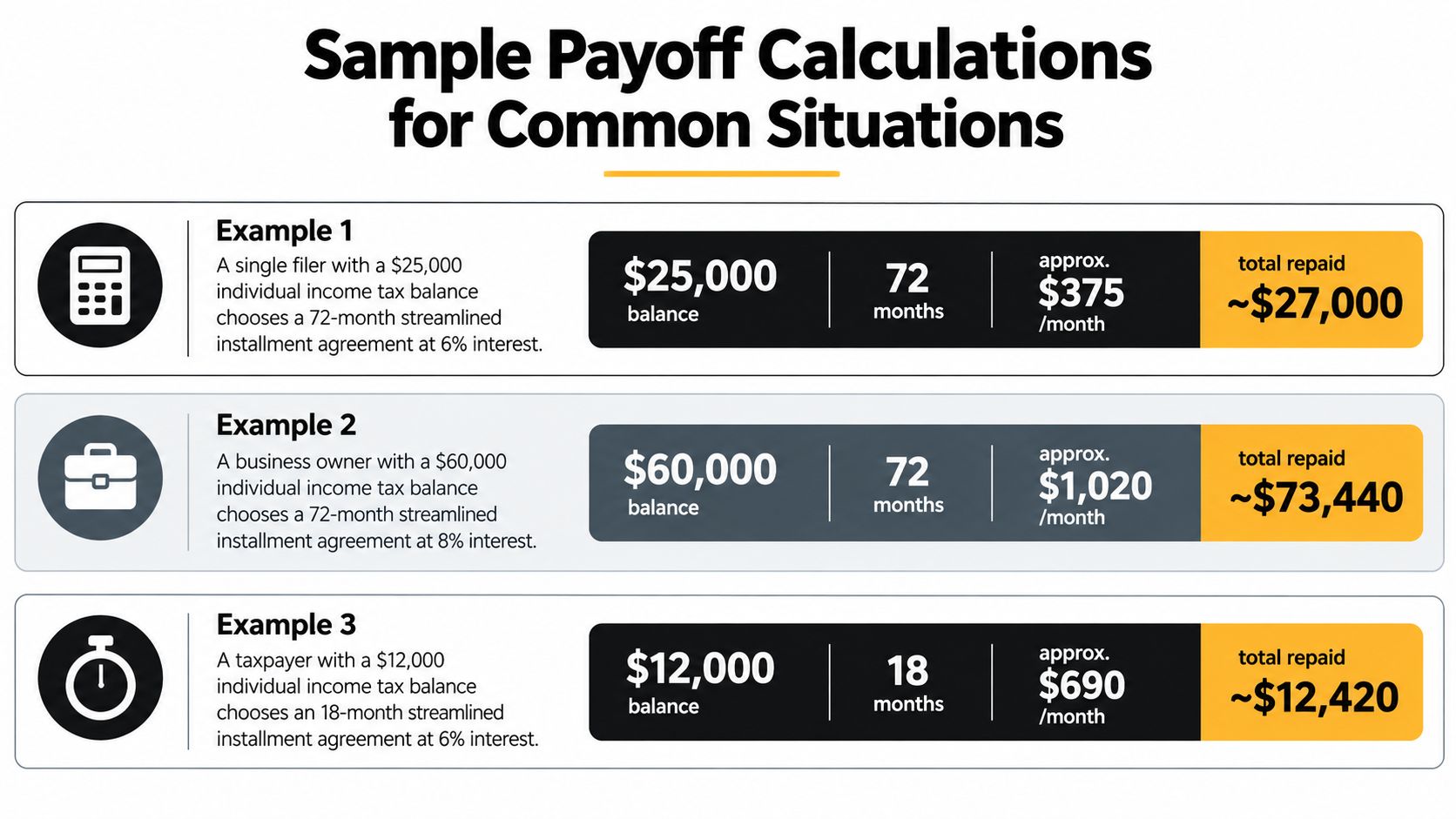
A taxpayer with a $25,000 individual income tax balance may qualify for a standard arrangement if the account meets the IRS requirements. The taxpayer shouldn't stop at the quoted monthly amount. The analysis should show how much of each payment reduces the balance, how much covers accruals, and whether the projected final payment occurs before the CSED.
The monthly payment, total interest, and months to zero must be calculated from the actual IRS account. The taxpayer can then compare the standard proposal with a faster payment and decide whether the additional monthly amount is realistic.
Example two, a business owner with mixed exposure
A sole proprietor with a $90,000 balance may have several filing periods and types of liability mixed together. The correct first step isn't choosing the longest term. It's separating the periods, confirming all returns are filed, identifying the CSED for each assessment, and preparing accurate financial information.
If the financial statement shows the taxpayer cannot fully pay before the collection period ends, a partial-pay analysis may be more appropriate than a payment schedule built on an unrealistic promise. The total amount paid under either path must be calculated from the account and the accepted terms.
Example three, a trust fund assessment
A $15,000 trust fund-related assessment requires immediate classification and review. Don't assume the same compromise or installment logic used for individual income tax automatically applies. Confirm the assessment, the responsible-person determination, the balance, and the available collection runway before setting a payment.
The IRS payment plan calculator guide can help organize the questions, but it can't replace a transcript review. A calculator estimates. The IRS account controls.
Strategies to Shorten Your Payoff Timeline
The fastest way to reduce the payoff window is to stop treating the installment agreement term as the target. The target is a payment schedule that clears the balance before the applicable CSED while limiting the time exposed to accruals.
Rank the decisions
Calculate the CSED first. List each assessed year, its assessment date, and the remaining collection runway. A single blended payment can hide the fact that one year has much less time remaining than another.
Increase the payment when cash flow allows. Direct additional money toward the balance instead of allowing a temporary surplus to disappear into discretionary spending. Even an irregular extra payment can change the amortization schedule, but the projected result must be recalculated.
Use legitimate lump sums carefully. A refinance, family loan, asset sale, or retirement distribution may reduce the balance, but each source carries its own cost and tax consequences. Don't borrow at a higher cost merely to feel that the IRS balance is smaller.
Prevent new assessments. File current returns, make required current payments, and adjust estimated payments when income changes. A new balance can undermine an existing arrangement and destroy the assumptions behind the original payoff plan.
Coordinate federal and state liabilities. State collection periods and procedures don't automatically mirror federal rules. A federal plan may leave a state balance untouched, and paying one government doesn't resolve the other.
Practical rule: Never accept a monthly payment until you know which assessed year it pays down, how the payment is applied, and whether the remaining balance clears before the applicable CSED.
Waiting is not neutral. While you wait, the account may continue accumulating charges, the collection runway may shrink, and your options may become harder to use. Acceleration should be deliberate, not panic-driven, but it should be part of the plan from the start.
Red Flags That Put Your Payoff Plan at Risk
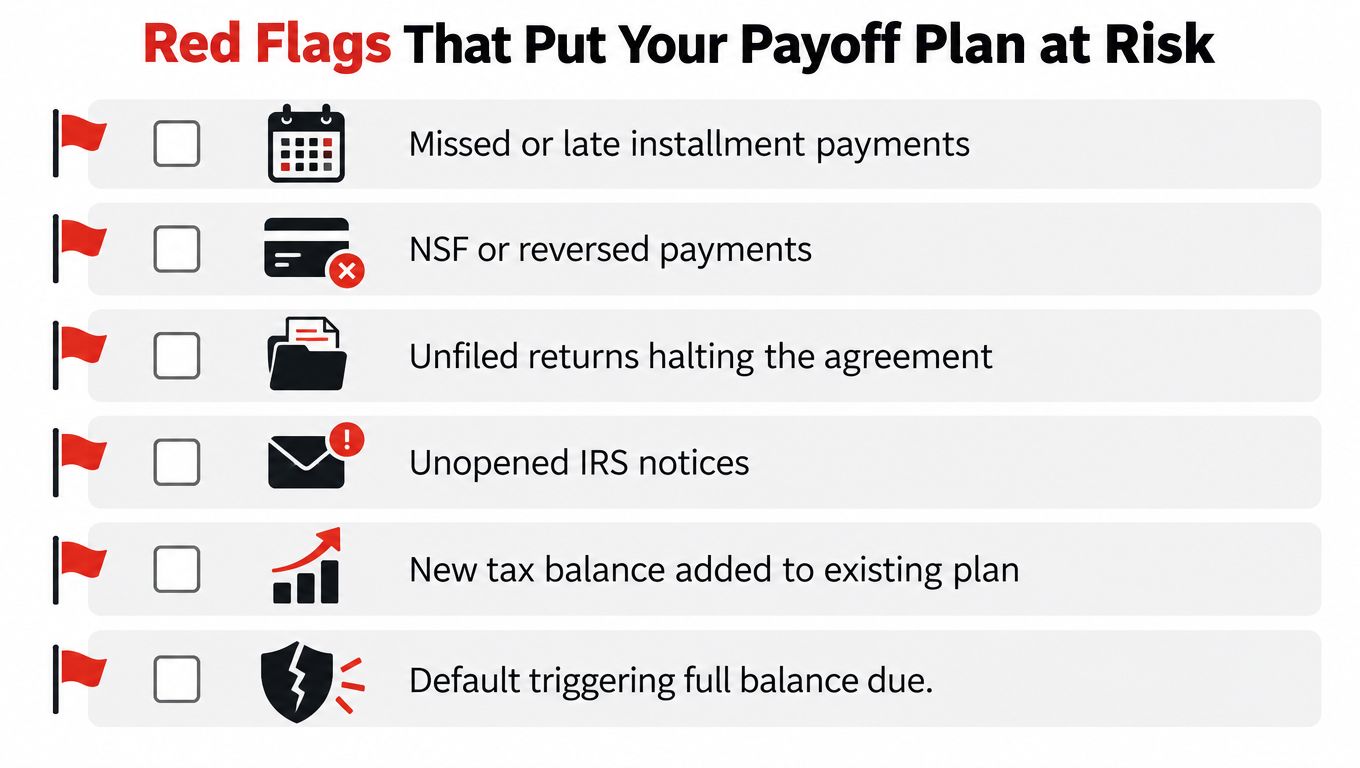
Many installment agreements fail for ordinary reasons, not dramatic ones. A missed payment, an unfiled return, or a new liability can turn a workable arrangement into a default problem.
Watch the account before the IRS reacts
Missed or late payments: A payment that arrives late can place the agreement in default and require corrective action. Don't wait for a termination notice before addressing it.
NSF or reversed payments: A bank rejection tells the IRS that the agreed payment wasn't received. Replace the payment promptly and investigate the cash-flow failure.
Unfiled current returns: The IRS generally expects filing compliance while an arrangement is active. An unfiled return can block approval, trigger default concerns, or create a new balance.
New tax liabilities: A new assessment changes the total exposure and may invalidate the payment assumptions used for the existing plan. Fix the current-year problem before it compounds with the old one.
Ignored notices: IRS notices contain response windows and consequences. Ignoring them doesn't preserve the agreement. It removes your opportunity to respond before the next collection step.
State tax problems: State agencies can pursue their own liabilities even when the federal account is under an arrangement. Include every jurisdiction in the cash-flow plan.
A curable default may be addressed by bringing the account current or modifying the agreement, depending on the circumstances. A terminated agreement can expose the taxpayer to more aggressive collection activity and force a new resolution analysis. The moment a payment bounces or a return goes unfiled, get the account reviewed.
When to Get Professional Help Paying Off Tax Debt
You don't need a tax attorney merely because the IRS balance is unpleasant. You do need experienced help when the account has multiple years, payroll exposure, disputed assessments, missing returns, active levies or liens, or a CSED that may be close. Those facts can change the resolution, not just the paperwork.
A credentialed tax attorney can evaluate audits, appeals, collection procedure, Tax Court issues, penalty relief, installment agreements, and offers in compromise within one legal strategy. A national resolution chain may just place a taxpayer into a payment plan and charge a fee for work the taxpayer could have requested directly. That isn't resolution advice. It's payment processing with a marketing budget.
Pay for analysis when the analysis can change the result
A professional review should answer concrete questions:
- Which tax years are included?
- What are the assessment dates?
- What is the CSED for each liability?
- Are all returns filed?
- Which charges may be challenged or abated?
- Can the proposed payment clear the balance before collection expires?
- Would a partial-pay arrangement or offer be more realistic?
- Are state liabilities creating a separate enforcement risk?
A shorter plan can save substantial accruals, but nobody should promise a particular savings amount before reviewing the account. The fee is justified when the representative identifies a viable option, corrects an assessment, protects rights, or prevents a costly default. It isn't justified by fear, vague promises, or a demand for a large upfront payment before diagnosis.
If you need administrative support with document organization or case preparation, HireParalegals legal assistants may be a useful resource. Legal assistants can help with process and organization, but they aren't a substitute for a licensed tax attorney making the legal and collection strategy decisions.
Tax Attorney Stephen A Weisberg starts with a free tax debt analysis to determine whether he can help and what the account actually requires before charging for resolution work. That approach is sensible when the central question is not merely how to obtain a payment plan, but how to avoid paying longer and more than necessary.
Tax Attorney Stephen A Weisberg reviews IRS and state tax debt, installment agreements, partial-pay options, audits, and collection deadlines through a case-specific analysis rather than a fear-based sales pitch. Visit Tax Attorney Stephen A Weisberg to request a free tax debt analysis and find out whether your proposed payoff timeline is realistic.


