How Long Does Offer in Compromise Take? a Real Timeline
How long does offer in compromise take? Get the real IRS timeline, key stages, what slows cases down, and practical steps to speed up your OIC.
In this article
- The Straight Answer on OIC Timing
- The Four Stages of an IRS Offer in Compromise
- Stage one preparation
- Stage two submission and initial review
- Stage three investigation
- Stage four decision and appeal
- Why Some OIC Cases Move Fast and Others Crawl
- The variables that change elapsed time
- Three Real-World OIC Timelines by Case Type
- Case A, a small restaurant with payroll debt
- Case B, a consultant with changing income
- Case C, a construction business with a trust fund penalty
- What Happens to Collections and Liens While You Wait
- The wait requires active management
- Liens and post-acceptance obligations
- How to Shorten Your Own OIC Timeline
- Start with the file, not the offer amount
- Choose the payment structure deliberately
- Treat IRS letters as deadlines
- Deciding Whether the Wait Is Worth It
An IRS offer in compromise can legally take up to 24 months, although many cases are resolved sooner. Where your case lands depends mainly on four stages, preparation, submission, IRS investigation, and the final decision or appeal.
You may be sitting at a kitchen table with Form 656, a detailed financial statement, bank records, and an IRS notice warning that collection action is approaching. The question, how long does an offer in compromise take, isn't academic. The answer affects whether you can protect cash flow, respond to a levy threat, sell property, or choose a faster resolution.
The IRS's workload changes, and a complete file can still require months of review. The practical mistake is treating the timeline as a simple calendar estimate. You need to understand what starts the clock, what extends it, and what collection consequences continue while the IRS considers your offer.
The Straight Answer on OIC Timing
The controlling benchmark is 24 months. The IRS says a complete OIC investigation can take up to that long, with timing affected by inventory and case complexity, as explained in the IRS Offer in Compromise FAQs. Separately, the statute provides that an offer is deemed accepted if the IRS doesn't reject it within 24 months of receipt, excluding an appeal period. Many cases finish earlier, but no responsible practitioner should promise a short approval timeline before reviewing the facts.
That outer limit doesn't mean every taxpayer waits two years. Routine cases generally move more efficiently when the application is processable, the financial disclosures reconcile, and the taxpayer answers requests promptly. More complicated files can remain open while the IRS validates assets, fluctuating income, business records, or disputed liabilities.
The four stages determine the elapsed time:
- Preparation, which occurs before the IRS review clock meaningfully begins.
- Submission and initial review, when the IRS determines whether the offer can be processed.
- Investigation, where an Offer Specialist tests the financial information.
- Resolution, through acceptance, rejection, withdrawal, or appeal.
The IRS reported 38,797 offers submitted in fiscal year 2025 and 5,464 accepted, totaling $98.1 million. Those figures appear in the IRS's collections activities and appeals data. Reporting based on earlier IRS-published figures also described about 5,500 fiscal-year 2025 acceptances, compared with about 12,700 in fiscal year 2023, while the acceptance rate for cases reaching an acceptance-or-rejection determination was about 53% in fiscal year 2026 versus about 51% in fiscal year 2025. That workload helps explain why an apparently complete submission may still wait in an inventory queue.
Before filing, treat timing as a strategic input. A pending offer may reduce immediate collection pressure, but it can also tie up funds, suspend aspects of the collection period, and leave a business exposed to unresolved payroll obligations. The practical rules and filing mechanics discussed in IRS offer in compromise rules explained should be part of the decision, not an afterthought.
The Four Stages of an IRS Offer in Compromise
An OIC doesn't begin with the IRS deciding whether your settlement is reasonable. It begins with a processability review. That distinction matters because a rejected or returned packet may never reach an Offer Specialist's substantive financial analysis.
Stage one preparation
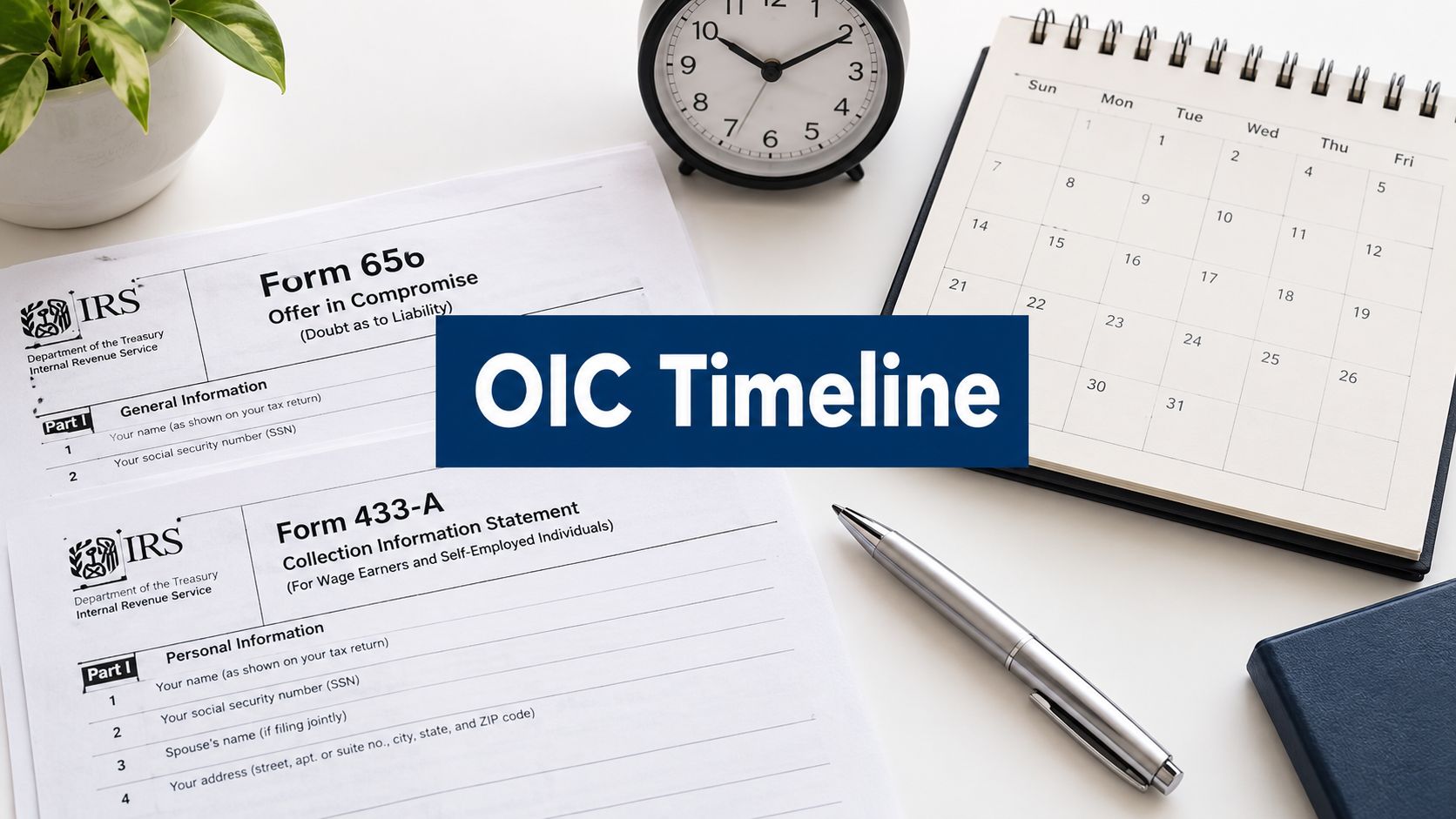
Preparation is the part taxpayers control most directly. An individual generally needs Form 656, the offer document, and Form 433-A(OIC), while a business typically uses Form 433-B(OIC). The submission must also address required returns, current compliance, supporting financial records, the application fee, and any required initial payment.
A missing signature, inconsistent bank balance, unexplained asset value, or incomplete income disclosure can send the file back before the IRS investigates the merits. The Taxpayer Advocate Service has noted that even complete submissions can take several months, and sometimes more than a year, when the IRS must validate financial forms, supporting documents, and payments. A careful review of Form 433-A(OIC) is therefore more valuable than rushing a weak packet into the mail.
Stage two submission and initial review
After receipt, the IRS checks whether the offer is processable. IRS procedures call for a preliminary determination within about 16 days, with taxpayer contact within 120 days, according to the IRS procedures discussed in the Taxpayer Advocate Service report. Those are operational milestones, not guaranteed final-decision dates.
At this stage, the IRS may identify missing information, payment problems, filing noncompliance, or a form issue. A processability problem is different from a substantive rejection. The former says the file can't proceed as submitted. The latter follows financial and legal review.
Stage three investigation
Investigation is usually the largest portion of the timeline. The assigned Offer Specialist reviews the taxpayer's financial statement, compares reported income with IRS records, tests asset equity, and may request updated statements, valuation evidence, or clarification of expenses.
Self-employed taxpayers often face more questions because their income changes, business and personal funds may overlap, and expenses require closer reconciliation. The IRS can also conduct a financial interview or propose a counteroffer when its collection-potential calculation exceeds the amount offered.
Stage four decision and appeal
The IRS may accept, reject, return, or treat the offer as withdrawn. A rejection generally creates a 30-day appeal period, and a timely appeal can extend the overall timeline because the statutory calculation excludes the appeal period.
Practical rule: An IRS deadline is part of the case strategy. Missing a response window can cost more time than the original request would have required.
Why Some OIC Cases Move Fast and Others Crawl
The fastest files are predictable, not lucky. The IRS can work more efficiently when the financial story is complete, internally consistent, and supported by records that answer likely questions before the specialist asks them.
The main operational bottleneck is often the front-end processability review. Larger or more complicated cases can then face additional review requirements. The IRS may require Treasury General Counsel review for accepted offers involving large assessed balances or criminal matters, which adds friction even when the application is complete.
The variables that change elapsed time
Completeness matters first. Include records that support bank balances, income, expenses, vehicle and real estate values, business interests, and liabilities. Don't assume the IRS will infer why two documents differ. Reconciliation is faster than explanation after a discrepancy has already caused a request.
Case type also matters. Doubt as to liability can follow a different path when a specific legal or factual dispute exists. Doubt as to collectibility requires a detailed financial analysis. Effective Tax Administration cases can take longer because the taxpayer must establish hardship or inequity even though the tax is generally collectible.
Payment structure affects risk and administration. A cash offer can be simpler to evaluate than a periodic payment proposal because the IRS isn't assessing the same future-payment risk. That doesn't make a cash offer appropriate if funding it would create hardship.
| Factor | Faster outcome | Slower outcome |
|---|---|---|
| Financial records | Complete statements and reconciled figures | Missing documents or unexplained discrepancies |
| Income pattern | Stable wages or clearly documented revenue | Fluctuating commissions or mixed personal and business funds |
| Asset analysis | Supported valuations and clear equity calculations | Real estate, retirement, or business assets requiring deeper review |
| Offer basis | A focused, well-supported legal or factual issue | Broad collectibility or hardship analysis |
| Taxpayer response | Prompt, complete replies | Missed letters, partial answers, or late records |
| IRS review path | Standard processing | Large balances, criminal matters, or additional counsel review |
The taxpayer usually controls the last category. Respond to every IRS letter fully, not selectively. A counteroffer can also slow the case because both sides must settle on the financial assumptions behind the proposed amount.
Marketing claims about guaranteed speed don't change these mechanics. A polished submission helps, but it doesn't eliminate IRS inventory, specialist assignment, or required review.
Three Real-World OIC Timelines by Case Type
The following examples are anonymized composites, used to show how the same legal framework can produce different results. The debt amounts and outcomes are illustrations, not verified case statistics, so they shouldn't be treated as predictions for a particular taxpayer.
Case A, a small restaurant with payroll debt
A restaurant owner has $42,000 in payroll tax debt, current filings, and a documented offer funded through an upfront payment. The financial statement shows limited realizable equity, and the proposed amount exceeds the IRS's reasonable collection potential.
This file moves cleanly because the business records support the application and the IRS doesn't need to reconstruct missing periods. The practical work happens before submission, confirming payroll filings, separating business assets from personal assets, and documenting the source of the funds. An uncomplicated file of this kind may reach a decision earlier than a case involving fluctuating income or unresolved examinations.
Case B, a consultant with changing income
A self-employed consultant owes $180,000 in individual income tax liabilities. Commission income changes from month to month, and a prior installment agreement has lapsed. The IRS needs current bank statements, a revised Form 433-A(OIC), and an explanation of transfers between business and personal accounts.
The delay isn't caused by the form alone. The specialist has to determine whether the reported monthly income represents a temporary low point or a realistic ongoing figure. The taxpayer's response should include complete statements, contracts or invoices where relevant, and a consistent explanation of ordinary business expenses. Partial submissions create another cycle of questions.
Case C, a construction business with a trust fund penalty
A construction company owner faces a $310,000 trust fund recovery penalty, disputed payroll filings, and an open payroll examination. The OIC can't be evaluated in isolation because the underlying payroll records and responsible-person issues may affect the liabilities under review.
That file can approach the statutory ceiling when the offer remains dependent on another examination. The useful decisions occur before filing, such as determining which assessments are actually disputed, correcting payroll compliance, and deciding whether an offer is premature while the examination remains open.
| Case profile | Debt type and amount | Key complications | Submission to acceptance |
|---|---|---|---|
| Restaurant owner | Payroll tax debt, $42,000 | Limited equity, current filings, funded offer | Earlier resolution is possible when records are complete |
| Self-employed consultant | Individual income tax, $180,000 | Variable commissions, lapsed agreement, revised financial statement | Extended review while income and expenses are reverified |
| Construction owner | Trust fund recovery penalty, $310,000 | Disputed payroll filings and open examination | May move toward the 24-month ceiling |
The lesson is practical. The IRS can't make a clean decision about a file whose liability, income, or asset picture remains unsettled.
What Happens to Collections and Liens While You Wait
A pending OIC generally changes collection activity, but it doesn't create a complete shield. IRS guidance says collection activity is generally suspended while the offer is pending, for 30 days after rejection, and during a timely appeal, as described in IRS Tax Topic 204. The same guidance warns that the IRS may file a federal tax lien while considering an offer or an installment-payment arrangement.
That distinction matters to anyone facing payroll enforcement, a wage levy, a bank levy, or a pending property transaction. A pending offer may buy time, but it doesn't erase the lien record or resolve every practical consequence of the debt. Businesses also need to keep current payroll and income tax obligations separate from the old liabilities under review.
The wait requires active management
Keep proof that the IRS received the submission, confirm that the fee and required payment were processed, and monitor IRS notices. If an existing levy doesn't stop as expected, the taxpayer or representative may need to contact the responsible IRS unit rather than assume the pending offer has automatically resolved the immediate problem.
A concise, well-organized case summary can help the assigned specialist understand the liabilities, financial evidence, and requested treatment. This resource on how a case summary speeds resolution offers useful background on presenting that information clearly.
Liens and post-acceptance obligations
An accepted offer doesn't end the relationship immediately. The IRS says lien release after acceptance generally occurs within 45 days after final payment and verification, so taxpayers planning a refinance or sale need to account for that administrative period.
The taxpayer must also remain compliant after acceptance. Timely filing and payment obligations continue during the required monitoring period, and default can put the settlement at risk. Don't spend the waiting period assuming approval is the finish line. Preserve cash for required payments, keep current tax obligations funded, and address new IRS correspondence quickly.
How to Shorten Your Own OIC Timeline
You can't control the IRS inventory, but you can prevent avoidable rework. The most effective preparation is boring, document-heavy, and far more useful than a promise that a representative has a special shortcut.
Start with the file, not the offer amount
Confirm filing compliance. File every required return and verify that current withholding or estimated payments are adequate. The IRS won't make a meaningful compromise decision while basic compliance remains unresolved.
Build Form 433 carefully. Use the correct individual or business form, report every account and asset, and make the figures match the supporting records. Review how to qualify for an offer in compromise before assuming eligibility.
Value assets defensibly. Gather real estate information, vehicle records, investment statements, loan balances, and business-asset support. An unsupported value invites a request and may change the reasonable collection potential calculation.
Reconcile the math. The offer amount must make sense against the financial disclosure. If the proposed settlement doesn't track the assets, income, allowable expenses, and payment structure, the specialist has a reason to reopen the analysis.
Choose the payment structure deliberately
A lump-sum proposal and a periodic-payment proposal don't carry the same funding requirements or practical risk. A taxpayer who can fund a cash offer without sacrificing essential living expenses may avoid future-payment uncertainty. Someone who needs time to fund the offer should model whether the proposed installments remain affordable if income changes.
Don't choose a payment structure merely because it produces a lower initial payment. The wrong structure can create a default or leave nonrefundable payments at risk if the offer fails.
Treat IRS letters as deadlines
Answer every request with a complete package within the stated period. If a document isn't available, explain why and provide a credible substitute or expected delivery date. A practitioner who has authority to communicate with the IRS can also seek direct contact with the assigned Offer Specialist, clarify what remains outstanding, and prevent an avoidable misunderstanding from sitting in the file.
Deciding Whether the Wait Is Worth It
An OIC is worth considering when the taxpayer's reasonable collection potential is below the liability, an installment arrangement can't realistically resolve the debt, and the taxpayer can fund the offer without creating a new hardship. The acceptance question comes before the timing question. Waiting two years for an offer that the financial evidence doesn't support is not a strategy.
A pending OIC may be tolerable when collection activity is otherwise manageable and the taxpayer has a credible path to acceptance. It may be the wrong tool when a wage levy, foreclosure, asset sale, or operating payroll problem demands a faster intervention. An installment agreement or currently-not-collectible status can address immediate exposure with less extensive compromise analysis, depending on the facts.
Trust fund recovery penalty cases require particular caution because the IRS can pursue responsible individuals personally. Waiting while payroll liabilities, filing disputes, or business compliance problems remain unresolved can increase the practical stakes.
Before filing, compare three items: the probability that the IRS will accept the proposed amount, the cost of tying up the required funds, and the consequences of the alternatives. The 24-month ceiling is the governing reality, but it isn't automatically the right clock for every taxpayer.
Tax Attorney Stephen A Weisberg reviews IRS tax debt, OIC eligibility, financial disclosures, and collection alternatives before recommending a path. Visit Tax Attorney Stephen A Weisberg to request a free Tax Debt Analysis and determine whether an offer, payment arrangement, or hardship status fits your situation.


