How long does a irs audit take: Your Definitive Timeline
Discover how long does a irs audit take, and what to expect at each stage: correspondence, office, and field, plus key duration factors.

In this article
- Your IRS Audit Timeline Explained
- The Three Main Audit Categories
- IRS Audit Timelines at a Glance
- The Three Types of IRS Audits and Their Timelines
- Correspondence Audits: The Quickest Resolution
- Office Audits: A More Detailed Review
- Field Audits: The Most Comprehensive Examination
- What Makes an IRS Audit Take So Long?
- The Complexity of Your Tax Return
- Your Level of Organization and Preparedness
- Responsiveness and Communication
- The Role of Professional Representation
- Factors Impacting Your IRS Audit Timeline
- Navigating the Audit Process Step by Step
- Stage 1: The Initial Audit Notice
- Stage 2: Gathering Your Documentation
- Stage 3: The Examination
- Stage 4: Reviewing the Findings
- Stage 5: Closing the Audit and Responding
- How Far Back Can the IRS Really Go?
- The Standard Three-Year Window
- When Three Years Becomes Six
- When the Clock Never Stops Ticking
- When Should You Hire a Tax Attorney for an IRS Audit?
- Warning Signs: When to Call an Attorney Immediately
- The Strategic Edge of Having a Lawyer on Your Side
- Common Questions About IRS Audit Timelines
- What Happens After the IRS Audit Is Finished?
- Can I Get an Extension for Providing Documents?
That sinking feeling you get when an IRS notice arrives in the mail is universal. The first question that pops into your head is almost always, "how long does a IRS audit take?"
There’s no one-size-fits-all answer, but you can generally expect the process to last anywhere from a few months to well over a year. The timeline really hinges on two things: the type of audit you’re facing and how complex your tax situation is.
Your IRS Audit Timeline Explained

Much of the stress from an IRS audit comes from the fear of the unknown. When you don't have a clear road map, it's easy to let your mind race. But once you understand how the IRS structures these examinations, the whole process becomes a lot less intimidating.
Think of it like a car inspection. Sometimes, the mechanic just needs to check your tire pressure and send you on your way—that’s like a simple audit. Other times, they might hear a strange noise and need to take a deeper look under the hood, which is more like a comprehensive audit. The IRS does the same, tailoring its approach based on what flagged your return for review.
The Three Main Audit Categories
Your audit timeline is almost entirely dictated by which of the three main audit types you've been selected for. Each comes with a different level of scrutiny and, naturally, a different average duration.
- Correspondence Audit: The most common and least intrusive. It's handled entirely through the mail.
- Office Audit: A step up in intensity. This one requires you to visit an IRS office in person.
- Field Audit: The most thorough examination. An IRS agent comes to your home or business to review your records on-site.
Knowing which type of notice you received is the first step in figuring out your timeline. A simple request for a missing W-2 will wrap up far more quickly than a full-scale review of your company's books.
IRS Audit Timelines at a Glance
To give you a clearer picture, this table breaks down what you can generally expect from each type of audit.
| Audit Type | Typical Duration | What It Involves |
|---|---|---|
| Correspondence Audit | 3-6 Months | Responding to IRS letters and mailing in specific documents to clear up minor questions on your return. |
| Office Audit | 6-9 Months | Meeting with an IRS agent at their office to go over specific line items and provide documentation for your income or deductions. |
| Field Audit | 12+ Months | An in-depth, on-site examination of your financial records by an IRS agent, often covering your entire tax return. |
This table helps set a baseline, but remember these are just averages. The actual time can vary based on your specific circumstances.
At its core, an IRS audit is simply a request for proof. The more organized you are and the faster you can provide clear, complete documentation, the smoother and quicker the entire process will be.
Once you identify your audit type, you can start preparing for what's ahead. If you find yourself in a more complicated situation, it might be worth exploring professional tax audit representation to help you navigate the process.
The Three Types of IRS Audits and Their Timelines

If you're wondering how long an IRS audit will take, the first thing to figure out is what kind of audit you're facing. The IRS doesn't have a one-size-fits-all process. Instead, they use three different approaches, and each has its own scope, intensity, and typical timeline.
Think of it like a car repair. A simple oil change is quick and routine. A brake job takes a bit more time in the shop. But a full engine rebuild? That's a major project. Knowing which one you're in for is the key to setting expectations and preparing for what's next.
Correspondence Audits: The Quickest Resolution
The most common and least painful audit is the Correspondence Audit. As the name implies, it’s handled entirely through the mail. You’ll never have to sit down face-to-face with an agent. It's really just the IRS's way of asking a quick follow-up question about your return.
Usually, these are triggered by a simple, straightforward issue. The most common culprits include:
- A basic math error on your return.
- Missing paperwork, like a W-2 or 1099 that an employer or client reported but you didn't include.
- A question about a specific deduction or credit that looks a little off.
Because these audits are so narrowly focused, they’re almost always the fastest to get through. You’ll receive a letter (often a CP2000 notice) explaining the problem and asking for documents or a clarification. A prompt, complete response is the secret to a speedy resolution.
A correspondence audit isn't a deep dive into your finances; it's a spot-check. The agent is just looking to verify one or two items. The best way to close the case quickly is to give them exactly what they asked for—clear, organized, and directly to the point.
Resist the urge to over-explain or send a mountain of unrelated paperwork. That only confuses the issue and drags things out. A clean, targeted response can often wrap the whole thing up in just a few letters.
Office Audits: A More Detailed Review
Moving up the ladder in intensity, we have the Office Audit. This one requires you to visit a local IRS office and meet with an auditor in person. It’s a step up from a correspondence audit because the issues at hand are usually more complex and require a real conversation.
An office audit zeroes in on specific parts of your return that need more than just a document to explain. For instance, a self-employed consultant with a lot of business meal and travel deductions might get called in for an office audit. The auditor will want to see your receipts, mileage logs, and bank statements to back up your claims.
While these audits are more involved, they are still limited to the items flagged in your initial audit letter. You aren't there to defend your entire financial life, just the specific areas the IRS is questioning. Coming to that meeting prepared is everything. Get all your documents together, organize them logically, and be ready to walk the auditor through them. Understanding what commonly triggers a tax audit can give you a good idea of what they'll be looking for.
Field Audits: The Most Comprehensive Examination
The most serious and involved audit is the Field Audit. This is when an IRS revenue agent comes to you—at your business, your home, or your accountant's office—to conduct a full-scale review of your books and records.
Field audits are generally reserved for the most complex tax situations. Think large businesses, corporations, or individuals with complicated investments and multiple streams of income. Unlike the other two types, a field audit can be a sprawling investigation. It might start with a few specific questions, but if the agent finds anything concerning, they have the power to expand the audit to other parts of your return, and even to prior or future tax years.
This is the deepest the IRS can dig. The agent might spend days or even weeks on-site, poring over your records, interviewing you and your staff, and getting a firsthand look at your operations. Because they are so incredibly thorough, field audits take the longest to complete by a wide margin.
The type of audit directly dictates the timeline. Recent IRS Performance Assessment data shows just how stark the difference is. A correspondence audit takes an examiner about 1.4 to 1.5 hours of work. In contrast, a business field audit requires an average of 37.1 hours of an agent's time. That massive gap in hands-on effort is why one can be over in a few months, while the other can easily stretch past a year.
What Makes an IRS Audit Take So Long?
The difference between an audit that's over in a few months versus one that drags on for more than a year isn't random. It almost always boils down to a handful of key factors. Think of it this way: an audit is a conversation with the IRS, and how you prepare for and manage that conversation directly controls how long the IRS audit will take.
Some things, like the complexity of your tax return, are out of your hands. But you absolutely have control over your responsiveness and the quality of your documentation. Let’s look at what really moves the needle, for better or for worse.
The Complexity of Your Tax Return
This is the big one. A simple audit questioning a single charitable donation is just going to be faster than a field audit digging into a business with international transactions. It's just a matter of scale.
Certain tax situations are like waving a flag that tells an agent to slow down and take a closer look. These often include:
- Multiple Business Entities: If you own several businesses, the agent has to trace money moving between all of them. It's a lot of work.
- Complex Investments: Things like day trading, crypto, or complicated partnership K-1s require a deep dive into every single transaction record.
- Substantial Business Expenses: If you're deducting huge amounts for travel, meals, or entertainment, you can bet the IRS will want to see thorough proof for every dollar.
- Foreign Bank Accounts: The IRS is hyper-focused on international assets and income. This adds a whole other layer of scrutiny and time to the process.
If your return has any of these elements, the agent simply needs more time to connect the dots, which naturally extends the timeline.
Your Level of Organization and Preparedness
Picture this: someone asks you for a specific receipt from two years ago. If your records are neatly filed, you can pull it up in minutes. If they’re all crammed in a shoebox under your bed, you’ll be digging for days. That's a perfect analogy for an audit.
The quality of your record-keeping is the most powerful tool you have to shorten an audit. When you can hand over clear, complete documents right away, you make the agent's job easier and build credibility. That alone can speed things up immensely.
Disorganized, incomplete, or missing records are the number one reason audits get stuck in limbo. Using tools for efficient digital receipt management can make a world of difference by keeping your financial documents organized and ready to go.
Responsiveness and Communication
An audit isn't a one-sided interrogation; it's a back-and-forth process. How quickly and professionally you respond to the agent's requests sets the pace for the entire examination.
Ignoring letters, blowing past deadlines, or giving vague answers will only raise red flags and cause major delays. Prompt and professional communication is key. If an agent asks for documents by a certain date, hit that deadline. If you need more time, don't ghost them—call, explain why, and ask for a reasonable extension. It’s a simple courtesy that shows you’re cooperating and keeps the audit from stalling out.
The Role of Professional Representation
Trying to handle an audit alone can feel like you're in over your head, and a simple misstep can cost you serious time and money. This is where bringing in a qualified tax attorney or CPA can be a game-changer for the timeline.
An experienced pro knows the audit playbook inside and out. They speak the IRS's language and understand exactly what agents need to see. They act as a critical buffer between you and the IRS, managing all communication and making sure you only provide the specific information requested—nothing more. This focused approach prevents the audit from spiraling into other areas and keeps the process moving forward, often toward a much faster and better resolution.
The table below breaks down how these common factors can either work for you or against you during an audit.
Factors Impacting Your IRS Audit Timeline
This table outlines common factors that can either extend or shorten the duration of an IRS audit.
| Factor | Impact on Timeline (Slows Down) | Impact on Timeline (Speeds Up) |
|---|---|---|
| Record-Keeping | Messy, incomplete, or missing documents require time-consuming searches and follow-ups. | Well-organized digital or physical records provide quick, clear answers to the agent's questions. |
| Return Complexity | Multiple businesses, international accounts, or complex investments require in-depth investigation. | Simple returns with straightforward income and deductions are verified quickly. |
| Responsiveness | Ignoring deadlines or providing slow, evasive answers creates delays and raises suspicion. | Prompt, professional, and complete responses to information requests keep the process moving. |
| Professional Help | Going it alone can lead to mistakes, unnecessary information sharing, and scope creep. | An experienced representative focuses the audit, handles communication, and prevents delays. |
Ultimately, being prepared and responsive are your best strategies for navigating the process as efficiently as possible.
Navigating the Audit Process Step by Step
Understanding the lifecycle of an IRS audit can turn a nerve-wracking experience into a manageable process. It’s not some mysterious, endless ordeal; it follows a predictable path. Once you know the stages, you can anticipate what's coming, prepare the right way, and have more say in how long it all takes.
Think of it as a journey with a clear roadmap. Each stop—from that first letter in the mail to the final resolution—is an opportunity to move things forward. Let's walk through the five key stages you can expect.
Stage 1: The Initial Audit Notice
It always starts with a formal letter from the IRS, usually a Form 4564 or a CP notice. This letter is your starting gun. It will clearly state which tax year(s) are under review, what kind of audit you’re facing (correspondence, office, or field), and what initial information the IRS needs from you.
Whatever you do, don't ignore this letter. The very first thing to do is read it carefully and circle the response deadline. That isn't a suggestion—it's a hard date that dictates the pace of the entire audit. Missing it creates instant complications and starts the clock on unnecessary delays.
Stage 2: Gathering Your Documentation
This is where you have the most direct control over how long the IRS audit will take. The IRS is asking you to prove the figures you put on your tax return. It's your job to pull together every relevant document that backs up your income, deductions, credits, and expenses for that year.
The auditor's request list, often called an Information Document Request (IDR), is your guide. They'll typically ask for things like:
- Proof of Income: W-2s, 1099s, bank deposit records, or sales invoices.
- Expense Records: Receipts, canceled checks, and bank or credit card statements.
- Deduction Substantiation: Mileage logs for your business vehicle, receipts from charitable giving, or records for medical expenses.
- Asset Information: Documents showing the purchase and sale of stocks or property.
The goal here is simple: be thorough and organized. Dumping a shoebox full of crumpled receipts on an agent's desk will only frustrate them and easily add weeks, if not months, to the process. Clean, complete, and well-organized records signal cooperation and make their job much easier.
Stage 3: The Examination
Now we get to the main event. For a correspondence audit, this just means mailing your documents to the IRS for their review. For an office or field audit, this is the actual meeting where you (or your representative) will sit down with the agent.
During the exam, the agent will go through your documents and ask questions to clarify things. Your job is to answer honestly and directly, but—and this is important—don't volunteer extra information. Stick to the specific items under review. Bringing up unrelated topics can accidentally broaden the audit's scope, which is the fastest way to drag out the timeline.
This is where your prep work really pays off.
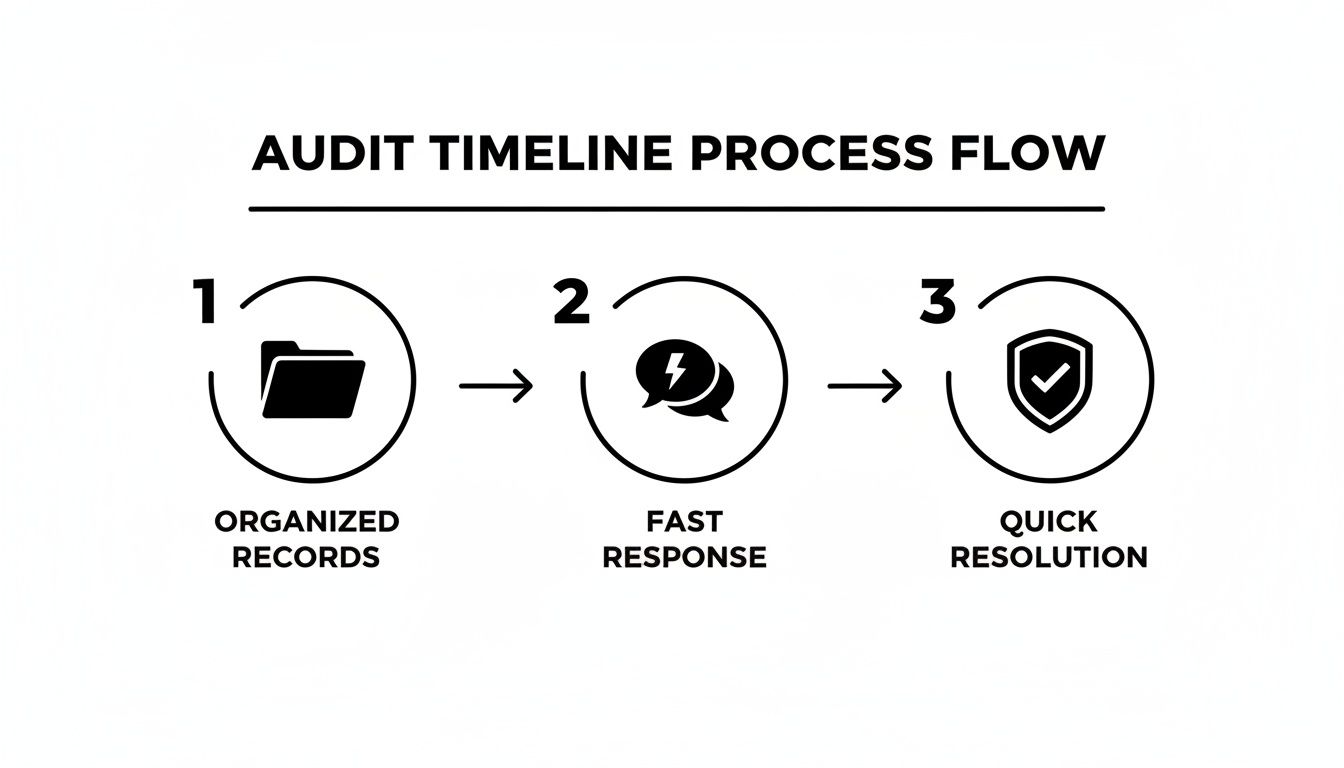
As you can see, there’s a direct line between being organized and responsive and getting to a quick resolution.
Stage 4: Reviewing the Findings
Once the agent has finished their review, they’ll explain their proposed changes. They will present a report, often a Form 4549, Income Tax Examination Changes, that details any adjustments they feel are needed.
This is a critical moment. You have every right to go over these findings with a fine-toothed comb. Make sure you understand exactly why each change is being proposed. If you disagree, this is your chance to provide any extra documents or arguments that support your position.
An agent's initial findings are not the final word—they are a proposal. This stage is your opportunity to correct misunderstandings or provide overlooked evidence before the case is formally closed.
Sometimes, all it takes is one more receipt or a simple explanation to resolve a major point of contention.
Stage 5: Closing the Audit and Responding
The final step is to officially respond to the audit report. You have three main paths, and each one takes you to a different outcome and timeline:
- Agree: If you accept the findings, you'll sign the report. The IRS will then mail you a bill for any extra tax, penalties, and interest you owe. Paying it promptly officially closes the books on the audit.
- Disagree: If you don't accept the findings, you can ask for a meeting with the agent's manager. If that doesn't work, you can formally appeal the decision with the IRS Independent Office of Appeals.
- No Response: Simply not responding is treated the same as disagreeing. The IRS will issue a formal Notice of Deficiency, which gives you 90 days to either pay up or file a petition with the U.S. Tax Court.
Your choice here has a huge impact on the final timeline. Agreeing is the fastest way to the finish line. Disagreeing and entering the appeals process can tack on several more months, or even years, to the audit. For anything more than a simple disagreement, getting a professional IRS audit representative is almost always the smartest move.
How Far Back Can the IRS Really Go?
One of the biggest fears surrounding an IRS audit is just how far back they can dig into your financial life. Is everything you've ever done suddenly fair game? Thankfully, it's not an infinite black hole. The IRS is bound by rules called the statute of limitations, which sets a specific time limit on how long they have to audit your returns.
Knowing these timelines is key. An audit that looks at one or two years is one thing, but an audit covering half a decade is an entirely different beast and will obviously take much longer to resolve.
The Standard Three-Year Window
For most people, the IRS has a three-year window to start an audit. That clock starts ticking from the date you filed your tax return or the due date of the return, whichever is later.
So, if you filed your 2023 tax return on the April 15, 2024, deadline, the IRS generally has until April 15, 2027, to come knocking. This is the rule of thumb that applies to the vast majority of taxpayers and provides a welcome sense of certainty. But, as with many things involving the IRS, there are a few major exceptions that can throw that timeline right out the window.
When Three Years Becomes Six
The most common reason for an extended look-back period is what's known as the six-year rule. This gets triggered if you've substantially understated your income. What does that mean in plain English? The IRS can look back a full six years if you left off more than 25% of your gross income on your return.
This is a real pitfall for small business owners, freelancers, and anyone with a side hustle. It’s surprisingly easy to do by accident with complex transactions or just sloppy bookkeeping. For instance, if your actual gross income was $100,000 but you only reported $70,000, that’s a 30% omission. Boom—the IRS now has six years to examine.
You can learn more about how the IRS audit period works on bestlawyers.com, but the bottom line is that this extended statute of limitations dramatically increases the audit risk period, especially for the self-employed.
A six-year audit isn't just double the work; it's an exponential leap in complexity. Think about trying to track down every receipt, invoice, and bank statement from six years ago. It’s a massive undertaking for you and a much longer process for the auditor.
When the Clock Never Stops Ticking
In the most serious cases, there is no statute of limitations at all. The IRS essentially gets a lifetime pass to audit you.
This only happens in a few specific, and quite serious, situations:
- You filed a fraudulent return: If there’s evidence you intentionally tried to deceive the IRS, all bets are off. They can investigate as far back as they need to.
- You didn't file a return at all: The statute of limitations clock can't start if a return was never filed. The IRS can show up years—or even decades—later asking about that missing return.
- You willfully tried to evade tax: This is more than just a mistake. It involves a deliberate, conscious effort to avoid paying what you owe.
Audits under these circumstances are the most grueling and invasive you can face. They often turn into a forensic investigation of your entire financial history and are a clear sign that you need to get an experienced tax attorney involved immediately.
When Should You Hire a Tax Attorney for an IRS Audit?
Sure, you're legally allowed to represent yourself in an IRS audit. But let's be honest, it's a bit like trying to do your own dental work—it's possible, but the risks are high if you don't know exactly what you're doing. Some situations just raise the stakes too high, making professional help not just a good idea, but an absolute necessity.
Spotting these red flags early on can be the difference between a quick resolution and a years-long nightmare.
A simple correspondence audit asking for a specific document might be something you can handle. But the second that letter hints at something more, or the audit type escalates, it's time to seriously think about calling in a pro.
Warning Signs: When to Call an Attorney Immediately
Some audit scenarios are simply too dangerous to navigate on your own. If any of these situations sound familiar, your first call should be to an experienced tax attorney.
- It's a Field Audit. When an IRS agent wants to visit your home or business, the game has changed. This is the most intrusive type of audit, and an attorney’s job is to manage that visit, control what information is shared, and keep the agent from digging into areas outside the original scope.
- A Lot of Money is on the Line. The more money involved, the higher the risk of a massive tax bill, crushing penalties, and compounding interest. In these high-stakes audits, an attorney's negotiation skills are worth their weight in gold.
- The IRS is Looking at Multiple Years. An audit covering several tax years is a huge red flag. It often means the IRS suspects a recurring pattern of non-compliance. Building a defense requires a coordinated strategy that a professional is best suited to create.
- There's any Mention of "Fraud." If you hear an agent use phrases like "badges of fraud" or learn your case is being referred to the Criminal Investigation (CI) division, stop talking. Immediately. This is no longer just about money; it’s a criminal investigation where anything you say can be used against you.
The Strategic Edge of Having a Lawyer on Your Side
Hiring a tax attorney is about more than just reducing your stress levels. It’s a strategic move. Your attorney becomes your official representative, creating a protective buffer between you and the IRS. They handle all the phone calls, letters, and meetings, making sure every response is carefully worded to avoid accidentally opening a new can of worms.
You can dive deeper into the specific benefits of hiring a tax attorney to understand the full scope of their protective role.
An attorney’s job is to protect your rights and control the narrative. They make sure you only give the IRS what is legally required—nothing more—preventing the audit from spiraling and pushing for a faster, better outcome.
It’s also crucial to understand the legal protections that come with an attorney. The most important of these is the Attorney-Client Privilege rules, which keeps your conversations confidential. This same level of protection doesn't typically apply to CPAs or other tax preparers, making an attorney the safest bet when you're discussing sensitive financial information.
Bringing a lawyer into the picture sends a clear signal to the IRS: you're taking this seriously. That alone can change the dynamic of the audit, streamline negotiations, and get you to a resolution much faster.
Common Questions About IRS Audit Timelines
Even when you know the basic steps, the reality of an audit brings up a lot of specific questions. Getting clear on the details can go a long way in managing the stress of the situation. Let's tackle some of the most common things taxpayers ask about the audit timeline and what to expect.
First off, getting an audit notice doesn't mean you're in trouble. While mistakes can trigger an audit, many returns are simply flagged by an IRS computer program that looks for outliers. If your return deviates from the statistical norm for your profession or income level, it might get a second look.
Think of it as a request for clarification. If your records are solid and you can back up your return, the audit can easily wrap up with no changes at all.
What Happens After the IRS Audit Is Finished?
Once the agent has finished their review, the process isn't quite over. You'll receive a formal letter outlining their findings, and from there, the road splits into three possible directions.
- No Change: This is the best possible outcome. It means the IRS agrees with your return as filed, and the case is closed. You're done.
- Agreed: The agent proposes changes to your tax liability, and you agree with them. You'll receive a bill for the extra tax, plus any penalties and interest. Once you pay it, the audit is officially finished.
- Disagreed: You don't accept the agent's proposed changes. This is where things get more serious. You have the right to appeal the decision, and this is the stage where having a tax attorney in your corner becomes crucial to defending your position.
Knowing these potential outcomes helps you prepare for what comes after the main examination, so you're not caught off guard by the final letter.
Can I Get an Extension for Providing Documents?
Yes, absolutely. The IRS understands that life is messy and that digging up old records can take time. Requesting an extension is almost always an option, but the key is how you do it.
Be proactive. As soon as you realize you won't make the deadline, contact the auditor.
Ignoring deadlines is one of the fastest ways to complicate an audit and extend how long the IRS audit will take. Polite, open communication shows cooperation and is almost always met with a reasonable response from the agent.
Don't just say you need more time—explain why and propose a new, specific date you can meet. As long as your request is reasonable, agents are typically willing to work with you. Keeping the conversation going is always the best strategy for a smoother process.
Navigating the complexities of an IRS audit requires expertise and a steady hand. At Attorney Stephen A Weisberg, we provide a FREE Tax Debt Analysis to determine exactly how we can help before you commit. If you're facing an audit and need clear, strategic guidance, visit weisberg.tax to secure the professional representation you deserve.