How Far Can IRS Go Back on Taxes? A Quick 3, 6, and 10-Year Guide
How far can irs go back on taxes? Our guide covers the 3-, 6-, and 10-year rules and unlimited lookbacks to help you plan and file confidently.

In this article
- The Standard IRS Lookback Window: The 3-Year Rule
- When The Three-Year Clock Starts Ticking
- Understanding The ASED In Practice
- When the Audit Clock Doubles: The 6-Year Rule
- What Counts as a Substantial Understatement?
- Other Triggers for the 6-Year Rule
- When the Clock Never Starts: Unlimited Lookback Scenarios
- Filing a Fraudulent Return
- Failure to File a Return
- The 10-Year Clock: Understanding How Long The IRS Has To Collect
- The Collection Statute Expiration Date (CSED)
- IRS Assessment vs. Collection Timelines
- Be Careful: The 10-Year Clock Can Be Paused
- What This Means for You: Staying Prepared and Stress-Free
- Get Smart About Your Record-Keeping
- What to Do When That IRS Envelope Arrives
- Knowing When to Call in a Professional
- Your Top Questions About IRS Timelines, Answered
- Does Filing an Amended Return Restart the Clock?
- What About State Tax Lookback Periods?
- Are There Special Rules for Payroll Taxes?
- What Happens if I Never Filed and the IRS Files for Me?
- Can an Audit Go Back Further Than 3 or 6 Years?
When people ask, "How far back can the IRS go?" there's usually a straightforward answer for most situations. For the average taxpayer who files on time and reports everything correctly, the IRS generally has three years to take a second look at your return.
This three-year window acts as a finish line, giving you peace of mind that a tax year is officially in the rearview mirror.
The Standard IRS Lookback Window: The 3-Year Rule
Out of the 150+ million tax returns filed in the U.S. each year, this three-year rule is the gold standard. Think of it as the IRS's shot clock. Once you file and that three-year period is up, you can generally consider that tax year closed for business.

This fundamental timeline is officially known as the Statute of Limitations for Assessment. It’s a critical legal boundary that prevents the IRS from endlessly digging into your past. It strikes a balance between the government's need to enforce tax laws and your right to finality.
But the most important question is: when does this three-year clock actually start ticking?
When The Three-Year Clock Starts Ticking
The starting gun for this countdown doesn't fire the moment you hit "submit" on your e-file. The rule is very specific, designed to be fair to both you and the government.
The clock begins on the LATER of these two dates:
- The date you actually filed your tax return.
- The official tax filing deadline for that year (usually April 15).
This means filing early won't speed things up. Let's say you file your 2023 taxes on February 10, 2024. The IRS's three-year window still begins on the April 15, 2024 deadline. Their time to assess any additional tax for that year won't run out until April 15, 2027. This levels the playing field, giving the IRS a consistent timeframe to review all returns.
Key Takeaway: The finish line for this standard lookback period is called the Assessment Statute Expiration Date (ASED). Once this date passes, the IRS is generally barred from assessing any additional tax, interest, or penalties for that specific tax year.
Understanding The ASED In Practice
The Assessment Statute Expiration Date (ASED) is the official end of the line for a potential audit on that return. If you filed your 2020 taxes right on the April 15, 2021 deadline, the IRS had until April 15, 2024, to open an audit.
This rule, laid out in Internal Revenue Code Section 6501, is a core protection for taxpayers. And it matters. In a recent fiscal year, the IRS closed over 505,000 audits and recommended more than $29 billion in additional taxes, which shows just how active they are within this window. You can dive deeper into the laws that govern these timelines by reading up on understanding IRS statutes of limitations.
While it's true that historical audit rates for individual returns have been quite low—dropping from 0.9% in 2011 to 0.3% in 2018—the possibility is always there. The three-year rule provides certainty, which is why financial experts universally advise keeping your tax records for at least three years after filing.
This three-year period is the foundation of IRS timelines, but it’s not the whole story. As we’ll see, certain situations can stretch this window out much, much longer.
When the Audit Clock Doubles: The 6-Year Rule
While that three-year statute of limitations feels like a finish line for most taxpayers, it's not set in stone. Certain situations can give the IRS a much longer, six-year reach into your financial past, effectively doubling the standard audit window.

This extension isn't for minor typos or simple math errors. It’s reserved for what the IRS calls a “substantial understatement of income”—a serious gap in your reporting that goes well beyond an honest mistake.
What Counts as a Substantial Understatement?
So, what does it take to trigger this extended lookback? The six-year rule kicks in when you fail to report more than 25% of your gross income on your tax return.
Gross income is everything you earned before any deductions or expenses. If the income you left off your return is more than a quarter of that total figure, the IRS gets an extra three years to find it.
Let's put this into perspective. Imagine you're a freelance consultant who earned a total of $100,000 one year. In the rush of tax season, you completely forget about a $30,000 project where you received a Form 1099.
Because that omitted $30,000 is more than 25% of your $100,000 gross income, the IRS now has six years from the date you filed to audit that return. A single oversight just gave them twice as long to scrutinize your finances. This is precisely why meticulous record-keeping is non-negotiable for anyone with multiple income streams.
Other Triggers for the 6-Year Rule
Leaving off income isn't the only way to double the audit clock. A few other specific, and equally serious, scenarios can also give the IRS six years to review your return.
These other triggers include:
- Overstating Your Asset Basis: When you sell an asset like stock or real estate, your taxable gain is the sale price minus your "basis" (what you originally paid). If you inflate that basis by more than 25% to shrink your reported gain, the six-year rule applies.
- Omitting Certain Foreign Income: Failing to report more than $5,000 of income earned from foreign financial assets will also trigger the extended lookback. This is a major focus for the IRS as it cracks down on offshore tax evasion.
These issues are major red flags for the IRS. A substantial understatement of income is one of the most common reasons people get audited, and you can learn more about what triggers a tax audit in our detailed guide.
Ultimately, the six-year rule is designed to catch significant errors and omissions that drastically change your tax liability. It’s a powerful tool that allows the IRS to go after returns that seriously misrepresent a taxpayer’s financial reality, whether it was done on purpose or through sheer carelessness. It’s a whole different ballgame from the standard three-year window.
When the Clock Never Starts: Unlimited Lookback Scenarios
While most tax situations have a clear finish line, some mistakes are so serious that the IRS audit clock never even starts to tick. In these cases, the answer to "how far back can the IRS go?" is simple: forever.
This isn't about a simple math error or a forgotten deduction. The IRS reserves this unlimited power for two specific situations it considers the most severe violations of tax law. When you cross these lines, the normal statutes of limitations vanish, leaving your financial history permanently open for review.
Filing a Fraudulent Return
The first and most serious trigger for an unlimited lookback is filing a fraudulent tax return. It's really important to understand the difference here: fraud is not the same as negligence or an honest mistake. To prove fraud, the IRS has to show you had a willful intent to deceive them and evade paying what you owe.
That’s a high bar for the government to clear. They have to build a case showing you intentionally did things like:
- Keeping two sets of books to conceal income.
- Claiming deductions for expenses that never actually happened.
- Deliberately hiding money or assets in offshore accounts.
- Creating fake entities or people to shift income or expenses.
If the IRS can prove fraud, there is no statute of limitations. None. They can come back and assess more tax, penalties, and interest on that return 10, 20, or even 50 years down the road.
A fraudulent return is one filed with the intent to evade tax. If fraud is proven, the statute of limitations never expires. This means the IRS can come back and assess tax, penalties, and interest for that fraudulent year at any time.
This indefinite exposure is what separates a genuine mistake from a deliberate attempt to cheat the system. It’s a permanent black mark, and the consequences are designed to be that severe.
Failure to File a Return
The second scenario that stops the clock is much simpler: you just don't file a tax return at all. The logic is pretty straightforward—the statute of limitations for assessing tax on a return can't begin until a return is actually filed.
A lot of people fall into the trap of thinking that if they don't hear from the IRS after a few years, they're safe. That's a dangerous myth. An unfiled return from a decade ago is just as vulnerable to IRS action as one that was due last year.
When the IRS eventually catches on that you had income but never filed, they can create a Substitute for Return (SFR) on your behalf. They'll use information from third parties, like your W-2s and 1099s, to piece together a return for you.
Here’s the catch: an SFR is always filed in the government's best interest, not yours. It will almost always give you zero deductions or credits, even ones you were clearly entitled to, leading to a much larger tax bill than you would have had otherwise. You can learn more about the serious consequences of unfiled tax returns in our comprehensive guide.
Even if the IRS files an SFR for you, the problem isn't over. The best move is always to file your own, accurate return to claim your rightful deductions and finally get that statute of limitations clock started. Ignoring it just leaves you exposed forever.
The 10-Year Clock: Understanding How Long The IRS Has To Collect
It's easy to get tangled up in the different IRS timelines, but there's one core distinction you absolutely need to grasp: the difference between assessing a tax and collecting a tax. They are two completely separate things, each with its own stopwatch.
All the rules we've talked about so far—the 3-year general rule, the 6-year lookback for major understatements—are about the IRS's window to audit you and determine that you owe them money. That's the assessment phase.
But once the IRS officially says, "You owe us this much," a brand new clock starts ticking. This is the collection phase, and it's governed by a powerful 10-year rule.
The Collection Statute Expiration Date (CSED)
When the IRS formally assesses a tax against you—meaning it's officially on their books—they have 10 years to collect what you owe. This hard deadline is known as the Collection Statute Expiration Date, or CSED.
Think of the assessment as the starting gun for a race. The CSED is the finish line. In that 10-year span, the IRS has a whole arsenal of tools they can use to get that money. If the clock runs out before they’ve collected the full balance, the debt is generally wiped clean. It becomes uncollectible, forever.
This is why the CSED is such a critical date for anyone facing a significant tax bill. Within that decade, the IRS can take some serious actions.
They can place a federal tax lien on your property, which is a legal claim against everything you own and will own in the future. They can also issue a bank levy, snatching funds directly from your checking or savings account, or a wage garnishment, forcing your employer to send a chunk of your paycheck to them instead of you.
For a deeper dive into how this timeline works, you can learn more about the IRS Collection Statute Expiration Date and its nuances.
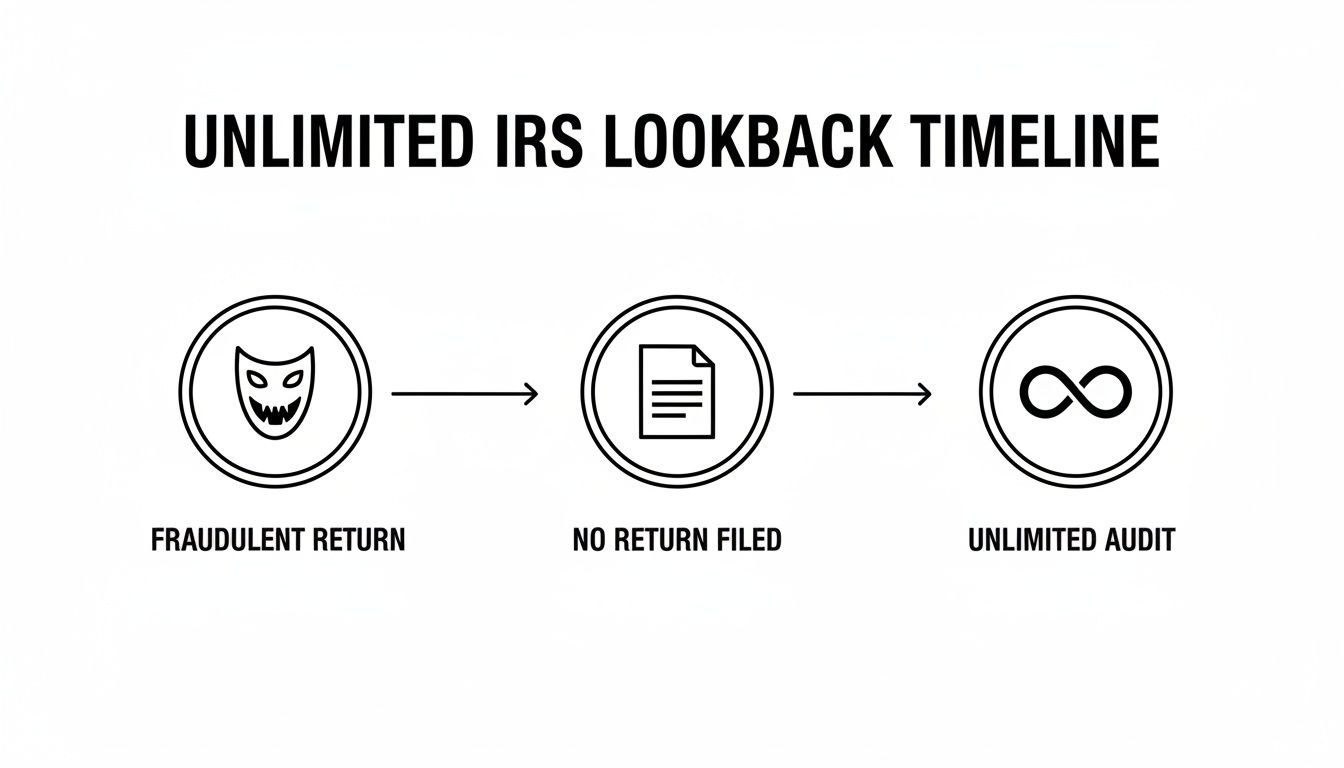
As you can see, certain actions like filing a fraudulent return or no return at all can give the IRS an unlimited window to assess the tax. But once they do, that 10-year collection clock still starts to run.
To make this distinction crystal clear, here’s a quick comparison of the two main timelines.
IRS Assessment vs. Collection Timelines
The table below breaks down the key differences between the IRS's power to figure out what you owe (assessment) and their power to actually take it (collection). They are related, but they don't run at the same time.
| Timeline Concept | What It Is | Standard Time Limit | Starts When... | Key Exceptions |
|---|---|---|---|---|
| Assessment | The IRS's window to audit a return and determine a tax liability. | 3 years | You file your tax return. | 6 years for substantial underreporting; unlimited for fraud or no return. |
| Collection | The IRS's window to collect a tax debt that has already been assessed. | 10 years | The tax is formally assessed. | The clock can be paused ("tolled") by bankruptcy, OICs, and other events. |
Understanding which clock is ticking in your situation is the first step toward finding a resolution. One is about discovery, the other is about enforcement.
Be Careful: The 10-Year Clock Can Be Paused
Now, here’s where things get tricky. The CSED might sound like a simple 10-year countdown, but it doesn't always run in a straight line. Certain actions you take can "toll" the statute—a legal term for pausing the clock.
This is a massive trap for the unwary. Often, the very steps you take to resolve your tax problem can end up giving the IRS more time to collect from you.
The most important thing to remember is that the 10-year collection clock isn't guaranteed. Actions like filing for bankruptcy or submitting an Offer in Compromise will pause the CSED, sometimes adding years to your collection window.
Here are some of the most common events that toll the collection statute:
- Filing for Bankruptcy: The collection clock is frozen for the entire time you are in bankruptcy, plus an extra six months after the case is over.
- Submitting an Offer in Compromise (OIC): The clock stops while the IRS considers your offer, plus 30 days after a rejection. If you appeal, the clock stays paused.
- Requesting an Installment Agreement: While your request is pending with the IRS, the clock isn't running.
- Requesting a Collection Due Process (CDP) Hearing: The CSED is tolled from the day you request the hearing until the final determination is made.
- Living Outside the U.S.: If you are out of the country for six months or more straight, the collection clock is paused for the duration of your absence.
Knowing about these tolling events is non-negotiable. A seemingly straightforward 10-year period can easily stretch into 11, 12, or even more years. This is why you have to be strategic about every move you make when you owe the IRS.
What This Means for You: Staying Prepared and Stress-Free
Knowing the IRS time limits is great, but that knowledge doesn't do much good sitting on a shelf. The real goal is to turn that understanding into practical habits that keep you protected and give you genuine peace of mind.
Let's shift gears from the "what" and "why" to the "how." We'll cover two of the most important things you can do: getting your records in order and knowing exactly how to handle that dreaded letter from the IRS if one ever shows up.
Get Smart About Your Record-Keeping
Think of your financial records as your evidence. If the IRS ever comes knocking with questions about a past return, well-organized documents are your best defense. They can often shut down an inquiry before it ever escalates. The trick is simply knowing what to keep and for how long.
A good rule of thumb is to let the statutes of limitations guide your filing cabinet. Since the IRS has a few different timeframes, your retention strategy should have a few layers.
- The 3-Year Baseline: At a minimum, hold onto your tax returns and all supporting documents for three years from the date you filed (or the due date, whichever was later). This covers the most common audit window.
- The 6-Year Safety Net: This is where just tossing everything after three years gets risky. If your finances are more complex—maybe you run a business, have investment properties, or freelance—keeping records for at least six years is a much safer move. It protects you from that extended lookback period if the IRS finds a major income understatement.
- The "Keep Forever" File: For major assets like your home, stocks, or business equipment, you need to keep records related to their purchase and any improvements indefinitely. These documents establish your cost basis, which you'll absolutely need to correctly calculate your profit or loss when you eventually sell.
Pro Tip: Want a simple, set-it-and-forget-it strategy? Just keep all your tax-related records for a rolling seven years. This single rule of thumb covers both the 3-year and 6-year statutes with a year to spare. It's the perfect balance—offering robust protection without turning your home into a permanent document archive.
What to Do When That IRS Envelope Arrives
Getting a letter from the IRS can make your heart skip a beat, but it’s rarely time to panic. Most of these notices are computer-generated, often flagging simple math errors or a document mismatch. How you react, though, is what really matters.
A calm, methodical response is your best bet for resolving the issue quickly and painlessly. If you get an IRS notice about a past tax year, here’s what to do.
- Don't Ignore It. This is the golden rule. Sticking that letter in a drawer and hoping it goes away is the worst thing you can do. It only guarantees more letters, bigger penalties, and a much more serious problem down the road.
- Read the Notice Carefully. Open it right away. Figure out which tax year it's for, what specific issue they're raising, and—most importantly—the deadline they’ve given you to respond.
- Pull Your Records. Before you do anything else, find your copy of the tax return for that year and all the backup documents. Compare what you have with what the IRS letter says. A lot of the time, you'll spot the discrepancy right away.
- Respond in Writing. Even if you end up calling them, you should always send a formal written response by the deadline. Clearly state your case and include copies (never send your originals!) of any documents that prove your point. It's well worth the few extra dollars to send it via certified mail so you have proof it was delivered.
New tools are also making this process easier. For example, developments in AI in accounting can help keep financial records organized and accurate, which is a massive help when you need to pull documents for a timely IRS response.
Knowing When to Call in a Professional
Not every IRS notice requires hiring an expert. If you get a basic CP2000 notice because you forgot a 1099 and you agree with the IRS's correction, you can probably handle it on your own.
But some situations are an immediate red flag that you're out of your depth. You should get a tax attorney or a qualified professional on the phone right away if:
- The notice involves a large amount of money.
- The problem is complex and tied to things like business expenses, asset sales, or foreign accounts.
- You're officially being audited.
- The letter uses words like "fraud" or "criminal investigation."
- You know the IRS is wrong but aren't confident you can build a strong enough case to prove it.
A good pro can step in, talk to the IRS for you, and make sure your rights are protected every step of the way. Getting the right help quickly can end up saving you a tremendous amount of time, stress, and money.
Your Top Questions About IRS Timelines, Answered
Even after getting a handle on the main 3-year, 6-year, and 10-year rules, real-life situations always bring up more questions. Let's walk through some of the most common "what if" scenarios that people run into.
Think of this as the practical guide to those tricky exceptions and specific circumstances you might be wondering about.
Does Filing an Amended Return Restart the Clock?
This is a classic question, and for good reason—the answer isn't a simple yes or no. Filing an amended tax return (using Form 1040-X) does not give the IRS a fresh three-year window to comb through your entire original return. That’s the good news.
However, it does crack the door open for a limited time. The IRS gets a 60-day window from the moment they receive your amended return to assess any extra tax related only to the changes you made. This 60-day period applies even if the original three-year clock was just about to run out.
So, while you're not inviting a brand-new audit of the whole year, you are giving the IRS a specific, short-term opportunity to look at what you’ve changed.
What About State Tax Lookback Periods?
Here’s a critical piece of advice: never assume your state tax agency plays by the same rules as the IRS. It’s a common and costly mistake. While many states do follow the federal three-year standard, plenty of others give themselves more time.
California, for instance, has a standard four-year statute of limitations for assessment. Other states can have even longer lookback periods, especially in certain situations.
Key Takeaway: You absolutely must know the specific statute of limitations for both assessment and collection in every state where you file. Federal and state timelines are often not the same.
This becomes especially important if an IRS audit changes your federal tax liability. You’re almost always required to report those changes to your state by filing an amended state return, which can kick off a whole new review at the state level.
Are There Special Rules for Payroll Taxes?
Yes, and the IRS takes them incredibly seriously. When a business withholds Social Security, Medicare, and income taxes from employee paychecks but fails to send that money to the government, it's a huge red flag. The IRS considers those funds to be "trust fund" money—it belongs to the employee and the government, not the business.
For these Trust Fund Recovery Penalties (TFRP), the IRS has a three-year statute of limitations to assess the penalty against the individuals they deem responsible. That clock starts ticking from the later of two dates: either April 15 of the year after the quarter the tax was due, or the date the payroll tax return was actually filed.
And "responsible individuals" is a broad term. It can include owners, corporate officers, and even bookkeepers—basically, anyone with the authority to handle tax payments who willfully failed to do so. In cases of outright evasion, the unlimited lookback for fraud can also come into play.
What Happens if I Never Filed and the IRS Files for Me?
If you fail to file a tax return, the IRS won't wait forever. Eventually, they may file what’s known as a Substitute for Return (SFR) on your behalf. But here's the catch: an SFR created by the IRS does not start the statute of limitations clock for assessment.
The only way to get that three-year assessment clock ticking is to file your own original tax return.
An SFR is essentially the IRS’s best guess at what you owe, and it’s never in your favor. They use income data from W-2s and 1099s but give you zero deductions or credits. Even after an SFR is on the books, the IRS has unlimited time to come after you for that tax year until you file a proper return yourself.
Can an Audit Go Back Further Than 3 or 6 Years?
In most civil tax audits, the IRS is bound by the 3-year or 6-year lookback periods. But if an auditor smells fraud, the rules change completely.
If a routine audit uncovers evidence that you willfully and intentionally tried to deceive the IRS, the case can morph into a "civil fraud" investigation. If they can prove it, the statute of limitations is eliminated entirely for that year. There is no time limit.
Things can get even more serious. If a civil audit reveals potential criminal-level offenses, the auditor can refer your case to IRS Criminal Investigation (CI). This is a separate law enforcement branch, and it opens a whole new can of worms with a standard six-year statute of limitations for prosecuting most tax crimes, which begins on the date the crime was committed.
Navigating IRS statutes of limitations can feel overwhelming, especially when your financial future is on the line. At Attorney Stephen A Weisberg, we don't believe in high-pressure sales tactics. We start with a FREE, no-obligation Tax Debt Analysis to determine the best path forward for your specific situation. If you're facing questions about past tax years, let's talk. Visit https://weisberg.tax to schedule your free analysis and find clarity.


