How Far Back Can the IRS Go? An Expert Guide
Wondering how far back can the IRS go? Learn the definitive time limits for audits, collections, and unfiled returns in our clear, practical guide.

In this article
- The IRS Statute of Limitations: More Than Just a Deadline
- The Standard: Why Three Years Is The Magic Number
- IRS Look-Back Periods At a Glance
- Decoding the Standard Three-Year Audit Window
- When Does the Three-Year Clock Actually Start Ticking?
- Real-World Examples of the Three-Year Rule
- What Does This Mean for You?
- When the IRS Gets Six Years to Look Back
- The 25% Gross Income Rule
- How the 25% Calculation Works in Real Life
- Why This Rule Should Matter to You
- When the Audit Clock Never Starts
- The Problem With Never Filing a Return
- Understanding Tax Fraud Versus an Honest Mistake
- The Ten-Year Rule for Collecting Tax Debt
- What the IRS Can Do During the Ten-Year Period
- How the Ten-Year Clock Can Be Paused
- Got Questions About IRS Timelines? We’ve Got Answers.
- What Should I Do If I Haven't Filed Taxes for Several Years?
- Does Amending a Tax Return Reset the Audit Clock?
- How Does a State's Look-Back Period Compare to the IRS?
- When Should I Contact a Tax Attorney Instead of a CPA?
For most taxpayers, the answer to the big question—"how far back can the IRS go?"—is surprisingly straightforward: three years. Think of it as the IRS's standard window of opportunity. Once you file your return, a countdown clock starts, giving them that much time to take a closer look.
The IRS Statute of Limitations: More Than Just a Deadline
"Statute of limitations" sounds like something straight out of a law drama, but in the tax world, it's a concept you absolutely need to know. It’s the legal time limit the government has to do three things:
- Audit your return for accuracy.
- Assess any additional tax they think you owe.
- Start the collection process for that debt.
This isn't just some internal IRS guideline; it's the law. Once that clock runs out, they can’t come back and question that tax year. It’s your legal shield, providing a clear end date to the stress of a potential audit and preventing old tax issues from haunting you forever.
But here’s the catch: that clock doesn't tick the same way for everyone. The specifics of your situation—like a major income understatement, unfiled returns, or outright fraud—can dramatically change the timeline, sometimes extending it indefinitely.
This visual breaks down the most common scenarios at a glance. It shows how a standard, honest return gets the three-year protection, while more serious issues keep the door open for the IRS much longer.
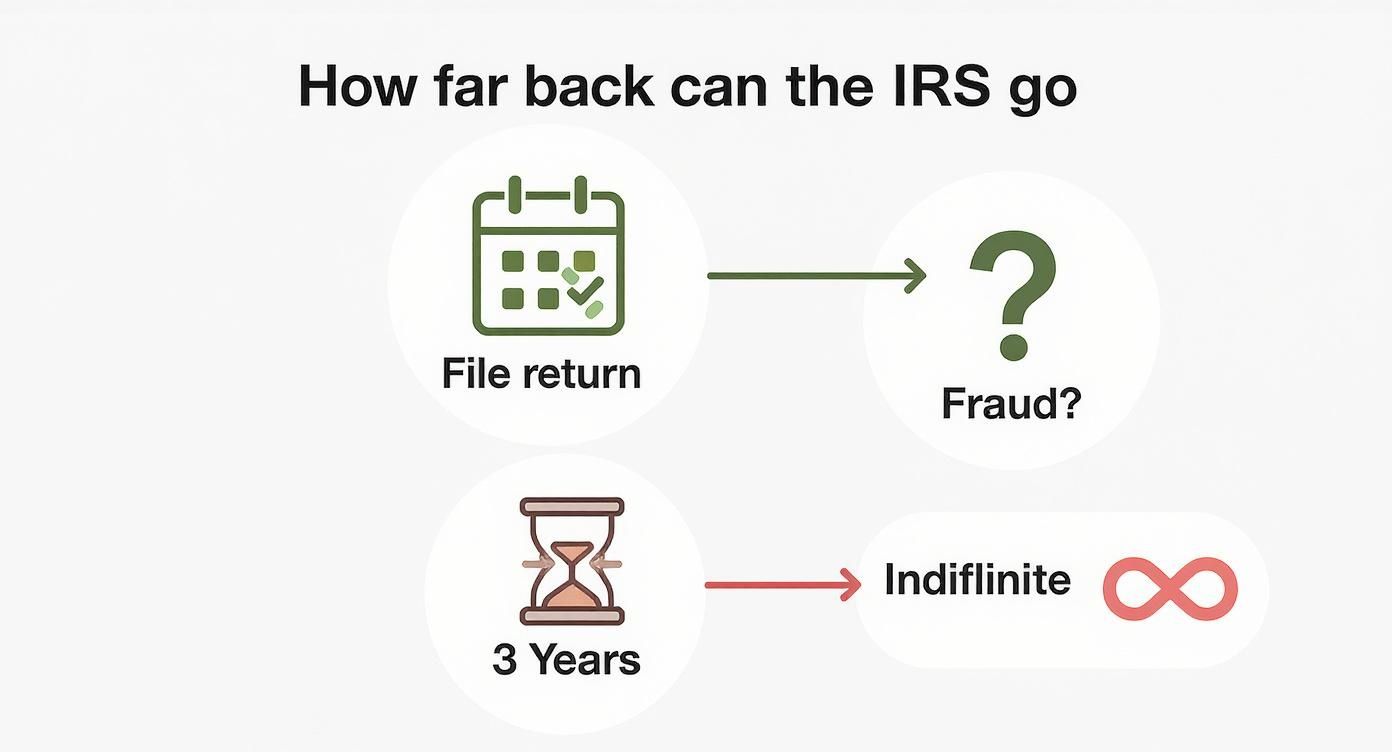
The takeaway is simple but powerful: how you handle your tax obligations directly impacts how long the IRS can keep you under the microscope.
The Standard: Why Three Years Is The Magic Number
So, where does this three-year rule come from? The clock officially starts ticking on the later of two dates: the tax filing deadline or the date you actually filed.
Let’s use a real-world example. Say you filed your 2023 tax return right on time, on April 15, 2024. In that case, the IRS generally has until April 15, 2027, to initiate an audit. If you filed early, say on February 1st, the clock still doesn’t start until the April 15th due date.
Key Takeaway: For a correctly filed return, the statute of limitations provides taxpayers with a predictable and legally binding endpoint for potential IRS scrutiny.
This three-year period is the bedrock of tax administration, but it's crucial to know it's not the whole story. To dig deeper, you can learn all about the complete IRS statute of limitations in our dedicated guide. For a different perspective on the general audit process, you might also find value in understanding the nuances of tax audits, as many procedural principles are similar.
The following sections will walk you through the important exceptions that can stretch this timeline far beyond the standard three years.
For a quick reference, this table summarizes the different timelines the IRS operates under.
IRS Look-Back Periods At a Glance
| Situation | Time Limit to Audit & Assess Tax | Time Limit to Collect Tax |
|---|---|---|
| Standard Filing | 3 years from the filing date or due date (whichever is later). | 10 years from the date the tax was assessed. |
| Substantial Understatement (>25% of gross income) | 6 years from the filing date or due date. | 10 years from the date the tax was assessed. |
| Unfiled Return | Indefinite. The clock never starts. | 10 years from the date a return is eventually filed and tax is assessed. |
| Fraudulent Return | Indefinite. There is no time limit. | Indefinite. The IRS can collect at any time. |
This table makes it clear that the best way to keep the IRS's window of review as short as possible is to file an honest and accurate return every single year.
Decoding the Standard Three-Year Audit Window
For most people, the question "how far back can the IRS go?" has a pretty straightforward answer: three years. This isn't just a friendly suggestion from the IRS; it's a hard-and-fast rule baked into the tax code, known as the statute of limitations for assessment.
Think of it as a shot clock in basketball. The moment your return is filed, the clock starts counting down, giving the IRS a specific amount of time to take a closer look. Once that clock hits zero, they generally can't come back and demand more tax for that year.

This three-year period is the standard window the IRS has to audit your return and assess any extra tax they think you owe. Understanding how this timer works is the first step toward getting some peace of mind.
When Does the Three-Year Clock Actually Start Ticking?
This is where a lot of the confusion comes in. You might think the clock starts the second you e-file your return, but that's not quite right. To keep things fair and consistent, the IRS starts the three-year countdown on the later of two dates:
- The official tax filing deadline (which is usually April 15th).
- The date you actually filed your return.
What's the big deal? It means filing early doesn't start your audit clock any sooner. If you file in February, your clock doesn't start until April 15th, just like everyone else who filed on time. It's a simple but important detail.
Imagine your tax return is a ship scheduled to set sail on a three-year voyage. The official departure day is April 15th. Even if you get all your cargo loaded and are ready to go in February, the ship isn't leaving the harbor until that official April 15th departure date.
Real-World Examples of the Three-Year Rule
Let's make this crystal clear with a couple of common scenarios for a 2023 tax return, which was due on April 15, 2024.
Scenario 1: The Early Filer You were on top of things and filed your 2023 return on February 5, 2024.
- Filing Date: February 5, 2024
- Due Date: April 15, 2024
- Clock Starts: April 15, 2024 (the later date)
- Audit Window Closes: April 15, 2027
Even though you filed months ahead, your three-year audit window doesn't close any sooner. The IRS has until mid-April 2027 to take a look.
Scenario 2: The On-Time Filer You filed your 2023 return right on the deadline, April 15, 2024.
- Filing Date: April 15, 2024
- Due Date: April 15, 2024
- Clock Starts: April 15, 2024
- Audit Window Closes: April 15, 2027
This one is as simple as it gets. The three-year period runs exactly from one tax day to the next, three years down the road.
Key Insight: Filing your tax return after the deadline starts the clock on the day the IRS receives it, giving them a full three years from that later date. This is why filing on time isn't just about avoiding penalties; it's about starting that countdown as soon as you can.
What Does This Mean for You?
Knowing this rule means you can figure out exactly when a particular tax year is generally in the clear. For a normal, on-time return, you can circle a date on your calendar three years after the tax deadline and breathe a sigh of relief.
Of course, the best strategy is always to file a complete and accurate return to begin with. That's the surest way to minimize your chances of hearing from the IRS in the first place. You can learn more about what triggers a tax audit in our detailed guide on the topic.
This three-year window gives millions of taxpayers a sense of finality. It creates a clear finish line, so you don't have to worry about old tax years being questioned forever. But as we're about to see, this standard rule has some major exceptions that every taxpayer needs to know about.
When the IRS Gets Six Years to Look Back
Most people breathe a sigh of relief after three years, thinking they're in the clear with the IRS. But that three-year clock isn't set in stone. Certain mistakes—especially big ones—can give the IRS a reason to double that time and dig into your finances for a full six years.
Think of the three-year rule as the standard statute of limitations. The six-year extension is what happens when you commit a "flagrant foul" in the tax world. This isn't about a simple math error or forgetting a tiny bit of interest income. The six-year rule is reserved for something much more serious.
The 25% Gross Income Rule
So, what triggers this extended look-back period? The main culprit is a substantial understatement of gross income. The tax code is crystal clear on this: if you leave off more than 25% of the gross income you were supposed to report, the game changes.
The IRS uses this 25% threshold as a bright line. An omission that large is rarely seen as an innocent mistake. Instead, it suggests a significant reporting failure that gives them grounds to scrutinize your tax life for a much longer period.
Let's say you reported $80,000 in income but really made $110,000. That $30,000 you left off is more than 25% of what you reported, so the IRS now has six years, not three, to come knocking.
How the 25% Calculation Works in Real Life
To really understand how this plays out, let's look at a couple of scenarios. It’s all about the percentage, not the raw dollar amount.
Example 1: A Minor Slip-Up (Stays in the 3-Year Window)
- Actual Gross Income: $100,000
- Reported Gross Income: $95,000
- Omitted Income: $5,000
In this situation, maybe a freelancer forgot to report a single 1099 from a small gig. The $5,000 they missed is only 5% of their total income. They'll still owe tax and interest on it if caught, but this kind of small-scale error doesn't trigger the extension. The IRS only has the standard three years to find it.
Example 2: A Major Omission (Triggers the 6-Year Window)
- Actual Gross Income: $120,000
- Reported Gross Income: $80,000
- Omitted Income: $40,000
Here, the taxpayer has a day job but conveniently "forgot" to report the significant income from a thriving side business. The unreported $40,000 is 33.3% of their actual gross income ($120,000 / $40,000). Because this sails past the 25% threshold, the IRS now gets six years from the filing date to audit that return.
Key Takeaway: This isn't just for sophisticated tax evasion schemes. The six-year rule often catches people who fail to report income from side hustles, rental properties, crypto gains, or other freelance work.
Why This Rule Should Matter to You
Having the IRS audit window double from three to six years is a big deal. It means you need to keep meticulous records for much longer, and the cloud of a potential audit hangs over your head for twice the time.
This rule really drives home how important it is to report every single dollar of income, no matter where it comes from. If the IRS does find a substantial understatement, you're not just on the hook for back taxes and interest. They can, and often will, tack on hefty penalties.
Knowing the difference between a simple mistake and a major omission is key to understanding your risk. The penalties can escalate quickly, so it's worth getting it right from the start. You can learn more about how the IRS comes down on these issues in our guide to tax fraud penalties.
Ultimately, the six-year rule is a powerful tool for the IRS, reminding everyone that significant reporting gaps won't just be overlooked—they’ll reset the clock entirely.
When the Audit Clock Never Starts

While the three- and six-year rules cover most tax situations, there are a couple of major exceptions where the clock never starts ticking at all. In these high-stakes cases, the statute of limitations simply doesn't apply. This gives the IRS a permanent, open-ended window to audit, assess, and collect.
Think of it this way: filing your tax return is like firing the starting pistol on the IRS's race to audit you. If you never fire that pistol, the race never officially begins. The clock stays at zero, forever. This is exactly what happens in two key situations: you don't file a return at all, or you file a fraudulent one. In those cases, the IRS can come knocking five, ten, or even twenty years down the road.
The Problem With Never Filing a Return
The most direct way to leave the door wide open for the IRS is to simply not file a tax return when you were legally required to. The law is crystal clear on this point: the statute of limitations clock only starts on the date a return is actually filed. No return, no clock.
This is a really dangerous spot to be in. The IRS eventually finds out about unfiled returns through third-party information, like the W-2s and 1099s sent in by your employer or clients. When they catch on, they can assess tax, penalties, and interest for that year without any time limit holding them back. The myth that the IRS just "forgets" about an old unfiled return is one of the most hazardous misconceptions out there.
The good news? You can start the clock yourself by filing that late return. Once the IRS gets and accepts your delinquent return, the standard three-year statute of limitations for an audit on that year finally begins. It’s almost always better to come forward voluntarily than to wait for the inevitable letter to show up.
Understanding Tax Fraud Versus an Honest Mistake
The second situation that gives the IRS unlimited time is filing a fraudulent return. This is the big one—the most serious tax violation—and the IRS gives itself a permanent green light to pursue it.
But it’s absolutely critical to understand the high bar for what the government considers fraud.
Tax fraud is not an accident. It is the willful and intentional attempt to evade paying your tax obligations. The burden of proof is on the IRS to show that you knew what you were doing was wrong and you did it on purpose.
Crucial Distinction: The core difference between a simple error and tax fraud is intent. An honest mistake, even a big one, is not fraud. Fraud requires a deliberate act of deception.
Let’s look at a couple of examples to make this clear:
- Honest Mistake (Not Fraud): A self-employed graphic designer is tallying up their income and accidentally transposes a couple of numbers, understating their income by $5,000. They have all the records to back up their actual income and expenses; it was a simple clerical slip-up.
- Tax Fraud: An investor deliberately opens a series of offshore bank accounts to hide investment income from the IRS. They then intentionally omit any mention of these accounts or the money they generated on their tax return.
The first example is just a mistake. If the IRS finds it, the designer will owe back taxes and interest, but that's it. The second example is a calculated act of deception, and the IRS has an unlimited amount of time to uncover it, assess massive penalties, and even pursue criminal charges.
Because proving intent can be tricky, the IRS looks for clear "badges of fraud"—things like keeping two sets of books, lying to agents, or a consistent pattern of hiding income over many years.
The Ten-Year Rule for Collecting Tax Debt
It’s a common and costly mistake to confuse how long the IRS can audit you with how long they have to collect a tax debt. These are two completely different clocks, and mixing them up can lead to serious trouble.
Once the audit period is over and the IRS officially puts a number on what you owe—a process called a tax assessment—a brand new, much longer countdown begins.
From the date of that assessment, the IRS generally has a full ten years to collect every penny. This deadline is officially known as the Collection Statute Expiration Date, or CSED. You can think of the assessment like a final judgment in court; the ten-year period is the time the government has to enforce it.
This decade-long window gives the IRS a massive amount of time and power to come after the outstanding debt. They aren't just going to sit back and wait.
What the IRS Can Do During the Ten-Year Period
The ten-year collection statute isn't a passive waiting game for the IRS. It's an active enforcement period where they can, and will, escalate their efforts to get paid. If you find yourself in this situation, you absolutely need to know what they can do.
Some of their most powerful collection tools include:
- Filing a Notice of Federal Tax Lien: This is a public legal claim against all your property, from your house to your car. It secures the government’s interest in your assets and can absolutely tank your credit score, making it nearly impossible to get a loan.
- Issuing a Levy: A levy is a huge step up from a lien. This isn't just a claim—it's the actual seizure of your property. The IRS can garnish your wages, snatch funds directly from your bank accounts, or even take physical assets to satisfy the debt.
- Seizing Your Tax Refunds: Expecting a refund next year? Think again. The IRS will automatically intercept any future refunds and apply them to your old tax debt until it's paid off.
These actions are aggressive and can create devastating financial hardship. Understanding that this ten-year clock is ticking is the first critical step toward fixing the problem before things get this serious.
How the Ten-Year Clock Can Be Paused
Now, here’s where things get tricky. While the ten-year rule seems straightforward, it's not always a simple countdown from ten to zero. Certain actions you take can "toll" the statute, which is a legal term for hitting the pause button on that clock. This pause extends the total time the IRS has to collect from you.
Key Concept: Tolling the statute of limitations means the collection clock stops running for a period of time, effectively giving the IRS more than the original ten years to collect the debt. The clock resumes once the tolling event is over.
Several common actions can temporarily halt this critical countdown:
- Submitting an Offer in Compromise (OIC): The clock stops while the IRS considers your settlement offer and for 30 days after they make a decision.
- Requesting an Installment Agreement: The collection period is paused while your request to get on a payment plan is pending.
- Filing for Bankruptcy: The moment you file for bankruptcy, an "automatic stay" goes into effect. This halts all IRS collection actions and pauses the ten-year clock.
- Requesting a Collection Due Process (CDP) Hearing: If you ask for a hearing to dispute a collection action, the clock is tolled until the appeal becomes final.
- Living Outside the United States: If you are out of the country continuously for at least six months, the collection statute is suspended for the duration of your absence.
It's crucial to know what pauses the clock. While these options can provide much-needed temporary relief from collections, they also prolong the time you're under the IRS's thumb. This area is incredibly complex, and small missteps can have big consequences. To get a better handle on how these events affect your specific timeline, you can find more information about the IRS collection statute expiration date and its many nuances. Properly navigating this is the key to finally putting the issue behind you.
Got Questions About IRS Timelines? We’ve Got Answers.
Even when you know the basic three, six, and ten-year rules, real-life situations always bring up more questions. It's one thing to know the rules of the game; it's another to know how to play your hand. This section is all about tackling those common "what-if" scenarios so you can move forward with confidence.

Let's clear up the confusion and give you the practical knowledge you need to handle your taxes like a pro.
What Should I Do If I Haven't Filed Taxes for Several Years?
If you have a backlog of unfiled tax returns, the absolute best thing you can do is get proactive. For every year you don't file, the clock on audits and assessments never even starts. That means your potential liability just keeps growing. Simply waiting and hoping the IRS forgets is not a strategy—it's a gamble you will eventually lose.
The right move is to file those old returns as soon as you can. While every situation has its nuances, the IRS generally advises filing the last six years of returns to get back into good standing. When you file voluntarily, you put yourself in a much better position. It helps you sidestep the harshest penalties, can head off a criminal investigation, and finally gets the statute of limitations clocks ticking.
Important Reminder: Filing past-due returns isn't just about avoiding trouble. You might be owed a refund! But be aware: you typically have just three years from the original filing deadline to claim it, so don't delay.
Does Amending a Tax Return Reset the Audit Clock?
This is a classic point of confusion, but the short answer is no—not really. Filing an amended return on Form 1040-X does not restart the main three-year statute of limitations for your entire original return. That window is still firmly tied to the date you first filed.
But there is a small catch. If your amendment shows you owe more tax and you file it within the last 60 days of that three-year period, the IRS gets a fresh 60 days from the day they receive it to assess the new tax you reported.
Think of it this way: it doesn't reopen the whole return for another three years. It just gives the IRS a brief, limited extension to process the specific changes you made. You can't wait until the last minute, admit you owe more, and expect the clock to run out before they can act. Knowing the logic behind government calculations, like how the IRS calculates life expectancy for retirement planning, can shed light on their procedural nature.
How Does a State's Look-Back Period Compare to the IRS?
Assuming your state's tax rules mirror the federal government's is a huge mistake. Every state with an income tax has its own agency, its own laws, and its own deadlines for audits and collections. More often than not, they are different from what the IRS uses.
For instance, while the IRS gets three years, a state like California has a four-year statute of limitations to audit you. Some states have even longer periods.
This creates a few critical issues you need to be aware of:
- Longer Exposure: You could be completely in the clear with the IRS for a certain year, yet still be on the hook for a state audit on that same return.
- Record Keeping: You have to hold onto your tax records long enough to satisfy both federal and state requirements. The safe bet is to always follow the longer of the two timelines.
- Audit Domino Effect: If a federal audit results in changes to your income, you are almost always required to file an amended state return to match. This can trigger a whole new audit window with the state.
Always, always check the specific tax laws in your state to understand the full picture.
When Should I Contact a Tax Attorney Instead of a CPA?
CPAs and tax attorneys are both invaluable, but they play different positions on your team. Knowing who to call—and when—is key to protecting your interests.
A CPA is your go-to expert for tax preparation, financial planning, and representing you in a standard civil audit. They are masters of the tax code from an accounting and compliance standpoint.
But it's time to call a tax attorney the moment things get serious. You should reach out immediately if your situation involves:
- Potential Criminal Charges: If you have any reason to believe an audit is turning into a criminal investigation for tax fraud or evasion.
- Attorney-Client Privilege: What you say to your CPA isn't always protected. An attorney can shield your conversations from the IRS, which is absolutely essential if criminal charges are on the table.
- Going to Tax Court: If you need to challenge an IRS decision in U.S. Tax Court, you must have a lawyer who is licensed to practice there.
- Aggressive Collections: When the IRS is threatening serious actions like seizing property, or you need to negotiate a complex resolution like an Offer in Compromise, a tax attorney's skill set is what you need.
If an IRS inquiry ever starts to feel like more than just a routine check-up on your math, it's time to get a legal expert involved.
At Attorney Stephen A Weisberg, we understand that dealing with the IRS can be overwhelming. Instead of asking for a large retainer upfront, we start with a FREE Tax Debt Analysis to determine exactly how we can help resolve your issues. If you're facing tax debt, an audit, or other complex problems with the IRS, contact us today for a no-obligation consultation.


