how far back can taxes be filed - A Quick IRS Guide
how far back can taxes be filed? Find out deadlines, refunds, penalties, and how to file late with confidence.

In this article
- The Three-Year Window to Claim Your Tax Refund
- What Happens if You Miss the Deadline?
- Putting It All Together
- Key IRS Time Limits for Filing Back Taxes
- Understanding IRS Statutes of Limitations
- The Three-Year Audit Window
- The Ten-Year Collection Clock
- What Happens If You Just Never File a Return?
- The Dreaded Substitute for Return (SFR)
- Exceptions That Extend the IRS Audit Clock
- The Six-Year Rule for Substantial Understatement
- When the Clock Never Stops Running
- How US Tax Timelines Compare Globally
- A Look at Other Major Economies
- Common Questions About Filing Back Taxes
- What If I Can't Afford to Pay What I Owe? Should I Still File?
- I've Heard About a "Six-Year Rule." What Is That?
- What Documents Do I Need to File an Old Return?
When it comes to filing old tax returns, the first question on everyone's mind is usually, "Can I still get my refund?" The short answer is yes, but you're on the clock.
You generally have a three-year window from the original tax deadline to file that return and claim any money the government owes you. Miss that deadline, and your refund is gone for good—forfeited to the U.S. Treasury.
The Three-Year Window to Claim Your Tax Refund
Think of your potential tax refund like a gift card with a hard expiration date. While you can file an old tax return at any time, your ability to actually collect a refund is limited. The IRS calls this the statute of limitations for refunds, and they are incredibly strict about it.
This three-year countdown doesn't start at the end of the tax year; it starts on the original filing deadline. For instance, your 2020 tax return was due on April 15, 2021. That means the clock started ticking on that day, giving you until April 15, 2024, to file and get your money back.
What Happens if You Miss the Deadline?
If you don't file within those three years, the outcome is simple and unforgiving: you lose the refund. It doesn't matter if it was $50 or $5,000. That money becomes the property of the U.S. Treasury, and there are no do-overs.
The key takeaway is that waiting too long directly impacts your wallet. The IRS has many years to come after you for taxes you owe, but your right to claim a refund is on a much shorter leash.
This rule is a big deal because it also covers valuable tax credits you might have been eligible for. Things like the Earned Income Tax Credit can only be claimed as part of a refund within that three-year window. You can learn more about how filing deadlines affect your ability to claim credits and refunds.
Putting It All Together
Let's walk through a quick example to make it crystal clear:
- Tax Year: 2021
- Original Filing Deadline: April 18, 2022
- Refund Claim Deadline: April 18, 2025
If you suddenly realize in May 2025 that you never filed your 2021 return and were owed a nice refund, you'd be out of luck. The window slammed shut on April 18, 2025, and that money is gone forever. It really pays to act sooner rather than later.
To help you keep track, here is a quick summary of the most important time limits when dealing with back taxes.
Key IRS Time Limits for Filing Back Taxes
| Situation | Time Limit | What It Means for You |
|---|---|---|
| Claiming a Refund | 3 years from the original deadline | You must file your past-due return within this window to get any money you overpaid. Miss it, and the refund is lost forever. |
| Filing to Avoid Penalties | No time limit (but act fast) | The sooner you file and pay, the less you'll owe in failure-to-file and failure-to-pay penalties, which add up quickly. |
| IRS Assessment of Tax | 3 years from when you file | Once you file a return, the IRS generally has three years to audit you and assess additional tax. This window can be longer in special cases. |
These deadlines are firm, so paying attention to the calendar is crucial for protecting your money and staying on the right side of the IRS.
Understanding IRS Statutes of Limitations
Think of IRS statutes of limitations as the official "game clock" for your taxes. These are legally defined time limits that dictate how long the IRS can look back to audit you or come after you for unpaid taxes. Knowing these deadlines is crucial—they protect you from the forever-looming threat of a tax review.
When you file a tax return, you essentially start two very important clocks.
The Three-Year Audit Window
The first clock is the one most people think about: the Assessment Statute of Limitations. In most cases, the IRS has three years from the date you file your return to review it and assess any extra tax they think you owe.
So, how does that work in practice? The three-year countdown starts from the day you file or the original due date of the return, whichever is later. For example, if you filed your 2022 tax return early, say in February 2023, the IRS's clock doesn't start until the April 18, 2023 deadline. That gives them until April 18, 2026, to initiate an audit.
The same three-year rule applies to claiming a refund you might be owed. If you wait too long, you lose it for good.
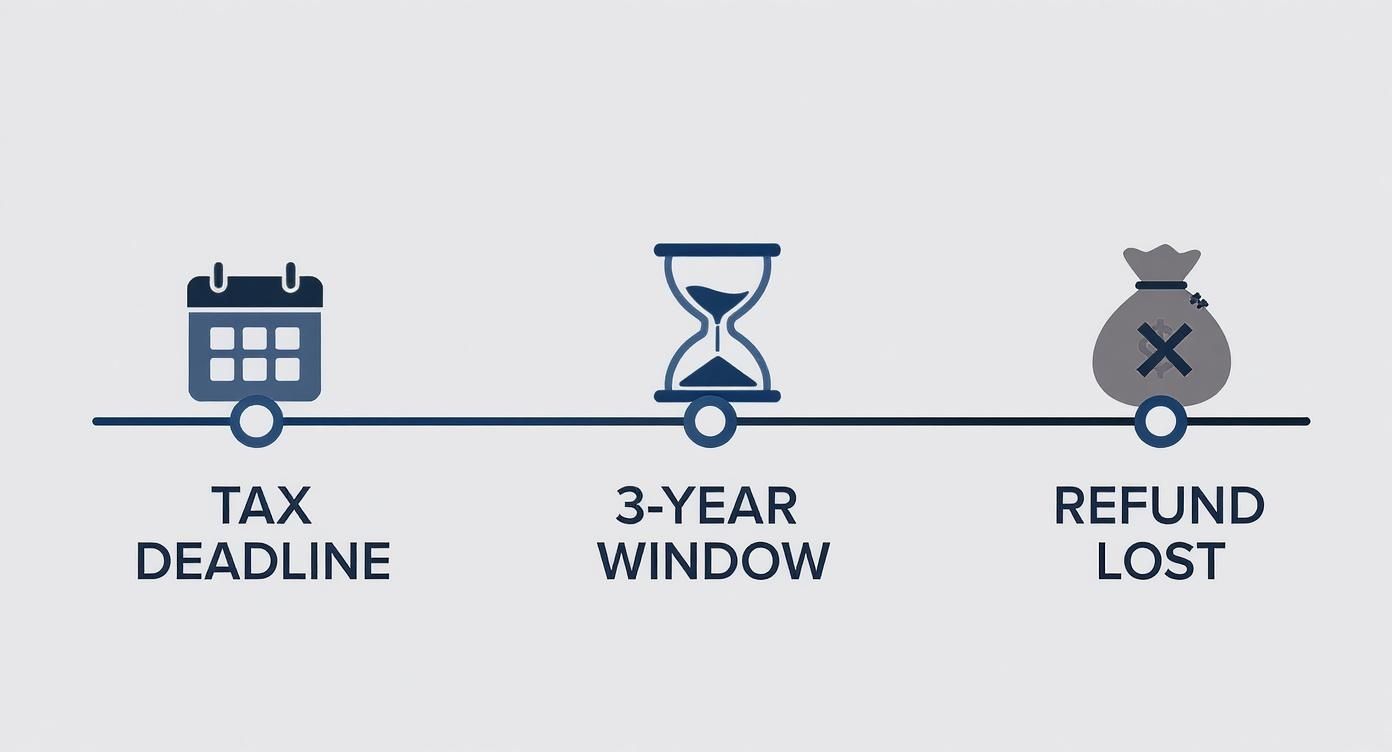
As the visual above shows, once that three-year window closes, any unclaimed refund is permanently forfeited to the U.S. Treasury.
The Ten-Year Collection Clock
The second timeline is much, much longer. It's the Collection Statute of Limitations. Once the IRS officially assesses a tax debt against you, a separate 10-year clock begins to tick. This gives them a full decade to use their collection tools—like placing liens on your property or levying your bank accounts—to get the money.
It's absolutely critical to understand that filing a return is what starts these clocks. If you never file, the statute of limitations for the IRS to assess tax never even begins. You remain exposed indefinitely.
This dual-clock system is designed to be a balance. It provides taxpayers with a reasonable window of certainty while giving the government enough time to enforce tax law. The assessment period is short, but the collection period is long, which highlights just how seriously the government takes tax debt.
You can learn more about how the IRS statute of limitations affects collections and what it means for you. Ultimately, these rules make it clear that tackling tax issues head-on, no matter how old they are, is always the smartest move for your financial well-being.
What Happens If You Just Never File a Return?

It's a question I hear more often than you'd think: "What if I just... don't file?" People sometimes hope that if they lay low, the IRS will eventually forget about them. Unfortunately, that's not how it works.
The truth is, not filing a tax return is one of the biggest mistakes you can make. The reason is simple and critical: the statute of limitations for the IRS to assess tax never begins.
When you file a return, you start a three-year countdown. Once that clock runs out, the IRS generally can't audit that return or assess more tax. But if you never file? That clock never starts, giving the IRS a limitless window to come after you for taxes, penalties, and interest.
The Dreaded Substitute for Return (SFR)
Don't think the IRS will just sit back and wait. If you fail to file, they have a tool they can use to file for you. It’s called a Substitute for Return (SFR).
Imagine the IRS doing your tax homework for you, but they're not trying to get you a good grade. They'll use information from third parties—like the W-2 from your employer or 1099s from your clients—to piece together your income.
Here's the catch: the SFR is calculated in the most unfavorable way possible. It typically uses a "single" filing status and only the standard deduction. It completely ignores all the credits and deductions you might have been entitled to, like business expenses, education credits, or dependents.
The result is almost always a tax bill that's significantly higher than what you actually owed. Once the SFR is filed, the IRS has officially established a tax debt in your name, and they can start aggressive collection actions like putting a lien on your property or levying your bank account.
A Substitute for Return is the IRS's way of forcing the issue. It's never in your favor and opens the door to collections. Filing your own accurate return is the only way to fix it.
Filing your own return, even if it's many years late, will replace the government-prepared SFR. It’s always the right move. With the IRS cracking down on non-filers and unfiled returns, getting ahead of the problem is more crucial than ever. It's the only way to finally get that statute of limitations clock ticking and put the issue behind you.
Exceptions That Extend the IRS Audit Clock

While that three-year rule for audits is a comforting benchmark, it’s definitely not set in stone. Certain situations can give the IRS a much longer leash to examine your returns, stretching the statute of limitations from a few years to, well, potentially forever.
Think of the three-year window as the standard speed limit on a clear day. Most of the time, it applies. But if you make a really big mistake—or what the IRS considers a big mistake—you’ve just entered a zone with a much, much higher limit.
The most common exception that taxpayers run into is the six-year rule. This extended timeline kicks in if you’ve substantially understated your gross income.
The Six-Year Rule for Substantial Understatement
So, what does the IRS consider a "substantial understatement"? The magic number is 25%. If you leave off more than 25% of your gross income from your return, the audit clock doubles. This isn't for minor math errors; it’s for major omissions.
Let's walk through an example. Say you earned $100,000 from various sources but only reported $70,000. You’ve understated your income by $30,000, which is 30% of what you actually made. Boom. You've just triggered the six-year rule, giving the IRS a full six years from your filing date to initiate an audit.
This extended period isn't just for underreporting regular income. It also applies to a few other specific situations, including:
- Omitting more than $5,000 in income earned from foreign sources.
- Failing to report certain required foreign financial assets.
It's a safety net for the government to catch significant errors, whether you meant to make them or not. It’s also important to know that the audit window is separate from how long the IRS has to collect a debt; you can learn more about the IRS collection statute expiration date to understand that distinct timeline.
When the Clock Never Stops Running
Now we get to the scary part. There are a couple of scenarios where the statute of limitations disappears completely. If the IRS suspects you of tax fraud or if you simply don't file a return at all, there is no time limit on how far back they can go.
When you file a fraudulent return, that protective countdown clock never even starts. The IRS can come knocking five, ten, or even twenty years down the road to investigate.
This infinite look-back period is reserved for the most serious offenses, like intentionally hiding income, inventing deductions out of thin air, or knowingly filing a false return. It really underscores why filing an accurate and honest return is so critical—it’s your only true shield against indefinite scrutiny from the IRS.
How US Tax Timelines Compare Globally
Ever wonder if these tax deadlines are just a US thing? It turns out, they're not. While the IRS has its own specific set of rules, the basic idea of a "look-back" period is pretty common around the world.
Think of it like a statute of limitations for taxes. Most developed countries give their tax agencies a set window—usually three to six years—to audit a return or for a taxpayer to claim a refund. It's a system that creates predictability for everyone involved.
A Look at Other Major Economies
So, how does the US system really stack up against others? Let's glance at a couple of our international partners to see the similarities and differences.
Canada: Right next door, the Canada Revenue Agency (CRA) generally has three years to go back and reassess a tax return after they've sent out the initial assessment. Sound familiar? It’s a near-perfect mirror of the standard US timeframe.
United Kingdom: Across the pond, HM Revenue & Customs (HMRC) typically has four years to make an assessment. But here’s where things get interesting. If they suspect deliberate tax evasion, that window can stretch out to a whopping 20 years. You can see a breakdown of how they compare to US rules for a deeper dive.
The big takeaway is this: standard time limits are there to protect honest taxpayers. But if you try to pull a fast one with fraud or major underreporting, those protective timelines can vanish, giving tax authorities a lot more room to investigate.
Of course, things get more complicated when you're dealing with cross-border taxes. For instance, there's specific tax guidance for Canadians working in the US that adds another layer to filing obligations. It just goes to show that no matter where you earn your money, timely and accurate reporting is always the golden rule.
Common Questions About Filing Back Taxes
Once you get a handle on the IRS statutes of limitations, the practical questions start to pop up. Let's tackle some of the most common concerns people have when facing old tax returns.
What If I Can't Afford to Pay What I Owe? Should I Still File?
Yes, absolutely. This is probably the single most important thing to understand. Filing your tax return and paying your tax bill are two separate actions in the eyes of the IRS.
Even if you don't have a single dollar to send them, file the return anyway. Doing so immediately stops the brutal failure-to-file penalty from growing, which can be far more expensive than the failure-to-pay penalty. It also starts the 10-year clock on the collections statute. Once the return is on record, you can start exploring payment plans or other settlement options with the IRS.
I've Heard About a "Six-Year Rule." What Is That?
The "six-year rule" is a scary exception to the normal three-year audit window. Typically, the IRS has three years to audit you, but they can extend that to six years if you've left out a significant amount of income.
The trigger is a "substantial understatement of income," which the IRS defines as leaving off more than 25% of your gross income.
Let's say you earned $80,000 one year but only reported $50,000. That's an understatement of $30,000, or 37.5% of your actual income. Because that's well over the 25% threshold, the IRS now has six years from the date you filed to come back and audit that return. It’s a powerful incentive to be thorough and honest.
The bottom line is this: always file, even if you owe money and can't pay right away. Filing is your first and best line of defense. It opens up resolution options that simply aren't available if you stay off the grid.
What Documents Do I Need to File an Old Return?
Digging up old paperwork sounds like a nightmare, but it’s often more manageable than you think. You’ll need the same kinds of documents you'd use for a current-year return.
Your starting point should be:
- Income Records: W-2s from your jobs, 1099s if you did freelance work, and any other statements showing what you earned.
- Expense Records: Receipts for any deductions or credits you plan to claim, like business expenses, mortgage interest, or student loan interest.
Can't find them? Don't panic. The IRS has your back. You can request a free Wage and Income Transcript directly from them for the past 10 years. This official document lists all the income information that was reported to the IRS under your Social Security number, making it an incredible tool for piecing together an old return. For a complete guide, see our article on how to file back taxes.
And for business owners looking to stay compliant, getting good advice is key. While our focus is on US tax, you can find comprehensive UK tax advice for small businesses from our colleagues across the pond.
Feeling the weight of unfiled returns or a tax debt you can't see a way out of? At Attorney Stephen A Weisberg, we begin every case with a FREE Tax Debt Analysis to map out the best solution for your unique circumstances. Stop letting the uncertainty control you—get a free consultation today and start your journey toward financial peace of mind.


