how far back can i amend tax returns: A clear IRS guide
Discover how far back can i amend tax returns with our guide to IRS 3-year and 2-year rules, Form 1040-X steps, and claim refunds.

In this article
- The IRS Clock: Understanding the 3-Year Rule
- Pinpointing Your Exact Deadline
- Why This Rule Is So Important
- Quick Guide to IRS Tax Amendment Deadlines
- A Closer Look at the 2-Year Rule for Tax Payments
- How It Plays Out in the Real World
- So, Which Deadline Is Yours?
- When the Standard Deadlines Don't Apply
- Special Cases That Give You More Time
- When the IRS Gets an Extended Clock
- Situations with No Time Limit at All
- Exceptions to Standard Tax Amendment Deadlines
- How to Confidently File Your Form 1040-X
- First Things First: Gather Your Documents
- Filling Out the Form, Step-by-Step
- E-File or Snail Mail?
- Managing State Tax Amendments After Your Federal Return
- Why State Rules Are Different
- Finding Your State's Requirements
- When to Call a Tax Professional for Help
- Red Flags That Signal You Need an Expert
- Common Questions We Hear About Amending Tax Returns
- Can I Amend a Return After the 3-Year Deadline?
- How Can I Check on My Amended Return's Status?
- What if My Amendment Shows I Actually Owe More Tax?
When it comes to your taxes, finding a mistake after you’ve filed can be a heart-sinking moment. Your first question is probably, "Can I still fix this?" The good news is, yes, you usually can—but the clock is ticking.
Generally, you have three years from the date you filed your tax return to amend it and claim a refund. This is the golden rule of tax amendments, often called the "3-year rule," and it's the most critical deadline for most people to remember.
The IRS Clock: Understanding the 3-Year Rule
The concept that governs how far back you can go is the statute of limitations. It’s simply the legal window of time you have to file an amended return for a refund, or for the IRS to come back and assess more tax.
For most taxpayers, that window is three years. You have until three years from the day you filed your original return to submit a Form 1040-X, the Amended U.S. Individual Income Tax Return. A small but important detail: if you filed early (before the typical April 15th deadline), the IRS considers your filing date to be the deadline itself.
Pinpointing Your Exact Deadline
Let's walk through a real-world example. Say you filed your 2022 tax return on March 10, 2023. Since you filed before the official April 15, 2023, due date, the IRS starts your three-year clock on April 15, 2023.
This means you have until April 15, 2026, to amend that return and claim any money you might have missed.
This flowchart gives you a quick visual to see if you're still within that primary amendment window.
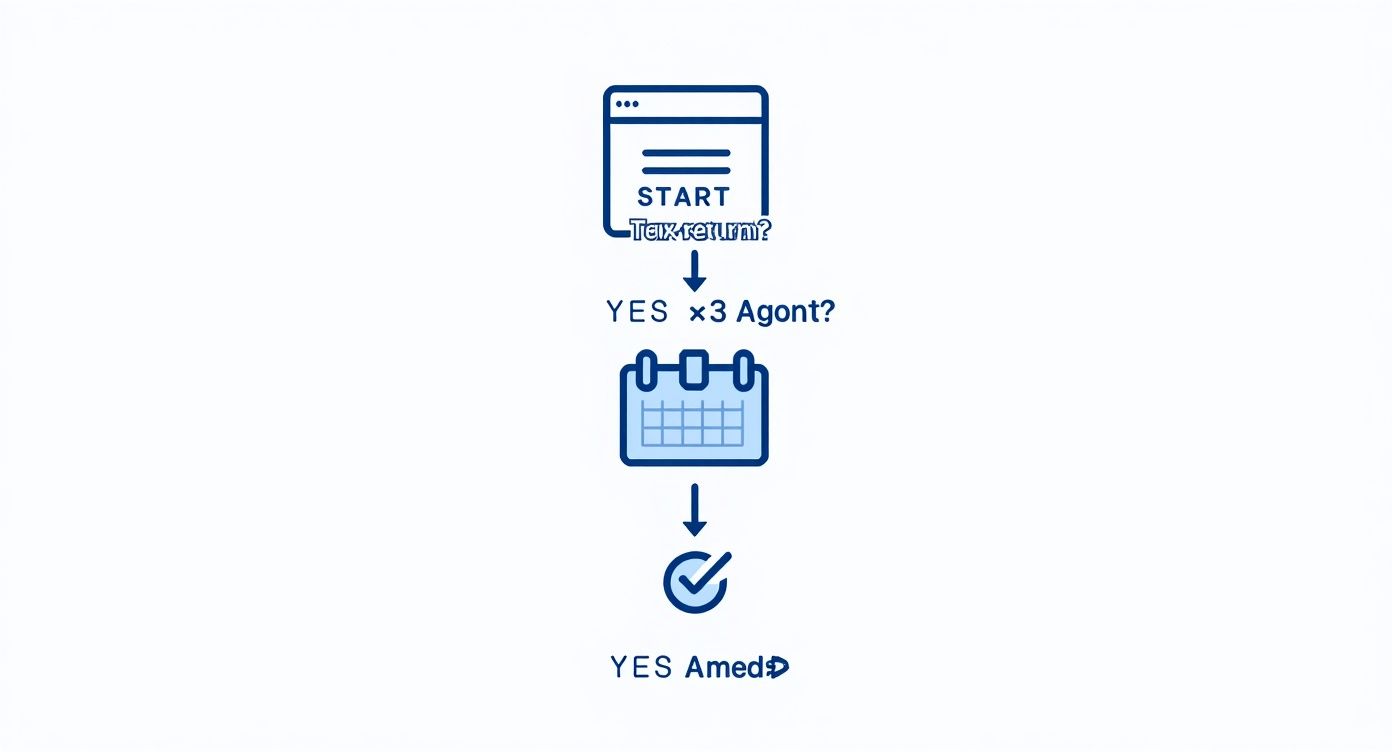
As you can see, that three-year mark is the first and most important checkpoint for almost every amendment scenario.
Why This Rule Is So Important
Missing this deadline has serious financial consequences. While you can technically file an amended return after the three-year window closes to correct your information, you lose the right to any refund you were owed. The IRS will gladly accept the updated form, but they won't be sending you a check.
The vast majority of amended returns are processed within the standard 16-week timeframe, but if you file after the deadline, you won't see a dime, no matter how long the processing takes.
To help you keep these key dates straight, here is a quick guide to the main rules.
Quick Guide to IRS Tax Amendment Deadlines
This table breaks down the primary time limits for filing an amended return to claim a refund.
| Rule | Deadline Calculation | Example Scenario |
|---|---|---|
| The 3-Year Rule | 3 years from the date you filed your original return. If you filed early, the clock starts on the tax due date (e.g., April 15th). | You filed your 2022 return on March 1, 2023. Your deadline to amend is April 15, 2026. |
| The 2-Year Rule | 2 years from the date you paid the tax, if that date is later than the 3-year rule's deadline. | You paid a tax bill for your 2022 return on May 20, 2024. You have until May 20, 2026, to amend and claim a refund of that specific payment. |
Understanding your specific deadline is the first step toward successfully claiming money you are rightfully owed.
The statute of limitations for amending a return isn't a suggestion; it’s a hard deadline.
This time limit provides a sense of finality for both you and the government. If you spot an error, the best thing you can do is act quickly. To get a more detailed look at how these rules work, you can explore our full guide on the IRS statute of limitations.
A Closer Look at the 2-Year Rule for Tax Payments
While the 3-year rule is the main player, there’s another critical deadline from the IRS that can be a real lifesaver: the 2-year rule. This one isn't about when you filed; it's all about when you actually paid the tax. Think of it as a separate, secondary clock that starts ticking the moment the IRS gets your money.
The best way to understand it is to see the two rules as separate windows of opportunity. The 3-year rule is the big, main window that opens when you file. But the 2-year rule is a smaller, parallel window that opens on the day you make a payment. The IRS lets you use whichever window stays open longer—a detail that’s incredibly important if you paid your tax bill well after you filed.
This rule is a crucial safety net. It prevents a frustrating situation where you could pay a tax bill only to realize the three-year window from your filing date has just closed, meaning you'd have no way to get that money back if you found an error.
How It Plays Out in the Real World
Here’s the deal: you can file an amended return to claim a refund within two years from the date you paid the tax. This is a game-changer for anyone who pays their tax bill long after the original filing deadline, especially if the three-year window is about to slam shut.
The catch is that any refund you claim under this rule can't be more than the amount you actually paid within that specific two-year period.
Let's walk through a concrete example to see how the two rules work together.
- Filing Date: You filed your 2020 tax return right on time, on April 15, 2021.
- 3-Year Deadline: This means your main deadline to amend is April 15, 2024.
- Late Payment: Money was tight, and you couldn't pay the $2,000 you owed until June 1, 2024.
See the problem? By the time you paid, your three-year amendment window had already closed. But you're not out of luck. The 2-year rule kicks in, starting a new clock on June 1, 2024. This gives you until June 1, 2026, to amend that 2020 return and claim a refund for up to the $2,000 you paid.
This interplay between the 3-year and 2-year rules is a fundamental taxpayer protection. It ensures the act of paying the tax itself creates a fresh opportunity to claim a refund, so you aren't penalized just for paying late.
So, Which Deadline Is Yours?
It’s simple: you get to use whichever deadline gives you more time. Figuring out how far back you can amend your tax returns often comes down to running the numbers on both.
To find your final deadline, you just have to calculate two dates:
- Three years from the day you filed your original return (or its due date, whichever is later).
- Two years from the day you paid the tax for that return.
Your true deadline is whichever of those two dates is later. This dual-timeline approach provides a lot of flexibility, particularly for people on IRS payment plans or who simply needed more time to settle up. Always check both dates before you assume the window to get your money back has closed.
When the Standard Deadlines Don't Apply
While the 3-year/2-year rule is a great rule of thumb, it's not the whole story. The tax code is full of twists and turns, and there are several important exceptions that can completely change the timeline for amending a return. These special circumstances can work both for you and against you.
Knowing these exceptions is critical. In some cases, a door you thought was long closed might swing open, letting you claim a refund you’d written off. On the flip side, certain mistakes can give the IRS a much longer look-back period, so it pays to understand where you stand.
Special Cases That Give You More Time
Sometimes, the financial fallout from an event doesn't become clear until years later. The tax code thankfully recognizes this reality and offers a longer runway in a few key situations.
One of the most valuable extensions is the 7-year rule for bad debts or worthless securities. Let’s say you invested in a promising startup, but after a long, slow decline, it finally went belly-up. Or maybe you loaned a significant sum to a business venture that just couldn't make it.
For these specific scenarios, you have up to seven years from the original due date of the return to amend it and claim that loss. This makes sense—it can often take that long to definitively say a debt is uncollectible or a stock is truly worthless.
A Real-World Example In 2018, you bought shares in a tech company. The company struggled for years and was officially declared bankrupt in 2024, rendering your stock worthless. The standard three-year window for your 2018 return closed long ago. However, thanks to this exception, you have until the 2025 tax filing deadline to amend your 2018 return and deduct that loss.
This is a powerful provision for anyone with investments that have gone south, but be prepared with solid documentation. You'll need to prove precisely when the investment officially became worthless.
When the IRS Gets an Extended Clock
The timeline doesn't always stretch in the taxpayer’s favor. Making a major mistake on your return can give the IRS extra time to catch it and assess more tax. The most common trigger for this is a substantial understatement of income.
If you leave off more than 25% of your gross income on your return, the IRS's window to audit and assess tax expands from three years to a full six years. This isn't for a simple typo or a minor math error; we're talking about a serious omission that drastically alters your tax picture.
- How this plays out: An independent consultant earns $120,000 in a year but, due to messy bookkeeping, only reports $80,000. Since they understated their income by more than 25% (in this case, 33%), the IRS now has six years, not three, to come back and collect the unpaid tax, along with interest and penalties.
This six-year rule is a stark reminder of why careful and complete income reporting is so important. Forgetting a single 1099 form might not be enough to trigger it, but leaving out a major client or side hustle almost certainly will.
Situations with No Time Limit at All
Finally, we get to the most serious circumstances—the ones where the clock for the IRS never runs out. These are reserved for major compliance failures, giving the government unlimited time to take action.
There is no statute of limitations in these three situations:
- Filing a fraudulent return: If the IRS can prove you knowingly and intentionally lied on your return, they can audit and assess tax on it at any time in the future.
- Failure to file a return: If you were required to file but never did, the three-year clock can't start because there’s no return to start it from. The IRS can come after you for that year whenever they discover the non-filing.
- Willful tax evasion: This goes beyond simple fraud and involves actively trying to conceal income or assets to avoid paying taxes. Just like fraud, it erases any time limit for the IRS.
These exceptions highlight the different goalposts that exist outside the standard amendment rules.
To make it easier to see how these special rules compare, here is a quick overview.
Exceptions to Standard Tax Amendment Deadlines
| Exception Type | Extended Time Limit | Who It Applies To |
|---|---|---|
| Bad Debts & Worthless Securities | 7 years from the original due date | Taxpayers who need to claim a loss on an investment or uncollectible loan. |
| Substantial Income Understatement | 6 years for the IRS to assess tax | Taxpayers who fail to report more than 25% of their gross income. |
| Fraud or Failure to File | No time limit for the IRS to act | Taxpayers who intentionally file a fraudulent return, evade taxes, or never file at all. |
Understanding these scenarios gives you a complete picture of your rights and responsibilities. While some exceptions offer a lifeline for claiming missed deductions, others underscore the serious consequences of major reporting errors.
How to Confidently File Your Form 1040-X
Knowing the deadlines for amending a tax return is half the battle. The other half is taking action. Once you're sure you're within those crucial time limits, it’s time to tackle Form 1040-X, the Amended U.S. Individual Income Tax Return. It might sound a little intimidating, but it’s actually a pretty logical process when you break it down.
Think of it like correcting a typo on an important contract. You wouldn't just scribble something in the margin and hope for the best. Instead, you’d pull out the original, pinpoint the exact change needed, and use a formal addendum to make it official. That's precisely what Form 1040-X does—it creates a clear, documented record of your changes for the IRS.
First Things First: Gather Your Documents
Before you even glance at Form 1040-X, a little prep work goes a long way. Getting all your paperwork in order first prevents those frustrating stops and starts and, more importantly, helps you avoid making a new mistake.
Start by pulling together these key items:
- Your Original Tax Return: You absolutely need a copy of the tax return you're amending. This is your starting point—the "before" picture.
- New or Corrected Paperwork: This is the evidence that triggered the amendment. It could be a corrected W-2 (often called a W-2c), a 1099 that showed up late, or receipts for deductions you initially forgot.
- Form 1040-X: You can grab the latest version right from the IRS website. While it's best to use the form specific to the year you're amending, the most current version of Form 1040-X can often work in a pinch.
Having these documents ready will make the whole process feel less like a chore and much more straightforward.
Filling Out the Form, Step-by-Step
Form 1040-X is designed with a simple three-column layout that makes it easy to show the IRS exactly what you're changing. It’s all about showing where you started, where you ended up, and what the difference is.

The form walks you through a few key parts:
- The Basics: Up top, you'll simply fill in the tax year you're amending along with your name, Social Security number, and current address.
- The Numbers: This is the heart of the form. Column A is for the figures from your original return. Column C is for the correct figures. And Column B is just the math—the difference between the two.
- The Bottom Line: Here, you'll recalculate your tax based on the new numbers. This will show whether you’re due a refund or if you owe a bit more.
- Part III: Explanation of Changes: Don’t skip this part! This is your chance to tell the IRS why you're making these changes. A clear, simple explanation is all you need. For example: "Amending my 2022 return to include income from a Form 1099-MISC received after the filing deadline."
Think of your explanation in Part III as a direct note to the IRS agent reviewing your return. Be specific. A vague note like "I made a mistake" is a surefire way to invite questions and slow things down.
E-File or Snail Mail?
For decades, amending a return meant licking a stamp. While you can still file by mail, the IRS now accepts e-filed amended returns for tax years 2019 and later through most popular tax software.
Honestly, e-filing is the way to go. It's faster, you get a confirmation that the IRS received it, and you can track its status online. If you have to file by mail, double-check the Form 1040-X instructions for the correct mailing address, as it changes depending on where you live.
If you find out you've paid too much tax, the next step is getting that money back. While this article focuses on the U.S. system, taxpayers elsewhere follow similar procedures; for example, this guide on how to claim tax refunds offers helpful insights for those in the UK. For a more detailed walkthrough on how to properly amend a tax return in the U.S., a step-by-step guide can ensure you get every detail right.
Managing State Tax Amendments After Your Federal Return
So you’ve corrected a mistake on your federal tax return. You might feel like you’ve crossed the finish line, but for most people, it's only halfway there. Amending your federal return is often just the first domino to fall. The second, and frequently forgotten, domino is your state tax return.
Think of your federal and state returns as two interconnected gears. When you turn the big gear (your federal return), the smaller one (your state return) almost always has to turn with it. That’s because most states use your federal Adjusted Gross Income (AGI) as the starting point for their own tax calculations.
Any change you make to your federal income, deductions, or credits will send ripples right through your state return. If you ignore this crucial next step, you could be in for an unpleasant surprise down the road, like an unexpected bill for back taxes, penalties, and interest from your state’s tax agency.
Why State Rules Are Different
One of the most common traps people fall into is assuming state tax amendment rules are just a copy of the IRS's. It's a dangerous assumption. While the federal government gives you that well-known three-year window, states play by their own rulebooks and have their own unique procedures.
This is exactly why you have to treat the state amendment as a completely separate and equally important task. Some states might give you more time than the IRS, while others could have a much shorter window to claim a refund or fix an error.
Here are some of the key differences you’ll likely run into:
- Different Deadlines: Many states have their own statute of limitations for amendments, and they often don't align with the federal three-year or two-year rules.
- Unique Forms: Just like the IRS has its Form 1040-X, every state has its own specific form for filing an amended return. You can't just send them a copy of your federal form.
- Varying Notification Requirements: Some states require you to tell them about a federal change within a tight timeframe, like 60 or 90 days after the IRS accepts your amendment.
Missing these state-specific deadlines can be costly. You could forfeit a state refund you’re entitled to or get hit with penalties for not reporting an increase in your tax bill on time.
Finding Your State's Requirements
So, how do you figure out the rules for your specific state? Your best bet is always to go straight to the source: your state's official department of revenue or taxation website. Once you're there, look for the search bar and type in phrases like "amend my return," "amended tax form," or "statute of limitations."
These government websites will have the most accurate, up-to-date information, including the correct forms and detailed instructions. For example, understanding the Michigan statute of limitations on debt collection can give you a good idea of how seriously states take their deadlines.
Never assume what works for the IRS will work for your state. Always verify the process directly with your state's tax authority to avoid simple but expensive mistakes.
Let’s walk through a quick example. Say you filed your federal return and later realized you forgot to report $5,000 in freelance income. You file a Form 1040-X with the IRS to fix this, which naturally increases your federal AGI.
Because your state return was based on that original, lower AGI, it’s now wrong. You have to file a state amended return to report that extra $5,000 of income, recalculate your state tax, and pay whatever you now owe. Taking this step closes the loop and keeps you compliant at both the federal and state levels.
When to Call a Tax Professional for Help
Filing an amended return because you found a forgotten W-2 is usually no big deal. But not all tax corrections are that simple. While you can probably handle a basic Form 1040-X on your own, some situations are complex enough that going it alone is a real gamble.
Knowing when to wave the white flag and call in an expert is a critical decision. It can save you a mountain of time, money, and stress down the road.
Think of it this way: a simple amendment is like changing a flat tire. Most people can manage it. A complex amendment, on the other hand, is like rebuilding the engine. One wrong move can create a cascade of much bigger, more expensive problems. If your fix involves more than just plugging in a single income form or taking a standard deduction, it's probably time to get some help.

Red Flags That Signal You Need an Expert
Certain scenarios dramatically raise the stakes. The more money, years, or complicated rules involved, the higher the odds of attracting unwanted attention from the IRS if the amendment isn't perfect. An expert doesn't just guarantee accuracy; they know how to package the changes to minimize your audit risk.
Here are some clear signs that it’s time to call in a pro:
- You're Amending Multiple Tax Years: If you've found an error that affects several years of returns, you need to coordinate the fixes carefully. It’s a domino effect, and you have to get it right.
- The Amendment Involves a Large Refund: A big refund claim—we're talking thousands of dollars—is far more likely to get a second look from the IRS. A professional will make sure your documentation is airtight.
- It Involves Complex Financial Situations: Amending returns with things like business expenses, capital gains, rental property income, or foreign assets requires deep expertise.
- You're Already Under Audit or Received an IRS Notice: Never, ever try to amend a return that the IRS is already auditing without professional guidance. It can complicate matters exponentially.
An experienced tax attorney or CPA doesn’t just fill out forms; they build a strategy. They anticipate what the IRS will question and prepare a comprehensive package that answers those questions before they're even asked, smoothing out the entire process.
If you're in a tricky spot, it's worth understanding the benefits of professional tax representation when you have a problem with the IRS. Investing in expert advice ensures your amendment is done right the first time, protecting you from future headaches.
Common Questions We Hear About Amending Tax Returns
Even with the main rules laid out, you're bound to have some specific questions pop up when you realize you need to fix a past return. Let's tackle a few of the most common ones we see in our practice.
Can I Amend a Return After the 3-Year Deadline?
Technically, yes. You can physically mail a Form 1040-X for a very old tax year, and the IRS won't just throw it out because it’s late. They'll accept it.
The real question, however, is what it accomplishes. If you're filing after the statute of limitations has run out—that's usually three years from your original filing date—you've lost your chance to claim a refund. Amending after this point is mostly for your own records or to correct information for other legal reasons, but don't expect a check from the Treasury.
How Can I Check on My Amended Return's Status?
The IRS has a specific tool just for this called "Where's My Amended Return?". It’s the best way to track your Form 1040-X once you've sent it in.
To get an update, you’ll need to plug in a few details:
- Your Social Security number
- Your date of birth
- Your zip code
A word of advice: be patient. It can take up to three weeks from the day you mail your form for it to even show up in their system. After that, the full processing time can easily stretch to 16 weeks or even longer.
What if My Amendment Shows I Actually Owe More Tax?
This is a situation where you need to act fast. If your corrected return shows you underpaid, file that Form 1040-X and pay the extra tax as quickly as you can. The sooner you do, the less you'll owe in interest and penalties.
The IRS starts charging interest on underpayments from the original due date of that tax return (think April 15th) and doesn't stop until you've paid every penny. Every day you wait, the bill gets a little bigger.
Filing and paying promptly shows the IRS you're acting in good faith. It also stops the failure-to-pay penalty clock. It's always best to send your payment with the amended return. If you can't pay the full amount at once, you can look into setting up a payment plan, but the key is to be proactive instead of waiting for a notice to arrive in the mail.
Trying to untangle the rules for an amended tax return can feel overwhelming, especially when a lot of money or several tax years are on the line. At Attorney Stephen A Weisberg, our focus is on resolving complex tax issues with the IRS and state tax agencies. You can start with a FREE Tax Debt Analysis to see where you stand. Find out more at https://weisberg.tax.