How Far Back Can an IRS Audit Go Uncovering the Rules
Wondering how far back can an IRS audit go? This guide breaks down the 3-year, 6-year, and indefinite lookback periods to help you understand your risk.

In this article
- The IRS Audit Clock: How Far Back They Can Really Look
- IRS Audit Lookback Periods at a Glance
- The Standard 3-Year Audit Window: Your Baseline for IRS Scrutiny
- How the 3-Year Rule Plays Out in Real Life
- Why Good Records Are Your Best Defense
- When the IRS Can Look Back Six Years
- How Easily Can This 25% Rule Be Triggered?
- The Legal Fine Print: IRC 6501(e)
- A Critical Distinction: Gross Income vs. Taxable Income
- When the Audit Clock Never Stops Ticking
- Situation 1: Filing a Fraudulent Return
- Situation 2: Failing to File a Return at All
- Diving Into Special Rules for Businesses and Foreign Assets
- The High Stakes of Unpaid Payroll Taxes
- Longer Audit Timelines for Foreign Financial Assets
- What to Do If You're Worried About an Old Tax Return
- First, Review—Don’t React
- Seek Confidential Professional Advice
- Common Questions About IRS Audit Timelines
- Does Amending a Tax Return Restart the Audit Clock?
- If the IRS Audits One Year, Will They Audit Others?
- What’s the Difference Between an Audit and a Collection Statute?
- Do State Tax Audits Follow the Same Timeline as the IRS?
So, you're wondering, "How far back can the IRS really go to audit my taxes?" The short answer is usually three years from the date you filed. But that's just the starting point.
Several major exceptions can stretch that timeline to six years or, in some cases, leave the door open for an audit indefinitely. It all hinges on the specifics of your tax return.
The IRS Audit Clock: How Far Back They Can Really Look
Think of the IRS's power to audit you as being on a timer, legally known as the statute of limitations. For the vast majority of people who file an honest return on time, that timer is set for three years. Once those three years pass, the IRS generally can't come back and demand more tax for that year. It gives you closure.
But this standard timeframe isn't set in stone. Certain mistakes—or intentional actions—can add more time to the clock or even break it completely. Knowing which timeline applies to your situation is crucial for understanding your audit risk and figuring out how long to hang onto all that paperwork.
IRS Audit Lookback Periods at a Glance
To make this easier to digest, here’s a quick summary of the different timeframes the IRS has to audit your tax returns based on your filing situation.
| Situation | IRS Lookback Period | Governing Rule |
|---|---|---|
| Standard Tax Return Filed On Time | 3 Years | General Statute of Limitations |
| Substantial Understatement of Income (>25%) | 6 Years | Extended Statute of Limitations |
| Fraudulent Return Filed | Indefinite | Fraud Exception |
| No Tax Return Filed | Indefinite | No Statute of Limitations |
As you can see, the details matter. A simple, honest return gives you a clear three-year window, while bigger issues can keep you looking over your shoulder for much longer.
Under the standard three-year rule, spelled out in tax code section 26 U.S.C. § 6501, the IRS has three years to audit you, starting from the date you filed your return or the original due date, whichever is later. For most small business owners and freelancers, this means any audit will likely focus on the past three years.
In fact, the IRS itself says most audits happen on returns filed within the last two years. You can find more insights about audit frequency on 1040abroad.com.
This flowchart helps visualize how the path you take determines the audit window.
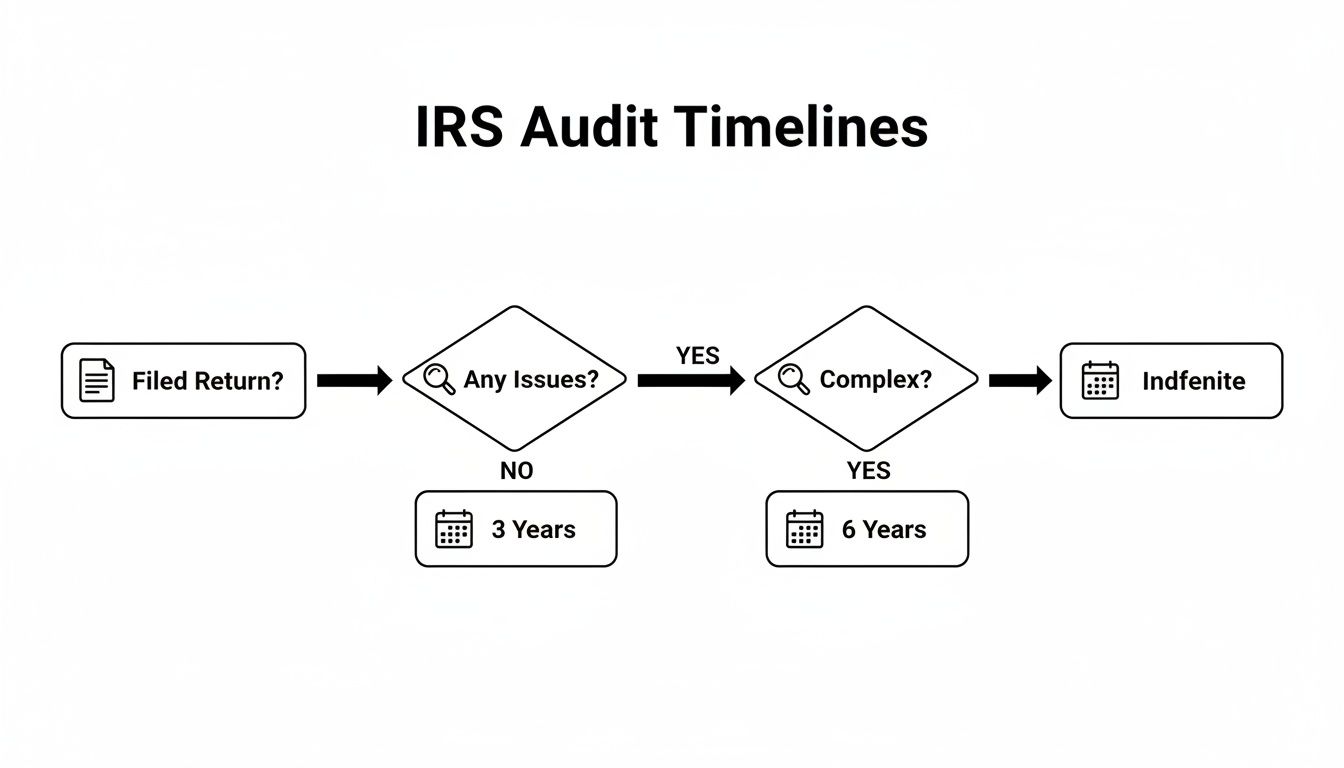
As the graphic shows, everything starts when you file a return. But the accuracy and honesty of what's inside that return are what truly decide whether the IRS has three years, six years, or forever to take a closer look.
The Standard 3-Year Audit Window: Your Baseline for IRS Scrutiny
For most taxpayers, the burning question—"How far back can the IRS audit me?"—has a surprisingly straightforward answer: three years. This is the standard statute of limitations for an audit, and it’s a crucial concept for every taxpayer to understand.
Think of it as a countdown clock. Once that clock runs out for a specific tax year, the IRS generally can't come knocking to audit that return. It’s the rule that prevents you from having to save every receipt for your entire life. But the devil is in the details, specifically, when that three-year clock actually starts ticking.
It doesn’t begin on January 1st. Instead, the IRS starts its three-year countdown from the later of two possible dates:
- The date you actually filed your tax return.
- The original tax filing deadline for that year (usually April 15th).
This distinction is more important than it sounds. Filing early is great for peace of mind and getting your refund faster, but it won't shorten the IRS's window to look at your return. They always get their full three years from the official due date, at a minimum.
How the 3-Year Rule Plays Out in Real Life
Let's walk through a couple of common scenarios to see how this works in practice.
Scenario 1: The Early Filer Imagine you’re on top of your game and file your 2023 tax return on February 10, 2024. The official tax deadline that year is April 15, 2024.
- When does the audit clock start? April 15, 2024. Even though you filed in February, the clock doesn't start until the deadline because that's the later of the two dates.
- When is the audit window closed? The IRS has until April 15, 2027, to audit your 2023 return.
Scenario 2: The Extension Filer Life happens. You get an extension and file your 2023 return on the last possible day, October 15, 2024.
- When does the audit clock start? October 15, 2024. In this case, your filing date is later than the original April 15th deadline, so that’s when the countdown begins.
- When is the audit window closed? The IRS now has until October 15, 2027, to initiate an audit.
By filing an extension, you’ve effectively pushed back the start date of the three-year statute of limitations.
The core principle is simple: The IRS's three-year window begins only after a return is officially considered filed, which is never before the original tax deadline. Understanding the exact IRS statute of limitations is the first step in managing your tax compliance effectively.
Why Good Records Are Your Best Defense
This three-year rule is the foundation of a smart record-keeping strategy. It might be tempting to shred old bank statements and receipts to free up space, but doing it too soon can leave you completely exposed if the IRS does select your return for an audit.
If an auditor questions a business expense you claimed two years ago, simply saying "I don't have the receipt anymore" isn't going to cut it. You have to be able to back up every number on your return.
For this reason alone, you should hang on to all your supporting tax documents for at least three years from the date you filed or the due date (whichever is later). This includes things like:
- Proof of Income: All your W-2s, 1099s, and records of business revenue.
- Expense Records: Receipts, credit card statements, and bank records that verify your deductions.
- Property Records: Documents related to buying or selling a home, including improvements.
Having these documents organized and ready is your primary line of defense. It lets you prove your case quickly and confidently, often resolving an audit before it ever escalates into a major problem. And while three years is the baseline, we're about to explore the exceptions that can stretch that audit window out much, much longer.
When the IRS Can Look Back Six Years
Just when you think you’re in the clear after three years, the IRS has a rule that can double its lookback window. This isn't for minor slip-ups. It's reserved for what the tax code considers a substantial understatement of gross income.
So, what does "substantial" mean? The magic number is 25%. If you leave out more than 25% of the gross income you should have reported, the IRS gets six years, not three, to come knocking. Imagine you actually earned $100,000 but only reported $74,000 on your tax return. That omission crosses the 25% threshold, and suddenly, tax returns you thought were long gone are fair game for an audit.
This rule is a powerful tool for the IRS, designed to catch significant discrepancies that might otherwise fly under the radar.

How Easily Can This 25% Rule Be Triggered?
For business owners, freelancers, and anyone with multiple income streams, hitting that 25% mark can happen more easily than you’d think. It’s often not about deliberate tax evasion; simple but serious bookkeeping errors are a common culprit.
Here are a few all-too-common scenarios that could trigger the six-year lookback:
- The Overlooked 1099: A freelance designer has a great year and brings in $100,000. In the hustle of tax season, they misplace a Form 1099-NEC from a single client worth $30,000. By failing to report it, they've just underreported their income by 30%.
- The Cash-Heavy Business: A food truck owner deals mostly in cash. A faulty point-of-sale system or sloppy daily reconciliations cause them to underreport $50,000 in cash sales over the year. If their properly reported income was $150,000, that forgotten cash represents a 25% understatement of their true $200,000 income.
- The Unreported Investment Gain: Someone sells a chunk of cryptocurrency or stock for a significant gain but forgets to report it on their Schedule D, assuming their brokerage firm "handled it." That one omission could easily push them over the 25% line.
In all these examples, an honest mistake has just doubled the audit risk period from three years to six.
The Legal Fine Print: IRC 6501(e)
This extended timeframe isn't just an internal IRS policy; it’s written into the law. The authority comes directly from Internal Revenue Code § 6501(e), which explicitly gives the agency six years to assess taxes if a taxpayer omits over 25% of their gross income.
This 'six-year statute' kicks in for substantial errors, defined as omitting more than 25% of gross income, such as forgetting Schedule C income for independent contractors or excessive deductions for multi-member LLCs. The IRS rarely goes beyond six years except in severe cases, explicitly stating they 'usually don't go back more than the last six years,' focusing audits on recent returns to maintain efficiency. You can discover more insights about the statute of limitations on Allen Barron's site.
This provision highlights why meticulous record-keeping is so critical. A single large, unreported transaction can have consequences that linger for years, keeping you on the IRS's radar far longer than you'd expect.
A Critical Distinction: Gross Income vs. Taxable Income
Here’s a detail that trips up many business owners: the 25% rule is based on gross income, not your AGI (Adjusted Gross Income) or final taxable income. Gross income is every dollar that comes in the door before you subtract a single business expense.
This is a huge deal. Let’s break it down with an example:
- Actual Gross Revenue: $200,000
- Legitimate Business Expenses: $120,000
- Correct Net Profit (Taxable Income): $80,000
Now, let's say the business owner accidentally leaves out $60,000 of that revenue.
- Reported Gross Revenue: $140,000
- Reported Business Expenses: $120,000
- Reported Net Profit: $20,000
The IRS doesn't care that the net profit was only off by $60,000. They look at the top-line number. The $60,000 omission is 30% of the actual gross revenue of $200,000. That alone is enough to trigger the six-year audit window. It's a stark reminder that tracking every single dollar of revenue is absolutely non-negotiable.
When the Audit Clock Never Stops Ticking
While the three- and six-year rules give most of us a finish line, there are two high-stakes situations where the IRS audit clock isn’t just extended—it’s thrown out completely. In these cases, the statute of limitations simply doesn't apply, giving the IRS a permanent green light to dig into your finances.
This means a tax return from five, ten, or even twenty years ago can be put under the microscope as if it were filed yesterday. It’s absolutely critical to understand what triggers this unlimited lookback period, as it’s reserved for the most serious tax violations.

Situation 1: Filing a Fraudulent Return
The first trigger for an endless audit period is tax fraud. Let’s be clear: this isn’t about making an honest math error or forgetting a stray 1099. We’re talking about a willful and intentional scheme to deceive the IRS and illegally evade paying taxes.
The difference between a mistake and fraud is everything. A mistake is an accident, like transposing a few numbers or getting tripped up by a complicated tax rule. Fraud, on the other hand, means the IRS has to prove you intended to cheat.
What does that look like in the real world?
- Keeping Two Sets of Books: One set of records for your own use and a completely different, falsified version for the IRS.
- Deliberately Hiding Income: Actively funneling business revenue into personal accounts to keep it off the books.
- Claiming Fake Dependents: Making up dependents out of thin air or claiming people who don't qualify just to get bigger tax credits.
- Willfully Misclassifying Employees: Calling your full-time staff "independent contractors" specifically to dodge payroll taxes.
Proving intent is a high legal bar, so the IRS usually reserves this for the most blatant cases. But if they succeed, the statute of limitations for that tax year is gone for good.
Situation 2: Failing to File a Return at All
The second scenario that gives the IRS unlimited time is far more common: simply failing to file a tax return. The logic here is straightforward but unforgiving.
The statute of limitations clock—whether it’s for three years or six—can't start ticking until you file a return. If you never file, the clock never starts.
This leaves you permanently exposed. The IRS can show up anytime—next year or thirty years from now—and assess taxes, penalties, and interest for that unfiled year. If this is your situation, getting a handle on the process for dealing with unfiled tax returns is the essential first step toward putting it behind you.
A lot of people fall into the trap of thinking that if they haven't heard from the IRS after a few years, they're in the clear. That's a dangerous assumption. Remember, the IRS gets copies of W-2s and 1099s from your employers and clients, so they often know you earned income even if you never filed. Their computer systems might not flag your case right away, but that liability never, ever goes away.
The consequences for not filing can be harsh and include:
- Substitute for Return (SFR): The IRS can file a return for you. They’ll usually include your income but give you few, if any, of the deductions you deserve, resulting in a much higher tax bill.
- Steep Penalties: The failure-to-file penalty alone can rack up to 25% of your unpaid tax bill.
- Losing Your Refund: If you were actually owed a refund, you generally have just three years from the original deadline to file and claim it. Wait too long, and that money is gone forever.
In both fraud and non-filing cases, the absence of a time limit gives the IRS incredible power. This indefinite exposure highlights just how serious these issues are and why getting professional help isn't just a good idea—it's essential to finding a way forward.
Diving Into Special Rules for Businesses and Foreign Assets
The standard three and six-year audit windows we've discussed so far mostly cover income taxes, whether personal or business. But the rules of the game change when we start talking about specific obligations like payroll taxes or assets you hold overseas. In those cases, the question of "how far back can the IRS audit?" gets a whole lot more complicated.
For any business with a team, payroll taxes are an absolute hot-button issue for the IRS. These aren't just seen as a debt you owe the government; they're treated as funds you were holding "in trust."
The High Stakes of Unpaid Payroll Taxes
Think about it this way: when you withhold Social Security, Medicare, and federal income tax from an employee's paycheck, that money was never yours to begin with. You're just the middleman, entrusted with passing it along to the U.S. Treasury on your employee's behalf.
If your business fails to hand over these "trust fund" taxes, the IRS doesn't mess around. The initial assessment period is still three years, but the fallout is dramatically more severe and can quickly become a personal problem for the people in charge.
The IRS has a powerful weapon called the Trust Fund Recovery Penalty (TFRP). This allows them to hold "responsible persons" personally on the hook for the unpaid trust fund taxes.
This is a big deal. The TFRP lets the IRS pierce the corporate veil of your LLC or corporation and come after the personal assets of owners, officers, or even a bookkeeper who had significant control over the company's finances. An assessment under the TFRP creates a brand new, personal tax bill with its own ten-year collection clock, completely separate from the business's debt. This personal liability is exactly why staying on top of payroll taxes is one of the most critical responsibilities for any business owner.
To understand more about the red flags for companies, take a look at our guide on what triggers a small business IRS audit.
Longer Audit Timelines for Foreign Financial Assets
In our connected world, it's easier than ever to have assets outside the United States. Because of this, the IRS has put strict reporting rules in place to combat offshore tax evasion, and these rules come with much longer audit periods.
Two key situations can dramatically extend the lookback window:
- Missing Foreign Income: If you forget to report more than $5,000 of income that came from a foreign financial asset, the statute of limitations automatically jumps from three years to six years. That's a much lower bar to clear than the 25% rule for domestic income.
- Forgetting to File Informational Returns: Many foreign assets require you to file specific forms, like Form 5471 for interests in foreign corporations or Form 3520 for foreign trusts. If you fail to file one of these required forms, the statute of limitations for your entire tax return for that year never even starts. It remains open to audit indefinitely.
The Report of Foreign Bank and Financial Accounts (FBAR) is another major area of focus. If you're a U.S. person with more than $10,000 in foreign accounts at any point during the year, you have to file an FBAR. The government has a full six years from the FBAR's due date to hit you with penalties for non-compliance. These extended timelines send a crystal-clear message: the IRS takes international tax compliance very seriously.
What to Do If You're Worried About an Old Tax Return
Learning about how far back the IRS can look into your taxes can stir up a bit of anxiety. It's only natural to wonder about your own past returns. The good news is you don't have to sit with that uncertainty. You can replace it with a clear-headed plan. The key is to move carefully and not make any sudden moves that could accidentally make things worse.
Your first gut reaction might be to rush and file an amended return for a year that's nagging at you. This is often a mistake. Scrambling to amend can pop a red flag on a return that might have otherwise gone unnoticed. In some situations, it can even reset the clock, giving the IRS more time to assess tax. It’s a bit like trying to perform surgery on yourself—you might fix one problem only to create several new, more serious ones.
First, Review—Don’t React
Before you do anything official, take a deep breath and conduct a calm, preliminary review of the tax returns in question. Your goal here isn't to panic; it's simply to gather information and spot potential red flags that might catch the IRS's attention.
Here are a few common issues to look for:
- Missing Income: Did you forget about any 1099s or cash payments? Cross-check your reported income against your bank deposits and records from payment processors.
- Unusually Large Deductions: Do any of your claimed expenses—like meals, travel, or vehicle use—seem way out of proportion to your revenue?
- Inconsistent Numbers: Does the story your tax return tells match up with other financial documents, such as loan applications or business agreements?
Think of this as a fact-finding mission. You’re just trying to identify potential areas of concern so you can have a productive conversation with a professional.
Seek Confidential Professional Advice
Once you have a handle on any potential weak spots, your next move is the most important one: talk to a qualified tax attorney. This is how you get clarity without creating new risks. Your conversations are protected by attorney-client privilege, which means you can be completely open about your situation without worrying that the information could be used against you.
A confidential consultation gives you a clear-eyed assessment of your actual exposure. A tax pro can dig into your specific situation, explain the real-world risks, and lay out your options—which could range from doing nothing to making a strategic disclosure.
This professional guidance is invaluable. It helps you figure out if your fears are justified or if you’re losing sleep over a minor issue. To keep your financial data safe during this process, it's also smart to have robust cybersecurity and accounting practices in place.
Ultimately, an expert can tell you if you even need an IRS audit representative and help you build a proactive defense. This ensures you’re making informed decisions that protect both your personal and business finances.
Common Questions About IRS Audit Timelines
When you're dealing with the IRS, a lot of questions pop up about how far back they can dig into your past tax returns. Getting straight answers to these common questions is the first step toward feeling more in control of your situation.
Does Amending a Tax Return Restart the Audit Clock?
This is a huge point of confusion, but the answer is no, it doesn't. Filing an amended return won't reset the original three-year clock for your entire return.
What it can do, however, is give the IRS a little more time, but only for the specific things you changed. If you amend a return after the original three-year window has closed, the IRS gets a new, very limited 60-day window to assess tax just on the items you adjusted. If you amend while the original period is still open, that clock just keeps on ticking as it was.
If the IRS Audits One Year, Will They Audit Others?
It’s not a guarantee, but it happens more often than not. Think of it from the agent's perspective: if they find a significant error on one return, their next logical question is, "Did this happen in other years?"
If the mistake seems like it could be a pattern—like misclassifying an employee or consistently overstating certain deductions—they have the authority to expand the audit. They'll often pull the tax years immediately before and after the one they're already looking at. This is exactly why keeping clean, consistent records year after year is your best line of defense.
What’s the Difference Between an Audit and a Collection Statute?
This is a critical distinction that trips a lot of people up. The audit clock and the collection clock are two completely separate timers.
- The Audit Statute: This is the window the IRS has to propose and assess a new tax bill. It's the "lookback period" we've been discussing—usually three or six years.
- The Collection Statute: This timer starts after a tax has been officially assessed. Once the bill is on the books, the IRS generally gets a full 10 years to collect that debt.
Knowing which clock is running is fundamental to figuring out how to handle your tax problem. One determines if they can still send you a bill, and the other determines how long they have to collect on a bill you already have.
Do State Tax Audits Follow the Same Timeline as the IRS?
Not necessarily. Many states mirror the IRS with a three or four-year lookback period, but you can't assume they're all the same. Each state has its own set of rules. For example, California’s standard statute of limitations is four years, a full year longer than the IRS standard.
Here's the real kicker: if a federal IRS audit changes your income, most states require you to report that change. Doing so can reopen a state tax year you thought was long closed, triggering a fresh state audit. Always check your specific state’s tax laws—don't get caught off guard.
Facing uncertainty about a past tax return or a potential audit? Don't leave it to chance. At Attorney Stephen A Weisberg, I provide a FREE Tax Debt Analysis to give you clear answers and a strategic path forward. Before you pay anything, you'll know exactly how I can help resolve your IRS issues. Find out more at https://weisberg.tax.


