How Does the IRS Payment Plan Work A Taxpayer's Guide
Struggling with a tax bill? Learn how does the IRS payment plan work with our step-by-step guide on eligibility, types, costs, and how to apply.
In this article
- Your First Steps When You Can't Pay The IRS
- Understanding Your Options
- IRS Tax Debt Solutions at a Glance
- Finding the Right IRS Payment Plan for You
- Short-Term Payment Plan (Up to 180 Days)
- Guaranteed Installment Agreement
- Streamlined Installment Agreement
- Partial Payment Installment Agreement (PPIA)
- Understanding the True Cost of a Payment Plan
- The Initial Setup Fee
- IRS Installment Agreement Fee Structure
- Interest Charges on Your Unpaid Balance
- Penalties: The Good and The Bad
- A Step-by-Step Guide to Applying Online
- Step 1: Gather Your Essential Information
- Step 2: Navigate the Online Payment Agreement Tool
- Step 3: Propose a Payment You Can Afford
- Step 4: Submit and Finalize Your Agreement
- How to Successfully Manage Your Payment Plan
- Defining and Avoiding a Default
- Proactive Strategies for Staying on Track
- What to Do If Your Financial Situation Changes
- When a Payment Plan Isn't the Right Answer
- Offer in Compromise: A Fresh Start
- Currently Not Collectible: A Temporary Pause
- Penalty Abatement: Forgiving Mistakes
- Got Questions? Here Are Some Common Ones About IRS Payment Plans
- What If I Haven’t Filed This Year's Taxes? Can I Still Get a Payment Plan?
- Can I Pay the Whole Thing Off Early?
- Will Setting Up a Payment Plan Wreck My Credit Score?
That sinking feeling when you see a tax bill you can't possibly pay right now? It's a tough spot to be in, but it’s not a dead end. The IRS actually has structured ways for you to get back on track.
An IRS payment plan is essentially a formal agreement, officially called an Installment Agreement, that lets you chip away at your tax debt over time with monthly payments you can actually handle. It’s like a loan from the government, but its main purpose is to keep you out of hot water and avoid more aggressive collection tactics like seizing your wages or levying your bank account.
Your First Steps When You Can't Pay The IRS
Getting a notice from the IRS is stressful, no doubt about it. But the absolute worst thing you can do is ignore it. The problem won't disappear; it just gets bigger as penalties and interest pile up. The good news is, you have options.
The most common path forward is an Installment Agreement. By setting one up, you're essentially telling the IRS, "I know I owe this, and I'm making a good-faith effort to pay." This simple act can stop more severe collection actions in their tracks and give you some much-needed breathing room.
Understanding Your Options
Before you jump into an application, you need to get a crystal-clear picture of your finances. This isn't the time for guesswork. A crucial step is to get all your financial data in order so you can figure out what you can realistically afford to pay each month. For a deep dive, you might need to convert bank statements to Excel for detailed analysis.
To help you see the landscape clearly, let's break down the main ways the IRS helps taxpayers manage their debt.
IRS Tax Debt Solutions at a Glance
This table outlines the main options the IRS provides for handling tax debt, helping you quickly see which path might best fit your financial situation.
| Payment Solution | Best For | Repayment Timeline | Key Characteristic |
|---|---|---|---|
| Short-Term Payment Plan | People who can pay their full balance within 180 days. | Up to 180 days | No setup fee, but interest and penalties don't stop. |
| Long-Term Payment Plan (Installment Agreement) | Those owing under $50,000 who need more than 180 days. | Up to 72 months | Comes with a setup fee; automatic monthly payments are required. |
| Offer in Compromise (OIC) | Taxpayers with serious financial hardship who can't pay in full. | Varies (Lump Sum or Periodic) | Lets you settle your tax debt for less than the total amount you owe. |
| Currently Not Collectible (CNC) | Individuals who can't even afford basic living expenses. | Temporary | The IRS agrees to pause collection efforts until your situation improves. |
Each of these solutions is designed for a different financial reality, so it's important to find the one that truly fits your circumstances.
The IRS has made it surprisingly easy to get started online. In many cases, you can apply for a payment plan directly on their website, which is almost always the fastest way to get approved.
This is a look at the IRS's online payment portal. From here, you can check if you're eligible, apply for a plan, and manage your account. Using these self-service tools can save you from a long, frustrating phone call and often results in immediate approval.
Finding the Right IRS Payment Plan for You
Staring at a tax bill you can't pay is a daunting experience. The good news is, the IRS has several tools in its toolbox to help you resolve that debt over time. But which one is right for you? It's all about matching the solution to your specific financial situation.
Think of it like this: you wouldn't use a sledgehammer to hang a picture frame. If you just need a few extra months to get caught up, a simple short-term plan is a much better fit than a complex, multi-year agreement. The key is understanding what each plan does and who it's designed for.
This decision tree gives you a bird's-eye view of the first choice you'll face, pointing you toward either a payment plan or other potential relief options.
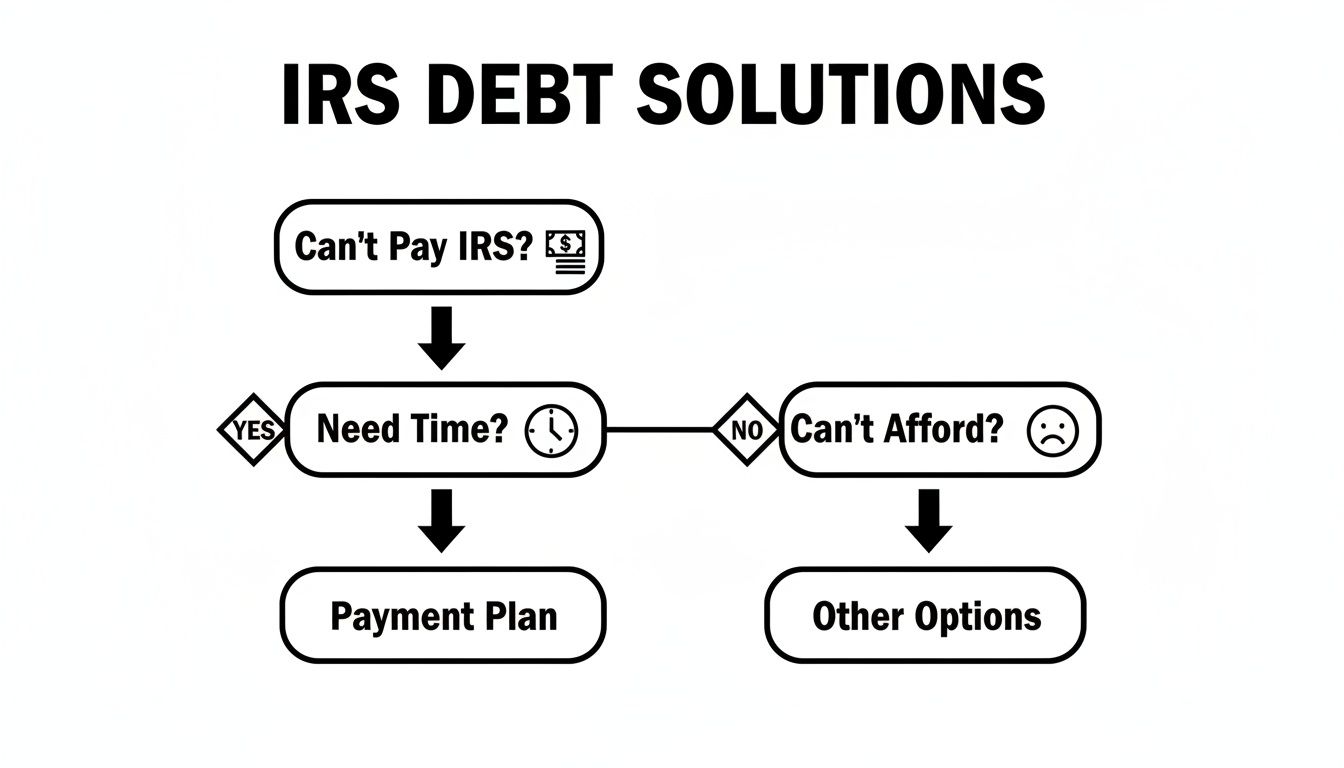
As you can see, it all starts with one question: Do you just need more time, or can you genuinely not afford to pay the full amount? Your answer determines which path you take.
Short-Term Payment Plan (Up to 180 Days)
If you’re confident you can pay your entire tax bill within the next six months, the Short-Term Payment Plan is probably your best bet. This option simply gives you up to 180 additional days to settle up.
The biggest perk? No setup fees. While interest and late-payment penalties will keep ticking on your unpaid balance, you avoid the administrative cost that comes with a formal, long-term installment agreement. This is a perfect solution for a small business owner waiting on a big client payment or a freelancer who knows a project payout is just around the corner.
Guaranteed Installment Agreement
For smaller tax debts, the Guaranteed Installment Agreement is exactly what it sounds like. If you check all the boxes, the IRS is required by law to approve your request.
Here’s what it takes to qualify:
- You must owe $10,000 or less in tax (this figure doesn't include penalties and interest).
- You have a clean record for the past five years—meaning you've filed and paid all your taxes on time.
- You agree to pay off the full balance within three years.
This is tailor-made for someone with a solid history of tax compliance who got hit with a small, unexpected bill. It provides a secure, no-fuss way to get back on track.
Key Takeaway: Think of the Guaranteed Installment Agreement as a right, not a request. It's the IRS's way of rewarding a history of good compliance with an automatic path to resolving minor tax debts.
Streamlined Installment Agreement
This is the workhorse of IRS payment plans, covering a much wider range of situations. The Streamlined Installment Agreement is for taxpayers who owe more but can still realistically pay it off within a reasonable timeframe.
The thresholds are much more generous here:
- Individuals can owe up to a combined $50,000 in tax, penalties, and interest.
- You get up to 72 months (six years) to clear the balance.
The IRS has made it easier than ever to get one of these set up, thanks to major improvements to its online tools. Many people can now set up plans for balances up to $50,000 for individuals ($25,000 for businesses) right from their online IRS account. In fact, after a recent filing deadline, the IRS had already processed over 138 million individual returns, with a growing number of taxpayers using these digital tools to manage what they owe.
Partial Payment Installment Agreement (PPIA)
But what if you can't afford to pay your entire tax debt, even stretched out over six years? This is where the Partial Payment Installment Agreement (PPIA) comes into play. A PPIA lets you make monthly payments based on what you can actually afford, even if those payments won't pay off the full debt before the statute of limitations on collection expires.
This option is reserved for taxpayers facing true financial hardship. Be prepared to open your books, as the IRS will require detailed financial information to prove you can’t pay more. It's a critical safety net, but getting one approved is a complex process. If you find yourself in this tough spot, it's worth taking a closer look at a guide to the Partial Pay Installment Agreement to understand the nuances.
Understanding the True Cost of a Payment Plan
An IRS payment plan can be a lifesaver when you're facing a tax bill you can't pay all at once. But it’s critical to go in with your eyes wide open. Think of it less like a simple payment extension and more like a loan from the government—it comes with its own costs that add to your total bill over time.
Knowing exactly what these costs are from the get-go is the key to budgeting properly and deciding if an installment agreement is truly the right move for you. The main expenses you'll run into are setup fees, interest, and ongoing penalties. While that might sound daunting, setting up a formal plan is almost always a better financial decision than ignoring the debt and letting those penalties stack up at their full, unforgiving rate.
Let's break down each piece so you know exactly what you’re getting into.
The Initial Setup Fee
The first thing you’ll pay is a one-time setup fee to get a long-term installment agreement in place. This isn't a one-size-fits-all charge; the amount actually depends on how you apply and whether you agree to let the IRS pull payments directly from your bank account.
The fee can range anywhere from $31 to $225. The IRS offers a big incentive for taxpayers to use its online system and set up automatic payments. The good news is that these fees are often reduced or even waived for low-income taxpayers, making these agreements much more accessible. You can see more about recent trends in the IRS's own filing season statistics.
Below is a quick overview of what you can expect to pay for setting up a plan.
IRS Installment Agreement Fee Structure
This table breaks down the one-time setup fees for a long-term payment plan. Notice how much you can save just by applying online and choosing direct debit.
| Application Method | Standard Fee | Direct Debit Fee | Low-Income Applicant Fee |
|---|---|---|---|
| Online | $130 | $31 | $31 (Waived with Direct Debit) |
| Phone or Mail | $225 | $107 | $43 |
The takeaway here is pretty clear: the IRS is pushing everyone toward their automated, online tools. If you can, apply online and use direct debit—it’s the cheapest way to get started.
Interest Charges on Your Unpaid Balance
Just like a credit card company, the IRS charges interest on any unpaid tax debt. What’s more, this interest is compounded daily. That means you’re not just paying interest on the original tax you owe, but also on the penalties and the interest that has already piled up.
The rate itself isn't fixed; the IRS adjusts it every quarter. It’s calculated as the federal short-term rate plus 3%. Because of that daily compounding, the longer you take to pay off your balance, the more interest you'll ultimately pay. For a deeper dive into understanding the implications of interest on tax debt, this resource offers some helpful context, even though it's focused on another country's tax system.
Penalties: The Good and The Bad
Finally, let's talk penalties. The most common one you'll run into is the Failure to Pay penalty. Normally, this penalty is 0.5% of your unpaid tax bill for every month (or even part of a month) that it goes unpaid, and it can grow until it hits a cap of 25% of your original debt.
Crucial Benefit: Here's the major silver lining. As soon as your installment agreement is officially approved, the IRS immediately cuts that Failure to Pay penalty rate in half, dropping it from 0.5% down to just 0.25% per month. This reduction is easily one of the biggest financial perks of getting into a formal payment plan.
To get a clearer picture of how these fees, interest, and penalties might look in your specific case, check out our detailed IRS payment plan calculator guide. Just by taking the step to set up an agreement, you're not only getting compliant—you're also saving a significant amount of money over the long haul.
A Step-by-Step Guide to Applying Online

Knowing your options is one thing, but the next step is putting a plan into action. The good news is the IRS has made this much easier with its Online Payment Agreement (OPA) tool. For most people, this is the fastest way to get a payment plan in place, often giving you an immediate answer without ever picking up the phone.
Let's walk through exactly how to use the online system. We'll break down what can feel like a daunting task into a few straightforward steps, from getting your papers in order to submitting your final request.
Step 1: Gather Your Essential Information
Before you even open your web browser, a little prep work will make the whole process go smoothly. Think of it like gathering your ingredients before you start cooking—it prevents a lot of scrambling later.
Make sure you have these key items handy:
- Your Personal Details: Your name and address exactly as they appear on your last tax return, a valid email, and your Social Security Number (SSN) or Individual Taxpayer Identification Number (ITIN).
- Key Tax Information: You'll need the total amount you owe and the specific tax year or period it's for. This is all listed on the notice the IRS sent you.
- Financial Details: If you plan on setting up automatic payments (which I highly recommend), have your bank routing and account numbers ready.
Once you’ve got this information in front of you, you’re ready to get started.
Step 2: Navigate the Online Payment Agreement Tool
With your documents ready, head over to the IRS website and find the Online Payment Agreement (OPA) application. You'll first need to verify your identity, which is a standard security step to protect your information.
Once you’re in, the system will show you the payment options you likely qualify for. It often presents a pre-calculated monthly payment based on clearing your debt within 72 months, the maximum term for a Streamlined Installment Agreement.
The OPA tool is built for speed. If you fall within the Streamlined or Guaranteed Agreement rules, the system can approve you on the spot. It's a prime example of how the IRS payment plan works in a more modern, digital-first way.
Step 3: Propose a Payment You Can Afford
The payment amount the IRS initially suggests might not work with your budget, and that’s perfectly fine. The tool allows you to propose a different monthly payment.
Just be realistic here. If you propose a number so low that it won't pay off the debt inside that 72-month window, the online system will probably reject it.
If your proposed payment is too low for automatic approval, you'll likely need to provide the IRS with a full financial statement. For these more complex cases, a detailed Form 433-F guide can help you resolve an IRS collection case by showing you exactly how to present your financial situation.
Step 4: Submit and Finalize Your Agreement
After you’ve entered your proposed payment, the last step is to review everything and submit your application. This is your final chance to make sure every detail is correct.
In most straightforward cases, you’ll get an immediate notification of approval. The confirmation will spell out your monthly payment, the due date of your first payment, and the one-time setup fee that gets tacked onto your tax balance.
Pro Tip for Success: When setting up your plan, always opt for direct debit. Doing so drops the setup fee from $130 to just $31 for online applications. More importantly, it automates your payments, which is the best way to avoid accidentally missing one and defaulting on the entire agreement.
How to Successfully Manage Your Payment Plan

Getting your IRS payment plan approved is a huge relief, but it’s really just the beginning. The real challenge is staying compliant for the life of the agreement until that tax debt is finally gone for good. Successfully managing your plan comes down to attention to detail and a proactive mindset.
Think of it like getting a mortgage. The bank gives you the loan, but you're on the hook for making every single payment for the next 15 or 30 years. Your IRS agreement is no different—consistent, on-time payments are the only way to get to the finish line without hitting a major snag.
Defining and Avoiding a Default
The most critical part of managing your plan is knowing exactly what can cause it to collapse. An IRS installment agreement can go into default for two main reasons, and thankfully, both are entirely within your control.
- Missing Payments: This one’s obvious. If you don't make your agreed-upon monthly payments on time, the agreement is broken.
- Not Filing Future Returns: You are required to file all future tax returns on time, even if you owe more tax that you can't pay right away.
Defaulting is a big deal. It completely cancels your agreement and opens the door to serious consequences.
The High Cost of Default: When an agreement defaults, the Failure to Pay penalty—which was cut in half to 0.25% per month while your plan was active—immediately doubles back to the standard 0.5% rate. Worse, the IRS can restart aggressive collection actions, like filing a federal tax lien or levying your bank accounts and wages.
Proactive Strategies for Staying on Track
Staying out of default isn't about hoping for the best; it's about building a solid system. Treat your IRS payment like any other mission-critical bill, and you'll be fine. Here are a few practical strategies to keep you on the right path.
1. Automate Everything If you didn't set up a direct debit when you applied, you should do it now through your IRS Online Account. It’s the single best way to prevent a missed payment. The money is withdrawn automatically each month, so you can set it and forget it.
2. Mark Your Calendar For those who need or want to make manual payments, don't leave it to memory. Set multiple reminders using your phone's calendar, a physical planner, or whatever tool you trust. I always recommend setting an alert a few days before the due date to give yourself a buffer.
3. File Every Year, No Matter What Make filing your annual tax return a non-negotiable priority. Even if you know you’re going to owe more money, you absolutely must file by the deadline. You can often roll a new tax debt into your existing payment plan, but failing to file will put your current agreement in default automatically.
What to Do If Your Financial Situation Changes
Life happens. A job loss, a surprise medical bill, or a downturn in your business can suddenly make your payment unaffordable. If you find yourself in this situation, the worst thing you can do is just stop paying. The IRS has a process for this.
You can often modify your installment agreement right from your IRS Online Account. The system may let you adjust your monthly payment to something that better fits your new financial reality. By acting quickly and communicating the change, you’re showing the IRS you’re still making a good-faith effort to pay what you can.
If you do fall behind and your agreement gets terminated, don't panic. You can often get it reinstated, though you might have to pay a reinstatement fee. The key is to act fast, contact the IRS, and explain what’s going on to get things back on solid ground.
When a Payment Plan Isn't the Right Answer
Sometimes, the math just doesn't work. Even stretched out over six years, a standard installment agreement can be a financial impossibility if you're facing a serious hardship. When that’s the case, simply getting more time to pay isn't the solution—you need a different kind of relief.
Fortunately, the IRS has other programs designed for situations where your ability to pay is fundamentally broken. Knowing these alternatives exist is critical. Jumping into a payment plan you can't actually afford is a recipe for default, which only digs the hole deeper. For some taxpayers, a different path—like settling the debt for a fraction of what’s owed or hitting a temporary pause button on collections—is the only responsible way forward.
These options are definitely more complex and come with a higher burden of proof, but they can be an absolute lifeline for those who truly need one.
Offer in Compromise: A Fresh Start
An Offer in Compromise (OIC) is exactly what it sounds like: an agreement with the IRS to settle your tax debt for less than the full amount you owe. This isn't a get-out-of-jail-free card; it’s reserved for taxpayers in dire financial straits where the IRS has serious doubts it could ever collect the full debt.
Think of it as a final settlement. To even be considered, you have to prove that paying in full would create a genuine "economic hardship." This means the IRS will put your finances under a microscope, looking at everything:
- Your real ability to pay based on current income and necessary living expenses.
- The total value of your assets—from your home and car to investments.
- Your realistic future earning potential.
If your OIC is approved, you pay the negotiated amount, and the IRS wipes the rest of the debt clean. It's an incredibly powerful tool, but the application is invasive, and the approval standards are notoriously tough.
Currently Not Collectible: A Temporary Pause
What happens when you can't even cover basic living expenses, let alone a monthly tax payment? That’s where Currently Not Collectible (CNC) status comes into play. It’s important to understand this doesn't make the debt disappear, but it provides a crucial breathing room.
When the IRS places your account in CNC status, they agree to stop all aggressive collection actions. That means no bank levies, no wage garnishments, no more immediate threats while you work to get back on your feet.
Your tax debt, however, is still on the books. It will continue to grow as interest and penalties pile up, but the immediate pressure is gone. The IRS will periodically review your financial situation to see if things have improved enough for you to start paying again. CNC is a powerful short-term fix for someone dealing with a job loss, a major medical crisis, or another overwhelming financial setback. For a deeper dive into the process, you can learn more about how to get not collectible status with the IRS.
Penalty Abatement: Forgiving Mistakes
Look closely at your tax bill. Sometimes, a huge chunk of what you owe isn't the original tax at all—it’s the penalties. If you have a legitimate reason for failing to file or pay on time, you can formally request a Penalty Abatement.
The IRS has the authority to forgive certain penalties if you can demonstrate "reasonable cause." This isn't just any excuse; it has to be a compelling reason, such as:
- A serious illness or death of an immediate family member.
- Your home or business records were destroyed in a natural disaster.
- You relied on incorrect advice from a competent tax professional.
Getting penalties removed can drastically shrink your total debt, which might suddenly make a standard payment plan affordable again. Each of these alternatives—the OIC, CNC status, and Penalty Abatement—requires meticulous documentation and a well-argued case. This is where professional help often becomes essential to navigate the IRS bureaucracy and get the best possible result.
Got Questions? Here Are Some Common Ones About IRS Payment Plans
When you're staring down a tax bill, it's natural to have a lot of questions about how a payment plan actually works. Let's tackle some of the most frequent ones I hear from clients.
What If I Haven’t Filed This Year's Taxes? Can I Still Get a Payment Plan?
This is a firm "no" from the IRS. Before they’ll even consider letting you pay in installments, you have to be completely caught up on filing all your past-due tax returns. It's a non-negotiable first step.
If you know you're going to owe on a return you haven't submitted yet, don't let that stop you from filing on time. Filing is crucial because it helps you dodge the Failure to File penalty, which is often much steeper than the penalty for not paying. My advice? File the return, pay what you can immediately, and then apply for a payment plan for the rest.
Can I Pay the Whole Thing Off Early?
Yes, you absolutely can, and you absolutely should if you're able. The IRS has no prepayment penalties, so you're not punished for getting ahead.
Think of it this way: interest and penalties are ticking up every single day. By paying your balance off early, you stop that clock. Every extra payment you make chips away at the actual tax you owe, not just the interest, which can save you a ton of money in the long run. You can easily make extra payments or pay the full balance right from your IRS Online Account.
Will Setting Up a Payment Plan Wreck My Credit Score?
An IRS payment plan itself doesn't get reported to Equifax, Experian, or TransUnion. So, just having the agreement won't directly hurt your credit score.
The real danger to your credit comes from the IRS filing a Notice of Federal Tax Lien. A tax lien is a public claim against your property, and it can do serious damage to your credit report. Here's the good news: being proactive and setting up a payment plan is one of the best ways to convince the IRS not to file a lien. And if your debt is over $25,000, agreeing to a Direct Debit Installment Agreement might even qualify you to have an existing lien withdrawn after you've made a few on-time payments.
Navigating IRS debt can be complex, and every situation is unique. If you're struggling with tax issues and need expert guidance, Attorney Stephen A Weisberg offers a free, no-obligation Tax Debt Analysis to determine the best path forward for you. Instead of facing the IRS alone, get a clear strategy from an experienced tax attorney. Find out how I can help at https://weisberg.tax.


