How Does a 1099 C Affect My Taxes: Your 2026 Tax Guide
Learn exactly how does a 1099 c affect my taxes. Understand when it's taxable, how to report it correctly, or claim an exclusion in 2026.
In this article
- That Unexpected Letter The 1099-C Explained
- Why people get blindsided
- What to do first
- Why Canceled Debt Counts as Income
- The easiest way to think about it
- Why ignoring the form is a mistake
- What the form usually tells you
- Is Your Canceled Debt Actually Taxable?
- Scenarios that are generally taxable
- Scenarios that may be excluded
- Taxability of canceled debt scenarios
- The mistake people make here
- Claiming Exclusions with Form 982
- Start with the right exclusion
- How the insolvency test really works
- How much can you exclude
- The filing checklist
- How to Report a 1099-C on Your Tax Return
- Path A for taxable canceled debt
- Path B for excluded canceled debt
- Personal debt versus business debt
- If you already filed it wrong
- Common Pitfalls and State Tax Rules
- The mistakes I see most often
- Why state taxes deserve separate attention
- Your Next Steps After Receiving a 1099-C
You open the mail expecting another routine tax document and instead find Form 1099-C, Cancellation of Debt. The reaction is commonly the same: confusion first, then dread. You thought that old credit card, settled loan, or charged-off account was behind you. Now it looks like the IRS has entered the conversation.
Take a breath. A 1099-C doesn't automatically mean you owe tax. It does mean you need to deal with it correctly. If you ignore it, you can create a second problem after finally getting rid of the first one.
The question clients usually ask is simple: How does a 1099-C affect my taxes? The short answer is that canceled debt can become taxable income unless an exclusion applies. The complete answer depends on what kind of debt it was, when it was canceled, and whether you were in bankruptcy or insolvent at that moment. That's where strategy matters.
That Unexpected Letter The 1099-C Explained
A 1099-C is the form a lender sends when it says a debt was canceled or forgiven. In plain English, the creditor is telling both you and the IRS, “We're no longer expecting repayment of this amount.”
That feels backward to many taxpayers. You didn't get money. You didn't receive a paycheck or a bonus. You just stopped owing an old debt. But from a tax standpoint, that change can matter.
The first thing to understand is that the form itself is not a tax bill. It's a reporting document. It tells you what the creditor claims happened, and it gives the IRS a data point to match against your return.
Practical rule: A 1099-C is never something to toss in a drawer and “deal with later.” The IRS computer system usually treats silence as an error, not as a valid position.
Why people get blindsided
This form often arrives long after the financial event that caused it. You may have settled a debt, stopped hearing from a creditor, or moved on after a rough period. Then the 1099-C arrives and reopens the issue.
That timing catches people off guard because tax law focuses on when the debt was canceled, not when payments first went bad. If a creditor reports cancellation in a given tax year, that's the year you analyze.
What to do first
Before you panic, do three things:
- Read every box on the form. Confirm the creditor name, account, and canceled amount.
- Compare it to your records. Look for settlement letters, payment histories, bankruptcy paperwork, or collection notices.
- Don't assume it's taxable yet. Some canceled debt is taxable. Some isn't.
That distinction matters. A lot.
Why Canceled Debt Counts as Income
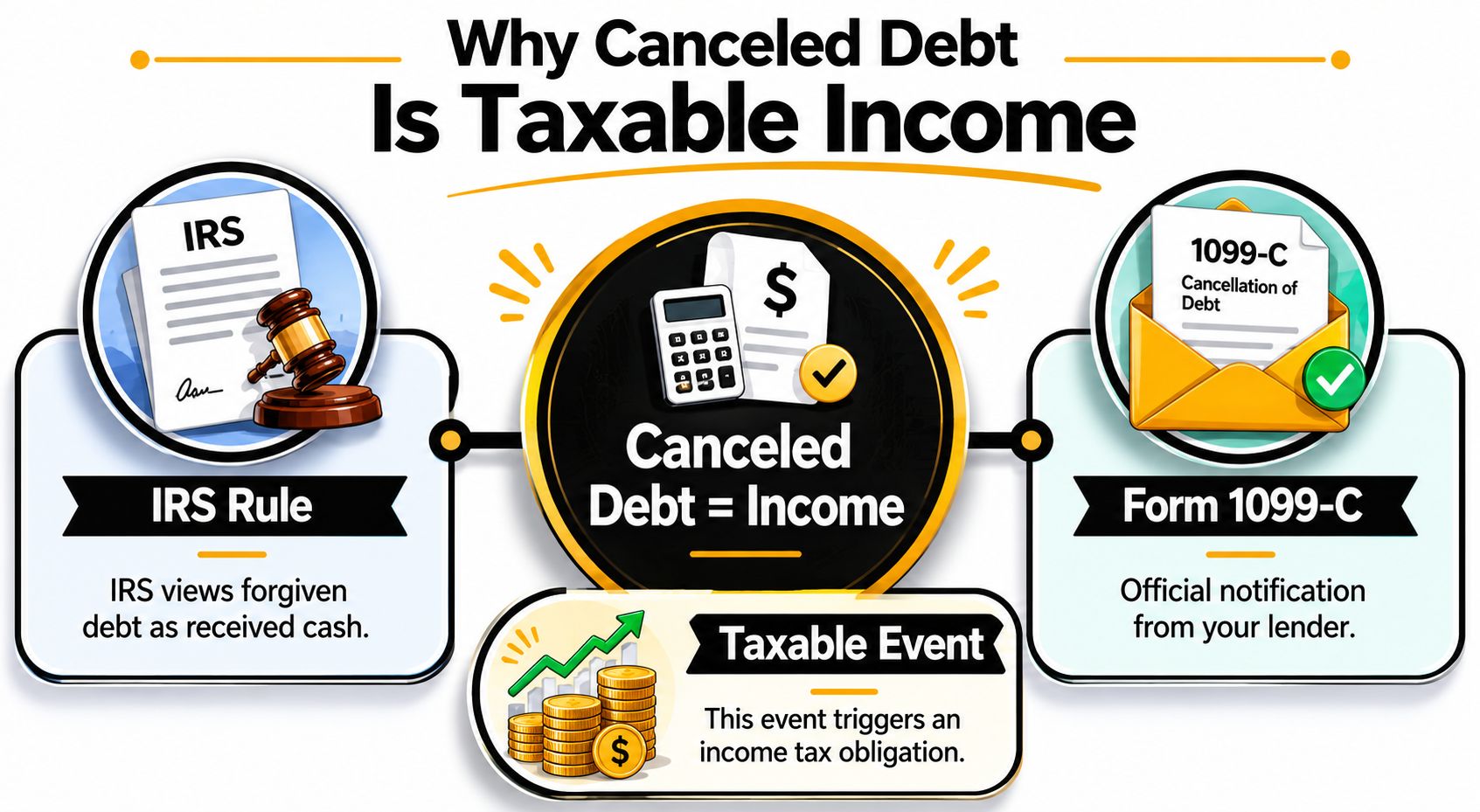
The IRS treats canceled debt as income because your legal obligation to repay money has disappeared. In practical terms, your balance sheet improved. You didn't get cash in hand, but you no longer owe what you once owed.
That is the core idea behind cancellation of debt income. It is often called phantom income because it can create tax consequences even though no cash hit your bank account.
Under IRS Topic 431, the IRS generally treats canceled debt as taxable income in the year the cancellation occurs. The same IRS guidance also says the canceled portion is ordinarily included in gross income when a debt is forgiven for less than the amount owed, and lenders generally issue Form 1099-C when they cancel $600 or more of debt.
The easiest way to think about it
Suppose you owed a creditor money and that legal obligation vanished. The IRS often sees that as economically similar to receiving money and then using it to pay off the debt. That's why the tax system treats it as income in many situations.
You may not like that rule. This feeling is common. But fighting the concept usually wastes time. The smarter move is figuring out whether an exclusion applies and then reporting it the right way.
Why ignoring the form is a mistake
A 1099-C is an information return. The creditor sends one copy to you and one to the IRS. That means your tax return gets matched against it.
If your return says nothing about the canceled debt, the IRS may send a notice because its records show income that your return doesn't reflect. Even if you qualify for an exclusion, you still need to handle the form properly.
The worst response to a 1099-C is no response. If the form is right, report it correctly. If it's wrong, challenge it with documents.
What the form usually tells you
You don't need to memorize every box, but you should review the form carefully. Focus on these practical points:
- Canceled amount: This is the figure that may become taxable unless an exclusion applies.
- Date of cancellation: This controls the tax year that matters.
- Creditor identity: Make sure the reporting party matches the debt you had.
- Interest and related details: These entries can matter, especially if the debt had mixed components or was tied to business activity.
If you're asking how does a 1099 C affect my taxes, this is the first fork in the road. The form starts the analysis. It doesn't finish it.
Is Your Canceled Debt Actually Taxable?
Here's the answer clients want and deserve: not every 1099-C creates taxable income you have to pay tax on. The default rule is unfavorable, but several exclusions can wipe out some or all of the tax effect.
The key is to sort your situation into the right category. Don't guess. Don't use wishful thinking. Match the facts.
Scenarios that are generally taxable
Personal debts are often the ones that create the most surprise. If you settled an unpaid credit card, personal loan, or similar consumer debt and you were financially able to pay your debts at the time, the canceled amount is generally taxable.
That's especially common when someone negotiates a settlement for less than the full balance and then assumes the matter is over. Financially, the collection may be over. Tax-wise, it may just be starting.
Scenarios that may be excluded
Some canceled debt can be excluded from income. The major categories recognized by the IRS include:
- Bankruptcy debt: Debt discharged in bankruptcy is a classic exclusion.
- Insolvency: If your liabilities exceeded your assets immediately before the cancellation, some or all of the canceled debt may be excluded.
- Certain farm debt: This is specialized and fact-specific.
- Qualified real property business debt: Usually relevant in business settings, not ordinary consumer cases.
- Qualified principal residence indebtedness: This can matter under current IRS expiration-date rules referenced in Topic 431.
If your debt was wiped out in bankruptcy, start there. Many taxpayers dealing with unsecured debt should also understand the broader legal context around discharge. This guide to credit card debt bankruptcy gives useful background on how bankruptcy interacts with consumer debt. For tax-side issues involving debt forgiveness and IRS treatment, this discussion of IRS debt forgiveness issues is also worth reviewing.
Taxability of canceled debt scenarios
| Scenario | Generally Taxable? | Key Consideration |
|---|---|---|
| Credit card debt settled for less than full balance | Usually yes | Often taxable unless bankruptcy or insolvency applies |
| Personal loan forgiven outside bankruptcy | Usually yes | Consumer debt forgiveness often creates income |
| Debt discharged in bankruptcy | Usually no | Must be claimed correctly on the return |
| Debt canceled while insolvent | Potentially no | Exclusion may apply up to the amount of insolvency |
| Certain farm debt | Potentially no | Requires a specific qualifying situation |
| Qualified real property business debt | Potentially no | More common in business and real estate contexts |
| Qualified principal residence indebtedness | Potentially no | Depends on current law and timing rules |
The mistake people make here
They jump from “I got a 1099-C” to “I definitely owe tax.” That's not disciplined analysis.
The better approach is this:
- Identify the debt type.
- Identify whether you were in bankruptcy.
- Check whether you were insolvent immediately before cancellation.
- Only then decide whether the amount belongs in taxable income.
If your facts are simple, you can often sort this out yourself. If they aren't, paying for experienced advice is usually money well spent.
Claiming Exclusions with Form 982
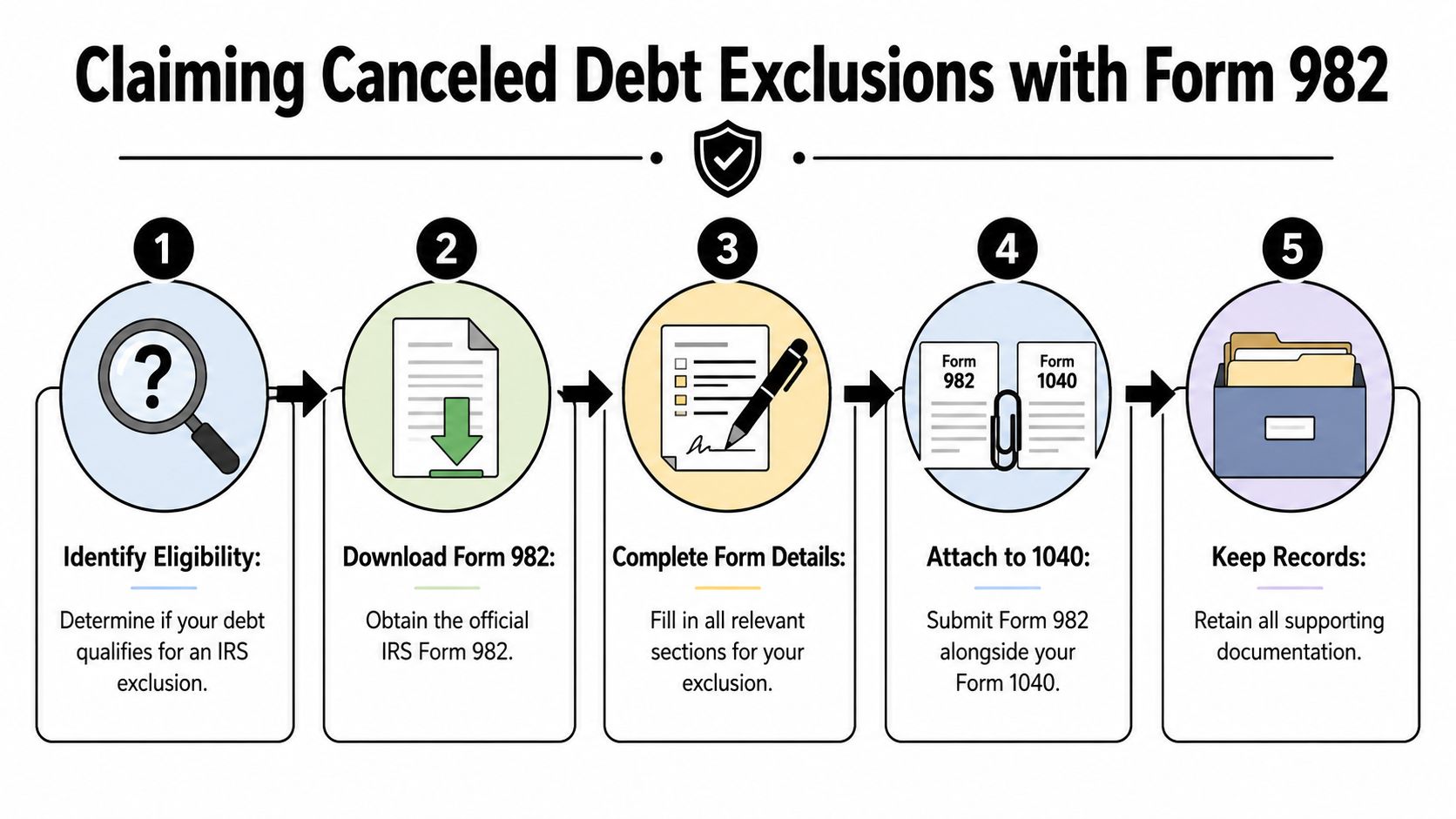
If an exclusion applies, the IRS won't automatically assume it for you. You generally claim it using Form 982, Reduction of Tax Attributes Due to Discharge of Indebtedness. Many taxpayers often stumble at this point. They know an exclusion exists, but they fail to file the form correctly.
That error is avoidable.
Start with the right exclusion
Form 982 asks you to identify why the canceled debt isn't taxable. For many individuals, the two most important possibilities are:
- Debt discharged in bankruptcy
- Debt excluded because you were insolvent
If your debt was canceled in bankruptcy, the analysis is usually cleaner. You identify that basis on Form 982 and attach it to your return. If your situation involved bankruptcy and tax debt issues at the same time, this overview on whether you can file bankruptcy on tax debt gives helpful context.
How the insolvency test really works
Insolvency means your total liabilities were greater than the fair market value of your total assets immediately before the debt was canceled. Timing matters. “I was broke that year” isn't enough. The snapshot must match the moment before cancellation.
This is not a vibe test. It's a worksheet.
You list what you owned and what you owed at that moment.
Include assets realistically
Your asset list usually includes items such as:
- Cash and bank balances: Checking, savings, and similar accounts
- Vehicles: Use fair market value, not what you wish they were worth
- Real estate: Equity matters, so market value and debt both matter
- Retirement accounts and investments: These often get overlooked
- Personal property: Business equipment, valuable household items, or other property can matter
Include liabilities completely
Your liabilities usually include debts you legally owed immediately before cancellation, such as:
- Credit cards and personal loans
- Mortgage balances
- Auto loans
- Medical debts
- Tax debts and other enforceable obligations
Important: Sloppy insolvency calculations create bad tax returns. If you lowball assets or forget liabilities, your conclusion may be wrong and the IRS can challenge it.
How much can you exclude
If you were insolvent, the exclusion generally applies up to the amount of that insolvency. If your insolvency was larger than the canceled debt, you may exclude all of it. If your insolvency was smaller, only part may be excluded.
That's why records matter. Pull account statements, payoff figures, property values, and debt balances from that period. Reconstruct the exact financial picture. Don't estimate if you can document.
The filing checklist
When claiming an exclusion:
- Complete Form 982 carefully.
- Check the correct exclusion box.
- Enter the excluded amount accurately.
- Attach the form to your federal return.
- Keep your support documents.
If the issue is straightforward, software may get you there. If it involves mixed personal and business debt, old settlements, disputed values, or multiple 1099-Cs, I'd strongly consider professional help before filing.
How to Report a 1099-C on Your Tax Return
Once you've determined whether the canceled debt is taxable, the next step is reporting it properly. Through proper reporting, taxpayers either cleanly close the issue or create an avoidable notice problem.
Path A for taxable canceled debt
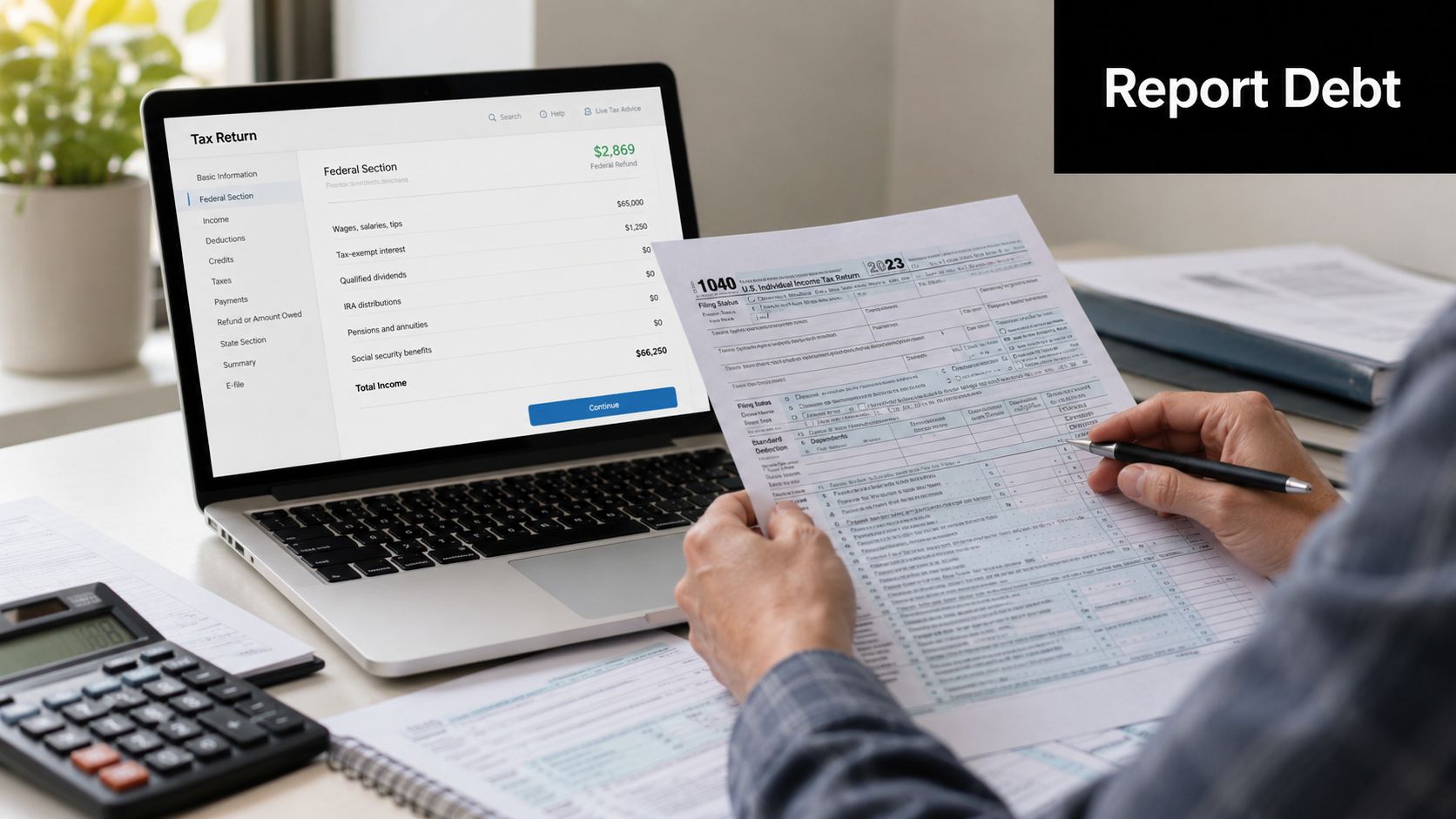
If no exclusion applies, the canceled debt is generally reported as income on your federal return. For many individuals with personal debt, that means reporting it through Schedule 1 as additional income, which then flows to Form 1040.
Use the 1099-C information carefully. Match the amount and the year. If the debt was personal, don't bury it in a business section of the return. If it was tied to a sole proprietorship, rental activity, or other business context, the reporting location may differ based on the nature of the debt.
That distinction matters because business and rental debt can affect other parts of the return differently than personal consumer debt.
Path B for excluded canceled debt
If bankruptcy, insolvency, or another exclusion applies, you generally do not ignore the 1099-C. You address it by filing Form 982 and reporting the exclusion properly.
That tells the IRS why the income shown on the information return shouldn't be taxed. Done correctly, it aligns your return with the IRS record while preserving your legal exclusion.
When a 1099-C is excluded, the goal isn't silence. The goal is a paper trail the IRS can follow without guessing.
Personal debt versus business debt
A common mistake is treating all 1099-C forms the same. They aren't.
- Personal credit card or loan debt: Often flows through additional income reporting if taxable.
- Business debt: May affect business schedules depending on the debt and entity structure.
- Rental property debt: Can raise separate classification issues.
If you use software, choose one that lets you trace where the canceled debt is landing on the return. If you need a practical overview of digital filing tools, you can discover cloud based tax solutions that help organize tax documents and workflow. Just don't confuse convenience with judgment. Software can enter numbers. It can't always classify debt correctly.
If you already filed it wrong
This happens all the time. People report the amount as taxable and later realize they qualified for insolvency. Or they leave it off entirely and get an IRS notice.
If that's your situation, fix it. Don't wait for the problem to grow. This guide on how to amend a tax return can help you understand the correction process.
For complex cases, one option is to work with a tax controversy attorney such as Attorney Stephen A. Weisberg, whose practice includes IRS dispute and tax debt matters involving reporting issues and relief strategy.
Common Pitfalls and State Tax Rules
Most 1099-C problems aren't caused by the form itself. They're caused by bad assumptions.
The first bad assumption is that no cash means no tax issue. That's wrong often enough to get people into trouble. The second is that a lender's form must be perfectly accurate. Sometimes it is. Sometimes it isn't. But you need proof before you challenge it.
The mistakes I see most often
- Ignoring the form entirely: This is the fastest route to an IRS notice.
- Botching the insolvency calculation: People forget retirement accounts, vehicles, or other assets, then overstate their exclusion.
- Assuming the cancellation date is wrong without checking records: Timing controls the tax year, so verify before you dispute.
Another mistake is treating “settled,” “charged off,” and “canceled” as if they mean the same thing for tax reporting. They don't always line up. The creditor's tax reporting date is what you have to evaluate.
State tax treatment is where many careful federal filers get blindsided. A federal exclusion doesn't automatically carry over the way you think it should.
Why state taxes deserve separate attention
States can follow federal treatment, modify it, or require their own adjustments. That means you can be right on the federal return and still have a state issue.
Check your state's rules before you file. If your state decouples from part of the federal treatment, you may need a separate state adjustment, separate form, or different inclusion result. Don't assume your tax software got this right just because it imported your federal return.
If you received a federal exclusion and your state return looks odd, stop and review it. That's cheaper than dealing with penalties and interest later.
Your Next Steps After Receiving a 1099-C
Don't overcomplicate this. Handle it in order.
First, verify the form. Make sure the debt is yours, the amount is right, and the cancellation year matches your records. If something is off, contact the creditor and ask for a corrected form in writing.
Second, determine whether the canceled debt is taxable or excluded. Bankruptcy and insolvency are the two most common places to look, but don't force facts that aren't there. If you qualify, document it and file accordingly.
Third, report it correctly on the return. That may mean including it as income, or it may mean attaching Form 982 and excluding it properly. Either way, you need a return that matches reality and makes sense to the IRS.
If the debt was large, tied to a business, mixed with old settlements, or involved a disputed form, get help. That's not weakness. That's judgment. Tax advice is a poor place to be cheap when the issue can trigger notices, added tax, and state complications.
If your 1099-C turns into a balance you can't pay, you should also understand your broader IRS resolution options. This guide to settling tax debt with the IRS is a good place to start.
If you received a 1099-C and you're not sure whether it creates taxable income, whether Form 982 applies, or how to fix a filing mistake, talk to Attorney Stephen A Weisberg. He helps individuals and business owners analyze IRS issues, evaluate exclusions, and respond strategically when canceled debt creates a tax problem.


