How Do Tax Resolution Services Work: A 2026 Guide
Learn how do tax resolution services work, from IRS negotiations to fees and timelines. Discover what to expect in 2026.

In this article
- Why Tax Problems Need Triage Before Resolution
- What Happens During Intake and Financial Analysis
- How Ability to Pay Shapes the Available Outcome
- Common Tax Resolution Strategies and What They Can Change
- Attorney Led and Non Attorney Tax Services Compared
- Fees Timelines and the Client's Continuing Responsibilities
- Warning Signs of Tax Resolution Scams and Bad Advice
- Practical Next Steps and Frequently Asked Questions
The first letter usually lands when life is already crowded. Maybe you're self-employed and just opened a payroll-tax notice between client calls. Maybe you've ignored a stack of IRS letters for too long and now there's talk of a levy, a lien, or worse, you're not even sure what the next deadline is.
That's where people get misled. Tax resolution services aren't one magic product, and they're not a promise that someone knows the right IRS employee to call. In practice, they're a structured way to sort a taxpayer's facts, figure out what relief is available, and move the case into a legal or administrative posture the IRS can process. The hard part is that the outcome is constrained by the paperwork, the account history, the compliance posture, and the taxpayer's ability to pay.
Why Tax Problems Need Triage Before Resolution
A real tax problem usually starts with a notice, not a settlement offer. One client may have missed quarterly estimates and now owes on a self-employment return. Another may be dealing with payroll tax notices, and a third may have gone so far down the road that collection activity is already underway. Those are all “tax debt” issues, but they don't get solved the same way.
The first useful move is triage. A responsible provider has to identify the tax periods, the type of tax, whether returns were filed, whether the IRS has started enforcement, and what result the taxpayer wants. That screening step matters because a service that says “we'll fix it” before checking the facts is selling confidence, not a strategy. If you're trying to decide what to do with back taxes, this guide to what to do if you owe back taxes is the kind of starting point that should come before any fee commitment.
Practical rule: preserve every IRS notice, answer honestly, and don't let fear push you into a false statement. The facts determine the available remedy, not the sales pitch.
A credible provider should also tell you if the case is not ready for a resolution submission. Sometimes the first answer is filing missing returns, fixing account records, or stopping the bleeding before anyone can negotiate. That's not a bad result. It's often the only path that leads to a real resolution instead of a rejected submission and more time lost.
What Happens During Intake and Financial Analysis
A client often thinks the process starts with a settlement offer. In practice, it starts much earlier, with conflict checks, engagement authority, and a clear answer to who is handling the matter. If the representative cannot confirm that authority and identify the taxpayer, the IRS work should not begin.
After that, the file has to be built from records, not assumptions. Expect a request for filed and unfiled returns, IRS notices, W-2s or 1099s, pay stubs, bank statements, loan statements, proof of rent or mortgage, business revenue records, asset information, and ordinary household or business expense records. A business case usually needs payroll records, vendor obligations, and profit-and-loss data as well. The goal is to show what the IRS will review when it decides whether a payment plan, collection hold, or compromise analysis is even available.
The financial analysis is the part that turns documents into a workable position. A representative reviews transcripts, current income, assets, liabilities, and allowable expenses to test whether the taxpayer can pay in full, pay over time, or qualify for a collection hold or compromise review. If the forms are incomplete or the numbers do not line up, the IRS may never receive a submission it can process. For a detailed look at the financial disclosure form, see this guide to IRS Form 433-A.
For readers comparing intake workflows, the AI legal intake system comparison shows why structured data collection matters. Tax resolution is not software, but it depends on the same discipline. A missed notice, a blank field, or an unsupported expense can change the result before negotiations ever start.
The taxpayer also needs a clear scope of representation. Some engagements cover IRS administration only. Appeals, litigation, or other contested matters may require separate legal work, different authority, or a different agreement. If a service cannot explain that plainly, it probably has not scoped the case correctly.
How Ability to Pay Shapes the Available Outcome
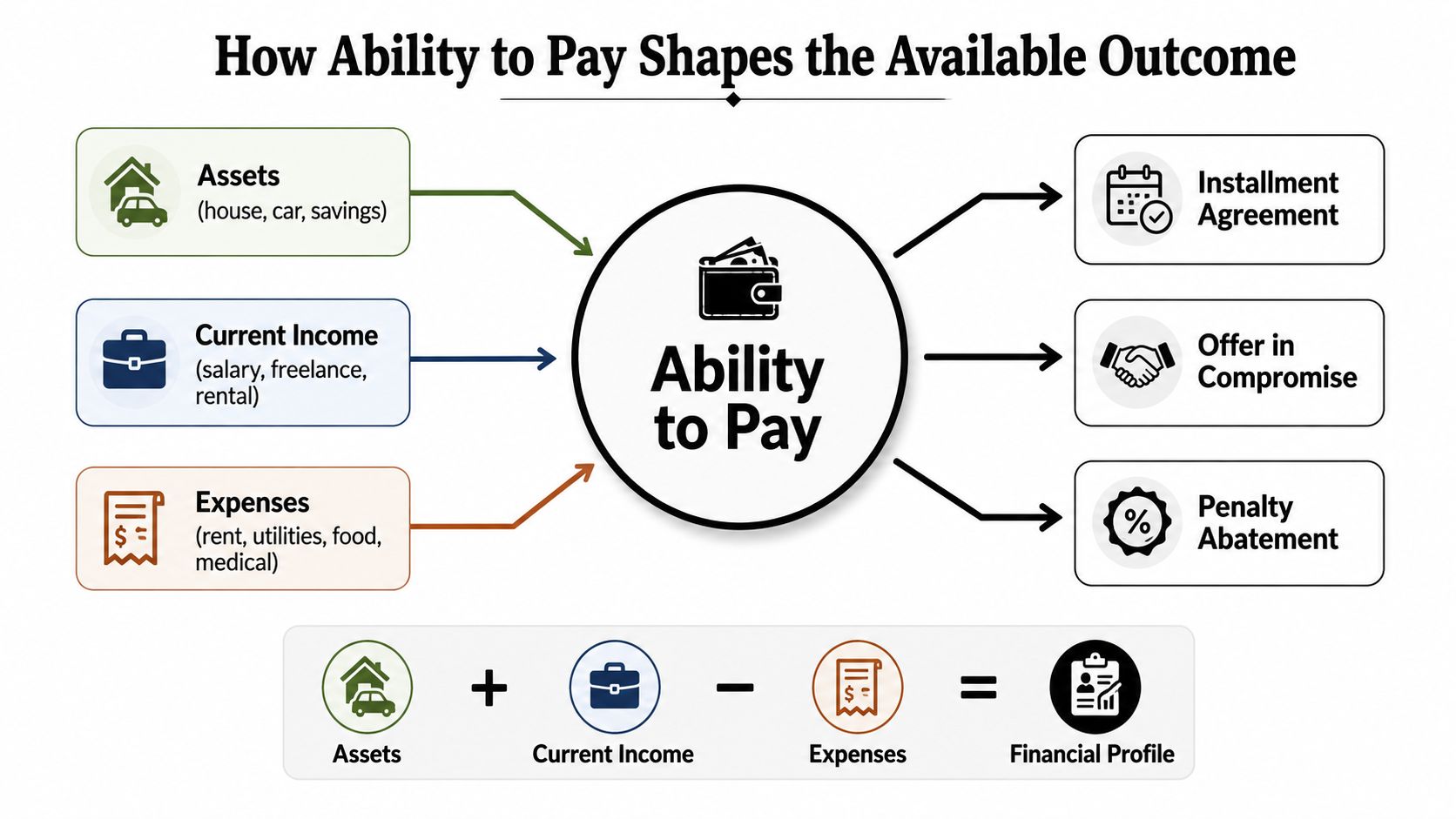
A taxpayer can have a valid balance due and still end up with very different outcomes depending on the financial record in front of the IRS. The question is what the account can support after transcripts, income records, assets, and monthly expenses are reviewed. If the numbers support steady payments, an installment agreement may fit. If the facts show no realistic collection capacity, a Currently Not Collectible status review may be the better fit. If there is a factual basis for reduced-balance treatment, that conclusion has to come from the taxpayer's actual financial picture, not from pressure or frustration.
A simple way to read the file is this, income, assets, and allowable expenses are compared to see what the IRS can collect without guesswork. That does not mean the agency uses a casual shortcut. It means the case turns on documented capacity, and that capacity can point in different directions. A taxpayer with regular income may be steered toward a payment plan. A taxpayer with thin cash flow may still have equity in a home, a vehicle, or other property that changes the analysis. Another taxpayer may have to clean up missing filings before any collection alternative is realistic.
A hardship story alone does not carry the case. The IRS wants documents, and the submission has to match the taxpayer's compliance status.
That is why one service cannot promise the same result for every client. One taxpayer may need a payment structure that stops active collection while the account stays current. Another may need penalty relief because the penalties, not only the tax, are driving the problem. A third may need to file missing returns before the IRS will even review a collection alternative. Those are different outcomes, and the financial disclosures determine which ones are available.

The practical test is what the service can realistically change. It can change the payment structure, the timing of collection, or the taxpayer's compliance obligations. It cannot force an outcome that the eligibility rules do not support, even when the client is under stress.
Common Tax Resolution Strategies and What They Can Change
Tax resolution is a toolbox, not a synonym for settlement. Each remedy changes something different, and knowing the difference keeps taxpayers from overbuying a result the facts won't support. The main administrative outcomes are installment agreements, offers in compromise, currently not collectible status, and penalty relief. Other work may involve liens, levies, delinquent returns, audits, or appeals, which are separate issues even when they overlap.
| Strategy | What it can change | What it usually leaves unchanged |
|---|---|---|
| Installment agreement | Turns a balance into structured payments | The debt still exists, and compliance still matters |
| Offer in compromise | May reduce the balance if the facts support it | It's selective, not routine, and requires strong disclosure |
| Currently not collectible status | Can pause active collection when payment isn't feasible | The debt doesn't disappear, and the IRS can revisit later |
| Penalty relief | Can remove or reduce penalties when the facts fit | The underlying tax may remain due |
A case can also begin with filing work. If returns are missing, that usually takes priority because the IRS can't fairly evaluate the account without current filings. A taxpayer facing a lien or levy may need immediate administrative response, while an audit requires a different type of representation altogether. The representative's authority and the procedural posture dictate the path.
For a more detailed breakdown of compromise submissions, the IRS offer in compromise guide is a practical companion, but it should be read with one caution. An offer is a selective outcome, not a default one. In FY 2025, taxpayers submitted 38,797 offers in compromise, and the IRS accepted 5,464 for a total of $98.1 million according to the IRS collections data (IRS statistics on collections, penalties, and appeals). That's real relief, but it's not routine.
The same caution applies to collection holds. If a taxpayer can't pay right now, that doesn't make the balance go away. It can mean breathing room, a better filing posture, or time to get organized, which is sometimes the most valuable change available.
Attorney Led and Non Attorney Tax Services Compared
The provider matters because authority matters. A tax attorney can give legal advice, represent a client where permitted, handle litigation and appeals as appropriate, and frame the matter in terms of risk as well as compliance. An enrolled agent can represent taxpayers before the IRS within the scope of that credential, and a CPA can bring accounting and tax preparation expertise that's useful when the case turns on records, returns, or financial analysis. Non-attorney resolution firms may prepare forms, gather financial data, and communicate with the IRS if authorized, but they can't provide attorney-client legal advice or act like a courtroom lawyer.
| Provider | Typical Work | Key Limitation |
|---|---|---|
| Tax attorney | Legal advice, negotiation, appeals, litigation, complex controversy work | May not be the right fit if the matter is purely accounting or filing cleanup |
| Enrolled agent | IRS representation, financial analysis, form preparation, negotiations | Not a substitute for a lawyer in legal disputes or court settings |
| CPA | Tax return work, accounting analysis, supporting documentation, some IRS matters | May not handle legal strategy or litigation |
| Non-attorney resolution firm | Intake, document assembly, administrative coordination, IRS communication when allowed | Cannot provide attorney-client legal advice or court representation |
The practical question is who will personally handle the file. Ask who signs the submissions, who talks to the IRS, and whether a licensed attorney reviews the strategy. That's especially important for payroll tax debt, trust fund recovery issues, liens, levies, bankruptcy-related tax questions, and any matter that might move beyond routine collections.
Tax Attorney Stephen A Weisberg offers attorney-led tax debt analysis, financial review, and negotiation work for taxpayers, businesses, and professionals who need the IRS issue handled in a structured way. That kind of service is different from a form-filling shop because the scope can include legal judgment where the case needs it.
Fees Timelines and the Client's Continuing Responsibilities
Tax resolution fees are usually tied to the work involved, not just the label on the service. A provider may charge for an initial assessment, a flat-fee phase for document prep and filing, hourly legal work for contested matters, administrative charges, and third-party costs such as CPA or appraisal work. The only smart comparison is total cost against total scope, including what happens if the IRS rejects the submission or asks for more information.
The timing is just as important. A case usually moves through assessment, authorization, document completion, transcript review, filing or negotiation, IRS processing, and response to follow-up requests. Faster service usually comes from complete records and quick client decisions, not from anyone's ability to pressure the IRS. If the file is incomplete, the clock slows down.
For readers comparing professional support with accounting help, what a CPA actually does is a useful reference because it helps separate tax preparation, accounting support, and controversy work. Those aren't the same service, and the distinction affects both cost and results.
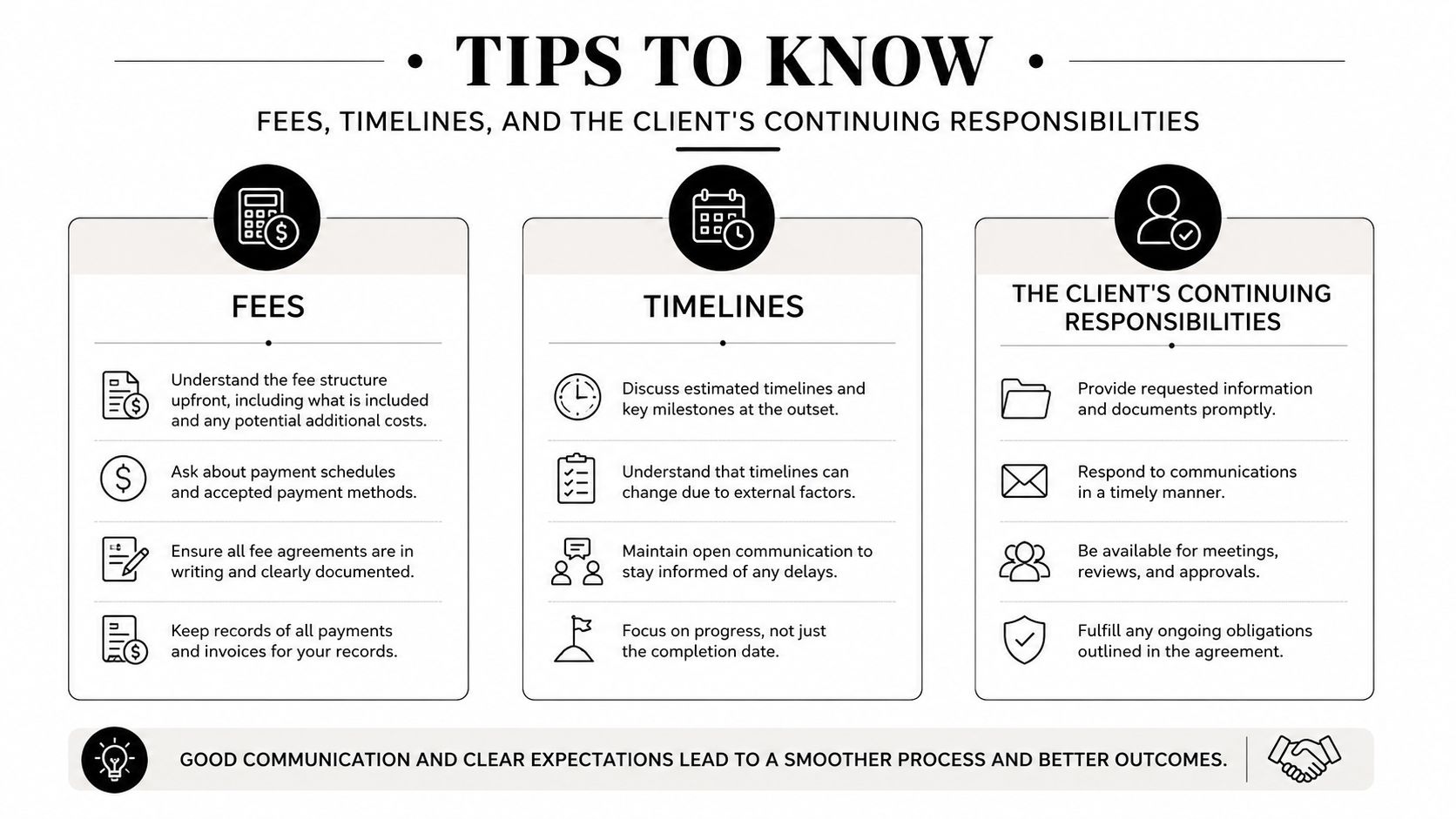
The client still has a job to do. Report changes in income or assets, keep required filings current, respond accurately, and read every agreement before signing. If the provider can't explain the renewal terms, payment obligations, or the client's continuing duties in plain English, stop and ask for a written version before moving forward.
Warning Signs of Tax Resolution Scams and Bad Advice
The biggest red flag is a promise that sounds too neat. No one can guarantee that the IRS will accept a settlement, erase a balance, or eliminate debt for “pennies on the dollar” without first seeing the financial facts. A credible service explains uncertainty. A bad one hides it behind urgency.
Watch for claims of insider access, demands for large fees before any meaningful assessment, or pressure to finance the fee as if the financing itself were the solution. Be careful if someone tells you to stop opening IRS mail, ignore deadlines, or leave out assets and income. Those are not aggressive strategies. They're shortcuts that can damage the case and create bigger problems later.
A practical screening sequence helps:
- Check credentials first. Confirm whether the person is an attorney, enrolled agent, CPA, or some other authorized professional.
- Ask who does the work. Find out who prepares the forms, who reviews the numbers, and who speaks to the IRS.
- Request the scope in writing. The engagement letter should say what is included and what is not.
- Question the outcome language. If the pitch sounds certain before the records are reviewed, treat that as a warning.
- Confirm communication limits. Know whether the provider can represent you in the setting your case needs.
The IRS says taxpayers may be able to use payment plans or other collection alternatives, but the right option depends on the taxpayer's facts and compliance status (IRS help with tax debt). That's the standard a real provider should mirror. If the sales process ignores that reality, the service is selling comfort, not representation.
Practical Next Steps and Frequently Asked Questions
Start with the notices you've already received. Identify the agency, the tax years or periods involved, and any deadline that could trigger collection or enforcement. Then gather the core tax and financial records, compare written terms from any provider you're considering, and only then authorize representation.
If you're choosing between an attorney and another tax professional, ask whether the issue is purely administrative or whether legal advice, appeals, or litigation may be needed. If the matter might involve a contested legal posture, attorney-led help is usually the safer fit. If it's mainly filing support, transcript cleanup, and negotiation, another credentialed professional may be enough.
| Question | Why It Matters |
|---|---|
| Who will personally handle my case? | You need to know whether the file is being reviewed by the person selling the service |
| What documents do you need from me? | Missing records slow the process and can block submission |
| What outcomes are realistic in my case? | It separates a real strategy from a sales promise |
| What happens if the IRS rejects it? | You should know the fallback plan before signing |
The IRS doesn't have to be contacted first in every situation, but silence is rarely a strategy. A timely, credentialed assessment is usually better than waiting until a levy or lien notice forces the issue.
Tax problems improve when facts are organized and the right remedy aligns with the actual financial picture. If you want that analysis handled by an attorney who works directly on tax debt, audits, and IRS controversy matters, visit Tax Attorney Stephen A Weisberg and request a free tax debt analysis before you sign anything.


