How Do Tax Relief Services Work? Your 2026 Guide
Confused? Learn how do tax relief services work in our 2026 guide. We explain the process, common solutions, costs, & red flags to avoid when solving tax debt.

In this article
- What Are Tax Relief Services Really
- Think specialist, not generalist
- What legitimate help looks like
- The Tax Relief Process from Start to Finish
- Step one is investigation
- Step two is financial analysis
- Step three is choosing the strategy
- Step four is negotiation with the IRS
- Step five is compliance after approval
- Common Tax Relief Solutions Explained
- The main options people actually use
- What these options really mean
- Hardship and spouse cases require precision
- Understanding Fees Timelines and Outcomes
- What fees should cover
- What a realistic timeline looks like
- What outcomes are realistic
- Red Flags and How to Spot Predatory Companies
- The sales pitch tells on them
- What ethical firms do differently
- How to Vet and Choose the Right Professional
- Ask these questions before you hire anyone
- Verify, don't trust
- Your Next Step A Free Tax Debt Analysis
The IRS notice is open on your screen. You've read the first paragraph three times, and all you're really thinking is, “How bad is this, and who can fix it?”
That's the moment individuals often start searching for tax relief services. Not because they want a clever trick. Because they want the calls to stop, the letters to make sense, and a real plan from someone who knows how the IRS works.
My view is simple. Good tax relief is professional representation. Bad tax relief is marketing. If a company leads with fear, guarantees, or a giant invoice before it understands your case, walk away. If a professional starts with transcripts, missing returns, your actual finances, and a realistic strategy, you're in the right room.
What Are Tax Relief Services Really
Tax relief services are not a secret program. They are not a loophole. They are not a promise that your tax debt disappears.
They are a professional advocacy service for people and businesses dealing with IRS or state tax problems. A legitimate tax attorney, CPA, or Enrolled Agent steps in, analyzes the case, deals with the tax agency, and works toward the best resolution that fits the facts.
Think specialist, not generalist
Your regular tax preparer is often like a family doctor. They're valuable for annual filings, bookkeeping questions, and staying current.
A tax relief professional is the specialist you call when the problem has become serious. You've got back taxes, collection notices, payroll issues, garnishment risk, or years of returns that weren't filed correctly. That's no longer routine compliance. That's controversy work.
For business owners, this distinction matters even more. If you're already struggling with operational compliance, including navigating payroll regulations, tax debt usually isn't an isolated problem. It's part of a bigger financial and administrative mess that needs a coordinated fix.
What legitimate help looks like
A real tax relief engagement starts with facts. The professional wants to know:
- What the IRS says you owe
- Whether all returns have been filed
- What your income and expenses are
- What assets and liabilities you have
- Which relief options fit your case
That's why I tell people to ignore flashy slogans and focus on whether the firm explains its process clearly. A useful starting point is this guide to finding expert help with tax debt relief companies, because the biggest mistake people make is hiring before they understand who is really handling the matter.
Practical rule: If a company talks more about “settling for pennies” than about transcripts, filings, and compliance, it's selling hope, not legal work.
Tax relief, done right, is a strategic partnership. You provide complete information. Your representative does the analysis, communicates with the IRS, and pushes for the strongest lawful outcome. That's how tax relief services work in practice.
The Tax Relief Process from Start to Finish
Most readers asking how do tax relief services work want a straight answer. Here it is. Legitimate tax relief follows a structured process, not improvisation.
The process begins with a financial investigation and IRS transcript review, moves into strategy and negotiation, and ends with mandatory compliance after a resolution is approved, as described in this explanation of the five-step tax relief process.
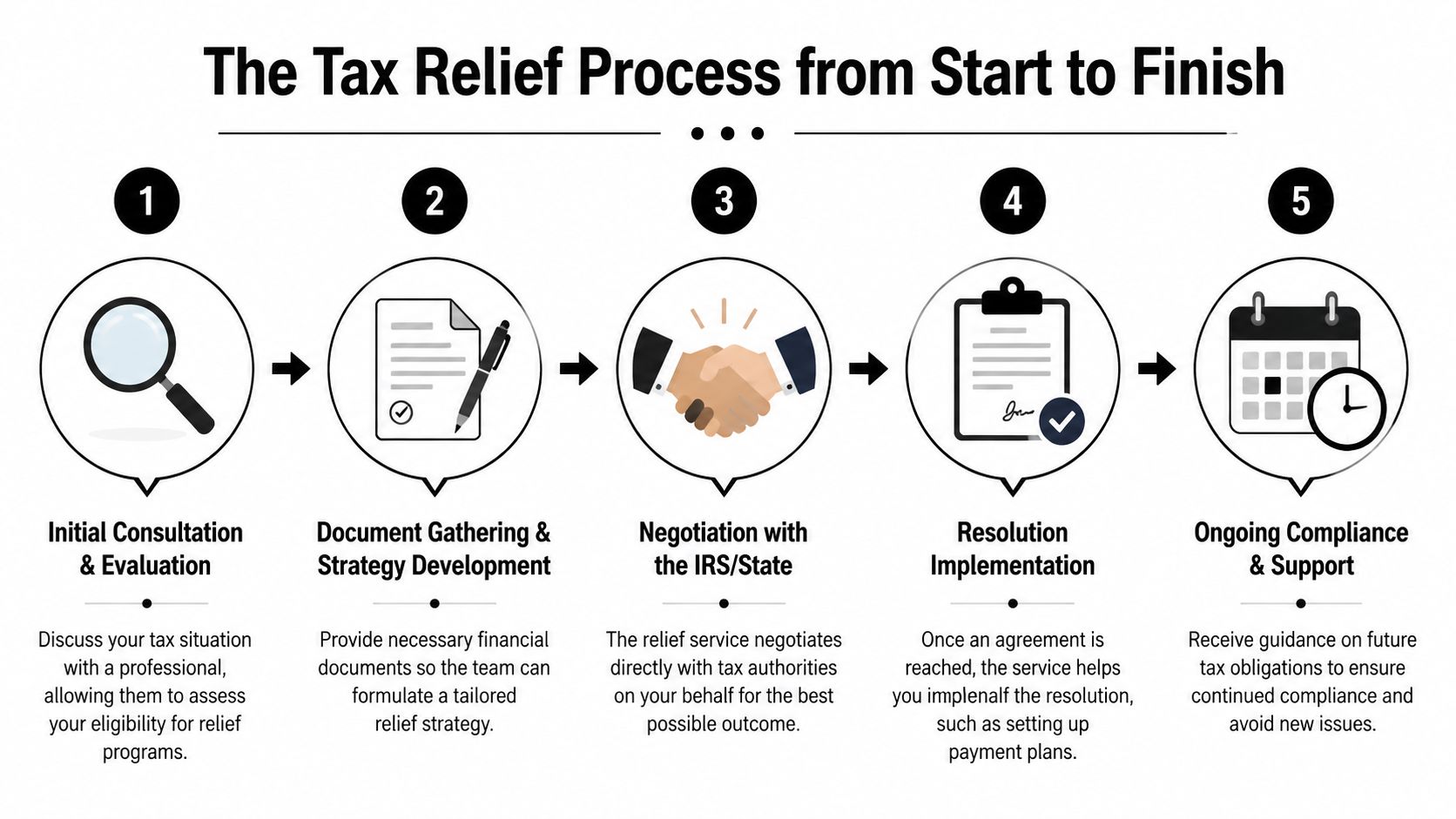
Step one is investigation
Before anyone can negotiate, they need the record straight.
A proper investigation usually includes obtaining IRS account transcripts, reviewing balances, checking penalties and interest, and confirming whether all required returns have been filed. That last part is not optional. If returns are missing, the IRS generally won't approve relief programs.
This is also where your representative gets authority to deal with the IRS directly. In practice, that often means signing a power of attorney so the professional can speak with collection personnel, receive records, and manage communications.
Step two is financial analysis
Once the records are in hand, the next question is not “What do you want to pay?” It's “What can you afford under the rules?”
A serious review looks at income, necessary living expenses, assets, and liabilities. That often means gathering a stack of documents. Bank statements, pay records, business records, mortgage or rent information, loan statements, and proof of recurring expenses all matter.
This stage frustrates clients because it feels invasive. It is invasive. But it's also necessary. The IRS doesn't approve relief based on vibes.
Step three is choosing the strategy
Experience is paramount.
A good representative matches the facts to the right tool. Some cases call for an installment arrangement. Some call for penalty relief. Some involve hardship and a request for collection to be paused. Others may justify a more aggressive resolution approach.
Here's what should happen in this phase:
- The professional explains your realistic options. Not every case qualifies for every program.
- The downside gets discussed. If interest keeps accruing or compliance rules are strict, you should hear that upfront.
- The paperwork gets built around the strategy. A weak submission wastes time and gives the IRS reasons to deny or delay.
The best strategy is usually the one you can actually complete and keep, not the one that sounds dramatic in a sales pitch.
Step four is negotiation with the IRS
This is the part people think of first, but it comes after the groundwork.
Once the documentation is submitted, the representative communicates with the IRS, answers follow-up questions, clarifies financial details, and advocates for terms that fit the taxpayer's situation. A lot of the work here is administrative and persistent. The IRS may request more records, challenge expense categories, or require clarification before it approves anything.
The negotiation itself is usually less theatrical than people expect. It's not courtroom drama. It's a disciplined back-and-forth built on documents.
Step five is compliance after approval
Many people often slip.
After a resolution is in place, you must stay compliant. Future returns must be filed on time. New taxes must be paid when due. If you fall behind again, the IRS can void the agreement and restart collection action.
For taxpayers in severe hardship, the IRS may approve Currently Not Collectible status, which can temporarily suspend collection activity and stop wage garnishments and levies while enforcement pauses, though interest continues to accrue and the IRS may review the taxpayer's finances later. That breathing room is real, but it isn't forgiveness.
Common Tax Relief Solutions Explained
You owe the IRS, the phone rings, and a sales rep promises to "settle for pennies." That is usually the moment people get pushed into the wrong program.
Real tax relief does not start with a script. It starts with matching the problem to the right remedy. If a firm pushes the same answer on every caller, leave.
The main options people actually use
Here is the practical breakdown of the relief paths that come up most often.
| Solution | Best For | Impact on Debt | Key Requirement |
|---|---|---|---|
| Offer in Compromise | Taxpayers whose finances may support a reduced settlement | May allow resolution for less than the full balance | Strong financial documentation and eligibility under IRS standards |
| Installment Agreement | Taxpayers who can pay over time but not in one lump sum | Debt remains, but payment becomes structured | Ability to make ongoing payments and stay current |
| Penalty Abatement | Taxpayers with a basis to ask that penalties be removed | Reduces penalties rather than the underlying tax | A valid basis for penalty relief |
| Currently Not Collectible | Taxpayers facing serious financial hardship | Collection pauses, but interest keeps accruing | Proof that current finances don't allow payment |
| Innocent Spouse Relief | Taxpayers whose liability stems from a spouse's actions | May shift responsibility away from the requesting spouse | Facts showing the debt is tied to a spouse's conduct |
What these options really mean
Offer in Compromise gets the hype, and that is exactly why shady firms sell it so aggressively. It can work. It can also be a terrible fit. The IRS reviews income, assets, expenses, and future ability to pay. If your numbers show you can pay through another method, an offer is likely going nowhere.
Installment Agreement is often the right answer for working taxpayers with steady income. You still pay the tax. You avoid the fantasy pitch and get a structured plan you can maintain. In real practice, this is often more useful than a weak settlement application that burns time and money.
Penalty Abatement can produce meaningful savings when penalties, not just tax, have inflated the balance. The key question is simple. Do you have a valid legal or administrative basis to ask for relief? If yes, pursue it. If no, a firm should say so upfront instead of billing you to chase a long shot.
Hardship and spouse cases require precision
Currently Not Collectible status helps taxpayers who cannot pay without falling behind on basic living expenses. It pauses collection pressure. It does not erase the balance, and interest can continue. Predatory firms often market this as if the debt disappeared. It did not.
Innocent Spouse Relief is narrower and more fact-driven. It applies when one spouse should not be held responsible for tax problems tied to the other spouse's reporting or conduct. These cases depend on documents, timing, and credibility. They are not filing-mill work.
If you want a cleaner side-by-side review, this guide to tax debt relief options does a good job of showing which remedy fits which financial situation.
One more point. A legitimate professional should tell you which options are off the table, not just which ones sound attractive. That upfront analysis is where the true value is. It separates legal judgment from telemarketing.
If you are comparing providers, review actual client experience before signing anything. A public page for collecting 990 tax reviews can help you see whether a firm explains options clearly, sets realistic expectations, and treats people like clients instead of leads.
The right tax solution is the one you qualify for, can afford, and can keep. Everything else is sales copy.
Understanding Fees Timelines and Outcomes
You get a call from a tax relief company. The salesperson says you need to sign today, pay a large retainer, and trust the process. Stop there. Before you pay anyone, you need to know what the fee buys, how long the work usually takes, and what result is realistic in your case.
Tax relief work costs real money because the work is real. Someone has to pull transcripts, review filings, identify the right resolution path, prepare forms, respond to IRS notices, and keep the case moving. Good firms charge for that effort. Bad firms charge first and decide later whether your case was worth taking.
That difference matters.
What fees should cover
A legitimate fee should pay for specific work, not vague promises. You should expect the engagement to cover investigation, transcript review, financial analysis, document preparation, submissions, and direct communication with the IRS or state agency.
The most honest firms separate the upfront analysis from the full representation fee. That is the right model. You pay a smaller amount first to find out what you qualify for. If the facts support a workable plan, then you decide whether to hire the firm for the full case.
Be careful with any company that jumps straight to a large retainer before reviewing your transcripts and financials. That is how people end up paying thousands of dollars for a solution they never qualified for in the first place.
Ask for the fee structure in writing. Ask what happens if the review shows you do not qualify for the option mentioned on the sales call. Ask who will do the work, and whether that person is a tax attorney, CPA, enrolled agent, or case processor.
What a realistic timeline looks like
Tax resolution is rarely quick. Even clean cases take time because the IRS works through backlogs, reviews submissions in stages, and often asks for more information before making a decision.
A slow case does not always mean your representative is doing a poor job. It may mean the file is in the normal administrative queue. What you want is steady, documented progress.
Use this standard:
- Early stage: transcripts are ordered, deadlines are identified, and the firm gives you a clear strategy based on your actual records.
- Middle stage: forms and financials are submitted, the IRS has acknowledged receipt, and follow-up requests are handled on time.
- Late stage: a decision is issued, the terms are explained to you, and you know exactly what you must do to stay compliant.
If a company cannot explain where your case sits in that sequence, you have a management problem.
What outcomes are realistic
A good outcome depends on the facts. Sometimes the best result is a lower settlement. Sometimes it is a payment plan that stops enforced collection and fits your budget. Sometimes it is penalty relief, account correction, or a temporary pause while you recover financially.
The right question is not, “Will they wipe out my tax debt?” The right question is, “What result do my records support, and what will it take to keep that result in place?”
That is how experienced tax professionals evaluate a case. Predatory firms sell hope first. Legitimate professionals start with analysis, set expectations early, and tell you when the answer is no.
Red Flags and How to Spot Predatory Companies
The tax relief industry has a fraud problem. Not a minor one. A major one.
The blunt warning you need to hear is this: the FTC warns consumers to ignore claims that they automatically “qualify” for relief because only the IRS can decide that, and the source cited in the provided data also states that 99% of radio-advertised tax relief services are fraudulent and use fear tactics like wage garnishment threats, while many people can handle payment plans directly with the IRS, as summarized from this discussion of tax relief fraud warnings and qualification claims.
The sales pitch tells on them
Predatory firms usually sound polished. That's the trap.
They say you're prequalified before reviewing transcripts. They imply urgency before confirming the facts. They want a signature before you know who will handle the case. In many cases, they are lead generators, not actual legal or tax professionals. They collect your information and sell it.
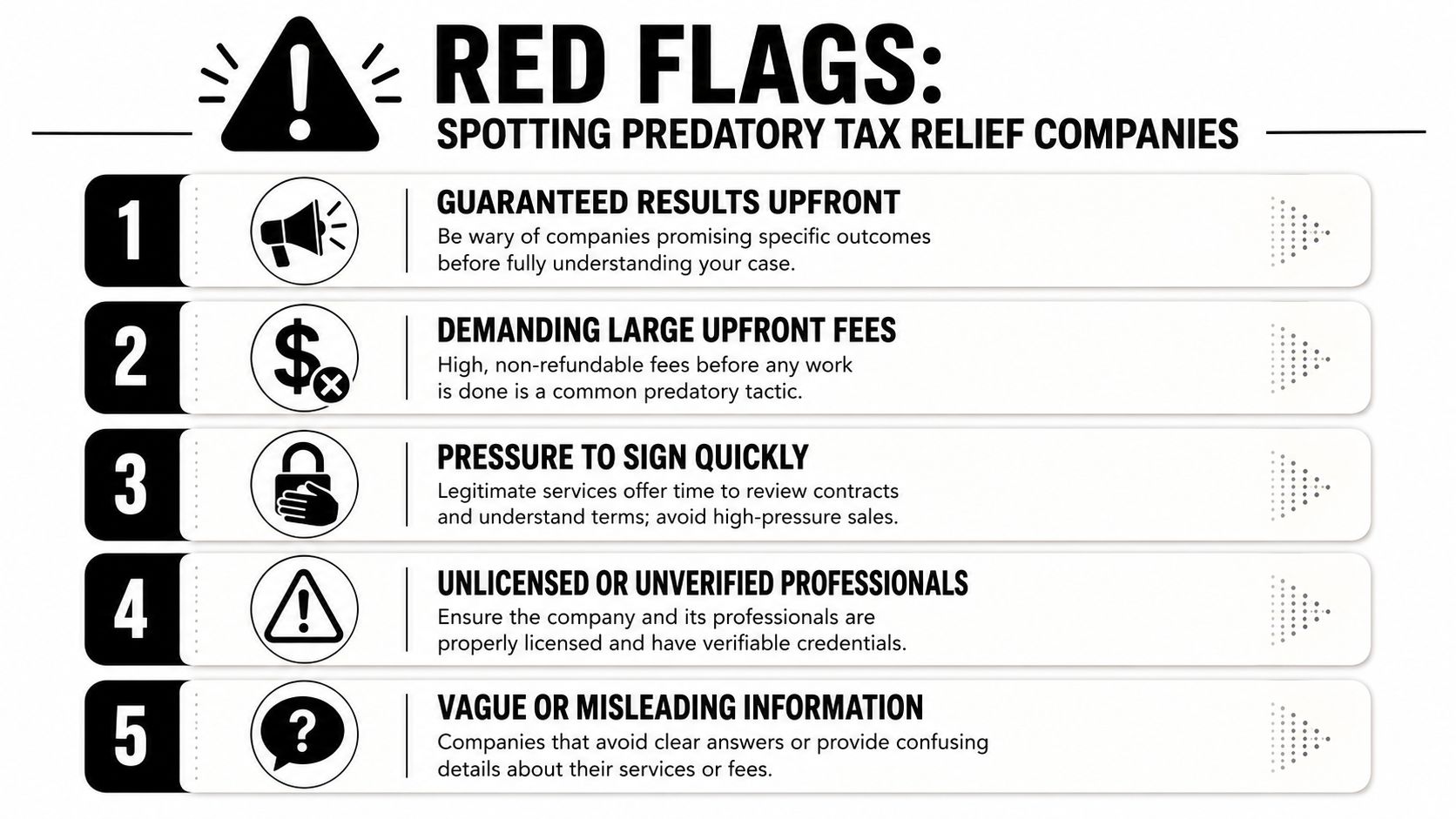
Here are the red flags that matter most:
- Guaranteed outcomes: No one can promise acceptance into a relief program before a real review.
- Big fees before analysis: A large upfront demand with no meaningful investigation is a bad sign.
- Pressure tactics: If they want you to sign immediately, they're managing your emotions, not your case.
- Vague staffing: If you can't tell whether a CPA, EA, or attorney is assigned, that's a problem.
- Fear-heavy marketing: Repeated threats about levies or garnishments are often there to rush you.
What ethical firms do differently
A legitimate attorney or licensed tax professional starts with due diligence. They explain what documents are needed, what authority they need, what options might fit, and what risks exist.
They don't tell everyone the same story.
If the company sounds like an infomercial and can't explain who is doing the legal work, leave.
They also respect a simple truth. Plenty of taxpayers do not need an expensive middleman for a standard payment arrangement. Complex controversy cases are different. Routine cases should be described truthfully.
How to Vet and Choose the Right Professional
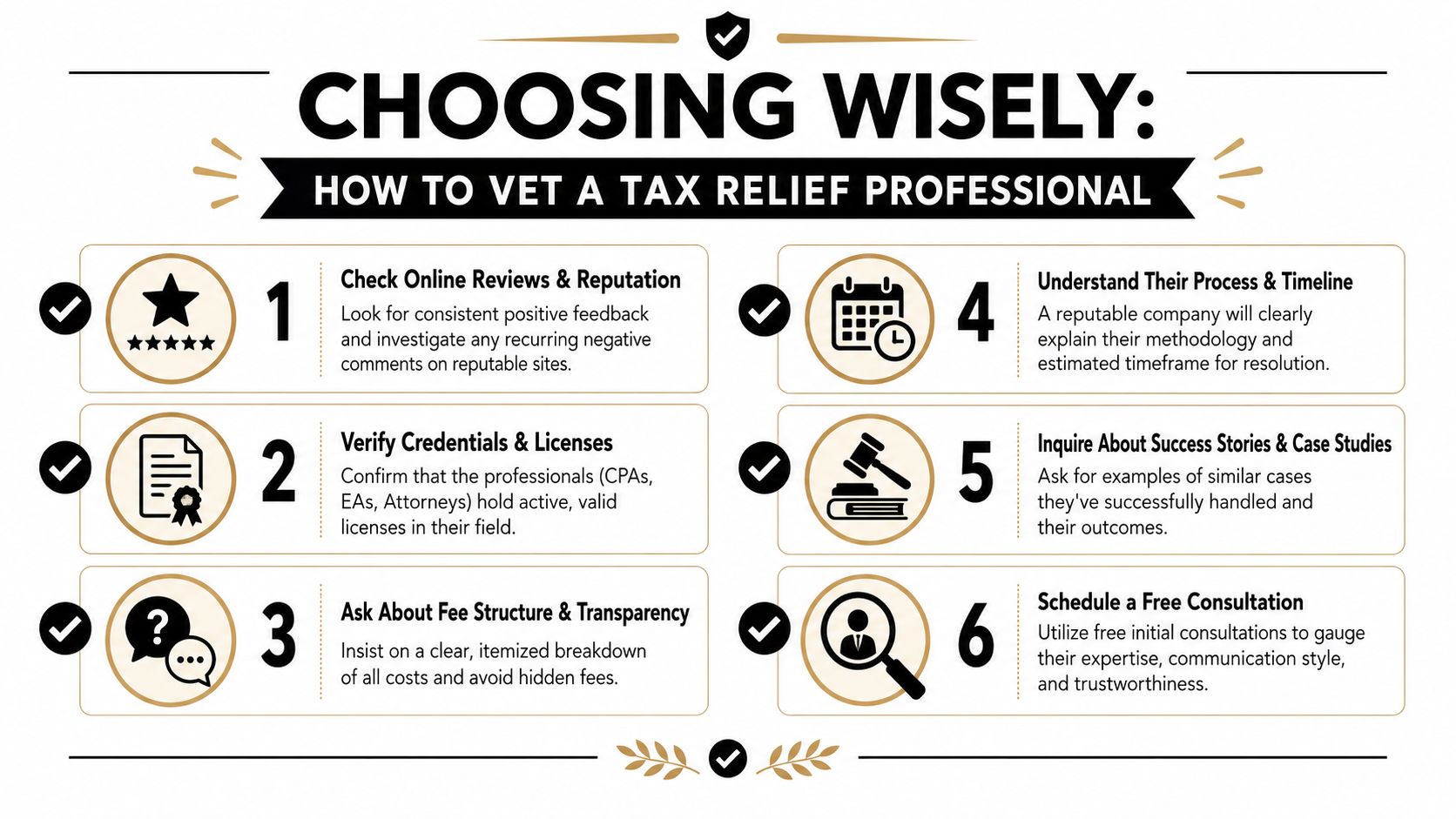
You don't need to become a tax lawyer overnight. You do need a short checklist and the discipline to use it.
Recent IRS updates emphasize that taxpayers can scan QR codes on IRS notices for immediate help, and free resources such as Low Income Taxpayer Clinics and the Taxpayer Advocate Service can be effective in many situations, as explained in the FTC's consumer guidance on tax relief companies and free help options.
Ask these questions before you hire anyone
Don't ask whether they can “get rid of” your debt. Ask better questions.
- Who will handle my case? Get the name and credential of the actual attorney, CPA, or EA.
- What happens first? If they don't start with records and analysis, that's a warning.
- How are your fees structured? You want clarity, not a blurry promise.
- What happens if I have missing returns? Their answer will tell you whether they understand the process.
- When do I need paid help, and when can I work directly with the IRS? Honest professionals answer this directly.
Verify, don't trust
Check licenses. Look up attorneys through state bar records. Verify CPAs through state boards. Confirm Enrolled Agent status through reliable professional channels.
Also ask whether free help may be enough. If your issue is straightforward, an LITC, TAS, or direct IRS contact may do the job. If your case involves major collection action, disputed liability, payroll tax issues, or spouse-related complexity, paid representation makes more sense.
For a fuller screening framework, this guide on how to find a good tax attorney is worth reading before you sign anything.
One legitimate paid option in this space is Attorney Stephen A Weisberg's Tax Debt Analysis, which is described as an attorney-led review of transcripts and facts before a resolution plan is proposed. That kind of upfront analysis is exactly what you should look for from any provider.
Your Next Step A Free Tax Debt Analysis
If you're overwhelmed, simplify the decision.
Tax relief services work when they start with facts, not promises. The right professional investigates first, verifies the IRS record, evaluates your finances, and then recommends a path you can complete. The wrong company sells certainty it can't deliver.
Your next step should be low risk and information-driven. Get a real case analysis before you agree to representation fees, before you hand over sensitive records to a marketing company, and before the problem gets worse.
If you want that kind of starting point, request a free tax debt analysis. That gives you a chance to understand whether there's a workable strategy, what the likely process will involve, and whether professional help is even necessary in your case.
If you want direct guidance from Attorney Stephen A Weisberg, start with a straightforward conversation about your IRS or state tax problem. You should leave that first step with clarity about your transcripts, your options, and whether hiring representation makes sense at all.


