Home Office Deduction Audit: How to Prepare and Respond
Fear a home office deduction audit? Learn what triggers the IRS, how to prepare documentation for Form 8829, and when to hire a tax attorney.

In this article
- Understanding Home Office Audit Triggers
- Why the deduction receives focused questions
- The Legal Tests Behind the Deduction
- What changed after Soliman
- Simplified Method vs Regular Method Evidence
- The simplified method
- The regular method
- Building Your Documentation Checklist
- 1. Establish the physical space
- 2. Prove exclusive and regular business use
- 3. Support the financial calculation
- 4. Preserve income and business records
- Navigating the Audit Response Process
- Start with a controlled response
- Keep the chronology clear
- When to Engage a Tax Attorney
- Warning signs that the matter has outgrown DIY handling
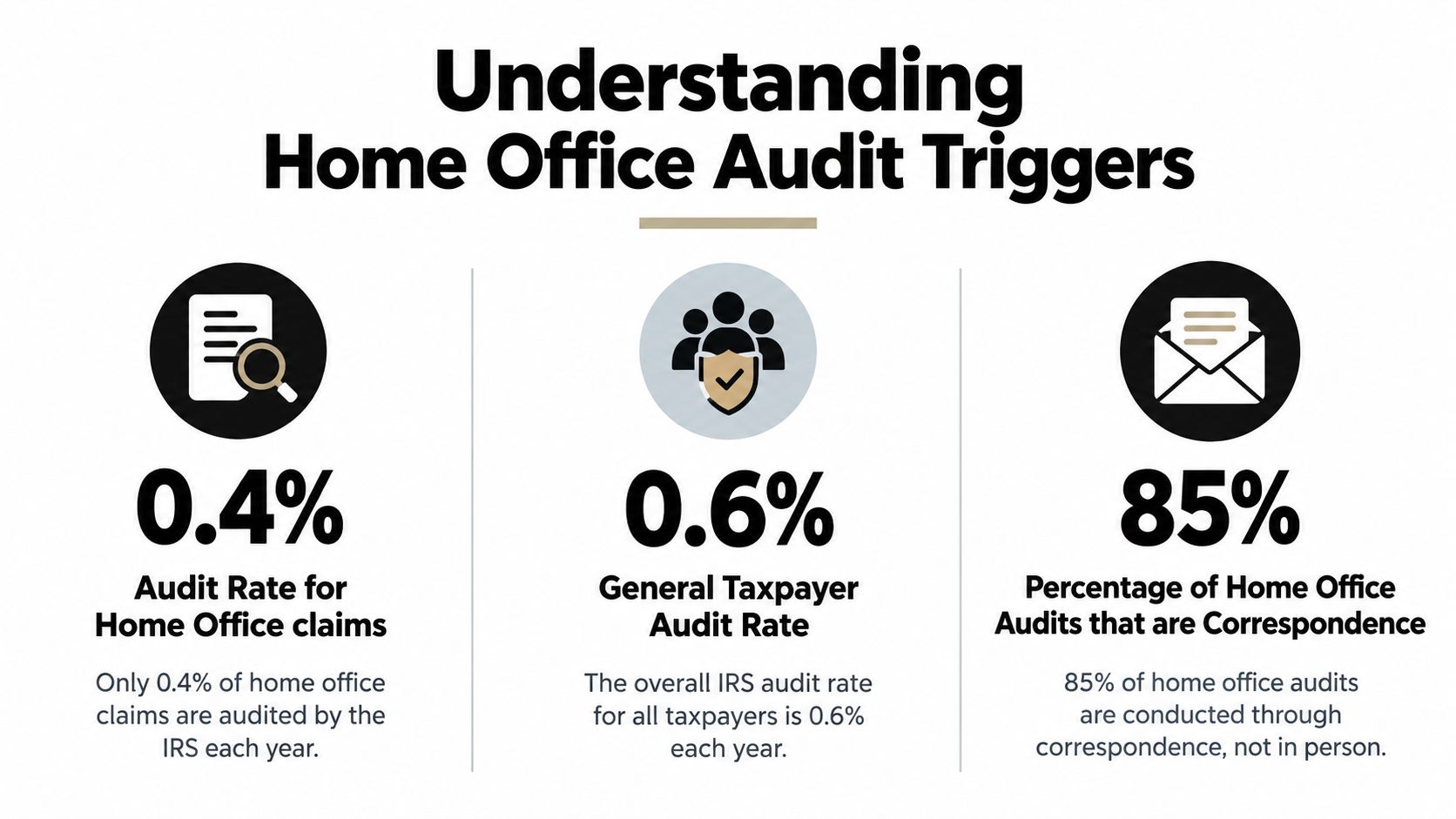
While the overall IRS audit rate is roughly 0.19%, fewer than 2 per 1,000 returns, claiming the home office deduction creates specific documentation requirements that become the focal point if your return is selected for examination. A home office claim doesn't automatically mean you'll be audited, but a weak paper trail can make an otherwise legitimate deduction difficult to defend.
The practical question isn't whether the deduction looks suspicious in isolation. It's whether you can prove, with contemporaneous records, that the space met the legal tests and that your calculation matches the business use you claimed. In a home office deduction audit, the IRS is usually testing evidence: measurements, expenses, business activity, and the boundary between professional and personal use.
Understanding Home Office Audit Triggers
A self-employed consultant once treated the home office deduction as simple arithmetic. The office occupied a defined room, the expenses were available, and the return included a business-use calculation. During an examination, however, the taxpayer could not produce a clear floor plan, consistent records showing how the room was used, or a persuasive explanation for why the claimed area matched the business activity. The calculation was easy. The evidence was not.
IRS-wide data supplies context. For fiscal year 2024, the agency audited 505,514 returns out of approximately 266 million returns processed, an overall rate of about 0.19%, or fewer than 2 audits per 1,000 returns (IRS Publication 587). That figure is not a home-office-specific audit rate, and it does not eliminate risk. It does show why the deduction should be defended with records rather than treated as an automatic audit trigger.
Why the deduction receives focused questions
A home office claim places several legal judgments into one line on the return. An examiner may ask whether the space was used regularly and exclusively, whether it served as a principal place of business, and whether the percentage applied to household costs follows a documented measurement method. A large business-use percentage without a reliable calculation gives the IRS a direct issue to examine.
For fiscal year 2024, correspondence examinations represented 77.9% of all audits, according to the IRS examination coverage data. That format changes the defense strategy. You may never meet the examiner. Instead, a notice will request records, and your written response must connect each document to the deduction being tested.
A defensible response starts with accurate framing. Claiming the deduction does not make a taxpayer a criminal suspect. It does require substantiation if the IRS asks for it. The guidance on what triggers a tax audit helps distinguish general selection concerns from the specific proof problems raised by a home office claim. The strongest defense is forensic: preserve the floor plan, identify the business activity, trace the expenses, and make the claimed percentage easy to verify.
The Legal Tests Behind the Deduction
A home office deduction is governed by a statutory test, not by the fact that work occurred in a spare room. Congress enacted Internal Revenue Code section 280A in 1976 to restrict attempts to treat otherwise nondeductible residential costs as business expenses. The statute generally requires regular and exclusive business use, plus a connection to the taxpayer's principal place of business or regular customer meetings.
In an audit, the question is factual: what happened in the room, how often, and how did that activity relate to the business? A room labeled “office” after the fact does little. A consistent record of business functions, measurements, and expenses can answer the examiner's questions without relying on general descriptions.
What changed after Soliman
The Supreme Court refined the principal-place-of-business analysis in Commissioner v. Soliman, decided in 1993. The Court rejected a physician's deduction because his home office was not where his most important business activities occurred. The Soliman decision examined both the relative importance of activities performed at each location and the time spent at each location.
Congress amended section 280A in 1997. The change made qualification easier for taxpayers who performed administrative and management work at home when no other fixed location was available for substantial administrative work. The IRS later issued Publication 587 in 1998 to explain the revised rules and related requirements (IRS Publication 587).
That history explains why an examiner may ask more than whether the taxpayer worked from home. A professional who meets clients or performs services elsewhere may still qualify if the home office handled meaningful administrative or management functions and no other fixed location was available for that work. The taxpayer must connect those facts to the business, rather than merely describe the room as a workplace.
| Legal issue | Evidence that addresses it |
|---|---|
| Exclusive use | A floor plan, dated photographs, and a description of the space |
| Regular use | Business calendars, work logs, appointment records, or recurring administrative activity |
| Principal place of business | Records showing where management and administrative work occurred |
| Business-use percentage | Consistent measurements and a reproducible calculation |
The home office deduction requirements identify the facts that should be documented before an examination begins. During an audit, those facts form the defense: they show how the space was used, why it met the statutory tests, and how the claimed percentage was calculated.
Simplified Method vs Regular Method Evidence
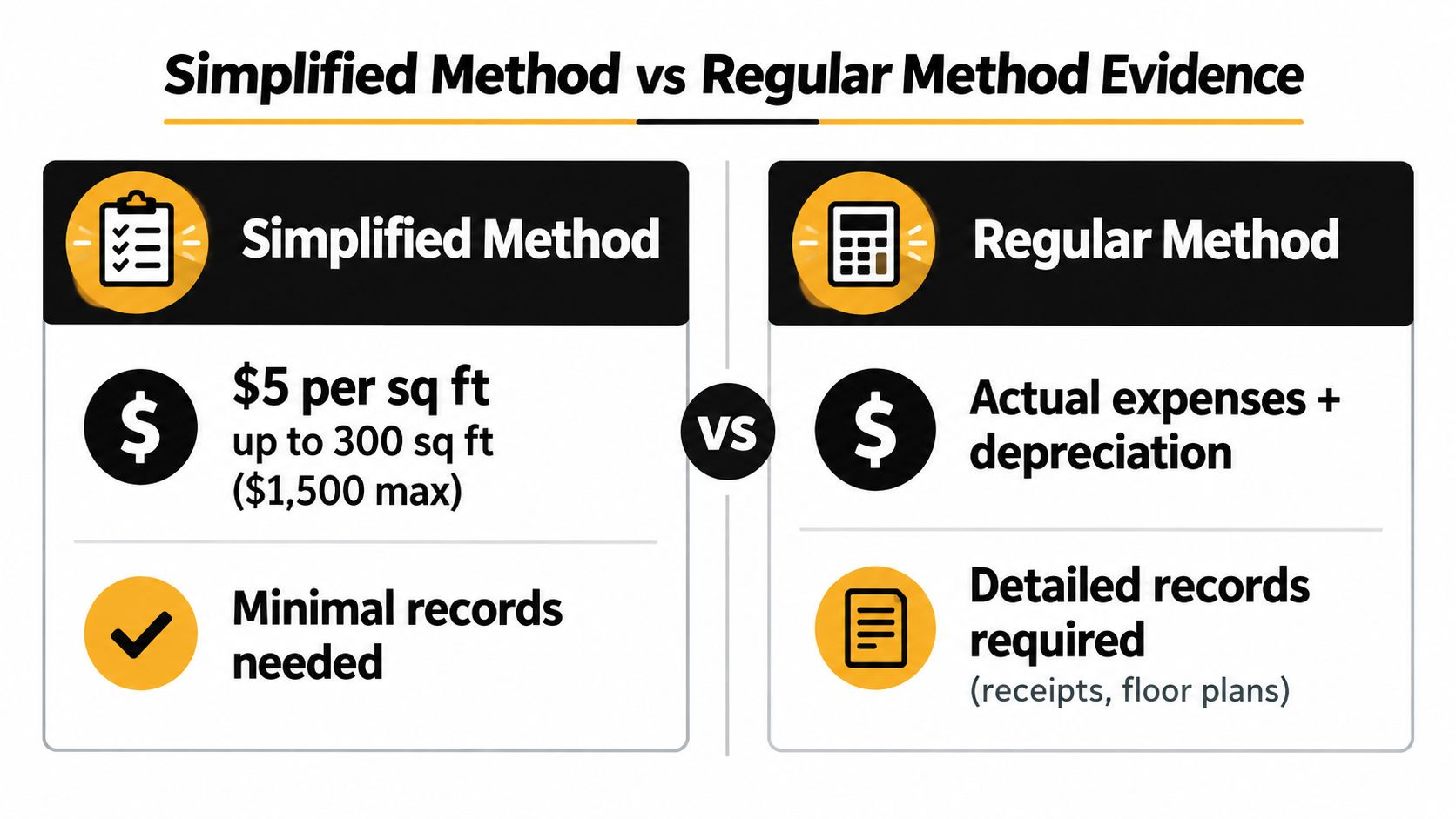
The simplified method reduces calculation and recordkeeping requirements. It doesn't erase the eligibility rules. The regular method generally demands more detailed financial records because the taxpayer allocates actual household costs and supports the business-use percentage. Both methods still depend on the same threshold question: was the space used regularly and exclusively for business?
The simplified method
The simplified method can be attractive when the taxpayer wants less administrative work. It reduces the need to allocate and preserve every eligible household expense, but an auditor can still request evidence showing the size and character of the workspace. You should be able to identify the area, explain how you measured it, and show why personal activity didn't occur there.
Minimal calculation doesn't mean minimal credibility. A dated photograph, a simple floor plan, and a written description of the room's business function can be more valuable than a polished spreadsheet that doesn't establish exclusive use.
The regular method
The regular method creates a larger documentation project. Depending on the claim, the file may include utility records, insurance records, mortgage or lease documents, repair receipts, depreciation information, measurements, and the allocation formula used to separate business and personal costs. Each item should tie back to the period and property covered by the return.
| Method | Main audit strength | Main weakness |
|---|---|---|
| Simplified | Easier calculation and fewer expense records | Doesn't replace proof of eligibility or workspace size |
| Regular | Can reflect actual allocable expenses with supporting records | More opportunities for inconsistent calculations and missing documents |
A useful companion resource is this explanation of home office deduction recordkeeping from Bookkeeping and Accounting of Florida Inc., particularly for organizing the calculation before a notice arrives.
Practical rule: Choose the method you can explain and support, not merely the method that produces the most appealing result.
The strongest defense under either method is consistency. The floor plan, tax return, expense allocation, and explanation of business activity should describe the same workspace and the same business reality.
Building Your Documentation Checklist
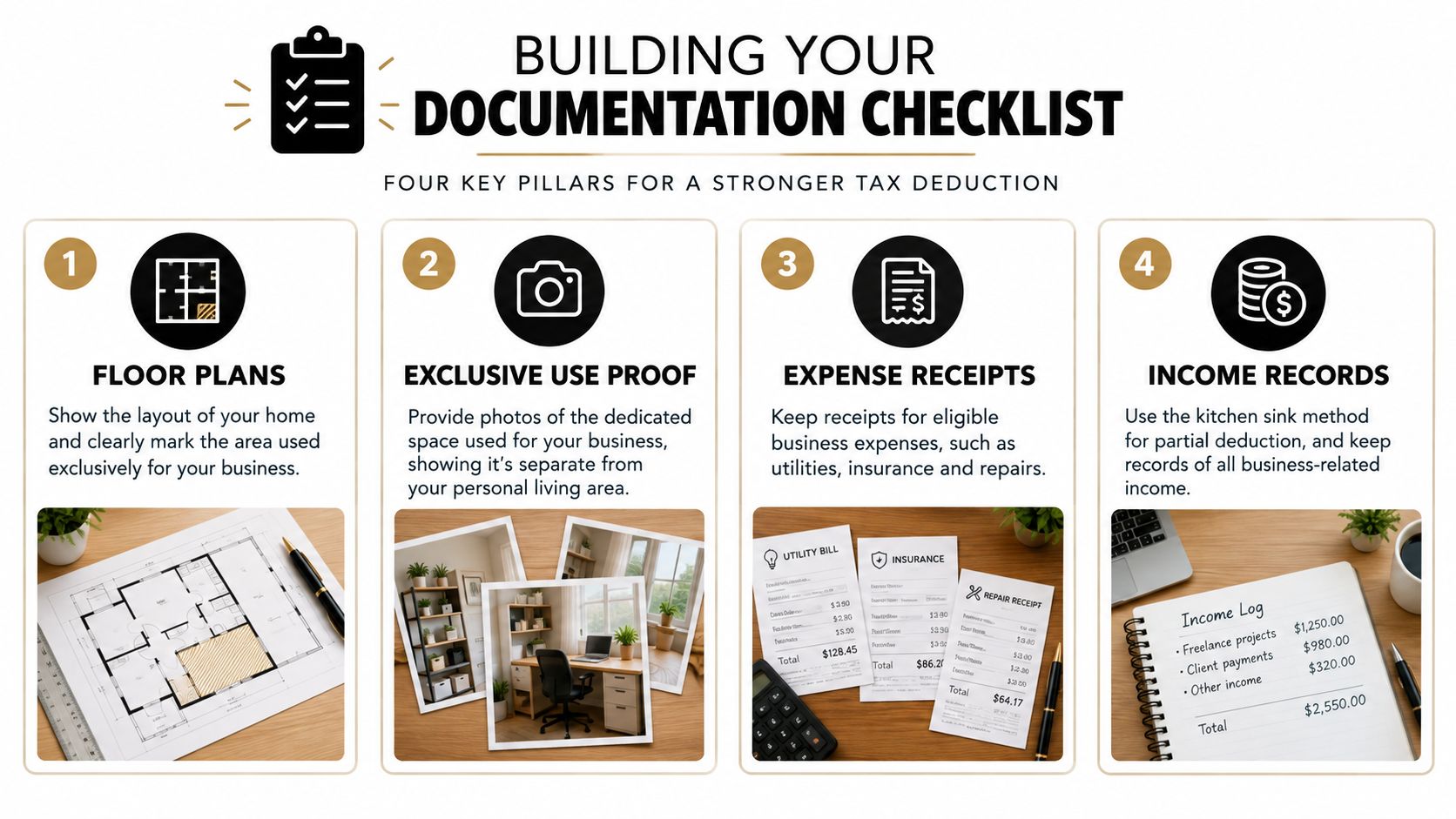
An audit file should let a third party reconstruct the deduction without relying on your memory. Build it around four evidence groups, and keep the records together by tax year. If a document supports both the space and the calculation, label it clearly rather than making the examiner search through unrelated household files.
1. Establish the physical space
Start with a floor plan, even if you draw it yourself. Mark the total home area, the office area, entrances, and any portion excluded from the calculation. Add measurements and identify whether the office is a full room or a separately identifiable part of a larger room.
Keep dated photographs showing the workspace as it was used during the relevant period. Photographs won't prove every legal element by themselves, but they can corroborate your description and expose inconsistencies before the IRS does.
2. Prove exclusive and regular business use
Create a short written statement describing what happens in the space and why those activities are part of the business. Preserve business calendars, project records, client scheduling information, or work logs that show recurring use. Don't manufacture a log after receiving a notice. Explain clearly what records existed at the time and use later-created summaries only as summaries of underlying records.
3. Support the financial calculation
Your file should contain the records needed for the method you selected:
- Housing records: Preserve lease or mortgage documents and records that identify the relevant property and period.
- Operating expenses: Organize utility, insurance, repair, and similar receipts by date and category.
- Allocation worksheet: Show the measurements, business-use percentage, expenses included, and expenses excluded.
- Method selection: Keep a copy of the workpaper showing why the simplified or regular method was used.
A consistent digital filing system matters more than an elaborate one. A dated folder structure, searchable filenames, and a spreadsheet that ties each expense to a source document can make a written response far easier to prepare. For practical methods of sorting and retaining receipts, the Approved Lux Personal Assistant receipt guide offers useful organizational ideas.
4. Preserve income and business records
Keep invoices, engagement records, bookkeeping reports, and bank information that connect the office to an operating business. These records don't substitute for exclusive use, but they can support the explanation that the claimed area served a real business purpose.
Before responding to any IRS notice, review the broader preparation principles in how to prepare for an IRS audit. The objective is simple: send relevant proof in an organized package, not an uncontrolled dump of documents.
Navigating the Audit Response Process
A correspondence examination rewards discipline. The initial notice should be treated as a document-management problem with legal consequences, not as an invitation to send every record you possess. Read the tax year, deadline, requested items, and submission instructions carefully, then create a response file that mirrors the IRS request.
Start with a controlled response
Prepare an index before attaching records. For each requested issue, identify the document that answers it and add a short explanation. If the notice asks about square footage, provide the floor plan and measurement worksheet. If it asks about expenses, provide the relevant records and calculation rather than unrelated personal bills.
An auditor may ask questions such as:
- What is the total square footage of the home?
- How did you measure the office area?
- Is the space used for any personal activity?
- Where do you perform administrative and management work?
- Do you have another fixed location available for those activities?
- How often do you use the office for business?
- How did you calculate the business-use percentage?
Answer the question asked. If the space was sometimes used for personal purposes, don't describe it as exclusively business use. A damaging overstatement can undermine otherwise helpful records. A precise, limited answer is usually stronger than an expansive narrative that introduces contradictions.
Keep the chronology clear
Your submission should explain the facts in the order an examiner needs to verify them:
- Identify the business and the tax year.
- Describe the office and its measurements.
- Explain the regular business activities performed there.
- Show the calculation method and supporting records.
- Address any unusual fact directly, such as a move, a shared room, or a change in business location.
Correspondence audits can resolve on paper, but silence or incomplete responses can lead to an adverse adjustment. Retain proof of delivery, copies of everything submitted, and a record of follow-up communications. If the IRS asks for clarification, respond to the new question without casually expanding the examination into unrelated topics.
An audit response should be complete enough to prove the claim, but narrow enough to avoid creating confusion.
If the proposed adjustment disallows the deduction, review the explanation and deadline before agreeing. You may have additional rights to respond or appeal, and those rights can be affected by what you sign or concede.
When to Engage a Tax Attorney
Self-representation can work when the claim is modest, the records are complete, and the IRS request is narrow. It becomes risky when the facts are disputed, the deduction is only one issue among several, or the taxpayer feels pressured to answer immediately without understanding the consequences.
Bring in a tax attorney when the IRS questions exclusive use and your records are incomplete, when the principal-place-of-business analysis is complicated, or when the examination expands beyond the home office. A professional can help separate facts that should be conceded from facts that require proof, prepare a focused submission, and manage communications so informal comments don't become unnecessary admissions.
Warning signs that the matter has outgrown DIY handling
Consider representation if:
- The notice raises multiple issues: A home office question paired with unreported income, business expenses, payroll matters, or entity issues requires broader risk analysis.
- The IRS proposes a substantial adjustment: The potential tax, penalties, and interest may justify professional review before you sign an agreement.
- The facts are unfavorable: Mixed personal use, inconsistent measurements, missing receipts, or another available office can require a carefully framed response.
- You receive a formal examination result: Appeals and collection consequences involve deadlines and strategy that extend beyond ordinary record submission.
- You feel unable to communicate clearly: Anxiety often leads taxpayers to overexplain, ignore deadlines, or send disorganized material.
An attorney's value isn't limited to arguing over square footage. The attorney can assess the record as a whole, identify exposure created by related issues, and decide whether correspondence, negotiation, or an appeal is appropriate. The practical decision criteria in when to hire a tax attorney are especially relevant when a routine documentation request starts to broaden.
Tax Attorney Stephen A Weisberg handles IRS audit representation, including examinations involving questionable home office claims and documentation of home office deductions. He works with individuals, business owners, and tax professionals who need help evaluating an IRS notice and preparing a defensible response.
If the IRS has questioned your home office deduction, gather the notice, return, measurements, expense records, and prior correspondence before responding. Contact Tax Attorney Stephen A Weisberg to discuss the evidence, the scope of the examination, and a practical strategy for protecting your position.


