Expert Help with State Tax Debt Solutions
Overwhelmed by state tax debt? Get expert help with state tax debt today. Stop collections, explore relief, & resolve tax issues quickly in 2026.

In this article
- First Steps When You Discover State Tax Debt
- Gather every notice before you call anyone
- Verify the balance with the state directly
- Confirm filing compliance first
- Halting Aggressive State Collection Actions
- Know the difference between a lien and a levy
- What to say when you call
- Short-term damage control matters
- A simple call script
- Exploring Your State Tax Relief Options
- State tax relief options at a glance
- Installment agreements work when the number is real
- Offer in compromise is real, but it isn’t the default
- Penalty work is often overlooked
- Special issues for business owners
- Coordinating State and Federal Tax Debt
- Why the state often gets priority
- Build one payment strategy, not two separate promises
- Common coordination mistakes
- A practical framework
- When to Call a Tax Attorney for Help
- The red flags that usually justify counsel
- Why attorney analysis is different from a resolution factory
- What good representation should feel like
- Your Next Steps to Becoming Tax Debt-Free
- Use this short action list
A state tax notice has a way of taking over the whole day. You open the envelope, see words like levy, lien, garnishment, or intent to assess, and your mind jumps straight to frozen bank accounts, missed payroll, or a refund that disappears before you touch it.
That reaction is normal. It’s also the moment when people make their worst decisions. They ignore the notice, send money they can’t afford, or sign up with a tax resolution company that talks in circles and asks for a large retainer before anyone has analyzed the case.
Help with state tax debt starts with replacing panic with sequence. State tax problems are solvable, but they usually aren’t solved by treating the state and IRS as two unrelated problems. Many self-employed taxpayers, LLC owners, and small businesses owe both. If you handle one badly, the other can get worse. The right approach is coordinated, practical, and focused on preventing the next enforcement move while building a payment structure you can keep.
First Steps When You Discover State Tax Debt
The first day matters. Not because you need to solve everything immediately, but because you need a reliable picture of what’s real and what’s just fear.

Gather every notice before you call anyone
Start with paper. Pull every state notice, letter, billing statement, and collection warning you’ve received. If you’ve moved, check scanned mail, email notices, and any online account messages from the state department of revenue or treasury.
What you’re looking for is basic but critical:
- Tax years involved: One year often turns into several once you review the file.
- Type of tax: Income tax, sales tax, withholding, or payroll-related liabilities follow different rules and carry different risks.
- Deadline language: Some notices are informational. Others are final warnings.
- Collection stage: Assessment, billing, garnishment warning, bank levy threat, warrant, or license-related action.
If you owe in more than one state, separate everything by state. Each state has its own process, forms, and deadlines.
Verify the balance with the state directly
Don’t assume the amount on the first notice is still accurate. Penalties and interest may have changed. The state may also be applying payments, offsets, or estimated assessments that don’t reflect what you owe.
Use the online portal if the state offers one, then confirm by phone if the account history looks incomplete. If the debt is substantial or the notices are confusing, that’s where many people benefit from a structured review such as this guide on what to do if you owe taxes.
Practical rule: Don’t negotiate from a notice. Negotiate from the account transcript, account history, or the state’s current payoff information.
Confirm filing compliance first
This is the step people skip because it feels backward. They want to talk settlement before they’ve cleaned up filing problems. State agencies usually won’t allow that.
A key rule in state tax resolution is that taxpayers must first file all missing returns and ensure current taxes are paid before any back-tax resolution can be negotiated, as explained in this discussion of state tax debt procedures and compliance requirements.
That means if you have unfiled returns, the first win is not a settlement. It’s bringing the account into filing compliance so the state will even consider your options.
Use this short checklist in the first 24 hours:
- Build a timeline: List each notice by date and tax year.
- Check the online account: Confirm balance, status, and any scheduled enforcement.
- Identify missing returns: Don’t guess. Verify each year.
- Stop making random payments: Payment without a plan can create new problems.
- Calendar deadlines: Protest rights and collection deadlines don’t wait.
Control starts when the facts are organized.
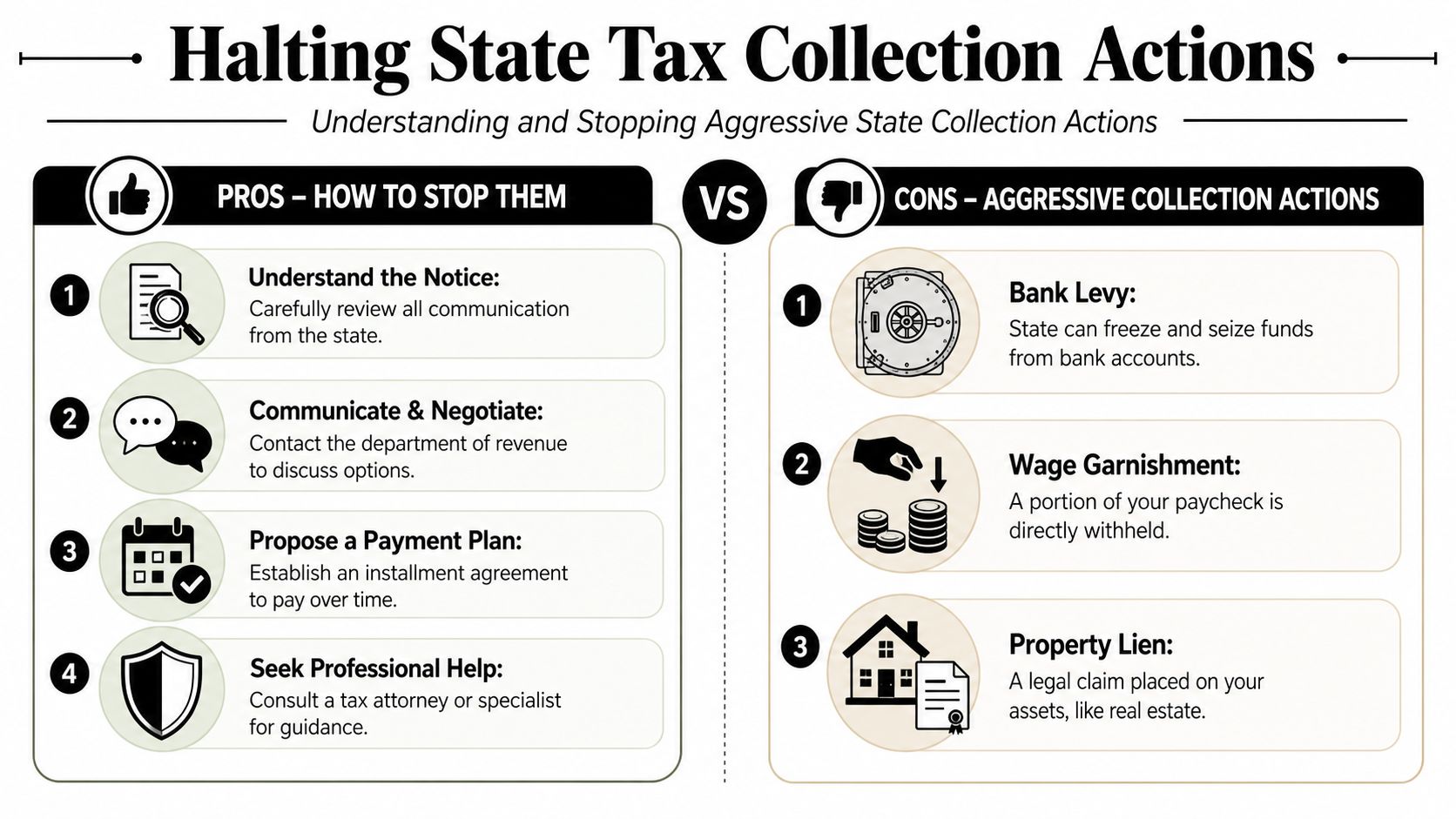
Halting Aggressive State Collection Actions
The state’s strongest advantage is speed. If you wait, the account can move from letters to action quickly.
An important backdrop here is financial pressure on the states themselves. According to Truth in Accounting’s report on the financial condition of the states, states collectively held $2.9 trillion in total debt obligations against $2.2 trillion in assets, leaving a $765 billion shortfall as of fiscal year 2024. That doesn’t excuse harsh collections, but it does help explain why state agencies often move hard and fast.
Know the difference between a lien and a levy
People use these terms interchangeably, and that creates bad decisions.
- A lien is the state’s legal claim against your property. It can attach to real estate and affect refinancing, sale proceeds, and credit-related issues.
- A levy is actual seizure. The state reaches into a bank account or takes other property.
- A wage garnishment directs part of your pay to the state before you receive it.
Each requires a slightly different response, but they all have one thing in common. Silence helps the state, not you.
What to say when you call
Your first call shouldn’t be a long explanation of your life story. It should be focused, calm, and aimed at creating time.
Try this approach:
- Identify the account clearly: Give the notice number, tax years, and your current contact information.
- Ask the direct question: “Is any levy, garnishment, or other enforced collection currently pending?”
- Request a short hold: Tell them you are gathering records, confirming filing status, and preparing a formal resolution proposal.
- Ask what they need next: Some states will note the file and give a short administrative pause. Others will tell you exactly what must be submitted.
What not to do:
- Don’t guess about income or assets
- Don’t promise a payment you can’t sustain
- Don’t argue the whole liability on a collection call if you haven’t reviewed the account
- Don’t ignore a request for missing returns or financials
Call before the deadline on the notice, not after the bank account is frozen.
Short-term damage control matters
In many cases, the most valuable first result is a brief collection hold. That breathing room lets you decide whether the right answer is an installment agreement, hardship request, amended filing work, or legal challenge.
Some readers also benefit from broader consumer guidance on strategies for managing debt collections, especially if tax debt is colliding with other collection pressure. Tax debt is its own system, but the communication habits still matter. Document everything. Keep names, dates, and call summaries.
If your wages are already at risk, this more specific overview of how to stop state tax garnishment can help you understand the urgency and response options.
A simple call script
Use language like this:
“I received the notice, I’m working to bring the account into compliance, and I want to prevent enforced collection while I submit the required information. What do you need from me to request a temporary hold?”
That script works because it does three things. It shows cooperation, avoids admissions you may regret later, and moves the conversation toward procedure instead of panic.
Exploring Your State Tax Relief Options
Once the immediate fire is contained, the question becomes simpler. What resolution fits this type of debt and this taxpayer’s actual cash flow? The answer is rarely the most advertised program.
Many states offer several forms of relief, but they don’t all work equally well. In practice, taxpayers often do better with a realistic payment structure than with a low-probability settlement request.
Practitioners note that state Offer in Compromise programs are often more restrictive than federal ones, and that a structured installment agreement paired with penalty reduction negotiation is usually the more reliable path for most taxpayers, as discussed in this analysis of state tax dispute resolution strategies.
State tax relief options at a glance
| Relief Option | Best For... | Key Consideration | Success Likelihood |
|---|---|---|---|
| Installment Agreement | Taxpayers with steady or somewhat predictable income | The payment has to be sustainable, not just impressive on paper | Often the most practical route |
| Offer in Compromise | Taxpayers with limited ability to pay and a well-documented financial hardship case | State approval is usually discretionary and strict | Lower than many people expect |
| Penalty Abatement | Taxpayers whose balance grew because of penalties and who can show reasonable cause | It may reduce part of the debt, not the tax itself | Useful when facts support it |
| Hardship hold or not-collectible status | People dealing with unemployment, illness, or severe cash flow disruption | Collections may pause, but the debt usually remains | Helpful as a temporary shield |
| Innocent spouse or similar relief | Spouses who should not be held responsible for certain joint return liabilities | State rules vary and must be reviewed carefully | Fact-specific |
| Protest or appeal | Taxpayers who dispute the assessment itself | Deadlines are strict and missing them changes leverage | Strong when the assessment is wrong |
Installment agreements work when the number is real
An installment agreement is often the right answer for self-employed people, sole proprietors, and small businesses with income that comes in unevenly but consistently enough to support a monthly obligation.
The mistake is treating the payment like a negotiation contest. A high monthly amount can get accepted and still fail three months later. When that happens, the state usually has less patience the second time.
A strong installment proposal should account for current compliance first. If you’re an independent contractor, that means current estimated taxes. If you own a business with employees, that means current payroll deposits. Old debt doesn’t get resolved if new debt keeps forming.
Offer in compromise is real, but it isn’t the default
State OICs attract attention because they sound like the cleanest ending. Pay less, close the file, move on. Sometimes that happens. Often it doesn’t.
The catch is that many states apply strict discretion and expect detailed financial proof. If the reviewer believes you can pay through time, they may reject the compromise even when the total debt feels overwhelming to you.
That’s why I usually view OIC as a targeted tool, not a starting assumption. It fits best when the financial picture is thoroughly documented and the payment alternatives don’t work.
For readers dealing with Michigan issues, this explanation of Michigan’s state Offer in Compromise process shows how state-level compromise programs can differ from what taxpayers expect after hearing about IRS settlements.
Penalty work is often overlooked
Penalty relief doesn’t get the same attention as settlement ads, but it can make a meaningful difference in the total balance and improve affordability under a payment plan.
Look at penalty issues when:
- The tax was filed late because of a serious event: illness, records loss, or another documented disruption
- The business had a specific breakdown: bookkeeper departure, payroll system error, or banking problem with records to support it
- The account grew mainly because time passed: not because the original tax was impossible to pay
A good resolution plan doesn’t chase the most dramatic program. It uses the program the state is most likely to approve and the taxpayer is most likely to complete.
Special issues for business owners
Business tax debt raises the stakes. Sales tax, withholding, and payroll-related balances can threaten operations, licensing, and personal exposure. If the business is still open, the state will focus heavily on whether current tax obligations are being paid correctly right now.
That’s one reason many taxpayers need more than generic online advice. General resources on strategies for unpaid taxes can be useful for orientation, but the actual choice among agreement, hardship, protest, or compromise should be based on the account history and the state’s specific procedures.
In more complex files, one practical option is formal representation. Attorney Stephen A. Weisberg’s practice, for example, uses powers of attorney, transcript review, and threat assessment to identify liens, levies, garnishments, and payment history before recommending a path. That kind of case analysis matters because relief programs are only as good as the facts supporting them.
Coordinating State and Federal Tax Debt
Many people get trapped. They assume the IRS is the bigger problem because the federal balance is larger, so they put all available cash there first. Meanwhile, the state files a garnishment, freezes a bank account, or takes the federal refund through offset.
The better analogy is this: you’re juggling two objects, and they don’t behave the same way. One bounces if dropped. The other shatters. In many cases, state debt is the glass ball.
A survey cited by TaxAudit states that over 60% of tax professionals reported that clients with combined state and federal tax debts were confused about which to prioritize, and that tools like the Treasury Offset Program can seize federal refunds for state debts, even for balances under $2,000. That discussion appears in this resource on resolving state tax debt and coordinating with federal issues.

Why the state often gets priority
This doesn’t mean the IRS should be ignored. It means your first dollars and first negotiations should often be shaped by which agency is more likely to hit cash flow first.
States frequently create more immediate business disruption because they may move faster on:
- Bank levies
- Wage garnishments
- Refund offsets
- Professional license consequences
- State-specific enforcement deadlines
If the IRS is on a slower track while the state is about to garnish wages, your plan should reflect that reality.
Build one payment strategy, not two separate promises
Most taxpayers make the same mistake. They agree to one monthly amount with the IRS, then another with the state, and only later realize the two numbers don’t fit inside the same household or business budget.
Instead, start with a single cash flow worksheet. Then assign priorities.
A workable order often looks like this:
- Keep current taxes current
- Stop the fastest enforcement threat
- Protect expected refunds from offset where possible
- Set federal payments at a level that won’t cause the state plan to fail
- Review the sequence again if income changes
That last step matters for self-employed people and seasonal businesses. A plan that works in one quarter may collapse in another.
Common coordination mistakes
The most expensive mistakes are usually procedural, not legal.
- Paying the IRS first because the balance is larger: Size alone doesn’t determine urgency.
- Assuming a state balance is too small to matter: Offset systems can still hit refunds.
- Submitting financials to one agency without considering the other: Inconsistent positions can create credibility problems.
- Ignoring payroll tax overlap: Business owners can face linked state and federal exposure from withholding problems.
If you owe both the IRS and a state, the question isn’t “Which debt is morally more important?” The question is “Which agency can damage cash flow first, and how do we stop that without defaulting the other?”
A practical framework
For most dual-debt cases, I use a sequence-based analysis:
Stabilize
Confirm all returns are filed, determine current balances, and identify any active levy, garnishment, or offset risk.
Protect income
If the state is moving faster, deal with that first. If the IRS is already intercepting or threatening aggressive action, adjust. The facts drive the order.
Match payments to reality
The best payment plan is the one you can keep while staying current on this year’s taxes. A collapsed agreement is usually worse than a modest one that survives.
Revisit settlement only after compliance is stable
Compromise options become more useful once current filing and payment behavior is under control.
That integrated approach is the part most generic guides miss. Help with state tax debt is often really help with managing two tax systems that can hurt you in different ways at the same time.
When to Call a Tax Attorney for Help
Some state tax cases are manageable without hiring anyone. A single notice, a small balance, and full filing compliance can sometimes be handled directly with the agency.
A lot of cases don’t stay simple for long. The risk increases when the file involves business taxes, unfiled returns, interstate issues, or conflicting state and IRS demands. That’s when a legal strategy matters more than a call-center script.
The red flags that usually justify counsel
You should strongly consider hiring a tax attorney if any of these apply:
You owe payroll, withholding, or sales tax
These cases can escalate quickly and may create personal exposure for owners and responsible parties.
You have multiple years of unfiled returns
Filing order affects strategy, and rushed filings can lock in avoidable liability.
You own a business that is still operating
The plan has to protect operations while keeping current taxes paid.
You received levy, garnishment, lien, or license-related notices
Once enforcement is underway, timing becomes critical.
You may face a fraud or criminal issue
At that point, representation is not optional.
The debt is large enough to affect major decisions
Selling property, refinancing, resolving divorce issues, closing a mortgage, and planning a bankruptcy filing all become harder when tax debt is unresolved.
Why attorney analysis is different from a resolution factory
Large national tax resolution companies often sell hope first and analysis later. That’s backward. You shouldn’t pay a major fee just to find out whether the facts support relief.
A careful attorney starts by examining the account, compliance history, deadlines, and collection posture. Then the attorney tells you whether the case calls for a payment arrangement, protest, penalty work, settlement analysis, or a combination.
That’s the practical difference. Forms are only part of the work. The harder part is sequencing.
For a more detailed discussion of where the line usually falls, this article on when to hire a tax attorney is a useful starting point.
What good representation should feel like
It should feel calm, specific, and grounded in records. You want someone who can explain trade-offs clearly:
- what happens if you pay the state first
- what happens if you delay filing missing returns
- whether a hardship request helps or merely postpones the problem
- whether an OIC is realistic or just attractive in theory
Good tax counsel doesn’t sell fear. Good tax counsel reduces uncertainty.
Your Next Steps to Becoming Tax Debt-Free
Tax debt usually gets worse when people wait for certainty before they act. You do not need certainty. You need sequence.
If you’ve read this far, you already know the roadmap. First, get the facts together. Second, stop collection momentum if it’s already building. Third, choose a relief path that fits your real numbers, not the one with the flashiest marketing. Fourth, if you also owe the IRS, coordinate both systems as one problem.
Use this short action list
- Pull every notice and sort by tax year and tax type
- Verify the current balance with the state
- Identify any missing returns
- Check whether enforcement is active or imminent
- Request time if you need it, but do it before deadlines pass
- Choose a payment or relief strategy you can maintain
- Coordinate state and federal obligations before agreeing to monthly payments
Doing nothing is still a decision. It’s usually the most expensive one.
Some people can handle the early steps alone. Others need someone to step in quickly, obtain transcripts, review notices, contact the state, and build a plan that won’t collapse the moment another tax agency gets involved. The important thing is to move before the state makes the next move for you.
If you want real help with state tax debt, start with an analysis, not a sales pitch. A good review should tell you what you owe, what the state can do next, what relief options are available, and how any IRS issue changes the plan. Once those pieces are clear, the problem usually feels far less chaotic.
Attorney Stephen A. Weisberg offers a free, confidential Tax Debt Analysis through Attorney Stephen A Weisberg. Instead of leading with fear or demanding a large upfront retainer before reviewing the facts, he starts by determining whether he can help, how the state and IRS issues interact, and what concrete strategy fits your case.


