Help with irs tax debt: Fast, Real Solutions You Can Trust
Overwhelmed by IRS notices? Get practical options, negotiation tips, and trusted help with irs tax debt today.

In this article
- First Steps When You Get an IRS Notice
- Deciphering the IRS Code
- Decoding Common IRS Notices and Your Next Steps
- Your Most Powerful Tool: The IRS Transcript
- Why This Data is Crucial
- Figuring Out Your Best Path Forward on Tax Debt
- The Offer In Compromise: A True Fresh Start
- Installment Agreements: Structuring a Way Out
- When You Genuinely Can't Pay: Currently Not Collectible
- Navigating the Application and Negotiation Maze
- The Heart of Your Financial Story: Forms 433-A and 433-B
- Presenting Your Case to Win
- What Happens After You Submit Your Proposal?
- How to Spot Scams and When to Hire an Attorney
- Common Tax Relief Scams to Avoid
- Understanding Your Professional Options
- When Hiring an Attorney Is Non-Negotiable
- So, What's the Next Step in Resolving Your Tax Debt?
- From Overwhelmed to In Control
- Why This Matters So Much for Businesses
- Common Questions We Hear About IRS Tax Debt
- How Long Does the IRS Get to Chase Me for Old Tax Debt?
- Can I Get the IRS to Remove My Penalties and Interest?
- What Happens If I Just Ignore the IRS?
Getting that dreaded envelope from the IRS can make your heart sink. But before you let panic set in, take a breath. That notice in your hand isn't just a bill; it's a roadmap. The key to getting help with IRS tax debt is to act immediately and strategically, and it all starts with a calm, fact-finding mission.
This isn't the time to hide the letter in a drawer. Ignoring it is the single worst thing you can do. Instead, you need to put on your detective hat and figure out exactly what the IRS is saying.
First Steps When You Get an IRS Notice
The moment a letter from the IRS arrives, your mind probably jumps to the worst-case scenario. I've seen it countless times with new clients. But that piece of paper is just data. It holds crucial clues: deadlines, the specific tax years in question, and the exact amount the IRS thinks you owe.
The IRS sends millions of these notices every year. Many are simple requests for information or minor adjustments. Others, however, are far more serious collection warnings that signal things are about to escalate. Your job is to figure out which one you're holding.
Deciphering the IRS Code
Different notices mean different things, and some are much more urgent than others. For instance, a CP504 Notice of Intent to Levy is basically the IRS's final warning shot before they can start taking your money directly from your bank account or paycheck. A Notice of Federal Tax Lien is a public declaration that the government has a legal claim to your property, which can absolutely wreck your credit.
No matter what the notice says, you need to find three key pieces of information right away:
- The Response Deadline: This is non-negotiable. Miss it, and you could lose your right to appeal and fast-track the collection process against you.
- The Tax Periods: The notice will spell out exactly which years are at issue (e.g., 2021, 2022).
- The Total Amount Due: This isn't just the tax. It’s the original amount plus all the penalties and interest that have been piling up.
By breaking down the notice, you turn an intimidating demand into a simple set of facts. This is a critical mental shift. It's how you start taking back control and preparing for what comes next.
This initial analysis is your first real step toward a solution. To dig deeper, you can review our detailed guide to understanding IRS letters and notices.
To give you a head start, here’s a quick rundown of some of the most common notices we see and what you should do immediately.
Decoding Common IRS Notices and Your Next Steps
| IRS Notice Number | What It Really Means | Your Immediate Action |
|---|---|---|
| CP14 | This is the first official bill for unpaid taxes. It means your return was processed and the IRS shows a balance due. | Review the balance. If it's correct, pay it. If not, contact the IRS or a tax professional immediately to dispute it. |
| CP501 / CP503 | These are reminders. The IRS is telling you they still haven't received payment and that interest and penalties are adding up. | The situation is becoming more serious. Do not ignore these. It's time to figure out a payment plan or resolution strategy. |
| CP504 | "Notice of Intent to Levy." This is a final, statutory notice. They are now legally authorized to seize your assets. | This is an urgent warning. You have 30 days to act. Contact a tax professional now to prevent levies on your bank accounts or wages. |
| LT11 / Letter 1058 | Similar to a CP504, this is a "Final Notice of Intent to Levy and Notice of Your Right to a Hearing." It's a formal warning. | You have appeal rights (Collection Due Process hearing), but you must request it within 30 days. This is your last official chance to appeal before seizure. |
| CP90 / CP297 | This is another Final Notice of Intent to Levy, often sent to a last known address or place of business. | The clock is ticking. Immediate action is required to stop the IRS from garnishing wages, seizing bank funds, or levying other assets. |
Seeing your notice number on this table should make it clear: the time to act is now.
Your Most Powerful Tool: The IRS Transcript
While the IRS notice tells you what they think you owe today, your tax transcripts tell the entire story. Think of them as your complete, unabridged IRS file. They show every single action on your account—when returns were filed, payments made, penalties added, and everything in between.
This is the undisputed source of truth and the bedrock of any successful negotiation.
You can and absolutely should get your transcripts directly from the IRS website. For tax debt issues, you’ll want two specific types:
- Account Transcript: This gives you a chronological list of everything that’s happened on your account for a specific tax year.
- Record of Account Transcript: This is the big one. It combines your Account Transcript data with key information from your original tax return.
Why This Data is Crucial
Armed with your transcripts, you can verify every claim the IRS is making. Is the debt amount correct? When does the clock run out for the IRS to collect on each tax year? This "collection statute expiration date" is one of the most important dates in any tax debt case.
This information isn't just helpful—it's essential for building a defense.
The IRS is a massive collection agency. Recent data shows it collected a net of $77.6 billion from unpaid assessments on filed returns. They also tacked on $17.8 billion in penalties for late returns and collected nearly $3.2 billion from those taxpayers. As you can see from tax gap insights on crfb.org, the agency is serious about collecting.
Having your own verified data from transcripts means you can negotiate from a position of strength, not surprise.
Figuring Out Your Best Path Forward on Tax Debt
Once you have your IRS transcripts in hand, the fog starts to clear. You're no longer just reacting to scary-looking notices; you can finally get on the offensive and find a real solution. The good news is the IRS has several established programs to help people get back on track.
These aren't some secret back-door deals. They're official, structured pathways for taxpayers who find themselves in a tough spot. The real trick is figuring out which one actually fits your financial reality, not just the one that sounds best on paper.
The Offer In Compromise: A True Fresh Start
People often talk about the Offer in Compromise (OIC) as the ultimate "fresh start" program, and it can be. An OIC is a formal agreement where the IRS accepts less than the full amount you owe and calls it even. It's a powerful option, but it's also one of the most challenging to get approved. The IRS isn't just giving away money.
You have to prove one of three specific situations:
- Doubt as to Collectibility: This is the most common path. You must prove, with hard numbers, that you simply don't have the assets or income to pay the full debt before the collection statute runs out.
- Doubt as to Liability: This is for rare cases where you can show a legitimate reason why you don't actually owe the tax in the first place.
- Effective Tax Administration: You can argue that paying the full amount would create an extreme economic hardship or would be fundamentally unfair.
The IRS relies on a rigid formula called Reasonable Collection Potential (RCP) to make their decision, especially for "Doubt as to Collectibility" cases. They scrutinize the equity in your assets—your house, cars, bank accounts—and project your future disposable income. Only if that calculation shows you can't pay the full debt will they even consider your offer.
Here's a real-world example: A freelance graphic designer owes $65,000 in back taxes after a few years of unpredictable income. After a complete financial workup, we determine her RCP is $12,000. She can submit an OIC for $12,000, and if the IRS accepts it, the remaining $53,000 is wiped away once she pays the offer amount.
Be warned, though—the OIC process is a marathon, not a sprint. It involves a mountain of paperwork and can easily take a year or more for the IRS to review. One small mistake on the forms can get the whole thing thrown out.
Installment Agreements: Structuring a Way Out
If you can't pay everything right now but you can make steady monthly payments, an Installment Agreement (IA) is usually the most straightforward solution. It’s simply a formal plan to pay your full tax debt over an extended period.
But not all installment agreements are created equal. The right one for you depends on how much you owe.
- Guaranteed Installment Agreement: If your debt is under $10,000, you’re pretty much guaranteed an agreement as long as you meet a few basic requirements.
- Streamlined Installment Agreement: This is a huge help for many people. For debts up to $50,000 (or $25,000 for a business), the application process is much simpler, and you often don't have to provide detailed financial statements.
- Partial Payment Installment Agreement (PPIA): What if you can make payments, but not enough to clear the debt before the ten-year collection clock runs out? A PPIA might be the answer. This is more complex and requires a full financial disclosure, but it allows you to pay what you can afford each month until the debt expires.
This flowchart gives a great visual of how to approach the situation from the moment you get that first IRS notice.
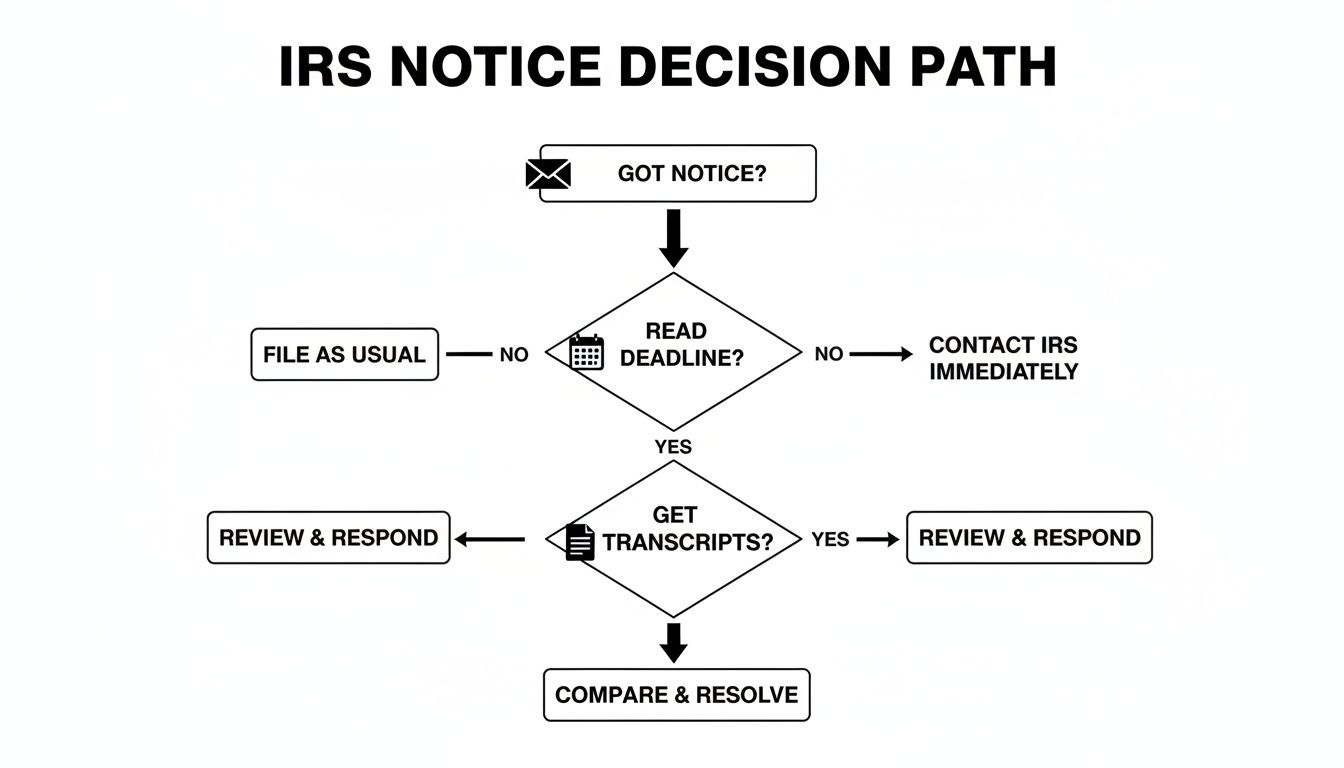
Getting this initial groundwork done—checking the deadline, pulling your transcripts—is absolutely essential. It’s the only way to know which of these resolution programs you might actually qualify for.
When You Genuinely Can't Pay: Currently Not Collectible
Sometimes, life hits hard. For taxpayers facing true financial devastation, the IRS may grant Currently Not Collectible (CNC) status. This is not a forgiveness program; think of it as a temporary pause button on collections. If you've lost your job, have an income that doesn't even cover basic living costs, or are dealing with a major illness, the IRS might place your account in CNC.
While your account is in CNC, the IRS will stop aggressive actions like wage garnishments and bank levies. But here’s the catch: interest and penalties keep piling up, and the IRS will check in on you periodically to see if your financial situation has improved. They can also still file a federal tax lien against you.
Finding the right way to get help with IRS tax debt is all about matching the solution to your specific life circumstances. Our deep-dive into tax debt relief options explores these programs in greater detail. Trying to force a solution that doesn't fit your finances is a recipe for wasted time and money, which is why a careful analysis from the start is the only way to move forward with any confidence.
Navigating the Application and Negotiation Maze
Applying for an IRS resolution program isn't about just filling out forms and hoping for the best. It's a strategic negotiation. You're essentially building a case, backed by meticulous documentation, to convince the IRS that your proposed solution is the most they can realistically expect to collect.
The whole process demands precision. One small mistake or a single missing document can get your entire application kicked back, wasting months and adding to your stress.

This is exactly where all that prep work you did earlier pays off. I've seen it time and again: every successful resolution is built on a rock-solid foundation of verifiable financial data. The IRS simply won't take your word for it—they need to see the proof.
The Heart of Your Financial Story: Forms 433-A and 433-B
At the core of almost every negotiation with the IRS is the Collection Information Statement. This is where you lay all your financial cards on the table, and knowing which version to use is your first critical move.
- Form 433-A (OIC) is the one for individuals. It's an incredibly detailed look into your personal finances, digging into everything from your monthly income and living expenses to the value of your assets like your home, cars, and retirement accounts.
- Form 433-B (OIC) is its counterpart for businesses. This form outlines the company's financial health, covering income, expenses, accounts receivable, inventory, and all business assets.
Think of these forms as the lens the IRS uses to see your ability to pay. They'll take the income and assets you list and measure them against the expenses you claim, but they use their own strict national and local standards to decide what's "allowable." Anything left over is considered disposable income they believe is available to pay your tax debt.
Key Takeaway: The IRS isn't just collecting numbers; they're calculating what they call your Reasonable Collection Potential (RCP). Your entire job is to provide a complete and accurate financial picture that logically supports the resolution you're asking for, whether that's an Offer in Compromise or an Installment Agreement.
Presenting Your Case to Win
Just filling out the forms is never enough. You have to present your financial situation in a way that's not only accurate but also persuasive. You need to anticipate the questions an IRS examiner is going to ask before they even ask them.
A classic mistake I see people make is sending in a messy, incomplete package. Your application needs to be clean and professional, with every number backed by clear evidence. That means including things like:
- Recent pay stubs (or profit-and-loss statements if you're self-employed).
- Bank statements for the last three to six months for all your accounts.
- Proof for every major expense you claim, like mortgage statements, utility bills, and car payments.
- Valuations for your assets—think a market analysis for your home or Kelley Blue Book values for your vehicles.
Treat it like you're building a legal case. If you put down a $2,000 mortgage payment on Form 433, you better have the statement to back it up. If your income fluctuates because you're a contractor, your P&L statements need to clearly show that reality. The more organized and credible your submission is, the better your chances are. Our guide on how to set up a payment plan with the IRS provides more practical tips for getting these documents in order.
What Happens After You Submit Your Proposal?
Hitting "send" on your proposal is really just the beginning of the journey. Your case gets assigned to an IRS employee—usually an Offer Examiner or Revenue Officer—who will go through every single line item with a fine-toothed comb. It’s almost guaranteed they will come back with questions or requests for more information.
This is the real negotiation phase. How you respond can make or break your entire case. Be ready for letters and phone calls, and make sure your responses are prompt, professional, and directly answer their questions. If they want clarification on an expense, give it to them along with the document that proves it.
It helps to remember the scale of this issue. States with huge populations and complex economies like California, New York, Texas, and Florida consistently have the highest levels of tax debt. Even in states with no personal income tax, like Texas and Florida, business payroll and sales tax problems create staggering liabilities. This is why the IRS is so thorough—they have to be. Navigating this on your own is a tall order, which is why getting professional help can be so vital.
How to Spot Scams and When to Hire an Attorney
When you're facing down the IRS, you're in a vulnerable spot. It’s stressful, and unfortunately, a whole industry of predatory companies has popped up to exploit that fear. They use high-pressure sales tactics and make wild promises, so learning to spot the red flags is your first line of defense.

You’ve probably seen the ads—they’re all over the radio, TV, and internet, promising to settle your debt for "pennies on the dollar." They hook you with guarantees that no legitimate, experienced professional would ever dare to make.
Common Tax Relief Scams to Avoid
Be skeptical. Be very skeptical of any company that makes a grand promise before they’ve even seen a single one of your documents. Real tax resolution isn’t magic; it’s a detailed process that starts with a deep dive into your specific financial life and IRS records.
Here are the biggest warning signs I've seen over the years:
- Guaranteed Outcomes: If anyone guarantees they can slash your debt by a certain percentage or get you an Offer in Compromise, just hang up the phone. The IRS has the final say, and a promise of a specific result is a sure sign of a scam.
- Massive Upfront Fees: Shady outfits often demand thousands of dollars before they lift a finger. A reputable firm will start with a thorough analysis—often for free or a reasonable fee—to figure out if and how they can actually help you first.
- High-Pressure Sales Calls: You shouldn't feel like you're being cornered by a used car salesman. If the person on the other end of the line is pushing you to sign a contract and give them your credit card number right now, it's a huge red flag.
The "pennies on the dollar" line is a classic bait-and-switch. The Offer in Compromise program is a real thing, but the IRS only approves it for a small fraction of applicants who meet incredibly strict financial hardship criteria. Predatory companies sell this dream to everyone, knowing full well most won't qualify.
Understanding Your Professional Options
When you need real help, you have three types of federally authorized tax practitioners to turn to. They each have different skill sets, and picking the right one is absolutely critical for a good outcome.
| Professional | Key Strengths | Best For |
|---|---|---|
| Enrolled Agent (EA) | Deep tax knowledge. They are licensed by the IRS and can represent you in all administrative matters. | Tax preparation, audit representation, and negotiations with IRS agents and appeals officers. |
| Certified Public Accountant (CPA) | Strong background in accounting and financial planning. They are licensed by the state. | Untangling complex financial records, handling business tax issues, and getting your books in order. |
| Tax Attorney | Licensed to practice law. They offer everything an EA and CPA can, plus critical legal protections. | Legally complex cases, potential criminal tax exposure, and representing you in U.S. Tax Court. |
While EAs and CPAs are fantastic for many tax issues, a Tax Attorney brings a level of protection the others simply can't. The biggest advantage is attorney-client privilege, which means your conversations are legally confidential. This is non-negotiable if there's even a whiff of a criminal investigation. On top of that, only an attorney can represent you if your case has to go to U.S. Tax Court.
For a deeper look, check out our guide on finding a good tax attorney.
When Hiring an Attorney Is Non-Negotiable
Some situations are just too serious to handle with anyone but a lawyer. Trying to navigate these scenarios with a less-qualified representative can lead to disastrous financial and legal consequences. When your situation involves complex legal questions, qualified law firms and attorneys are your best bet.
You should hire a tax attorney immediately if you find yourself in one of these situations:
- Facing a Trust Fund Recovery Penalty (TFRP): This is when the IRS is coming after you personally for your business's unpaid payroll taxes. It's a brutal move that bypasses the corporate shield and puts your personal home, car, and bank accounts on the line.
- A Revenue Officer Shows Up: If an IRS Revenue Officer comes to your home or business, your case has escalated. These are local field agents with serious enforcement power. This is no longer just a letter in the mail.
- The Tax Debt Is Large or Complex: If your debt is over $100,000 or involves messy issues like business assets, multiple unfiled years, or international accounts, an attorney’s strategic oversight is vital.
- You're Contacted by Criminal Investigation (CI): If an IRS CI Special Agent contacts you, say nothing more than, "I will have my attorney contact you." Then, hire one. Immediately. Anything you say can and will be used against you in a criminal proceeding.
Choosing the right help is the single most important decision you'll make in this process. Steer clear of the national "tax relief" factories with their empty promises, and find a qualified professional who will analyze your actual case before asking for a dime.
So, What's the Next Step in Resolving Your Tax Debt?
Figuring out what to do after you've stared down the reality of your tax problem can be paralyzing. It feels like you're at a crossroads with no clear map, and every direction seems risky. This is precisely where a carefully considered, personalized strategy for tackling IRS debt becomes your best asset.
The good news is, you don't have to navigate this alone. The bad news? You have to be incredibly careful about who you trust. The tax resolution industry is unfortunately filled with high-pressure sales tactics that exploit fear. Many push costly, cookie-cutter "solutions" that might not even be right for your situation. A real professional will never guarantee an outcome or ask for a huge fee before they've even looked at your file.
From Overwhelmed to In Control
The smartest and most responsible first move you can make is to get a complete Tax Debt Analysis. This isn't a sales call; it's a diagnostic deep-dive. A qualified tax pro will pull your official IRS transcripts, go through your financial situation with a fine-tooth comb, and lay out the actual, viable options available to you.
This kind of analysis should be no-obligation and all about giving you clarity and power. It's built to answer the questions that are probably keeping you up at night:
- Based on the IRS’s rigid calculations, do I even have a shot at an Offer in Compromise?
- What kind of Installment Agreement could I realistically afford right now?
- Is it possible to get some of these penalties waived, and if so, how?
This is all about shifting from a state of paralyzing worry to one of informed confidence. You should walk away from a proper analysis knowing exactly what can be done, how we'd do it, and why it's the right move for you—long before you ever sign anything or pay a dime.
This is especially true for small business owners and self-employed people, who are squarely in the IRS's crosshairs.
Why This Matters So Much for Businesses
Think about this for a moment. The IRS estimates a massive "tax gap," and a huge chunk of it comes from businesses. Over half of the underreporting on individual returns—a staggering $194 billion—is tied to pass-through business income. On top of that, another $127 billion comes from employment taxes, which is a constant struggle for small companies. You can find more details on these tax gap statistics at jdavidtaxlaw.com.
Those numbers aren't just statistics; they're the reason the IRS is so aggressive with business owners over unpaid payroll and income taxes.
A levy on your business bank account or a seizure of your accounts receivable can shut you down, literally overnight. A proactive, professional analysis spots these dangers ahead of time and builds a shield before the IRS makes a move. This isn't just about paying off an old tax bill; it's about protecting the business you've worked so hard to build.
Once you have a solid plan, you're no longer just reacting to threatening letters from the IRS. You'll have a team in your corner, ready to put a strategy into action that's built for your specific financial reality. This is the moment you stop letting the tax debt dictate your life and start taking back control.
Common Questions We Hear About IRS Tax Debt
When you're facing down the IRS, a million questions probably run through your mind. It's completely normal. Based on my experience helping countless people sort out their tax issues, here are some of the most common questions I hear—and the straight answers you need.
How Long Does the IRS Get to Chase Me for Old Tax Debt?
This is a big one. The IRS generally has 10 years to collect a tax debt from the date it was officially assessed. This deadline is called the Collection Statute Expiration Date, or CSED. Once that 10-year clock runs out for a specific tax year, the IRS legally can't touch you for that debt anymore.
But here's the catch: it's not always a simple 10-year countdown. Certain actions you take can pause the clock, a process known as "tolling." This gives the IRS more time.
Actions that can pause the CSED clock include:
- Submitting an Offer in Compromise
- Requesting a Collection Due Process (CDP) hearing
- Filing for bankruptcy
- Living outside of the United States for an extended time
Knowing your CSED for each tax year is a crucial piece of the puzzle. Sometimes, the best strategy involves a carefully structured plan that allows the statute of limitations to expire on some of the older debt.
Can I Get the IRS to Remove My Penalties and Interest?
Yes, getting penalties removed is definitely possible, and it can slash your total bill significantly. The process is called Penalty Abatement, but you have to have a good reason—the IRS doesn't just hand it out.
The most straightforward way is qualifying for a First-Time Abatement (FTA). If you've been a model taxpayer for the three years before the year you slipped up (meaning you filed and paid on time), the IRS will often agree to waive penalties for that one bad year as a courtesy.
If you don't qualify for the FTA, you can argue for Reasonable Cause. This means you have to prove that something beyond your control prevented you from paying or filing. Think major life events like a severe illness, a death in the family, a natural disaster, or even getting bad advice from a tax pro.
A Quick Word on Interest: Interest is a different beast. By law, the IRS has to charge interest on unpaid taxes, and getting it waived is extremely rare. The good news? If we successfully reduce the tax you owe or get penalties abated, the interest tied to that amount automatically goes down, too.
What Happens If I Just Ignore the IRS?
I can't stress this enough: ignoring IRS notices is the absolute worst thing you can do. The problem doesn't go away. It gets bigger, more aggressive, and a lot more expensive. The IRS has a methodical process that starts with letters and ends with them taking your money and property.
First, you'll get a series of letters, each one sounding more serious. If you don't respond, they'll bring out the big guns.
This is what that looks like:
- A Federal Tax Lien: The IRS files a public legal claim against all your property—your house, your car, everything. It wrecks your credit and makes it nearly impossible to sell property or get a loan until the debt is paid.
- A Levy: This isn't a threat; it's the actual seizure of your assets. They can clean out your bank accounts without warning, garnish a huge chunk of your paycheck, or even take a piece of your Social Security benefits.
- Seizure of Business Assets: For business owners, this is devastating. The IRS can levy your accounts receivable, meaning they tell your clients to pay them instead of you. It can bring a business to its knees overnight.
The only way to stop this is to engage. Reaching out to the IRS (or having a professional do it for you) is the only way to head off these catastrophic consequences and find a solution that works.
Ready to stop worrying and start solving? The first step is a clear, honest assessment of your situation. At The W Tax Group, we provide a completely free Tax Debt Analysis to show you exactly what resolution options you qualify for before you ever pay a fee. Get your free, no-obligation analysis today at weisberg.tax and take the first step toward peace of mind.


