help with irs tax audit: expert guidance for resolution
Facing an audit? Get help with irs tax audit guidance in our step-by-step guide. Learn how to respond, gather documents, and navigate resolution confidently.

In this article
- That IRS Letter Arrived. Now What?
- Your Immediate IRS Audit Action Plan
- Identify the Type of Audit
- Deciphering the IRS Notice
- Assembling Your Documents and Building Your Case
- Pinpoint the Exact Information Needed
- Create a Comprehensive Document Checklist
- Organize Your Evidence Logically
- Understanding the New Wave of IRS Audits
- A Laser Focus on High-Income Filers and Businesses
- The Power of Data and Technology
- When Should You Hire a Professional for an Audit?
- The Red Flags: When to Call for Help Immediately
- Choosing the Right Kind of Expert
- Choosing Your Tax Professional EA vs CPA vs Tax Attorney
- The True Value of a Professional Representative
- From First Contact to Final Handshake: Navigating the Audit Itself
- Talking the Talk: How to Communicate with an Auditor
- The Three Ways an Audit Can End
- Don't Like the Result? The IRS Appeals Process
- Got Questions About an IRS Audit? You're Not Alone.
- What Makes the IRS Pick My Return to Audit?
- How Long is This Audit Going to Take?
- Can I Actually Negotiate with the IRS?
- What Happens If I Just Ignore the Audit Notice?
Receiving a notice from the IRS is enough to make anyone's stomach drop, but your first moves are the most important. Getting the right help with an IRS tax audit can turn that initial wave of fear into a controlled, proactive plan. Instead of panicking, think of the notice as the starting point for resolving the issue, not an accusation.
That IRS Letter Arrived. Now What?

The moment you see an envelope from the Internal Revenue Service, your heart might skip a beat. It’s a completely natural reaction. But what you do in the first 24 hours truly sets the tone for the entire process.
The most important rule is simple: do not panic and do not ignore it. An IRS notice isn't automatically a sign you’ve done something wrong. More often than not, it’s just a request for more information or a check on your numbers.
Your immediate goal is to figure out exactly what the IRS wants. Is it a simple math error? Are they asking for a missing document? Or are you facing a more detailed examination of your entire return? The letter itself holds all the clues you need to get started.
To keep you on track, here's a quick action plan for those first critical moments.
Your Immediate IRS Audit Action Plan
This checklist breaks down the essential first steps to take as soon as you open that envelope. Following them ensures you stay organized and avoid common pitfalls.
| Action Item | Why It's Important | Deadline |
|---|---|---|
| Read the entire notice carefully. | Skimming can cause you to miss crucial details like the tax year, specific items in question, and the response deadline. | Immediately |
| Identify the notice number and type of audit. | This tells you the seriousness of the inquiry (e.g., mail vs. in-person) and what to expect. | Immediately |
| Do not call the IRS right away. | You need time to understand the issue and gather your thoughts and documents. An impulsive call can lead to mistakes. | Within 24 hours |
| Mark the response deadline on your calendar. | Missing the deadline, typically 30 days, can escalate the situation and limit your options. | Immediately |
| Locate the tax return for the year in question. | You'll need to review your original filing to understand the context of the IRS's questions. | Within 24-48 hours |
| Contact a qualified tax professional. | An expert can interpret the notice, advise you on the next steps, and handle all communication with the IRS. | Within the first week |
This initial, methodical approach puts you back in the driver's seat. You're no longer just reacting; you're responding with a clear strategy.
Identify the Type of Audit
Not all audits are created equal. The IRS has a few different ways of examining returns, and knowing which one you’re facing is key to preparing properly. Each format requires a different level of effort and has different implications.
- Correspondence Audit: This is the most common and least intimidating type. It’s all handled through the mail and usually hones in on a specific, narrow issue. For example, the IRS might just want to see proof of the charitable contributions you claimed because they seem high for your income level.
- Office Audit: This one is a step up in seriousness. You’ll have to go to a local IRS office and meet with an auditor. These audits typically cover a wider range of issues than a correspondence audit, but they’re still limited to specific items on your tax return.
- Field Audit: This is the most comprehensive and serious audit. An IRS agent will actually come to your home, business, or accountant's office to do a deep dive into your books and records. Field audits are usually reserved for complex business returns or individuals with complicated financial lives.
The type of audit dictates the entire scope of the inquiry. Responding to a simple request for a document by mail is a world away from preparing for an IRS agent to examine your entire business's financial history in person.
Deciphering the IRS Notice
That form number printed on the top corner of your notice is a crucial piece of the puzzle. It tells you exactly why the IRS is reaching out.
For instance, a CP2000 notice isn't even a true audit. It's the IRS's way of saying, "Hey, the income information we got from your employer or bank doesn't match what you reported. Here's what we think you owe." It's a proposed change, not an accusation.
On the other hand, a notice like the CP504 is far more urgent. It signals the IRS has already determined you owe a balance and is now stating its intent to levy your assets to collect it. You can learn more by decoding the IRS CP504 notice to fully grasp its serious implications.
By calmly analyzing the notice, you transform an intimidating piece of mail into an actionable checklist. You’ll know the tax year in question, the exact items under review, and your response deadline. This is the foundation for everything that comes next.
Assembling Your Documents and Building Your Case

After you've decoded the IRS notice, the real work begins: gathering the evidence that proves your tax return is accurate. A successful audit response hinges on meticulous organization. This isn't about finding a bigger shoebox for your receipts; it's about building a clear, coherent case file.
Think of it this way—you're telling the financial story of your year, and your documents are the facts that back it up. Your job is to make it incredibly simple for the auditor to follow along and agree with your conclusion. A well-organized file immediately signals that you're credible and prepared, which can genuinely speed up the whole process.
Pinpoint the Exact Information Needed
That IRS notice is your road map. Before you start digging through files, read it again, carefully. Identify the exact tax year and the specific income, deductions, or credits being questioned. Sending over a mountain of irrelevant paperwork just wastes time and, worse, could invite new questions.
For instance, if the audit is strictly about your 2023 business mileage, the agent doesn't need to see your 2022 charitable donation slips. Stick to the script. Only provide what they explicitly ask for.
Never volunteer documents or information beyond the scope of the IRS's request. Providing more than what's necessary can inadvertently expand the audit, creating more work and potential headaches for you.
Create a Comprehensive Document Checklist
Now that you know the audit's focus, make a checklist. A structured approach is your best defense against forgetting something crucial. While the specifics will vary, some documents are staples in almost any audit.
Your core evidence file will likely include:
- Bank and Credit Card Statements: These are non-negotiable for verifying income deposits and tracing expenses. I recommend highlighting the specific transactions that tie back to the items under audit.
- Receipts and Invoices: Collect every receipt for the deductions in question. For business expenses, they must clearly show the date, amount, vendor, and a description of what was purchased.
- Business Expense Logs: If you're defending deductions for mileage, travel, or meals, you need contemporaneous logs. A mileage log, for example, must detail the date, start/end locations, business purpose, and total miles for each trip.
- Proof of Income: This means all your W-2s, 1099s, and any other records of money you received.
- Legal or Official Documents: Depending on the situation, you might need closing statements from a home sale, a divorce decree, or other legal agreements that impact your finances.
Using a comprehensive compliance audit checklist can also be helpful. While it covers more than just taxes, it reinforces the systematic approach to document preparation that is essential here.
Organize Your Evidence Logically
Once you have everything, the final preparation step is to arrange it all into a professional, easy-to-navigate package. A messy, disorganized pile of papers sends the wrong message. A logical presentation shows you're diligent and makes the auditor’s job easier—and that’s always a good thing.
Here’s a practical way I advise clients to structure their files:
- Lead with a Cover Letter: Start with a brief, professional letter stating you are responding to the specific audit notice (include the notice number and tax year).
- Follow the IRS's Order: Arrange your documents in the same order as the items listed in the IRS letter. If they ask about charitable donations first, that's your first section.
- Label and Tab Everything: Use dividers with clear labels for each category, like “Schedule C - Travel Expenses” or “Itemized Deductions - Medical.”
- Add a Table of Contents: If you have a lot of documents, a simple table of contents at the front is a great touch that helps the auditor quickly find what they need.
For business owners, this level of organization shouldn’t be a one-time thing. Our small business tax preparation checklist is a great resource for maintaining audit-ready records all year long. Being proactive makes audit prep a simple task of printing reports, not a frantic treasure hunt.
Understanding the New Wave of IRS Audits
It's a whole new ballgame at the IRS. If you've just received that dreaded audit notice, it’s critical to understand that the agency you're dealing with isn't the same one from a few years ago. Armed with a huge funding boost and powerful new technology, the IRS is smarter and more targeted than ever before.
This isn't about scaring you; it's about getting you prepared. The IRS isn't just throwing darts at a board anymore. It’s using sophisticated data analytics to pinpoint returns that show the highest probability of errors or under-reporting. That means the notice you're holding is almost certainly not random.
Simply put, you have to take this seriously from the moment you open the envelope. The old mindset of audits being a rare, lightning-strikes event is quickly becoming a thing of the past, especially for certain taxpayers. Acknowledging this new reality is the first real step toward building a solid defense.
A Laser Focus on High-Income Filers and Businesses
The IRS has been very public about its new priorities. A huge chunk of its new funding is being funneled directly into ramping up enforcement on complex returns—think high-income individuals, large partnerships, and corporations. This isn't a minor adjustment; it's a fundamental shift in strategy.
For example, the agency's updated Strategic Operating Plan spells it out clearly. By 2026, audit rates for taxpayers with over $10 million in income are set to jump to 16.5%. That's a staggering 50% increase from the 11% audit rate back in 2019. You can find more details about this increased IRS audit risk on this Maryland tax lawyer's blog.
But don't make the mistake of thinking this only affects the ultra-wealthy. The ripple effect is already being felt by small business owners, real estate investors, and anyone with a slightly complicated financial picture. The IRS now has the tools to dig into partnerships, S corporations, and pass-through income like never before. If that sounds like you, your odds of an audit are climbing.
The Power of Data and Technology
Today's IRS relies less on random spot-checks and more on powerful algorithms. The agency is constantly cross-referencing a mountain of third-party data, from Form 1099s and W-2s to reports from cryptocurrency exchanges. It uses this information to build a detailed digital profile of your finances, and if your tax return doesn't match up, a red flag goes up instantly.
So, what does this actually mean for you?
- Precision Targeting: The IRS can spot discrepancies with chilling accuracy. That forgotten 1099-INT for a few dollars of bank interest is far less likely to go unnoticed.
- Lifestyle Audits: The agency can easily compare your reported income to public records of your assets, like real estate or expensive vehicle purchases, to see if your lifestyle matches your tax return.
- Automated Scrutiny: Sophisticated software automatically compares your deductions and credits to statistical norms for people in your income bracket and profession. If you're an outlier, you get flagged.
This data-driven approach means the IRS examiner often has a very good idea of what they're looking for before they ever contact you.
Responding to this new reality requires more than just organized receipts; it demands a proactive strategy. Knowing the IRS is using advanced technology is precisely why getting professional help with an IRS tax audit is so crucial—it levels the playing field.
The bottom line is that this new wave of IRS audits is smarter, more focused, and better funded. The agency is on a mission to close the "tax gap"—the massive difference between what taxpayers owe and what they actually pay. Understanding this context helps you appreciate the seriousness of that notice and prepare your response with the diligence it deserves.
When Should You Hire a Professional for an Audit?
Trying to handle an IRS audit yourself is a lot like performing your own dental work. It's theoretically possible, but the odds of a painful and expensive outcome are incredibly high.
While a simple letter asking for a missing W-2 might seem manageable, the risks of saying the wrong thing, misinterpreting a request, or simply being outmaneuvered by a trained IRS agent are very real. Knowing when to call in a professional isn't admitting defeat; it’s making a smart, strategic move to protect yourself.
Many people think, "I have my receipts, I've done nothing wrong, so I can handle this." The hard truth is that an audit is less about honesty and more about navigating a maze of complex tax laws, strict procedures, and documentation rules. One poorly phrased answer or a misunderstood document request can quickly snowball a minor inquiry into a major headache.
The Red Flags: When to Call for Help Immediately
Some situations are clear signals that you need an expert in your corner, right now. If your audit involves any of the following, your very next step should be contacting a tax professional, not the IRS.
- There’s a Lot of Money on the Line: If the IRS is questioning an amount that would significantly impact your finances—whether that’s $5,000 or $50,000—the stakes are simply too high to gamble.
- The Issues are Complicated: Audits digging into business expenses, real estate deals, foreign bank accounts, or cryptocurrency are legal minefields. These areas have very specific, and often confusing, substantiation requirements.
- You're Feeling Stressed and Overwhelmed: The pressure of an audit can be immense. If you’re feeling intimidated or confused, you won't be able to advocate for yourself clearly and effectively.
- It’s a Business Audit: Audits of businesses are worlds apart from personal ones. They are far more invasive, with auditors scrutinizing every line of your books. A professional knows exactly what auditors are trained to look for.
If an IRS agent’s questions start to feel like an interrogation or they hint at fraud, stop the conversation immediately. This is a critical sign that the audit could be escalating toward serious civil penalties or even a criminal investigation.
Choosing the Right Kind of Expert
When you need help with an IRS tax audit, you’ll find that not all tax professionals are created equal. Your main choices are an Enrolled Agent (EA), a Certified Public Accountant (CPA), or a Tax Attorney. Each brings a distinct set of skills to the fight.
To help you decide, here’s a quick breakdown of what each professional specializes in.
Choosing Your Tax Professional EA vs CPA vs Tax Attorney
| Professional Type | Key Strengths | Best For |
|---|---|---|
| Enrolled Agent (EA) | Federally licensed tax specialists who have unlimited practice rights before the IRS. They are true experts in tax law and representation. | The vast majority of IRS audits, negotiating settlements, and resolving tax debt. EAs offer the most focused expertise for audit defense. |
| Certified Public Accountant (CPA) | Licensed at the state level with broad accounting expertise. Many CPAs specialize in tax, but not all focus on IRS representation. | Audits where complex accounting, bookkeeping records, or financial statement issues are the central problem. |
| Tax Attorney | A lawyer specializing in tax law who holds attorney-client privilege, which legally protects your communications. | Audits with potential criminal charges, cases that might go to Tax Court, or complex legal disputes over the interpretation of tax law. |
For most audits, even fairly complex ones, an Enrolled Agent is often the perfect fit. They are trained and tested by the IRS itself on the very issues you're facing. However, if there is even a hint of criminal risk, a Tax Attorney is essential. Only they can offer the protection of attorney-client privilege.
In today's environment, many top-tier representatives also use tools like legal transcription services to create a perfect record of every interaction, ensuring nothing is lost or misinterpreted.
The True Value of a Professional Representative
Hiring an expert does more than just bring knowledge to your side; it creates a vital shield between you and the IRS. Once you sign a Power of Attorney, your representative takes over completely. You never have to speak to the auditor again.
This is what a good representative does:
- They Dive Deep into Your Case: They'll meticulously review the audit notice, your tax returns, and your documents to build a solid defense strategy from day one.
- They Handle Every Interaction: All phone calls, letters, and meetings go through them. This instantly reduces your stress and ensures every communication is precise and professional.
- They Fight for You: Professionals know what’s negotiable. They can argue to get penalties waived and push back against an auditor’s incorrect assumptions.
- They Protect Your Rights: A representative makes sure the IRS agent follows the rules and doesn't overstep their authority, which can and does happen.
Ultimately, the goal is to get the best possible result with the least amount of financial and emotional damage. The reality is that you often need professional tax representation even if you think you don't, because an expert can spot traps you would walk right into. Paying for a pro isn’t just an expense—it’s an investment in your peace of mind.
From First Contact to Final Handshake: Navigating the Audit Itself
Once the prep work is done, you're in the thick of it. The audit process can feel like a long road, but understanding the map—from the initial meetings to the final decision—is the best way to stay calm and in control. This phase is all about careful communication, strategically presenting your documentation, and knowing the potential outcomes.
Your interactions with the auditor are where the rubber meets the road. The goal here is to be cooperative and responsive, but—and this is critical—without offering up any extra information. Think professional but guarded. Answer the specific questions they ask, provide only the documents they've requested, and avoid chitchat or guessing.
Remember, every single thing you say can become part of the official record. This is precisely why having an expert get you help with an IRS tax audit can be such a game-changer. A good representative handles all the communication, making sure every word serves your best interests and acting as a filter to prevent an innocent remark from opening a brand new can of worms.
Talking the Talk: How to Communicate with an Auditor
Believe it or not, your tone can make a real difference. The auditor is just a person doing their job, so treating them with respect while firmly holding your ground is the best approach.
Here are a few ground rules for communication that I've seen work time and time again:
- Be Prompt and Professional. Always meet their deadlines. It immediately shows you’re taking this seriously and aren't trying to dodge anything.
- Get It in Writing. As much as you can, use written correspondence. This creates a bulletproof paper trail and eliminates the "he said, she said" confusion that can come from phone calls.
- Answer Only the Question Asked. Don't elaborate. Don't offer up theories about why something is the way it is. If you don’t know an answer, simply say you'll look into it and get back to them.
If you remember only one thing, make it this: Never, ever hand over original documents. Always provide clean, organized copies. Keep your originals safe and sound.
Deciding whether to go it alone or bring in a pro is a major decision point. This chart can help you think through that choice.
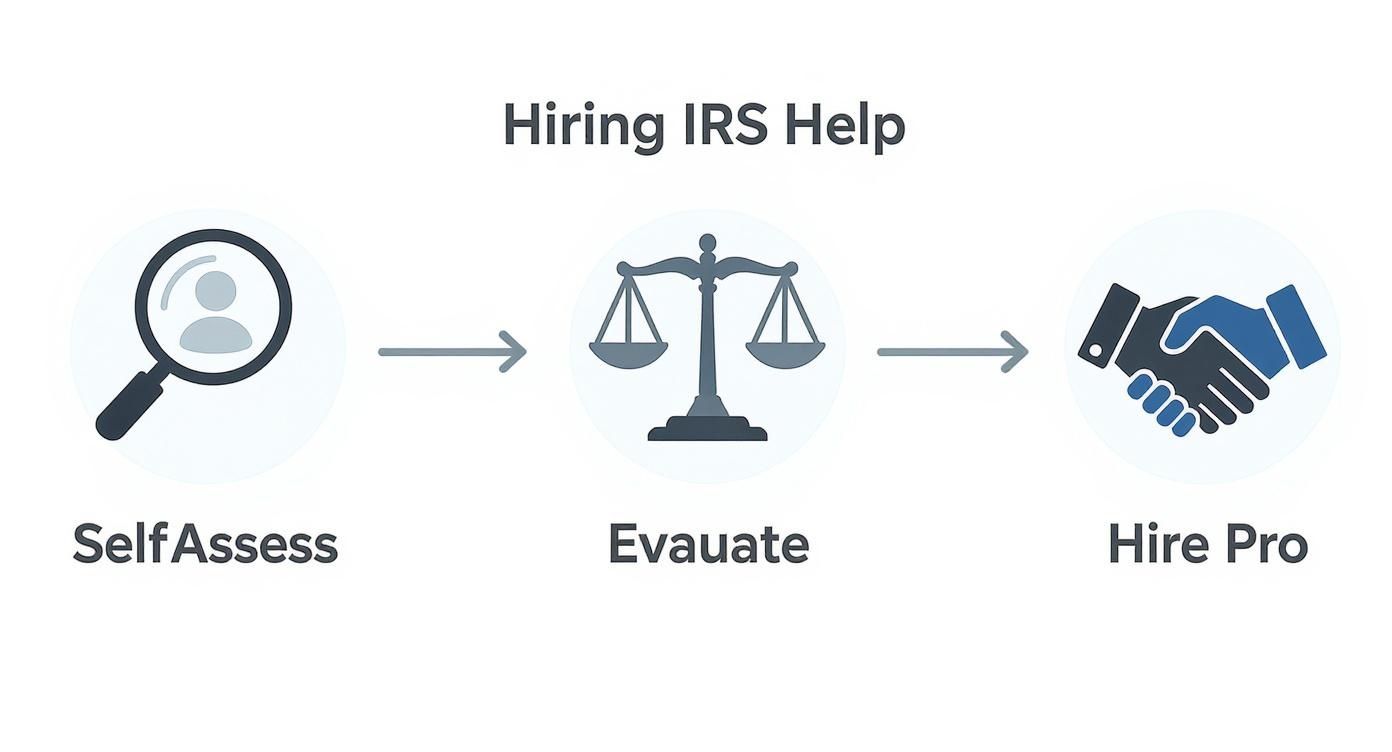
As the visual shows, hiring help isn't a sign of weakness; it's a strategic move based on the complexity of your case and how well-equipped you feel to handle the pressure.
The Three Ways an Audit Can End
Every single audit concludes in one of three ways. Knowing what these are from the start helps you manage expectations and prepare for whatever comes next.
- No Change: This is the home run. The auditor reviewed your return and accepted it as filed. You’ll get a "no change" letter, the case is closed, and you can breathe a huge sigh of relief.
- Agreed: This is common. The auditor proposes changes to your tax return, and you agree with their assessment. You'll sign an examination report, and eventually, the IRS will send a bill for the extra tax, plus any penalties and interest.
- Disagreed: If you don't agree with the auditor's proposed changes—and you have every right not to—the process isn't over. This is where you move on to formally appeal the decision.
Don't Like the Result? The IRS Appeals Process
Just because an auditor makes a decision doesn't mean it's the final word. The IRS has an independent Office of Appeals specifically designed to resolve these disputes without forcing everyone into tax court.
To get the ball rolling, you'll need to file a formal protest letter. This document clearly lays out which of the auditor's findings you dispute and, most importantly, why.
Think of the appeals process as a negotiation. An Appeals Officer who is new to your case will review everything—your position and the auditor's—with the goal of reaching a fair and impartial settlement. This is often where a seasoned tax pro earns their keep, using their deep knowledge of tax law and negotiation tactics to work toward a much better outcome.
The stakes are high. The IRS's own data shows that in fiscal year 2024, its Automated Underreporter Program alone closed 1.2 million cases, resulting in $7.7 billion in additional tax assessments. You can dig into more IRS compliance and enforcement efforts on their website. Seeing numbers like that really drives home why it's so important to fight an incorrect assessment through an appeal.
Got Questions About an IRS Audit? You're Not Alone.
Getting that letter from the IRS can make your heart sink, and a million questions probably start racing through your mind. It's completely normal. Let's walk through some of the most common questions I hear from clients to help you get a clearer picture of what's ahead.
What Makes the IRS Pick My Return to Audit?
People often assume it's just bad luck, but most audits aren't random. The IRS uses a powerful automated system called the Discriminant Information Function (DIF). Think of it as a sophisticated pattern-recognition tool that scores every tax return, flagging any that stray too far from the statistical norm.
So, what kind of things get its attention? In my experience, a few key issues pop up again and again:
- Sky-High Deductions: Claiming deductions that seem way out of line with your income is a big one. For example, if you're a freelance consultant reporting $60,000 in income but claim $45,000 in business expenses, that ratio is going to get a second look.
- A Business That Never Makes Money: The IRS understands that businesses can have a tough year. But if you're reporting significant losses for three, four, or five years in a row, they start to wonder if it's a real business or a hobby you're trying to write off.
- Mismatched Income Reports: This is probably the most common trigger. The IRS receives a copy of every W-2 and 1099 issued with your Social Security number. If the income you report doesn't line up with what they've been told, their system will automatically flag your return for review. It's a simple matching game, and any discrepancy is an easy catch for them.
- Claiming 100% Business Use of a Vehicle: This is a classic red flag. Unless you have a dedicated delivery truck that you never use for a personal errand, claiming 100% business use is almost always an exaggeration in the eyes of an auditor. Be realistic.
How Long is This Audit Going to Take?
This is the million-dollar question, and unfortunately, there's no easy answer. The timeline really depends on the type of audit and its complexity.
A simple correspondence audit, where they just want proof for a single deduction and you handle everything by mail, could be wrapped up in a couple of months.
But for more serious audits, you need to be prepared for a longer haul.
An in-person office audit or a full-blown field audit at your home or business can easily drag on for six months to over a year. The process can get even longer if there are complicated records, major disagreements with the auditor, or if you end up needing to file an appeal.
Can I Actually Negotiate with the IRS?
Yes, absolutely. Negotiation is a crucial part of the process, but it takes a couple of different forms.
If you agree with the audit findings but just don't have the cash to pay the bill, you have options. You can work with the IRS to set up a formal payment plan (Installment Agreement). For those in a tougher spot financially, an Offer in Compromise (OIC) might be possible, allowing you to settle your tax debt for less than the full amount owed.
On the other hand, if you flat-out disagree with the auditor's conclusions, your route is to challenge them. This isn't an argument in the audit room; it’s a formal process where you file a protest and take your case to the IRS Independent Office of Appeals. This is a specific forum designed to negotiate and settle disputes to avoid going to court.
What Happens If I Just Ignore the Audit Notice?
Let me be blunt: ignoring an audit notice is the single worst thing you can do. It will not go away. It will only get exponentially worse.
If you don't respond, the IRS won't just give up. They'll move forward without you, making a final decision based only on the information they have. In almost every case, this means they'll disallow every deduction in question and assess the highest possible tax amount.
Then come the penalties and interest, which pile up fast. Before you know it, you’ll be facing aggressive collection actions like wage garnishments, levies on your bank accounts, and federal tax liens slapped on your property.
Don't let an IRS problem spiral out of control. At Attorney Stephen A Weisberg, I start with a FREE Tax Debt Analysis to determine exactly how I can help before you ever pay a fee. If you need expert representation to resolve your IRS issues, let's talk.