haven t filed taxes in 3 years - Your Recovery Plan
haven t filed taxes in 3 years? Discover a clear, step-by-step plan to resolve IRS issues, stay compliant, and regain peace of mind.

In this article
- The Reality of Unfiled Taxes for 3 Years
- Why Acting Now Is Critical
- Immediate Risks of Not Filing for 3+ Years
- What Happens When the IRS Catches Up? Penalties and Collections
- The One-Two Punch of IRS Penalties
- When the IRS Files a Return for You (And It’s Never in Your Favor)
- From Paper Notices to Seizing Your Assets
- Your Step-By-Step Guide to Getting Back on Track
- Step 1: Gather Your Essential Documents
- Step 2: Prepare and File Your Overdue Returns
- Step 3: Address Your Tax Bill
- How to Handle Your IRS Tax Debt
- Find Your Best Path Forward
- Comparing IRS Tax Resolution Programs
- When Your Tax Situation Gets Complicated
- Civil Non-Filing vs. Criminal Tax Evasion
- Red Flags That Scream "Willful"
- Deciding If You Need a Tax Professional
- When to Immediately Call for Help
- Common Questions About Unfiled Taxes
- Can I Go to Jail for Not Filing Taxes for 3 Years?
- What if the IRS Owes Me a Refund for Those Years?
- Will I Lose My Passport for Owing Back Taxes?
- Can the IRS Really Take My House or Paycheck?
If you haven't filed taxes in 3 years, it’s time to take action. This isn't a problem that will just disappear. The good news is that no matter how deep the hole seems, there's always a clear path back to compliance, and I've helped countless people navigate it.
The Reality of Unfiled Taxes for 3 Years
That sinking feeling you get when you realize it's been three years since you last filed is completely normal. Life happens—financial struggles, health crises, or just plain old procrastination can get the best of anyone. You're far from alone in this.
The crucial thing to understand is that ignoring the IRS isn't a viable strategy. They already have your income data from employers (W-2s) and clients (1099s). When they see income but no tax return, they don't just wait. Instead, they can prepare what’s called a Substitute for Return (SFR).

Think of an SFR as the IRS filing for you, and trust me, it’s never to your benefit.
An SFR is built using only your income information. It completely ignores any deductions or credits you deserve—things like business expenses, mortgage interest, or credits for your children. The result is almost always a tax bill that's drastically higher than what you would have owed if you'd filed yourself.
Why Acting Now Is Critical
Every day you wait, the problem gets more expensive and more complex. Penalties for failing to file and failing to pay are steep, and they're compounded by daily interest. What started as a manageable tax debt can quickly spiral out of control.
Here’s a quick look at the immediate risks you’re facing.
Immediate Risks of Not Filing for 3+ Years
A summary of the primary consequences and the potential financial impact of prolonged non-compliance with IRS filing requirements.
| Risk Area | What Happens | Potential Financial Impact |
|---|---|---|
| Penalties & Interest | The failure-to-file penalty alone is 5% per month (up to 25%) on your unpaid tax, plus interest on top. | A modest tax debt can quickly double or triple, making it much harder to pay off. |
| Lost Refunds | You generally have only three years from the original due date to file a return and claim a refund. | Any money the government owes you from those years will be permanently lost to the U.S. Treasury. |
| Collection Actions | The IRS can file a federal tax lien against your assets or issue a levy to seize funds directly from your bank or paycheck. | Loss of property, frozen bank accounts, and significant reduction in your take-home pay. |
| Substitute for Return | The IRS files a return for you that doesn't include any of your eligible deductions or credits. | An artificially inflated tax bill that's much higher than what you actually owe. |
The bottom line is that the situation gets worse, not better, with time. Plus, the federal government is renewing its focus on compliance. As recent reports show, the IRS is cracking down on non-filers and unfiled returns, making proactive resolution more critical than ever.
Let's walk through the exact steps to get this sorted out and get you back on track.
What Happens When the IRS Catches Up? Penalties and Collections
If you haven't filed taxes in 3 years, it's easy to hope the IRS has simply forgotten about you. Unfortunately, that's not how it works. Their automated systems are designed to eventually catch up, and when they do, the financial consequences can snowball quickly.
Think of it like an ignored credit card bill. The original balance doesn't just sit there; it starts ballooning with late fees and interest, making the debt much harder to tackle down the road. The IRS operates in a similar way, but with far more power.
The One-Two Punch of IRS Penalties
The moment your tax return becomes overdue, two key penalties kick in and start adding to your balance.
First, there's the failure-to-file penalty, which is the more severe of the two. The IRS charges 5% of your unpaid tax bill for each month (or part of a month) that your return is late. This penalty keeps adding up until it hits a cap of 25% of what you owe.
At the same time, you'll get hit with the failure-to-pay penalty. This one is for not paying your tax liability by the deadline and accrues at 0.5% of your unpaid taxes each month. It also maxes out at 25%. When both penalties are running in the same month, the IRS adjusts the calculation slightly, but the combined effect can rapidly inflate your debt. To make matters worse, interest compounds daily on the entire outstanding amount—the original tax, plus the penalties.
When the IRS Files a Return for You (And It’s Never in Your Favor)
If years go by without a return from you, the IRS won't wait forever. They'll eventually take matters into their own hands and create what's called a Substitute for Return (SFR). They use the income data they already have from W-2s and 1099s to calculate a tax bill on your behalf.
Here's the problem: an SFR is a worst-case-scenario calculation. It’s designed to establish a debt, not to be fair. The IRS gives you only the most basic standard deduction and a single filing status, ignoring everything that could have reduced your tax bill, such as:
- Itemized Deductions: Things like mortgage interest, state and local tax payments, or charitable giving are completely left out.
- Tax Credits: Forget about credits for children, education, or other common life events. The IRS doesn't include them.
- Business Expenses: If you're a freelancer or business owner, none of your legitimate operating costs are considered.
An SFR almost always results in a tax bill that is drastically higher than what you actually would have owed. Its sole purpose is to create a legally collectible debt so the IRS can start coming after you for the money.
This isn't just a rare occurrence; it's a huge problem. Non-filing is a major contributor to the nation's "tax gap"—the difference between taxes owed and taxes paid. For tax year 2022, non-filers were responsible for an estimated $63 billion of this gap, which hit $696 billion in total. It’s a clear sign of just how many people fall into this trap. You can dig into more official data on the U.S. tax gap and compliance on the IRS website.
From Paper Notices to Seizing Your Assets
Once the IRS has a number on the books—either from your late-filed return or their own SFR—and the bill goes unpaid, they can shift from sending letters to taking direct action.
Their first major move is often filing a Notice of Federal Tax Lien. This is a public legal claim against all your property—your house, your car, your future assets. A lien secures the government's claim to your property, absolutely tanks your credit score, and makes it almost impossible to sell anything or get a loan.
If a lien doesn't get your attention, the IRS can escalate to a levy. A levy isn't just a claim; it's the actual seizure of your property to pay off the debt. The IRS has the authority to:
- Garnish your wages, taking money right out of your paycheck.
- Seize funds from your bank accounts, often without warning.
- Take physical assets like your car, real estate, or even your retirement funds.
The good news is that even if penalties are piling up, you're not out of options. It's often possible to get penalties reduced or even completely removed if you can show you had a good reason for not filing or paying on time. Our guide on IRS penalty abatement for reasonable cause is a great place to start understanding how to fight back.
Your Step-By-Step Guide to Getting Back on Track
Staring at three years of unfiled tax returns can feel like you're at the foot of a mountain, with no clear path to the top. But here’s the secret: you don't climb a mountain in one leap. You take it one step at a time. This guide is your playbook, designed to turn an overwhelming task into a clear, manageable plan.
The first move, before anything else, is to gather your gear. You simply can't prepare an accurate tax return without the right financial documents. And don't panic if your records aren't perfect; there are ways to reconstruct your financial picture.
Step 1: Gather Your Essential Documents
Before you can even think about filling out a tax form, you need to collect all the necessary paperwork for each of the three years you missed. Think of yourself as a detective investigating your own finances. Start by hunting down the most common income forms.
- W-2 Forms: If you worked for an employer, they would have sent you a W-2 each year detailing your wages and the taxes already withheld.
- 1099 Forms: Were you a freelancer, independent contractor, or did you have other side income? You'll be looking for forms like the 1099-NEC, 1099-MISC, or 1099-K.
- Other Income Records: Don’t forget about investment income (1099-DIV, 1099-INT) or records of mortgage interest you paid (Form 1098).
What happens if you can't find these? This is a really common hurdle, but the IRS has a solution. You can request a Wage and Income Transcript for free, directly from them. This official document lists all the income information that was reported to the IRS under your Social Security number for a specific year—which is exactly what you need to get started.
Step 2: Prepare and File Your Overdue Returns
With your documents in hand, it’s time to actually prepare each tax return. It's absolutely critical to file an original, accurate return for each year. You should never just accept a Substitute for Return (SFR) the IRS might have created for you. Why? Because your own return will include all the deductions and credits the IRS ignored, which almost always results in a much lower tax bill.
As a general rule, the IRS wants taxpayers to file the last six years of delinquent returns to be considered compliant again. Since you haven't filed taxes in 3 years, you're well within this window. Tackling this now is smart because it stops the problem from snowballing into something bigger and more complicated. Accuracy is everything here; a rushed, incorrect return can just create a whole new set of problems.
This is the typical path IRS collections take when taxes go unfiled and unpaid.
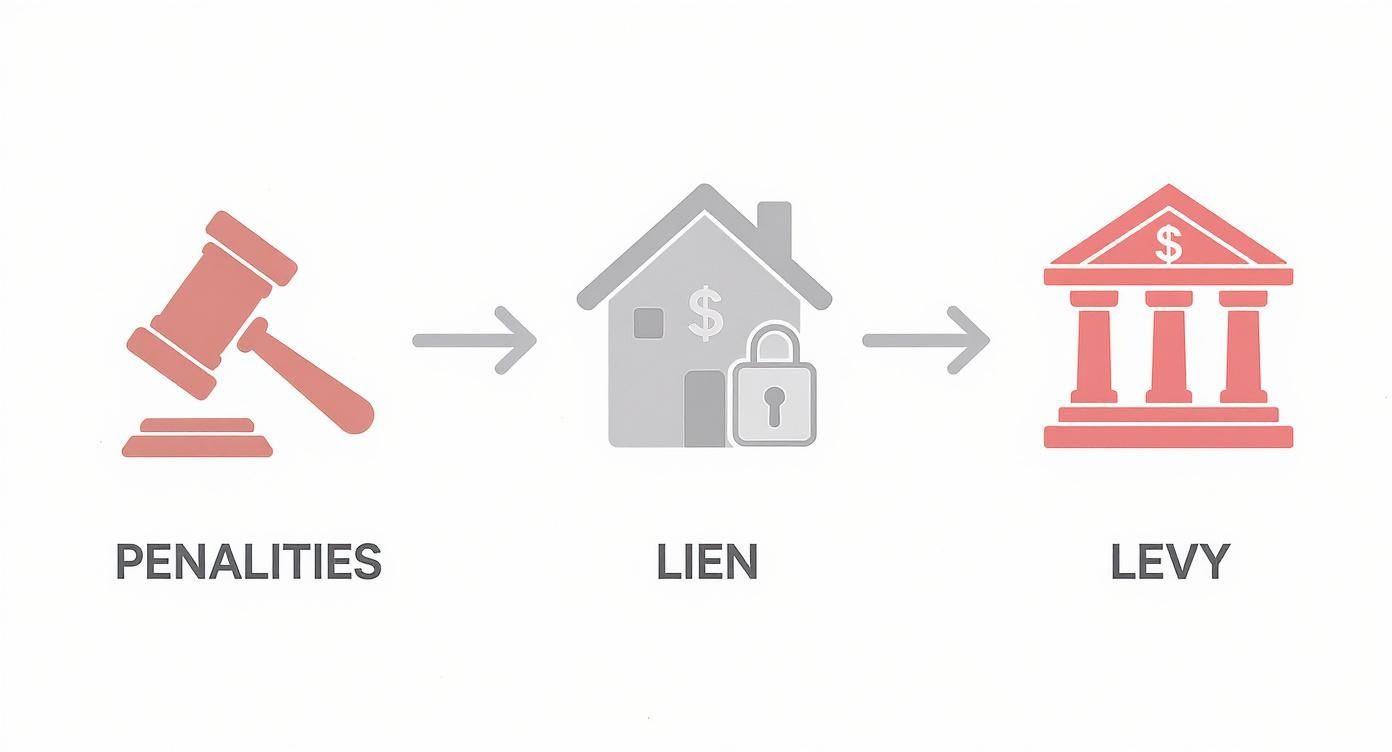
As you can see, what starts with penalties can quickly escalate to more aggressive actions like liens and levies. That's why getting ahead of it is so important.
Step 3: Address Your Tax Bill
Once your returns are filed, the IRS will send you a notice detailing what you owe, which includes the original tax, plus penalties and interest. Whatever you do, don't ignore this letter. This is your moment to decide how you're going to handle the debt.
If you can pay the full amount, that's always the fastest way to put this behind you. But let's be realistic—many people who fall behind on their taxes can't just write a huge check. The good news is the IRS has several resolution programs available, which we'll dive into in the next section.
Key Takeaway: The goal isn't just to file the old returns. It's to become fully compliant with the IRS, which means filing all the required back taxes and having a solid plan to deal with the resulting debt.
Getting back taxes filed can feel complex, and making sure every detail is right is crucial. For a more in-depth look, our comprehensive guide on how to file back taxes offers more strategies to help you through it. Getting professional guidance can ensure you complete each step correctly and avoid common—and costly—pitfalls. Being proactive is truly your best defense against further IRS action.
How to Handle Your IRS Tax Debt
Filing those three years of back taxes is a massive accomplishment, but it's only the first step. The next hurdle—staring at the total amount you owe—can feel just as overwhelming. But here's the good news: you don't have to write a check for the full amount tomorrow. The IRS has several established programs to help people get back on their feet.
Think of it like this: filing your returns gets you on the right road. These resolution programs are the different routes you can take to finally reach your destination of being debt-free. You just have to figure out which path is the best fit for your current financial situation.

Find Your Best Path Forward
Let's walk through the four main options the IRS offers. Each program is designed for a different kind of financial hardship, so understanding how they work is crucial to finding the right solution.
Installment Agreement (IA)
This is the most common and straightforward path. An Installment Agreement is exactly what it sounds like: a formal payment plan with the IRS. If you owe a large sum but have the income to make consistent monthly payments, this is usually your best bet.
It’s a lot like getting a car loan for your tax debt. You agree to a set payment each month until the entire balance, including any interest and penalties that have built up, is paid off. Most agreements can be set up for a period of up to 72 months.
Offer in Compromise (OIC)
An Offer in Compromise, or OIC, is the holy grail of tax resolution, but it's also the toughest to get approved. An OIC allows you to settle your tax liability for a fraction of what you originally owed. The IRS only accepts an OIC when they're convinced it’s the absolute most they could ever hope to collect from you.
Think of it as a final settlement. You and the IRS agree on a smaller lump-sum payment to wipe the slate clean for good. This option is reserved for people with substantial debt but very few assets and limited income, making full payment an impossibility.
Penalty Abatement
Did you have a good reason for not filing or paying your taxes on time? If so, you might qualify for Penalty Abatement. This program doesn't touch the original tax you owe, but it can get rid of the failure-to-file and failure-to-pay penalties, which often make up a huge chunk of the total bill.
What counts as a "reasonable cause?" The IRS is looking for serious, unforeseen circumstances. Things like a severe illness, a death in your immediate family, or your records being destroyed in a fire or flood are all considered valid reasons.
Currently Not Collectible (CNC)
For people in a truly dire financial spot, Currently Not Collectible (CNC) status can be a lifeline. If paying anything toward your tax bill would mean you couldn't afford basic necessities like rent and food, the IRS can agree to put a pause on all collection efforts.
This isn’t a permanent fix, though. The IRS will revisit your financial situation down the road, and if your income improves, they'll expect you to start paying. All the while, interest and penalties keep adding up. CNC is a temporary breathing room, not a long-term solution.
Comparing IRS Tax Resolution Programs
Choosing the right program can be tricky, as each one is designed for a specific financial scenario. This table breaks down the key differences to help you see where you might fit.
| Resolution Program | Who It's For | Key Outcome |
|---|---|---|
| Installment Agreement | Taxpayers with steady income who can pay off their full debt over time. | A manageable monthly payment plan until the debt is fully resolved. |
| Offer in Compromise | People with significant debt but very low income and few assets. | The IRS agrees to accept less than the full amount owed as final payment. |
| Penalty Abatement | Individuals who had a valid, documentable reason for not filing or paying. | Penalties are removed, significantly reducing the total amount owed. |
| Currently Not Collectible | Those facing severe financial hardship who can't afford basic living costs. | The IRS temporarily stops all collection activity until your situation improves. |
The IRS keeps a close eye on compliance trends. Their data shows that while they process around 153 million individual returns each year, unfiled returns contribute a staggering $63 billion to the national tax gap. Taxpayers who haven't filed taxes in 3 years are often those with complicated financial lives or lower incomes—the very people who need these resolution programs the most.
Figuring out which of these options is right for you is the key to finally putting this problem behind you. Each program has its own detailed application process and strict eligibility rules. For a more detailed breakdown, take a look at our guide on how to settle tax debt with the IRS. Making the right choice now is the best way to protect your financial future.
When Your Tax Situation Gets Complicated
Look, while many people who haven't filed can get back on track with a few straightforward steps, some situations are just plain trickier and carry much higher stakes. It's crucial to know the difference, especially when you haven't filed taxes in 3 years, because certain factors can turn a simple civil problem into something much more serious.
One of the biggest myths I hear is about the statute of limitations. People often think the IRS only has a handful of years to come after them for unfiled returns. That's a dangerous mistake. The truth is, the clock for the IRS to assess tax and slap on penalties doesn't even start ticking until you actually file a tax return.
Think about that for a second. If you never file, the IRS has forever to come after you for that year's taxes. The problem doesn't just fade away with time; it stays open, waiting for you, indefinitely.
Civil Non-Filing vs. Criminal Tax Evasion
It’s vital to understand the line between simply failing to file and willfully evading taxes. The vast majority of cases are civil matters. That means the consequences are financial—you'll face penalties, interest, and maybe a lien or levy. You messed up, maybe even in a big way, but the IRS generally assumes you didn't do it with criminal intent.
Criminal tax evasion is a whole different ballgame. This isn't about forgetting or procrastinating; it's about a deliberate, intentional effort to defraud the government. For the IRS to pursue a criminal case, they have to prove beyond a reasonable doubt that you knew you had a legal duty to file and pay, and you intentionally chose not to.
Red Flags That Scream "Willful"
Certain actions can push a non-filing case from the civil arena into a potential criminal investigation. In the tax world, we sometimes call these "badges of fraud" because they signal a clear intent to deceive.
Keep an eye out for these major red flags:
- Using a False Social Security Number: This is a pretty clear sign of trying to hide from the system.
- Hiding Assets or Income: Funneling money into offshore accounts, putting property in your cousin's name, or using shell companies to hide what you're earning are classic evasion tactics.
- Dealing Heavily in Cash: If you're consistently using cash for large transactions specifically to avoid a paper trail, the IRS will see that as an attempt to conceal income.
- Destroying Records: Intentionally shredding or "losing" financial records to get in the way of an investigation is a big no-no.
This issue of hiding assets is a massive global problem. It's not uncommon for individuals who don't file for years to use offshore tax havens to stash their income. In fact, it's estimated that a staggering $8.7 trillion is held by individuals in global tax havens, which creates huge revenue gaps for governments. You can get more insights on this global challenge from the International Monetary Fund.
I'm not pointing out these red flags to scare you. The goal is to give you clarity. If any of this sounds uncomfortably familiar, you need to understand the heightened risk you're facing. This is the point where professional legal help stops being a good idea and becomes absolutely essential for your protection.
Deciding If You Need a Tax Professional
Look, it's technically possible to handle unfiled taxes on your own. But trying to navigate the IRS when you haven't filed taxes in 3 years is a bit like trying to perform surgery on yourself. You might know what needs to be done, but you don't have the right tools, the specialized training, or the steady hand to deal with unexpected complications.
A seasoned tax professional is that experienced surgeon. They bring precision, expertise, and a crucial outside perspective to the table. Hiring professional tax preparation services isn't just about filling out old forms; it's about strategy, negotiation, and protecting your rights.
When to Immediately Call for Help
While pretty much anyone behind on their taxes can benefit from an expert's advice, some situations are more than just tricky—they're downright dangerous to handle alone. If any of the following sound familiar, it's time to stop what you're doing and get a professional on the line.
The Debt is Significant: If you think you'll owe more than $10,000, you're on the IRS's radar in a big way. Their collection tactics become much more serious at this level, and a pro knows how to negotiate resolutions you probably can't get for yourself.
You're a Business Owner with Payroll Issues: This is a big one. The IRS takes unpaid payroll taxes incredibly seriously—they see it as you holding onto money that belongs to your employees and the government. These cases escalate fast and require an expert.
The IRS Is Already Taking Action: Are they already garnishing your wages, levying your bank account, or slapping a lien on your property? You need immediate intervention. This is not a "wait and see" situation. An experienced pro can step in, communicate with the IRS, and work to get these aggressive collection actions stopped.
You're Worried About Criminal Charges: If any of those "red flags" for willfulness we talked about earlier apply to you (like hiding money offshore, using a fake SSN, etc.), you absolutely need the protection of an attorney. Don't even think about going it alone.
The single biggest advantage of hiring a tax attorney is attorney-client privilege. This is a powerful legal shield that makes your conversations completely confidential. You can be 100% honest about every detail of your situation, knowing that your words cannot be used against you by the IRS.
An accountant or an enrolled agent simply can't offer this level of protection. This privilege creates a safe harbor where you and your attorney can build the strongest possible defense and resolution strategy. Think of hiring an expert not as an expense, but as a critical investment in getting your life back on track.
Common Questions About Unfiled Taxes
When you’re behind on your taxes, especially for 3 years or more, a lot of questions—and fears—start to surface. Let's tackle some of the most common concerns I hear from clients to give you a clearer picture of what you're up against.
Can I Go to Jail for Not Filing Taxes for 3 Years?
This is the number one fear, and thankfully, the answer is almost always no. Jail time is reserved for criminal tax evasion, and that’s a very high bar for the government to clear. The IRS would have to prove you had a willful intent to defraud them—think hiding money in offshore accounts or creating a second set of books.
For most people, simply failing to file is a civil matter. It comes with financial penalties and interest, not a prison sentence. The key is to stop ignoring the problem. By taking the first step to get compliant, you ensure your situation stays on the civil side of the line.
What if the IRS Owes Me a Refund for Those Years?
It happens more often than you'd think, but you're on a strict clock. The IRS gives you a three-year window from the original tax deadline to file a return and claim any refund you're owed.
If you don't file within that three-year period to claim your refund, the money is gone for good. It goes to the U.S. Treasury, and you can never get it back or even apply it to another tax debt.
So, for one of those three years you haven't filed, you might still be able to get money back. But for the older years, that opportunity has likely vanished. Filing now is the only way to find out and recover what’s yours.
Will I Lose My Passport for Owing Back Taxes?
Yes, this can absolutely happen. If your tax debt is deemed "seriously delinquent"—a specific amount that's adjusted for inflation each year—the IRS can certify your debt to the State Department. This typically happens after they've filed a tax lien against you and you've exhausted your appeals.
Once that certification is made, the State Department can deny your passport application or even revoke your current one. The good news? Getting your returns filed and setting up a formal payment plan with the IRS will put a stop to this process.
Can the IRS Really Take My House or Paycheck?
They certainly can. The IRS has two powerful tools for this: liens and levies. Think of them as a one-two punch.
- A tax lien comes first. It’s a legal claim against all of your property—your house, your car, everything. It’s the government’s way of saying, "We have first dibs on your assets," and it wrecks your credit score.
- A tax levy is the next step: the actual seizure of your property. This isn't just a threat. They can legally garnish your wages straight from your employer or clean out your bank account overnight, without any final warning.
These are aggressive collection tactics, but the IRS usually only uses them after multiple letters and notices have gone unanswered.
Staring down three years of unfiled returns is intimidating, but you don't have to sort this out on your own. Attorney Stephen A. Weisberg at The W Tax Group provides a free, no-obligation Tax Debt Analysis to review your specific situation and map out a clear strategy. Before you ever pay a fee, you'll understand exactly what can be done. Schedule your free analysis today and take the first real step toward putting your IRS problems behind you for good.


