How to Get My IP PIN from the IRS
Learn how to get my IP PIN from the IRS with clear steps for online enrollment, retrieving a lost PIN, and handling identity-thevictim cases.

In this article
- Why You Need an IP PIN Before You File
- Using the IRS Online Tool to Get Your PIN
- What the online process looks like
- Choosing Between Online, Form 15227, and In Person
- When You Cannot Verify Online and the PIN Is Lost
- The common failure points
- Special Rules for Identity Theft Victims
- Working With Tax Preparers and When to Call an Attorney
- Your IP PIN Checklist and Next Steps
You're sitting at the return screen, your documents are open, and the IRS still needs that six-digit code you can't find. Maybe the notice got tossed, maybe the account is locked, or maybe you're coming back after an identity-theft mess and you just want to file without another headache. Get your IP PIN now, before you submit anything, because this is one of those IRS controls that can stop a return cold if you ignore it.
An IRS Identity Protection PIN is a six-digit code the IRS uses to confirm your identity on federal income tax returns and certain related forms. In practice, it's both a lock and a key. The IRS puts the lock on your filing, and you need the key in hand before the return goes out. The IRS also treats the program as nationwide, so if you're enrolled continuously, a new PIN should show up each year through your online account or the annual notice.
The smart move is to treat the IP PIN as part of your annual filing setup, not a one-time rescue step. If you wait until the last minute, you're asking for delays, especially if you need the IRS to reissue anything by mail. If you already know your account is a problem, stop trying to brute-force the return and deal with the PIN first.
Why You Need an IP PIN Before You File
A lot of taxpayers only care about the IP PIN once something breaks. They can't find last year's notice, their preparer asks for the code, or the IRS account won't let them in. That's the wrong time to learn how this system works.
The IRS uses the Identity Protection PIN to confirm that the person filing is really the taxpayer. It applies to federal income tax returns and certain related forms, so this isn't a narrow niche feature. If you're enrolled and you omit the PIN when the IRS expects it, you're creating a filing problem before the return even gets off the ground.
Practical rule: if you already have an IP PIN, file with it every time the IRS expects it. Don't assume the software will “figure it out” later.
The safer habit is to think in terms of continuity. If you stay enrolled continuously, you don't need to restart the process each year from scratch. A fresh PIN shows up automatically through the IRS account or the annual notice, and that matters because the people who get tripped up are usually the ones who only chase the code after they've already started the return.
You should also treat the IP PIN as sensitive tax data, not as something to email around casually. If a preparer needs it, give it directly and keep your own record somewhere secure. The point is simple, you want the IRS to recognize your filing, not give an identity thief a cleaner shot at the same return.
Using the IRS Online Tool to Get Your PIN

If you can use the IRS online portal, use it. That is the cleanest route, and it's the one I'd tell a client to try first every time. The IRS says the online account route is the fastest, and once identity verification is done, the PIN appears immediately on screen. The University of Florida's payroll guidance says the same thing, the most reliable route is signing in to your IRS account, going to your profile, and enrolling in the IP PIN program.
What the online process looks like
Start with your IRS online account. If you already have one, sign in and go to your Profile page. If you don't, create the account and complete the identity verification step the IRS requires before you can see the PIN.
Once you're verified, enroll in the IP PIN program and retrieve the current code. Then decide whether you want one-time enrollment for this tax year or continuous enrollment for future years. I usually tell taxpayers who've had a fraud issue to lean toward continuous enrollment, because the whole point is to stop revisiting the same problem every spring.
Keep the PIN somewhere secure, not in a casual email thread. A password manager is a better choice than your inbox.
If you're doing this while preparing to file, check the number twice before you hand it to a preparer or enter it into software. One wrong digit can create a filing delay that's entirely avoidable. If the account route works, stop there and move on.
For taxpayers who want to see how this fits into the broader filing transition, the IRS has pushed more of the process online, and this firm update on digital refund changes is worth a read if you're already managing your tax workflow digitally.
Choosing Between Online, Form 15227, and In Person
Not everyone gets to use the same path, and guessing wrong wastes time. The IRS gives you three basic routes, but they are not equal, and they are not all open to everybody.
| IRS IP PIN Methods Compared | Eligibility | Processing Time | Best For |
|---|---|---|---|
| Online account | Taxpayers who can verify online | Fastest, PIN appears immediately after verification | Most taxpayers who can access their account |
| Form 15227 | Adjusted gross income below $84,000 for individuals or $168,000 for married couples filing jointly | Slower than online, because identity is verified by phone and the PIN is mailed | Lower-income taxpayers who can't use the online route |
| In person at a Taxpayer Assistance Center | Taxpayers who are ineligible for Form 15227 or need face-to-face help | Depends on appointment and IRS processing | Hard cases, account access failures, and taxpayers who need direct help |
The IRS says the online account route is the fastest, and that's the route I'd choose whenever it's available. If online verification fails and your income fits the threshold, Form 15227 can still get the job done. If your income is above that limit, stop trying to force the form and go straight to a Taxpayer Assistance Center.
That income cutoff matters more than you might realize. It knocks a lot of filers out of the mail-in path, which is why taxpayers who keep trying to use Form 15227 outside the limits end up losing days they don't have. If you already know you're above the threshold, skip the paperwork detour.
The practical decision rule is blunt. Online if you can, Form 15227 only if you qualify, in person if neither of the first two works. That is the cleanest way to avoid spinning your wheels.
When You Cannot Verify Online and the PIN Is Lost
Real filers get stuck here. The IRS account won't verify, the CP01A notice never arrived, the old address is wrong, or the envelope showed up and disappeared before anyone found it. If that's your situation, stop treating it like a software problem.
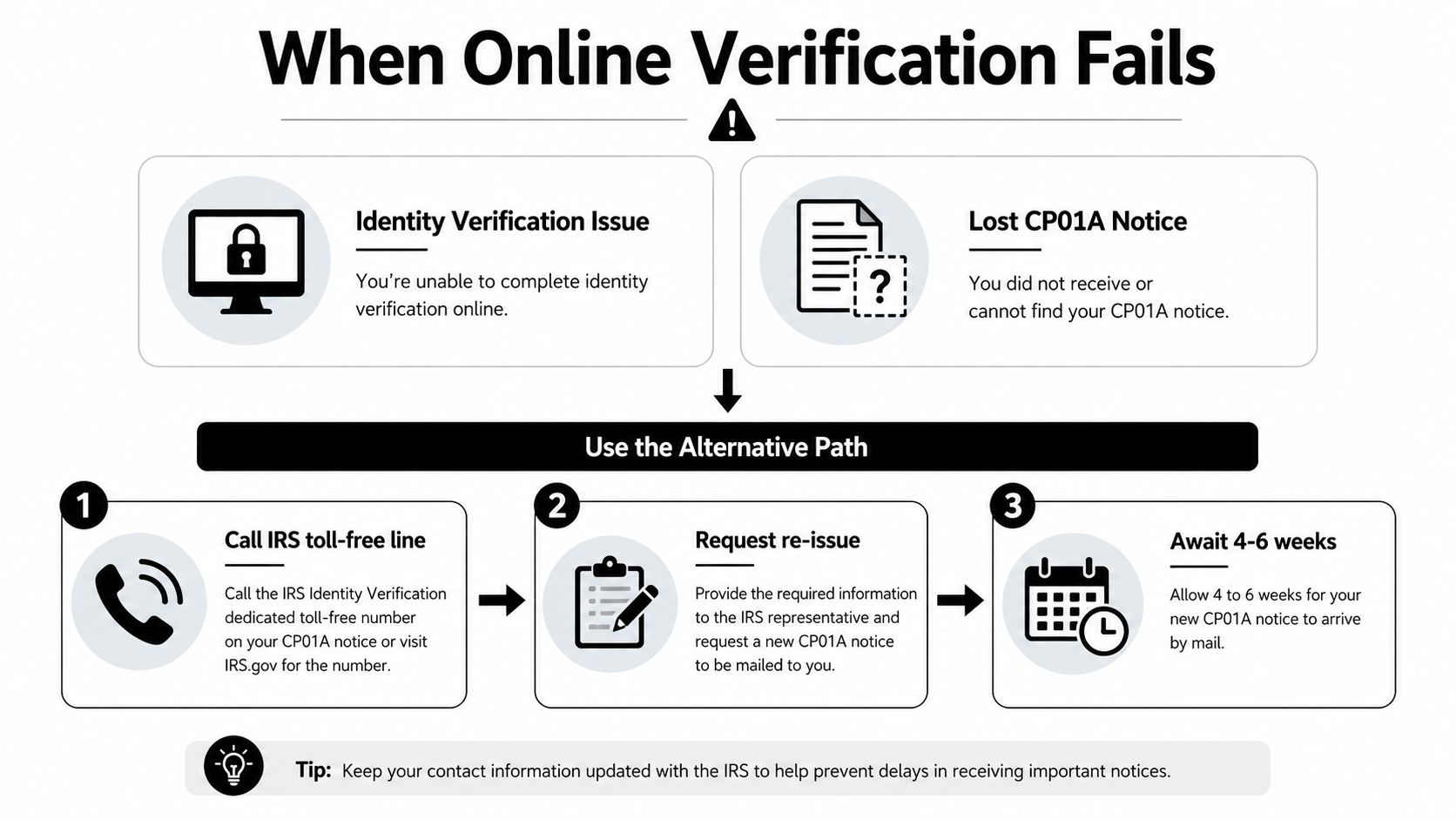
The IRS says taxpayers who can't access the online account can call 800-908-4490 in the U.S. or 267-941-1000 from abroad. If the IRS has to reissue the PIN by phone, it verifies identity and mails the PIN to the address of record within 21 days. That timeline matters if your filing deadline is close, because phone help is not instant help.
The common failure points
The first problem is online verification that won't pass. That can happen even when the taxpayer is legitimate and the records are just messy. The second problem is a lost notice, especially when a move or address mismatch interfered with delivery. The third is simple bad timing, where the IRS does reissue the PIN but mailing still leaves you waiting.
If you're calling, have your records in front of you and be ready to answer identity questions. If your address changed, fix the address issue as part of the request instead of assuming the old record is good enough. If you need more context on dealing with IRS contact failures and delays, this discussion of unresponsive taxpayer-advocate situations is a useful companion read.
The main mistake is panic. People keep restarting the same online attempt, then they miss the deadline window while waiting for a magical fix. If the account doesn't work, move to the phone route or the in-person route and let the IRS process catch up.
Special Rules for Identity Theft Victims
If someone already used your Social Security number in a fraudulent filing, the IP PIN is not just a convenience. It becomes part of your defense. The IRS uses the PIN program to help stop the same misuse from happening again, and that's why documented fraud history changes how I look at the file.
Identity-theft victims should also keep their paperwork tight. IRS Form 14039, Identity Theft Affidavit, helps document what happened and supports the IRS response when a fraudulent return is already in play. If the bad return has already been filed, don't treat the PIN as the whole solution. You need the paper trail too.
A useful companion resource is safeguarding your digital identity, because tax fraud usually rides along with broader account compromise. The more your email, banking, and tax records are exposed, the easier it is for the problem to spread beyond one return.
For victims, continuous enrollment usually makes more sense than one-time use. The IRS keeps the PIN in the cycle for future filings, and that gives you a standing control instead of forcing a fresh scramble every year. If you're working through identity theft and want a practical recovery framework, this overview of IRS identity-theft handling fits the same reality.
Working With Tax Preparers and When to Call an Attorney
A CPA, EA, or return preparer can help file the return, but that doesn't mean they should be treated as a vault for your IP PIN. An authorized e-file provider can enter the PIN on the return, but the taxpayer still needs to provide it directly. Don't send it around in loose email chains or through a text thread you wouldn't want exposed.
Practical rule: your preparer can use the PIN, but you should control where it lives and who sees it.
For taxpayers who stay continuously enrolled, the IRS says a new IP PIN appears each year, typically through the online account or the annual CP01A notice. That is exactly why preparers need to check whether you're using the current number, not last year's. A stale PIN can break an otherwise clean filing.
The bigger issue is when the IP PIN problem keeps repeating. If you're dealing with repeated identity-theft incidents, mismatched IRS records, notices that keep referencing the same filing issues, or wages that still don't reconcile, DIY stops being the right move. That's when a tax attorney makes more sense, especially if you're self-employed or running a small business and the fraud risk keeps touching payroll, contractor income, or entity filings.
For a plain-language guide on when legal help is the better call, this article on hiring a tax attorney gives a sensible threshold. My view is simple. When the IP PIN issue is isolated, solve it with the IRS tools. When it's tied to identity theft, prior filings, or multiple IRS notices, bring in counsel.
Your IP PIN Checklist and Next Steps
Tonight, do three things in order. First, log in to your IRS account and see whether your current PIN is there. Second, confirm your address of record is correct if you may need a mailed reissue. Third, save the PIN securely and give it to your preparer only when you're ready to file.
If you're continuously enrolled, watch for the next year's PIN through the account or the annual notice. Don't wait until the return is half-finished to go hunting for it. That's how simple filing turns into an avoidable delay.
The red flags for professional help are straightforward. Repeated account failures, identity-theft history, bad IRS records, and missing notices all tell you the same thing, the self-service path has ended. At that point, you want someone who deals with IRS controversy every day, not another round of guesswork.
Tax Attorney Stephen A Weisberg helps taxpayers who are stuck in exactly these kinds of IRS problems, especially when identity theft, lost notices, or filing issues are interfering with a clean return. If your IP PIN situation has moved past simple self-service, visit Tax Attorney Stephen A Weisberg and talk through the facts before the IRS delay becomes a bigger tax problem.