How to Get IRS Transcript: Step-by-Step Guide for 2026
Need to get irs transcript for a loan or tax issue? Learn how to request your records online, by mail, or by phone with our expert 2026 guide.

In this article
- Why You Need an IRS Transcript and Which Type
- The transcript types that matter most
- Match the transcript to the problem
- The Fastest Method Get Transcript Online
- What you need before you start
- The online path that usually works
- When I would choose online first
- When online is a poor first choice
- Mail and Phone Options When Online Fails
- When mail or phone makes sense
- Where these methods fail
- IRS Transcript Request Methods Compared
- Strategic choice between the two
- Using Form 4506-T and Professional Help
- When Form 4506-T is the right tool
- Why professionals often use a different route
- Choosing between 4506-T and a POA request
- Solving Common IRS Transcript Hurdles
- ID.me keeps rejecting the login
- Transcript not available
- The transcript shows a balance due or strange codes
- The mailed transcript never arrives
- Using Your Transcript for Tax Debt Resolution
- What professionals actually look for
- Why transcript-first strategy works
You usually need an IRS transcript when something important is already in motion. A lender wants proof of income. An IRS notice raises questions about a return you thought was settled. A bankruptcy or family law matter stalls because someone needs tax records now, not weeks from now.
In practice, the hard part usually isn't understanding what a transcript is. It's choosing the right way to get it. Online is often fastest. It's also the method most likely to fail when the taxpayer's address, ID, or account details don't line up cleanly. Mail and phone are slower but steady. Form 4506-T solves a different set of problems. And when tax debt is involved, a Power of Attorney request can be the smartest route because it changes who is asking and how the records are pulled.
Why You Need an IRS Transcript and Which Type
A transcript request usually starts with a concrete problem. A lender questions income. An IRS notice refers to a payment the taxpayer does not recognize. A divorce, probate matter, or collection case turns on what was filed, when it was processed, and what the IRS has on its books. In those situations, the strategic issue is not whether to get a transcript. It is which transcript answers the actual question without wasting time.

A full copy of the return is often unnecessary. In practice, I reserve Form 4506 return copies for narrow situations, such as litigation, amended return disputes, or cases where the attachments themselves matter. For many lending, compliance, and controversy issues, a transcript gives the faster and cheaper answer.
For business owners, self-employed taxpayers, and professionals helping clients through underwriting or IRS disputes, the first question is simple. What decision will this document support? If you are still assembling records before filing or before sending documents to a bank, a practical checklist like this small business tax prep guide helps identify the records you should compare against the IRS file.
The transcript types that matter most
Tax Return Transcript
Use this for line-item verification from the original return as filed. It is commonly the right document for mortgage underwriting, student aid issues, and other income verification requests. It does not show later account activity, so it is a poor first choice if the dispute involves payments, penalties, or IRS adjustments.
Tax Account Transcript
Use this when timing and money matter. It shows assessments, payments, penalty entries, and other account actions. If a client says the IRS cashed a check but still shows a balance, or believes a return was filed but not properly posted, this is usually the first transcript to request.
Record of Account Transcript
This combines return data with account activity. In controversy work, it is often the best starting point because it reduces guesswork. You can compare what was filed with what the IRS later did to the account. The IRS description of transcript types for individuals and ways to order them is useful, but the practical takeaway is simpler. If the issue involves both reported numbers and later IRS action, this is usually the most efficient choice.
Wage and Income Transcript
Use this to reconstruct third-party reporting. It helps when W-2s, 1099s, 1098s, or brokerage statements are missing, or when the taxpayer suspects the IRS received income records that never made it onto the return. It is often the right transcript before preparing delinquent returns.
A good rule is this. Match the transcript to the dispute, not to the name that sounds familiar.
Match the transcript to the problem
- Loan or income verification: Tax Return Transcript usually fits.
- Missing W-2s or 1099s: Wage and Income Transcript is the better first request.
- Payment disputes, penalties, or collection analysis: Tax Account Transcript usually matters more than the return transcript.
- Cases involving both filing data and IRS account action: Record of Account Transcript often saves a second request.
- Need for the actual signed return or attachments: Consider a full return copy instead of a transcript.
That last point matters more than many taxpayers expect. I often see someone order a return transcript because a bank asked for "tax records," only to learn the underwriter wanted proof of filing data and the collections attorney needed assessment dates. Those are different problems. Ordering the wrong transcript first creates a delay, and delays are expensive when a closing date, court deadline, or IRS response date is already set.
Tax professionals also need to account for process risk. A method that works well for one transcript type may not be the best route in another case. For example, a taxpayer trying to confirm old income documents may tolerate a slower request. A taxpayer facing levy action usually cannot. The IRS has also been changing how taxpayers access records and interact with online systems, which affects transcript strategy in practice. This overview of IRS technology changes affecting taxpayer access and case handling gives useful context.
If your goal is to get irs transcript records efficiently, start with the question you need answered. Then choose the transcript that answers that question with the fewest follow-up requests.
The Fastest Method Get Transcript Online
A client calls on Monday because a lender wants tax records before Friday. In that situation, online access is usually the first option I test, but only after I decide whether the client is a good fit for it. Speed matters. So does the risk of getting stuck in identity verification and losing a day you do not have.

The online method is fastest because, when it works, you can usually view and download the transcript right away. That makes it the best first choice for taxpayers with a clean identity trail, current personal information, and a short deadline. It is also the method I prefer when I need to confirm a filing issue, compare IRS records to a return already in front of me, or get documents into a case file the same day.
What you need before you start
The online process depends on successful ID.me verification and matching IRS account information. Have these items ready before you log in:
- Government-issued photo ID: It needs to be current and readable.
- Social Security number and date of birth: These must match IRS and identity records.
- Smartphone or device access: Verification may require a selfie or mobile prompts.
- Current mailing address from the latest filed return: Address consistency still matters, even for online access.
I tell clients not to start this process casually. If the name on the ID differs from IRS records, if the address recently changed, or if the phone number is tied to an old account, online access can turn from a quick fix into a time drain.
The online path that usually works
The steps are straightforward:
- Sign in to the IRS Individual Online Account or create access through ID.me.
- Complete identity verification carefully, using the exact legal name and current data tied to your records.
- Open the tax records section.
- Select the transcript type and tax year.
- Download the PDF if it is available.
For a taxpayer who needs to get irs transcript records quickly, this is often the shortest path between the problem and the answer.
The larger reason online access matters is that the IRS has shifted more taxpayer activity into digital systems. That affects how transcripts are requested, how accounts are reviewed, and how quickly a practitioner can assess a case. This overview of IRS technology changes affecting taxpayer access and case handling helps explain why online transcript strategy now matters in day-to-day practice.
When I would choose online first
Online is usually the right first move when:
- The taxpayer has a near-term deadline: Loan underwriting, audit response, amended return review, or case screening.
- Personal information has been stable: Same name, same address, no recent identity record changes.
- The goal is immediate review: You need to read the transcript now, not wait for delivery.
- The taxpayer can complete ID verification without assistance: No expected trouble with document upload, selfie checks, or login authentication.
In those cases, online is not just faster in theory. It is faster in practice.
When online is a poor first choice
I do not treat online as automatic. I avoid making it Plan A when the facts suggest a failed verification attempt is likely.
Be cautious if any of these apply:
- Recent move or unresolved address issue: Account data may not line up cleanly.
- Name mismatch: Marriage, divorce, corrected Social Security records, suffix differences, or inconsistent middle names can block access.
- Prior verification failures: A second failed attempt rarely improves the day.
- Urgent matter with no time for troubleshooting: If a court, lender, or revenue officer deadline is fixed, the better strategy may be to line up a backup method immediately.
- Older or less tech-comfortable taxpayer: The problem is not intelligence. It is tolerance for a process that can be unforgiving.
That is the strategic point. Online is the fastest method only when the taxpayer can get through verification cleanly. If the facts suggest friction, a tax professional should decide that upfront and choose the method that is most likely to produce the transcript on time, not the method that looks fastest on paper.
Mail and Phone Options When Online Fails
A common fact pattern looks like this. The taxpayer needs a transcript quickly, the online login failed, and the deadline is real. At that point, the decision is less about convenience and more about whether the IRS will mail the record to the right place without creating a second problem.
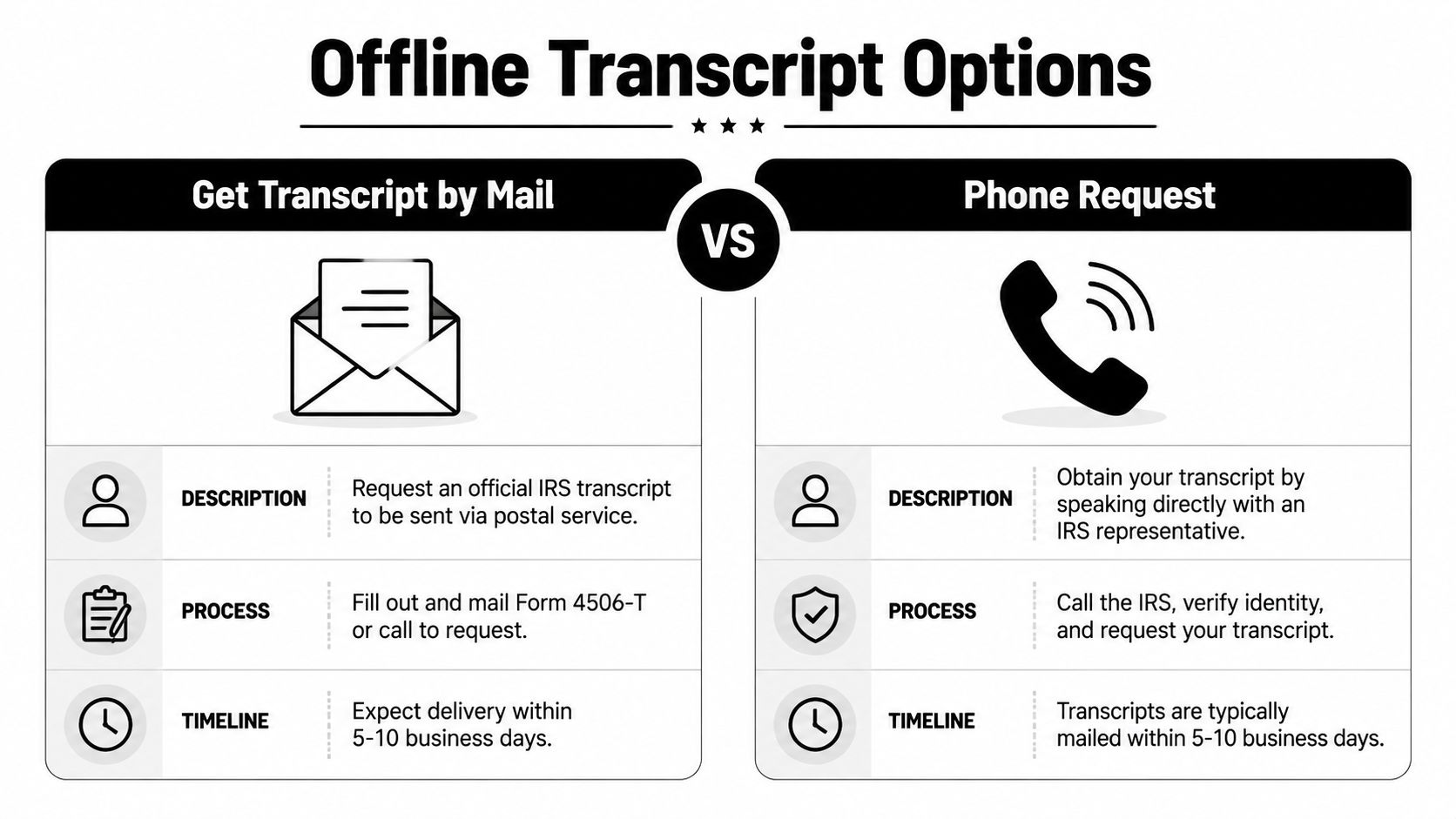
The two standard fallback options are a mail request and the automated phone line at 800-908-9946. Both are simple. Both avoid the online identity verification process. Both also depend on the same weak point. The IRS sends the transcript to the address it already has on file.
When mail or phone makes sense
I use these methods when the online problem is verification, not record accuracy.
That distinction matters. If ID.me fails, mail or phone can still work well. If the IRS file has an old address, these methods usually send the transcript to the wrong place and waste time.
Mail or phone is often the right call when:
- Online identity checks keep failing: The taxpayer cannot get past login or verification.
- The address on the last filed return is still correct: Delivery risk is low.
- The request is routine: The taxpayer just needs the transcript mailed to them, not to a third party.
- Speed matters, but not same-day speed: These methods are usually slower than online, but often faster than spending days retrying a failed verification process.
In practice, I tell clients to expect roughly a week or a little longer for delivery under normal IRS processing. That is common IRS guidance, not a guarantee. Mail delays, identity issues, and address mismatches can stretch the timeline.
Where these methods fail
The biggest trap is an outdated address.
If the taxpayer moved and the IRS has not caught up, neither the phone system nor a basic mail request fixes that problem. The transcript goes to the address of record. For a taxpayer in collection, litigation, or a lending deadline, that can turn a simple request into lost time and a privacy issue.
I also do not rely on these options when the request needs tighter control. If you are sending related forms or correspondence to the IRS at the same time, use proof of mailing. This guide to sending certified mail to the IRS is useful when the record request is part of a larger response strategy.
IRS Transcript Request Methods Compared
| Method | Typical speed | Requirements | Best For |
|---|---|---|---|
| Get Transcript by Mail | Usually about a week or a bit longer | Correct IRS address on file | Taxpayers who cannot verify online and have a stable mailing address |
| Phone Request | Usually about a week or a bit longer | Correct IRS address on file and ability to complete the automated call | Straightforward individual requests where the taxpayer wants the simplest fallback |
If the address on file is wrong, mail and phone usually repeat the same problem instead of solving it.
Strategic choice between the two
Between mail and phone, the difference is usually practical, not legal. I choose the method the taxpayer is most likely to complete correctly on the first try.
The phone line is fine for a clean, simple request. Mail can be better when the taxpayer wants a paper trail of what was requested and is less comfortable using an automated system. Neither option is a strong choice when the address is uncertain, the year needed may fall outside the standard system, or another person needs the transcript directly.
That is the strategic split. Use mail or phone when online failed for identity reasons and the IRS mailing address is reliable. Skip both when the core problem is outdated IRS records, delivery control, or a more specialized transcript request.
Using Form 4506-T and Professional Help
Form 4506-T comes into play when the ordinary consumer paths stop being enough. That's common in older-year requests, third-party delivery situations, and tax controversy matters where the transcript needs to reach someone other than the taxpayer.

The form matters because the IRS online account doesn't solve every transcript problem. The IRS states that online availability generally covers current and prior years within that system, while Form 4506-T is the route that extends access to older years in appropriate cases, as noted in the earlier IRS guidance. It's also the route people use when a lender, attorney, or other authorized third party needs the transcript directly.
When Form 4506-T is the right tool
Use Form 4506-T when the issue isn't speed alone, but scope or routing.
Common examples include:
- Older transcript requests: The year you need isn't available through the normal online view.
- Third-party delivery: A lender, lawyer, or other authorized recipient needs the record sent directly.
- High-document wage and income situations: Some filers run into transcript limits and need a more formal request path.
- Structured case preparation: You want a paper trail for exactly what was requested.
If you need a form-specific walkthrough, this article on what a 4506-T form is is a useful starting point.
Why professionals often use a different route
For tax debt cases, Form 4506-T is often only part of the picture. A signed IRS Form 2848, Power of Attorney, lets an authorized representative access records through IRS practitioner channels. That changes the strategy because the representative is no longer waiting on the taxpayer to clear every authentication hurdle personally.
According to the referenced source on transcript access workarounds, an attorney-led POA request through IRS e-Services can bypass the ID.me process entirely for taxpayers with verification problems, and the same source notes that about 30% of self-employed individuals report online verification issues that would otherwise push them into a 5 to 10 day delay through mail methods, based on the workaround discussion here.
Case judgment: If the taxpayer is self-employed, under deadline, and already locked out online, stop trying to force the portal. Move to an authorized representative route.
Choosing between 4506-T and a POA request
These aren't interchangeable.
Form 4506-T is usually the better fit when the taxpayer needs a formal record request, older materials, or direct delivery to a third party.
Power of Attorney access is usually the better fit when the actual problem is access friction and the records are needed for active representation, negotiation, or case analysis.
At The W Tax Group, Attorney Stephen A Weisberg uses transcript retrieval as part of an initial tax debt analysis because those records show the liability history, penalty entries, payment activity, and timing that drive strategy. That's not a substitute for the taxpayer's own access. It's a separate professional path that often works better when the taxpayer's own access has stalled.
Solving Common IRS Transcript Hurdles
Most transcript problems fall into a small number of buckets. Identity verification fails. The transcript isn't available when expected. The mailed copy doesn't arrive. Or the record shows something the taxpayer didn't expect.
The fix depends on diagnosing the right failure. Guessing usually wastes another week.
ID.me keeps rejecting the login
This is the most common obstacle in online access. A cited industry resource states that approximately 15% to 20% of initial authentication attempts fail because of mismatched personal information, outdated ID documents, or similar issues, and those failures often push taxpayers into mail or phone requests that add 5 to 10 calendar days, according to this authentication failure discussion.
Start by checking the basics:
- Address match: Use the mailing address that aligns with the latest IRS-filed return.
- Name consistency: Watch for suffixes, middle names, and post-divorce name changes.
- Document quality: Blurry ID images can derail verification.
- Mobile access: If the system expects phone-based verification, switching devices mid-process can cause problems.
If those items don't resolve it quickly, I wouldn't keep retrying indefinitely. Move to mail, phone, Form 4506-T, or representative access depending on the deadline.
Transcript not available
This message usually means one of a few things.
The return may not have processed yet. The year selected may not be available in that transcript category. Or the taxpayer may be looking for a filing record that doesn't exist because the return wasn't filed.
A practical sequence is:
- Confirm the transcript type. Wage and income, return, and account transcripts don't populate in the same way.
- Confirm the tax year. People often click the wrong year, especially near filing season.
- Check whether the IRS has processed the return. A filed return and a processed return are not the same thing.
- Consider whether a non-filing issue exists. That changes the next step entirely.
A "not available" message isn't one problem. It's several different problems that look the same on screen.
The transcript shows a balance due or strange codes
Transcripts become useful and confusing at the same time. Unexpected balances, adjustments, and account entries often show up before the taxpayer fully understands why.
The first move is not to panic and not to ignore it. Compare the transcript against:
- Your filed return
- Any IRS notices already received
- Your payment records
- Any prior amendment or adjustment activity
If the issue involves collections, penalties, payroll tax exposure, or years you thought were resolved, the transcript is telling you that more review is needed. That's when a tax professional can read the account history in context rather than as isolated entries.
The mailed transcript never arrives
If a mailed transcript doesn't show up, ask two questions first.
Was it sent to the current IRS address of record? And was enough time allowed for delivery? If the address is old, requesting again the same way often produces the same result. If the address is current and enough time has passed, use a different method rather than repeating the same failed step.
For urgent matters, switching methods is usually smarter than waiting longer.
Using Your Transcript for Tax Debt Resolution
Getting the transcript isn't the finish line. It's the beginning of competent tax analysis.
For tax debt cases, the account transcript and record of account transcript tell the story that matters. They show filing activity, assessments, payments, adjustments, and the penalty timeline. That information drives the decision between an installment agreement, an Offer in Compromise, a challenge to the liability, or a strategy built around timing and collection posture.
What professionals actually look for
When I review transcripts in a tax debt case, I'm not looking for one dramatic line item. I'm looking for a sequence.
That includes:
- When the return was filed
- When the IRS assessed the tax
- Whether penalties were added later
- How payments and credits were applied
- Whether the balance history matches what the client believes happened
Those details shape strategy. If you're also evaluating broader debt solutions, resources discussing DebtBusters tax debt relief strategies can help frame where tax debt fits within the larger financial picture, especially when bankruptcy questions overlap with IRS collection issues.
Why transcript-first strategy works
Many taxpayers attempt to settle their debt before they verify the account history. That is backwards. You cannot choose the right resolution if you do not know what the IRS account says.
If you need a practical overview of resolution options after you get the records, this guide on how to settle tax debt with the IRS is a useful next step.
The transcript is the closest thing to seeing the file from the IRS side. Once you have that, the conversation gets more precise. You stop guessing about what was filed, what was assessed, and what the IRS thinks is still owed.
If you want a second set of eyes on your IRS transcript or you're stuck choosing between online access, 4506-T, or a Power of Attorney route, Attorney Stephen A Weisberg offers a free Tax Debt Analysis for taxpayers and professionals dealing with IRS issues.


