Your Guide to IRS Fresh Start Tax Relief
Feeling overwhelmed by tax debt? Learn how IRS fresh start tax relief can help. This guide explains your options, from payment plans to debt reduction.

In this article
- What Is The IRS Fresh Start Program?
- A Modern Approach To Tax Debt
- Core Relief Options Available
- Exploring Your Tax Relief Options
- Offer in Compromise (OIC)
- Installment Agreement (IA)
- Partial Payment Installment Agreement (PPIA)
- Penalty Abatement
- Currently Not Collectible (CNC) Status
- Who Actually Qualifies for Fresh Start Relief?
- The Universal Requirements for All Applicants
- Unpacking the IRS Financial Formulas
- Eligibility for Different Taxpayer Types
- Common Disqualifiers to Watch Out For
- A Step-by-Step Guide to the Application Process
- Stage 1: Gather Your Financial Documents
- Stage 2: Complete the Correct IRS Forms
- Stage 3: Submit and Wait for IRS Review
- Stage 4: Navigate the Negotiation and Decision
- Common Mistakes That Can Derail Your Application
- Providing Incomplete or Inaccurate Financials
- Failing to Stay Current on New Tax Obligations
- Falling for 'Pennies on the Dollar' Scams
- What's the Next Move? Charting Your Course to Financial Freedom
- Start with a Free Tax Debt Analysis
- When Is It Time to Call a Tax Attorney?
- Your Questions About Fresh Start Relief Answered
- Can Fresh Start Actually Erase My Debt Completely?
- How Long Does This Whole Process Take?
- Will Applying for Relief Stop the IRS from Coming After Me?
When you're staring down a mountain of tax debt, it can feel like you're trapped. The good news is, you're not out of options. The IRS has a set of programs, collectively known as fresh start tax relief, that act as a lifeline for taxpayers who simply can't pay what they owe all at once. It’s not a single magic button, but rather a toolkit with several different ways to tackle overwhelming tax debt.
What Is The IRS Fresh Start Program?
The IRS Fresh Start Program is an initiative the agency rolled out to give struggling taxpayers—both individuals and small businesses—a realistic way to manage their tax liabilities. It marked a big shift in how the IRS handles collections, moving away from a rigid "pay now" approach to a more flexible system that acknowledges real-world financial hardship. The whole point is to help people get compliant and back on solid ground without the crushing weight of a massive, immediate tax bill.
Essentially, this initiative opens the door to solutions that can stop harsh collection actions like wage garnishments or bank levies before they start. Instead of a one-size-fits-all demand for payment, Fresh Start provides structured paths to resolve your debt based on what you can actually afford.
A Modern Approach To Tax Debt
Launched back in 2011, the program was a direct response to the economic struggles many Americans were facing. Its impact was immediate and pretty dramatic. In Fiscal Year 2012, just after the program got going, the IRS reported a 157 percent increase in tax lien withdrawals compared to FY 2010. One of the most significant changes was raising the minimum debt amount for a federal tax lien from $5,000 to $10,000, which instantly protected countless taxpayers from the serious credit damage a lien can cause. For a deeper dive, the Taxpayer Advocate's report details the program's initial effects.
Core Relief Options Available
"Fresh Start" isn't one single application; it’s an umbrella term for several distinct relief options. Getting familiar with them is the first step toward figuring out which one fits your situation. We'll break down each of these in detail throughout this guide, but here's a quick look at the main tools in the Fresh Start toolkit:
- Offer in Compromise (OIC): This allows you to settle your tax debt with the IRS for less than the full amount you owe. It’s for those in serious financial distress.
- Installment Agreements: This is a straightforward payment plan. You agree to pay your full tax debt over an extended period, making the monthly payments much more manageable.
- Partial Payment Installment Agreements: A bit of a hybrid option. You make affordable monthly payments for a set period, and at the end of that term, the rest of your tax debt may be forgiven.
- Penalty Abatement: If you have a good reason for failing to file or pay on time (like a serious illness or natural disaster), the IRS might agree to forgive the penalties they charged you.
- Currently Not Collectible (CNC) Status: This temporarily puts a pause on all collection efforts. It's for people who can prove that paying anything toward their tax debt would prevent them from covering basic living expenses.
Exploring Your Tax Relief Options
Knowing the Fresh Start program exists is the first step, but digging into the specific tools is where you start to build your path out of tax debt. Each relief option is built for a different financial reality, and picking the right one is absolutely crucial.
Think of it this way: you wouldn't use a wrench to hammer a nail. Similarly, the best fix for your tax problem depends entirely on your income, your assets, and your ability to pay over time.
Let's break down the five main options on the table. We’ll look at what each one does, who it’s really for, the good and the bad, and the specific IRS forms you'll need to even get in the door. This will give you a clear, honest picture of what you're getting into with each choice.
To help you see where you might fit, this decision tree lays out the core questions that steer you toward the right solution.
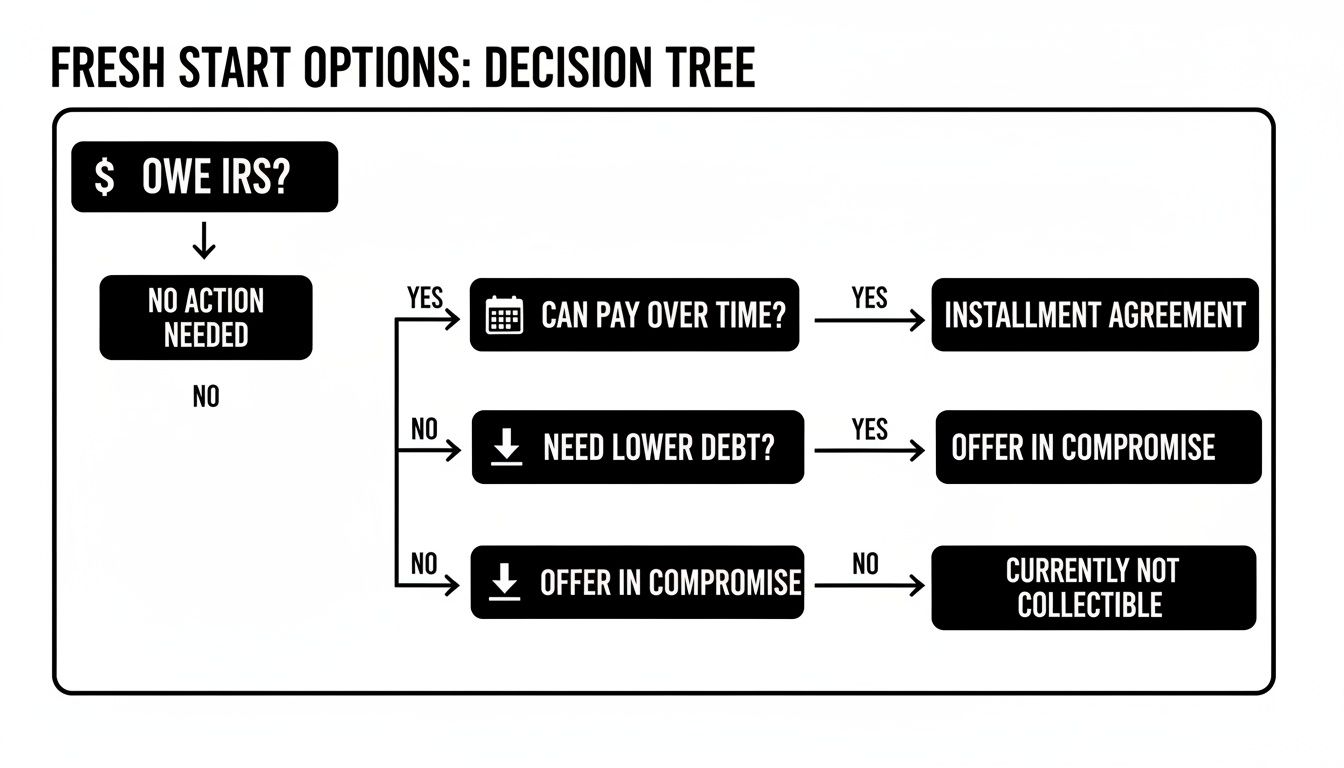
As you can see, it really boils down to two things: can you pay the debt over time, and do you need to shrink the total amount you owe? Answering those questions honestly is the key to finding the best fresh start tax relief path for you.
Offer in Compromise (OIC)
An Offer in Compromise (OIC) is what most people are thinking of when they hear stories about settling with the IRS for "pennies on the dollar." It’s a formal agreement where the IRS accepts less than the full amount you owe, effectively wiping the slate clean. But this isn't a simple negotiation; it’s a grueling process reserved for people in legitimate financial distress.
The IRS only agrees to an OIC if they're convinced it’s the absolute most they could ever hope to collect from you. To figure that out, they conduct a forensic-level review of your finances to calculate your Reasonable Collection Potential (RCP)—a specific formula based on your income, expenses, and the value of your assets.
An OIC can be a life-changing fresh start, but it's not a get-out-of-taxes-free card. The IRS is notoriously tough and approves only a small fraction of applications. A rock-solid, well-documented case is the only way to have a shot.
- Who It’s For: Taxpayers buried under a mountain of debt who can prove they simply don't have the income or assets to pay it all back. This often applies to people who've lost a job, had a business go under, or are facing catastrophic medical bills.
- Key Forms: The journey starts with Form 656 (Offer in Compromise), paired with either Form 433-A (OIC) for individuals or Form 433-B (OIC) for businesses, which lay out your entire financial life.
- Pros: The upside is enormous—the potential to settle your debt for a fraction of what you owe and truly move on.
- Cons: The application process is invasive and can drag on for months, even a year. You have to open up all your books, and if approved, you must walk the straight and narrow with your taxes for the next five years.
Installment Agreement (IA)
If you have the ability to pay back what you owe but just can't do it all at once, a standard Installment Agreement (IA) is your most straightforward option. It works just like a car loan or any other payment plan: you make a fixed monthly payment over an agreed-upon period until the debt is paid in full.
The IRS has made this process fairly accessible. For example, if you owe less than $50,000 in combined tax, penalties, and interest, you can often apply for a payment plan online without having to submit a mountain of financial paperwork.
This is by far one of the most common and practical forms of fresh start tax relief, designed for people who have the means to pay but need the breathing room of a monthly budget.
Partial Payment Installment Agreement (PPIA)
A Partial Payment Installment Agreement (PPIA) is a bit of a hybrid, sitting somewhere between an OIC and a regular payment plan. Under a PPIA, you agree to make affordable monthly payments, but the key difference is that these payments won't be enough to clear your debt before the government's legal time to collect it runs out.
That deadline is called the Collection Statute Expiration Date (CSED), which is typically 10 years from the day the tax was first assessed. Once that date hits, any remaining debt is legally wiped away. Like an OIC, the payment amount for a PPIA is based on what you can truly afford after covering essential living expenses.
- Who It’s For: People who can afford to make consistent monthly payments but, based on the math, won't be able to pay off the entire debt before the 10-year collection clock expires.
- Key Forms: You’ll use Form 9465 (Installment Agreement Request) but will also need to provide a complete financial picture with Form 433-A or Form 433-F.
- Pros: You get a predictable, manageable monthly payment with the very real possibility of having a portion of your debt forgiven down the line.
- Cons: For any debt over $25,000, the IRS will almost certainly file a Notice of Federal Tax Lien. You also have to stay perfectly compliant on all future tax filings and payments.
Penalty Abatement
Let's be honest: sometimes the tax itself isn't the killer. It's the crushing weight of penalties and interest that have piled up over time. Penalty Abatement is a program where the IRS agrees to forgive (or "abate") certain penalties if you can prove you had a "reasonable cause" for filing or paying late.
What counts as reasonable cause? This isn’t about just forgetting or not having the cash on hand. The IRS is looking for legitimate, often unavoidable, circumstances.
Examples of Reasonable Cause Include:
- Serious Illness or Death: A major health crisis involving you or a close family member that prevented you from managing your affairs.
- Natural Disaster: A fire, flood, hurricane, or other disaster destroyed your home or critical records.
- Bad Advice: You can prove you relied on faulty information from a tax professional.
- First-Time Abatement: This is the easiest one to get. If you have a squeaky-clean track record with the IRS, they will often waive the penalty for a single, honest mistake.
Getting penalties removed can slash your total debt significantly, often making the remaining balance manageable enough to pay off with a simple installment plan. For a deeper dive into all the ways to tackle IRS debt, check out our comprehensive guide on tax debt relief options.
Currently Not Collectible (CNC) Status
Finally, for people facing the most dire financial hardship, Currently Not Collectible (CNC) status offers a temporary lifeline. This doesn't make the debt disappear, but it does hit the pause button on all aggressive collection actions from the IRS. That means no bank levies, no wage garnishments.
To qualify, you must show the IRS that paying anything toward your tax debt would leave you unable to cover basic necessities like food, housing, or medical care. It's a high bar to clear. The IRS will put your account on hold but will re-evaluate your financial situation every year or two to see if anything has changed.
While you're in CNC status, penalties and interest keep adding up. However, it provides crucial breathing room to get your finances in order without the constant threat of collections. If your situation doesn't improve by the time the 10-year collection statute expires, the debt is written off for good.
Who Actually Qualifies for Fresh Start Relief?
Figuring out if you qualify for the IRS Fresh Start program isn't as simple as checking a box. It's more like navigating a series of checkpoints, and the IRS has a clear set of universal rules you must pass before they’ll even look at your case.
Getting these foundational requirements right is the absolute first step. If you miss them, your application for fresh start tax relief will be rejected right out of the gate, no matter how legitimate your financial hardship is.
The Universal Requirements for All Applicants
Before the IRS even begins to analyze your finances, every single applicant has to meet two non-negotiable conditions. Think of these as the IRS's way of making sure you're committed to getting and staying on the right side of the tax system.
First, you must have filed all of your required tax returns. The IRS won't even entertain a deal on old tax debt if you still have unfiled returns hanging out there. They need to see the complete picture of what you owe across all years.
Second, if you're a business owner or self-employed, you have to be current on your estimated tax payments for the present year. This demonstrates good faith—it shows the IRS you're trying to keep up now while you work to resolve the past.
Unpacking the IRS Financial Formulas
Once you've cleared those first two hurdles, the IRS gets down to business with a deep dive into your financial situation. They are focused on one question and one question only: what is your real ability to pay? To find the answer, they use a strict calculation to determine your Reasonable Collection Potential (RCP).
This isn't a quick glance at your bank statement. The RCP formula is a detailed, and often unforgiving, calculation that includes:
- Your net monthly income: This is what’s left after subtracting your allowable living expenses from your total income. The key word is "allowable"—the IRS uses rigid national and local standards, not necessarily what you actually spend.
- The quick-sale value of your assets: This includes everything from cash and investments to the equity you have in your home, cars, and other property. They’re looking at what they could get for it in a hurry.
The IRS essentially asks, "If we took all your disposable income for a set period and liquidated your non-essential assets, how much could we collect?" That final RCP number is the foundation for any negotiation, especially for an Offer in Compromise.
Understanding how the IRS arrives at this number is critical. It takes the emotion out of the equation and boils your financial hardship down to the cold, hard figures that will ultimately determine which relief options, if any, are on the table for you.
Eligibility for Different Taxpayer Types
How the IRS looks at your case is also shaped by how you earn your living. The rules and the paperwork required can change quite a bit depending on your situation.
- W-2 Employees: If you're a wage earner, the process tends to be more straightforward. Your income is easy to verify with pay stubs, and your expenses are measured against the IRS's pre-set standards.
- Sole Proprietors & Small Businesses: The financial analysis gets much more complex for business owners. The IRS will pore over your business's income, assets, and expenses to gauge its financial health and its ability to help pay down the tax debt.
- Independent Contractors: Much like business owners, contractors need to provide meticulous records of their income and expenses. Proving a consistent—or, just as importantly, an inconsistent—income stream is a vital part of their review.
Common Disqualifiers to Watch Out For
Finally, a few situations can automatically knock you out of the running, even if you seem to meet all the other criteria. Knowing about these roadblocks ahead of time can save you a world of frustration. If your financial situation is truly dire, you can learn more about how the IRS deals with extreme hardship in our article on Currently Not Collectible status.
One of the most common disqualifiers is an active bankruptcy proceeding. The IRS generally won't work on an Offer in Compromise or other relief applications while you're in an active bankruptcy. You'll almost always have to wait until the case is discharged or dismissed before you can approach the IRS for a resolution.
A Step-by-Step Guide to the Application Process
Applying for tax relief can feel like staring up at a mountain, but it’s a climb you can absolutely manage one step at a time. This is your guide to the trail, breaking down the entire process from gathering your gear to reaching the summit—the IRS’s final decision. Think of it like a how to create a step-by-step guide for your finances; we’re here to make the journey feel clear and straightforward, cutting through the confusion and anxiety.
Our goal is to give you a clear, sequential path to follow. Let's get started.

Stage 1: Gather Your Financial Documents
Before a single form is filled out, you need to get your financial house in order. The IRS needs a complete, accurate, and up-to-date picture of your financial life. Having every document ready from the start is the single best way to avoid frustrating delays and potential rejections. This is the foundation of your entire application.
Here’s what you’ll need to pull together:
- Proof of Income: This means recent pay stubs, W-2s, 1099s, and any documentation for other income, like Social Security benefits or rent payments you receive.
- Bank Statements: You'll need at least three to six months of statements for every checking and savings account you have.
- Monthly Expense Records: Gather up recent bills for all your core living costs. This includes your rent or mortgage, utilities, car payments, insurance premiums, and medical expenses.
- Asset Information: The IRS will want to see statements for retirement funds, brokerage accounts, and current valuations for big-ticket items like your home and vehicles.
Stage 2: Complete the Correct IRS Forms
With all your documents organized, it’s time to tackle the official paperwork. The specific forms you’ll need depend entirely on which type of fresh start tax relief you're applying for. I can't stress this enough: accuracy and honesty are non-negotiable here. Even small inconsistencies can trigger an immediate rejection.
These are the most common forms you’ll encounter:
- Form 433-A (OIC) or 433-F: This is the Collection Information Statement for individuals. It's a deep dive into your finances, where you have to list every dollar of income, every expense, every asset, and every liability.
- Form 656: This is the Offer in Compromise application. It's the form where you officially make your settlement proposal to the IRS and it must be submitted alongside the Form 433.
- Form 9465: This is the Installment Agreement Request. You use this form to set up a monthly payment plan to resolve your tax debt over a period of time. If you're unsure which plan makes sense for your situation, you can learn more about how to set up a payment plan with the IRS.
A common pitfall is listing your actual monthly expenses instead of the IRS’s national and local allowable standards. This single mistake can sink an otherwise solid application before an agent even gives it a serious look.
Key Takeaway: Don't think for a second the IRS just takes your word for it. They verify everything. Assume every number you write down will be checked against their own records and data from third parties. Complete transparency is your only real strategy.
Stage 3: Submit and Wait for IRS Review
Once your application is in the mail, the waiting game begins. This phase can be a true test of patience, as it often takes several months for the IRS to even assign your case to an examiner for review. While you wait, it is absolutely critical that you continue to file and pay all your current taxes. Falling behind now will derail the whole process.
When an examiner is finally assigned, they will go through your paperwork with a fine-toothed comb. They might reach out with questions or request additional documents to get a clearer picture of your finances. Responding quickly and completely is the best way to keep things moving.
Stage 4: Navigate the Negotiation and Decision
This is where the rubber meets the road. After their review, the IRS will do one of three things: accept your proposal, reject it, or come back with a counteroffer. If you’re rejected, they must provide a reason, which can open the door for you to appeal or submit a stronger, revised offer.
If they make a counteroffer, the negotiation starts. This is where having a professional in your corner—or at least a deep understanding of IRS collection standards—becomes a massive advantage. You'll have to defend your position using their own financial rules as a basis.
Finally, the IRS will issue their decision. If your request for fresh start tax relief is approved, congratulations! You'll receive a formal agreement detailing the terms. Following these terms to the letter, especially staying current on all future tax obligations, is mandatory to keep your agreement active and secure that true financial fresh start.
Common Mistakes That Can Derail Your Application
When you're applying for fresh start tax relief, knowing what not to do is just as important as knowing the right steps. It’s a process that demands precision. One small, honest mistake can be all it takes for the IRS to reject your application, sending you right back to square one.
But if you know the common traps ahead of time, you can steer clear of them. Let's walk through the most frequent errors that trip people up, so you can build a solid case from the very beginning.
Providing Incomplete or Inaccurate Financials
This is, without a doubt, the number one reason applications get denied. The IRS needs a completely transparent, crystal-clear picture of your financial situation. Any missing pieces or fuzzy numbers will immediately make them suspicious.
Think of your financial statement as the foundation of your entire request. If that foundation is shaky, everything else falls apart. Some of the most common mistakes I see are:
- Forgetting Assets: It's easy to overlook an old 401(k) or a small savings account, but the IRS won't. They have access to a staggering amount of third-party data and will almost certainly find anything you've missed.
- Misrepresenting Expenses: This is a big one. You can't just list what you actually spend each month. The IRS has its own rigid, non-negotiable standards for allowable living expenses. If your numbers don't align with theirs, your application is likely dead on arrival.
- Omitting Income: That side hustle or freelance gig? It counts. Failing to report every single source of income undermines your credibility and is a fast track to rejection.
Bottom line: The IRS will cross-check everything. Accuracy isn't optional—it's everything.
Failing to Stay Current on New Tax Obligations
This mistake can completely unravel all your progress. Once you've submitted an application for relief, like an Offer in Compromise, you’re under a microscope. The IRS is watching to see if you're serious about staying on the right side of the law from now on.
Crucial Reminder: While your application is under review—a process that can drag on for many months—you absolutely must file all new tax returns on time and pay all current taxes as they become due.
If you fall behind on new tax debts while trying to settle old ones, the IRS sees it as a major red flag. For them, it's a deal-breaker. This is especially true for self-employed individuals and business owners who need to keep up with their estimated tax payments. A missed payment signals that you aren't committed to compliance, and they will almost certainly deny your request for relief.
Falling for 'Pennies on the Dollar' Scams
The tax resolution world has its fair share of sharks. You've probably heard the ads promising to settle your tax debt for "pennies on the dollar." These companies prey on desperate people, charge massive upfront fees, and rarely deliver on their wild promises.
Be extremely skeptical of any firm that guarantees a specific outcome before they've even seen your financial details. They often leave taxpayers in a deeper hole than they started in. To learn more, it’s worth understanding the risks of falling for misleading tax company promises and how to spot a scam.
A true tax professional will never start with a guarantee. They'll start with a deep, thorough analysis of your unique situation.
What's the Next Move? Charting Your Course to Financial Freedom
We've covered a lot of ground, from the nuts and bolts of an Offer in Compromise to the structured relief of an Installment Agreement. You now have a solid understanding of the tools the IRS Fresh Start program puts on the table. But knowing about the tools and using them effectively are two different things.
The real key to success is building a strategy that fits your specific financial picture.

The very first thing you should do is get a professional, objective look at your situation. Trying to navigate the IRS’s labyrinth of rules and financial calculations on your own is a huge gamble. One small mistake can get your application tossed out, setting you back to square one.
The smartest move you can make right now is to figure out exactly where you stand and which fresh start tax relief option makes the most sense.
Start with a Free Tax Debt Analysis
Instead of trying to piece it all together yourself, why not start with a clear, no-cost evaluation? A FREE Tax Debt Analysis gives you a professional breakdown of your tax debt, income, living expenses, and assets.
This is the single most important first step because it clarifies:
- Which Fresh Start programs you’re a good candidate for.
- A realistic estimate of what a final resolution could look like.
- A concrete, actionable game plan for moving forward.
This analysis takes the guesswork out of the equation and lets you make a smart decision without spending a dime or committing to anything.
Getting tax relief isn't just about filling in the blanks on a form. It's about telling your financial story in a way that aligns with the IRS's rigid guidelines. A professional analysis ensures you get that story right from the very beginning.
When Is It Time to Call a Tax Attorney?
For some simple tax situations, a DIY approach might work. But when the problem gets bigger and more complicated, you absolutely need a legal professional in your corner. The stakes are just too high.
You should seriously consider hiring a tax attorney if you're dealing with:
- A substantial tax bill (generally anything over $50,000).
- Complicated business or payroll tax liabilities.
- An official IRS audit or a formal appeal.
- Aggressive collection actions like a lien on your property, a levy on your bank account, or wage garnishment.
A seasoned tax attorney does more than just give advice. They protect your rights, negotiate directly with the IRS for you, and build the most compelling case possible. Making that call can be the one thing that separates a successful resolution from years of ongoing financial stress.
Your Questions About Fresh Start Relief Answered
When you're facing tax debt, it's natural to have a lot of questions. Let’s clear up some of the most common ones people ask about the IRS Fresh Start program.
Can Fresh Start Actually Erase My Debt Completely?
It's the million-dollar question, isn't it? While completely wiping out your tax debt is rare, it can happen in very specific situations through an Offer in Compromise (OIC). But think of an OIC as a last resort; the IRS has strict eligibility rules and low approval rates.
More often than not, the Fresh Start initiative is about restructuring your debt into something you can actually handle, not just making it disappear.
How Long Does This Whole Process Take?
The timeline really depends on which path you take. If you qualify for a straightforward online Installment Agreement, you could be set up in a matter of minutes. It's quick and relatively painless.
On the other hand, an Offer in Compromise is a completely different beast. Gathering all the detailed financial information, submitting the application, and waiting for the IRS to review it can easily take 6 to 12 months, sometimes even longer.
The key thing to remember is this isn't an overnight fix. Patience is your best friend here. A meticulously prepared application is the single best way to avoid unnecessary delays and get a faster decision from the IRS.
Will Applying for Relief Stop the IRS from Coming After Me?
Yes, for the most part. When you formally submit an application for an OIC or an Installment Agreement, the IRS usually puts a temporary hold on aggressive collection activities. This means actions like garnishing your wages or levying your bank account should stop while they review your case.
Just keep in mind that interest and penalties don't stop. They will continue to add up until your case is officially resolved.
Your next step is the most important one you'll take. Don't guess which program fits your situation—get a clear, professional assessment. At the Law Office of Attorney Stephen A. Weisberg, we start every potential client with a FREE Tax Debt Analysis to pinpoint exactly how we can help, all before you ever pay a fee.


