Your Guide to the IRS Fresh Start Tax Program
Feeling overwhelmed by tax debt? Discover how the IRS Fresh Start tax program offers real solutions like payment plans and OICs to help you find relief.
In this article
- Understanding the IRS Fresh Start Program
- Who Is This Program For?
- The Foundation of Tax Debt Relief
- Exploring Your Options Under the Fresh Start Program
- Comparing IRS Fresh Start Program Options
- Settle for Less with an Offer in Compromise
- Create Predictable Payments with Installment Agreements
- Reduce Your Balance with Penalty Relief
- Clear Your Credit with a Tax Lien Withdrawal
- How to Qualify for IRS Tax Relief
- The Universal Starting Point: Filing All Returns
- Qualifying for a Streamlined Installment Agreement
- Meeting the Bar for an Offer in Compromise
- Securing Penalty Relief and Lien Withdrawals
- The Real-World Impact on Taxpayers and Businesses
- A Game-Changing Shift in IRS Policy
- The Numbers Tell the Story
- Navigating the Application Process and Avoiding Pitfalls
- Your Essential Document Checklist
- Common Pitfalls That Derail Applications
- When You Should Hire a Tax Professional
- High-Stakes Scenarios Requiring an Expert
- The Value of Professional Representation
- Common Questions About the Fresh Start Program
- Can the Program Stop Wage Garnishment?
- What if My Income Changes After Getting a Plan?
- Does an OIC Application Pause Collections?
- Is This a One-Time Deal?
Think of the IRS Fresh Start Program as a collection of policies, not one single application. It’s a set of tools the IRS created to give taxpayers who are buried in tax debt a realistic way to get back on their feet. These options are designed to make it much more manageable for individuals and businesses to handle what they owe.
Understanding the IRS Fresh Start Program
Imagine your tax debt is a massive, tangled knot. The more you pull on it, the tighter it gets. The IRS Fresh Start Program is like being handed a pair of scissors and a helping hand to carefully untangle that knot, piece by piece. The core idea is that the IRS would rather work with you to collect what you can realistically pay than push you to a point where they get nothing at all.
This initiative really took shape back in 2011, when the IRS recognized just how many Americans were struggling financially. It marked a shift in their thinking, an acknowledgment that aggressive, old-school collection tactics weren't always effective, especially for people in genuine financial distress. The program aims for a win-win: you get a path to resolve your debt, and the government collects the revenue it's owed.
Who Is This Program For?
The Fresh Start Program is a lifeline for taxpayers who feel completely trapped by what they owe. While anyone with tax debt can look into relief, this program is especially helpful for:
- Small Business Owners: If you're an entrepreneur wrestling with payroll taxes or dealing with unpredictable income, this program can offer a sensible payment solution.
- Independent Contractors & Freelancers: Gig workers who get hit with a surprisingly high self-employment tax bill can set up predictable, manageable payment plans.
- Individuals Facing Hardship: If you've lost your job, faced a medical emergency, or had your income drop significantly, you can seek relief based on what you can actually afford to pay now.
The ultimate goal is to provide a lifeline. It’s a structured way for the IRS to help you move from being overwhelmed by debt to becoming a compliant taxpayer in good standing.
The Foundation of Tax Debt Relief
At its core, the program is built around a few key relief options. Think of it as a toolkit, with each tool serving a specific purpose. For some, an Offer in Compromise (OIC) is the best fit, as it lets them settle their debt for less than the total amount owed. For others, a Streamlined Installment Agreement is the right move, giving them a clear, fixed monthly payment over several years.
These solutions are part of a broader menu of tax relief strategies. Once you understand the main components of the Fresh Start Program, you can start to see which path makes the most sense for your unique situation. To see how these options stack up against others, you can learn more about the top 8 tax debt relief options available.
In the end, this initiative gives you more than just a financial break—it offers peace of mind. It allows you to stop looking over your shoulder for aggressive collection actions like wage garnishments or bank levies and start focusing on a clear plan to finally put your tax debt behind you.
Exploring Your Options Under the Fresh Start Program
When you're facing a significant tax debt, it can feel like you're staring at a mountain with no idea how to start climbing. The IRS Fresh Start Program is essentially a set of trail maps, offering different routes to get you back on solid financial ground. It’s not a single, one-size-fits-all fix; it's a collection of tools designed for different financial situations.
The key is figuring out which tool is right for you. Let's walk through the four main pillars of the program to see which path makes the most sense for your business and your bottom line.
This flowchart gives you a quick visual of the starting point for anyone dealing with tax debt and the options that open up from there.
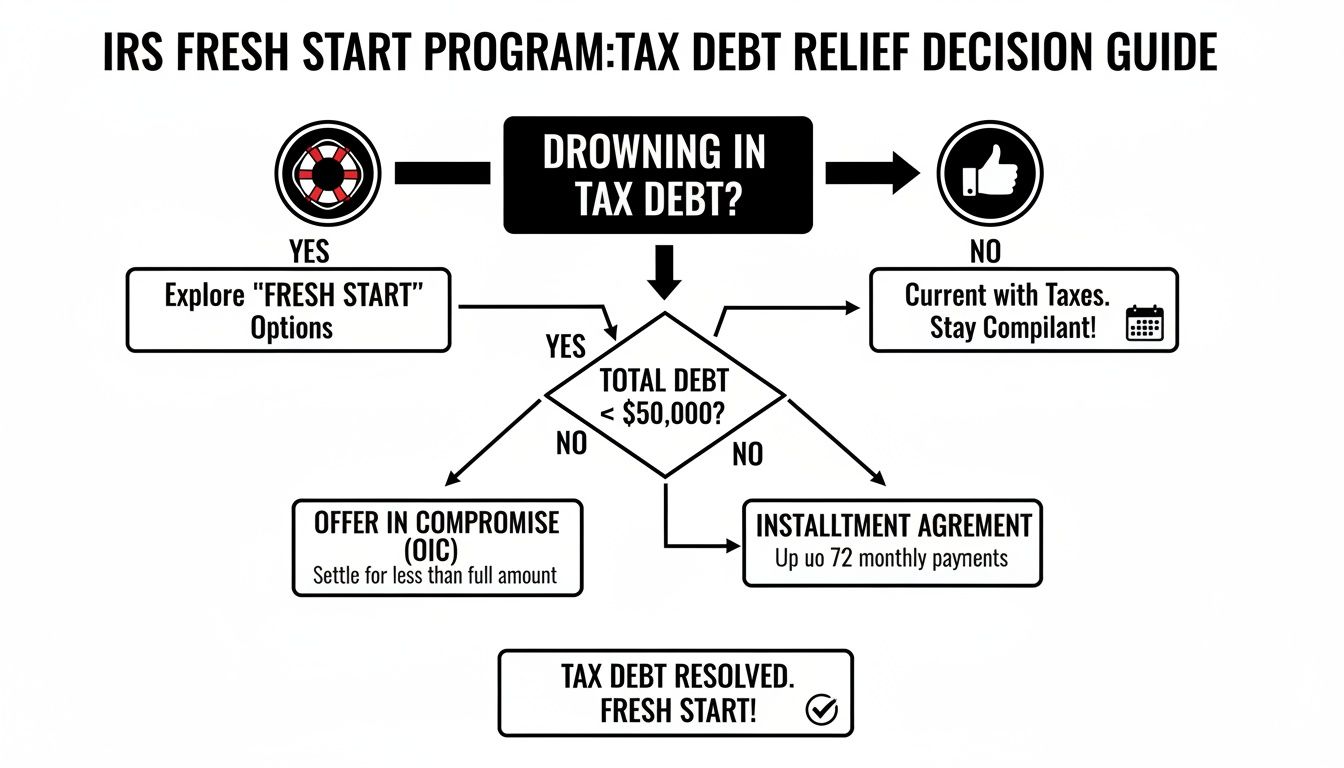
As you can see, simply acknowledging the debt is the first, most critical step. From there, you can start exploring real solutions like those within the Fresh Start Program.
To help you get a clearer picture of which solution might be the best fit, here's a quick comparison of the main options available under the Fresh Start initiative.
Comparing IRS Fresh Start Program Options
| Solution | What It Does | Ideal Candidate | Key Benefit |
|---|---|---|---|
| Offer in Compromise (OIC) | Settles your tax debt for less than the full amount owed. | Taxpayers in genuine financial hardship who cannot realistically pay the full debt. | Potentially huge savings and a complete financial reset. |
| Streamlined Installment Agreement | Breaks down your total tax debt into manageable monthly payments. | Individuals or businesses who can afford to pay over time but not all at once. | Stops aggressive collections and creates a predictable payment plan. |
| Penalty Relief (Abatement) | Removes certain penalties, lowering your overall tax bill. | Taxpayers with a good compliance history or a valid "reasonable cause." | Reduces the total amount you owe without forgiving the base tax. |
| Tax Lien Withdrawal | Removes the public Notice of Federal Tax Lien from your record. | Taxpayers on a payment plan who want to repair their credit. | Clears your credit report and restores financial opportunities. |
Each of these paths offers a distinct form of relief. Now, let’s dig a little deeper into what each one entails so you can make an informed decision.
Settle for Less with an Offer in Compromise
An Offer in Compromise (OIC) is probably the most talked-about part of the fresh start tax program, and for good reason. Think of it as a formal settlement negotiation with the IRS. If you can prove that paying what you owe in full would cause you serious financial hardship, the IRS might agree to accept a smaller amount and wipe the slate clean.
This is a lifeline for people who are truly struggling—those whose income, expenses, and assets simply don't add up to the total tax bill. The application process is intense and requires a very thorough look at your finances, so it’s not for everyone. But for those who qualify, an OIC can be the difference between being crushed by debt and getting a genuine fresh start.
The Fresh Start Initiative made some big improvements here. Back in 2012, the IRS relaxed the OIC rules, opening the door for more struggling taxpayers to find relief. Before, the calculations for future income and living expenses were so strict that many small business owners couldn't get a fair shake. Now, the formulas are more realistic, making it easier for sole proprietors and S Corps to get a reasonable offer accepted.
If you think this might be your best option, it’s critical to understand the nitty-gritty of the qualification process. You can dive deeper in our complete guide to tax debt settlement through an Offer in Compromise.
Create Predictable Payments with Installment Agreements
What if you have the income to pay your tax debt, just not all at once? That’s where a Streamlined Installment Agreement comes in. This option takes that big, intimidating bill and chops it up into predictable monthly payments you can actually manage.
Under the Fresh Start Program, if your combined tax, penalties, and interest are $50,000 or less, you can often set up a payment plan for up to 72 months (6 years) without having to submit a mountain of financial paperwork. This makes the whole process much faster and less stressful.
- Benefit 1: You get a structured, predictable payment schedule that fits your budget.
- Benefit 2: It immediately stops aggressive IRS collection actions, like wage garnishments or bank levies, as long as you stick to the plan.
- Benefit 3: The application is far simpler than what’s required for an OIC.
This is a perfect fit for many small business owners or independent contractors who have steady cash flow but need some breathing room to get caught up.
Reduce Your Balance with Penalty Relief
Sometimes, the penalties tacked onto a tax bill are what make it feel truly impossible. The IRS knows that good people make honest mistakes, and that’s why they offer penalty relief, also known as abatement. This doesn’t forgive the tax itself, but it can slash your total balance by removing hefty penalties.
The Fresh Start Program makes it easier to get a break on these penalties. The two most common grounds for relief are:
- First-Time Abatement: If you've kept a clean tax record for the last three years, the IRS will often waive penalties for your first slip-up, like a failure-to-file or failure-to-pay penalty.
- Reasonable Cause: You can also get penalties removed if you can prove you had a legitimate reason for not filing or paying on time. Think serious illness, a death in the immediate family, a natural disaster, or even relying on bad advice from a tax pro.
Getting penalty relief approved requires a solid argument backed by documentation, but the savings can be well worth the effort.
Clear Your Credit with a Tax Lien Withdrawal
A federal tax lien is a public black mark on your credit report. It attaches to all your property and assets, making it incredibly difficult to get a business loan, sell your house, or even open a new line of credit. It’s a serious roadblock.
One of the most powerful but lesser-known parts of the Fresh Start Program is the ability to get a tax lien withdrawn. A withdrawal completely removes the public Notice of Federal Tax Lien, making it as if it was never filed in the first place. This is a huge deal for your financial health.
You can often qualify for a lien withdrawal if you:
- Owe $25,000 or less.
- Enroll in a Direct Debit Installment Agreement.
- Successfully make three consecutive on-time payments.
Once you meet these conditions, you can formally request the withdrawal. It’s a fantastic tool that helps taxpayers who are doing the right thing get their financial reputation back on track.
How to Qualify for IRS Tax Relief

Getting into the IRS Fresh Start Program isn't about finding a secret loophole. It's about meeting a specific set of criteria, and the rules are actually quite clear. Think of it like a series of gates you need to pass through—you can't even get to the second one until you've cleared the first.
The biggest, most non-negotiable requirement is simple: tax compliance. Before the IRS will even talk about a deal, you must have filed every single one of your overdue tax returns. They won't consider a payment plan or settlement from anyone with unfiled returns still hanging out there.
Filing those returns is the ultimate sign of good faith. It shows the IRS you're serious about getting right with them and opens the door to actually resolving the problem.
The Universal Starting Point: Filing All Returns
Whether you’re aiming for a payment plan, a settlement, or penalty relief, the IRS needs a complete picture of what you owe. An unfiled return is a giant question mark from their perspective. By getting everything filed, you're putting all the cards on the table, which is exactly what the agency needs before they’ll work with you.
For business owners, this also means you have to be current on your estimated tax payments and federal tax deposits for the present quarter. The IRS sees this as your commitment that you won't dig a deeper hole while they help you fix the old one.
Once you’re fully filed up, you can start exploring which specific program fits your situation.
Qualifying for a Streamlined Installment Agreement
For many taxpayers, this is the most direct path to relief. It's designed to be a simpler process that doesn't require a deep dive into your finances, as long as you meet the basic thresholds.
Here's what it typically takes:
- Your total tax, penalty, and interest bill is $50,000 or less.
- You can commit to paying off the full balance within 72 months (6 years).
What if you owe a little more than $50,000? You might still get in. Often, making a one-time payment to get the balance below that key threshold is enough to qualify. This one move can save you from a massive amount of financial paperwork.
This program is a real game-changer for independent contractors and small businesses. It lets you lock in a predictable payment plan and stop aggressive collection actions, all without having to lay your entire financial life bare for the IRS.
Meeting the Bar for an Offer in Compromise
An Offer in Compromise (OIC) is the toughest program to qualify for, and for good reason—it allows you to settle your tax debt for less than you actually owe. The IRS only says yes when they're convinced they can't collect the full amount. The official term is "doubt as to collectibility."
To figure this out, the IRS calculates your Reasonable Collection Potential (RCP). It's a formula that weighs two main things:
- Your net monthly income after the IRS's own strict, allowable living expenses.
- The equity you have in your assets, like your home, vehicles, and bank accounts.
If your RCP is lower than your total tax debt, you might have a shot at an OIC. Be prepared, though. The process is intense and demands full financial disclosure on either Form 433-A (for individuals) or 433-B (for businesses). To get a real feel for the nitty-gritty details, it pays to understand how to qualify for an Offer in Compromise before you even think about applying.
Securing Penalty Relief and Lien Withdrawals
Getting penalties waived isn't about how much you owe; it's about why you fell behind. You can often get penalties removed if you have a clean history (First-Time Abatement) or if you can show you had a reasonable cause, like a serious family illness or getting bad advice from a professional.
Getting a federal tax lien withdrawn is also pretty straightforward. You need to:
- Owe $25,000 or less.
- Be on a Direct Debit Installment Agreement.
- Have made three on-time payments in a row.
Once you meet those conditions, you can formally ask the IRS to withdraw the Notice of Federal Tax Lien. This removes that damaging public record from your credit report and gives you back a huge piece of your financial freedom.
The Real-World Impact on Taxpayers and Businesses
To really understand how much of a lifeline the IRS Fresh Start Program is, you need to see the "before and after" picture for real taxpayers and small businesses. Before this program came along, a relatively small tax debt could trigger a devastating federal tax lien. This wasn't just a letter in the mail; it was a public mark against you that could absolutely wreck a business owner's credit score practically overnight.
Think about it. How do you get a small business loan, lease new equipment, or even rent a new office when a federal tax lien is slapped on your credit report? It was next to impossible. For countless entrepreneurs who were otherwise running viable businesses, this one aggressive collection tool was often the final push over the edge.
A Game-Changing Shift in IRS Policy
The Fresh Start Program completely changed that reality. Its most powerful move was raising the dollar amount that automatically triggered a Notice of Federal Tax Lien (NFTL). Before the program, a tax debt of just over $5,000 could set this destructive process in motion. The initiative bumped that minimum up to $10,000. Even better, taxpayers can now often get into payment plans for debts up to $25,000 without a lien ever being filed.
This was a monumental change. It meant that countless freelancers, gig workers, and small shop owners could finally sort out their tax problems without having their financial lives and businesses completely derailed. The IRS basically acknowledged a simple truth: you’re better off helping taxpayers stay afloat to collect what's owed than pushing them into bankruptcy. This is especially true for the self-employed, where managing self-employed quarterly taxes can be tricky and lead to these kinds of situations.
The Numbers Tell the Story
The data really shows what a dramatic difference this made. Before the IRS launched Fresh Start back in 2011, the agency was filing over 1 million Notices of Federal Tax Lien every single year. Just one year later, after the new rules were in place, NFTL filings dropped by 32% to about 708,000. The numbers kept falling, and by 2023, lien filings had plummeted by nearly 76% from their 2010 peak to fewer than 250,000 annually.
This wasn't just a number on a chart. This represented hundreds of thousands of people and their businesses who got a real chance to bounce back from a financial stumble without the crushing weight of a public lien.
This single policy shift has saved livelihoods, kept businesses open, and given countless taxpayers the breathing room they desperately needed to get their finances in order. The focus moved from aggressive enforcement to finding workable solutions. After all, a taxpayer with a functioning business is in a much better position to pay their debt than one who's been forced to close up shop. This practical mindset is the very heart of effective business tax debt relief strategies and is why the fresh start tax program is such a vital tool.
Navigating the Application Process and Avoiding Pitfalls

Applying for any of the IRS Fresh Start Program options can feel like you’re trying to get a major loan approved. Every detail you provide is scrutinized, and one little oversight can send your entire application right back to the bottom of the pile. The IRS process is incredibly methodical, so your success really boils down to building the strongest, most honest case you can, right from the start.
Think of it this way: the IRS isn't trying to trick you, but they absolutely require you to follow their procedures to the letter. Let's walk through how to navigate this maze successfully.
Your Essential Document Checklist
Before you even think about filling out a form, you need to get your financial house in order. Gathering all your documents upfront doesn't just make the process faster; it ensures the numbers you submit are spot-on. The entire foundation of your request for relief is proving your financial situation.
Here’s what you should start pulling together:
- Proof of Income: Grab your most recent pay stubs. If you're self-employed, you'll need current profit and loss statements. Basically, anything that shows money coming in.
- Bank Statements: The IRS will want to see the last three to six months of statements for every single checking and savings account you have.
- Asset Information: Make a clear list of any real estate, vehicles, retirement accounts, or other major assets you own, along with their fair market value.
- Expense Records: You need to document your essential monthly living expenses—things like your rent or mortgage, utility bills, groceries, and transportation costs.
- Filed Tax Returns: Make sure you have copies of all your filed tax returns, particularly for the years connected to the tax debt you’re trying to resolve.
This collection of documents isn't just paperwork; it’s the evidence that provides the IRS with a verifiable snapshot of your financial reality.
Common Pitfalls That Derail Applications
I’ve seen it happen countless times: a taxpayer who absolutely qualifies for relief gets their application rejected. Why? Not because they were ineligible, but because they fell into a few common and completely avoidable traps. Knowing what these are ahead of time is your best defense.
By far, the biggest mistake is incomplete or inaccurate financial disclosure. People leave a line blank on Form 433 because the answer is "zero," or they guess at a monthly expense instead of digging up a bank statement. To the IRS, this looks either sloppy or suspicious, and it can be enough to get your file sent back.
A rejected application is more than just a delay. It can trigger the restart of aggressive collection actions like liens and levies. Getting it right the first time is absolutely critical to protect your assets and keep moving forward.
Another massive error is failing to stay current on new tax obligations. If you apply for an installment agreement for old tax debt but then miss an estimated payment for the current quarter, the IRS will almost certainly deny your request. They need to see that you're committed to staying compliant from this point on.
Watch out for these other critical missteps:
- Missing a Deadline: The IRS operates on strict timelines. If they send a letter asking for more information, you have to respond promptly. No exceptions.
- Submitting an Unrealistic Offer: When making an Offer in Compromise, your proposed settlement has to be grounded in the financial data you provide. A lowball offer without any justification is a guaranteed non-starter.
- Forgetting to Sign the Forms: It sounds almost too simple to be true, but an unsigned form is an invalid form. I always tell my clients to double- and triple-check every single page before mailing it.
By carefully preparing your documents and steering clear of these common blunders, you dramatically boost your odds of getting the relief you need. The goal is to present a clear, honest, and complete picture that gives the IRS agent everything they need to say "yes."
When You Should Hire a Tax Professional
While you can navigate some parts of the Fresh Start Program on your own, some situations really call for an expert. Trying to handle a serious tax issue yourself is a bit like performing your own dental work—it might be possible, but the risks of making things much worse are incredibly high. Knowing when to call in a pro is half the battle.
Think of it this way: if your tax bill is relatively small and fits neatly into the streamlined installment agreement criteria, you can probably set it up online yourself without much fuss. But once you're dealing with high-dollar debt, complicated business tax problems, or an active audit, going it alone is a huge gamble. These are the bright red flags telling you it's time to get a professional involved.
High-Stakes Scenarios Requiring an Expert
Some tax problems are just too complex or carry too much financial weight to tackle without professional backup. An experienced tax attorney doesn’t just fill out paperwork; they build a strategic case for you, designed to get the best possible outcome.
Here are a few specific times when hiring a professional is a smart, strategic investment:
- High-Dollar Tax Debts: Once your debt climbs over the $50,000 streamlined threshold, the IRS starts asking for a lot more financial documentation. It's a whole different ballgame.
- Complex Business Taxes: If you're wrestling with payroll tax issues (Form 941) or the Trust Fund Recovery Penalty, you need an expert. These penalties are notoriously aggressive and can attach to you personally, even if your business is an LLC or corporation.
- An Offer in Compromise (OIC): The OIC application is famously tough. In 2023, the IRS only accepted 42% of the applications they received. One small mistake on the forms can get your entire offer thrown out.
- Ongoing Audits or Appeals: If the IRS is already auditing you or you're in the appeals process, having professional representation isn't just a good idea—it's essential for protecting your rights.
The Value of Professional Representation
A qualified tax professional, whether it's an attorney or an Enrolled Agent, knows how to speak the IRS's language. They understand the unwritten rules and internal procedures that can make or break a case, allowing them to negotiate from a position of strength. They know what questions the IRS will ask before they ask them, how to assemble the right documents, and can shield you from those stressful, intimidating calls with revenue officers.
The right professional can be the difference between a resolution that gives you a true fresh start and years of ongoing financial stress. They help you move forward with confidence, not fear.
Once you decide to get help, the first step is giving your chosen professional the authority to speak to the IRS for you. This usually requires understanding the differences between an authorized representative and a power of attorney to ensure they have the legal standing to fully represent you. This simple document puts a knowledgeable advocate between you and the IRS, leveling the playing field and dramatically improving your odds of success.
Common Questions About the Fresh Start Program
When you're staring down a significant tax bill, the questions and what-ifs can feel just as overwhelming as the debt itself. Getting straight answers is the first step to taking back control. Let's walk through some of the most pressing questions we hear from business owners about the Fresh Start Program.
Can the Program Stop Wage Garnishment?
Yes, it absolutely can. This is one of the most immediate and powerful benefits of the program.
Once you have a formal resolution approved by the IRS—like a streamlined installment agreement or an accepted Offer in Compromise—they are required to stop aggressive collection tactics. This means they will release wage garnishments and bank levies, giving you back your paycheck and access to your accounts.
What if My Income Changes After Getting a Plan?
Life is unpredictable, and your income can fluctuate, especially when you're self-employed. The IRS gets this. If you’ve entered an installment agreement and then your income takes a serious hit, you aren't necessarily stuck with the original payment.
You can petition the IRS to modify your agreement. You'll need to submit updated financial documentation to prove your circumstances have changed, but it's entirely possible to get your monthly payment lowered to something you can realistically afford.
A word of advice here: be proactive. Don't just stop making payments and hope the problem goes away. As soon as you know your income has dropped, you or your tax professional need to contact the IRS to start the modification process. This keeps you in good standing and prevents a default.
Does an OIC Application Pause Collections?
Filing an Offer in Compromise (OIC) does put a temporary hold on most collection activities. While the IRS is reviewing your case, they generally won't garnish your wages or levy your accounts, which provides some crucial breathing room.
However, there's a very important trade-off. The 10-year clock on the Collection Statute Expiration Date (CSED) also pauses. So, if your offer is pending for eight months, those eight months get added to the back end of the collection period.
Is This a One-Time Deal?
You can think of it as a powerful second chance, but not a get-out-of-jail-free card you can play repeatedly. After the IRS grants you relief, you enter a probationary period.
For the next five years, you must be perfectly tax compliant. That means filing every return and paying every new tax bill on time and in full. If you stumble, the IRS can void your original agreement, bringing the full, original tax debt—plus penalties and interest—roaring back to life.
Figuring out these rules and trade-offs is where having an expert in your corner truly pays off. Instead of trying to navigate the IRS maze alone, Attorney Stephen A Weisberg begins with a FREE Tax Debt Analysis to map out the best strategy for your unique situation. Learn how The W Tax Group can help you achieve a true fresh start.


