Your Guide to the IRS Fresh Start Tax Program
Struggling with tax debt? Learn how the IRS Fresh Start tax program offers relief through manageable solutions like OICs and payment plans.

In this article
- What Is the IRS Fresh Start Tax Program?
- The Origin and Purpose of the Program
- Key Objectives of the Fresh Start Initiative
- IRS Fresh Start Program at a Glance
- Your Options Under the IRS Fresh Start Program
- Offer in Compromise: Settling for Less Than You Owe
- Installment Agreements: A Straightforward Repayment Plan
- Penalty Abatement: Asking for a Clean Slate
- Tax Lien Relief: Getting Your Name Cleared
- Do You Qualify for Fresh Start Tax Relief?
- Universal Requirements for Any Fresh Start Option
- Eligibility for Specific Relief Programs
- Fresh Start Relief Options Compared
- Offer in Compromise (OIC)
- Streamlined Installment Agreement
- Penalty Abatement
- How to Apply for the IRS Fresh Start Program
- H3: Gather Your Essential Documents
- H3: Find and Complete the Correct IRS Forms
- H3: What to Expect After You Apply
- The Real-World Impact of the Fresh Start Program
- Making Relief More Accessible for Everyone
- How the U.S. Compares to Global Tax Relief
- Changing the Settlement Landscape
- When Should You Call a Professional for Help with Your Tax Debt?
- Clear Signs It’s Time to Hire a Tax Pro
- The Real-World Impact of Expert Help
- Common Questions About the IRS Fresh Start Program
- Can My Small Business Qualify?
- What Happens If My Application Is Rejected?
When you're buried under a mountain of tax debt, it can feel like there's no way out. The IRS Fresh Start Program is the government's answer to that feeling—it's less a single program and more a collection of policies designed to throw a lifeline to taxpayers facing real financial hardship.
This initiative creates several different paths to get right with the IRS, from setting up payment plans you can actually afford to potentially settling your debt for a fraction of what you originally owed.
What Is the IRS Fresh Start Tax Program?

Think of the IRS Fresh Start Program as a set of tools the IRS can use to help people who are genuinely struggling. It's not a get-out-of-jail-free card, but it is an official acknowledgment that life happens. People lose jobs, businesses fail, and unexpected medical bills pop up.
Before this initiative, the rules for dealing with tax debt were often rigid and unforgiving, failing to consider a person's actual ability to pay. The Fresh Start Program changed that by introducing more flexibility and common sense into the collection process.
The Origin and Purpose of the Program
The modern version of the Fresh Start Program really took shape back in 2011. It was a direct response to the economic fallout from the 2008 financial crisis, which left millions of Americans struggling to make ends meet. The IRS realized that its old, inflexible collection tactics weren't working for people who had lost their jobs or businesses through no fault of their own.
So, they updated their policies to help people resolve their tax debts without facing catastrophic collection actions like property seizures and wage garnishments. A huge part of this was simplifying the financial disclosure process, which opened the door for more taxpayers to qualify for help. You can explore more about the IRS's evolving relief strategies at innovativetaxreliefllc.com.
This marked a major shift in how the IRS approaches tax debt. Instead of just being a collections agency, it started acting more like a creditor willing to negotiate.
At its core, the fresh start tax program is about finding a realistic middle ground. It balances the government's responsibility to collect taxes with the reality of a taxpayer's financial situation. It’s built on the idea that collecting a manageable amount is far better than collecting nothing at all from someone who is financially broken.
This approach creates a win-win scenario. You get a clear, manageable path to becoming debt-free, and the IRS resolves an account that might otherwise have been uncollectible.
Key Objectives of the Fresh Start Initiative
The program is designed around a few core goals, all aimed at giving you tangible relief and a way forward.
- Making Relief More Accessible: One of the biggest changes was increasing the debt thresholds for certain relief options. This means more people can now qualify for things like a streamlined installment agreement without having to submit a mountain of financial paperwork.
- Focusing on Your Current Situation: When considering a settlement (known as an Offer in Compromise), the IRS now gives more weight to your current income and reasonable living expenses. They're less focused on what you might earn in the future and more on what you can actually afford today.
- Preventing Harsh Collection Actions: A primary goal is to keep taxpayers out of the crosshairs of aggressive collection tactics. For instance, the program raised the minimum debt amount that triggers a Notice of Federal Tax Lien, which is a huge deal for protecting your credit score and assets.
To give you a clearer picture, here's a quick breakdown of the program's main components.
IRS Fresh Start Program at a Glance
| Relief Component | Primary Purpose | Best For Taxpayers Who... |
|---|---|---|
| Offer in Compromise (OIC) | Settle tax debt for less than the full amount owed. | Have very limited income and assets and cannot realistically pay their full tax debt. |
| Installment Agreements | Pay off tax debt over time with manageable monthly payments. | Can't pay in full now but can pay off the debt over a period of up to 72 months. |
| Penalty Abatement | Remove certain penalties from the total tax bill. | Have a history of good tax compliance but made a mistake or faced a difficult situation. |
| Lien Withdrawal | Remove a public tax lien notice after certain conditions are met. | Have set up a payment plan and need to improve their credit to secure loans or housing. |
In the end, the Fresh Start Program isn't just about policies and forms; it's a structured pathway to financial recovery. It provides the tools and common-sense flexibility needed to help hardworking people finally put their tax problems behind them for good.
Your Options Under the IRS Fresh Start Program
Think of the IRS Fresh Start Program not as a single solution, but as a toolkit with several specialized tools. A good mechanic knows you don't use a wrench to fix a flat tire, and in the same way, the IRS has different programs designed for specific tax debt problems. Figuring out which tool fits your situation is the critical first step toward getting out from under your tax burden.
Each option has its own set of rules, qualifications, and ideal scenarios. Let's walk through the four main relief options one by one, breaking down how they work in the real world.
Offer in Compromise: Settling for Less Than You Owe
The Offer in Compromise (OIC) is the big one—it's what most people are thinking of when they hear about settling tax debt for "pennies on the dollar." An OIC is a formal agreement where the IRS agrees to accept less than the full amount you owe, essentially wiping the slate clean. But make no mistake, this isn't a casual negotiation. It's a serious process for taxpayers in genuine financial distress.
Imagine you owe a bank $50,000. After they look at your income, assets, and essential living costs, it's obvious the most you could ever hope to repay is $5,000. The bank might just agree to take the $5,000 and write off the rest. Why? Because getting something is better than getting nothing. An OIC works on the same logic. You have to prove to the IRS that your offer is the most they can ever realistically expect to collect from you.
An Offer in Compromise hinges on a concept called Reasonable Collection Potential (RCP). This is a specific IRS formula that calculates what you can realistically pay after accounting for your income, assets, and necessary living expenses. If your RCP is significantly lower than your tax debt, you just might be an OIC candidate.
To even be considered, you have to be current on all your tax filings. The IRS will put your finances under a microscope, so this path is really for people with limited income and assets who truly can't pay their tax debt, either now or in the foreseeable future.
Installment Agreements: A Straightforward Repayment Plan
If you can afford to pay your tax debt, just not all at once, an Installment Agreement (IA) is usually the most direct route. This isn't a settlement; it's a payment plan. You simply agree to make a fixed monthly payment until your entire debt—including penalties and interest—is paid off.
The Fresh Start initiative made these agreements far easier to get. The biggest improvement was the Streamlined Installment Agreement.
- For debts up to $50,000: If you owe a combined total of $50,000 or less, you can typically set up a payment plan for up to 72 months (that's six years) without having to submit a mountain of financial paperwork.
- Avoiding a Tax Lien: If your debt is under $25,000, setting up your payments via direct debit can often help you avoid a Notice of Federal Tax Lien altogether. That's huge, because a tax lien is a public record that can absolutely wreck your credit.
This is the perfect option for someone with a steady income who just needs a manageable way to catch up. It stops aggressive collection actions like wage garnishments and gives you a predictable path back to good standing.
Penalty Abatement: Asking for a Clean Slate
Sometimes the original tax bill isn't the real killer—it's the mountain of penalties for filing late or paying late that makes the debt feel impossible. Penalty Abatement is the formal process of asking the IRS to remove those penalties. They won't do it just because you ask nicely; you need a legitimate reason.
Generally, you can get penalties removed on two grounds:
- First-Time Penalty Abatement: If you've been a model taxpayer for the past three years (you filed and paid on time), the IRS may grant you a one-time "get out of jail free" card for an honest mistake.
- Reasonable Cause: You can also argue for abatement if you can show a "reasonable cause" prevented you from paying or filing on time. This includes things like a serious illness, a death in the family, a natural disaster, or even getting bad advice from a tax professional.
Getting penalties abated can make a massive difference. Say you owe $20,000 in tax and have another $5,000 in penalties tacked on. A successful abatement request could instantly cut your total liability by 25%.
Tax Lien Relief: Getting Your Name Cleared
A Notice of Federal Tax Lien is the government's legal claim against all your property. It's a public record that follows you everywhere, making it nearly impossible to get a loan, sell your house, or maintain good credit. The Fresh Start Program created more flexibility for taxpayers to deal with these liens.
A key provision is lien withdrawal. Under the right circumstances, the IRS can actually withdraw a filed tax lien, which pulls it from your public record as if it never happened. One common way to qualify is by getting into a Direct Debit Installment Agreement. A lien withdrawal can be a complete game-changer for your financial future, letting you rebuild your credit while you're still paying off the underlying tax debt.
Choosing the right path forward is all about your specific financial picture. For a deeper dive into these and other potential solutions, you can explore our comprehensive guide to tax debt relief options. Each tool in the Fresh Start kit has a job to do, and knowing which one to use is the key to your financial recovery.
Do You Qualify for Fresh Start Tax Relief?
So, you're staring down a tax bill and wondering if the IRS Fresh Start Program is your way out. It’s a great question, and the first step is figuring out if you’re even in the right ballpark. Before we get into the nitty-gritty of specific programs, you need to pass a few universal checkpoints.
Think of it like this: the IRS won't even open the door to discuss relief options unless you've shown you're serious about getting back on track.
First and foremost, you absolutely must be current on all your tax filings. Even if you know you owe and can't pay a dime, you have to file those returns. The IRS won’t negotiate with someone who has unfiled returns hanging out there. Period.
You also can't be in an active bankruptcy case. A bankruptcy filing puts a legal "stay" on all collection actions, so the IRS can't work with you until that case is fully resolved.
If you can check those two boxes, you're in the game. From here, the right solution boils down to your specific financial reality.
Universal Requirements for Any Fresh Start Option
The IRS sets a baseline for anyone who wants help. These aren't suggestions; they're hard-and-fast rules to prove you’re ready to stay compliant moving forward.
- All Required Tax Returns Filed: This is the big one. No missing years, no excuses.
- No Active Bankruptcy Proceeding: Your bankruptcy case must be discharged or dismissed before the IRS will consider a Fresh Start application.
- Current on Tax Payments: If you're a business owner or self-employed, you must be up-to-date on your current-year quarterly estimated tax payments and any federal tax deposits.
Once you’ve met these foundational requirements, we can start to figure out which program actually fits your situation.
This flowchart gives you a quick visual roadmap of the main paths available.
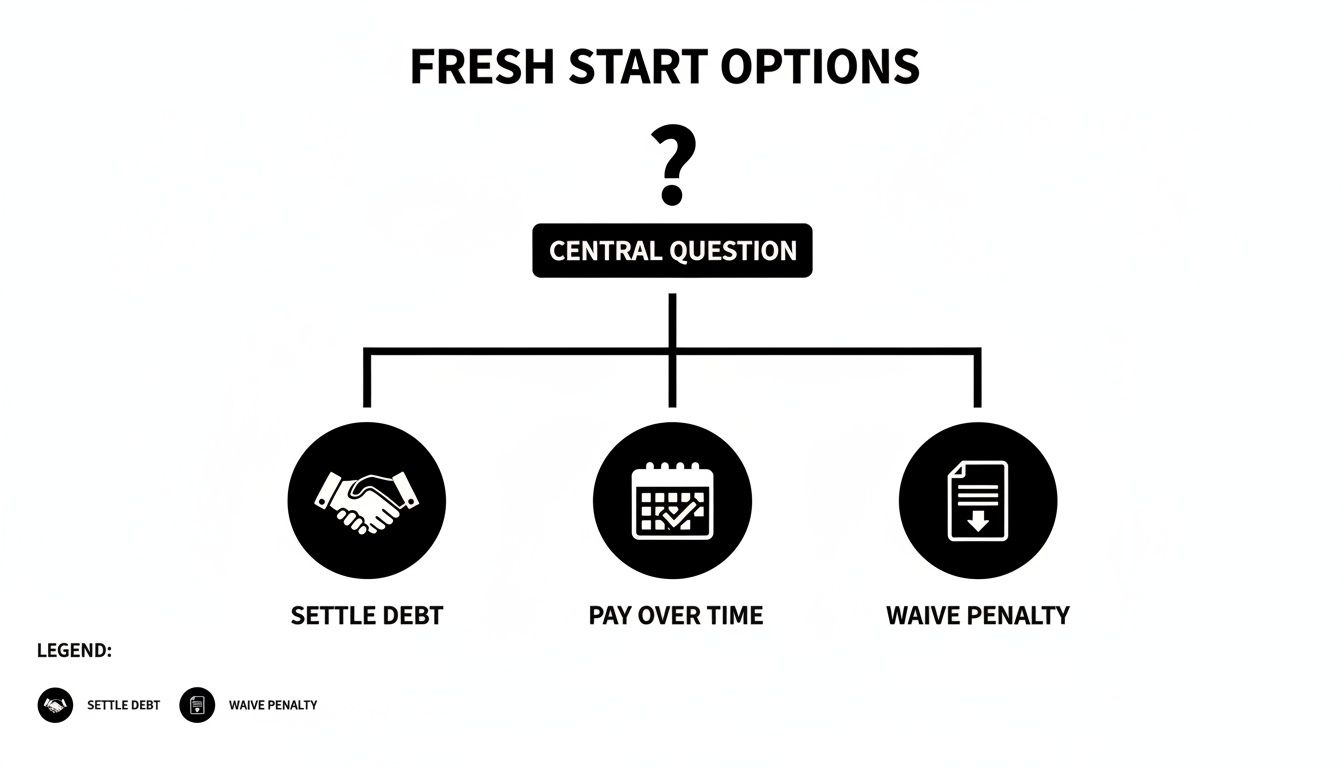
As you can see, everything branches off from a central question: can you realistically pay what you owe? Your answer to that question sends you down a very different path.
Eligibility for Specific Relief Programs
Each program under the Fresh Start umbrella has its own unique set of rules. Your income, expenses, what you own, and how much you owe will all point you toward one solution over another.
Fresh Start Relief Options Compared
Choosing the right relief option can feel overwhelming. This table breaks down the key differences to help you see where you might fit. It’s a quick-glance guide to match your tax debt and financial situation with the most likely solution.
| Relief Option | Typical Tax Debt Amount | Key Eligibility Factor | Potential Outcome |
|---|---|---|---|
| Offer in Compromise | $10,000+ | Inability to pay full debt based on income, assets, and expenses. | Settle the tax debt for less than the full amount owed. |
| Streamlined Installment Agreement | Under $50,000 | Ability to pay the full debt off within 72 months. | Pay the full debt over a period of up to six years. |
| Penalty Abatement | Any Amount | A valid reason for non-compliance (e.g., first-time mistake, illness). | Removal of failure-to-file and/or failure-to-pay penalties. |
| Partial Pay Installment Agreement | Over $50,000 | Inability to pay the full debt before the collection statute expires. | Make monthly payments you can afford until the debt legally expires. |
Keep in mind, this is just a starting point. The details matter, and the IRS will scrutinize your financial information before approving any agreement.
Offer in Compromise (OIC)
This is the big one—the program that lets you settle your tax debt for less, sometimes much less, than what you owe. But it's reserved for taxpayers in genuine financial distress.
To get an OIC, you have to prove that the IRS is unlikely to ever collect the full amount. They calculate your Reasonable Collection Potential (RCP), a strict formula that looks at your disposable income and the equity in your assets. If your RCP is lower than your tax debt, you have a shot. You can learn more about the math behind it in our detailed guide on how to qualify for an Offer in Compromise.
Streamlined Installment Agreement
If you can afford to pay your tax debt but just need some time, this is often the simplest path. It's designed to be a straightforward, less invasive process.
- Total Debt: Your combined balance of tax, penalties, and interest must be $50,000 or less.
- Payment Term: You have to be able to clear the debt completely within 72 months (that’s 6 years).
- Benefit: The best part? For most people who meet these criteria, the IRS doesn't require a mountain of financial paperwork.
What if you owe more than $50,000? You can still get an installment agreement. It just won't be "streamlined." You'll have to submit a full financial disclosure (Form 433-F) and negotiate a payment plan based on what the IRS determines you can afford.
Penalty Abatement
Sometimes the issue isn't the tax itself, but the crushing weight of penalties tacked on top. Penalty relief isn't about your ability to pay; it's about why you fell behind in the first place.
You might get penalties waived if you can show:
- First-Time Abatement: You have a perfect track record. If you’ve filed and paid on time for the previous three years, the IRS may forgive a current mistake as a one-time courtesy.
- Reasonable Cause: Life happened. A serious illness, a death in the family, a natural disaster, or even relying on bad advice from a tax professional can be grounds for "reasonable cause" and get the penalties removed.
Getting this right is critical. A misplaced application or a misunderstanding of the rules can get you a flat-out rejection, leaving you right back where you started while interest and penalties just keep piling up.
How to Apply for the IRS Fresh Start Program

Alright, you understand the different relief options. Now it's time to go from learning to doing. Applying for any fresh start tax program is a game of precision and detail. You're not just filling out paperwork; you're building a formal case to convince the IRS of your financial reality and your intent to get right with them.
Think of it as the official start of your negotiation. A well-organized, thorough application can drastically speed things up and tilt the odds in your favor. On the flip side, a sloppy or incomplete package is a fast track to rejection, putting you right back where you started while interest and penalties continue to mount. Let's walk through how to do this right the first time.
H3: Gather Your Essential Documents
Before you even think about downloading an IRS form, you need to get your financial life in order. The IRS operates on a "trust, but verify" model, and they need hard proof of your income, expenses, and assets to even consider you for relief.
Start pulling together the following:
- Proof of Income: This means recent pay stubs, W-2s, and any 1099s. If you’re self-employed, you'll need up-to-date profit and loss statements.
- Bank Statements: Plan on gathering the last three to six months of statements for every single bank account you have, both checking and savings.
- Proof of Expenses: Collect recent bills for all your necessary living costs—rent or mortgage, utilities, groceries, car payments, insurance, and medical bills. The IRS has their own standards, but they still need to see your actual numbers.
- Asset Information: You'll need to document anything of significant value you own. This includes your home, vehicles, and retirement accounts. Be prepared with statements showing their current value and any loans against them.
Having this financial file ready will make the application process a hundred times smoother and far more accurate.
H3: Find and Complete the Correct IRS Forms
Each path to tax relief has its own specific form. Grab the wrong one, and your application is dead on arrival. There's no "close enough" with the IRS; you have to be exact.
Here are the key forms you'll likely be dealing with:
- Offer in Compromise (OIC): For this, you’ll need Form 656, the Offer in Compromise booklet. It includes Form 433-A (OIC) for individuals or Form 433-B (OIC) for businesses. This is by far the most intensive application, requiring a complete financial disclosure.
- Installment Agreement: The go-to form is Form 9465, Installment Agreement Request. If you owe less than $50,000, you can often set up a payment plan directly on the IRS website, which is usually the quickest route.
- Penalty Abatement: To ask for penalty relief, you'll file Form 843, Claim for Refund and Request for Abatement. The form itself is simple, but you must attach a compelling written statement explaining your "reasonable cause."
Always, always download the latest version of these forms directly from the IRS website. They change, and using an outdated form is an unforced error.
H3: What to Expect After You Apply
Hitting "submit" or dropping that envelope in the mail is just the beginning. The most important thing to have now is patience. The wheels of the IRS turn slowly.
Good news first: Once your application is received, the IRS usually puts a temporary pause on aggressive collection actions like wage garnishments or bank levies while they review your case. The bad news? Interest and penalties don't stop. They keep growing until your agreement is officially approved.
Here is a realistic timeline for what happens next:
- Initial Acknowledgment: Within 30 to 60 days, you should get a letter in the mail confirming the IRS has your application.
- Review and Questions: Your case will be assigned to an IRS agent. It’s incredibly common for them to send a follow-up letter asking for more documents or clarification on a few points. Respond immediately.
- Decision: Getting a final answer can take anywhere from a couple of months for a straightforward installment agreement to over a year for a complex Offer in Compromise.
If your request gets denied, don't give up. You have a 30-day window to appeal the decision, and this is often the point where having a seasoned tax professional in your corner makes all the difference.
To get a better handle on what your monthly payments might look like, our IRS payment plan calculator guide can help you set some realistic expectations right from the start.
The Real-World Impact of the Fresh Start Program
The Fresh Start Program isn't just a bunch of bureaucratic rules on paper. For millions of Americans, it's a genuine financial lifeline that has had a massive, positive impact. It represents a major shift in how the IRS deals with tax debt—moving away from a purely punitive approach to one that's more realistic and humane.
When you look at the actual numbers and hear the stories, you see how this initiative truly works. The program’s success is obvious in how it opened up relief to more people, softened the devastating blow of tax liens, and completely changed the game for negotiating settlements with the IRS.
Making Relief More Accessible for Everyone
One of the biggest game-changers was raising the debt limit for Streamlined Installment Agreements to $50,000. Before this, anyone with a moderate tax debt was buried in a complicated, invasive financial disclosure process.
Now, if you owe less than that amount, you can often set up a payment plan for up to 72 months (that’s six years!) without having to turn over a mountain of personal financial statements. This one change alone made manageable tax relief a reality for a huge group of people who were previously stuck.
Along the same lines, the IRS now waits until a tax debt hits $10,000 before automatically filing a Notice of Federal Tax Lien. This adjustment is huge. It prevents immediate and severe credit damage for people with smaller tax debts, giving them a critical opportunity to fix the problem before a public lien makes it impossible to get a loan, rent an apartment, or even pass a background check for a job.
The philosophy here is simple but incredibly effective: give people a reasonable way to get back on track before hitting them with crippling collection actions. This smarter approach helps taxpayers solve their issues and stay productive, which is a win for everybody.
How the U.S. Compares to Global Tax Relief
The idea of giving taxpayers a second chance isn't unique to the United States. Many other countries have figured out that offering structured relief programs is far more effective than just bringing the hammer down. The IRS fresh start tax program is part of a worldwide trend toward more practical tax administration.
While the specifics are American, the core principles echo relief measures you'd find in places like the UK and Canada. They also offer flexible payment plans and penalty forgiveness for taxpayers who are struggling financially. It's a recognition that helping people recover is better for the economy than pushing them into bankruptcy.
Changing the Settlement Landscape
The Fresh Start initiative also completely reshaped the Offer in Compromise (OIC) program. The IRS now focuses much more on a taxpayer's present-day financial reality—what they call your Reasonable Collection Potential (RCP)—instead of just guessing about what you might earn in the future.
This has made settlement negotiations far more realistic, leading to more accepted offers for people who can prove they're in a tough spot. By focusing on what a person can actually pay right now, the IRS closes more cases and brings in more revenue than it would otherwise.
This practical approach also helps taxpayers avoid the most aggressive collection tactics, like wage garnishments, which can trap a struggling family in a downward spiral of debt. If you're facing that kind of threat, our guide on how to stop IRS wage garnishment lays out the exact steps you need to take.
When Should You Call a Professional for Help with Your Tax Debt?

Trying to navigate the IRS Fresh Start Program can feel like you're trying to solve a complex puzzle with half the pieces missing. While some tax issues are straightforward enough to handle on your own, other situations can quickly become overwhelming. The stakes get higher, and the rules get much more complicated.
Knowing when to call in an expert isn't a sign of failure; it’s a smart, strategic decision to protect yourself and get the best possible result. Think of a seasoned tax professional—like an Enrolled Agent or a tax attorney—as your personal advocate. They don't just know the rules; they speak the IRS's language and understand the unwritten nuances that can make or break your case.
Clear Signs It’s Time to Hire a Tax Pro
There are a few clear red flags that signal it's time to stop going it alone and get an expert involved. Trying to manage these situations solo can easily lead to rejected applications, costly errors, and a whole lot more stress.
You should seriously consider hiring help if you're facing any of these scenarios:
- Your Tax Debt is Over $50,000: Once your debt crosses this line, the simple, streamlined options are usually off the table. The IRS will demand a much deeper dive into your finances, and the negotiations get far more intense.
- You're a Business Owner: Business tax problems are a different beast entirely, especially when it comes to payroll taxes (like Form 941 liabilities). The IRS is incredibly aggressive in collecting these debts, and the required paperwork is far more complex.
- You've Received Aggressive IRS Notices: If you get a letter threatening a bank levy, property lien, or wage garnishment, that's not a bluff. It’s a final warning. A professional can step in immediately to pause these collection actions while they negotiate a permanent solution for you.
- Your Relief Application Was Already Rejected: A denial isn't the end of the road. You have the right to appeal, but you’ll need a much stronger case the second time around. An expert can pinpoint why you were denied and represent you in the appeals process.
The real value of a professional goes way beyond filling out paperwork correctly. They know how to present your financial story in the most compelling way, anticipate the questions an IRS agent will ask, and negotiate directly with revenue officers to get you a deal you couldn't get on your own.
The Real-World Impact of Expert Help
The Fresh Start program has genuinely helped many people get back on their feet. For example, when the IRS expanded the streamlined installment agreement threshold to $50,000, it opened the door for thousands of taxpayers to get relief without jumping through endless hoops. You can read more about the program's impact in this CBS News report.
But even with these helpful programs, getting the most out of them requires a precise approach. A tax professional ensures every single detail of your application for fresh start tax relief is airtight, shielding you from common mistakes that could result in a bad deal—or an outright rejection. At the end of the day, paying for an expert isn't just a cost; it's an investment in your peace of mind and your financial future.
Common Questions About the IRS Fresh Start Program
After you get the big picture of the Fresh Start Program, a lot of practical questions start to pop up. How long does this actually take? What about my business? And the big one—what happens if the IRS says no? Let's clear up some of those common sticking points.
The timeline really hinges on which path you take. A simple Streamlined Installment Agreement can sometimes be set up online in minutes or approved within a couple of weeks. But if you’re aiming for an Offer in Compromise, you need to settle in for a much longer journey—it typically takes the IRS 6 to 12 months just to investigate your situation and make a decision.
Can My Small Business Qualify?
Yes, absolutely. Small businesses aren't left out in the cold. The IRS provides relief options for business tax debts, including those tricky overdue payroll taxes, but be prepared for a more rigorous process compared to personal tax issues.
You'll have to use business-specific forms, like Form 433-B, which is the Collection Information Statement for Businesses. The IRS will put your business's finances under a microscope, looking closely at assets, income, and your genuine ability to pay before they'll approve something like an OIC or a formal payment plan.
What Happens If My Application Is Rejected?
Getting that rejection letter in the mail feels like a gut punch, but it’s not the end of the line. If the IRS turns down your application for an Offer in Compromise or another payment plan, you have the right to challenge their decision.
You generally have 30 days from the date on the rejection letter to file an appeal. This is a crucial deadline. It's your window to build a stronger case, fix any problems the IRS found, and get a second look.
Successfully appealing a rejection is tough. It requires a solid grasp of tax law and knowing how the IRS appeals process works from the inside. This is often the point where getting professional help makes all the difference. An experienced representative knows how to navigate the system and negotiate directly with the IRS for you.
You don't have to figure this out on your own. At Attorney Stephen A Weisberg, we start every case with a FREE Tax Debt Analysis to map out the best strategy for your unique circumstances. Find out how we can help you achieve a true financial fresh start at weisberg.tax.


