Fresh Start Assistance: Tax Relief Options, OICs, and Plans
Discover fresh start assistance for tax debt relief, including OICs, payment plans, and steps to regain financial control.

In this article
- What Is IRS Fresh Start Assistance
- Who Benefits From This Program
- A Key Change That Provides Breathing Room
- Overview of Fresh Start Assistance Options
- Offer In Compromise vs. Installment Agreements
- The Offer In Compromise Path
- The Installment Agreement Route
- A Head-to-Head Comparison
- Clearing Your Record: How Penalty Abatement and Lien Withdrawals Work
- Erasing Penalties with Abatement
- Removing a Lien from Your Public Record
- Qualifying for a Lien Withdrawal
- Your Step-by-Step Guide to Applying for Tax Relief
- Step 1: Gather Your Financial Blueprint
- Step 2: Complete the Correct IRS Forms
- Step 3: Submit and Wait for the Review
- Step 4: Prepare to Negotiate
- Why an Expert Can Make All the Difference
- Leveling the Playing Field
- Strategic Guidance and Pitfall Protection
- Maximizing Your Chances of Success
- Your Top Questions About IRS Fresh Start, Answered
- I Haven't Filed in Years. Can I Still Get Help?
- How Long Will I Be Waiting for an Offer in Compromise Decision?
- Can the Fresh Start Program Actually Stop a Wage Garnishment?
When you're staring down a mountain of tax debt, it can feel like you're completely stuck. That's where the IRS Fresh Start initiative comes in. Think of it less as a single program and more as a toolkit of relief options the IRS created to help taxpayers who are struggling to pay what they owe. It’s a powerful, structured way to get back on solid financial ground and stop aggressive collection actions.
What Is IRS Fresh Start Assistance
Facing a huge tax bill is overwhelming. It feels like being caught in a current, pulling you further and further from shore. The IRS Fresh Start initiative is meant to be a lifeline in that situation, offering different ways to manage, reduce, or set up payments for your tax debt.
Frankly, it's the IRS's way of acknowledging that life happens. People lose jobs, get sick, or see their businesses take a hit. They realized that their old, rigid collection policies weren't always the best solution for the taxpayer or for the government.
The whole point of the initiative is to make tax resolution more realistic for regular people and small businesses. It opens doors for taxpayers to potentially settle their debt for less than what they originally owed, or at the very least, pay it off over a much longer, more manageable timeframe. This helps people regain their footing without the constant stress of liens, levies, and wage garnishments.
Who Benefits From This Program
This kind of assistance is a game-changer for a lot of different people. While everyone's situation is unique, we often see these programs become absolutely essential for a few key groups:
- Self-Employed Individuals and Gig Workers: Income can be a rollercoaster when you work for yourself. Fresh Start offers payment plans that can flex with that unpredictable cash flow.
- Small Business Owners: When a business hits a rough patch, payroll and income taxes can pile up fast. These programs can provide a path to getting compliant again without having to close up shop.
- Individuals Facing Hardship: Anyone who's gone through a major life event—a sudden job loss, a serious medical emergency—can use these options to stop a tax issue from snowballing into a full-blown financial disaster.
The initiative’s goal is to prevent taxpayers from defaulting entirely. By offering flexible solutions, the IRS increases its chances of collecting what it can while allowing taxpayers to remain productive members of the economy.
A Key Change That Provides Breathing Room
One of the biggest impacts of the Fresh Start initiative happened right at the beginning. When it launched back in 2011, the IRS raised the threshold for filing a federal tax lien from $5,000 to $10,000. Today, that threshold is even higher, sitting at $25,000.
What does that mean for you? It means the IRS generally won't file a public Notice of Federal Tax Lien if your debt is under that amount. That’s huge. It gives you critical breathing room because a lien can wreck your credit score and make it nearly impossible to get a loan. You can learn more about this crucial detail on TaxFortress.com.
Ultimately, these programs can turn what feels like an impossible situation into a problem with a clear solution. By understanding the various tax debt relief options available, you can find the right strategy for your specific circumstances and start moving toward financial peace of mind.
Here’s a quick breakdown of the most common relief options available under the Fresh Start umbrella to help you see which one might be the best fit.
Overview of Fresh Start Assistance Options
| Relief Option | Best For Taxpayers Who... | Key Outcome |
|---|---|---|
| Offer in Compromise (OIC) | Have very limited income and assets and can’t pay their full tax debt. | Settle the tax debt for a lower amount than originally owed. |
| Installment Agreement | Can't pay in full now but can make consistent monthly payments over time. | Pay off the full tax debt over a period of up to 72 months. |
| Penalty Abatement | Have a valid reason (like illness or a natural disaster) for failing to file or pay. | The IRS removes penalties, significantly reducing the total amount owed. |
| Currently Not Collectible | Are facing extreme financial hardship and can't afford basic living expenses. | The IRS temporarily pauses collection efforts until their financial situation improves. |
Each of these paths is designed for a different financial reality. The key is figuring out which one aligns with your ability to pay and gives you the best chance to finally put this debt behind you.
Offer In Compromise vs. Installment Agreements
When you're facing a tax bill you can't pay, the IRS Fresh Start program gives you two primary avenues for relief: the Offer in Compromise (OIC) and the Installment Agreement (IA). They both offer a path forward, but they are fundamentally different solutions. Knowing which one fits your unique financial reality is the first crucial step toward resolving your debt.
Think of an Offer in Compromise as a settlement. You're making a case to the IRS that you simply don't have the assets or income to ever pay back your full tax debt. It’s a route for those facing true financial hardship, and if approved, the IRS agrees to accept a lower amount as payment in full.
An Installment Agreement, on the other hand, is exactly what it sounds like—a structured payment plan. It’s an arrangement where you agree to pay the entire debt, including interest and penalties, over time through manageable monthly payments. This is the practical choice for people who can eventually pay what they owe but just can't come up with a lump sum right now.
This flowchart can help you visualize where to start when thinking about your options.
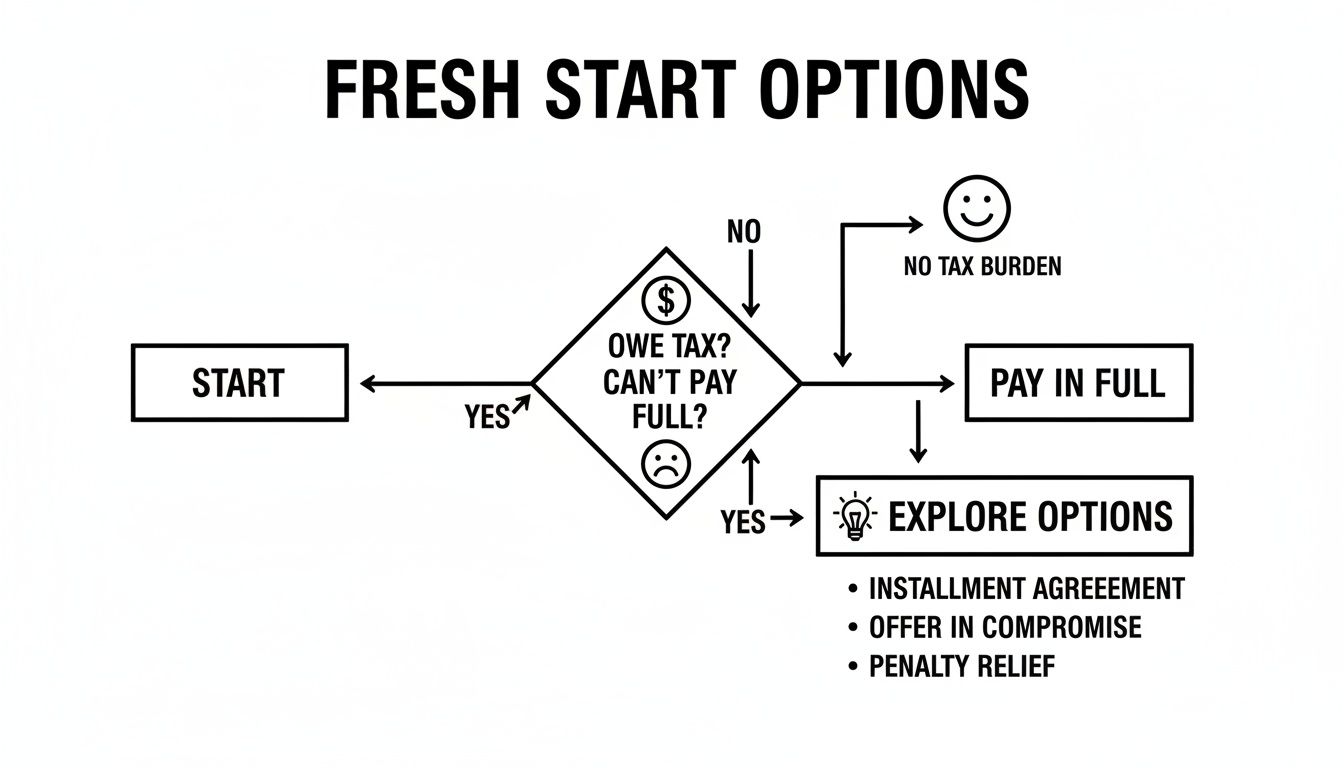
As you can see, the journey begins by assessing whether you can pay in full. If not, that's when you start exploring these relief programs.
The Offer In Compromise Path
The OIC is often called the "holy grail" of tax relief because it can erase a significant portion of your debt. But let's be clear: it's also incredibly difficult to get. The IRS is a collection agency, and they don't forgive debt lightly. They only accept an OIC when they are convinced they won't be able to collect the full amount from you.
To make that decision, they calculate what they call your Reasonable Collection Potential (RCP). This isn't just a guess; it's a strict formula that looks at:
- Your assets (cash, investments, home equity, vehicles).
- Your current income from every source.
- Your allowable monthly living expenses, which are based on rigid national and local standards.
If the IRS's calculation shows you have enough disposable income or assets to pay off the debt over time, your OIC will be denied. It's a high bar to clear. To truly understand what it takes, you can dig into this complete guide to tax debt settlement and see just how detailed the process is.
The Installment Agreement Route
For the vast majority of people, an Installment Agreement is a much more realistic and accessible path. The Fresh Start initiative actually made these plans easier than ever to set up, particularly for taxpayers who owe under a certain threshold.
For example, if your combined tax, penalties, and interest are less than $50,000, you can often qualify for a Streamlined Installment Agreement with far less hassle. The best part? Once it's in place, the IRS immediately halts aggressive collection actions like bank levies and wage garnishments. It gives you breathing room and a predictable plan.
These agreements allow you to spread your payments out over as long as 72 months (that’s six years). Breaking down a large debt into smaller, consistent payments can make the difference between financial stability and constant stress.
A Head-to-Head Comparison
So, how do you choose? It’s not about what you want; it’s about what your financial situation qualifies you for in the eyes of the IRS. The table below breaks down the key differences between an OIC and an IA to help clarify which path might be right for you.
| Feature | Offer in Compromise (OIC) | Installment Agreement (IA) |
|---|---|---|
| Primary Goal | Settle tax debt for less than the full amount owed. | Pay the full tax debt over an extended period. |
| Who It's For | Taxpayers with severe financial hardship and minimal assets. | Taxpayers who can afford monthly payments but can't pay all at once. |
| Financial Disclosure | Extremely detailed; requires full disclosure of all finances. | Less detailed, especially for streamlined plans under $50,000. |
| Impact on Debt | Debt can be resolved for a fraction of what was originally owed. | The full debt, plus penalties and interest, must be paid. |
| Approval Rate | Low. The IRS has very strict eligibility rules. | High. Much easier to qualify for, with clear thresholds. |
Ultimately, an OIC offers a chance to dramatically reduce your debt, but with a high risk of rejection. An IA provides a reliable and attainable way to pay what you owe without upending your life. Understanding where you stand financially is the key to making the right choice.
Clearing Your Record: How Penalty Abatement and Lien Withdrawals Work
When you’re staring down a tax debt, the original amount you owe is only part of the problem. The IRS often tacks on penalties and files public liens, which can feel like salt in the wound. Fresh start assistance isn't just about the core tax bill; it's also about tackling these painful extras.
Think of it this way: settling the tax debt is step one, but cleaning up your financial record is step two. That's exactly what Penalty Abatement and Lien Withdrawals are designed to do.

The Fresh Start initiative acknowledges that good people can fall behind on their taxes. Sometimes, life just gets in the way. These specific tools offer a path to address the damaging side effects of tax debt and truly move forward.
Erasing Penalties with Abatement
The IRS uses penalties to enforce its rules, but they aren't always set in stone. Penalty Abatement is the formal process of asking the IRS to remove—or "abate"—those penalties from your account. It's not an automatic forgiveness program; you have to ask for it and, more importantly, you need to have a legitimate reason.
The IRS will typically consider removing penalties for a few key reasons:
- First-Time Abate: This is the IRS's version of a "get out of jail free" card. If you've had a perfect compliance record for the past three years and then made one mistake, you can often get the penalties waived.
- Reasonable Cause: This is for situations where life threw you a curveball that was completely out of your control. We're talking about things like a sudden serious illness, a death in the immediate family, a major natural disaster, or even getting bad advice from a tax professional.
- Statutory Exception: In very specific cases, the law itself provides an exception. A common example is for military personnel serving in a combat zone.
Proving reasonable cause is all about telling a clear, compelling story backed up by solid proof. You have to show the IRS that you acted responsibly but were still unable to file or pay on time. Understanding what the IRS considers a valid reasonable cause for penalty abatement is absolutely critical to making a successful case.
Removing a Lien from Your Public Record
A Notice of Federal Tax Lien is more than just a letter—it's a public declaration of your debt. The IRS files it to stake a legal claim on your assets, and it absolutely torpedoes your credit score. Trying to get a car loan or a mortgage with a federal tax lien on your record is next to impossible.
A lien withdrawal is the solution. It completely removes the public notice, effectively wiping the slate clean on your credit history as if it never happened.
A lien withdrawal is a game-changer because it helps you rebuild your financial life while you're still paying off your tax debt. It signals to lenders that the public claim against you is gone, opening doors that were previously slammed shut.
Thanks to the Fresh Start program, getting a lien withdrawal is more achievable than ever. The most common way to do it is by setting up a Direct Debit Installment Agreement (DDIA).
Qualifying for a Lien Withdrawal
While it's never a guarantee, you have a strong chance of getting a lien withdrawn if you meet these general requirements:
- Set Up a Direct Debit Plan: You have to agree to have your monthly payments automatically taken from your bank account.
- Owe $25,000 or Less: At the time you ask for the withdrawal, your total tax bill must be under this amount.
- Make Consistent Payments: You need to have made at least three consecutive direct debit payments without any issues.
- Stay in Full Compliance: This means all your past tax returns must be filed, and you have to be current on any new tax obligations.
Once you check these boxes, you can file Form 12277, Application for Withdrawal of Filed Form 668(Y), Notice of Federal Tax Lien. Using these tools isn’t just about paying what you owe; it’s about strategically repairing the damage to your financial reputation so you can get a true fresh start.
Your Step-by-Step Guide to Applying for Tax Relief
Knowing your options for fresh start assistance is one thing, but actually getting through the application process is another challenge entirely. Let's break down the often-intimidating journey into a clear, manageable roadmap.
Think of it like getting a loan from a bank. You wouldn't just show up and ask for money; you’d come prepared with all your financial paperwork to prove your case. The IRS operates the same way, and being organized from the start is absolutely critical for success.
Step 1: Gather Your Financial Blueprint
Before you even think about filling out a form, you need to assemble a complete and honest picture of your financial life. The IRS needs to see everything to consider your request, and skipping this step is a surefire way to get rejected.
Start by tracking down these documents:
- Recent Tax Returns: First things first, you have to be current on your filings. If you have unfiled returns from previous years, tackling those is your top priority.
- Proof of Income: This means gathering recent pay stubs, profit and loss statements if you run your own business, and any records of other income, like pensions or social security benefits.
- Bank Statements: Pull together the last three to six months of statements for every single one of your accounts.
- Asset Records: Collect any paperwork related to property you own. This includes real estate deeds, vehicle titles, and statements from investment or retirement accounts.
- Monthly Expense Records: Get your hands on recent bills and statements for all your necessary living costs—housing, utilities, groceries, transportation, and medical care.
Having all of this organized not only makes the application process smoother but also ensures the numbers you provide are accurate and provable.
Step 2: Complete the Correct IRS Forms
With your financial documents in order, it's time for the official paperwork. This is where precision matters. Using the wrong form or leaving a section blank will trigger an automatic denial, sending you right back to square one.
- For an Offer in Compromise (OIC): You'll need Form 656, which is the main application. You'll also submit either Form 433-A (OIC) if you're an individual or Form 433-B (OIC) for a business. These forms demand a very detailed breakdown of your finances.
- For an Installment Agreement: The main application is Form 9465, the Installment Agreement Request. If your debt is over $50,000, the IRS will likely require a full financial statement on Form 433-F as well.
Common Mistake to Avoid: A huge red flag for the IRS is underreporting your income or inflating your expenses. The agency uses strict national and local standards to determine what are considered reasonable living expenses. They will absolutely verify every number you submit, so complete honesty is your only option.
Step 3: Submit and Wait for the Review
Once you’ve triple-checked every line on your application for accuracy, you’ll send it off to the IRS. Now comes the hard part: waiting. The IRS review process is notoriously slow, and timelines can vary wildly.
For a straightforward Installment Agreement, especially one for a debt under $50,000, you might hear back in a few weeks or a couple of months. An Offer in Compromise, however, is a much deeper dive.
The IRS can take anywhere from 6 to 12 months—sometimes even longer—to make a decision on an OIC. During this period, an examiner will be assigned to your case to meticulously verify every single detail you provided.
Step 4: Prepare to Negotiate
It's a common misconception that the IRS's first response is the final word. If they reject your OIC or propose an Installment Agreement with payments you can't afford, you usually have the right to appeal or negotiate.
This is where things can get tricky. The examiner might question your listed expenses or dispute the value you've placed on your assets. You’ll need to be ready to provide more documentation and build a logical argument for why your proposal should be accepted. This back-and-forth negotiation is often the stage where having an experienced tax professional in your corner can dramatically change the final outcome.
Following these steps methodically gives you the best possible shot at securing the fresh start assistance you need.
Why an Expert Can Make All the Difference
Trying to navigate the IRS Fresh Start program on your own is a lot like trying to perform complex surgery on yourself armed with a first-aid kit. You might have some of the basic tools, but the risk of making a critical mistake is incredibly high, and the consequences can be devastating. This is exactly why getting professional help is so important.
Hiring an experienced tax attorney is like bringing a seasoned guide on a trek through a dangerous, unfamiliar jungle. The IRS operates with its own language, unwritten rules, and incredibly complex procedures. A pro doesn't just speak this language; they know the terrain inside and out, understanding which paths lead to a successful resolution and which ones lead straight to a dead end.
Leveling the Playing Field
Let's be blunt: the IRS is one of the most powerful federal agencies, and they have nearly unlimited resources. Going up against them alone is a massive uphill battle. A tax attorney acts as your advocate and negotiator, stepping in to ensure your case is presented professionally and in the best possible light.
They take over all the direct communication, which means you no longer have to deal with the stress and intimidation of talking to revenue officers. That peace of mind alone is worth its weight in gold, letting you get back to your life while they handle the complex details.
A tax attorney’s job is to secure the best possible outcome for you under the law. They dive deep into your entire financial situation to build a strong, compelling case, turning what feels like an overwhelming mess into a structured, manageable plan.
This kind of expert representation isn't just a matter of convenience—it's about getting better results. A professional can often secure outcomes, like a lower Offer in Compromise settlement or more flexible installment terms, that are nearly impossible for a taxpayer to get on their own.
Strategic Guidance and Pitfall Protection
One of the biggest advantages of getting expert help is the strategy. A seasoned professional can look at your situation and immediately identify the best relief option for you. This saves you from wasting months of time and energy applying for programs you were never going to qualify for in the first place.
They also protect you from common—and very costly—mistakes. Things like:
- Submitting Incomplete Forms: One missing document or unchecked box can get your entire application rejected, sending you right back to square one.
- Miscalculating Your Ability to Pay: The IRS uses very strict formulas to decide what you can afford. An expert knows exactly how to apply these rules to your finances correctly.
- Missing Critical Deadlines: If you fail to respond to an IRS notice on time, they can default on your case and start aggressive collection actions like wage garnishments or bank levies.
This kind of strategic oversight is crucial. When thinking about how important experts are in tax matters, it can also be interesting to see how these professionals market their skills. For anyone curious, there's a helpful resource on finding qualified tax professionals that looks at this from another perspective.
Maximizing Your Chances of Success
Ultimately, hiring a professional for Fresh Start assistance is an investment in your financial future. The process is so much more than just filling out forms. It requires a deep knowledge of tax law, sharp negotiation skills, and a real understanding of how the IRS operates internally.
An expert knows how to frame your situation in a way that IRS examiners will understand and accept, giving your settlement offer the highest possible chance of success.
A skilled attorney might also spot opportunities you'd completely miss, like seeing if you qualify for a Penalty Abatement or a Lien Withdrawal. These can dramatically reduce what you owe and help clear your public record. The benefits of hiring a tax attorney go way beyond the final numbers; it's about getting a legitimate fresh start and the financial stability that comes with it.
Your Top Questions About IRS Fresh Start, Answered
When you're dealing with tax debt, a lot of questions pop up. It's completely normal to feel uncertain. Let's clear the air and tackle some of the most common concerns people have about getting a fresh start with the IRS.
I Haven't Filed in Years. Can I Still Get Help?
This is probably the most important question we get, and the answer is a hard no—at least, not yet. The IRS won't even look at a relief application until you're caught up on your filings.
Think of it from their perspective: they can't negotiate a debt if they don't know the full amount you owe. "Compliance" is the magic word here. To the IRS, that means all required tax returns for the past six years must be on file. Getting those back taxes filed is step one, and it's non-negotiable.
How Long Will I Be Waiting for an Offer in Compromise Decision?
Submitting an Offer in Compromise (OIC) is a marathon, not a sprint. The IRS does a deep dive into your financial life to confirm you truly can't pay what you owe, and that kind of investigation takes time.
Be prepared to wait. The official IRS timeline is anywhere from 6 to 12 months, but don't be surprised if it stretches even longer for more complicated situations. An IRS examiner will be assigned to your case, and they will meticulously verify every single piece of information you've submitted.
Setting realistic expectations is crucial. And while you're waiting, you have to stay current with all your new tax obligations. That means filing on time and making estimated tax payments if you're self-employed.
Can the Fresh Start Program Actually Stop a Wage Garnishment?
Yes, and this is where you can feel some immediate relief. Nothing is more stressful than having the IRS take money directly from your paycheck or bank account. Taking formal steps to resolve your debt can bring these aggressive collection tactics to a halt.
Here's a quick look at how it works:
- For Installment Agreements: As soon as the IRS formally accepts your request for a payment plan, they typically stop any active wage garnishments. The key is to keep making your monthly payments on time to keep the collections process on pause.
- For an Offer in Compromise: The moment the IRS officially accepts your OIC for processing, the law requires them to suspend most collection activities. This gives you critical breathing room while they evaluate your offer.
This protection is designed to give you the stability you need to work toward a final solution without the constant fear of having your income seized.
Trying to figure all this out on your own can be overwhelming. At The W Tax Group, tax attorney Stephen A. Weisberg has the experience to guide you through the process and fight for the best possible outcome.
It all starts with understanding exactly where you stand. Get your no-obligation, free Tax Debt Analysis to see your options and map out a clear path forward.


