Your 2026 Guide to Form W 4 in Spanish
Get clear guidance on the form w 4 in spanish. Learn if an official version exists, how to fill it out correctly, and avoid common costly mistakes. 2026 update.
In this article
- The Truth About an Official Spanish Form W-4
- What Spanish guides can and can't do
- Why this confusion creates risk
- Why the W-4 Is Critical for Your Paycheck
- The old “allowances” language still causes expensive confusion
- What happens if no valid W-4 is on file
- Why accuracy matters more than the size of a refund
- How to Accurately Fill Out Each W-4 Section
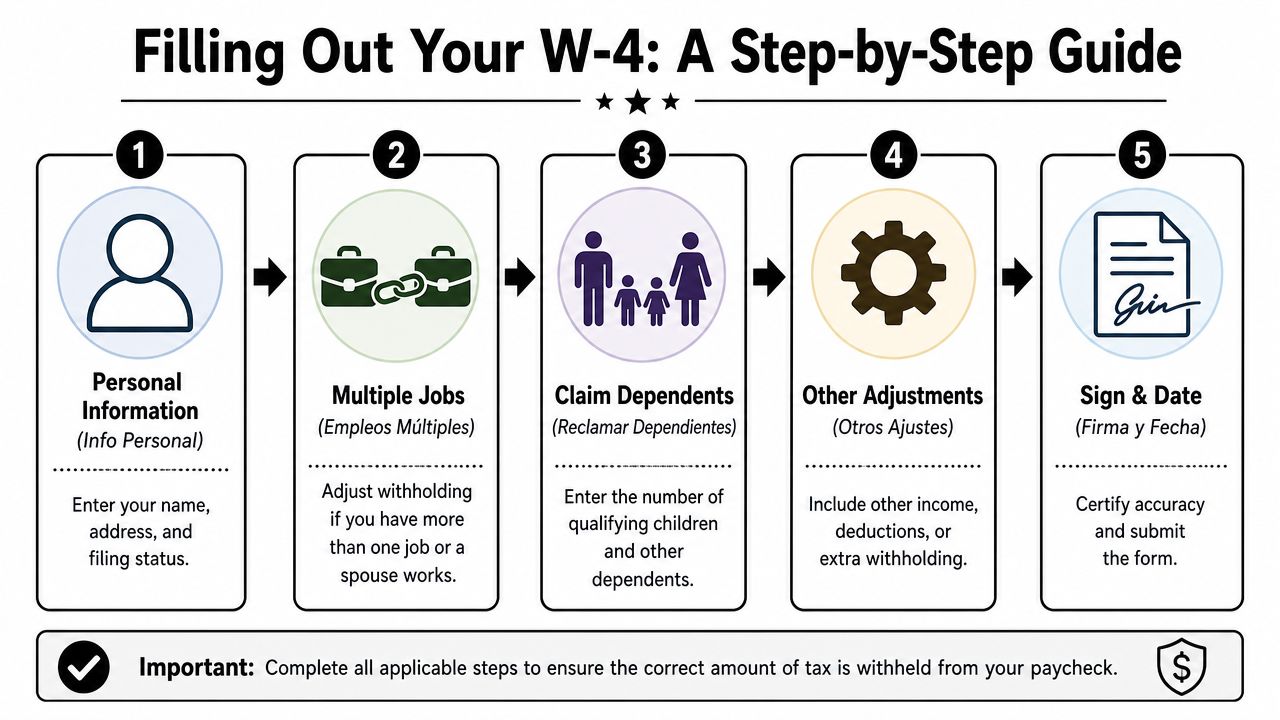
- Step 1 Personal information
- Step 2 Multiple jobs or spouse works
- Step 3 Claim dependents
- Step 4 Other adjustments
- Step 5 Sign and date
- Avoiding Costly Errors on Your W-4
- Errors that usually start as misunderstandings
- When the problem becomes legal, not just mathematical
- A useful way to judge risk
- What Employers Need to Know About Spanish W-4s
- What employers should do
- Where employers often create exposure
- A Note for Attorneys and Tax Advisors
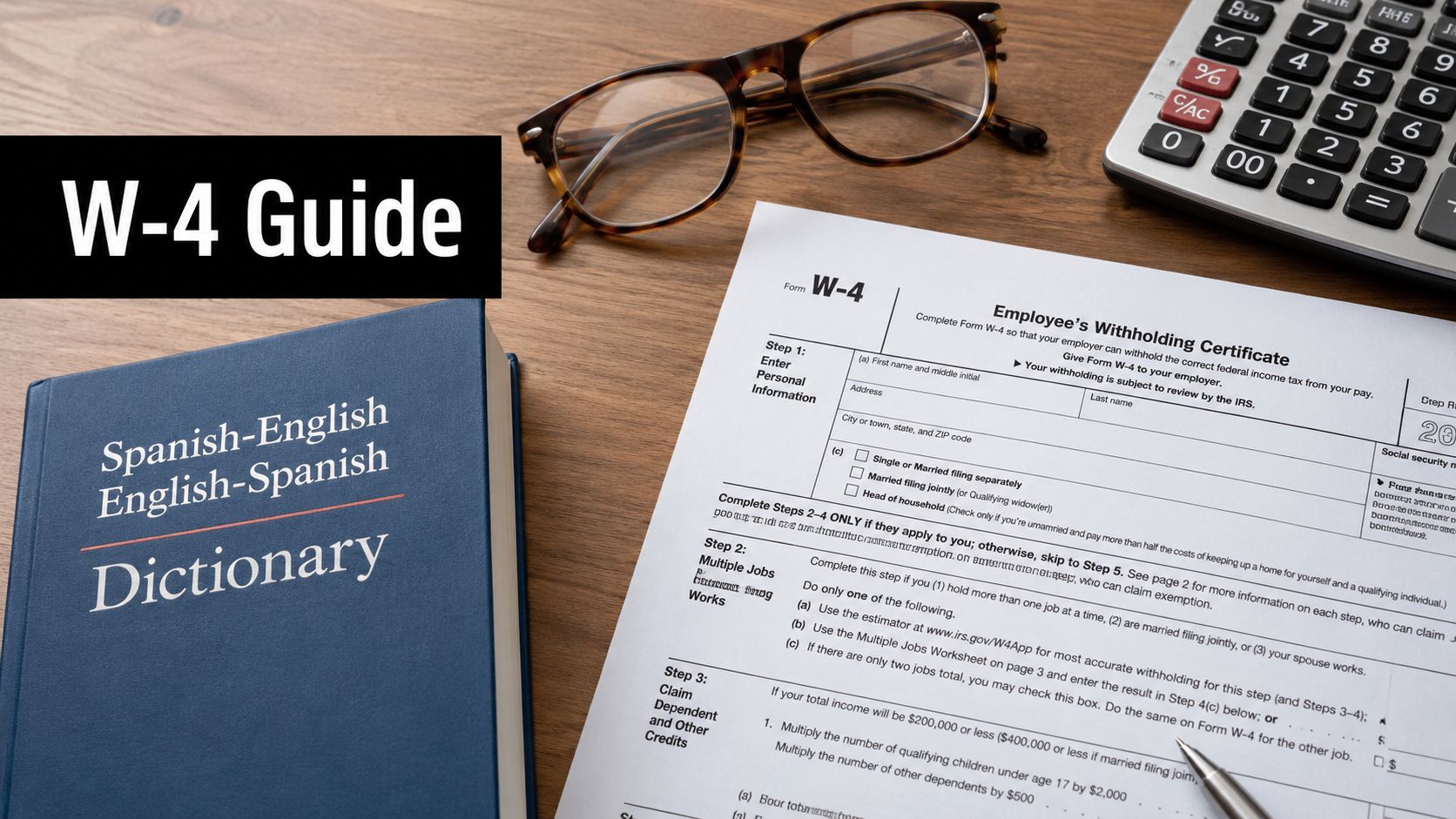
The IRS does not provide an official, submittable Form W-4 in Spanish, and employees must complete the English version. For 2026, Line 3 uses $2,200 for each qualifying child under age 17 and $500 for other dependents, so using a Spanish guide only as a reference can help you transfer the right information onto the actual English form.
That runs against a lot of popular advice online. Many articles and videos treat a “Spanish W-4” as if it were a separate IRS form you can hand to payroll. It isn't. That misunderstanding causes real problems, especially when an employee thinks a translated guide is the legal document, or when an employer accepts something that doesn't satisfy payroll compliance.
A better way to think about Form W-4 is this: the language aid may help you understand the form, but the English IRS form is the one that controls withholding. If you get that part wrong, the consequences aren't academic. They show up in your paycheck, your tax return, and in some cases, in IRS penalties.
The Truth About an Official Spanish Form W-4
The first thing to clear up is the biggest misconception. There is no official Spanish Form W-4 issued by the IRS for submission. The IRS form that employees must file with their employer is in English. Spanish-language materials are educational support only, not a legal substitute for the form itself, as explained in Deel's Spanish glossary entry on Formulario W-4.
That distinction matters more than commonly understood. If an employee asks for a “form W 4 in Spanish,” what they usually need is one of two things:
- A translation aid so they can understand each line before completing the English form
- An explanation of tax withholding so they know what they're telling payroll to do
Those are not the same thing.
What Spanish guides can and can't do
A Spanish guide can help someone understand terms like filing status, dependent, or additional withholding. It can also help a worker avoid simple transfer mistakes when moving information onto the English W-4.
But it can't replace the signed IRS form on file with the employer.
Practical rule: Use Spanish instructions to understand the form. Use the English IRS form to complete, sign, and submit it.
Why this confusion creates risk
When employees believe the translation itself is the form, they may never properly complete payroll onboarding. When employers assume a translated worksheet is “good enough,” they create a recordkeeping problem and a withholding problem at the same time.
That's why any discussion of Form W-4 in Spanish should start with legal reality, not with line-by-line mechanics. If the wrong document gets submitted, every later calculation sits on a weak foundation.
Why the W-4 Is Critical for Your Paycheck
The biggest W-4 mistake is not a math error. It is treating the form like routine onboarding paperwork when it is really a legal instruction to payroll.
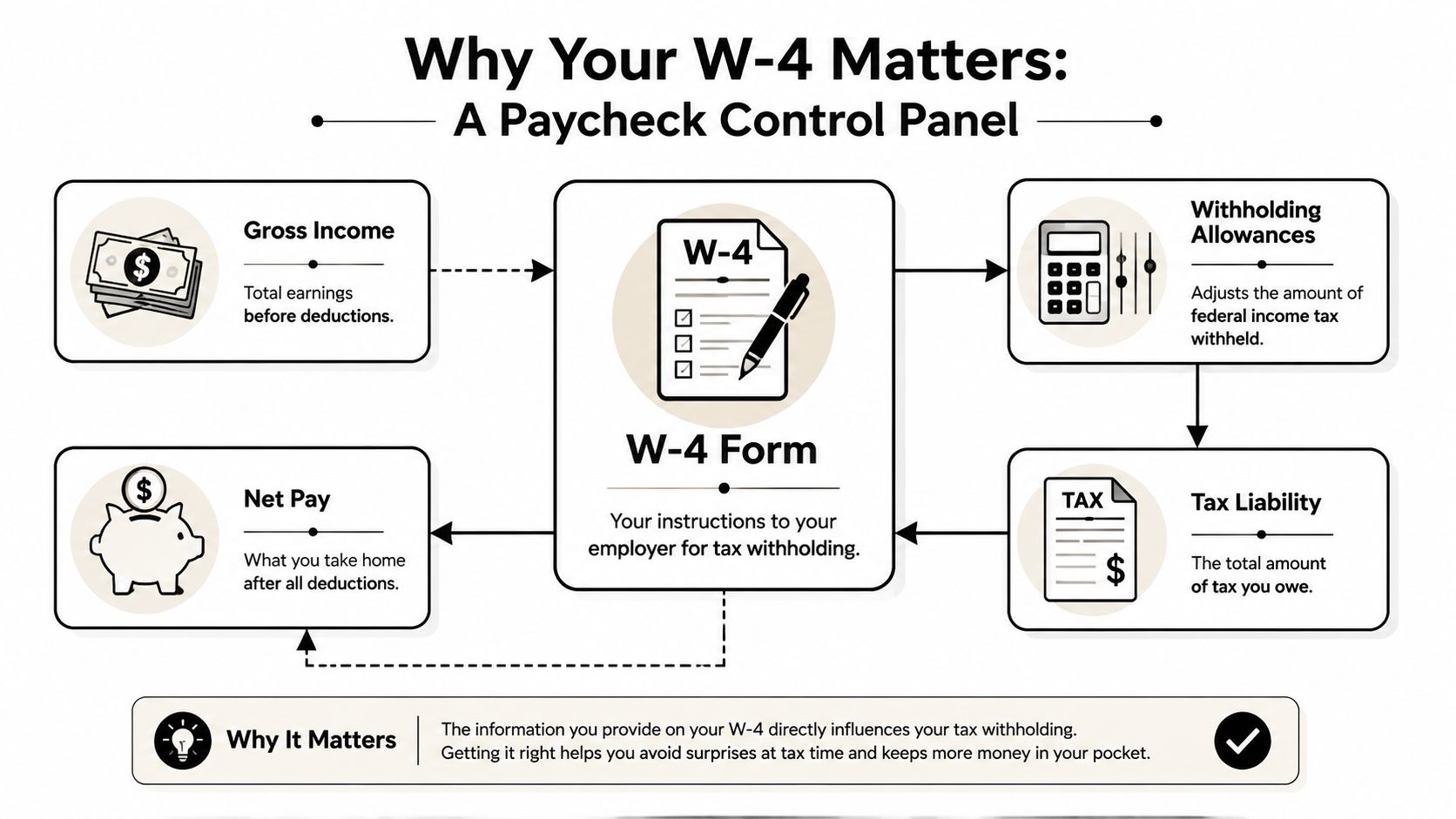
Form W-4, officially called the Employee's Withholding Certificate, tells an employer how much federal income tax to hold back from each paycheck. Payroll uses it like a set of coordinates. If the coordinates are wrong, the withholding calculation can still be precise, but it will send the money to the wrong place.
That is why errors on a W-4 create two kinds of risk at once. Employees face reduced take-home pay or a tax bill at filing time. Employers face payroll disputes, correction requests, and recordkeeping problems if the form on file is incomplete, outdated, or inconsistent with payroll treatment.
The old “allowances” language still causes expensive confusion
Many workers still ask how many allowances they should claim. That question comes from an older version of the form. The current W-4 no longer uses personal allowances, which is why old advice from prior years can push employees into the wrong withholding setup.
If you want the historical context, this explanation of tax allowances and what they used to mean helps connect the former system to the current one.
This confusion is common among employees who are reading translated guidance, hearing advice from family, and trying to complete an English payroll document at the same time. A language barrier can make outdated tax advice sound authoritative. The result is often a form that reflects old terminology rather than current IRS rules.
The same problem shows up in ordinary life. Someone can understand the general category of words without understanding the legal effect of the exact words on the page. That is part of why practical translation tools such as LenguaZen's Spanish menu decoder are useful in daily settings. Tax forms raise the stakes much higher because a misunderstanding does not just affect comprehension. It affects withholding, cash flow, and tax liability.
What happens if no valid W-4 is on file
If an employee does not submit a valid W-4, the employer cannot guess. Payroll must withhold based on the default rule that applies when no proper certificate is provided. For the employee, that often means a paycheck that feels unexpectedly small. For the employer, it means there is little room to improvise without creating compliance exposure.
Clients often get frustrated. An employee may believe payroll made an arbitrary choice. Payroll may be following the rule that applies in the absence of a valid form. The practical lesson is simple. If the W-4 is missing or defective, the default withholding result usually feels harsh.
Why accuracy matters more than the size of a refund
Some employees prefer heavier withholding because they like receiving a refund. Others want more money in each paycheck and are comfortable managing the risk of a balance due. Both approaches can be lawful if the form is completed accurately.
The financial trouble starts when the form does not match the household's real tax picture. A second job, a working spouse, dependents, bonus income, or major changes during the year can all shift the correct withholding amount. If the W-4 does not reflect those facts, the paycheck may look fine for months while the tax problem grows in the background.
An inaccurate W-4 can lead to:
- Too much withholding, which reduces take-home pay and strains household cash flow
- Too little withholding, which can produce a tax balance due and possible underpayment issues
- Faulty planning, especially for households with multiple jobs, variable income, or changing family circumstances
A well-prepared W-4 gives payroll accurate instructions. That does not guarantee a perfect tax result, but it sharply reduces preventable surprises for both the employee and the employer.
How to Accurately Fill Out Each W-4 Section
Accuracy on a W-4 is not a paperwork nicety. It is the instruction sheet your employer uses to decide how much federal income tax to hold back from each paycheck. A small entry error can create a cash flow problem now, or a tax balance due later.
The safest approach with a form W 4 in Spanish is simple. Read the Spanish explanation for understanding, but complete and submit the official English Form W-4. The translation helps you interpret the form. The English form is the legal document payroll must rely on.
Step 1 Personal information
Start with your legal name, address, Social Security number, and filing status. This section looks routine, but filing status errors can distort withholding for the rest of the year.
Treat filing status like the foundation of a house. If the foundation is wrong, every number built on top of it is off. “Single or Married filing separately” and “Married filing jointly” are not interchangeable labels. They tell payroll which withholding tables to use.
Use a Spanish guide to understand the terms. Do not copy translated labels onto a substitute document or assume the closest-sounding phrase is good enough.
If an employee struggles with everyday administrative English, that language barrier often affects more than tax forms. A practical tool like LenguaZen's Spanish menu decoder shows how often people need plain-language support just to interpret ordinary U.S. systems correctly.
Step 2 Multiple jobs or spouse works
This step creates a large share of withholding problems.
If you have two jobs, or if both spouses work, payroll at one job usually does not know what the other job pays. The W-4 is how you tell the system that your household income is coming from more than one source. Without that adjustment, each employer may withhold as if its paycheck is the only paycheck in the home. That often leads to under-withholding.
The IRS instructions direct employees in this situation to use the multiple-jobs options built into the form and its worksheet. As explained in this IRS-focused 2026 multiple-jobs explanation, the goal is to prevent both jobs from giving you the full benefit of lower withholding brackets at the same time.
A common point of confusion is who should complete the adjustment. In many households, the higher-paying job is the better place to make the Step 2, Step 3, and Step 4 entries, because that reduces the chance that credits or adjustments will be counted twice. The underlying principle matters more than the mechanics. Your household gets one real tax result, even if income comes from several paychecks.
If your income changes during the year, or your work pattern is uneven, a worksheet can still miss the mark. In that situation, the IRS estimator and periodic review are often safer than guessing.
Step 3 Claim dependents
Step 3 reduces withholding based on qualifying dependents. For 2026, Line 3 requires the employee to multiply each qualifying child under age 17 by $2,200 and each other dependent by $500, then enter the total, as described in Gusto's Spanish-language W-4 guide.
Here is a straightforward example:
| Dependent type | Amount |
|---|---|
| Qualifying child under 17 | $2,200 |
| Other dependent | $500 |
| Total for Line 3 | $2,700 |
That number lowers withholding. If you enter too much, your paycheck may look better now but the return may expose the error later. If you enter too little, you may be giving the government an interest-free loan through smaller paychecks.
Do not guess here. Dependency rules are legal tests, not household labels. A child who lives with you may qualify. A relative you support may qualify. Someone you help financially may not qualify at all. If there is uncertainty, it is usually cheaper to verify the rule now than to fix a tax debt after filing season.
Step 4 Other adjustments
Step 4 deals with items that do not fit neatly into the earlier boxes. This includes other income not from jobs, deductions beyond the standard deduction, and any extra withholding you want taken from each paycheck.
This section works like the fine-tuning dial on a machine. Steps 1 through 3 set the broad direction. Step 4 corrects for facts that would otherwise be invisible to payroll. That matters for people with freelance income, investment income, significant itemized deductions, or a household tax picture that changed after the original W-4 was signed.
Extra withholding in Step 4(c) can be a practical risk-control tool. For many employees, adding a fixed dollar amount each pay period is easier and safer than hoping a worksheet perfectly captures bonuses, side work, or irregular earnings.
If you want ongoing guidance about withholding problems that often lead to year-end tax bills, these IRS withholding tips are useful.
Step 5 Sign and date
The signature is the legal certification.
An unsigned W-4 is not complete, and a casually signed W-4 can become evidence that the employee gave payroll incorrect instructions. Before signing, read the form the way a payroll department will read it. Each line is an instruction with financial consequences, not a rough draft of your tax situation.
That extra minute matters. Once payroll processes the form, the withholding pattern usually continues until a new W-4 is submitted.
Avoiding Costly Errors on Your W-4
Most articles about Form W-4 stop at “fill in the boxes.” That's useful, but it misses the more important question: what happens when the form is wrong?
The answer depends on whether the error is accidental, careless, or knowingly false. A simple misunderstanding may create a withholding mismatch. A knowingly false W-4 can create a much more serious problem.
Errors that usually start as misunderstandings
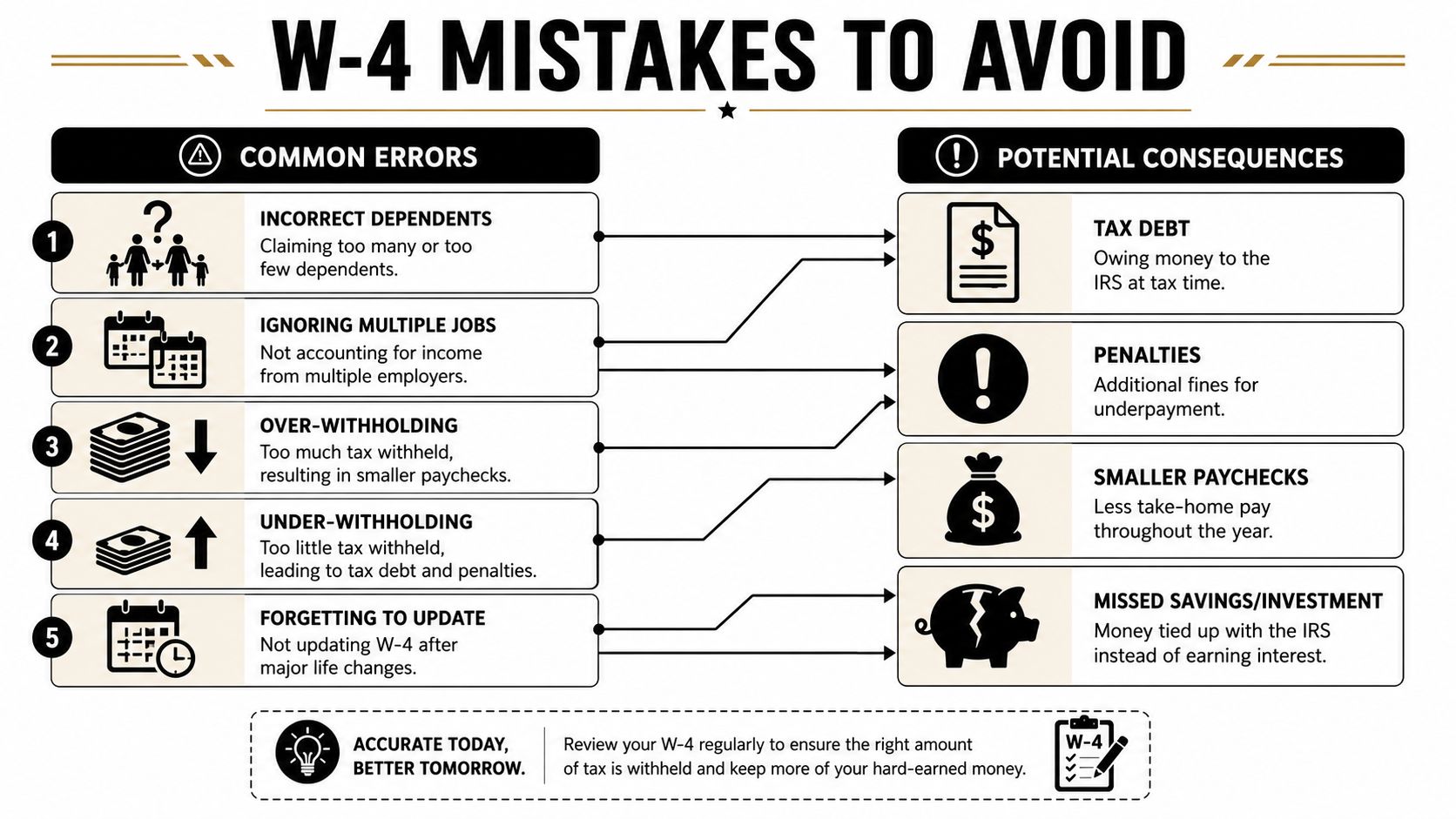
These mistakes are common because the form asks for tax-sensitive information in a payroll setting:
- Claiming dependents incorrectly because the employee doesn't understand which amount applies
- Ignoring another job so too little tax is withheld across the household
- Failing to update the W-4 after marriage, divorce, or a change in work arrangements
- Treating “exempt” as a shortcut instead of a narrow legal claim
Any of those can leave the employee under-withheld or over-withheld. Over-withholding hurts current cash flow. Under-withholding can lead to tax debt and penalties when the return is filed.
When the problem becomes legal, not just mathematical
Some Spanish-language guides explain how to fill out the lines but don't clearly warn readers that submitting an invalid or fraudulent W-4 can lead to IRS penalties, back taxes, and potential criminal charges, and that employers can also face penalties for knowingly accepting false forms, as noted by Atlas Taxes' Spanish W-4 discussion.
That is the missing warning many employees and small employers never hear.
A false W-4 isn't just a payroll mistake if the person signing it knows the information is untrue.
A useful way to judge risk
Ask two questions:
- Was the form inaccurate because the employee misunderstood the rules?
- Or was the form inaccurate because the employee knew the claim was false?
That distinction affects how a problem is analyzed and corrected. If the issue is carelessness, prompt correction often matters. If the issue involves a knowingly false position, the risk is much higher.
For readers dealing with penalty exposure, this explanation of the accuracy-related penalty and reasonable cause exception gives a helpful framework for understanding how the IRS evaluates mistakes and explanations.
What Employers Need to Know About Spanish W-4s
Employers need a practical rule that payroll staff can follow consistently. Accept Spanish-language resources as instructional support if you choose, but keep the English W-4 as the official form in the employee file.

That approach protects both compliance and communication. It lets Spanish-speaking employees understand what they're signing without creating confusion about which document controls withholding.
What employers should do
A clean internal process usually includes these steps:
- Provide the official English form as the document to complete and sign
- Offer translated guidance for employees who need language support
- Review for completeness before processing payroll
- Escalate unusual entries if a form appears incomplete, contradictory, or obviously questionable
Where employers often create exposure
Problems usually start when payroll tries to be helpful but crosses into casual acceptance of bad records. If a business knowingly accepts a false form, that can create penalty exposure. If it accepts a noncompliant substitute, it can create administrative and withholding problems.
That's one reason payroll education matters. Employers that want a stronger grasp of withholding-related obligations should also understand the broader payroll tax framework, including FICA and related payroll obligations.
For employers, the safest position is simple: help employees understand the form, but don't blur the line between translation assistance and official payroll documentation.
A Note for Attorneys and Tax Advisors
Advisors should treat a request for a “Spanish W-4” as a diagnostic moment, not a vocabulary issue. The client may need a translated explanation, a withholding analysis, or damage control for a form already submitted to payroll. Those are different legal and financial problems, and they should not be handled the same way.
A good intake process helps you separate a minor misunderstanding from a risk that can lead to underwithholding, tax debt, or credibility problems with the IRS. Ask whether the employee has more than one job, whether a spouse also earns wages, whether Step 3 was completed intentionally, and whether an exempt claim was made with a clear understanding of the rules. Those questions do more than improve math. They help you determine whether the problem is confusion, carelessness, or a knowingly false filing position.
For firms advising employers, consistency matters. A multilingual workforce often exposes weak onboarding controls the same way a stress test exposes cracks in a foundation. If HR staff give translated guidance but payroll processes only the official English form, the record is easier to defend. If the employer starts mixing unofficial translated paperwork into the payroll file, the business can create avoidable disputes over which document controls withholding. For practices evaluating staffing models and intake workflows, the benefits of outsourcing HR may help frame how centralized review can reduce documentation errors.
Keep your advice plain and defensible. Help the client understand the form in Spanish if needed. Use the English W-4 as the signed payroll document. If the facts suggest the employee or employer knew the form was false, treat the matter as a potential civil penalty or controversy issue, not routine payroll cleanup.
If you're dealing with W-4 errors, payroll withholding problems, tax debt, or IRS penalties, Attorney Stephen A Weisberg offers a free Tax Debt Analysis to determine whether he can help and what resolution path makes sense before charging for representation.


