Form 8812 Instructions for 2026: A Clear Tax Guide
Get clear Form 8812 instructions for 2026. Our expert guide walks you through eligibility, line-by-line steps, and how to claim the Child Tax Credit.
In this article
- What Is Form 8812 and Who Needs to File It
- When filing Schedule 8812 is necessary
- What the form does
- Decoding Eligibility for Child Tax Credits in 2026
- The two categories taxpayers confuse most
- 2026 child-related tax credits at a glance
- A Line-by-Line Guide to Completing Form 8812
- Start with records that answer the form's hardest questions
- Part I. Identify the correct credit category
- Part II-A and Part II-B. Calculate any refundable child tax credit
- Follow the line flow instead of jumping around
- Check how the result carries to Form 1040
- Use a two-pass review before filing
- Common Form 8812 Mistakes and How to Avoid Them
- Misclassifying the dependent
- Using the wrong income figure for the refundable portion
- Letting software make the legal call
- Ignoring a mistake after filing
- Reporting Your Credits on Form 1040 and Next Steps
- What to do after the schedule is finished
- Records to keep after filing
- Frequently Asked Questions About Form 8812
- Can both divorced parents claim the same child on Form 8812
- What if the child has an ITIN instead of a Social Security number
- Should I file Schedule 8812 if I don't owe any tax
- What if I already filed and now think I used the wrong dependent category
You're probably staring at Schedule 8812 with a familiar tax-season mix of hope and irritation. You know it has something to do with child-related credits. You also know that one wrong entry can delay a refund, reduce a credit, or trigger IRS correspondence you don't want.
That instinct is right. Form 8812 instructions matter because this schedule is where dependent-related credits stop being broad tax concepts and become numbers the IRS will allow on your return. The form is technical, but the underlying issues are practical: who qualifies, which credit applies, what income counts, and how to avoid claiming the right person in the wrong category.
A careful approach usually beats a fast one here. The taxpayers who run into trouble often aren't trying to cheat. They're trying to file quickly, and they assume the software will fix every classification issue for them. It won't.
What Is Form 8812 and Who Needs to File It
You list a child on your return, expect the credit, and then the software starts asking for earned income, residency, support, and dependent status. That is usually your first sign that Schedule 8812 is doing more than simple data entry. It is the worksheet and reporting schedule that determines whether a dependent-related credit is allowed, limited, or partly refundable.
Schedule 8812 attaches to Form 1040 or Form 1040-SR. It is used to calculate the Child Tax Credit, the Credit for Other Dependents, and, where allowed, the Additional Child Tax Credit. In practice, this is the form that turns family facts into a tax result the IRS can verify.

Clients often assume the dependent section of the return ends once the name and Social Security number are entered. It does not. Schedule 8812 is where mistakes start to matter. If you place someone in the wrong category, overstate refundable credit eligibility, or answer the earned income questions loosely, you raise the chance of a reduced refund or an IRS notice asking you to substantiate the claim.
When filing Schedule 8812 is necessary
You generally file Schedule 8812 when you are claiming one of the dependent-related credits tied to that schedule and the IRS requires the computation to be shown with the return. That usually includes taxpayers claiming a child tax benefit beyond identifying a dependent on page 1 of Form 1040.
The schedule also matters because not every dependent produces the same tax outcome. A younger qualifying child may support the Child Tax Credit and possibly a refundable amount. An older child, parent, or other relative may fall under the Credit for Other Dependents instead. Families in shared-custody or multigenerational households run into this issue often. For a practical example involving nonparent claims, review these IRS dependency rules for grandparents.
What the form does
From a tax attorney's perspective, Schedule 8812 serves three jobs at once:
Credit classification
It separates qualifying children from other dependents, which affects which credit you can claim.Credit calculation
It measures how much of the available credit can reduce your tax.Refundable credit testing
It applies the earned income and withholding rules that determine whether part of the credit can come back to you as a refund.
That last point is where taxpayers get tripped up. The IRS instructions for Schedule 8812 require careful treatment of earned income and certain payroll tax amounts when working through the refundable portion. Tax software helps, but it cannot fix a wrong answer about who lived with you, who can be claimed, or whether income belongs in the calculation.
One practical rule I give clients is simple. If the return asks follow-up questions about a child, income from work, or whether another person could claim the dependent, slow down and verify each answer before filing.
Tax rules in this area change often enough that older blog posts and prior-year screenshots can mislead you. If you want a reliable way to track revisions, follow recent IRS form changes and compare them against the year of the return you are filing.
Decoding Eligibility for Child Tax Credits in 2026
A parent sits down to file, sees a child listed as a dependent, and assumes the Child Tax Credit will follow automatically. That assumption causes a surprising number of Form 8812 problems. The legal question is narrower. Does this person meet the IRS definition for the specific credit you are claiming?
For practical filing purposes, many people searching for "2026" guidance are preparing a return filed during 2026 for the prior tax year. That makes year-specific instructions important. If the IRS updates the rules, the current-year form and instructions control. If not, use the rules tied to the return year you are filing and avoid relying on old screenshots or generic summaries.
From a tax attorney's perspective, eligibility disputes usually come down to facts, not arithmetic. Who did the child live with? How old was the child on December 31? Can another taxpayer claim that child first? Those are the questions that determine whether you have a valid credit or an avoidable IRS notice.
The two categories taxpayers confuse most
The first category is a qualifying child for Child Tax Credit purposes. The second is a dependent who may support the Credit for Other Dependents instead. The difference matters because the credit amount, refundability, and Schedule 8812 treatment are not the same.
Use this screening order before you touch the worksheet:
Age
A child must meet the age rule for the Child Tax Credit for the year at issue. If the child aged out by year-end, stop and test for the other dependent category instead of forcing the Child Tax Credit.
Residency
The child generally must have lived with you for more than half the year. Temporary absences for school, medical care, or similar reasons often need closer review, especially if another adult in the household is also claiming rights to the child.
Dependency
Family relationships alone do not decide the credit. The IRS dependency tests still have to be met, including support and claim priority rules where more than one taxpayer may qualify.
Competing claims
If divorced parents, separated parents, grandparents, or other relatives are involved, do not guess. Tie-breaker rules can override what feels fair at home.
Grandparent claims are a frequent trouble spot. If that applies to your household, review these IRS dependency rules for grandparents before filing. That issue often turns on residency, support, and whether a parent has the stronger claim under the IRS ordering rules.
2026 child-related tax credits at a glance
| Credit Feature | Child Tax Credit (CTC) | Additional Child Tax Credit (ACTC) | Credit for Other Dependents (ODC) |
|---|---|---|---|
| Basic purpose | Credit for a child who meets the qualifying-child rules | Refundable portion tied to the child tax credit calculation when allowed | Credit for a dependent who does not qualify for CTC treatment |
| How to evaluate it | Start with age, relationship, residency, and dependency status | Confirm the child qualifies first, then test refundability under Schedule 8812 | Confirm the person is your dependent, then determine whether they fall outside the CTC category |
| Refundable | Generally reduces tax before refundability is considered | Yes, if the Schedule 8812 rules are met | No, this is not the refundable child credit |
| Common filing risk | Claiming a child who does not meet residency or age rules | Using earned income figures incorrectly or assuming every CTC claim creates a refund | Treating every dependent as if they qualify for the child credit |
| Where it appears on Schedule 8812 | Child credit section of the schedule | Refundable credit section of the schedule | Dependent credit portion of the schedule |
One practical rule helps avoid mistakes. Classify each person first, then calculate the credit. Do not use Schedule 8812 to decide who your dependent is. Use it after you have already answered that question with supporting records in hand.
This is also where judgment matters. A child may have lived with you most of the year, but if another taxpayer has a stronger legal claim under the tie-breaker rules, claiming the credit can trigger a delay, an IRS letter, or both. Tax software can process entries. It cannot resolve disputed family facts for you.
If you want a reliable way to keep up with rule changes and recurring qualification issues, review IRS credit eligibility updates and commentary before you file.
A Line-by-Line Guide to Completing Form 8812
You sit down to finish the return, the dependency questions seem settled, and then Schedule 8812 turns a simple family-credit claim into a series of line references, income tests, and category decisions. That is usually the point where errors start. In practice, the taxpayers who avoid notices are not the ones who move fastest. They are the ones who complete this schedule in the right order and keep support for each answer.
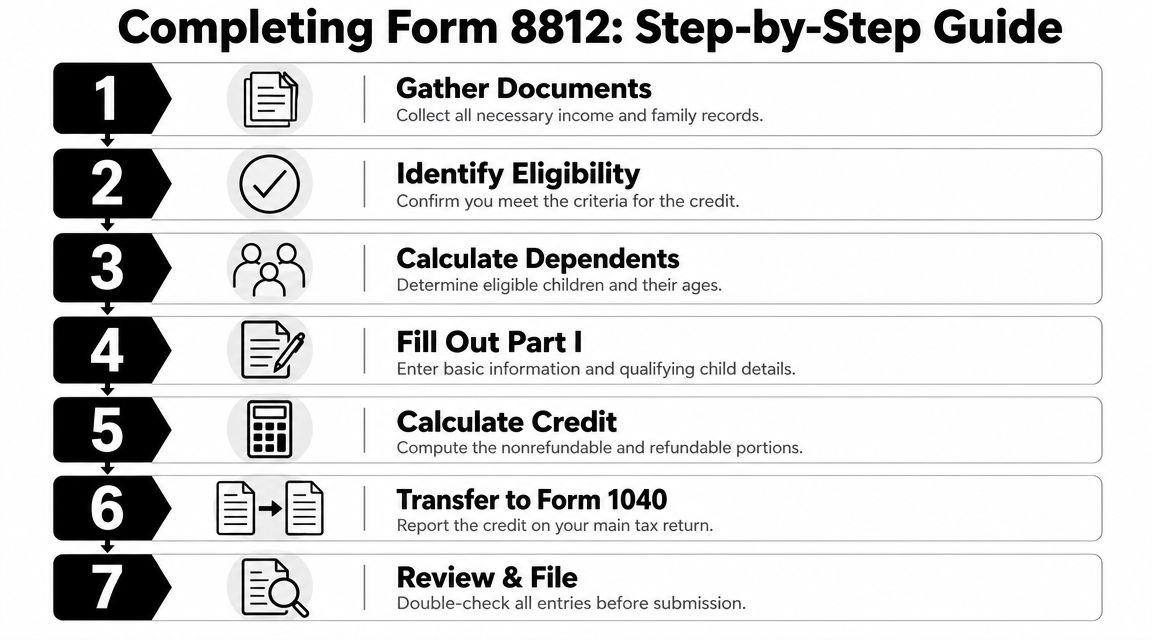
Use a simple file example. A married couple files jointly. One child qualifies for the child tax credit. One older relative qualifies as a dependent but may belong under the credit for other dependents instead. That distinction changes how the schedule is completed, and it is exactly the kind of detail that software can mis-handle if the underlying inputs are wrong.
Start with records that answer the form's hardest questions
Do not start by typing numbers into Schedule 8812. Start with the documents that prove residency, identity, and earned income. The arithmetic is usually manageable. Trouble primarily stems from entering a dependent in the wrong category or using the wrong income figure for the refundable credit calculation.
Have these items ready:
A completed or nearly completed Form 1040
Schedule 8812 depends on figures already determined on the main return.Social Security numbers and full identifying information for each dependent
A mismatch here can delay processing even when the credit itself is valid.Residency records for any child claimed for the child tax credit
School records, medical records, and similar documents matter if the IRS later asks who lived where.W-2s and other records relevant to earned income
The refundable portion does not use every type of income reported on the return.
One practical point from my office. If you are still debating whether someone is your dependent, stop and resolve that before you complete this schedule. Schedule 8812 is where you calculate the credit, not where you decide the family facts.
Part I. Identify the correct credit category
Part I is where many preventable mistakes begin. You list the people who qualify for the child tax credit and separate them from dependents who may qualify only for the credit for other dependents. The schedule rewards precision. Close enough does not work here.
In the example above, the qualifying child belongs in the child-credit portion of the schedule. The older dependent relative does not go there just because the taxpayer provides support. If that person does not meet the qualifying-child rules for this credit, the person must be handled in the other-dependent portion.
Review each entry carefully:
- Names and taxpayer identification numbers must match IRS records
- Each dependent must be placed in the correct credit category
- The dependent information on Schedule 8812 must agree with the dependent information on Form 1040
A good filing test is simple. If you cannot explain why each person belongs on a particular line, do not file yet.
Part II-A and Part II-B. Calculate any refundable child tax credit
This part causes more trouble than the first part because taxpayers often assume the child-related credit automatically becomes refundable. It does not. Schedule 8812 asks whether, after the nonrefundable credit is worked out, you are also allowed an Additional Child Tax Credit.
Part II-A and Part II-B handle that analysis under the official Schedule 8812 instructions. Part II-B applies in narrower situations, including certain taxpayers with three or more qualifying children and certain bona fide residents of Puerto Rico. If you fall into one of those categories, slow down and verify each line against your return before relying on software output.
Earned income becomes especially important here. For the refundable calculation, use the earned income amounts the schedule calls for, not every amount that increased your household cash flow during the year. Wages usually fit. Other amounts may not. Payroll tax withholding details can also affect the calculation, so do not skip those lines just because they look secondary.
I see three recurring errors in this section:
- taxpayers include income that does not count as earned income for this calculation,
- taxpayers overlook withholding information that affects the result,
- taxpayers assume a child on the return automatically creates a refundable amount.
That last mistake is expensive because it often leads to an overstated refund and a later IRS adjustment.
Follow the line flow instead of jumping around
Schedule 8812 is easier to complete if you respect its sequence. Start with the dependency and category lines. Then calculate the available credit. Then test whether any piece of that credit is refundable. Skipping ahead usually leads to a mismatch between the schedule and Form 1040.
That approach also helps if you later need to correct the return. If you discover after filing that a dependent was placed in the wrong category or earned income was entered incorrectly, review the process for how to amend a tax return after a credit error before sending in a correction.
Check how the result carries to Form 1040
Once Schedule 8812 is complete, the credit amount flows back to the main return. That sounds routine, but taxpayers often overlook a poor outcome. A number can transfer cleanly to Form 1040 and still be wrong because the schedule was built on a wrong classification, a wrong income figure, or both.
In the sample family, the child-related amount and the other-dependent amount do not stack without limit. The schedule first sorts the dependents, then applies the credit rules, then determines whether any amount is refundable. If one step is wrong, the rest of the return can look polished while still inviting an IRS notice.
Use a two-pass review before filing
A two-pass review catches many of the problems that create delays and letters.
On the first pass, confirm the identity and category of each dependent, verify residency support, and confirm the earned income figures used for the refundable calculation. On the second pass, compare each Schedule 8812 entry to Form 1040 and ask a blunt question: did this number come from a record, or from an assumption?
That review takes a few extra minutes. It is usually time well spent.
Common Form 8812 Mistakes and How to Avoid Them
A common tax-season problem looks like this: the return is finished, the refund number seems right, and Schedule 8812 still contains an error that could delay processing or trigger an IRS notice. In my practice, that usually happens because someone treated the dependent rules as intuitive. They are not. Schedule 8812 rewards careful classification and punishes shortcuts.
One of the biggest trouble spots is separating a qualifying child from a dependent who may still qualify only for the Credit for Other Dependents. That distinction affects whether you are working with the child tax credit amount or the smaller credit available for another dependent, and it also affects how the limitation rules apply on the schedule. A child who is your dependent for one tax purpose does not automatically belong in the child tax credit bucket.
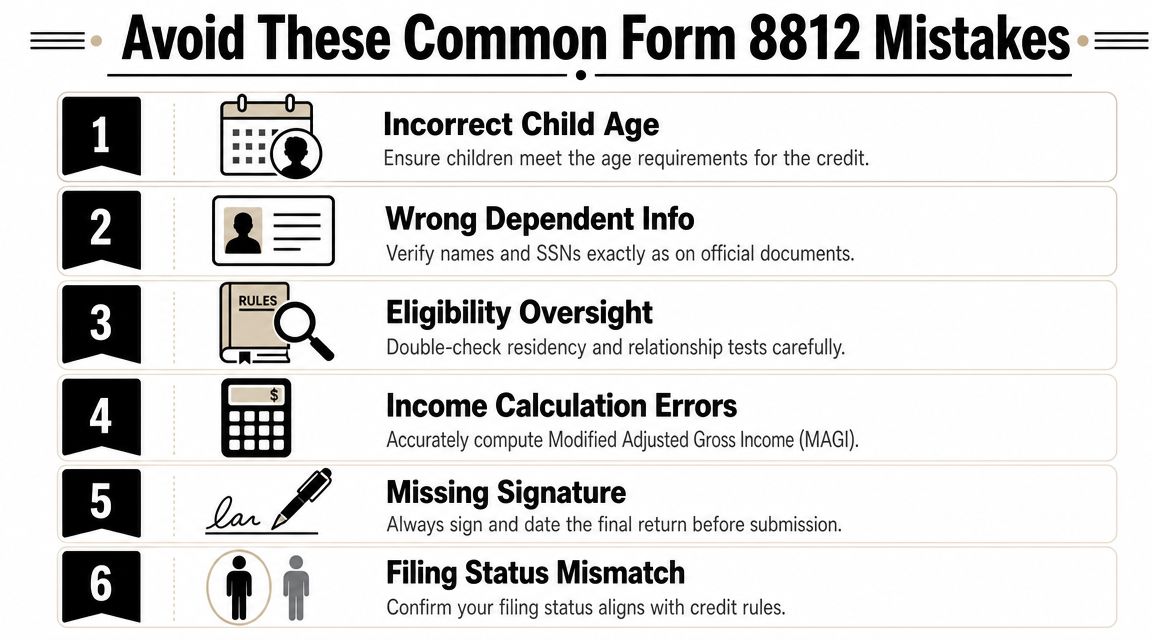
Misclassifying the dependent
This is the error I see most often.
A dependent can qualify you for a tax benefit and still fail the tests for the child tax credit. Age, relationship, residency, support, and Social Security number rules all matter. If one of those facts is off, the credit can shrink or disappear, even if the person was properly listed as a dependent elsewhere on the return.
The practical fix is to review each person separately, line by line, before you let software group them for you. Ask two questions. Is this person a dependent? If yes, do they also meet the narrower rules for the child tax credit?
Using the wrong income figure for the refundable portion
The refundable calculation causes trouble because taxpayers often use a broad, everyday meaning of income. Schedule 8812 does not use an everyday standard. It uses the earned income rules that apply under the form instructions and the return.
That means wages may count differently from other receipts showing up in the household. If the earned income entry is wrong, the rest of the schedule can look internally consistent while still producing the wrong credit amount. That is exactly the kind of mistake that survives a quick review and later creates correspondence with the IRS.
Letting software make the legal call
Tax software is useful for math. It is less reliable when the underlying facts are entered carelessly.
I regularly see returns where a filer clicked through dependency questions too quickly, answered one residency or relationship question incorrectly, and carried that error all the way to filing. The PDF version of the finished Schedule 8812 often reveals the problem immediately. The summary screen usually does not.
A better review process is simple:
Check each dependent entry against your records
Use birth dates, Social Security information, and residency support instead of memory.Confirm the legal category, not just the family relationship
A grandchild, niece, parent, or unrelated household member can qualify as a dependent, but not for the same credit.Read the completed Schedule 8812 before filing
If the form does not reflect the facts, the return is not ready.
Ignoring a mistake after filing
Some taxpayers wait for the IRS to sort it out. That approach can cost time and, in some cases, part of the refund.
If you claimed the wrong credit category, left out a dependent who qualified, or used the wrong earned income figure, review your options for how to amend a tax return after a credit error. A prompt, supported amendment is often cleaner than waiting for a notice and responding under deadline.
Reporting Your Credits on Form 1040 and Next Steps
Once Schedule 8812 is complete, the numbers don't stay there. They flow into your main return. That's where the form finally affects what you owe or what you get back.
The critical distinction is this: a nonrefundable credit can reduce your tax liability, while a refundable credit can still provide a benefit even when your tax liability is too low to absorb the full amount. Schedule 8812 is where that distinction becomes operational.
What to do after the schedule is finished
Use a closing review process before you file:
Confirm the transfer to Form 1040
Make sure the credit amount from Schedule 8812 appears where your software or preparer says it should on the main return.Check consistency across the return
Filing status, dependent entries, and income items should align with the completed schedule.Keep support documents in one place
If the IRS asks questions later, speed matters.
Records to keep after filing
You don't need a dramatic audit file. You do need an organized one.
Keep copies of:
- Identity records such as birth certificates or Social Security documentation
- Residency support such as school or medical records showing where the child lived
- Return records including the filed Form 1040 and Schedule 8812
- Income records that support the earned-income entries used on the schedule
A practical point many taxpayers miss is that refund administration is becoming more digital. If you're tracking filing and payment logistics, this note on the IRS digital transition away from paper refunds is worth reading.
If you keep the right records and your Schedule 8812 is internally consistent, you put yourself in a much stronger position if the IRS later asks for clarification.
Frequently Asked Questions About Form 8812
Can both divorced parents claim the same child on Form 8812
No. Only one taxpayer can properly claim the same qualifying child for the credit on a given return. In divorce and separation cases, the answer often depends on custody facts, dependency entitlement, and whether a release such as Form 8332 is part of the arrangement. This is one of those situations where reading only the software prompts is not enough. Review the underlying dependency rules before filing.
What if the child has an ITIN instead of a Social Security number
That issue can change which credit is available, or whether the child fits the qualifying-child category for the child tax credit at all. Don't assume an ITIN and an SSN are interchangeable for Schedule 8812 purposes. This is an area where identification status directly affects classification, so confirm the requirement before claiming the credit.
Should I file Schedule 8812 if I don't owe any tax
Yes, if you may qualify for the refundable portion and the schedule is required to compute it. This is one of the most important practical points in the Form 8812 instructions. Taxpayers sometimes skip the form because they assume no tax due means no reason to file the credit schedule. That can be a costly mistake.
What if I already filed and now think I used the wrong dependent category
Don't ignore it. Review the filed return, identify the exact error, and determine whether an amended return is appropriate. The IRS is far more manageable when the record is clear than when the taxpayer waits for a notice and tries to reconstruct the issue later.
If you're dealing with Form 8812 confusion, an IRS notice, or a dependent-credit issue that could affect your refund or expose a filing error, Attorney Stephen A Weisberg can help you evaluate the problem clearly and decide on the next step. He represents taxpayers in IRS matters, audits, and tax disputes, and offers a practical, direct approach grounded in real tax controversy work rather than sales pressure.


