Form 843 IRS: Quick Guide to Refunds and Abatements (form 843 irs)
Discover how to file form 843 irs for refunds and abatements with clear steps, tips, and common pitfalls.

In this article
- What Is IRS Form 843 and When Should You Use It
- Common Scenarios for Filing Form 843
- When Filing Form 843 Is the Right Move
- How to Complete Form 843 Line by Line
- Lines 1-2: The Basics—Who You Are
- Lines 3-4: The Core of Your Claim
- Lines 5-6: Classifying Your Request
- Line 7: Your Explanation—Telling Your Story
- Essential Documents to Support Your Form 843 Claim
- Crafting a Compelling Reasonable Cause Argument
- Defining Ordinary Business Care and Prudence
- Accepted Categories for Reasonable Cause
- Understanding the Strict Filing Deadlines for Your Claim
- The Two Core Timing Rules
- Exceptions and Why They Rarely Apply
- What Happens After You Mail Your Form 843
- The Processing Timeline
- Potential Outcomes and Your Next Steps
- When to Get Professional Help with Your Tax Claim
- Red Flags That Signal You Need an Expert
- Frequently Asked Questions About Form 843
- Can I Use Form 843 to Get My Income Tax Refund Back?
- Where Should I Mail My Completed Form 843?
- What Are My Options if the IRS Denies My Claim?
- Can I File Form 843 Electronically?
So, you’ve been hit with an IRS penalty or interest charge that just doesn’t seem right. What can you do? This is where IRS Form 843 comes into play. Think of it as your formal way of asking the IRS for a "do-over" on certain charges you believe were assessed unfairly.
It’s not for correcting a math error on your income tax return—that’s a job for Form 1040-X. Instead, Form 843 is a specialized tool for specific situations.
What Is IRS Form 843 and When Should You Use It
Let's say you were in the hospital for a week with a serious medical emergency and missed the deadline for depositing your company’s payroll taxes. The IRS sends you a notice with a hefty late-deposit penalty. Form 843 is the exact document you'd use to explain this reasonable cause and formally ask the IRS to waive, or abate, that penalty.
At its core, Form 843 is a multipurpose form for asking the IRS to either refund money you’ve already paid or cancel a charge they say you owe. But here's the key distinction: it's designed for issues that fall outside the scope of your main income tax liability.
Common Scenarios for Filing Form 843
This form is your go-to in several key situations where you need to officially push back on a charge. The most common uses by far include:
- Requesting Penalty Abatement: This is the number one reason people file Form 843. If you were hit with a penalty for filing late, paying late, or depositing taxes late, you can use this form to argue that you had a reasonable cause for the mistake.
- Disputing Interest Charges: You can request an abatement of interest if you can prove it was caused by an unreasonable error or delay by an IRS employee.
- Claiming Refunds on Certain Taxes: It's also used to claim refunds for specific employment taxes (like Social Security, Medicare, and FUTA), some excise taxes, and other niche assessments.
To help you quickly see if this form applies to your situation, here are some of the most common scenarios where filing Form 843 is the right move.
When Filing Form 843 Is the Right Move
| Scenario | What It Means | Real-World Example |
|---|---|---|
| Penalty for Late Filing/Payment | You missed a deadline due to circumstances beyond your control (reasonable cause). | A natural disaster, like a hurricane, destroyed your office records right before the tax deadline. |
| Interest Due to IRS Error | The IRS made a mistake or took an unreasonable amount of time, causing interest to pile up. | An IRS agent lost your file for a year, and interest accrued during that period of inaction. |
| Overpaid Employment Taxes | You mistakenly overpaid Social Security, Medicare (FICA), or federal unemployment (FUTA) taxes. | Your payroll software miscalculated and withheld too much FICA tax for an employee. |
| Bad Written Advice from IRS | You received incorrect written advice from the IRS, followed it, and ended up with a penalty. | You have an email from an IRS representative telling you a specific deadline, which turned out to be wrong. |
This table covers the big ones, but remember that the form's official title is 'Claim for Refund and Request for Abatement.' It’s the primary channel for getting relief from these kinds of assessments.
Key Takeaway: Form 843 isn’t about arguing how much income tax you owe. Its real power lies in challenging the penalties and interest connected to tax issues or specific non-income tax assessments. Getting this right is the first step toward a successful claim.
Understanding when this form is the correct tool is half the battle. For example, a small business owner blindsided by a trust fund recovery penalty would turn to Form 843. So would an individual who paid a penalty after relying on erroneous written advice from the IRS. Learning how to request a penalty abatement is a crucial skill that can save you a significant amount of money and headaches.
How to Complete Form 843 Line by Line
Filling out an IRS form can feel like navigating a maze. But when you break it down, Form 843 is simply a structured way to tell the IRS your side of the story and formally request your money back.
Think of each line as a building block for your case. Let’s walk through the form step-by-step, so you can fill it out with confidence.
Lines 1-2: The Basics—Who You Are
First things first, the IRS needs to know who you are. This section is all about clear identification.
- Line 1: Enter your name, current address, and taxpayer ID number. This will be your Social Security Number (SSN) or your business's Employer Identification Number (EIN). Double-check that this information is an exact match to what the IRS has on file for you.
- Line 2: This line is only for claims filed on behalf of an employer. If that’s you, put your employer’s name and address here. If you're filing for yourself as an individual or sole proprietor, just leave it blank.
Don't rush through these details. A simple typo or an old address can get your claim kicked back before an agent ever looks at the real substance of it.
This quick visual breaks down the entire Form 843 journey, from spotting an unfair charge to getting your refund.
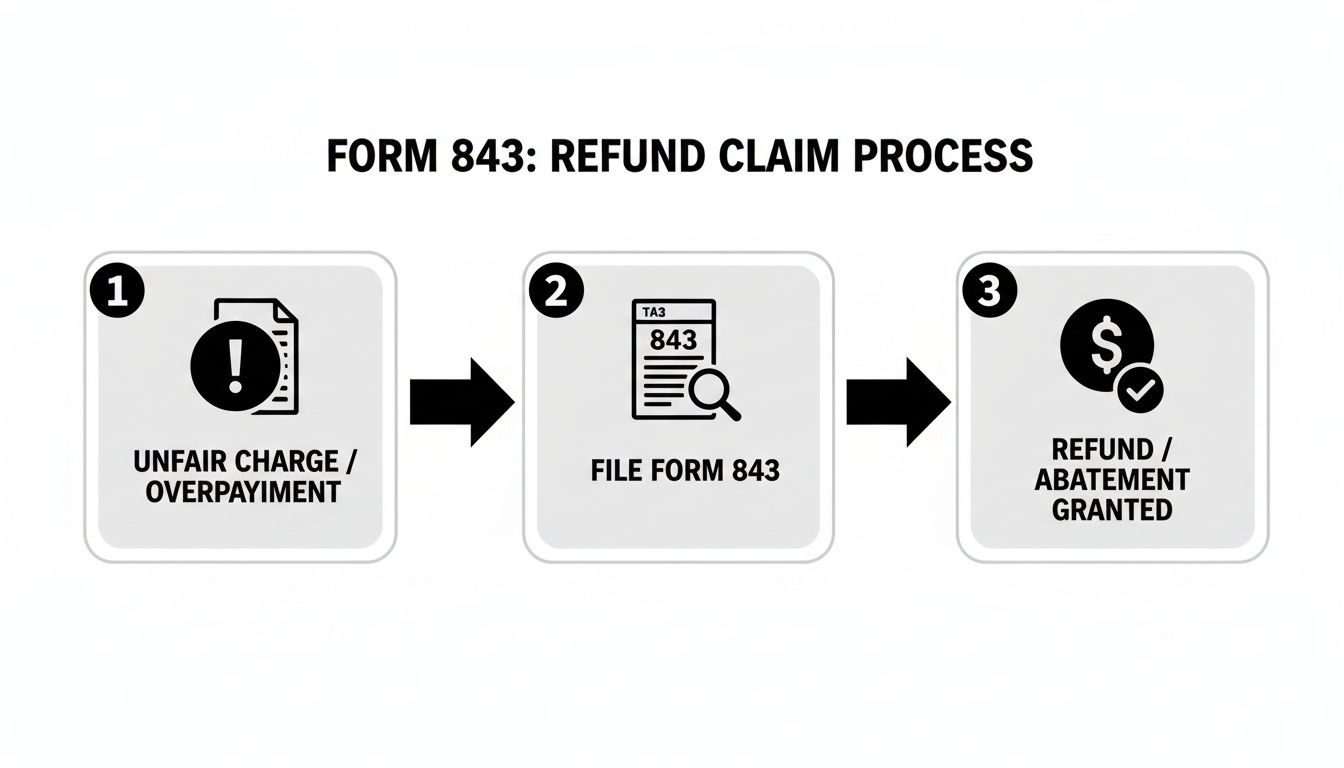
It’s a great reminder of how this form acts as the official bridge between identifying an incorrect assessment and getting a resolution.
Lines 3-4: The Core of Your Claim
Now we get to the heart of the matter: what period and how much money are you disputing? Accuracy here is everything.
On Line 3, you’ll pinpoint the tax period in question. This isn't always a full year. For payroll tax issues, it might be a specific quarter (like "3rd Quarter 2024"), while for an estimated tax penalty, it would be the calendar year (like "2024").
Line 4 is where you state the exact dollar amount you want refunded or abated. No estimates. If the penalty was $500, you write "$500.00." Be precise.
Lines 5-6: Classifying Your Request
These lines help the IRS categorize your claim so it gets to the right department.
Line 5a asks for the type of tax. Common answers are "Employment," "Excise," "Gift," or "Estate." For penalties on your personal income tax, you'd generally use an amended return, not Form 843.
Line 5b is for the specific form number associated with that tax, like Form 941 (Employer's Quarterly Federal Tax Return) or Form 720 (Quarterly Federal Excise Tax Return).
Line 6 deals with key dates that determine if your claim is timely. You’ll need to provide the date you paid the tax and the date you filed the related return. These dates are absolutely critical for meeting the statute of limitations.
Line 7: Your Explanation—Telling Your Story
This is it. Line 7 is the single most important part of the form. This is your space to make a clear, compelling argument for why you deserve a refund or abatement.
Don't think of it as just filling in a box. Treat it like a formal letter to the IRS agent who will decide your case. A strong explanation has three ingredients:
- The Facts: Lay out what happened in a simple, chronological order. Stick to the timeline and avoid emotional language.
- The Reason: Explain why the facts entitle you to relief. Are you pointing out an IRS error? Citing specific tax law? Or are you requesting relief based on reasonable cause?
- The Proof: Directly mention the documents you’re attaching to back up your story. For example, "As documented in the attached letter from the IRS dated 1/15/2025 (Exhibit A)..."
Expert Tip: Never, ever leave Line 7 blank or just write "See attached." While you should always attach a longer, more detailed statement, this space is for a powerful summary. It's the first thing the agent reads and frames their entire review of your case.
Here’s a great example of a concise summary for Line 7, arguing reasonable cause for a late payroll deposit:
"Requesting abatement of the failure-to-deposit penalty for Q1 2025. The company’s only bookkeeper was unexpectedly hospitalized from March 10 to March 25, 2025, which made a timely deposit impossible. The deposit was made immediately upon their return, showing ordinary business care. Please see attached hospital records (Exhibit A) and proof of deposit (Exhibit B)."
This statement is factual, professional, and points the IRS agent exactly where to look for proof. By carefully explaining your situation and backing it up with solid evidence, you turn Form 843 from a simple piece of paper into a powerful tool for getting your money back.
Essential Documents to Support Your Form 843 Claim
A claim with no proof is just an opinion. Your supporting documents are what turn your explanation on Line 7 into an undeniable, fact-based argument. This checklist outlines the supporting documents you need for different claims, helping you build a stronger, well-supported case.
| Type of Claim | Required Documents | Expert Tip |
|---|---|---|
| IRS Error |
| Highlight or circle the specific error on the IRS notice. Make it impossible for the reviewer to miss the mistake. |
| Reasonable Cause |
| A timeline of events can be incredibly helpful. Create a simple, one-page document listing key dates and what happened. |
| Bad IRS Advice |
| For verbal advice, you'll need the date, time, IRS employee name/ID, and a summary of the call. This is much harder to prove, which is why getting advice in writing is always best. |
| Excise Tax Refunds |
| Your records must clearly trace the item from purchase (with tax paid) to its final, non-taxable use or destination. |
Always label your attachments clearly (e.g., "Exhibit A," "Exhibit B") and refer to them by that label in your Line 7 explanation. This organized approach shows the IRS you're serious and makes it much easier for them to approve your claim.
Crafting a Compelling Reasonable Cause Argument
When it comes to getting the IRS to forgive a penalty, your entire case often boils down to one simple but powerful concept: reasonable cause. This isn't about having just any excuse. It’s about proving that you acted with what the IRS calls "ordinary business care and prudence" but still couldn't file or pay on time because of circumstances you couldn't control.
Think about it this way. If a sudden, catastrophic flood shuts down every road out of your town and makes you miss a critical deadline, that’s a reasonable explanation. But if you missed the deadline because you just forgot? That’s not going to fly. The IRS applies a very similar logic when they review your Form 843 IRS claim.
Defining Ordinary Business Care and Prudence
So, what does "ordinary business care and prudence" actually look like in the real world? It simply means you made the same effort a responsible person would under normal circumstances. The IRS will often glance at your past tax compliance; a clean record of filing and paying on time can go a long way in showing this was an isolated incident.
Your explanation has to show that your failure wasn't due to carelessness or willful neglect. You need to paint a clear picture of someone who tried to do the right thing but was stopped by a significant, unforeseen event. To successfully file for Form 843 abatement, you have to make your case convincingly.
Accepted Categories for Reasonable Cause
While the IRS doesn't publish a secret checklist, experience shows that some situations are consistently seen as valid reasons for penalty relief. The key for each is providing the right kind of proof.
Death, Serious Illness, or Unavoidable Absence: This is a strong argument if you, a member of your immediate family, or a person critical to your business (like your one and only bookkeeper) was suddenly incapacitated.
- Required Proof: You'll need documents like hospital records, a doctor's letter, or a death certificate. Crucially, the records must show the event's timing directly interfered with your ability to file or pay.
Fire, Casualty, Natural Disaster, or Other Disturbance: This applies if a disaster hit your home, office, or place where your records are kept, making it impossible to function.
- Required Proof: Think insurance claims, police reports, or dated photos of the damage. If it was a large-scale event, you can also reference official FEMA disaster declarations for your area.
For instance, the IRS has become more understanding of these situations over time. A taxpayer whose office was in the path of a wildfire can bolster their claim by providing evacuation orders, photos of the damage, and contractor invoices that show how the disaster and its aftermath overlapped with critical tax deadlines.
Inability to Obtain Records: Sometimes the fault isn't yours. You might be completely unable to file because you're waiting for essential documents from a third party who has gone silent.
- Required Proof: Show your work. Provide copies of dated emails and letters proving your repeated, good-faith attempts to get the information you needed.
Reliance on Incorrect IRS Advice: Did you get bad advice directly from the IRS? If they gave you incorrect information in writing and you followed it, you have an excellent case. Bad verbal advice is tougher to prove but not impossible if you kept detailed notes.
- Required Proof: For written advice, you need a copy of the letter or publication from the IRS. For verbal advice, you must have the date of the call, the IRS employee's name or ID number, and a log of what was discussed.
Key Insight: Your job is to connect the dots for the IRS agent reading your claim. Don't just say a "family emergency" happened. You need to explain how that specific emergency on a specific date directly prevented you from, say, filing your Form 941 or making your tax deposit.
Ultimately, a strong reasonable cause argument is a fact-based case, not just a sob story. A clear timeline backed by undeniable proof is your best strategy. If you want to dig deeper into this, you can learn more about the nuances of IRS reasonable cause in our dedicated article. By preparing your explanation for your Form 843 IRS claim with care, you give yourself the best possible shot at getting those penalties waived.
Understanding the Strict Filing Deadlines for Your Claim
When you're dealing with the IRS, deadlines are everything. And when it comes to filing a claim with Form 843, missing the cutoff is one of the most absolute and costly mistakes you can make. This isn't a minor administrative slip-up; it's a hard-and-fast rule that can permanently shut the door on your refund or penalty abatement, no matter how solid your case is.
This deadline is governed by something called the Statute of Limitations. Think of it as a countdown clock that starts the moment you file a return or pay a tax. Once that clock hits zero, your right to make a claim simply evaporates. You have to get your Form 843 filed before that happens.
The Two Core Timing Rules
The IRS actually gives you two different deadlines, and you get to use whichever one gives you more time. It's crucial to understand both to protect your right to a refund.
- The 3-Year Rule: You have three years from the date you filed your original tax return to submit your claim.
- The 2-Year Rule: You have two years from the date you actually paid the tax, penalty, or interest you are trying to get back.
Let's put this into a real-world scenario. Imagine your business got hit with a $1,000 late-payment penalty on its 2023 taxes. You paid that penalty on June 1, 2024.
Under the 2-year rule, that payment date starts the clock. Your deadline to file a Form 843 IRS claim to get that penalty back would be June 1, 2026. If you miss that date by even one day, that $1,000 is gone for good.
The Unforgettable Rule: The IRS statute of limitations is absolute. You must file a claim within 3 years of filing the return OR 2 years of paying the tax, whichever is later. Miss these dates, and your claim is void.
Exceptions and Why They Rarely Apply
Sure, a few very narrow exceptions exist. These are typically for people impacted by a federally declared disaster or for someone who is physically or mentally unable to manage their own affairs. But these are incredibly difficult to prove and require a mountain of documentation. You should never, ever assume an exception will apply to you.
The only reliable strategy is to act quickly. The moment you spot a potential overpayment or an unfair penalty, you need to start the process. Waiting until the last minute is a recipe for disaster. The various IRS statutes of limitations are notoriously complex, and it pays to know exactly how much time you have. To dig deeper, you can learn more about the critical details of the IRS statute of limitations in our in-depth guide.
The takeaway here is simple: treat these deadlines with the seriousness they command. The IRS is completely unforgiving on this point, and the courts almost always back them up. By filing your Form 843 IRS claim well within the statute of limitations, you're ensuring your case at least gets the chance to be heard.
What Happens After You Mail Your Form 843

So, you’ve double-checked everything, put the stamp on the envelope, and sent your Form 843 package on its way. That’s a huge step. But now comes the hard part: the waiting game. Knowing what’s happening behind the scenes at the IRS can help make this period a lot less stressful.
Once your claim lands at the right service center, it doesn't just sit in a pile. It gets logged into the system and assigned to a real person—an IRS agent who will review your entire case. This is where all your hard work preparing a clear, convincing argument on Line 7 and gathering solid documentation really shines. A well-organized claim makes the agent's job easier, which can only help your chances.
To give yourself some peace of mind that your claim actually arrived, I always recommend sending it via certified mail. You can learn more about the right way to do that in our guide on using Certified Mail for IRS correspondence.
The Processing Timeline
Be prepared to be patient. There’s no exact science to how long the IRS will take. It could be a few months, or for very complicated cases, it might stretch to over a year. Based on what we see with clients, claims for things like penalty abatement typically get an initial response in about two to four months. H&R Block has a good overview of what to expect if you want to dig deeper into how long IRS penalty abatement can take.
Don't be surprised if the IRS reaches out for more information during this time. If they do, respond as quickly and thoroughly as you can. It’s a good sign—it means they’re actively working on your case.
Potential Outcomes and Your Next Steps
Eventually, you’ll get an official notice in the mail with the IRS’s decision. When you file a Form 843 IRS claim, there are really only three ways it can go.
Approval (Full or Partial): This is the outcome you’re hoping for. The IRS notice will confirm they’ve accepted your claim. If you already paid the tax or penalty, you’ll get a refund check. If you hadn't paid yet, they'll simply remove the charge from your account.
Request for More Information: Sometimes, the agent reviewing your case just has a few more questions. They’ll send a letter asking for specific documents or clarification. This isn't a rejection; it's your chance to fill in any gaps and strengthen your argument.
Denial: If the IRS decides against your claim, you'll receive a formal rejection letter. Don't panic—this is not necessarily the final word. The letter itself will explain your right to appeal.
Crucial Next Step: If your Form 843 claim is denied, the IRS notice will inform you of your right to appeal the decision. You typically have 30 days from the date on the letter to file a formal protest and request a conference with the IRS Independent Office of Appeals.
That 30-day deadline is non-negotiable. If you miss it, you lose your automatic right to have an impartial appeals officer review your case. If a denial letter shows up in your mailbox, you need to act fast to keep your options open.
When to Get Professional Help with Your Tax Claim
While plenty of taxpayers can get through a simple Form 843 claim on their own, some situations are just too complex or carry too much financial risk to handle solo. Knowing when to call in a tax professional isn't an admission of defeat; it's a smart, strategic move to protect your bottom line.
Think of it this way: you might fix a leaky faucet yourself, but you'd call a plumber for a burst pipe. So, when does a straightforward claim become a burst pipe? You should seriously consider getting professional help if your case has any of these warning signs.
Red Flags That Signal You Need an Expert
- A Lot of Money is on the Line: If the penalty or interest you're fighting is substantial, a denial could have a major financial impact. The cost of a tax attorney is often small compared to the amount you stand to lose.
- The Problem Spans Multiple Years or Involves Complex Rules: When a claim covers several tax periods or touches on tricky areas of tax law—like the Trust Fund Recovery Penalty—you need someone with a deep understanding of IRS procedures and legal precedent on your side.
- Your Claim Has Already Been Denied: The moment you get that denial letter, a clock starts ticking. The next step is often the IRS Independent Office of Appeals, which is a formal, quasi-legal process. Here, a well-constructed legal argument will carry far more weight than a simple letter of explanation.
An experienced tax attorney doesn’t just fill out form 843 irs for you—they build a legal case from the ground up. They know what counts as admissible evidence, how to cite the specific tax code that supports your position, and can represent you in hearings to ensure your rights are protected.
A professional can find the weaknesses in the IRS’s position and frame your "reasonable cause" argument in the most persuasive legal terms. They also handle all the back-and-forth with the IRS, which can be a huge relief. For firms that provide this kind of tax help, it's also essential they're up-to-date on compliance, such as the rules for issuing a 1099 for attorney fees.
Ultimately, hiring a pro is about leveling the playing field. If your claim is simple—a one-time penalty from an honest mistake with clear documentation—you can probably manage it. But if the situation feels overwhelming or the financial stakes are high, bringing in an expert is the smartest investment you can make for your peace of mind and your wallet.
Frequently Asked Questions About Form 843
Even with a detailed guide, a few questions always pop up. Let's tackle some of the most common things people ask about Form 843 to clear up any lingering confusion.
Can I Use Form 843 to Get My Income Tax Refund Back?
No, and this is probably the most frequent and costly mistake people make. Think of Form 843 as a specialized tool in your tax kit, but it’s the wrong one for a simple income tax refund.
If you overpaid your income taxes, the form you need is Form 1040-X, Amended U.S. Individual Income Tax Return. Grabbing Form 843 by mistake will only get your claim rejected, forcing you to start all over again after a long delay.
Form 843 is reserved for very specific issues, like:
- Asking the IRS to waive (abate) a penalty.
- Challenging interest charged because of an IRS error.
- Claiming refunds for certain employment or excise taxes.
Using the right form from the start is half the battle.
Where Should I Mail My Completed Form 843?
This is another detail that trips people up. You do not send your Form 843 package to the same address where you mail your annual tax return. The right mailing address depends entirely on the reason you're filing the claim.
The IRS provides a chart in the official instructions for Form 843 that tells you exactly where to send your paperwork based on the type of tax or penalty involved. Before you seal that envelope, always double-check the latest version of the instructions on the IRS website. Sending it to the wrong place is a surefire way to get it lost in the system for months.
What Are My Options if the IRS Denies My Claim?
A denial letter from the IRS is never welcome news, but it isn't always the final word. When the IRS denies your claim, they'll send a formal notice explaining why. More importantly, this letter will also detail your right to appeal their decision.
You generally have 30 days from the date on the denial letter to file a formal protest. This is your chance to take your case to the IRS Independent Office of Appeals, which acts as an impartial third party to review the situation.
That 30-day window is a hard deadline. If you miss it, you could lose your right to an appeal altogether, which is why it’s critical to act fast. This is often the point where bringing in a tax professional can make all the difference in navigating the complex appeals process.
Can I File Form 843 Electronically?
Unfortunately, no. As of early 2026, Form 843 is still a paper-and-ink affair. You cannot e-file it.
The entire process has to be done the old-fashioned way:
- Download and print the form from the IRS website.
- Fill it out clearly and sign it.
- Gather and make copies of all your supporting documents.
- Mail the complete package to the correct IRS service center (as we discussed above!).
It’s always a good idea to check the IRS website for any last-minute procedural changes, but for now, you’ll need a printer and a stamp.
Navigating a complex tax claim or an IRS appeal can be daunting. At Attorney Stephen A Weisberg, I provide a FREE Tax Debt Analysis to determine the best path forward for your specific situation before you commit to anything. Find out how I can help you resolve your IRS issues by visiting weisberg.tax.