A Practical Guide to IRS Form 843 Abatement
Struggling with IRS penalties? Our guide to Form 843 abatement explains how to request relief with actionable steps and real-world examples.
In this article
- Defining Your Strategy for Penalty Relief
- First-Time Offense vs. Reasonable Cause
- When Form 843 Is Your Only Option
- Choosing Your Abatement Method
- Do You Even Qualify for Penalty Relief? Let's Find Out.
- The "Get Out of Jail Free" Card: First-Time Abatement
- Making Your Case with Reasonable Cause
- Statutory Exceptions and Other Avenues
- Navigating Form 843 Line by Line
- Mastering the Initial Details: Lines 1 to 6
- Crafting a Compelling Story on Line 7
- Gathering Your Essential Supporting Documents
- Building Your Evidence Package
- How to Organize and Present Your Documents
- Filing Your Claim and What to Expect Next
- Setting Realistic Timelines
- Interpreting the IRS Response
- What to Do If the IRS Denies Your Abatement Request
- Taking Your Case to the Next Level
- Got Questions About Form 843? We’ve Got Answers.
- Do I Have to Pay the Penalty Before I File?
- What’s the Deadline for Filing Form 843?
- Can I Get Both Penalties and Interest Forgiven?
When an IRS penalty notice lands in your mailbox, it’s easy to feel like the decision is final. But it rarely is. You often have a path to get that penalty removed, and your first job is to figure out the right strategy.
Form 843 is the official IRS document for requesting an abatement—a technical term for the removal—of certain penalties and interest. Think of it as your tool for formally pleading your case when you believe a penalty was slapped on unfairly due to circumstances you couldn't control. This is what the IRS calls reasonable cause. Just be clear: this form is for penalties and interest, not for getting a refund on your income tax. For that, you’ll need to file an amended return, like Form 1040-X.
Defining Your Strategy for Penalty Relief
So, you have a penalty. What now? The right approach depends entirely on your situation. Is this your first slip-up, or do you have a more complex reason for failing to file or pay on time? Knowing which path to take is half the battle.
You don't want to spend hours filling out a detailed form with supporting documents if a quick phone call would have solved the problem. On the other hand, you don't want your request to be dead on arrival because you tried to explain a complicated situation over the phone when it required a formal written argument.
First-Time Offense vs. Reasonable Cause
The first question to ask is: do you qualify for the First-Time Abatement (FTA) program? The IRS offers this as a sort of "get out of jail free" card for taxpayers who have a clean record. If you haven't had any penalties for the past three years for failing to file, pay, or deposit, you're likely a shoo-in for FTA.
For a simple First-Time Abatement, calling the IRS is almost always the fastest and easiest way to get relief. Save the paperwork for when you really need it. Form 843 is best reserved for situations that demand a detailed story and the evidence to back it up.
This decision tree breaks it down nicely:
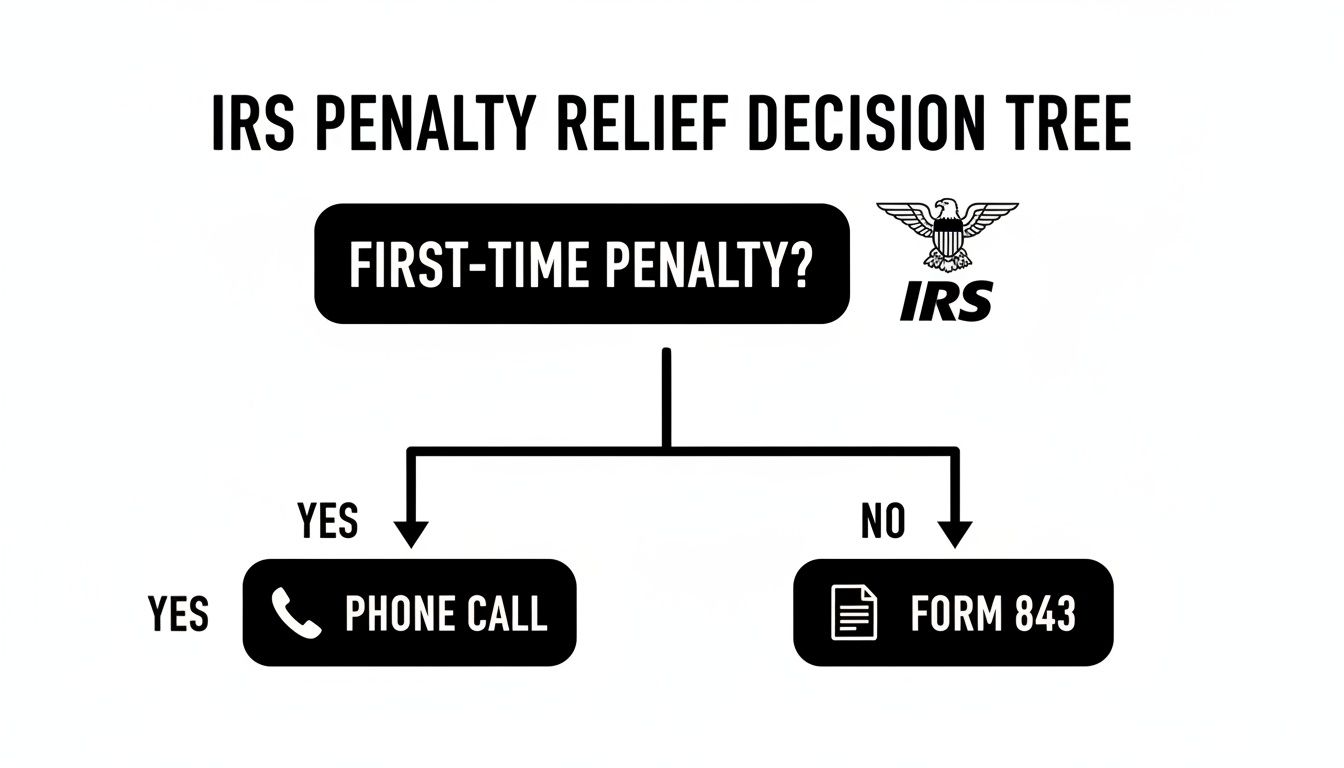
As you can see, your compliance history points you in the right direction. If it's your first offense, pick up the phone. Otherwise, it's time to get familiar with Form 843.
When Form 843 Is Your Only Option
A phone call is great for the low-hanging fruit, but Form 843 becomes essential in a few specific scenarios.
It's really about knowing which tool to pull out of your toolbox. A phone call is like a screwdriver, perfect for simple jobs. Form 843 is the whole socket wrench set, necessary for the more complex and high-stakes situations. This table breaks down when to use each method.
Choosing Your Abatement Method
| Scenario | Best Method | Reasoning |
|---|---|---|
| First failure-to-file penalty in years | Phone Call | The First-Time Abate program is designed for this. A quick call is the most efficient way to get relief. |
| You had a medical emergency | Form 843 | This requires a "reasonable cause" argument, which must be explained in writing with supporting documents (e.g., hospital records). |
| The IRS made an error causing interest | Form 843 | Interest abatement due to IRS error or delay must be requested in writing. A phone call won't work. |
| Overpaid Social Security tax | Form 843 | This is a specific claim for refund handled by Form 843, not a standard income tax return. |
| Minor, one-time calculation error | Phone Call or IRS Notice Response | Often, these can be corrected by responding directly to the notice or calling the number provided. |
Ultimately, a formal written request via Form 843 creates a paper trail. It ensures your argument is officially logged, reviewed, and on the record, which is invaluable if your initial request is denied and you need to take it to appeals.
- Arguing Reasonable Cause: If you're not eligible for FTA, your only path is to prove you had a good reason for the mistake. This always requires a written explanation and evidence, making Form 843 the official channel.
- Requesting Interest Abatement: You can only get interest waived if it piled up because of an unreasonable error or delay by the IRS. These claims are complex and must be submitted on Form 843.
- Disputing Other Assessed Fees: The form is a catch-all for other issues, like recovering Social Security or Medicare taxes that were incorrectly withheld.
The IRS assesses a staggering number of penalties. Back in fiscal year 2012, they hit taxpayers with 37.9 million penalties that added up to $26.8 billion. What's wild is that 74% of those were for issues that could have been waived under the First-Time Abatement program. As you can read in The Tax Adviser's analysis of penalty abatement, this relief is surprisingly underused, which just goes to show why you need to know your options.
Do You Even Qualify for Penalty Relief? Let's Find Out.
Before you spend hours filling out Form 843, let’s make sure you actually have a shot at getting those penalties removed. The IRS doesn’t just waive them because you ask nicely; you have to fit squarely into one of their approved reasons for relief.
Getting this right from the start is everything. Your whole case will be built around one of three arguments: First-Time Abatement, Reasonable Cause, or a Statutory Exception. Figuring out which lane you're in is the first—and most important—step.
The "Get Out of Jail Free" Card: First-Time Abatement
The easiest and cleanest path is the IRS’s First-Time Abatement (FTA) policy. Think of it as a one-time free pass for taxpayers who are usually on top of things. It’s the IRS acknowledging that good people sometimes have a bad day.
But there are rules. To qualify, you have to meet these three conditions:
- A Clean Track Record: This is non-negotiable. You can't have had any penalties in the three tax years right before the year you're asking for relief.
- You're All Caught Up: You must have filed all your required tax returns (or filed a proper extension). The IRS isn't going to help you out if you have other outstanding filing issues.
- The Tax Bill is Handled: You've paid the tax you owe or have set up an installment agreement to pay it. They want to see you're making a good-faith effort on the underlying tax.
If you meet all three requirements for a Failure to File, Failure to Pay, or Failure to Deposit penalty, you’re in a great spot. Honestly, while you can use Form 843 for an FTA request, it's often much faster to just call the IRS and ask for it over the phone.
Making Your Case with Reasonable Cause
What if you don’t have that perfect three-year record? Don't panic. Your next best option, and the most common reason for using Form 843, is to argue Reasonable Cause.
This is where you explain that you tried your best to comply—that you acted with "ordinary business care and prudence"—but something outside your control made it impossible.
The heart of any Reasonable Cause argument is proving your failure wasn't due to willful neglect. You have to show that any sensible person in your exact situation would have ended up in the same boat.
The IRS looks at these situations on a case-by-case basis, which means your explanation and your proof are critical. Vague excuses get denied. You have to draw a direct line from what happened in your life to your inability to file or pay on time.
For a much deeper look into what works and what doesn't, you can learn more about building a strong argument for reasonable cause for penalty abatement on our blog.
What Does the IRS Actually Consider "Reasonable"?
So what kind of excuses actually work? Here are some real-world scenarios that often get a Form 843 abatement approved:
- Death or Serious Illness: A sudden, debilitating illness or an unexpected death in your immediate family is one of the strongest arguments. For example, being hospitalized for two months leading up to the April deadline is a pretty open-and-shut case.
- Disaster Strikes: A fire, flood, hurricane, or even a major riot that destroys your home or office—and your tax records along with them—is a valid reason.
- Can't Get Your Records: Sometimes the records you need are simply out of your reach. Maybe they were destroyed in a fire, or perhaps a messy divorce has an ex-spouse refusing to hand them over. If you can prove you tried to get them, this can work.
- Bad Advice: This one is tough to prove, but it's a valid reason. If you relied on bad advice from a tax professional (or even an IRS employee!), you might get relief. The catch? You have to show that you gave them all the correct information and they were the one who made the mistake.
Statutory Exceptions and Other Avenues
Finally, there's a less-traveled path called a Statutory Exception. These are specific escape hatches written directly into the tax law. The classic example is when you receive erroneous written advice from the IRS itself. If you have that letter or notice and can show you did exactly what they told you to do, any resulting penalty is almost always waived.
At the end of the day, it's about matching your story to the IRS playbook. If your record is clean, go for the easy win with First-Time Abatement. If not, get ready to build a detailed, convincing, and well-documented case for Reasonable Cause.
Navigating Form 843 Line by Line
When you first look at Form 843, it can feel a little daunting. But once you understand what each line is asking for, it becomes a straightforward tool. The real secret isn't just filling in the blanks—it's about building a logical, persuasive case for why the IRS should abate your penalty.
Let's walk through the form, zeroing in on the spots where people most often get tripped up.
The top of the form is all about precision. Getting the tax period, tax type, and other details exactly right lays the groundwork for a successful claim.
Mastering the Initial Details: Lines 1 to 6
This first section sets the entire stage for your request. Simple mistakes here can cause major delays or even get your claim rejected before an agent ever reads your explanation.
Line 1: Tax Period This is a surprisingly common stumbling block. You need to enter the specific tax period where the penalty was applied.
- For a late filing penalty on your 2022 personal tax return, you’d enter "12/31/2022."
- For a quarterly payroll tax form (like Form 941), you’d enter the quarter-end date, such as "06/30/2023."
The rule of thumb is simple: one Form 843 per tax period. Don't try to bundle penalties from different years onto one form. The only time you can do that is if a single IRS error caused penalties across multiple periods, and even then, you'll need to attach a detailed explanation.
Line 2: Amount to be Abated Be exact. Pull the IRS notice you received and enter the precise dollar amount of the penalty or interest you're fighting. No estimating, no rounding.
Line 4: Type of Tax Select the right category. For most individuals, this will be "Income." For a business with payroll tax issues, you'd check "Employment." You absolutely cannot use Form 843 to ask the IRS to forgive your actual income tax—this is only for penalties and interest.
Line 6: IRC Code Section Check the IRS penalty notice again. It almost always lists the specific Internal Revenue Code (IRC) section that gives them the authority to assess the penalty. For example, a failure-to-file penalty usually falls under IRC § 6651(a)(1). Citing this shows the IRS you've done your homework.
Pro Tip: Accuracy is everything in this section. Before moving on, double-check your Social Security Number, the tax period, and the penalty amount against the official IRS notice. A single typo can send your request into a bureaucratic black hole for months.
Crafting a Compelling Story on Line 7
This is it. Line 7 is the heart and soul of your request. It's a big blank space where you tell your story and make your case for why the penalty should be removed.
Your explanation needs to be clear, concise, and persuasive. Think of it as a short, powerful narrative with three key parts:
- State the Facts: Start by laying out what happened and when. Stick to a chronological timeline and avoid overly emotional language.
- Explain Your Reasonable Cause: This is the "why." You must directly connect the events you just described to your inability to file or pay on time. If you were in the hospital, state the dates and explain how that physically prevented you from handling your taxes.
- Show You Acted Responsibly: Finally, prove that the mistake wasn't due to willful neglect. Explain the steps you took to get back into compliance as soon as you could. Mentioning that you filed the return or paid the tax immediately after recovering from an illness shows good faith.
Sample Wording for a Common Scenario
Let's say a sudden family emergency caused you to miss the tax deadline. Here’s a good way to frame your explanation for Line 7:
"I am requesting an abatement of the failure-to-file penalty for the 2022 tax year based on reasonable cause. On March 28, 2023, my elderly father suffered a severe stroke and was hospitalized. As his sole caregiver, I was responsible for his immediate medical decisions and round-the-clock care from that date through May 15, 2023.
This unforeseen and incapacitating event made it impossible for me to gather my tax documents and file my return by the April 18 deadline. I have attached hospital admission and discharge records to verify these dates. As soon as my father’s condition stabilized, I promptly hired a tax professional and filed the overdue return on May 20, 2023."
This explanation works because it's factual, it provides specific dates, it directly links the emergency to the tax problem, and it demonstrates responsible action once the crisis passed.
Getting these details right is critical because the IRS doesn't always handle these cases correctly. A 2012 report from the Treasury Inspector General for Tax Administration (TIGTA) found that a shocking 89% of sampled Reasonable Cause Abatement cases were handled incorrectly by the IRS. You can discover more insights about these IRS procedural challenges and see why a well-prepared form is your best defense. This history underscores the importance of submitting a claim that is clear, well-supported, and leaves no room for misinterpretation.
Gathering Your Essential Supporting Documents
Your written explanation on Form 843 tells your story, but the supporting documents are what prove it's true. Without solid, objective evidence, even the most heartfelt explanation will likely get rejected. It's best to think of this like a court case—your documents are the exhibits that make your argument impossible to ignore.
Simply telling the IRS you were in the hospital won't cut it. You need to show them the dated admission and discharge papers that line up with the tax deadline you missed. Every piece of paper you submit should draw a clear, undeniable line from the event that happened to your inability to file or pay on time.
Building Your Evidence Package
The goal here is to hand the IRS agent a professional, organized package that makes it easy for them to say "yes" to your form 843 abatement request. The exact documents you'll need will depend entirely on your specific reason for needing relief.
Let's walk through a few common real-world scenarios and the proof you'd need for each:
- Medical Emergency: If a serious illness sidelined you or an immediate family member, you need to gather the medical records. Think doctor's notes, hospital admission and discharge summaries—anything that clearly shows the dates you were incapacitated.
- Natural Disaster: If a fire, flood, or hurricane wrecked your home or office, you'll want to include insurance claims, police reports, or even photos of the damage. If FEMA or a state agency declared your area a disaster zone, include a copy of that official declaration.
- IRS Error or Bad Advice: This is one of the toughest arguments to win, but it’s not impossible. If an IRS agent gave you bad advice over the phone, your best evidence is your own detailed notes from the call: the date, time, the agent's name or badge number, and exactly what they told you. If you got bad advice in writing, that's gold—include a copy.
- Records Were Unavailable: Maybe your records were destroyed in a fire or a former business partner or ex-spouse refused to hand them over. You'll need proof, like a copy of the fire report or the letters your attorney sent demanding the documents.
A Proactive Approach: Don't make the IRS ask for more information. Try to anticipate their questions and provide all the necessary proof right from the start. A complete, well-documented submission has a much higher chance of getting approved on the first try, which can save you months of frustrating back-and-forth.
How to Organize and Present Your Documents
Once you have all your proof, how you present it really matters. Don't just cram a messy stack of papers into an envelope. A disorganized submission implies a weak argument and makes the agent's job harder.
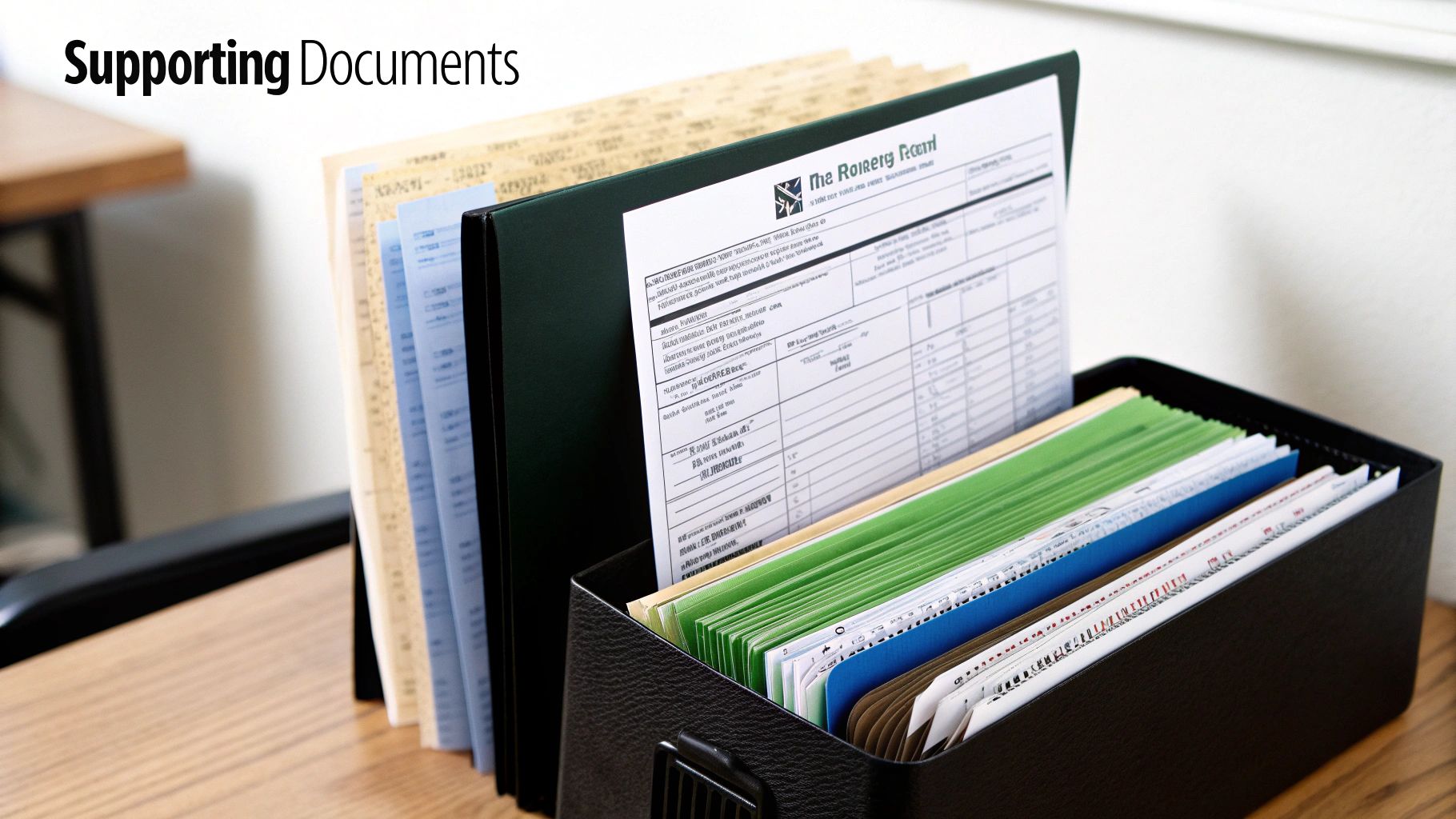
Start with a simple cover letter that briefly explains what you're asking for and includes a list of the documents you've enclosed. Arrange your evidence logically, usually chronologically. And a crucial tip: always send copies, never your originals.
If your request gets denied, don't just give up. You have the right to appeal the decision. This is your opportunity to strengthen your case, perhaps by adding more evidence or having a professional represent you with a Form 2848, Power of Attorney. If a single IRS error caused penalties over multiple years, you can often use one Form 843, but you have to be very clear about all the tax periods involved.
Finally, and I can't stress this enough, mail your completed package using a trackable service. Our guide to sending documents to the IRS via certified mail walks you through how to get undeniable proof of delivery. That little green receipt can be a lifesaver if the IRS ever claims they never received your request.
Filing Your Claim and What to Expect Next
Once you've got your completed Form 843 and all the supporting documents organized, it’s time to send it off. But hold on a second—before you seal that envelope, you need to be absolutely sure you’re sending it to the right place.
There isn't a single, universal address for Form 843 submissions. The correct IRS service center actually depends on the specific tax form or penalty your claim relates to. The most surefire way to find the right address is to double-check the latest official IRS instructions for the form. Sending it to the wrong location is a common mistake that can tack on serious delays to an already slow process.
My advice? Always, always use a mailing service with tracking. That delivery confirmation is your proof that the IRS received your package and when.

Setting Realistic Timelines
After you've mailed your form 843 abatement request, the real test of patience begins. It’s absolutely essential to set realistic expectations for how long this will take. A quick call to the IRS for a First-Time Abatement might get you an answer in a few weeks, but a formal written claim is a different beast entirely.
From my experience, a request for penalty relief using Form 843 can take anywhere from two to four months to get a decision. A simple phone request might get a confirmation letter in just two or three weeks, but a "reasonable cause" claim submitted on paper often stretches into the three or four-month range.
Key Takeaway: Don't expect a quick response. The IRS is buried in correspondence, and your claim is going into a very long queue. I tell my clients to mark their calendars for 90 days from the delivery date. If you haven't heard anything by then, it's time to follow up.
Interpreting the IRS Response
Eventually, a letter from the IRS will land in your mailbox. This is the moment of truth. The notice will clearly state their decision, which will fall into one of three categories. Understanding what each one means is your first step in figuring out what to do next.
- Full Approval: This is the best news you can get. The notice will confirm your request was granted and the penalty has been removed. Your account will be adjusted, and you can breathe a sigh of relief.
- Partial Approval: Sometimes the IRS will meet you halfway. They might agree with part of your argument but not all of it, removing some penalties while leaving others. The letter will break down their reasoning.
- Denial: If your request is denied, the letter will explain why the IRS didn't feel your circumstances met the criteria for abatement. Don't panic—this isn't necessarily the end of the line.
No matter the outcome, read that letter from top to bottom. It contains crucial information, including your appeal rights and deadlines for taking further action.
If you're working with a tax professional, they'll get a copy of the notice as long as a valid Power of Attorney is on file. For anyone needing help with that, our guide to the instructions for IRS Form 2848 walks you through authorizing someone to represent you.
And a pro tip: if the IRS requests more information after you've filed, faxing is often the quickest way to get it to them. If you're not used to sending faxes anymore, this guide on how to send a fax online is incredibly helpful.
What to Do If the IRS Denies Your Abatement Request
Getting a denial letter for your Form 843 request can feel deflating, but it's certainly not the end of the road. In my experience, this is often just the beginning of the real negotiation. The initial decision isn't the final word; it simply means it's time to take your case to someone with more authority.
The first thing you need to do is read that denial letter, and I mean really read it. The IRS has to explain why they rejected your request. That explanation is your roadmap—it tells you exactly which arguments you need to counter as you move forward.
Taking Your Case to the Next Level
When the IRS says no, your next move is to request a conference with the IRS Independent Office of Appeals. This is a crucial step. It gets your case in front of a fresh pair of eyes, someone completely separate from the department that originally denied you. The Appeals Office has more latitude to consider the unique circumstances of your case—the "hazards of litigation"—that the first reviewer might have ignored.
You typically have 30 days from the date on the denial letter to file your appeal. Pay close attention to this deadline. If you miss it, you lose your chance, so it's critical to act fast. For a detailed breakdown of what this involves, our guide on how to appeal an IRS decision walks you through building a compelling case for your appeals conference.
Practitioner's Tip: Persistence is key. So many taxpayers give up after the first "no," not realizing that the appeals process is precisely where complex cases are often won.
Don't let the low official abatement statistics scare you off. For example, in 2019, only about 9% of certain penalties were abated for individuals. But those numbers are misleading. As you can learn more about penalty abatement statistics, they include every taxpayer who received a denial and simply gave up without filing an appeal.
That’s a huge number of people who never challenged the decision. By simply pursuing your appeal, you are already putting yourself in a much stronger position to succeed.
Got Questions About Form 843? We’ve Got Answers.
When you're dealing with IRS penalties, a lot of questions can pop up. Let's walk through some of the most common ones that come across my desk when helping clients with Form 843.
Do I Have to Pay the Penalty Before I File?
This is a big one. Generally, the IRS likes to see the underlying tax paid off before they consider penalty relief. While it's not a hard-and-fast rule for every single penalty, it's absolutely critical for the failure-to-pay penalty.
The IRS typically won't even look at your request to abate a failure-to-pay penalty until the tax bill it's attached to has been paid in full. So, if you can, clear the tax debt first.
What’s the Deadline for Filing Form 843?
Timing is everything here, and missing the deadline means an automatic "no" from the IRS. You need to file Form 843 within a very specific timeframe.
You must file your claim within the later of these two dates:
- Three years from the day you filed the original tax return.
- Two years from the day you actually paid the tax or penalty.
Whichever of those dates gives you more time is the one that applies. Don't let it slip by.
Can I Get Both Penalties and Interest Forgiven?
Yes, but it's much harder to get interest waived than it is to get penalties abated. Think of them as two separate issues with very different standards of proof.
You can often get penalties removed through programs like the First-Time Abate policy or by showing you had a solid, reasonable cause for the mistake. Interest is a different beast entirely.
The IRS will typically only abate interest if its accrual was a direct result of an unreasonable error or delay caused by an IRS employee. Your own reasonable cause for paying late, no matter how good, won't get the interest waived. The good news? If the IRS agrees to remove a penalty, any interest tied directly to that penalty gets automatically recalculated and reduced.
Ready to tackle your tax issues head-on? The team at Attorney Stephen A Weisberg provides a FREE Tax Debt Analysis to determine exactly how we can help resolve your problems with the IRS before you ever pay a fee. Learn more and get your free analysis at weisberg.tax.


