Form 8300 Instructions Your Complete Guide for 2026
Master your IRS reporting with our complete Form 8300 instructions. Learn who must file, how to fill it out, and how to avoid costly penalties in 2026.
In this article
- When Do I Need to File Form 8300?
- What Exactly Is "Cash"?
- The "Related Transactions" Trap
- A Line-by-Line Walkthrough of Form 8300
- Part I: Information on Individual From Whom Cash Was Received
- Part II: Person on Whose Behalf This Transaction Was Conducted
- Part III: Description of Transaction and Method of Payment
- Part IV: Business That Received Cash
- Real-World Scenarios Where Form 8300 Is Triggered
- The Home Renovation Installment Plan
- The Mixed-Payment Car Down Payment
- The Agent and the Art Purchase
- Filing Deadlines and Procedures
- E-Filing vs. Paper Filing
- Notifying Your Customer
- The Five-Year Record-Keeping Rule
- The High Cost of Getting Form 8300 Wrong
- When Penalties Skyrocket
- The Trap of "Structuring" Payments
- How Audits Unfold and Problems Compound
- Common Questions About IRS Form 8300
- What if a Customer Refuses to Provide Their Information?
- Do I Report a Wire Transfer or Personal Check Over $10,000?
- Should I Use My SSN or My LLC's EIN on the Form?
- How Is Form 8300 Different From a SAR?
The fundamental rule for Form 8300 is simple: if your business takes in over $10,000 in cash from a single deal or a series of related ones, you have to report it. This isn't just about stacks of bills, either. The definition of "cash" is broader than you might think and includes things like cashier's checks and money orders.
This requirement is all about transparency. The government uses this information to trace large cash flows that could signal anything from money laundering to tax evasion. Think of it as a compliance backstop that protects your business just as much as it informs the IRS.
When Do I Need to File Form 8300?
Before you even think about filling out the form, you first have to figure out if you're required to. The trigger is always the same: receiving more than $10,000 in cash. But the devil is in the details, especially when it comes to what the IRS considers "cash" and "related transactions."
Here's a quick reference to help you decide.
When to File Form 8300 at a Glance
| Payment Scenario | Is Form 8300 Required? | Key Consideration |
|---|---|---|
| Customer pays with a $12,000 personal check. | No | Personal checks aren't considered cash for Form 8300. |
| Customer pays $15,000 in physical U.S. currency. | Yes | The payment is over $10,000 in cash. |
| Customer pays with a $9,000 cashier's check and $2,000 in cash. | Yes | The total cash and cash equivalents exceed $10,000. |
| Customer pays $6,000 in cash on Monday and $5,000 in cash on Friday for the same project. | Yes | These are related transactions totaling $11,000. |
| Customer pays with a single $20,000 wire transfer. | No | Wire transfers are not defined as cash for this purpose. |
This table should give you a good starting point, but let's break down the two most important concepts you need to master.
What Exactly Is "Cash"?
For Form 8300 purposes, cash isn't just the paper money in your wallet. The IRS definition is specific and includes:
- U.S. and foreign currency: The physical bills and coins you'd expect.
- Certain monetary instruments: This is the key. It includes cashier's checks, bank drafts, traveler's checks, and money orders, but only if they have a face value of $10,000 or less.
If a customer hands you several of these instruments (say, two $6,000 money orders), their combined total can trigger the filing requirement. On the other hand, a personal check or a wire transfer doesn't count as cash here, since those methods already have a built-in financial paper trail.
The "Related Transactions" Trap
This is where I see businesses get into trouble most often. The IRS considers transactions "related" if they happen between the same buyer and seller within a 24-hour period.
But it goes further. Transactions are also related if they occur over more than 24 hours and you know (or have good reason to believe) they are part of the same deal.
For example, a customer puts down a $6,000 cash deposit on a custom furniture order. Two weeks later, they pay the remaining $5,000 balance in cash upon delivery. Even though the payments were weeks apart, they are for the same transaction. The total cash received is $11,000, so you must file Form 8300.
This decision tree helps visualize the process.
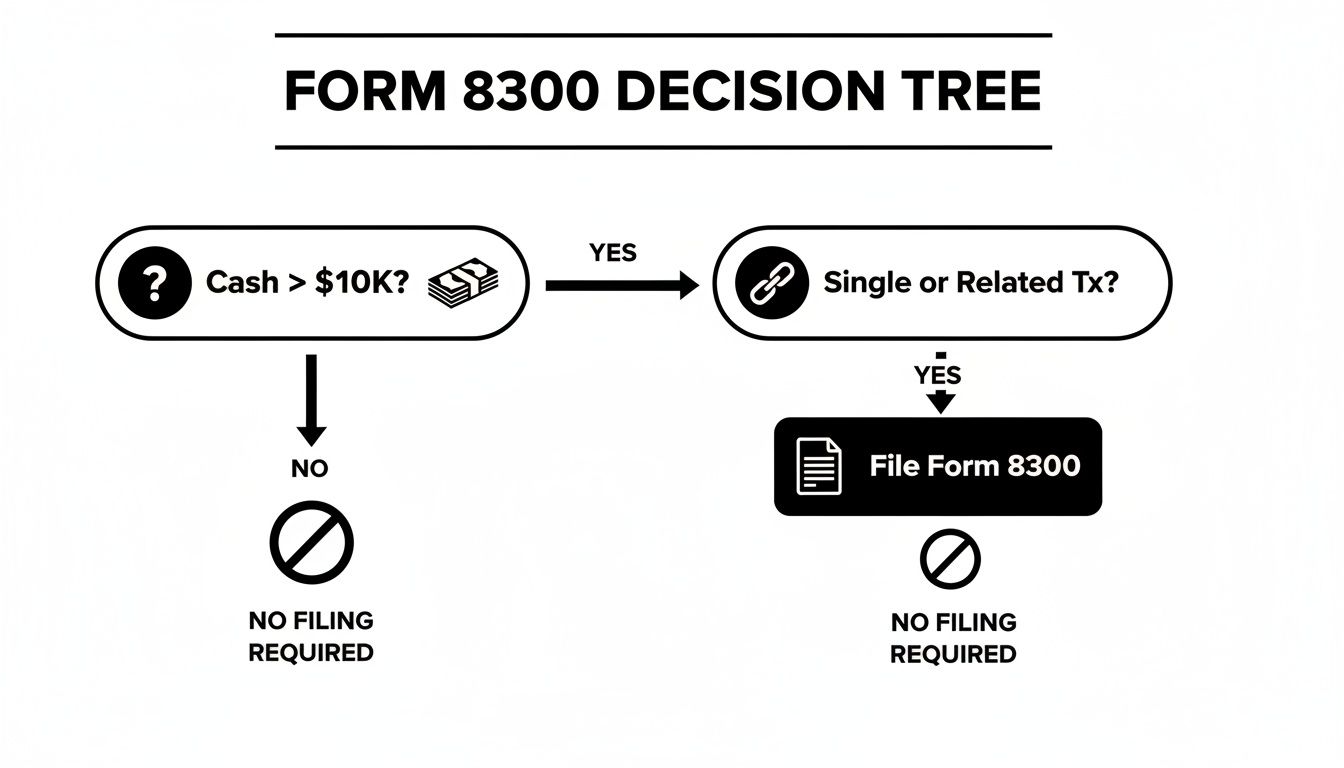
As you can see, a single large payment or several connected smaller ones can lead you down the path to filing.
Once a transaction triggers the requirement, the clock starts ticking. The rules, which are jointly enforced by the IRS and the Financial Crimes Enforcement Network (FinCEN), are strict. You have just 15 days from the date of the transaction to file Form 8300. You also must give a written statement to the person named on the form by January 31 of the following year and keep a copy of the form for five years.
Staying on top of your reporting duties is crucial. If large cash payments are a regular part of your business, it's wise to stay updated on all IRS filing requirements to ensure you remain fully compliant.
A Line-by-Line Walkthrough of Form 8300

Let's face it, Form 8300 can be intimidating. But once you understand the logic behind it, filling it out becomes second nature. I've walked countless business owners through this form, and the key is knowing exactly who and what goes in each box. We'll go through it section by section, clearing up the common sticking points.
Right at the top, you'll see a few checkboxes: "Amends prior report," "Multiple parties," and "Suspicious transaction." These are important but only apply in specific situations. Check "Amends prior report" only if you're correcting a form you've already filed. "Suspicious transaction" is your go-to if something feels off about a payment, even if it's under the $10,000 threshold, and you're filing voluntarily to cover your bases.
Part I: Information on Individual From Whom Cash Was Received
This is one of the most misunderstood parts of the form. Part I is for the "money mule"—the person who physically hands you the cash. It’s not necessarily your customer.
Think of it this way: a client at a law firm sends their assistant over with a cash retainer. The assistant is the one standing in front of you, so their details go right here in Part I. Your actual client gets detailed later in Part II.
You’ll need to get some specific information from this person:
- Full Name and Address: Their current, complete information.
- Social Security Number (SSN): This is required. If they refuse to provide it, you need to make a note of that.
- Occupation, Profession, or Business: Be specific. "Landscaper" is much better than a vague "Business Owner."
Key Takeaway: Part I is for the courier, the person who physically delivers the cash. If the person paying is also the person on whose behalf the transaction is made, you'll fill out Part I and then check box 14. This saves you from entering the same information twice.
Part II: Person on Whose Behalf This Transaction Was Conducted
This is where you put the details of your actual customer if they weren't the person who paid you.
Let's go back to that law firm example. The client who hired you? Their information goes here. If your customer is a business, like an LLC or corporation, you'll enter the company's details in this section.
- For an individual: You need their Name, Address, SSN or ITIN, and the details from an identifying document, like their driver's license.
- For an organization: Get the Organization's Name, Address, and Employer Identification Number (EIN). You won't need an individual's SSN in this case.
If the person in Part I is your actual customer and no one else is involved, you can leave this whole section blank. Just make sure you checked box 14 in Part I.
For example, a man walks into your jewelry shop and pays $12,000 in cash for a diamond necklace. He's buying it for himself. He is both the person giving you the money and the person conducting the transaction. You'd fill out his info in Part I, check box 14, and move on.
Part III: Description of Transaction and Method of Payment
Think of this section as telling the IRS a short, clear story about the deal. Be specific and give them all the necessary details to understand what happened.
Here's the essential information to include:
- Describe the transaction: Explain what the money was for. "Sale of 2024 Ford F-150," "Retainer for legal services," or "Down payment on kitchen remodel" are all good examples.
- State the total price: This is the full price of the item or service, even if only a portion was paid in cash.
- Record the cash amount: Write down the exact amount of cash and cash equivalents you received that triggered this report.
- Break down the payment: In box 33, you need to specify how much was U.S. currency, foreign currency, or cash equivalents (like money orders). If you accepted foreign money, report its U.S. dollar value and name the country it came from.
The IRS is constantly updating its rules and definitions. Staying current on what they consider a cash equivalent or how they view certain transactions is part of your due diligence. For more on this, you might find valuable information in recent updates on IRS form changes.
Part IV: Business That Received Cash
Finally, the easy part. This section is all about you—the business that received the cash.
Fill in your business's legal name, EIN, address, and what your business does (e.g., "Auto Dealership," "Jewelry Retail," "Law Practice"). One pro tip: always double-check that you're using your business's official EIN. Even if you're a single-member LLC, don't put your personal SSN here.
Sign it, date it, and you're all set to file.
Real-World Scenarios Where Form 8300 Is Triggered
It’s one thing to read the IRS rules, but it's another thing entirely to spot a reportable transaction in the middle of a busy workday. The theory seems straightforward, but real life is messy. This is exactly where I see well-meaning businesses get into trouble—they misinterpret the "related transactions" rule or don't realize a filing is necessary until it's far too late.
Let's get practical and walk through a few detailed scenarios you're likely to run into. These examples will help you connect the official regulations to your day-to-day operations, giving you a clearer framework for making the right call every time.
The Home Renovation Installment Plan
Imagine you're a contractor hired for a big kitchen remodel with a total project cost of $25,000. The homeowner decides to pay you in installments.
- Payment 1 (March 15): The client hands you $5,000 in cash for the initial deposit to order materials.
- Payment 2 (April 20): As work progresses, they make another cash payment of $6,000.
- Payment 3 (May 30): Once the job is done, they settle the final $14,000 balance with a personal check.
The alarm bells should go off on April 20. On that day, the total cash you've received for this single project hit $11,000, crossing the $10,000 reporting threshold. The final payment by check is irrelevant for Form 8300 purposes because it isn't considered cash.
Your responsibility kicks in the moment that second cash payment is made. You have just 15 days from April 20 to file Form 8300, making your deadline May 5. On the form, you'll report the $11,000 in cash received so far and list the homeowner in both Part I and Part II, since they are both the person paying and the one benefiting from the work.
Key Takeaway: The 15-day filing clock starts the second the cumulative cash for a transaction or related transactions tops $10,000. It isn't tied to the final payment or project completion. Diligent tracking of cash payments on a per-client, per-project basis is non-negotiable.
The Mixed-Payment Car Down Payment
Now, let's put you in the manager's office of a car dealership. A customer is ready to make a $12,500 down payment on a new SUV, but they pull out a mix of payment types that needs your immediate attention.
The customer presents you with:
- $7,000 in crisp U.S. bills.
- A money order for $3,000.
- A cashier's check for $2,500.
All three of these count as "cash" under the IRS definition. Because the money order and cashier's check are both individually under $10,000, they are treated as cash equivalents when combined with other funds for a single transaction. The total "cash" you just received is $12,500.
Since this amount is over the threshold, a Form 8300 is mandatory. Before you hand over the keys, you absolutely must get the customer's personal information, including their Taxpayer Identification Number. Forgetting this step will cause a major compliance headache when you realize you have to file the form but have no way to get the required info.
The Agent and the Art Purchase
Things can get a little more complex when an agent or representative is involved. Let's say you run an art gallery and have just sold a sculpture for $18,000.
An interior designer comes in and pays the full $18,000 in cash. She explains that the artwork is actually for one of her clients—a wealthy individual whose home she is decorating. She asks for the receipt and title to be put in her client's name.
This is a textbook example of why Part I and Part II of the form exist.
- Part I: This is for the person standing in front of you—the interior designer. She is the one who physically conducted the transaction. You must collect her name, address, and TIN.
- Part II: This is for the person on whose behalf the transaction was made—the homeowner. You'll need to get the client's name, address, and TIN from the designer.
Filing this way gives the IRS a complete and accurate picture of the transaction: who handed over the money and who ultimately received the goods. Simply listing the end client and ignoring the agent who delivered the cash would be an incorrect filing and a serious misstep. Capturing both roles is critical to getting it right.
Filing Deadlines and Procedures
Once you have a completed Form 8300 in hand, the clock starts ticking. Getting the form filed correctly and on time is just as crucial as filling it out accurately. Miss a deadline or a procedural step, and you could face the same steep penalties as if you never filed at all.
The most important rule to burn into your memory is the 15-day deadline. You are required to file Form 8300 within 15 calendar days from the date the cash transaction (or related transactions) crosses the $10,000 threshold. Keep in mind, this is calendar days, not business days, so weekends and holidays count.
So what if day 15 falls on a Saturday or a federal holiday? Thankfully, the IRS gives you a little grace here. The deadline rolls over to the next business day. If your 15th day is a Sunday, you have until that Monday to get it filed.
E-Filing vs. Paper Filing
You have two ways to get this form to the IRS: electronically or through the mail. Each path has its own rules and, frankly, one is much better than the other.
The IRS has been aggressively pushing businesses toward e-filing for years. In fact, a rule that went into effect on January 1, 2024, now requires many businesses to file electronically. If you file at least 10 other information returns (think W-2s or 1099s) in a calendar year, you must e-file your Forms 8300. Given the agency's current direction, paper filing is quickly becoming a thing of the past. You can read more on how the IRS zero-paper initiative will affect filing delays.
Here’s a quick breakdown of how the two methods stack up:
| Feature | Electronic Filing (E-Filing) | Paper Filing (by Mail) |
|---|---|---|
| Method | Submit through the FinCEN BSA E-Filing System. | Send the physical form via U.S. mail. |
| Speed | Instant. You receive an immediate confirmation. | Slow. Can take days or even weeks for the IRS to process. |
| Confirmation | You get a digital receipt and tracking number right away. | Your only proof of mailing is a certified mail receipt. |
| Error Rate | The system catches common errors before you submit. | High risk of manual errors, lost mail, or processing delays. |
| Best For | Required for most filers and highly recommended for everyone else. | Only for businesses that fall below the 10-return e-filing threshold. |
If you're one of the few still eligible to file by mail, and you choose to go that route, you must send the form to this specific address:
Internal Revenue Service Detroit Federal Building P.O. Box 32621 Detroit, MI 48232
Notifying Your Customer
Here’s a step many businesses forget: you’re not just reporting to the IRS. You also have to inform your customer that you've filed a report about their transaction.
By law, you must provide a written statement to the person named on the form by January 31 of the year after the transaction took place. For example, if you report a large cash payment in 2025, your deadline to notify that customer is January 31, 2026.
This notice doesn't need to be fancy. A simple letter will do, but it must include:
- Your business name and address
- The total amount of cash you reported on their Form 8300 for the year
- A sentence clearly stating that you reported this information to the IRS
This isn't optional. It's a required part of the process designed to keep everything transparent for both you and your customer.
The Five-Year Record-Keeping Rule
Your final obligation is to keep a copy of every Form 8300 you file. The IRS requires you to hold onto these records for five years from the date you filed them.
A common mistake is thinking the digital confirmation from the e-filing system is enough—it isn't. You need to save a complete copy of the form itself. I always advise clients to save a PDF of the submitted form in a secure, backed-up digital folder. This simple step ensures you can quickly produce the document if the IRS ever comes knocking for an audit, proving you did your due diligence.
The High Cost of Getting Form 8300 Wrong

Let's be blunt: ignoring your Form 8300 filing duties is one of the most costly mistakes your business can make. I’ve seen firsthand how what seems like a minor paperwork oversight can spiral into a financial nightmare. The IRS doesn’t see this as just another form—they see it as a critical tool in fighting money laundering, and they enforce the rules with a vengeance.
Even an honest mistake, like filing late or leaving out required information, comes with a $310 penalty for each form. But that's just the starting point. The real trouble begins when the IRS suspects you knew better.
When Penalties Skyrocket
If an agent determines your failure to file was intentional, the penalties become truly destructive. We’re not talking about a simple fine anymore. Willful non-compliance triggers a penalty of either $31,520 or the total cash received in the transaction, whichever is greater. A single unreported deal could literally bankrupt a small business.
This isn't a new development. Laws like the Anti-Drug Abuse Act of 1988 laid the groundwork for these severe civil and criminal penalties decades ago. Given the stakes, it's wise to work with experienced Tax Accountants who can ensure you're filing correctly and on time.
My takeaway from years in practice: The IRS designed these penalties to be punitive. An intentional failure to file isn't just an error; it's a serious offense where the penalty can far exceed the value of the transaction you tried to hide.
These problems rarely exist in a vacuum. I often see Form 8300 issues surface during audits for other tax problems, like payroll tax debt or a Trust Fund Recovery Penalty assessment. Suddenly, you're fighting a battle on multiple fronts. These situations are complex and require a very specific skill set to navigate.
The Trap of "Structuring" Payments
One of the brightest red flags for the IRS is something called "structuring." This is when a customer tries to get around the rules by breaking a large cash payment into smaller chunks to stay below the $10,000 reporting threshold.
For example, a client offers to pay $9,000 in cash today and another $9,000 next week for the same car or piece of jewelry. They might think they’re being clever, but the legal risk lands squarely on your shoulders. If you know—or even have a good reason to suspect—the payments are related and designed to dodge the reporting requirement, you are still obligated to file a Form 8300. Willfully going along with a structuring scheme can lead straight to criminal charges, which carry the risk of heavy fines and even prison time.
How Audits Unfold and Problems Compound
A Form 8300 audit usually kicks off with an official notice from the IRS, often Letter 2277, informing you that they're examining your cash reporting compliance. From there, an agent will likely issue a Form 4564 (Information Document Request) to dig through your records, looking for unreported transactions over the $10,000 limit.
An unresolved Form 8300 issue can create a serious ripple effect:
- Selling Your Business: Outstanding compliance problems can halt a business sale in its tracks. No savvy buyer wants to inherit that kind of liability.
- Legal Headaches: In divorce or bankruptcy proceedings, these tax issues can become a major sticking point, preventing a final resolution.
- Penalty Abatement: While getting penalties waived is possible, it’s incredibly difficult for willful non-compliance. The bar is extremely high. You can read more about the strict criteria for penalty abatement in our guide.
At the end of the day, treating Form 8300 compliance as a core part of your risk management isn't just good advice—it's essential for survival.
Common Questions About IRS Form 8300
Even with the official instructions, real-world cash transactions don't always fit neatly into a box. Over the years, I've seen the same tricky situations and points of confusion trip up countless business owners. Let's walk through some of the most common questions that come up when you're face-to-face with a compliance dilemma.
What if a Customer Refuses to Provide Their Information?
It’s an awkward but surprisingly common scenario: you’ve explained the law, but the customer still refuses to provide their Taxpayer Identification Number (TIN) or other details. First, know this: your legal obligation to file Form 8300 doesn't just disappear.
Your next step is to document everything. Immediately create a signed and dated statement explaining that you requested the information for Form 8300 and the customer declined. You must still file the form by the 15-day deadline, but you'll attach your statement to the incomplete form. This proves you made a good-faith effort to comply and puts the burden squarely back on the customer.
Expert Insight: Never, ever agree to take a large cash payment on the condition that you won't file the form. The IRS places the filing responsibility on the business receiving the cash. The severe penalties for non-compliance will fall directly on you, not the customer who talked you into it.
Do I Report a Wire Transfer or Personal Check Over $10,000?
No. This is a critical distinction that saves businesses from a mountain of unnecessary paperwork. Form 8300 reporting is specifically for 'cash' and certain 'cash equivalents.'
The following payment methods are not considered cash for these purposes, so you don't need to file:
- Bank wire transfers
- ACH payments
- Credit or debit card payments
- Personal checks
The reason is simple. These payments already create a clear financial paper trail through the banking system. The rule is designed to bring visibility to transactions that might otherwise be untraceable, like those made with physical currency or instruments like money orders and cashier's checks.
Should I Use My SSN or My LLC's EIN on the Form?
Always use the Employer Identification Number (EIN) of the business entity that actually received the cash. This is a frequent mistake, especially for single-member LLC owners who might be used to filing taxes on their personal returns.
In Part IV of the form, 'Business that Received Cash,' you must enter your business's legal name and its assigned EIN. The transaction was with your business, which is a separate legal entity. Using your personal Social Security Number (SSN) here is a recipe for filing errors, processing delays, and an inevitable notice from the IRS.
How Is Form 8300 Different From a SAR?
It’s crucial to understand the difference between filing Form 8300 and filing a Suspicious Activity Report (SAR). They serve very different functions.
Form 8300 is an objective report. It's triggered automatically by a specific event: receiving over $10,000 in cash. Its purpose is purely informational, giving the government a record of the transaction.
A SAR, on the other hand, is subjective. You file a SAR with the Financial Crimes Enforcement Network (FinCEN) when a transaction feels suspicious, regardless of the dollar amount. Suspicious behavior might include a customer trying to "structure" payments to stay just under the $10,000 threshold or otherwise acting like they're involved in illegal activity. While you can voluntarily file Form 8300 for a suspicious transaction under $10,000, a SAR is a separate obligation based entirely on your professional judgment.
Beyond Form 8300, understanding general IRS penalties for late tax filing can help businesses avoid broader compliance issues and costly fees.
At Attorney Stephen A Weisberg, we understand that navigating complex IRS rules can be overwhelming. If you're facing tax debt issues, an audit, or other problems with the IRS, we can help. Start with a FREE Tax Debt Analysis to discover your best path forward.


