Form 656 Offer in Compromise: A Complete Guide for 2026
Understand the Form 656 Offer in Compromise. This guide explains who qualifies, how to apply, and alternatives for settling your IRS tax debt.
In this article
- The Weight of Tax Debt and a Potential Path Forward
- What Is an Offer in Compromise and Who Truly Qualifies
- The three legal grounds
- The gatekeeper rules the IRS checks first
- Who tends to qualify in the real world
- How the IRS Calculates Your Offer Amount
- The asset side of the formula
- The income side of the formula
- Why payment choice changes the math
- The Step by Step Filing Process and Documentation
- The core packet
- What usually belongs in the documentation file
- What makes a package processable
- Common Rejection Reasons and How to Avoid Them
- The offer is below what the IRS thinks it can collect
- The file raises credibility problems
- The taxpayer falls out of compliance during review
- What actually improves approval odds
- Alternatives When an OIC Is Not the Right Fit
- A side by side view
- Installment agreement
- Currently Not Collectible status
- Penalty abatement and liability-based relief
- Next Steps and When to Engage a Tax Attorney
If you're reading about Form 656 late at night after opening another IRS notice, you're probably not looking for theory. You're looking for a way out that doesn't involve pretending the balance will somehow fix itself.
That situation is common. A self-employed person has a bad year, misses estimated payments, then falls behind on filing. A business owner uses cash flow to cover payroll and vendors first, only to realize the IRS debt has grown into something that no monthly payment seems to touch. An individual with old tax years hanging open starts getting bills and wonders whether settling for less is real or just a phrase used in ads.
It is real. But the Form 656 offer in compromise process is not a shortcut, and it isn't forgiving. The IRS will settle some tax debts for less than the full amount owed, but only through a formal process with strict entry rules, detailed financial disclosure, and close review of whether the government could collect more from you over time. That makes it a potential lifeline, but not an easy one.
A common challenge is that the program sounds simple from far away. Fill out a form. Make an offer. Wait for a decision. In practice, the actual work involves proving, with documents and numbers, why your offer is the most the IRS can reasonably expect to collect.
The Weight of Tax Debt and a Potential Path Forward
Tax debt has a way of taking over ordinary life. It follows people into work, sleep, marriage, business decisions, and basic planning. I've seen people avoid opening mail for weeks because they're afraid the next envelope will make the problem feel final.
Usually the problem didn't begin with one reckless choice. It built slowly. A contractor had uneven income and underpaid during the year. A business owner used available cash to keep employees paid. A divorced taxpayer found out the old returns were never really resolved. By the time they look at resolution options, they're not asking for a clever trick. They want to know whether there's a lawful way to close the gap between what the IRS says is owed and what they can realistically pay.
An offer in compromise can be that path. It is a formal IRS program that allows some taxpayers to settle for less than the full balance. But people get into trouble when they treat it like a general hardship request. It isn't. The IRS wants a full financial picture, and it will compare your offer against what it believes it can collect from your assets and future income.
Most bad OIC filings fail before the real debate even starts. The file is incomplete, the numbers don't match the documents, or the taxpayer simply wasn't eligible to apply yet.
That is why strategy matters. A strong case isn't just about low income or stress. It is about timing, compliance, documentation, and presenting a financial story that holds together under scrutiny.
For some taxpayers, the offer route is appropriate. For others, it wastes time and money that should have gone toward a different resolution plan. The goal is not to force an offer in compromise into every tax problem. The goal is to figure out whether this specific tool fits your facts.
What Is an Offer in Compromise and Who Truly Qualifies
A client usually asks this question after the balance has become more than a math problem. The IRS is collecting, the monthly budget is already tight, and every option seems to carry a cost. An offer in compromise is one possible resolution, but it is a narrow program with strict entry rules.
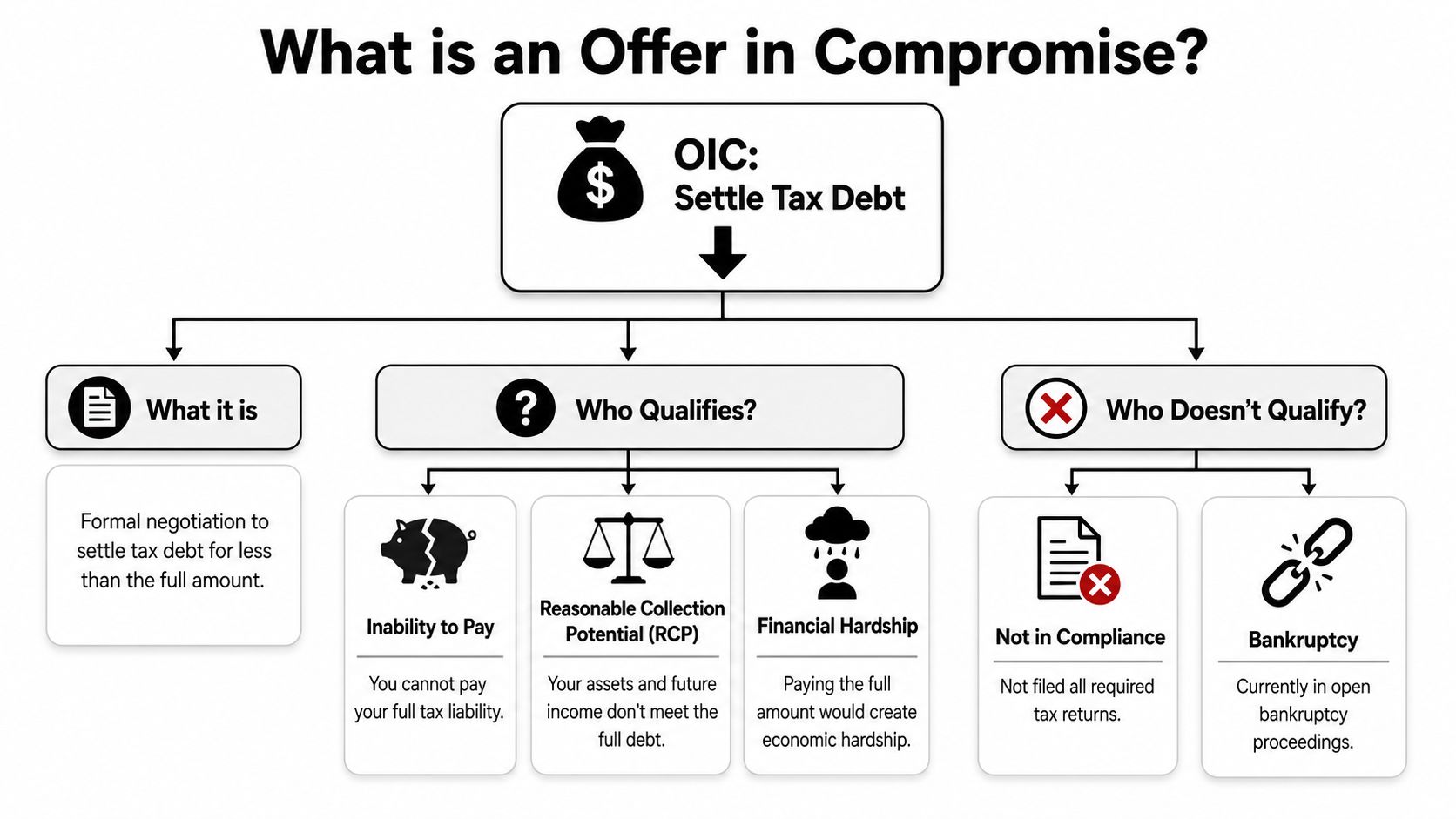
An Offer in Compromise, or OIC, is the IRS process for settling assessed tax debt for less than the full amount owed in limited cases. It exists under 26 U.S.C. § 7122. The filing usually involves Form 656 and a $205 application fee, although that fee does not apply in certain low-income cases or with a Doubt as to Liability offer filed on Form 656-L.
The three legal grounds
The label on the offer matters because it tells the IRS what question it is supposed to answer.
- Doubt as to Collectibility. The taxpayer agrees the tax is owed, but the IRS is unlikely to collect the full balance from available assets and future income.
- Doubt as to Liability. The taxpayer disputes that the tax is owed or disputes the amount assessed.
- Effective Tax Administration. The tax is legally owed and could be collected, but collecting in full would create economic hardship or produce an unfair result under IRS standards.
In practice, those inquiring about a form 656 offer in compromise are dealing with collectibility, not liability. They are not arguing over the assessment. They are trying to prove that the IRS's collection power is greater on paper than it is in real life.
That distinction shapes strategy. A collectibility case turns on financial documents, consistency, and timing. An effective tax administration case is harder to win and needs a carefully documented hardship story that fits the IRS's rules, not just a sympathetic set of facts.
The gatekeeper rules the IRS checks first
Before the IRS studies whether your offer amount is acceptable, it screens for basic eligibility. The agency generally expects applicants to:
- File all required tax returns
- Receive a bill for the debt being compromised
- Stay current with this year's estimated tax payments or withholding
- Stay out of open bankruptcy
I tell clients to treat these as threshold issues, not paperwork details. If someone is still missing returns or still falling behind for the current year, the IRS reads that as an unresolved compliance problem. In many cases, the offer will be returned without a real review.
A pending bankruptcy case usually stops the process immediately.
Who tends to qualify in the real world
A workable OIC case usually has three features. The taxpayer has limited equity in assets, little monthly income left after allowed living expenses, and a realistic path to staying compliant for the next several years.
The last point gets overlooked. The IRS is not only deciding whether to take less today. It is also deciding whether the taxpayer is likely to stay current after acceptance. If that answer looks doubtful, the file gets harder very quickly.
Irregular income creates a lot of confusion here. Self-employed taxpayers, contractors, and freelancers often have lean months that are real, but hard to present cleanly if the records are sloppy. Better month-to-month records, separate business and personal expenses, and realistic household budgeting can make the financial story more credible. Taxpayers dealing with uneven earnings often benefit from practical budgeting tips for freelancers before they submit numbers to the IRS.
Some taxpayers look distressed but still do not qualify for an offer. I see this often with people who have home equity, cash in the bank, or income that can support an installment agreement even if life feels financially strained. In those cases, filing an OIC can waste months and expose weak documentation without improving the outcome.
If you want a rough sense of how the numbers may be viewed, an IRS offer in compromise calculator can help frame the discussion before filing. It is not a substitute for legal judgment, but it can show why some cases are promising and others are not.
The practical question is simple. Can the IRS reasonably expect to collect more than you offer? If the answer is yes, the case is weak no matter how stressful the debt feels. If the answer is no, and the file is clean and credible, an offer may be the right tool.
How the IRS Calculates Your Offer Amount
A client sits across the table, owes far more than they can pay today, and asks the question almost everyone asks. "Can I just offer what I can afford?" The hard answer is no. The IRS starts with what it believes it can collect, not with what feels fair.
That calculation is called Reasonable Collection Potential, or RCP. In practice, the IRS adds two things: the net value of your assets and a set amount of future disposable income. For lump-sum offers, the future income portion is usually shorter. For periodic payment offers, it is usually longer. That one choice can change the minimum acceptable offer by thousands of dollars.

The asset side of the formula
The IRS reviews what you own and what portion of it could realistically be reached. That usually includes cash, bank balances, vehicles, real estate, retirement accounts, business interests, and other property. The question is not whether selling an asset would be inconvenient. The question is how much collectible equity exists after debts tied to that asset are accounted for.
Many offers get priced too low before they are ever filed when a taxpayer focuses on monthly strain and overlooks a paid-off vehicle, money sitting in an operating account, or equity in a home. From the IRS perspective, those items are part of the collection picture whether the taxpayer wants to use them or not.
Valuation also matters. I often see taxpayers use rough guesses for what a car, tool inventory, or small business interest is worth. Weak numbers invite scrutiny. Supported numbers give the examiner less room to substitute a harsher view.
The income side of the formula
Future income is where strategy matters most. The IRS reviews your actual income, then tests your expenses against what it considers allowable. If your budget includes spending the IRS views as above standard or optional, the examiner may treat part of that amount as money available to pay taxes.
That does not mean every case is mechanical.
An experienced review looks at whether an expense can be defended, documented, and tied to real life. Health costs, business necessities, commuting issues, child care, and court-ordered obligations often need explanation, not just a line entry on a form. The strongest offers do not merely list numbers. They tell a financial story the file can support.
Taxpayers with variable income need to be especially careful here. Freelancers, contractors, and seasonal business owners should clean up their records before presenting an average month to the IRS. Good records make swings in revenue easier to explain, and practical budgeting tips for freelancers can help organize that picture before the financial statement is submitted.
Why payment choice changes the math
Payment terms are not an afterthought. They directly affect the future-income portion of the offer.
| Payment approach | Future income factor |
|---|---|
| Lump-sum offer | 12 months |
| Periodic payment offer | 24 months |
That difference creates a real trade-off. A lump-sum offer can produce a lower number, but the client has to come up with the money faster. A periodic payment offer spreads out funding, but it often raises the minimum the IRS will accept. I discuss this with clients early because a good offer on paper can still fail if the payment structure does not match how the client will fund it.
If you want a rough starting point before filing, an IRS offer in compromise calculator can help test the numbers. It will not replace legal judgment. It does help show whether the case is in a realistic range before you invest months in an offer the IRS was unlikely to accept from the start.
The Step by Step Filing Process and Documentation
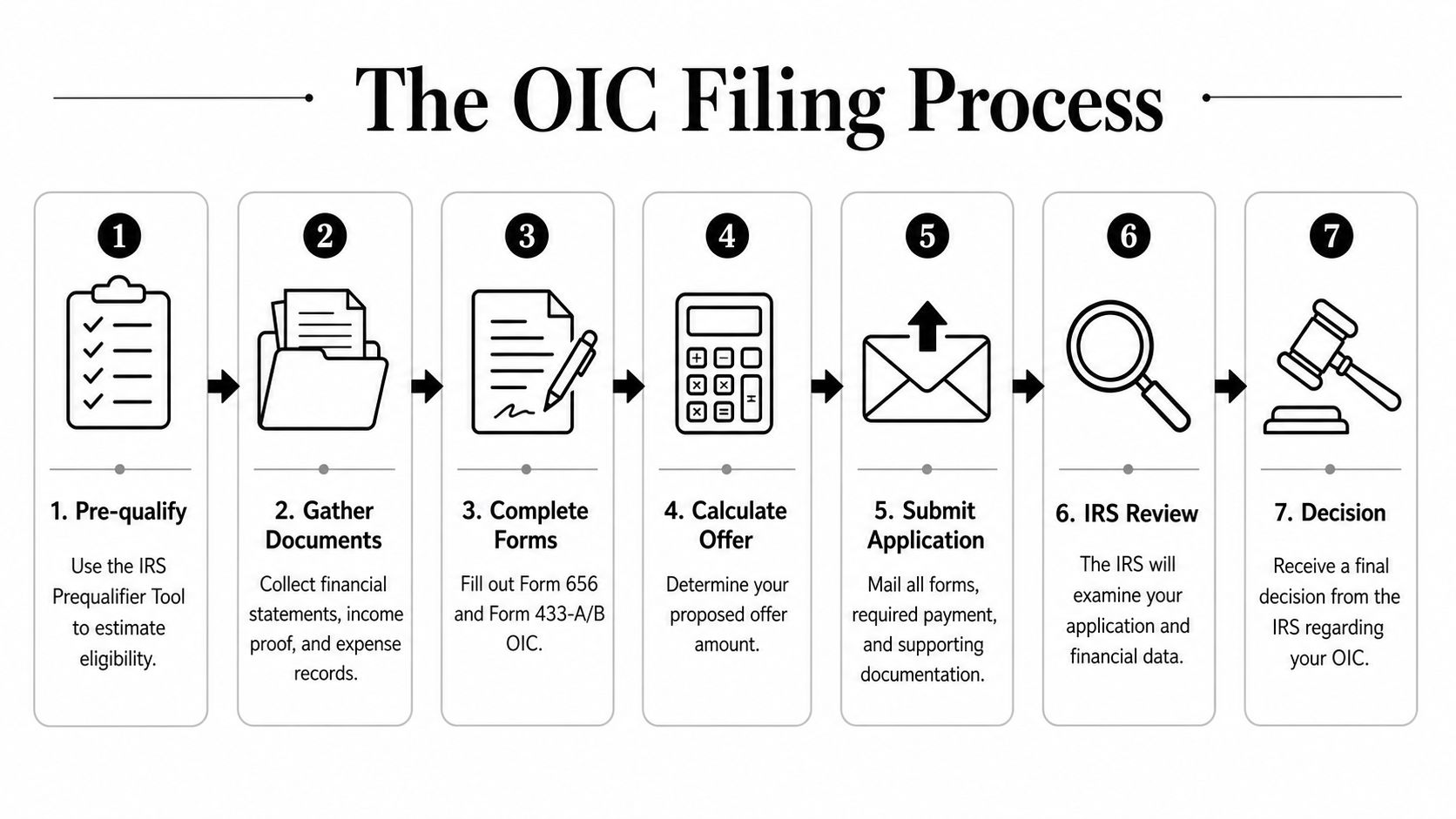
By the time someone starts filling out the forms, the strategic work should already be underway. The filing itself is mechanical. The preparation is where cases are won or lost.
The core packet
A standard offer package usually includes these pieces:
- Form 656. This is the actual offer. It identifies the tax years, tax types, and proposed amount.
- Form 433-A or Form 433-B. Individuals use Form 433-A and businesses use Form 433-B. These forms contain the detailed financial disclosures that drive the IRS review.
- Supporting records. The IRS expects documentation to support what appears on the financial statement.
- Required payment items. The package generally requires the nonrefundable application fee and the initial nonrefundable payment, unless an exception applies.
The IRS materials also make an important point that catches many business owners off guard. Individual and business liabilities must be submitted on separate Form 656 filings, each with its own fee and initial payment when required, and an offer will not be reviewed without the completed signed Form 656 and the matching Form 433-A or 433-B, according to the Form 656-L instructions and related IRS submission rules.
What usually belongs in the documentation file
The financial statement is only persuasive if the documents support it. Typical records include:
- Bank records. Personal statements are commonly required, and business records matter if a company is involved.
- Income proof. Pay stubs, profit and loss records, or other proof of incoming funds.
- Debt records. Loan statements, credit obligations, and documents showing secured balances.
- Asset records. Vehicle titles, real estate documents, retirement statements, and related records.
If you're preparing the individual financial disclosure, this guide to IRS Form 433-A OIC is a useful companion because the 433 is where most filers underestimate the workload.
What makes a package processable
A processable package is not the same as an acceptable offer. It means the IRS will review it rather than stop at intake.
The practical checklist looks like this:
- Signed forms. Unsigned forms can stop the file immediately.
- Consistent numbers. Income on the form should match the records well enough to make sense.
- Complete attachments. Missing statements create avoidable delays and suspicion.
- Correct separation of liabilities. Mixed personal and business liabilities often need separate submissions.
A thin application tells the IRS one of two things. Either the taxpayer didn't prepare carefully, or the taxpayer is hoping the examiner won't ask hard questions. Neither impression helps.
Good filing is less about volume than coherence. Every number should have a home, and every claim of hardship should have paperwork behind it.
Common Rejection Reasons and How to Avoid Them
A typical rejection starts the same way. The taxpayer is under real pressure, submits an offer that feels honest and affordable, and then learns the IRS sees the case very differently. The gap is rarely about sincerity. It is usually about valuation, documentation, or compliance.
In practice, the IRS is asking a narrower question than many people expect. It is not deciding whether the tax bill feels overwhelming. It is deciding whether it can reasonably collect more than you offered.
The offer is below what the IRS thinks it can collect
This is the issue I see most often.
Many taxpayers build an offer around what they can spare after paying their actual monthly bills. The IRS does not use that approach. It applies its own allowable expense standards, reviews equity in assets, and assigns a collection value to future income. An offer that feels realistic to the taxpayer can look too low on paper once the examiner runs that analysis.
Property is a common trouble spot. So are retirement accounts, vehicles with equity, and closely held businesses that the owner assumes have little liquidation value. If an asset can produce funds, or if the IRS believes it could borrow against that asset or reach equity over time, the offer needs to account for that.
The practical fix is to pressure test the number before filing. Calculate the case the way the IRS is likely to calculate it, then decide whether an offer still makes sense.
The file raises credibility problems
An examiner does not need to prove fraud to reject an offer. Doubt is enough.
That doubt usually comes from patterns, not one dramatic mistake. Bank deposits do not match reported income. Transfers between accounts are left unexplained. A hardship claim appears next to discretionary spending that undercuts the story. Business owners mix personal and company funds, then present a financial picture that is hard to follow.
Common triggers include:
- Unexplained deposits or withdrawals. If money moved, label it and document it.
- Expenses that exceed IRS standards without a clear basis. Some deviations can be defended, but they need support.
- Blurred business and personal finances. This is especially damaging in owner operated businesses.
- Asset values that look optimistic. Inflated loan balances or understated resale values invite closer scrutiny.
A good offer does more than fill in boxes. It answers the next question before the examiner has to ask it.
The taxpayer falls out of compliance during review
Strong cases fail here.
The IRS expects current filings to be up to date and current tax obligations to stay current while the offer is pending. If a taxpayer misses a new return, stops making required deposits, or creates another balance due during review, the examiner may conclude the problem is ongoing rather than temporary.
The same risk continues after acceptance. An accepted offer comes with continuing obligations. If those are not met, the IRS can default the agreement and restore the original liability. That is one reason some taxpayers are better served by an installment agreement or, in severe hardship cases, Currently Not Collectible status with the IRS instead of a weak offer filed too early.
What actually improves approval odds
The strongest offers are usually not the most emotional. They are the most disciplined.
That means three things:
- The amount is defensible under IRS methods
- The records support one consistent financial story
- Current compliance is stable before the offer goes in
There is a real strategic judgment here. Some cases should be filed promptly because the numbers support it now. Other cases improve if the taxpayer first cleans up filings, separates business and personal accounts, or waits long enough for a temporary spike in income to pass. Timing can matter as much as the Form 656 itself.
A successful offer is not a plea for sympathy. It is a documented case that gives the IRS a rational basis to settle.
Alternatives When an OIC Is Not the Right Fit
Sometimes the right advice is not to file Form 656 at all. That can be disappointing to hear, but it is often more helpful than spending money on a weak offer with predictable problems.
A side by side view
| Option | Best fit | Main result |
|---|---|---|
| Offer in Compromise | Taxpayer can't reasonably pay the full debt | Debt may be settled for less |
| Installment Agreement | Taxpayer can pay over time | Full debt is paid over time |
| Currently Not Collectible | Taxpayer has severe hardship right now | Collection activity may pause |
| Penalty Abatement | Penalties are the main driver and there is a valid basis for relief | Penalties may be reduced or removed |
Installment agreement
This is often the better choice when the taxpayer has steady income and the underlying issue is timing, not collectibility. It does not reduce the underlying tax debt, but it can create structure and predictability.
For some business owners, this is far more realistic than an offer. If the company has ongoing income and the owner can stay current prospectively, paying over time may fit better than trying to prove that full collection is unrealistic.
Currently Not Collectible status
When there is no present ability to pay, Currently Not Collectible, or CNC, may be the proper tool. This is not forgiveness. It is a recognition that active collection would not produce payment without creating hardship.
If that may fit your circumstances, this overview of Currently Not Collectible status with the IRS explains how the status works and when it is usually considered.
Penalty abatement and liability-based relief
If the tax itself is correct but penalties are inflating the balance, penalty relief may produce a meaningful reduction. In other cases, the deeper issue is that the taxpayer disputes the underlying liability. That shifts the discussion away from collectibility and toward whether the IRS assessed the right amount in the first place.
A taxpayer should not force a collectibility offer onto a liability dispute. That is the wrong tool for the job.
A good resolution plan starts with the right diagnosis. The IRS has several collection and relief tools. The mistake is assuming the most advertised one is always the most effective one.
Next Steps and When to Engage a Tax Attorney
The form 656 offer in compromise process is part financial statement, part legal positioning, and part credibility test. The IRS wants complete disclosure, disciplined current compliance, and a proposed number that matches its own collection logic. Small mistakes can carry big consequences because the filing fee and initial payments are generally nonrefundable, and a weak submission can waste time you needed for a different strategy.
Some taxpayers can prepare an offer on their own. Many should not. That is especially true if you own a business, have payroll tax issues, hold assets that need valuation judgment, move money between personal and business accounts, or disagree with the IRS about what is collectible. Those cases aren't impossible, but they are rarely simple.
A tax attorney's value isn't just filling out forms. It is identifying whether an offer should be filed at all, organizing the financial narrative, anticipating examiner concerns, responding to challenges, and protecting the case if the IRS's analysis is flawed. Attorney Stephen A. Weisberg offers a free tax debt analysis before charging for representation, which gives taxpayers a way to assess whether a formal offer strategy makes sense before paying the IRS to file.
If you're trying to decide whether to proceed alone or get help, this piece on when to hire a tax attorney for IRS problems is a practical place to start.
The key step is simple. Don't send Form 656 because you are desperate. Send it only after you know why the case qualifies, how the offer number was built, and what the IRS is likely to challenge.
If you want a practical review of whether an Offer in Compromise fits your situation, Attorney Stephen A Weisberg offers a free tax debt analysis focused on the actual facts of your case before you pay to move forward.


