form 4549 irs: A Clear Guide to the IRS Report
Find out form 4549 irs: what this report means, how to read it, and your options to respond, appeal, or negotiate.
In this article
- What Is IRS Form 4549 and Why Did You Get One?
- Common Reasons for Receiving Form 4549
- The Role of Form 4549 in the IRS Process
- Quick Guide to Understanding Form 4549
- Cracking the Code: How to Read and Understand Your Form 4549
- The Summary of Changes
- Adjustments to Income: The Starting Point
- The Tax Computation: A Cascade of Changes
- Penalty and Interest Calculations
- Your Three Strategic Response Options
- Option 1: Agree with the Findings
- Option 2: Disagree and Meet with a Manager
- Option 3: Disagree and File a Formal Appeal
- Comparing Your Response Options to Form 4549
- Understanding Deadlines, Timelines, and Penalties
- The Consequences of Missing the Deadline
- Decoding Common Penalties on Form 4549
- Can You Get Penalties Removed?
- How to Craft a Professional Response to the IRS
- The Key Elements of a Strong Rebuttal
- Sample Letter Template for Disputing Form 4549
- When to Hire a Tax Professional for Your Case
- Red Flags That Signal You Need an Expert
- The Value of Professional Representation
- Common Questions About IRS Form 4549
- Is Form 4549 an Actual IRS Bill?
- What Happens If I Ignore Form 4549?
- Can I Negotiate the Amount on Form 4549?
- Does Signing Mean I Admitted Wrongdoing?
That envelope from the IRS in your mailbox is rarely a welcome sight. When it contains a Form 4549, your heart might skip a beat, but it’s crucial to know what you’re looking at. Think of it less like a final bill and more like a mechanic’s report after they've looked under the hood of your tax return—it’s a summary of their proposed changes.
What Is IRS Form 4549 and Why Did You Get One?

At its heart, IRS Form 4549, which goes by the official title Income Tax Examination Changes, is the report card an IRS auditor fills out after they’ve finished an audit. If this form lands in your hands, it means an examiner has gone through your tax return and found things they believe need correcting.
This document is a fork in the road. It clearly lays out the IRS's position and gives you a choice: you can either agree with their proposed adjustments or you can disagree and fight them. It's not a bill or a court order. It's a proposal.
Common Reasons for Receiving Form 4549
So, why you? The reasons for getting a Form 4549 almost always stem from a recently completed audit. The audit could have been a full-blown review of every line item or a simpler correspondence audit handled through the mail. Either way, the result is the same: the IRS wants to make changes.
Here are a few of the most common triggers:
- Unreported Income: The IRS has powerful automated systems that match income reported by employers (on a W-2) or clients (on a 1099) to what you put on your tax return. If there’s a mismatch, it’s a huge red flag that often leads straight to an audit and a Form 4549.
- Disallowed Deductions: The auditor may have decided you didn’t have the right paperwork to back up your claimed business expenses, charitable donations, or other deductions you itemized.
- Incorrect Tax Credits: Maybe you claimed a credit you weren’t actually eligible for, like the Earned Income Tax Credit or an education credit. The examiner will remove it and recalculate what you owe.
The Role of Form 4549 in the IRS Process
It’s important to understand where this form fits into the grand scheme of things. It’s the official tool IRS agents use to put their audit findings on paper and propose tax adjustments. In the last fiscal year alone, the IRS closed hundreds of thousands of audits, recommending billions in additional tax—and Form 4549 was the centerpiece of that process. You can dig into these numbers on the official IRS website to see just how common this is.
Simply put, Form 4549 is the bridge between the IRS's investigation and their proposed resolution. It's your official notification that the audit phase is over and the decision phase has begun. How you respond will determine the next steps in your case.
To quickly get your bearings, here's a breakdown of what you'll find on the form and what it actually means for you.
Quick Guide to Understanding Form 4549
| Information on Form | What It Means for You |
|---|---|
| Tax Year(s) Audited | The specific tax return period(s) the IRS examined. |
| Adjustments to Income | Shows specific lines on your tax return that are being changed, like unreported income or disallowed deductions. |
| Tax Computation | The IRS's new calculation of your tax liability based on the proposed adjustments. |
| Penalties | Any penalties being added, such as for accuracy-related issues or late payment. This is often a significant amount. |
| Interest | The interest charged on the unpaid tax from the original due date. Interest can add up quickly. |
| Total Amount Due/Overpayment | The final bottom line—either what the IRS says you now owe or, in rare cases, what they owe you. |
| Consent to Assessment and Collection | The signature line where you agree to the changes. Do not sign this unless you fully agree. |
This table gives you a roadmap to the form. By understanding each part, you can see exactly where the proposed changes are coming from and decide on the best way to move forward.
Cracking the Code: How to Read and Understand Your Form 4549
Getting a Form 4549 from the IRS can be intimidating. It looks like a dense, complicated spreadsheet, full of jargon and numbers that don’t immediately make sense. But don’t let it overwhelm you.
Think of Form 4549 not as a final bill, but as the auditor's worksheet. It’s their step-by-step math problem showing you exactly how they got from the numbers on your original tax return to the new amount they believe you owe. Once you learn to follow their logic, you can pinpoint exactly where you disagree and build your case.
The Summary of Changes
The very top of the form is just the basics: your name, the tax year in question, and who prepared the report. It sets the stage.
The real action starts in the summary tables. You'll see columns like "As Shown on Return," "Corrected Amount," and "Difference." This is the core of the whole document—a side-by-side comparison of your numbers versus the IRS's proposed changes.
Let's walk through a common example. Imagine a freelance graphic designer named Alex filed his taxes and claimed a $5,000 home office deduction on his Schedule C. The IRS audited him and decided he didn't meet the strict "exclusive and regular use" rule for that space.
That one disallowed deduction is the first domino to fall on his Form 4549.
Adjustments to Income: The Starting Point
This is the most important part of the form to scrutinize. Every other number flows from here. This section lists the specific changes the examiner made to your income. For Alex, this is where that $5,000 home office deduction comes back to bite him.
- Line Item: The form will point to Business Income (Schedule C).
- As Shown on Return: Let's say Alex's original net profit was $50,000.
- Correction: The auditor disallows the $5,000 expense.
- Corrected Amount: His new net profit is now listed as $55,000.
Just like that, Alex's Adjusted Gross Income (AGI) is $5,000 higher. This single change will now cascade through the rest of the calculations.
The Tax Computation: A Cascade of Changes
With a new, higher AGI, the form 4549 irs then has to re-calculate your entire tax liability for that year. It’s not just about paying back the $5,000; it's about paying the tax on that extra $5,000 of income.
This part of the form will show you the math:
- Corrected Adjusted Gross Income (AGI): Alex's AGI is now $5,000 higher than what he reported.
- Deductions: Your standard or itemized deductions will be listed. These usually don't change unless they were also part of the audit.
- Taxable Income: The new AGI minus your deductions gives you a new, higher taxable income.
- Tax Liability: The form uses the official tax tables for that year to calculate a new, higher tax bill based on that new taxable income.
So, that disallowed $5,000 deduction doesn't mean Alex owes an extra $5,000. If he’s in the 22% tax bracket, it means he owes an additional $1,100 in taxes ($5,000 x 22%). That's a critical difference.
Penalty and Interest Calculations
And it rarely stops there. The IRS almost always tacks on penalties and interest, which can turn a manageable tax debt into a much bigger problem.
The most common penalty you'll see is the accuracy-related penalty, which is typically 20% of the underpaid tax. The IRS applies this when they believe the mistake was due to negligence or a significant understatement of what you owed.
Let's finish Alex's story:
- Underpayment: $1,100 (the extra tax from the disallowed deduction).
- Accuracy-Related Penalty: 20% of $1,100 comes out to $220.
On top of penalties, the IRS is legally required to charge interest on the unpaid tax, and it starts ticking from the day your original tax return was due. Since interest compounds daily, an audit for a tax return from a few years ago can result in a shocking amount of accumulated interest.
The form lays all this out, adding the corrected tax, penalties, and interest to arrive at the final "Balance Due." For Alex, his seemingly small $5,000 deduction issue has now ballooned into a proposed debt of over $1,320, plus whatever interest has accrued.
By carefully tracing the numbers from one section to the next, you take back control. You can check the IRS’s math, see exactly where they made changes, and prepare a focused, effective response. This form isn't just a bill—it’s a roadmap of the auditor's thinking, and understanding it is your first step to fighting back.
Your Three Strategic Response Options
Once you've wrapped your head around the numbers on Form 4549, you're at a crossroads. This isn't just about stroking a check; it's a strategic decision that will echo through your finances for years to come. You have three main paths you can take, and each one leads to a very different destination.
Think of it as a fork in the road. Which way you turn depends entirely on whether the IRS hit the nail on the head, missed the mark completely, or if the reality is somewhere in between.
This handy chart shows how common audit triggers, like missed income or questionable deductions, all lead to the same three choices you're facing right now.
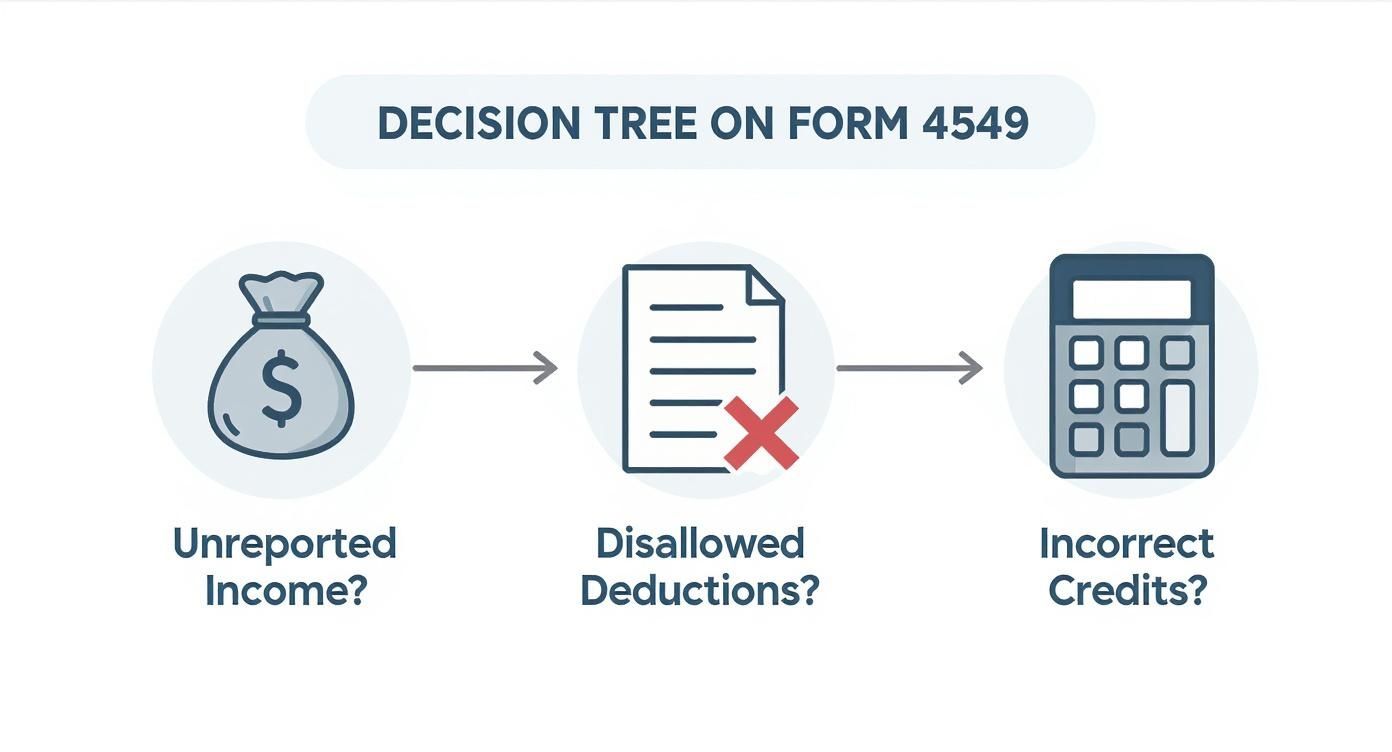
No matter what started the audit, the next step is yours to make. Let's break down what each option really means for you.
Option 1: Agree with the Findings
The simplest route is to agree with the IRS's proposed changes. This is the right move if you’ve reviewed the report and have that sinking feeling they’re correct. Maybe you honestly forgot about some freelance income or took a deduction that wasn't quite by the book. It happens.
If this is your situation, you just need to sign, date, and mail the form back to the IRS. Signing the form is your official agreement to the new tax bill they've calculated.
Heads up: Signing closes the case for good. You're waving goodbye to your right to appeal, so be absolutely sure this is the right call. The IRS will then update your account and send a formal bill for the tax, penalties, and interest.
When that bill arrives, you can pay it off in one go. If the amount makes your jaw drop, you can also look into setting up a payment plan.
Option 2: Disagree and Meet with a Manager
What if you look at the report and know the examiner got it wrong? Maybe they misunderstood your records or flat-out ignored a crucial piece of evidence. If that’s the case, whatever you do, do not sign the form.
Your first move is to ask for an informal conference with the examiner’s direct manager. Think of this as asking to speak to the manager at a store—it’s a way to get a fresh set of eyes on the problem before things escalate. This person has the authority to overrule the original examiner.
You’ll need to send a written request that clearly explains why you disagree. Be specific, point to your documents, and build a logical case. You’d be surprised how often this simple step can clear up misunderstandings and resolve the issue without a full-blown battle.
Option 3: Disagree and File a Formal Appeal
Let's say the meeting with the manager doesn't work out, or your disagreement is over a tricky point of tax law. Your next and most powerful option is to file a formal appeal. This takes your case out of the local office and sends it to the IRS Independent Office of Appeals.
This is a much more structured process. The Appeals Officers who will hear your case are trained to be neutral mediators. Their job is to settle disputes and avoid court, which means they can be more flexible. They often look at the "hazards of litigation"—basically, the odds that the IRS could lose if the case went to Tax Court—and use that to find a middle ground.
Filing an appeal keeps all your rights intact and opens the door for real negotiation. If you have a solid case but the auditor won't see reason, this is your best bet. It’s also worth knowing that if your case was already closed but you found new, game-changing information, you might be able to request an IRS audit reconsideration, which is a separate but related process.
Comparing Your Response Options to Form 4549
Making the right choice requires weighing the pros and cons of each path. The table below breaks down the key factors to help you decide which strategy fits your specific situation.
| Response Option | Process | Best For... | Key Consideration |
|---|---|---|---|
| Agree | Sign and return Form 4549. Wait for the bill and pay or arrange payments. | Situations where the IRS's adjustments are clearly correct and you have no evidence to dispute them. | This is the fastest way to close the audit, but you waive all your rights to appeal the decision later. |
| Disagree & Meet Manager | Send a written request for an informal conference. Present your evidence to the examiner's manager. | Correcting clear factual errors, misunderstandings, or presenting evidence the examiner may have overlooked. | It's less formal and faster than a full appeal, but the manager is still part of the same compliance division. |
| Disagree & Formal Appeal | File a formal protest to send your case to the IRS Independent Office of Appeals for mediation. | Complex legal disagreements or when you have a strong case but have reached a stalemate with the examiner. | This is your most powerful negotiation tool, preserving your right to go to Tax Court if needed. |
Ultimately, your response to Form 4549 sets the stage for everything that follows. Whether you agree and move on or decide to stand your ground, a well-thought-out decision is your best defense.
Understanding Deadlines, Timelines, and Penalties

When you receive a Form 4549, the clock starts ticking immediately. This isn’t a piece of mail you can just set aside for later. The IRS gives you a firm, 30-day window from the date on the letter to respond, and you need to treat that deadline seriously.
Think of this deadline as your chance to stay in the driver's seat. Acting within those 30 days keeps all your options on the table—whether you agree with the findings, want to discuss them with the auditor, or decide to formally appeal. Ignoring this deadline is easily the worst mistake you can make.
The Consequences of Missing the Deadline
Failing to respond within 30 days kicks off a chain reaction that you absolutely want to avoid. If the IRS doesn't hear from you, they assume your silence means you agree. From there, they move to the next stage and issue a formal Statutory Notice of Deficiency, which is often called a "90-day letter."
This isn't just another notice; it’s a legal line in the sand. The Notice of Deficiency gives you exactly 90 days to file a petition with the U.S. Tax Court. If you miss that second deadline, the proposed tax bill becomes final and legally assessed. At that point, the IRS collection machine starts to grind, and it can lead to some pretty severe consequences. Our guide on how to stop IRS wage garnishment details just how serious things can get.
Think of the 30-day window for Form 4549 as your last, best chance for an informal resolution. Once the 90-day letter arrives, your options narrow dramatically, and the path to a solution becomes far more complicated and legally intensive.
Decoding Common Penalties on Form 4549
Penalties can add a painful sting to the final balance on a Form 4549. They aren't just random fees; each one is tied to a specific reason. Knowing the most common ones can help you figure out if you have solid ground to fight them.
By far, the most frequent penalty is the accuracy-related penalty. This is typically a 20% surcharge on the portion of your tax underpayment that was caused by either negligence or a substantial understatement of your income tax.
- Negligence: This applies if the IRS feels you didn't make a reasonable attempt to follow the tax laws. A classic example is failing to keep adequate records to back up your deductions.
- Substantial Understatement: This penalty kicks in if the tax you understated on your return is more than 10% of the correct tax or $5,000, whichever is greater.
Let’s say an audit finds you owe an extra $10,000 in taxes because of disallowed business expenses. The accuracy-related penalty would be another $2,000 (20% of $10,000), tacked right on top of the tax you already owe.
Can You Get Penalties Removed?
Yes, it's possible to have penalties removed, but you need a good reason. The IRS can grant a penalty abatement if you can prove you had reasonable cause for the mistake and acted in good faith.
To argue for reasonable cause, you'll need to provide a compelling, honest explanation for what went wrong.
Examples of Reasonable Cause:
- You relied on incorrect advice from a tax professional who you had every reason to believe was competent.
- You or a close family member experienced a death, serious illness, or another unavoidable event that kept you from managing your tax affairs.
- Your records were destroyed in a verifiable disaster, like a fire or flood.
Simply forgetting or claiming you didn't understand the law usually won't cut it. If you believe you have a valid case, you must present it clearly with supporting documents. Addressing your Form 4549 promptly is the first and most critical step in protecting your financial future.
How to Craft a Professional Response to the IRS

If you disagree with the proposed changes on your Form 4549, your written response is your first, best shot at setting things right. A vague or emotional letter simply won't work. What you need is a professional, fact-based response that can stop the process in its tracks and push for a better outcome.
Your goal here is to build such a clear, logical case that the examiner's manager can easily understand your position. Think of yourself as an organized detective. You're not just telling the IRS they're wrong; you're showing them why, using your own documents as the evidence. This initial letter sets the tone for everything that follows.
The Key Elements of a Strong Rebuttal
Your response letter needs to be structured to make your position undeniable. It has to be more than a simple "I disagree." A powerful rebuttal is built on a foundation of clarity, professionalism, and solid proof.
A well-crafted letter should always have these core components:
- A Clear Statement of Disagreement: Kick things off by formally stating that you do not agree with the findings on the Form 4549 you received, and be sure to mention its date.
- A Point-by-Point Rebuttal: Tackle each specific adjustment you're disputing one by one. If the audit report disallowed three separate deductions, create three distinct sections in your letter explaining why each was perfectly valid.
- Reference Your Supporting Documents: For every claim you make, point directly to the evidence you've attached. For example, "Regarding the disallowed mileage expense, please see the attached mileage log for the 2022 tax year."
Sample Letter Template for Disputing Form 4549
Using a straightforward, professional template is the best way to make sure you cover all your bases. This structure acts as a guide for your formal request for a meeting with the examiner’s manager.
Your Name Your Address Your Phone Number & Email Date
Internal Revenue Service [Address from the IRS Letter]
Re: Disagreement with Form 4549 for Tax Year [Year] Taxpayer Name(s): [Your Name(s)] Social Security Number(s): [Your SSN(s)]
Dear [Examiner’s Manager Name, if known, or "To Whom It May Concern"],
I am writing to formally state my disagreement with the proposed adjustments outlined in the Form 4549, dated [Date of Form]. I respectfully request an informal conference with the examiner's manager to discuss these items.
My specific points of disagreement are as follows:
- Disallowed Business Expense - [Name of Expense]: The proposed adjustment disallows a deduction of $[Amount]. This was a legitimate business expense, and I have attached copies of the original receipts and corresponding bank statements as proof of payment.
- Unreported Income - [Source of Income]: The report incorrectly adds $[Amount] of income. This income was not received in the tax year in question. Please see the attached documentation clarifying this discrepancy.
I have enclosed all relevant documentation to support my position. I believe this evidence demonstrates that my original tax return was filed correctly. For a deeper understanding of your rights and options, learn more about how to dispute a tax assessment in our detailed guide.
Thank you for your time and consideration. I look forward to resolving this matter.
Sincerely, [Your Signature] [Your Printed Name]
When you're putting your response package together, make sure every necessary document is included. To be certain your submission is received and properly logged, consider sending it via certified mail or fax. If you're faxing, it's a good professional touch to utilize a free fax cover sheet template to keep things organized.
Remember, a calm, organized, and evidence-based approach is your strongest asset when challenging the IRS’s findings.
When to Hire a Tax Professional for Your Case
Getting a Form 4549 in the mail can feel like you’ve been dropped into a maze with no map. While some folks with very simple, straightforward issues might be able to handle it themselves, many situations really call for an expert. Deciding to bring in a professional isn’t giving up—it’s a smart, strategic move to protect your financial well-being.
I like to use this analogy: you might feel comfortable fixing a leaky faucet, but you’d call a plumber for a burst pipe flooding your kitchen. A Form 4549 with a huge proposed tax bill is a financial emergency. A tax attorney knows the complex rules and procedures the IRS has to follow, and they'll make sure your rights are protected every step of the way.
Red Flags That Signal You Need an Expert
Some scenarios are immediate red flags, telling you it’s time to get professional help. Trying to tackle these complex issues by yourself can lead to expensive errors and leave you at a major disadvantage. The stakes are just too high to wing it.
Here are some crystal-clear signs that you should hire a professional:
- The Proposed Debt is Large: If the amount the IRS says you owe would cause you significant financial hardship, you need a skilled negotiator fighting for you.
- You're Facing Complex Legal Issues: This isn't just about a missing receipt. When the disagreement is about how to interpret tax law, you need deep legal knowledge to build a winning argument.
- The IRS Alleges Negligence or Fraud: These are serious accusations that come with heavy penalties. A tax professional can build a defense to challenge the claims and fight for penalty relief.
- You Plan to Appeal or Go to Tax Court: The formal appeals process and Tax Court operate under their own strict rules. A representative can build your case, manage all the filings, and argue on your behalf.
Think of a tax professional as your advocate and your translator. They speak the IRS's language and can often negotiate solutions—like an Offer in Compromise or an installment agreement—that are incredibly difficult to secure on your own.
The Value of Professional Representation
At the end of the day, hiring a tax professional levels the playing field. They bring an objective, calm perspective to a stressful situation and can handle all the back-and-forth with the IRS, saving you a massive amount of time and anxiety. They know exactly how to package your evidence to make the strongest case possible. To learn more, see why you need professional tax representation when you have a problem with the IRS.
If your form 4549 irs situation is complicated and involves a significant amount of money, don't gamble with your financial future. The right expert can truly make all the difference.
Common Questions About IRS Form 4549
Getting a notice from the IRS always sparks a few questions. Let's walk through some of the most common concerns people have when a Form 4549 shows up in their mailbox.
Is Form 4549 an Actual IRS Bill?
No, not at all. It's best to think of Form 4549 as the auditor's report card—it's not a bill, but a proposal outlining their recommended changes to what you owe.
If you sign and send it back, you're giving the IRS the green light. They'll officially assess the new tax and then send you a formal bill. But if you disagree, this form is just the starting point for you to challenge their findings before any bill is created.
What Happens If I Ignore Form 4549?
Ignoring this form is probably the worst thing you can do. If the IRS doesn't hear from you within the 30-day window, they'll simply assume you agree with everything.
What comes next is a Statutory Notice of Deficiency, your final, 90-day warning to petition the U.S. Tax Court. Miss that second deadline, and the proposed tax becomes a real, legally assessed debt. That's when the IRS can start using heavy-handed collection tactics like liens and levies.
A prompt response is your best defense. Ignoring Form 4549 essentially forfeits your right to an informal dispute, forcing you into a more complex and legally intensive process.
Can I Negotiate the Amount on Form 4549?
Absolutely. If you don't agree with the numbers, this is your chance to negotiate. You can go back to the original examiner with new documents or ask to speak with their manager.
For bigger disagreements, you can file a formal protest. This moves your case to the IRS Independent Office of Appeals, a separate division whose entire job is to settle disputes and find a middle ground, often without anyone ever stepping foot in a courtroom.
Does Signing Mean I Admitted Wrongdoing?
Not in the way you might think. Signing the form just means you agree with the financial adjustments on the page. It's not an admission of fraud or that you tried to cheat on your taxes. It's simply you saying, "Okay, I accept these new calculations," which lets the IRS close the audit and move on.
Facing an IRS audit can feel like you're completely on your own, but you don't have to be. Attorney Stephen A Weisberg starts with a FREE Tax Debt Analysis to figure out exactly how we can help before you ever pay a fee. Get your free analysis today and take the first step toward resolving your IRS issues.