A Guide to Filing Back Taxes and Resolving IRS Issues
Feeling overwhelmed by unfiled returns? Learn the exact process for filing back taxes, handling penalties, and exploring relief options with this expert guide.

In this article
- The Real Consequences of Ignoring Unfiled Taxes
- How the IRS Takes Matters Into Its Own Hands
- Real-World Financial Roadblocks
- Aggressive Collection Actions You Can Avoid
- Getting Started: Figuring Out What You Owe and What You Need
- Your Official IRS Record is Waiting for You
- Building Your Document Arsenal
- What to Do with Messy or Missing Records
- Preparing and Filing Your Delinquent Tax Returns the Right Way
- Getting Your Hands on the Right Forms
- The Unofficial "Six-Year Rule" Everyone Asks About
- Submitting Your Completed Returns
- Understanding the Penalties on Your Notice
- The Easiest Win: First-Time Penalty Abatement
- Making Your Case with Reasonable Cause
- Choosing the Right IRS Payment and Relief Option
- The Most Common Path: IRS Installment Agreements
- When You Genuinely Can't Afford to Pay: Offer in Compromise
- A Temporary Pause Button: Currently Not Collectible Status
- Which IRS Tax Relief Option Is Right for You?
- When to Hire a Professional for Filing Back Taxes
- Scenarios That Demand an Expert
- The Value of a Tax Attorney
Let's be blunt: ignoring unfiled tax returns does more than just cause a lingering headache. It can bring your financial life to a screeching halt. The real problem isn't just the money you might owe the IRS; it's the doors that slam shut in your face and the aggressive collection tactics that can follow. The only way to get back on solid ground is to take control and file those old returns.
The Real Consequences of Ignoring Unfiled Taxes

A lot of people think if they just lie low, the IRS might overlook a few missing tax returns. This is a dangerous myth. The IRS's massive computer system is specifically designed to flag non-filers, and once you're on their radar, a whole series of escalating problems kicks off.
The longer you wait, the worse it gets. What starts as a simple oversight can quickly snowball into a major financial crisis that impacts everything from your credit score to your ability to make big life moves.
How the IRS Takes Matters Into Its Own Hands
When you don't file, the IRS doesn't just sit around and wait. Eventually, they'll file one for you. This is done through a process called a Substitute for Return (SFR). Think of the SFR as the IRS’s version of your tax return, built using whatever information they have from third parties, like your W-2s or 1099s.
Here's the catch: an SFR is calculated with one goal in mind—figuring out the highest possible tax you could owe. It’s almost always a worst-case scenario.
An SFR typically includes:
- The bare-bones standard deduction for a single filer.
- Zero business expenses, even if you’re a contractor or run your own business.
- None of the credits or deductions you might rightfully be entitled to claim.
This almost always creates a tax bill that's way higher than what you actually owed. Once that SFR is on the books, the IRS will send you the bill and kick off the collection process.
Real-World Financial Roadblocks
Unfiled returns create very real barriers that can stop you in your tracks. I see it all the time with my clients—their goals are put on ice entirely because of this one issue. For example, getting a mortgage or a business loan is next to impossible without several years of filed tax returns. Lenders simply won't approve the application.
I once worked with a small business owner who was ready to buy his family's dream home. He had the down payment, a great income, everything lined up. But the mortgage was denied at the eleventh hour because of three unfiled tax returns. That single oversight delayed his family's plans for over a year while we sorted everything out.
And it’s not just loans. Unfiled tax returns can threaten professional licenses, get you barred from government contracts, and even lead to your passport being seized if the tax debt becomes "seriously delinquent." You can learn more by reading our detailed guide on the https://www.weisberg.tax/articles/unfiled-tax-returns to see just how deep the consequences can run.
Aggressive Collection Actions You Can Avoid
Letting the problem fester long enough will inevitably lead to forced collection. And the IRS has some incredibly powerful tools to get the money it thinks you owe. These aren't empty threats; they are standard operating procedure.
These actions can include:
- Federal Tax Lien: A legal claim against all your current and future property, from your house to your car. It absolutely wrecks your credit.
- Bank Levy: The IRS can seize funds directly from your bank accounts, often without any warning.
- Wage Garnishment: A formal order sent to your employer, forcing them to send a chunk of your paycheck directly to the IRS.
The good news? All of this is preventable. By facing the issue head-on and filing those back taxes, you can stop the collections machine before it really gets going, protecting your assets and your financial future.
Getting Started: Figuring Out What You Owe and What You Need

Staring down a pile of unfiled tax returns can feel overwhelming. I've seen it countless times with new clients—it feels like you're at the bottom of a mountain with no clear path up. But the first step isn't as hard as you think. It's all about one thing: finding out exactly what the IRS already knows about you.
Forget trying to solve everything at once. This initial phase is pure intelligence gathering. You need to get the official record from the IRS, which cuts through the guesswork and gives you a real, tangible starting point. Honestly, it’s the most empowering thing you can do right now.
Your Official IRS Record is Waiting for You
The IRS keeps a detailed file on you. Every piece of income reported under your Social Security Number (or EIN for a business) is logged in their system. The good news is, you can access this data directly. It’s the key to knowing which years are missing and exactly what income you need to report.
The two documents you absolutely need are your IRS Transcripts. Think of them as the government's report card on your financial life.
- Wage and Income Transcript: This is the big one. It lists everything third parties have reported to the IRS about you—W-2s from your jobs, 1099-NEC forms from clients, 1099-INT from your bank. It's the definitive list of income the IRS expects to see on your return for any given year.
- Account Transcript: This transcript tells a different story. It shows your filing status for a specific tax year, confirming if the IRS has a return on file, if you've made payments, or if they've already hit you with penalties.
You can pull these transcripts for free right from the IRS website. I can't stress this enough: getting these documents is the single most important first move. It shows you the situation from their perspective.
Don’t let fear of the unknown paralyze you. In my experience, the anxiety of not knowing is almost always worse than the reality. Getting your transcripts turns a vague, stressful problem into a concrete to-do list you can actually start tackling.
Building Your Document Arsenal
With your transcripts in hand, you'll have a clear list of unfiled years. Now, it's time to gather the documents to prepare those returns correctly. If you were a W-2 employee, this might be relatively straightforward—you can often build the return just from the information on your Wage and Income transcript.
But for the self-employed and small business owners, it's a different ballgame. Your transcripts show your income, but they have no idea about your expenses, which are critical for lowering your tax bill. This is where you have to do some digging. If you find yourself struggling to figure out your tax liability, our guide can walk you through the process.
Start pulling together everything you can find, even if it’s a mess:
- All income forms: This includes any Forms 1099-NEC, 1099-MISC, and 1099-K. They document the gross income you got from clients and payment processors like PayPal or Stripe.
- Bank and credit card statements: If you don't have perfect receipts, these statements are your new best friends for piecing together your expenses.
- Receipts and invoices: Gather any physical or digital records you have for business purchases, software, supplies, travel—anything.
- Mileage logs: Don’t forget this one. If you used your car for business, those miles are a major deduction.
What to Do with Messy or Missing Records
Look, it's completely normal for records from a few years ago to be a disaster. Don't let it stop you. Procrastination is incredibly common; in fact, recent studies show that 31 percent of Americans put off filing their taxes, often because the whole process feels too complicated and stressful. You're definitely not alone in this.
If your records are a jumbled mess, the mission becomes reconstruction. Pour a cup of coffee and go through your bank and credit card statements month by month. Categorize every single business-related expense you can find. Yes, it can be tedious, but every legitimate expense you uncover directly lowers the tax you'll owe. Remember, imperfect records are infinitely better than claiming no expenses at all.
Preparing and Filing Your Delinquent Tax Returns the Right Way
Once you’ve got all your paperwork in order, it's time to actually prepare and file your back taxes. This is where precision becomes absolutely critical. I've seen countless people do all the hard work of gathering documents, only to make one simple but devastating mistake: using the wrong year's tax forms.
You have to remember that every tax year is a snapshot in time. The tax laws, deduction limits, and even the forms themselves are unique to that specific year. Applying today's rules to a tax return from five years ago is a surefire way to get it wrong, and that’s the kind of thing that waves a big red flag at the IRS.
Getting Your Hands on the Right Forms
Thankfully, the IRS makes this part pretty easy. They keep a massive archive of prior-year forms and instructions right on their website. You can just search for the Form 1040 and any schedules you need for a specific year and download them directly. Don't ever assume the forms are the same year to year—they're not.
When it comes to actually filling out the return, you've got a couple of paths you can take:
- Tax Software: Some of the big-name tax software companies offer past-year versions of their programs. If your tax situation is pretty simple (like you just have W-2 income), this can be a solid, cost-effective option.
- A Tax Professional: If you're looking at multiple unfiled years, have a business, or your records are a bit of a mess, now is the time to call in a pro. A seasoned CPA or tax attorney will not only make sure the returns are accurate but can also spot deductions you might have missed, all while ensuring everything is perfectly aligned with that year's specific tax code. If you want to dig deeper, this is a great resource: A Practical Guide on How to File Back Taxes.
The Unofficial "Six-Year Rule" Everyone Asks About
One of the first questions I always get is, "How many years do I actually have to file?" While there’s technically no statute of limitations for the IRS to come after you for unfiled returns, there's an unwritten internal policy that you should know about. It’s often called the IRS's "six-year rule."
In most situations, when a taxpayer voluntarily comes forward to get caught up, the IRS will only require them to file returns for the past six years to be considered compliant. This policy isn't about being nice; it's about resource management. The IRS has a limited budget and has to prioritize its enforcement actions on more recent—and often more significant—cases.
A Word of Caution: This is an internal policy, not a law. The IRS absolutely has the legal right to demand returns from more than six years ago, and they will if they suspect major fraud or see unusually high income. But for the average person who just fell behind, filing the last six years is usually the key to getting back on track.
Think about the sheer volume the IRS deals with. For the 2025 tax season alone, the agency processed 144.8 million individual returns by early May—a 1.1 percent increase from the year before. You can read more about these filing stats in the official TIGTA report on the 2025 tax season. With that kind of workload, it makes sense for them to focus on a manageable look-back period.
Submitting Your Completed Returns
After you've carefully prepared each return with the right forms and rules for that specific year, the last step is to mail them in. That's right—mail. The IRS e-filing system is typically only open for the current tax year and maybe the two immediately before it. For older returns, you have to go old-school with paper.
Here’s how to do it properly to avoid any hiccups:
- Print single-sided. Never print your returns double-sided.
- Sign and date it. An unsigned return is the same as an unfiled one in the eyes of the IRS. Sign it in ink with the current date.
- Use separate envelopes. Mail each tax year's return in its own envelope. Do not stuff six years of returns into one giant package; it's a recipe for a processing nightmare.
- Mail it with tracking. I can't stress this enough. Send each envelope using a method like USPS Certified Mail with a return receipt. This gives you undeniable legal proof that you sent it and that the IRS received it.
Filing back taxes correctly is about more than just numbers on a page. It's about showing the IRS that you're making a good-faith effort to get compliant. By following these steps, you ensure your hard work pays off and sets you up to handle the next phase: dealing with any balances, penalties, and interest.
So, you’ve wrestled with your past-due tax returns, gotten everything filed, and now a letter from the IRS has landed in your mailbox. Opening it up, you see the tax you owe... plus a whole lot more. It’s a gut-punch moment for sure, seeing those penalty and interest charges stacked on top of your original bill.
Don't panic. That notice isn't the final word. Think of it as the opening bid in a negotiation. The IRS has its rulebook for penalties, but it also has established, legitimate ways to provide relief. Knowing how these penalties are calculated is your first step toward fighting back and getting them reduced or even eliminated entirely.
Understanding the Penalties on Your Notice
When it comes to unfiled returns, you're almost guaranteed to see two specific penalties show up. They're calculated separately but can be applied to the same tax year, which is how a manageable tax debt can quickly spiral.
The Failure to File Penalty: This one hurts the most. The IRS charges 5% of your unpaid tax bill for every month (or part of a month) your return is late. It’s an aggressive penalty that can grow until it hits its cap of 25% of your total tax due. This is exactly why tax professionals always say to file on time, even if you can't pay a dime.
The Failure to Pay Penalty: This is for not paying the tax you reported by the deadline. It’s a bit gentler, at 0.5% of the unpaid taxes per month, but it can also reach a maximum of 25%.
And then there's the interest. The IRS charges interest on everything—the original tax, the failure-to-file penalty, and the failure-to-pay penalty. Because it compounds daily, it acts like an accelerant on the fire, making your total balance grow faster than you'd expect.
The Easiest Win: First-Time Penalty Abatement
If you’ve generally been a good taxpayer in the past, the IRS might give you a pass. It’s called First-Time Penalty Abatement (FTA), and it's one of the most effective tools we have for getting penalties waived.
To be eligible for this one-time courtesy, you need to check three boxes:
- You’re caught up on filing: All required returns have been filed (or you have a valid extension).
- You’re caught up on paying: You've paid the tax due or have set up a payment plan to do so.
- You have a clean record: You haven’t had any significant IRS penalties in the last three tax years.
This program is a game-changer. I’ve seen it completely wipe out thousands of dollars in penalties for clients who simply didn't know it existed. The IRS won't automatically offer it; you have to ask for it.
The best way to request FTA is often the simplest: call the number on your IRS notice. When you get a representative on the line, calmly explain the situation and specifically ask for "First-Time Penalty Abatement." You can also make a formal written request using Form 843, Claim for Refund and Request for Abatement.
Making Your Case with Reasonable Cause
What happens if you don't qualify for FTA? All is not lost. The next strategy is to argue for penalty removal based on Reasonable Cause. This is for situations where life simply got in the way, and you couldn't file or pay on time for reasons genuinely outside of your control, even though you tried your best. You can explore the various routes for IRS penalty abatement in our comprehensive guide.
The IRS looks at these on a case-by-case basis, but here are some common situations that may qualify:
- A death or serious illness affecting you or someone in your immediate family.
- A fire, flood, or other disaster that destroyed your records or home.
- You couldn't get the records you needed to file, despite your best efforts.
- You relied on incorrect advice from the IRS itself or a qualified tax pro.
To win a Reasonable Cause argument, you need to build a strong case. This means providing a clear, chronological story of what happened and backing it up with hard evidence—things like hospital records, insurance claims, or letters from doctors. Your goal is to prove that you acted responsibly but were derailed by circumstances that any prudent person would find overwhelming.
Choosing the Right IRS Payment and Relief Option
Once you've filed those old returns, the next hurdle is figuring out how to pay the final bill. Let's be honest—seeing the total amount owed, with years of penalties and interest tacked on, can feel like a punch to the gut. Most people can't just write a check for that amount, and that's okay.
Don't panic. The IRS has a number of established programs to help people manage and eventually resolve their tax debt. The key is to stop thinking of these as a last resort and start seeing them as strategic tools. My first step with any client in this situation is to do a deep dive into their finances. We need to find the most realistic and beneficial path forward to turn that overwhelming number into a manageable plan.
The Most Common Path: IRS Installment Agreements
For most people, the most direct way to handle tax debt is an IRS Installment Agreement (IA). It’s simply a formal payment plan that lets you chip away at your debt with regular monthly payments.
If you owe less than a combined total of $50,000 in tax, penalties, and interest, you can often set up a payment plan online yourself in a few minutes. You won't even have to talk to an IRS agent.
There are a few flavors of these agreements, depending on your situation:
- Guaranteed Installment Agreement: If your debt is under $10,000, approval is pretty much a sure thing as long as you've filed all your required returns.
- Streamlined Installment Agreement: This is the workhorse for debts up to $50,000. It gives you up to 72 months (that’s six years) to pay everything off.
- Partial Pay Installment Agreement: What if you can't pay the full amount before the collection statute runs out (usually 10 years)? This option lets you pay a smaller monthly amount based on what you can actually afford. The IRS agrees to accept these lower payments, even if it means the debt isn't fully paid when the clock expires.
Getting a payment plan in place is a huge win. It immediately stops the most aggressive collection actions, like bank levies and wage garnishments. The IRS just wants to see you're back on track and making a good-faith effort.
This decision tree gives you a good visual for how to start thinking about penalty relief specifically.
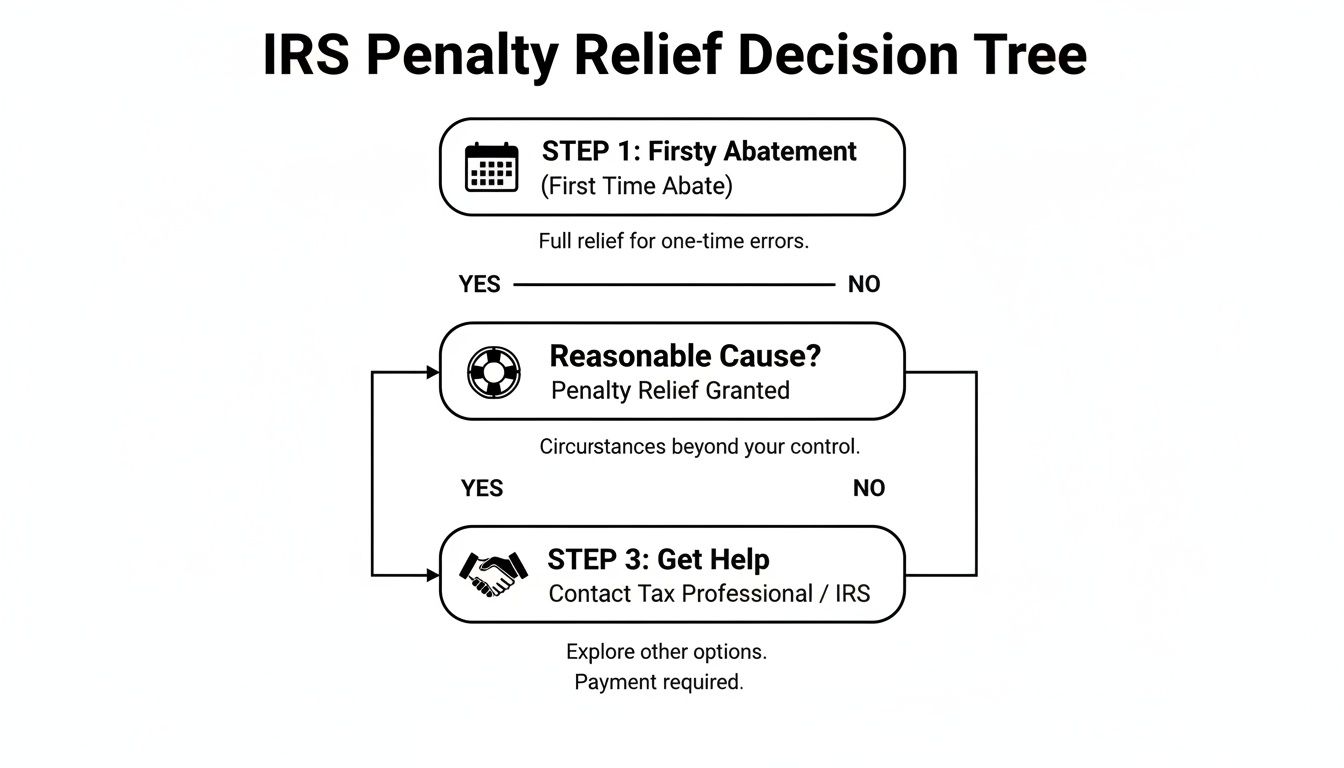
As you can see, it walks you through key questions about your filing history to see if simple options like First Time Abatement or a Reasonable Cause argument might work for you.
When You Genuinely Can't Afford to Pay: Offer in Compromise
You’ve probably heard the ads promising to settle tax debt for "pennies on the dollar." They're talking about an Offer in Compromise (OIC). While an OIC is an incredibly powerful tool, it's also one of the most misunderstood and difficult relief options to get.
An OIC is an agreement with the IRS to settle your tax liability for less than the full amount owed. But they'll only accept it if they are convinced it's the absolute most they could ever hope to collect from you. You have to prove that paying in full would cause you significant economic hardship.
An Offer in Compromise isn't about what feels fair; it's a cold, hard calculation based on the IRS's own formula. They look at your income, expenses, and the equity in your assets to determine your "reasonable collection potential." If their math shows you can pay the debt in full over time, they will reject the offer.
The application process is grueling. You'll submit Form 433-A (OIC), which is a complete financial colonoscopy. They will scrutinize every single detail. But for those who are truly in dire straits, an OIC can be life-changing.
A Temporary Pause Button: Currently Not Collectible Status
What happens when your financial situation is so bleak you can't afford any monthly payment, not even a small one? In these cases, the IRS might place your account in Currently Not Collectible (CNC) status.
Putting an account in CNC status is like hitting the pause button on collections. The IRS will stop sending threatening letters, and they won't levy your bank accounts or garnish your wages.
It's crucial to understand that CNC is a temporary fix, not a permanent solution. The debt doesn't disappear; in fact, penalties and interest keep piling up. The IRS will also check in on your finances periodically, usually every year or two. If your income goes up, they'll expect you to start paying again.
The silver lining? The 10-year statute of limitations on collections keeps running. It's entirely possible for the debt to expire while you’re in CNC status if your financial situation never improves enough to make payments.
To get a more in-depth look at all these options, you can learn more about the IRS Fresh Start Program in our article.
Deciding on the best path forward requires a clear-eyed look at your finances and a solid understanding of how each program works.
Which IRS Tax Relief Option Is Right for You?
Every situation is unique, and figuring out which program fits can be tricky. This table breaks down the most common IRS relief programs to give you a clearer idea of the requirements and who they're designed for.
| Relief Option | Who It's For | Key Requirement |
|---|---|---|
| Installment Agreement | Taxpayers who can afford to pay their debt over time. | A steady source of income sufficient to make monthly payments. |
| Offer in Compromise | Taxpayers with limited income and assets who can't pay their full debt. | Proving that paying the full amount would create an economic hardship. |
| Currently Not Collectible | Individuals with no ability to make any payment due to severe financial hardship. | Documented proof that monthly expenses equal or exceed monthly income. |
| Penalty Abatement | Taxpayers with a clean compliance history or a valid reason for failing to pay/file. | First-time offender (First Time Abate) or a documented "reasonable cause." |
Remember, this is just a starting point. The best choice always depends on the specific details of your financial life.
It's also worth noting how future refunds are handled. If you're owed a refund in a future year while you still have a tax debt, the IRS will automatically apply it to your balance. This is called a refund offset. As of mid-April 2025, the IRS had already issued 86,021,000 refunds totaling $253.116 billion—at an average of $2,942 per person. That's a lot of money that can be automatically rerouted to an old tax bill.
When to Hire a Professional for Filing Back Taxes

You can absolutely handle some back tax situations on your own. But there's a tipping point where a DIY approach goes from being a smart way to save money to a genuinely costly mistake. Recognizing when you've crossed that line isn't admitting defeat; it’s a strategic move to protect your financial future.
When the situation gets complicated, the stakes get much, much higher. Certain red flags are clear signals that you’ve moved beyond a simple filing problem and into serious tax territory where expert guidance is non-negotiable.
Scenarios That Demand an Expert
If you find yourself in any of the following situations, it's time to stop what you're doing and get professional advice before taking another step. Trying to navigate these issues alone is just too risky.
- Significant Tax Debt: Once your total tax bill climbs over $50,000, you can expect the IRS collection process to become far more aggressive. The solutions at this level are also much more complex.
- Unfiled Payroll Taxes: This is one of the most serious tax issues a business can face. The IRS can, and will, hold owners and key employees personally liable for these unpaid taxes via the Trust Fund Recovery Penalty.
- Complex Relief Negotiations: If you're hoping to secure an Offer in Compromise or prove you are Currently Not Collectible, the burden of proof is immense. The paperwork and negotiation process are grueling and designed to be difficult.
- An Audit or Criminal Investigation: If you receive an audit notice or have any inkling you might be under criminal investigation, do not talk to the IRS. Period. Anything you say can be used against you.
The Value of a Tax Attorney
When your case involves these high-stakes problems, a tax attorney provides a level of protection that no other professional can. The most crucial advantage is attorney-client privilege.
This legal shield means our conversations are completely confidential and cannot be used against you. It allows us to have an honest, no-holds-barred discussion about your entire tax history without you having to worry.
In my experience, the difference between a successful resolution and a disastrous outcome often comes down to having an experienced advocate in your corner. We handle the IRS communications, build a strategic defense, and negotiate from a position of strength and deep knowledge of tax law.
For a deeper dive into the specific regulations that might affect your back taxes situation, consulting comprehensive Tax Law resources can be highly beneficial, often underscoring the need for professional guidance.
Ultimately, a no-risk consultation is the best way to get clarity. Unlike a high-pressure sales firm, a genuine professional will analyze your specific situation to map out the best path forward, making sure you fully understand your options before you commit to anything.
The first step to resolving your IRS issues is understanding your options. At Attorney Stephen A Weisberg, I start with a free Tax Debt Analysis to discover if and how I can help you achieve the best possible outcome. Find out how we can help at https://weisberg.tax.


