A Practical Guide to File Back Taxes and Resolve IRS Debt
Feeling overwhelmed by unfiled returns? This guide provides actionable steps to file back taxes, manage IRS penalties, and find a resolution. Start here.
In this article
- Your First Steps to Tackle Unfiled Tax Returns
- Identify Which Tax Years You Need to File
- Start Gathering Your Financial Documents
- Reconstructing Your Financial History
- What Really Happens When You Don't File Your Taxes?
- The One-Two Punch: Penalties and Interest
- How the IRS Forces Collection
- Business Owners Face an Even Greater Risk
- Getting Your Overdue Tax Returns Prepared and Filed
- Nailing Down the Right Forms for Your Situation
- E-Filing Is Out, Paper Filing Is In
- Deciding How to File: A Look at Your Options
- DIY with Tax Software vs. Hiring a Professional
- Setting Up an IRS Installment Agreement
- Exploring Powerful Tax Relief Options
- How to Get Penalties Removed
- When You Truly Cannot Pay Anything
- When It's Time to Hire a Tax Resolution Attorney
- Why an Attorney Is Different Than a CPA
- The Shield of Attorney-Client Privilege
- Red Flags That Scream "Get a Lawyer"
- The Personalized Strategy You Need
- Answering Your Biggest Questions About Filing Back Taxes
- Can I Still Get a Refund If I File Late?
- How Many Years of Unfiled Taxes Do I Really Need to File?
- Will I Have to Pay Everything I Owe All at Once?
Filing your back taxes starts with a few key actions: figuring out which years you've missed, hunting down your income documents (like W-2s and 1099s), and then filling out the right tax forms for those specific years. While you can't e-file older returns, you can always mail them in. Getting them filed is the single most important step you can take to stop penalties from piling up and finally get your tax problems sorted out.
Your First Steps to Tackle Unfiled Tax Returns
Staring at a pile of unfiled tax returns can feel overwhelming, but just taking that first step is often the hardest part. The key is to break the process down into smaller, more manageable pieces. Your main goal here is to switch from a defensive position—where the IRS is calling the shots—to an offensive one where you're in control of the resolution.

I see it all the time: the fear of what might be owed or what the consequences could be is what keeps people from getting started. But ignoring the problem only makes it worse. Penalties and interest just keep growing, turning what might have been a small issue into a major financial headache. Getting proactive is your best defense against the IRS's more aggressive collection tactics.
Identify Which Tax Years You Need to File
Before you start digging through old boxes for paperwork, you need a clear target. How many years are you actually behind? You might have a rough idea, but it’s crucial to confirm exactly which years the IRS considers unfiled.
Luckily, you don't have to guess. The best way to get a definitive answer is by requesting a Tax Account Transcript from the IRS for each of the past several years. This document is a simple summary of your account activity, and it will clearly show a "no return filed" code for any missing years. This gives you an official, reliable starting point.
Pro Tip: As a general rule of thumb, the IRS expects you to file the last six years of tax returns to be considered "compliant" or in good standing. This can vary, though. If you're trying to get a tax lien released or stop a wage garnishment, the requirements might be different.
Start Gathering Your Financial Documents
With your list of missing years in hand, it's time to gather the documents needed to prepare each return accurately. For many, this feels like the most intimidating part, especially if your record-keeping hasn't been perfect.
Here’s a checklist of the key documents to look for:
- Income Statements: This includes W-2s from jobs, 1099-NEC forms if you were an independent contractor, 1099-MISC for other random income, and 1099-K forms if you received payments through services like PayPal or Square.
- Business Records: For the self-employed, this is where you'll need bank statements, credit card statements, profit and loss reports, and any receipts or records of your business expenses.
- Deduction and Credit Info: Look for records of mortgage interest (Form 1098), student loan interest (Form 1098-E), property tax payments, receipts for charitable donations, and anything else you think might be deductible.
Reconstructing Your Financial History
So, what happens if you can't find everything? It's completely normal to be missing a W-2 from five years ago. Don't let that stop you.
The IRS has a fantastic tool called a Wage and Income Transcript. This transcript lists all the income information that was reported to them under your Social Security Number by employers, banks, and other payers. It’s an absolute lifesaver when filing back taxes, as it fills in most of the missing income pieces for you.
For business owners missing receipts, your bank and credit card statements are your best evidence. They create a clear trail of your income and expenses, helping you piece together your financial story for a specific year. If you're wrestling with a long or complicated history of https://www.weisberg.tax/articles/unfiled-tax-returns, bringing in a professional can help you navigate the reconstruction process and ensure you get it right.
What Really Happens When You Don't File Your Taxes?
Ignoring a tax problem is a bit like ignoring a leaky pipe. It doesn’t just go away; it quietly gets worse, causing more and more damage until you’re facing a crisis. The real cost of unfiled taxes isn’t just the original amount you owed. It’s a snowball of penalties, interest, and aggressive collection actions that can completely derail your financial life.

The second that filing deadline passes, your account gets flagged in the IRS system. That's what kicks off the automated process of penalties and interest, which can turn a manageable tax bill into a mountain of debt faster than you’d think. Facing these numbers head-on is the only way to regain control.
The One-Two Punch: Penalties and Interest
The IRS hits non-filers with two primary penalties, and yes, they can stack up at the same time. This compounding effect is what makes falling behind so financially devastating.
- Failure-to-File Penalty: This one usually stings the most. It’s calculated as 5% of your unpaid taxes for each month your return is late, capping out at a painful 25% of your total tax bill.
- Failure-to-Pay Penalty: This penalty is a bit smaller at 0.5% of the unpaid taxes for each month the bill goes unpaid. It also maxes out at 25%.
Now, here’s the kicker. On top of all that, the IRS charges interest—not just on the tax you owe, but on the penalties, too. You’re essentially paying interest on your interest, which is why the debt can seem to grow exponentially.
How the IRS Forces Collection
If penalties and interest don't get your attention, the IRS's collection tools will. Once they’ve sent notices and gotten no response, they have immense power to take what they’re owed.
I’ve seen this happen countless times. Take the case of a freelance graphic designer who let a couple of years slide. First came a Notice of Federal Tax Lien. This is a public legal claim against all her assets—her car, her house, everything. It tanked her credit score overnight. When she still didn't act, the IRS levied her bank account, freezing it and seizing all the funds inside.
With the recent push in IRS enforcement, stories like this are becoming more common. We covered this in detail in our newsletter about how the IRS is cracking down on nonfilers and unfiled returns.
The most disruptive collection tool is often a wage garnishment. This is when the IRS instructs your employer to send them a huge chunk of your paycheck before you even see it. It continues until the debt is paid in full, leaving you with barely enough to get by.
Business Owners Face an Even Greater Risk
If you’re a business owner with employees, the stakes are even higher. The payroll taxes you withhold are called "trust fund" taxes because you’re holding your employees' money in trust for the government.
Failing to remit these taxes is one of the biggest mistakes a business owner can make. The IRS can invoke the Trust Fund Recovery Penalty (TFRP), a brutal measure that allows them to pierce the corporate veil and hold you personally responsible for the debt. This puts your personal assets—your home, your savings, your kids' college fund—on the line to pay for the business’s tax liability.
While the consequences are severe, getting back into compliance is more common than you might think. IRS data shows that in a recent fiscal year, the agency collected $120.2 billion in unpaid taxes beyond what was paid on time. Even after adjustments, that’s $77.6 billion collected from taxpayers who, at some point, were behind and came forward to fix it. You’re not alone in this.
Getting Your Overdue Tax Returns Prepared and Filed
Alright, you've done the hard work of gathering your documents. Now comes the part where we turn that pile of paper into properly filed tax returns and start putting this issue behind you. Filing an old return isn't quite the same as filing for the current year, especially when it comes to the forms you'll use and how you can send them in.
First things first: you absolutely must use the correct forms for each specific year you're filing. You can't just grab a current Form 1040 and use it for a 2018 return. Tax laws, deduction amounts, and even the tax brackets change every single year. Using the wrong form is a surefire way to have the IRS reject your filing.
Thankfully, the IRS keeps a deep archive of all prior-year forms and instructions on its website. A quick search for "Form 1040 2018" or "Form 1120S 2019" will get you exactly what you need.
Nailing Down the Right Forms for Your Situation
The specific forms you need depend entirely on your personal and business situation. It’s rarely just a single form; you often need various schedules and attachments to go with it.
- Individuals (W-2 Employees): Your main form will be the Form 1040 for the specific year you're filing.
- Sole Proprietors & Independent Contractors: You'll start with a Form 1040, but you also have to attach a Schedule C (Profit or Loss from Business). This is where you'll report all your business income and expenses. Don't forget the Schedule SE for self-employment taxes, either.
- S Corporations: This is a two-step process. The S Corp itself files an informational return using Form 1120-S. Then, the net income or loss "passes through" to the shareholders on a Schedule K-1, which you'll report on your personal Form 1040.
If getting your financial data in order feels overwhelming, especially for a business, some people find it helpful to outsource bookkeeping just to get organized for the filing. Remember, clean, accurate books are the bedrock of a solid tax return.
E-Filing Is Out, Paper Filing Is In
This is a major difference from your typical tax season. While the IRS pushes everyone to e-file for current returns, that option is usually off the table for older years. Most tax software platforms shut down e-filing for prior years once the filing season ends, meaning it's generally not available for tax years older than the past two to three years.
For most back tax filings, you’ll have to do it the old-fashioned way: paper file by mailing your returns to the IRS.
Crucial Tip: When you mail your back tax returns, always use USPS Certified Mail with Return Receipt. This is non-negotiable. It gives you official, undeniable proof of the exact date you mailed the returns and a signed card back once the IRS receives them. This little piece of paper can be your best friend if the IRS ever claims your returns were lost or never filed.
Deciding How to File: A Look at Your Options
When it comes to actually preparing and filing your back tax returns, you have a few paths you can take. You can try to handle it yourself with tax software, or you can bring in a professional. The best choice really depends on how complex your situation is.
The table below breaks down the pros and cons of each method to help you decide which route makes the most sense for you.
| Filing Method | Best For | Pros | Cons |
|---|---|---|---|
| DIY with Tax Software | Simple returns, like a W-2 employee with standard deductions. | Cost-effective; you maintain full control; software guides you through the process. | High risk of errors with complex situations; limited to software availability for prior years; no professional to represent you. |
| Hiring a CPA/EA | Moderately complex returns, business owners needing accounting help. | Ensures accuracy; can help organize financials; can represent you before the IRS in many matters. | More expensive than DIY; may not have the legal expertise for severe cases involving potential fraud or criminal charges. |
| Hiring a Tax Attorney | Highly complex cases, multiple missing years, large tax debts, fraud risk. | Offers attorney-client privilege; can handle all IRS communication; can negotiate complex settlements. | The most expensive option; may be overkill for simple, straightforward unfiled returns. |
Ultimately, choosing how to file is about weighing the cost against the potential risks. A simple W-2 return from two years ago is a world away from six years of unfiled S Corp returns with a six-figure tax liability.
DIY with Tax Software vs. Hiring a Professional
Using a prior-year version of tax software can work just fine if your situation is straightforward—say, you were a W-2 employee with just a few deductions. The software will walk you through the forms and handle the math.
But the complexity ramps up fast. A tax attorney becomes less of a luxury and more of a necessity when you're facing:
- Six or more missing tax years.
- Complicated business income and expense tracking.
- A very large anticipated tax debt.
- Any concern about civil fraud penalties or a potential criminal investigation.
When you file, your returns enter a system that handles over 140 million returns annually, giving you a chance to get things right and blend in. You might even be surprised to learn you could be owed a refund if you file within three years of the original due date. Wait any longer, and you forfeit that money forever.
For self-employed people or S corp owners, a tax controversy attorney can manage the entire multi-year filing process. They do more than just ensure accuracy; they provide a critical layer of legal protection. According to these insights into the tax system, professional guidance can be invaluable when navigating the IRS's procedural hurdles.
You've filed your back tax returns. That's a huge step forward, and you should feel a real sense of accomplishment. But now you're staring at the final bill—the total tax, penalties, and interest—and it can feel like a punch in the gut.
Don't panic. Seeing that number is often the hardest part, but the IRS has structured pathways to help you deal with it. The key is to find a solution that works with your actual financial situation so you can stop the debt from getting any worse.
This flowchart gives a good overview of the initial process, from getting your documents in order to figuring out how you'll file.
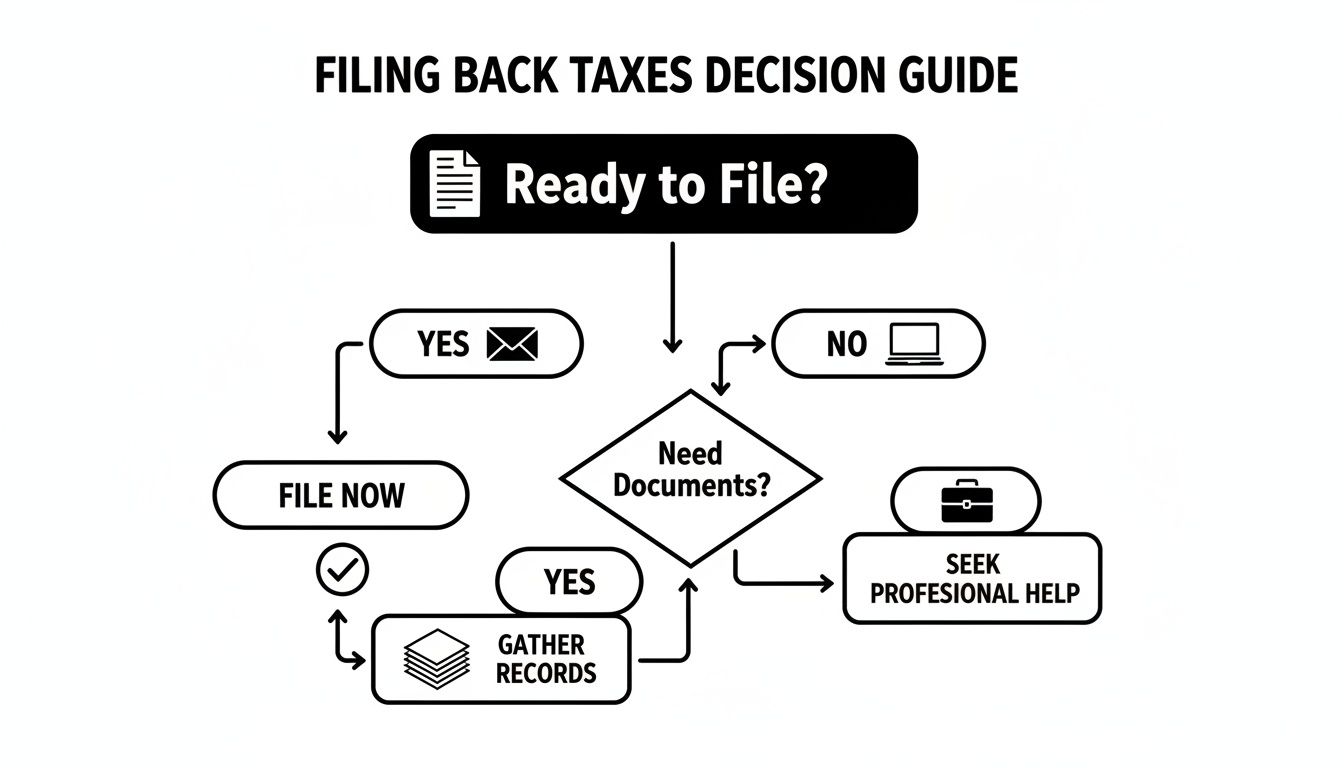
As you can see, having your paperwork ready is the foundation. From there, you can determine the best way to get those returns filed and move on to tackling the debt.
Setting Up an IRS Installment Agreement
For most people, the simplest way to handle tax debt is with an Installment Agreement (IA). Think of it as a straightforward monthly payment plan. You pay what you can afford over time, and in return, the IRS stops aggressive collection actions like wage garnishments or bank levies.
The type of payment plan you can get depends entirely on how much you owe and your financial circumstances.
- Guaranteed Installment Agreement: Owe less than $10,000 in tax? The IRS will generally guarantee you a payment plan, no questions asked.
- Streamlined Installment Agreement: This is the most common option. If your total debt is under $50,000, you can usually set up a plan online without having to submit a mountain of financial paperwork.
- Partial Payment Installment Agreement (PPIA): What if you can't pay the full amount before the 10-year collection statute runs out? The IRS might agree to a PPIA, letting you pay a smaller monthly amount until the debt legally expires.
We break down the nitty-gritty of each of these plans in our ultimate guide to IRS back taxes payment plan strategies.
Exploring Powerful Tax Relief Options
Sometimes, a payment plan just isn't enough. If you're facing genuine financial hardship, the IRS has more powerful relief programs, though they are much tougher to qualify for.
The most famous of these is the Offer in Compromise (OIC). An OIC is an agreement with the IRS to settle your tax debt for less than the full amount owed. It sounds great, and it can be life-changing, but it’s reserved for people in dire financial straits.
To get an OIC approved, you essentially have to prove to the IRS that they'll never be able to collect the full amount you owe. This is called "doubt as to collectibility." The application is incredibly invasive, requiring a deep-dive into every corner of your financial life.
How to Get Penalties Removed
Let’s talk about penalties. They can easily double or triple a tax bill, but they aren't always set in stone. The IRS can and does remove (or "abate") penalties if you have a good reason.
The easiest win here is often the First-Time Abatement (FTA). If you’ve had a clean tax record for the previous three years, you can often get a one-time pass on the failure-to-file and failure-to-pay penalties for a single tax year. It’s a simple request that can save you a fortune.
If you don't qualify for FTA, you might still get penalties waived for Reasonable Cause. This is for situations where life truly got in the way. Valid reasons include:
- A death or serious illness affecting you or your immediate family.
- Your records were destroyed in a fire, flood, or another disaster.
- You relied on bad advice from a tax professional who should have known better.
When You Truly Cannot Pay Anything
What happens when you can't even afford a small monthly payment? If your income is completely swallowed up by basic living expenses, the IRS may place your account into Currently Not Collectible (CNC) status.
CNC is a temporary timeout from collections. The debt doesn't go away—and interest and penalties keep piling up—but the IRS will stop trying to garnish your wages or levy your bank account. It gives you breathing room.
To get CNC status, you have to prove that your necessary monthly expenses are higher than your monthly income. The IRS will revisit your case every year or two, and if your finances improve, they’ll expect you to start paying again. Deciding which of these paths to take is the most important decision you'll make after filing your returns.
When It's Time to Hire a Tax Resolution Attorney
Let’s be honest: tackling a few old tax returns might be something you can handle yourself or with your local CPA. But when the numbers get bigger and the situation gets more complicated, there's a clear line you can cross where DIY becomes a massive risk.
Knowing when you've hit that tipping point—when an experienced tax attorney isn't a luxury but a necessity—is one of the most important decisions you can make to protect your finances and your future.
Why an Attorney Is Different Than a CPA
Many people assume a CPA and a tax attorney are basically the same, but in a serious dispute with the IRS, their roles are worlds apart. A CPA is your go-to expert for accounting and preparing your returns. A tax resolution attorney, on the other hand, is an expert in tax law and your legal advocate.
The difference becomes crystal clear when sensitive information is on the table.
The Shield of Attorney-Client Privilege
The single most powerful tool an attorney brings to your case is attorney-client privilege. This is a legal shield that makes all communication between you and your lawyer completely confidential. The IRS cannot break it. Period.
A CPA or an Enrolled Agent (EA) has a much weaker protection known as the tax practitioner privilege. The big problem? It evaporates the second a criminal investigation begins. If the IRS even suspects you committed fraud, they can put your accountant on the stand to testify against you. Every concern you shared, every mistake you admitted—like knowing you underreported income—can be used as evidence to prosecute you.
Here’s a real-world example: A small business owner got behind on payroll taxes and started using the money to cover rent and other expenses just to keep the doors open. He admitted this to his accountant. If the IRS launches a criminal investigation, that accountant can be forced to share that conversation. Had he told a tax attorney instead, the admission would be 100% protected, allowing them to build a defense strategy without handing the government a confession.
Red Flags That Scream "Get a Lawyer"
Some situations raise the stakes so high that you absolutely need more than a tax preparer. These are the moments when you need a legal defender in your corner.
You should be on the phone with an attorney if you're:
- Facing a Large Tax Debt: Once your total tax bill climbs over $50,000, the IRS collection machine gets much more aggressive. An attorney is equipped to negotiate sophisticated payment solutions that are often beyond the scope of a typical preparer.
- Dealing with Unfiled Payroll Taxes: The IRS takes payroll tax issues incredibly seriously. Because of something called the Trust Fund Recovery Penalty (TFRP), they can hold you personally responsible for the debt, putting your personal savings, your house, and your other assets on the chopping block.
- Worried About Criminal Charges: If you intentionally avoided filing or knowingly fudged the numbers, you need legal protection right away. The first sign of trouble is often a surprise visit from special agents from IRS Criminal Investigation (CI). Don't say a word until you have a lawyer.
- Needing to Fight an IRS Decision: If the IRS has shot down your Offer in Compromise or you're fighting an unfair audit result, an attorney can take your fight to the IRS Office of Appeals or even file a petition in U.S. Tax Court.
Navigating these high-stakes problems requires a deep understanding of tax law, procedure, and negotiation tactics. For more on this, check out our guide on how to find a good tax attorney who truly specializes in these complex cases.
The Personalized Strategy You Need
Those big national "tax relief" companies plaster their ads everywhere, promising to make your problems disappear. But what you usually get is a cookie-cutter approach from a call center. You might talk to a different salesperson every time you call and never even meet the person handling your file.
A dedicated tax resolution attorney works differently. They provide a personalized strategy built around your unique financial situation and goals.
The scale of the problem is huge. The IRS estimates the annual gross tax gap is a staggering $696 billion, with $77 billion of that coming from non-filing alone. To close this gap, the IRS collected $120.2 billion in unpaid taxes in just one recent year. An experienced attorney knows how to use the IRS's own tools—like penalty relief and installment agreements—to secure the best possible outcome for you within that system.
Ultimately, hiring a tax attorney isn't just about getting old returns filed. You're investing in a legal advocate who can shield you with privilege, build a strategic defense, and protect you from the worst consequences the IRS can throw at you.
Answering Your Biggest Questions About Filing Back Taxes
Deciding to tackle your unfiled tax returns is a huge step. It’s also completely normal for that decision to come with a lot of questions and a fair bit of anxiety. Let's walk through some of the most common concerns I hear from clients every day to give you some clear, straightforward answers.
The number one fear most people have? Jail time. Let’s get this out of the way right now: the IRS is a collection agency, not a police force. Their primary mission is to collect revenue and get taxpayers back into the system.
While tax evasion is a real crime, it requires proof that you willfully and intentionally tried to defraud the government. For the overwhelming majority of people who fell behind—maybe due to a lost job, a health crisis, or just plain disorganization—the IRS isn’t looking to build a criminal case. The single best thing you can do to show you’re acting in good faith is to voluntarily file those overdue returns.
Can I Still Get a Refund If I File Late?
Yes, absolutely. But there’s a catch, and it’s a big one. You only have a three-year window from the original tax deadline to claim a refund. This is called the Refund Statute of Limitations, and the IRS is incredibly strict about it.
For instance, your 2020 tax return was originally due in April 2021. To get that refund, you had to file by April 2024. If you file now, any money that was rightfully yours is gone forever—forfeited to the U.S. Treasury. It's a "use it or lose it" situation.
I can't tell you how many times I've seen people miss out on thousands of dollars simply because they waited too long. Millions in unclaimed refunds are lost every single year. Don't let that be you.
How Many Years of Unfiled Taxes Do I Really Need to File?
This is where things get a bit more nuanced. While technically you're supposed to file every return you missed, the IRS has an unwritten policy that filing the last six years will usually get you back into compliance. This is an internal guideline, not a law, but it’s what revenue officers generally look for to consider your case current.
However, this "six-year rule" isn't set in stone. There are a few key exceptions:
- You're a High-Income Earner: If you've historically earned a high income, the IRS might dig deeper and require you to file more than six years of returns.
- You Have a Specific Need: Sometimes you need to file older returns to qualify for a mortgage, remove a stubborn tax lien, or deal with another specific financial issue.
- Business or Payroll Taxes are Involved: These are a different beast entirely. The IRS takes unfiled payroll taxes very seriously and will almost always demand a more complete filing history.
The real goal is to convince the IRS you're serious about getting compliant. For most individuals, hitting that six-year mark is the key.
Will I Have to Pay Everything I Owe All at Once?
This is probably the biggest myth out there, and it stops so many people from even starting. The answer is absolutely not. The IRS knows that most people with a large tax debt can't just write a check for the full amount.
Filing your returns is the key that unlocks the door to all the payment solutions. Once the IRS knows exactly what you owe, you can start exploring your options. You might set up a monthly payment plan, negotiate a settlement for a fraction of the debt through an Offer in Compromise, or even have your account declared "Currently Not Collectible" if you're facing serious financial hardship.
But none of that can happen until the returns are filed.
Facing a pile of unfiled tax returns is incredibly stressful, but you don’t have to do it alone. At Attorney Stephen A Weisberg, we always start with a FREE Tax Debt Analysis. This lets us understand your specific situation and figure out the best way forward before you ever pay us a dime. Take the first step toward resolving your tax issues today by visiting us at https://weisberg.tax.


