Failure to File Penalty Explained and How to Resolve It
Understand the failure to file penalty, how it compounds monthly, and proven relief options. Learn actionable steps to reduce or eliminate IRS penalties.

In this article
- What the Failure to File Penalty Is
- Why the IRS treats late filing so aggressively
- How the Penalty Is Calculated and Compounds Over Time
- What the monthly compounding looks like in practice
- The 60-day minimum catches people off guard
- Comparing Failure to File with Other IRS Penalties
- The practical differences that matter
- IRS Relief Options and What Qualifies
- Reasonable cause is evidence-driven
- First-time abatement is narrower than people think
- What the IRS is looking for now
- Step-by-Step Actions to Address Assessed Penalties
- The immediate sequence that usually works best
- When professional help becomes worth it
- Preventing Future Penalties and Protecting Your Tax Position
- Habits that reduce exposure
The IRS assessed about 3 million failure-to-file penalties in fiscal year 2023, totaling roughly $6 billion. That works out to an average of about $2,000 per assessment, and about $2 billion of those assessed dollars were later removed through abatements or corrections, which tells you two things at once, this penalty is common, and relief is real when the facts support it.
A lot of people still think the failure to file penalty is just a nuisance charge. It isn't. It's a monthly penalty that starts quickly, stacks fast, and can become the bigger problem even when the tax itself isn't huge. If you're dealing with an unfiled return, a late filed return, or a notice that seems to assume the worst, the mechanics matter more than the slogans.
What the Failure to File Penalty Is
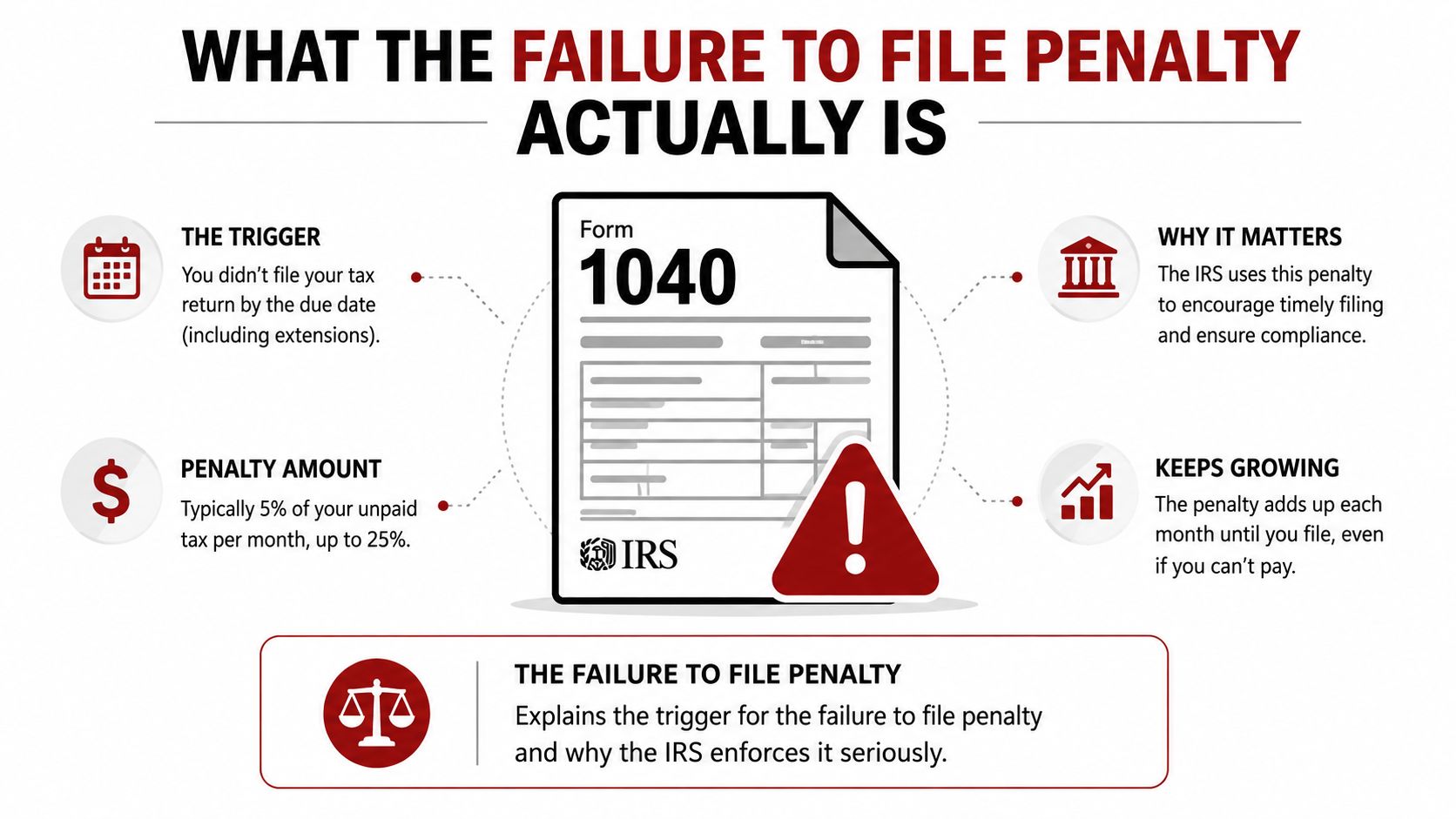
The failure to file penalty applies when a required return is not filed by the deadline, including a valid extension deadline. Under IRC §6651(a)(1), the IRS generally charges 5% of the unpaid tax per month or part of a month, up to 25%. Once a return stays unfiled long enough, the filing penalty can reach its full cap in roughly five months.
Why the IRS treats late filing so aggressively
The IRS uses this penalty because a filed return gives the agency the numbers it needs to assess tax, match payments, and move the case into the right processing track. In fiscal year 2023, the IRS assessed about 3 million of these penalties, which shows how often missed filing deadlines are treated as a compliance issue, not a paperwork mistake. The structure has stayed severe for a reason, late filing disrupts tax administration and often points to broader compliance risk. A useful overview of late filing consequences is also available in Stewart Accounting Services' guide to late filing penalties.
A common mistake is to assume that if payment is not possible, filing can wait. That usually makes the situation worse. Late filing starts the filing penalty, and delay can also keep the failure-to-pay penalty running, so the total exposure grows instead of shrinking.
Practical rule: filing late is almost always better than not filing at all, even when payment cannot happen yet.
The distinction matters even more for business owners and self-employed taxpayers. Income tax returns, information returns, and payroll-related filings do not carry the same rules, and a missed deadline can produce different consequences depending on what was supposed to be filed. For taxpayers with long-unfiled returns, a practical starting point is often to identify the scope of the missing filings, which is covered in this resource on unfiled tax returns.
How the Penalty Is Calculated and Compounds Over Time
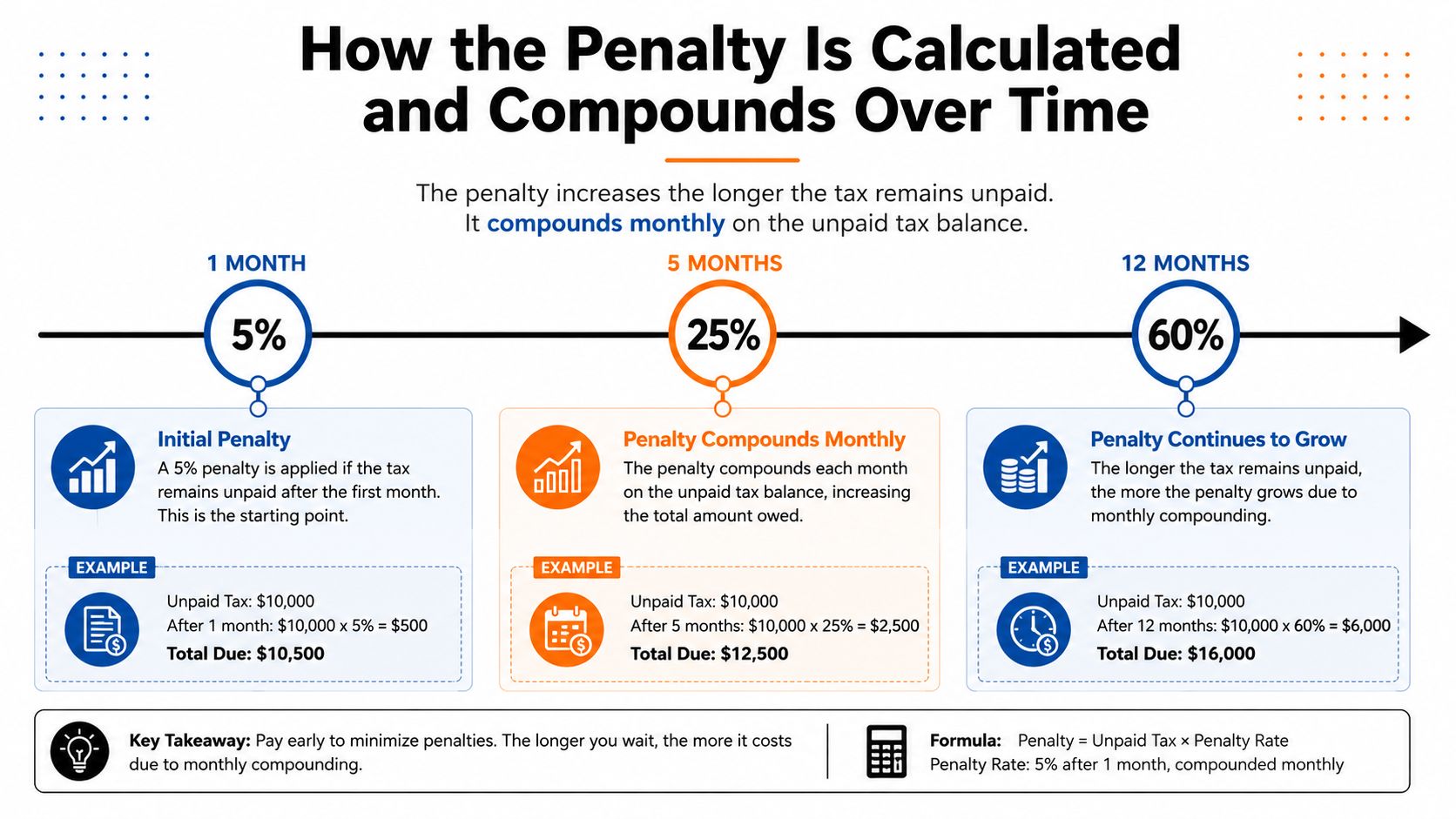
The math is simple, but the consequences aren't. The filing penalty is based on the unpaid tax shown on the return, and each month or part of a month counts as a month for penalty purposes. So a return filed one day late still starts a monthly cycle, which is why short delays can create outsized results.
What the monthly compounding looks like in practice
A taxpayer who owes $10,000 and files one month late is generally looking at $500 in filing penalty exposure for that first month, before other charges are considered. At five months, the filing penalty reaches the 25% cap, which means the penalty on that same balance would generally top out at $2,500 if the return still hasn't been filed. The point isn't the exact figure in every case, it's that the penalty stops growing as a percentage only after it reaches the cap, not before.
The IRS also charges the failure-to-pay penalty in the same month when both apply, but it reduces the filing penalty by the payment penalty amount in those overlapping months. That means the combined exposure isn't as simple as adding rates together. Operationally, the return stays expensive until it's filed, and every month of delay can preserve more than one penalty track at the same time.
Here's the key practical distinction: filing late with no payment is still usually better than not filing, because filing stops the filing penalty from continuing to stack. On the other hand, filing a return that's incomplete or not properly processed can leave the case in a bad position, since the IRS's system can still assess the charge on late-filed complete returns automatically.
The filing deadline creates the risk, but the late-filed return is what usually tells the IRS how much tax is at stake.
For a sole proprietor with a meaningful balance due, the numbers can escalate fast because the penalty is tied to the unpaid tax shown on the return, not to a subjective notion of “how late” the taxpayer feels. A taxpayer who ends up owing nothing after withholding and credits is in a different position, which is why the return type and the actual tax due matter more than some might assume. A step-by-step tax liability framework is useful here, and the mechanics are discussed further in this calculate tax liability step by step guide.
The 60-day minimum catches people off guard
If a return is more than 60 days late, the IRS says the minimum filing penalty for returns required in 2026 is the lesser of $525 or 100% of the tax owed. That floor can matter more than the percentage calculation on low-balance returns, because a taxpayer with a small amount due may be hit by the minimum instead of a tiny percentage-based result. In other words, late filing can become expensive even when the balance due is modest.
Comparing Failure to File with Other IRS Penalties
The failure to file penalty gets mixed up with other IRS penalties because they all sound similar in notices and correspondence. They're not the same. The filing penalty punishes delay in submitting the return, the payment penalty addresses unpaid tax, and the trust fund recovery penalty is aimed at unpaid payroll taxes that were collected from employees but not turned over to the government.
The practical differences that matter
The failure to pay penalty is generally 0.5% per month, capped at 25%, which is much less severe than the filing penalty's 5% per month rate. That's why filing on time, even without payment, is usually the better move. The trust fund recovery penalty is a different animal entirely, because it can apply in payroll-tax cases where a responsible person failed to remit amounts withheld from workers.
| IRS Penalty Comparison | Monthly Rate | Maximum Cap | Primary Trigger | Relief Options |
|---|---|---|---|---|
| Failure to file penalty | 5% | 25% | Return not filed on time | Reasonable cause, administrative relief |
| Failure to pay penalty | 0.5% | 25% | Tax not paid by due date | Reasonable cause, payment arrangements, relief procedures |
| Trust fund recovery penalty | Case-specific, not a simple monthly filing rate | Not framed as a monthly cap in the same way | Unpaid payroll trust fund taxes | Factual defenses, responsible-person analysis, relief procedures |
The overlap is where many cases go wrong. A business owner can face a late filing penalty on the income tax side and separate payroll exposure on the employment tax side, and those issues don't cancel each other out just because one notice arrived first. Business owners also need to watch for stacked penalties, because one delinquency can create more than one assessment path.
Bottom line: penalty type controls strategy. Treating every IRS penalty as the same problem leads to bad advice and missed relief opportunities.
The trust fund penalty deserves special attention because it's not based on the same return-filing logic as an individual income tax filing penalty. It's focused on whether trust fund amounts were collected and then paid over, which is why payroll tax cases require a separate analysis and often a very different defense plan. If someone tells you all IRS penalties are solved the same way, they're oversimplifying a system that's built to distinguish among several different kinds of noncompliance.
IRS Relief Options and What Qualifies
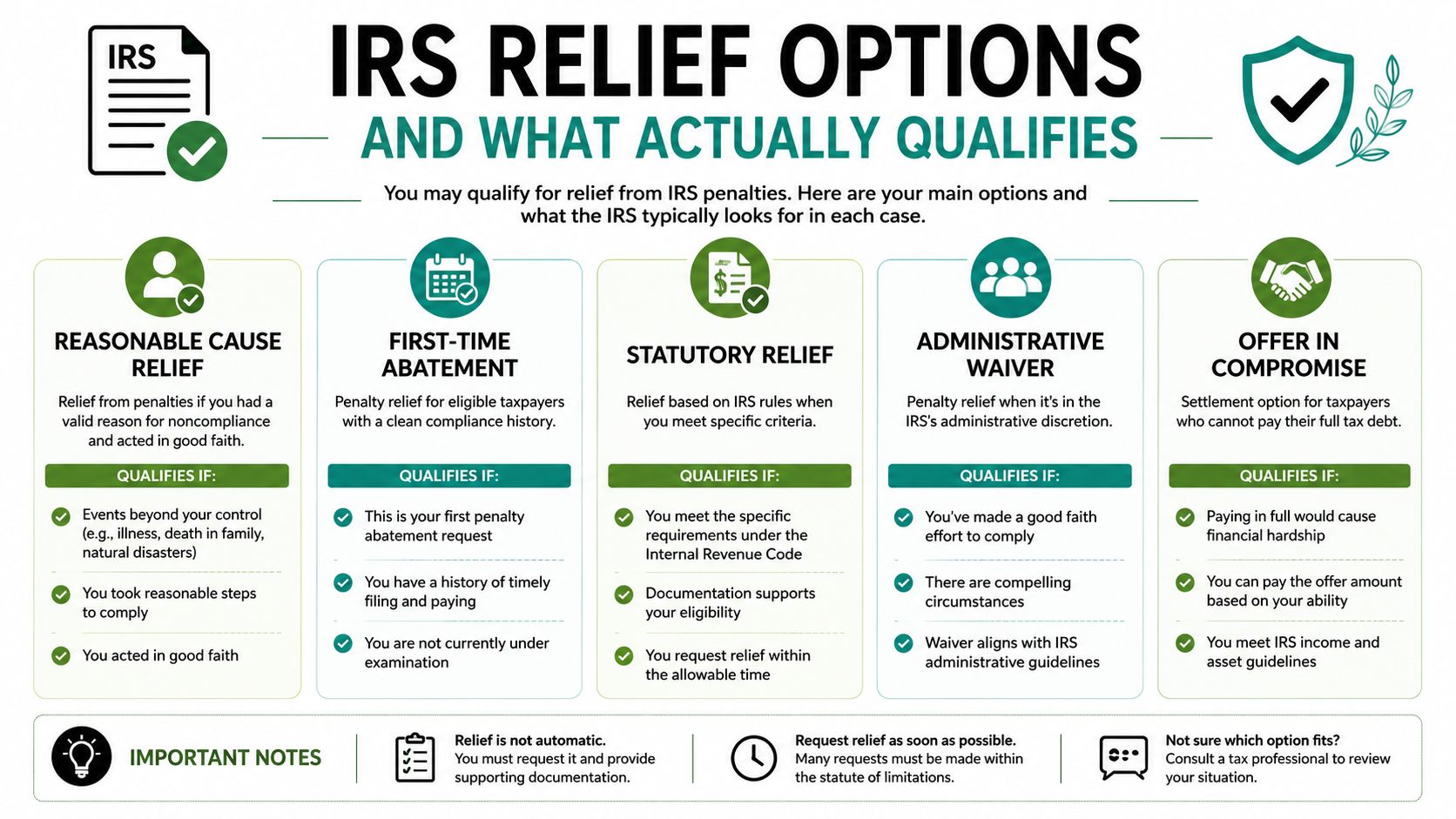
The IRS does grant penalty relief, but it does not hand it out for vague frustration or a promise to do better next year. The agency says it can provide administrative penalty relief, and the strongest requests are built on facts, records, and a clean compliance story. Assessed penalties are not always the end of the matter.
Reasonable cause is evidence-driven
Reasonable cause relief is the main statutory path when something beyond the taxpayer's control caused the late filing. The IRS looks for documented events like natural disasters, serious illness, death in the family, or destroyed records. That is a very different standard from “I was overwhelmed” or “I forgot,” and that is where many requests fail.
The documentation has to match the story. Medical records, death certificates, insurance documents, casualty reports, correspondence showing access problems, and a timeline of the event can matter more than a polished explanation. A request that reads like a factual record is easier to support than one that reads like a complaint letter.
First-time abatement is narrower than people think
First-time administrative relief is generally for taxpayers with a clean compliance history. The Tax Advocate materials describe the historic first-time abatement concept as available for certain filing, payment, and deposit penalties when the taxpayer had a clean history for the prior three years. That makes it a useful tool, but only if the compliance record supports it.
The common mistake is to ask for first-time relief without checking whether prior returns were filed and whether prior penalties already exist. That is a fast way to get a polite denial. The request has to fit the taxpayer's record, not the other way around.
A focused request package helps. At minimum, I would want the notice, the relevant tax period, proof of filing or late filing, and a short factual statement that ties the event to the missed deadline. For a more detailed walkthrough of the process, see penalty abatement.
What the IRS is looking for now
Current IRS guidance puts more weight on documented facts and compliance history than on generic hardship language. That matters because it rewards taxpayers who can show a real explanation and a record of prior compliance. It also means a well-prepared request can succeed where a phone call and a complaint will not.
Step-by-Step Actions to Address Assessed Penalties
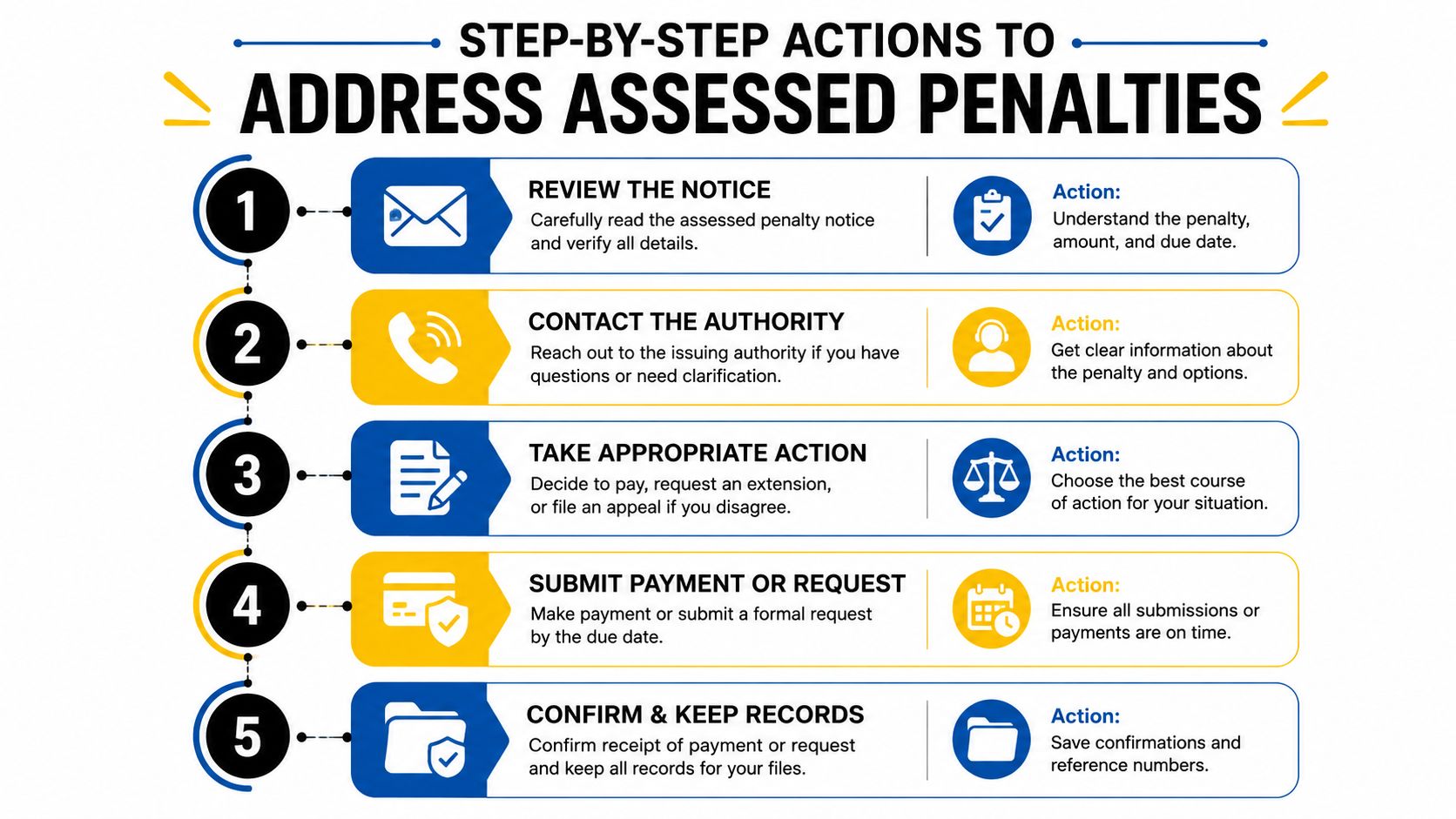
The first move is to open the notice and verify that the IRS got the underlying tax amount right. Duplicate assessments, wrong filing periods, and transcription errors happen, and if the base tax is wrong, the penalty computation can be wrong too. Don't start with a penalty argument until the assessment itself has been checked.
The immediate sequence that usually works best
- Confirm the notice details. Match the tax year, return type, and penalty code to the return history.
- File every missing return. Filing stops more filing penalty from building, even if payment isn't available yet.
- Gather relief evidence. Build the factual record before contacting the IRS.
- Request abatement in the right format. Some cases can be handled by written request, others need Form 843.
- Track the response and follow up. Keep copies of everything sent and note the date of mailing or submission.
That sequence matters because the IRS can process late-filed complete returns systemically starting in processing year 2022, so the penalty can be generated automatically when the late return hits the system. A missing return is a moving target, and waiting only leaves the case open longer. The practical play is to file first, then argue relief with the penalty frozen in place as much as possible.
For taxpayers who haven't filed in years, the consequences are more severe and the paperwork load gets heavier. A useful reference for that situation is this guide on haven't filed taxes in 3 years, because the strategy changes once the delinquency is old enough to involve multiple periods and collection activity.
When professional help becomes worth it
A tax attorney or experienced controversy practitioner becomes much more useful when the case involves collection, repeated noncompliance, payroll issues, or more than one penalty type. At that point, the issue isn't just filing a return, it's sequencing the filing, building the abatement request, and protecting the taxpayer's position if the IRS pushes back. One option for that kind of support is Tax Attorney Stephen A Weisberg, who handles IRS penalty matters and delinquent return issues through a direct case review process.
If the notice already led to collection pressure, the wrong letter can make the problem worse. A clean, documented request usually beats a rushed phone call.
Taxpayers in installment agreements or collection negotiations should remember that penalty relief and payment relief are related but not identical. A filing fix can improve the collection posture, but it doesn't replace a thoughtful approach to the rest of the debt. That's why the paperwork should be organized before the first substantive contact, not after the IRS has already made assumptions.
Preventing Future Penalties and Protecting Your Tax Position
The cheapest penalty is the one that never gets assessed. For people with steady W-2 income, that's mostly a filing calendar problem. For self-employed taxpayers, partnerships, S corporations, and businesses with payroll, it's a year-round compliance problem, because estimated payments, payroll deposits, and document gathering all affect whether the next return is clean.
Habits that reduce exposure
File extensions when needed, but remember that an extension usually gives more time to file, not more time to pay. Keep records organized during the year so the return doesn't become a scavenger hunt in March or April. Address IRS notices quickly, because silence turns a correctable issue into a collection file.
The taxpayers most exposed to repeat penalties are usually the ones with irregular cash flow or complex reporting. Independent contractors and owners of pass-through entities often have tax liability before they feel ready to pay it, and that's where planning beats improvisation. Estimated tax discipline matters because it lowers the chance that a late return will also show a meaningful unpaid balance.
For families and small business owners who are overwhelmed by filing backlogs, practical help can come from outside the tax niche too. Morgan & Morgan's page on how Morgan & Morgan helps Athens families is a reminder that people often need coordinated support when tax issues overlap with life events, legal problems, or financial strain. The right professional doesn't need to be the loudest one, just the one who understands the downstream consequences.
A good compliance history also matters because it keeps relief options open later. That's true whether the issue is a one-time mistake or a pattern that needs cleanup. If you're already behind, the smartest move is usually to file what's missing, document what happened, and get ahead of the next deadline before the IRS has another reason to assess a new penalty.
Tax Attorney Stephen A. Weisberg helps taxpayers and business owners deal with unfiled returns, IRS penalty exposure, and penalty abatement strategy based on the facts of the case. If you're facing a failure to file penalty or a stack of IRS notices, visit Tax Attorney Stephen A Weisberg to see how a focused case review can help you decide the next move.


