Does the IRS Garnish Wages? Understanding the Process
Facing tax debt? Learn the answer to 'does the IRS garnish wages,' see the warning signs, and discover your options to stop a levy and resolve your tax issues.

In this article
- Levy vs. Garnishment: Why the Difference Matters
- IRS Levy vs Private Creditor Garnishment at a Glance
- What Income Can the IRS Target?
- The IRS Warning Notices Before a Levy Begins
- The Paper Trail Leading to a Levy
- The Final Notice and Your 30-Day Window
- How Much Can the IRS Actually Take From Your Paycheck?
- The IRS Exemption Formula Explained
- A Look at the Harsh Numbers
- What This Looks Like in the Real World
- A Warning for Independent Contractors
- Your Employer's Role in an IRS Levy
- What Happens When Your Employer Gets the Notice
- The Consequences of Non-Compliance for Employers
- Proven Strategies to Stop an IRS Wage Levy
- Negotiate an Installment Agreement
- Settle for Less With an Offer in Compromise
- Qualify for Currently Not Collectible Status
- Exercise Your Right to an Appeal
- Special Risks for Business Owners and the Self-Employed
- The Trust Fund Recovery Penalty: A Business Owner's Nightmare
- Got Questions About IRS Wage Levies? We Have Answers.
- How Long Will the IRS Keep Taking My Paycheck?
- Can They Really Take My Social Security?
Yes, the IRS can absolutely take money from your paycheck. But there's a crucial distinction in how they do it that gives them far more power than a typical creditor.
While most people ask, "can the IRS garnish your wages," the term they actually use is a wage levy. This isn't just a matter of semantics—it’s a completely different legal process.
Levy vs. Garnishment: Why the Difference Matters
Think about a credit card company or a medical provider you owe money to. For them to get a piece of your paycheck, they have to go through a long process: sue you, win in court, and then get a judge to issue a wage garnishment order. It’s a formal, court-supervised action.
The IRS gets to skip all of that.
Thanks to its federal authority, the IRS doesn't need to ask a judge for permission. After they’ve sent the required legal notices, they can directly order your employer to start sending them a portion of your pay. This administrative power makes the IRS wage levy incredibly fast and aggressive, often catching people by surprise.
IRS Levy vs Private Creditor Garnishment at a Glance
To see just how different these two processes are, let's break it down. The table below highlights the key advantages the IRS has when it comes to collecting a debt from your wages.
| Feature | IRS Wage Levy | Private Creditor Wage Garnishment |
|---|---|---|
| Court Order Required? | No | Yes |
| Process Speed | Fast (administrative action) | Slow (requires a lawsuit and judgment) |
| Amount Taken | Based on federal tables (can be significant) | Limited by state and federal laws (often capped at 25%) |
| Legal Authority | Direct federal power | Requires court approval |
As you can see, the IRS plays by a different set of rules, which is why a wage levy is such a serious financial threat.
What Income Can the IRS Target?
This powerful collection tool isn't just for traditional paychecks. The IRS can go after almost any money you earn, which puts a wide range of people at risk.
- W-2 Employees: Your regular salary and hourly wages are the primary target.
- Independent Contractors: Payments for your freelance work (1099 income) are fair game.
- Bonuses & Commissions: That extra income you were counting on can be seized, too.
The most relentless part of an IRS levy is that it’s continuous. Once your employer receives that notice, they are legally required to keep sending a portion of every single paycheck to the IRS. It doesn't stop until the debt is fully paid or you make an official arrangement with the IRS to release it.
This ongoing nature is what can make an IRS levy so devastating. It’s not a one-time seizure; it's a constant drain on your income until you take action to resolve the underlying tax problem.
The IRS Warning Notices Before a Levy Begins
The IRS doesn’t just show up at your office one day and start taking your money. A wage levy is the last resort, the final play in a very predictable game that begins with a series of letters mailed right to your door. Think of it less like a surprise attack and more like a slow, steady drumbeat of warnings that get louder over time.
Ignoring these letters is the fastest way to get a real-world, and very painful, lesson in how the IRS collects its debts. But if you understand the sequence, these scary-looking notices transform into a roadmap, giving you multiple off-ramps to resolve the problem before your employer ever gets involved.
The Paper Trail Leading to a Levy
The IRS collection process follows a well-worn path. While the exact notice numbers can sometimes vary, the progression is always the same. It starts with a gentle reminder and ends with a final, legally binding demand. This paper trail is your early warning system—pay attention to it.
- First Bill (e.g., Notice CP14): This is the first official "you have a balance due" letter. It's surprisingly polite, clearly stating what you owe and why.
- Reminder Notices (e.g., CP501, CP503): If that first bill goes unpaid, you'll start getting follow-ups. The tone gets a bit more assertive with each notice, and they'll be sure to mention the mounting penalties and interest.
- Notice of Intent to Levy (CP504): This is where things get serious. This notice isn't just a reminder; it's an explicit threat stating the IRS intends to seize your assets, including things like your state tax refund, if you don't pay up.
This is where the unique power of the IRS really comes into play. Unlike a credit card company or a medical provider, they don't need to ask a judge for permission.
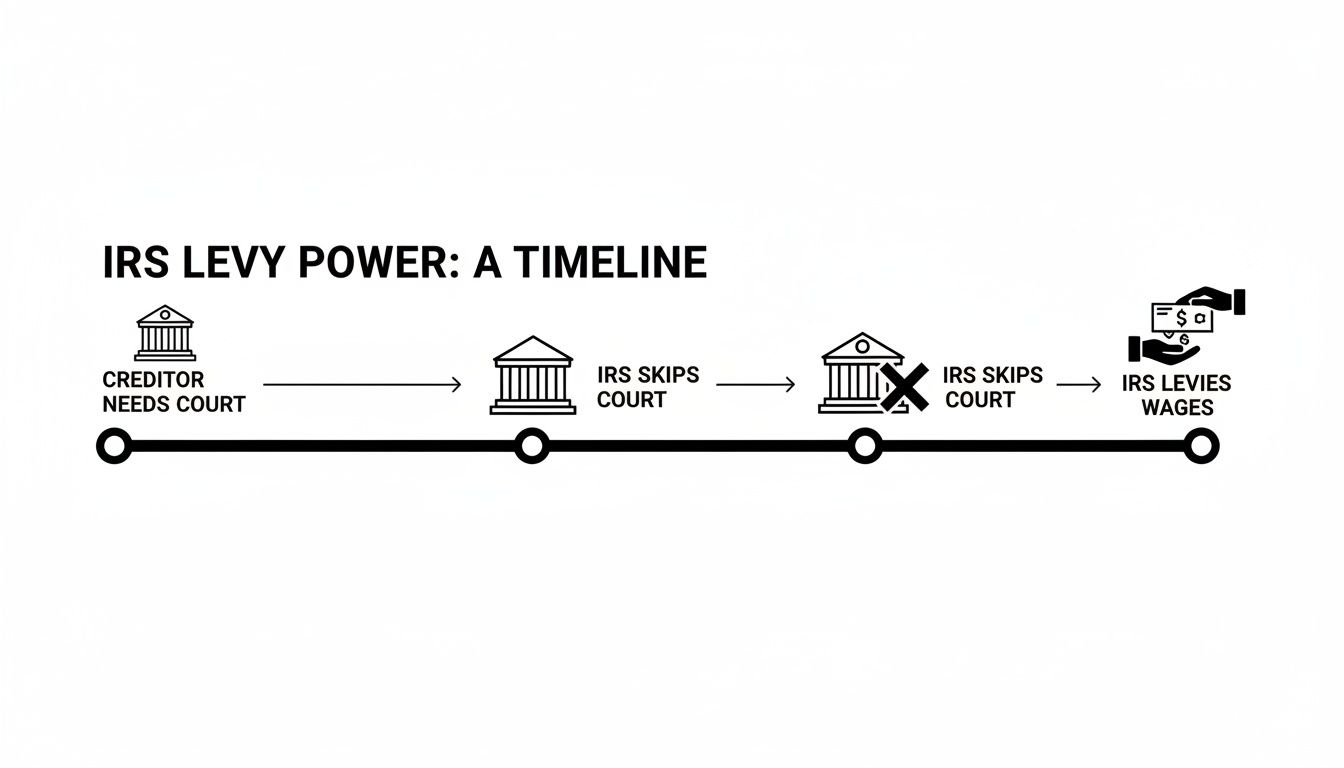
The crucial difference is that the IRS has the direct authority to levy your property and wages without going to court. This makes their collection process incredibly fast and powerful.
The Final Notice and Your 30-Day Window
Out of all the mail you'll get, one document is the most critical: the Final Notice of Intent to Levy and Notice of Your Right to a Hearing. This is usually a Letter 1058 or an LT11. When this letter arrives, it officially starts a 30-day countdown.
This isn't just another reminder; it's the final legal box the IRS has to check before they can legally contact your employer and start taking your wages. This 30-day window is your last, best chance to formally appeal the levy or work out a different payment arrangement.
The whole process kicks off with an initial bill (like Notice CP14) after you file. This is followed by a series of reminders (CP501, CP503, and CP504), all leading up to that critical Final Notice (Letter LT11 or 1058). Once that final notice is sent, you have just 30 days to respond before they can reach out to your employer and start the levy. To get a deeper dive into these letters, you can learn more about the specifics of what is a levy notice from our detailed guide.
How Much Can the IRS Actually Take From Your Paycheck?
Forget everything you know about typical wage garnishments. When a private creditor comes after your wages, they’re usually limited to taking about 25% of your disposable income. The IRS doesn't play by those rules. Their method is far more aggressive and can leave you with a shockingly small amount of money to live on.

Here’s the critical difference: instead of taking a percentage, the IRS formula works backward. It first calculates a small, fixed amount you are allowed to keep. After that tiny exemption, they take everything else.
The IRS Exemption Formula Explained
Your employer is required to use the tables found in IRS Publication 1494 to figure out how much of your pay is protected. This "exempt" amount is basically your standard deduction and personal exemptions, just broken down by your pay period (weekly, bi-weekly, monthly).
The problem is, these numbers are based on national averages and have nothing to do with your real-world expenses. Your mortgage, car payment, or sky-high utility bills? The IRS formula doesn't care. They have a set number, and that’s what you get to keep.
The most important thing to grasp is this: the IRS doesn't calculate what they can take; they calculate what you can keep. This fundamental difference is why an IRS wage levy feels so much more severe than a standard garnishment. It's designed for maximum collection pressure.
A Look at the Harsh Numbers
To show you just how little the IRS leaves on the table, here are a few examples of the monthly exempt amounts based on their 2024 tables.
Sample Exempt Amounts From an IRS Levy (Monthly Pay)
| Filing Status | Number of Exemptions Claimed | Monthly Amount You Keep |
|---|---|---|
| Single | 1 (Yourself) | $1,216.67 |
| Married Filing Separately | 1 (Yourself) | $1,216.67 |
| Married Filing Jointly | 2 (You and Spouse) | $2,433.33 |
| Married Filing Jointly | 4 (You, Spouse, 2 Children) | $3,200.00 |
| Head of Household | 2 (You and 1 Child) | $2,125.00 |
| Head of Household | 3 (You and 2 Children) | $2,491.67 |
As you can see, even with dependents, the amount you’re left with is nowhere near enough to cover the average American's cost of living. This is the financial squeeze the IRS uses to force taxpayers to resolve their debt.
What This Looks Like in the Real World
Let's run the numbers to see how this plays out for different people.
Example 1: The Single Filer Imagine you’re a single person with no dependents, and you take home $4,000 a month after taxes. According to the IRS tables, your exempt amount is just $1,216.67.
- Your Monthly Net Pay: $4,000
- Your Monthly Exempt Amount: $1,216.67
- Amount Your Employer Sends to the IRS: $2,783.33
In this all-too-common scenario, the IRS is taking nearly 70% of your take-home pay. You’re left with just over $1,200 to cover rent, food, gas, and everything else for an entire month.
Example 2: The Head of Household with Dependents Now, let's say you're a Head of Household with two children, earning that same $4,000 per month. Your exempt amount is higher because of the kids.
- Your Monthly Net Pay: $4,000
- Your Monthly Exempt Amount: $2,491.67
- Amount Your Employer Sends to the IRS: $1,508.33
While this is still a massive financial hit, having dependents provides a bit more of a buffer. It's crucial to get a handle on the specifics, so be sure to understand what's inside the IRS wage levy formula.
A Warning for Independent Contractors
If you think the situation is tough for W-2 employees, it’s even more dangerous for freelancers and independent contractors. When the IRS levies a payment from one of your clients (a 1099 payment), there are often no exemptions at all.
The IRS can simply instruct your client to send them 100% of what they owe you. That entire invoice payment goes straight to the government, leaving you with absolutely nothing from that project. For anyone who is self-employed, this makes resolving tax debt an immediate and urgent priority.
Your Employer's Role in an IRS Levy
So, you have a tax problem, but how does your employer get dragged into it? It’s not by choice. Once the IRS decides to levy your wages, your employer gets an official, legally-binding order that they simply can't ignore.
This order, a Form 668-W, Notice of Levy on Wages, Salary, and Other Income, transforms your employer from a bystander into a direct participant in the IRS's collection process. It's crucial to understand that they aren't choosing to take your money; the federal government is compelling them to.
What Happens When Your Employer Gets the Notice
The moment that levy notice lands in your company’s HR or payroll department, the clock starts ticking. They are required to act immediately.
First, they must give you a copy of the notice, which includes an exemption claim form (Part 3 of the Form 668-W). You have a very small window of time to fill this out and return it. This form is your only way to tell them how much of your pay is legally protected from the levy based on your filing status and dependents.
If you don't return that form, the law requires your employer to calculate your exemption based on a "married filing separately with zero dependents" status. This is the absolute worst-case scenario, as it results in the lowest possible exemption and lets the IRS take the maximum possible amount from your paycheck.
Don't delay. Your employer must start withholding funds from the very next full pay period after receiving the notice. There's no grace period for them to wait or for you to figure things out.
The Consequences of Non-Compliance for Employers
You might be thinking, "What if my boss is a great person and just ignores the notice to help me out?" Unfortunately, the IRS has already thought of that, and the consequences for the employer are severe.
An employer who fails to honor an IRS wage levy doesn't just get a slap on the wrist. They can be held personally liable for the full amount of your tax debt, plus a staggering 50% penalty on top of it all. This puts the business in incredible financial jeopardy.
Here’s what that looks like:
- Personal Liability: The business owner or the person responsible for payroll could be forced to pay your tax bill out of their own pocket.
- Heavy Penalties: A 50% penalty is tacked on for the failure to surrender the funds as ordered by the levy.
This is why even the most loyal and supportive boss will comply without question. The system is designed to make non-compliance a risk that no business owner can afford to take. The immense pressure on the employer is a key reason why an IRS wage levy is so effective.
Proven Strategies to Stop an IRS Wage Levy

Getting that official IRS notice about a wage levy can feel like hitting a financial brick wall. It’s overwhelming. But the most important thing to know is that this isn't a permanent sentence. While a levy is one of the IRS's most powerful collection tools, you have several proven ways to fight back and regain control of your paycheck.
The trick is to be proactive. The IRS isn't looking to ruin you; their main goal is simply to get you back into compliance. Once you open a line of communication and show you're serious about resolving the debt, they provide official pathways to get the levy released.
Negotiate an Installment Agreement
One of the most straightforward methods to stop a levy is to get into a formal Installment Agreement (IA). Think of it as a structured monthly payment plan, negotiated directly with the IRS, to clear your tax debt over an extended period.
As soon as your IA is officially approved, the IRS is required to release the wage levy. The main requirement is that you must have filed all your past-due tax returns. Depending on what you owe and your financial situation, there are different types of agreements available.
Settle for Less With an Offer in Compromise
An Offer in Compromise (OIC) is exactly what it sounds like: an agreement where the IRS accepts less than the full amount you owe to settle your tax liability. This path is reserved for people facing genuine, significant financial hardship.
An OIC isn't just a simple negotiation. The IRS uses a rigid formula to see if you qualify, looking closely at your ability to pay, your income versus expenses, and the equity in your assets. If they accept your offer, the wage levy stops.
Be prepared for a deep dive into your finances. The process is demanding and requires a mountain of paperwork, but for those who qualify, it’s a true fresh start.
Qualify for Currently Not Collectible Status
If your financial situation is so severe that you can't cover basic living costs, you might qualify for Currently Not Collectible (CNC) status. This is a temporary pause button. The IRS agrees to halt all collection actions—including wage levies—because taking any money would cause you an undue economic hardship.
To get CNC status, you have to prove your financial state with detailed documentation. Your tax debt doesn't disappear—penalties and interest will continue to pile up—but the IRS will stop taking your wages. This can provide the crucial breathing room you need to get back on your feet. For more on this, you can check out our detailed stop IRS wage garnishment guide.
Exercise Your Right to an Appeal
That Final Notice of Intent to Levy isn't just a threat; it's a legal document that grants you rights. Specifically, it gives you the right to a Collection Due Process (CDP) hearing. You have a strict 30-day window from the date on that letter to file Form 12153 and formally request your hearing.
The moment you file for a CDP hearing, the IRS is legally barred from starting a levy while the IRS Office of Appeals reviews your case. It’s a powerful tool that protects your income and gives you a formal venue to propose other solutions, like an Installment Agreement or an Offer in Compromise.
Special Risks for Business Owners and the Self-Employed
If you’re a W-2 employee, an IRS wage levy is a painful but fairly straightforward process. But for entrepreneurs, freelancers, and business owners, the game changes entirely, and the stakes get much, much higher. The lines between your business and personal finances can get blurry, and for the IRS, that just means there are more assets to target.
When you're self-employed, the IRS isn't limited to taking a portion of your paycheck. Instead, they can go directly to your clients. Imagine this: you finish a huge project, send the invoice, and wait for that much-needed payment to hit your account. But the IRS gets there first. They can levy the entire payment, demanding 100% of what your client owes you. One notice is all it takes to completely wipe out your revenue from a job, triggering a cash-flow emergency that could put you out of business.
The Trust Fund Recovery Penalty: A Business Owner's Nightmare
Things get even more serious if you have employees. When you run payroll, you withhold taxes from your employees' paychecks for Social Security, Medicare, and income tax. The IRS considers this money to be held in trust for the government. It was never your money to begin with.
Failing to hand over these payroll taxes is one of the biggest mistakes a business owner can make. To get that money back, the IRS has a powerful weapon called the Trust Fund Recovery Penalty (TFRP). This penalty isn't just a fine; it allows the IRS to pierce the corporate veil and hold individuals personally responsible for the business's unpaid payroll taxes.
The TFRP transforms a business debt into a personal one. The IRS can assess it against anyone they consider a "responsible person"—a surprisingly broad category that can include not just owners and officers, but also bookkeepers or managers with significant control over the company's finances.
Once the IRS pins that TFRP on you personally, they can come after your personal assets to collect the business's tax debt. This means a levy on your personal salary from a different job or a complete seizure of your personal bank accounts. Your own financial security is suddenly on the line for your company's payroll tax problems. This is a game-changer, and it’s why dealing with business tax issues the moment they appear is absolutely critical.
Got Questions About IRS Wage Levies? We Have Answers.
When you're facing down the IRS, a million questions probably race through your mind. It's a stressful, confusing time. Let's cut through the noise and get you clear, straightforward answers to the questions we hear most often.
How Long Will the IRS Keep Taking My Paycheck?
This is usually the first question people ask, and for good reason. An IRS wage levy isn't a single hit to your paycheck; it's a continuous levy.
That means your employer is required to keep sending a chunk of your earnings to the IRS from every single paycheck. It doesn't stop until one of three things happens:
- The tax debt, including all penalties and interest, is paid off completely.
- You successfully negotiate another solution with the IRS, like setting up an Installment Agreement.
- The statute of limitations for collecting the tax debt finally expires.
Can They Really Take My Social Security?
Yes, unfortunately, they can. The IRS has the power to levy federal payments, and that includes Social Security benefits. Through what's known as the Federal Payment Levy Program, they can take up to 15% of your monthly retirement or disability checks.
It's important to know, however, that some federal payments are off-limits. Supplemental Security Income (SSI) payments, for example, are protected and cannot be taken by the IRS.
A Quick Note on Bankruptcy: Filing for bankruptcy can act like an emergency brake. The moment you file, an "automatic stay" goes into effect, which legally forces most creditors—including the IRS—to immediately stop all collection activities. This can halt an active wage levy in its tracks.
For a bigger picture of how this all works, take a look at what to know about wage garnishment to get better prepared.
You don't have to deal with an IRS wage levy on your own. Attorney Stephen A Weisberg offers a free, no-obligation Tax Debt Analysis to show you exactly how we can step in, stop the levy, and find a permanent solution to your tax problems. Take the first step by visiting https://weisberg.tax today.


