Does Tax Debt Affect Credit Score and What to Do Next
Does tax debt affect credit score directly? Learn when liens, levies and indirect issues matter for loans and how to protect your credit.
In this article
- Introduction Why Tax Debt Feels Like a Credit Threat
- Why the fear feels immediate
- The practical question borrowers are really asking
- How Credit Scores Actually Work and Why Tax Debt Sits Outside Them
- What Happened to Tax Liens on Credit Reports After 2018
- Before and after the reporting change
- Removal from reports did not erase the lien itself
- Why old advice still causes confusion
- Federal vs State Liens Levies and Collections Compared
- Which Tax Actions Show Up Where
- The words matter because the consequences differ
- Federal and state issues are similar, but not identical
- Indirect Ways Tax Problems Can Still Hurt Your Credit
- Cash flow is where the trouble often starts
- Common indirect pathways
- Early warning signs to catch fast
- How Lenders Find Tax Debt Even When Your Score Looks Fine
- A lender reviews more than bureau data
- What tends to trigger delays
- Timing matters as much as the underlying problem
- Your Action Plan to Protect Credit and Resolve Tax Debt
- Start with the filing question
- Protect the accounts that do affect score
- Match the solution to the specific obstacle
- When to bring in a tax attorney
Tax debt itself doesn't lower your credit score because the IRS doesn't report unpaid balances, payment plans, audits, or routine collection activity to the major credit bureaus. But a filed tax lien and the world fallout around it can still block financing, delay closing, or trigger extra underwriting even when your score hasn't moved.
You may be in the exact situation that causes the most confusion. You checked your score. It looks fine. Then you remember you owe the IRS, or you're on a payment plan, or you've been getting notices, and you start wondering whether a lender is about to uncover something that your credit app didn't show.
That worry is rational. People often use credit score, credit report, tax debt, lien, and levy as if they all describe the same thing. They don't. That's where most of the bad advice starts.
A business owner trying to refinance equipment debt may think, “If my FICO score is still clean, I'm safe.” A self-employed borrower applying for a mortgage may think, “If the IRS hasn't shown up on my credit report, the underwriter won't care.” Both ideas miss the same technical point. Credit scoring and underwriting are related, but they are not the same system.
A clean score answers one question. It does not answer every question a lender asks.
The better way to think about this is to separate two lanes. One lane is what enters the credit-bureau file and affects score models. The other lane is what a lender, landlord, employer, or mortgage underwriter can still find through public records, document review, and manual checks.
If you understand that split, the whole topic gets easier. You stop treating every IRS notice like a credit catastrophe, and you start focusing on the events that change your options.
Introduction Why Tax Debt Feels Like a Credit Threat
A borrower is days from closing on a mortgage. The credit score looks solid. Then the lender asks for proof that back taxes are resolved, or a title search reveals a recorded tax lien. Suddenly the borrower is asking the question that brings people here: does tax debt affect credit score?
In many cases, the score stays the same while the loan gets harder.
That feels backwards at first, especially to business owners who are used to treating credit as the main financial report card. If an unpaid credit card can hurt a score, it seems reasonable to assume unpaid taxes work the same way. IRS debt carries the same pressure. Notices arrive. Deadlines matter. The amount owed can be large. So people expect the credit bureaus to be tracking the problem from the moment it starts.
What often happens is more frustrating. The score can remain clean while underwriting finds the issue anyway. A public-record lien, tax transcripts, bank-statement review, or a request for payment-plan documents can raise concerns that never appeared in the FICO number on the screen.
Credit scoring and loan approval work like two checkpoints at an airport. The score is one screen. Underwriting is another. Passing the first does not guarantee you clear the second.
Why the fear feels immediate
Tax debt creates uncertainty fast because it mixes several systems that people tend to lump together: credit reports, IRS collections, public records, and lender review. Once those get blurred, every tax notice feels like a direct hit to credit, even when that is not what is happening.
A common example is a self-employed borrower who owes the IRS, checks a credit app, sees no score drop, and assumes the issue is contained. Later, the underwriter asks for a tax payment agreement or proof the lien has been addressed. From the borrower's perspective, the tax debt “hit credit” overnight. In reality, the score may never have changed. The lender found the problem through a different channel.
That distinction matters because it changes where you focus your energy. Panic over the score can send attention to the wrong place.
The practical question borrowers are really asking
Business owners and self-employed taxpayers are usually asking a broader question than “Will my score fall?”
They want to know:
- Can I still get approved
- Will a lender treat this as a deal blocker
- Do I need to disclose it before they find it
- What can I do before closing or funding
Those are the right questions because they deal with outcome, timing, and documentation.
Practical rule: If you plan to borrow soon, treat tax debt as an underwriting issue first and a credit-score issue second.
That approach is especially important for sole proprietors, S corporation owners, independent contractors, and anyone whose business cash flow spills directly into personal finances. IRS payments can tighten monthly cash flow enough to affect ordinary debt payments later. A recorded lien can create trouble in the loan file even if the score still looks fine. That split between scoring and underwriting is the key to the whole topic.
How Credit Scores Actually Work and Why Tax Debt Sits Outside Them
A credit score measures a specific file, not your entire financial life. FICO and VantageScore work from the information in your consumer credit report. If a problem never enters that report, the scoring model has nothing to react to.
Credit scoring works like a recipe made from one pantry. The model can only use ingredients that were placed on the shelf. The IRS may be sending notices. Your CPA may be tracking a balance due. You may be paying the debt every month. But if that tax debt is not part of the bureau data, the score calculation does not treat it as an input.
Experian explains the core point clearly: unpaid tax balances, IRS payment plans, audits, and routine tax collection activity do not appear on standard consumer credit reports, so they are not part of the file FICO and VantageScore usually score (Experian tax lien reporting explanation).
That distinction helps resolve a common misunderstanding. Tax debt can be serious without being score-visible.
Here is the cleaner framework:
Credit-score issue: A fact that appears on the credit report and can be read by scoring models.
Underwriting issue: A fact a lender may discover through tax returns, transcripts, bank records, public filings, or direct document requests, even if the score itself stays unchanged.
Ordinary unpaid tax debt usually falls into the second bucket first. So does an IRS installment agreement. So does an audit. A business owner can owe a meaningful amount, check a credit app, and see the same score as last month.
That is why borrowers get mixed messages. They hear that tax debt does not affect a credit score and assume it stays hidden. What happens is narrower. The score may stay clean while the loan file gets harder.
A simple example shows the split. A self-employed contractor owes prior-year federal taxes and is on a payment plan. His credit card issuer may rely heavily on bureau data, see no score problem, and approve or price the account without much discussion. A mortgage underwriter reviews the same borrower differently and may ask for returns, IRS transcripts, proof of the payment arrangement, and confirmation that no public-record filing interferes with title or repayment ability.
So the right takeaway is precise. Tax debt usually sits outside the score formula. Approval risk can still rise because lenders do not rely on the score alone.
What Happened to Tax Liens on Credit Reports After 2018
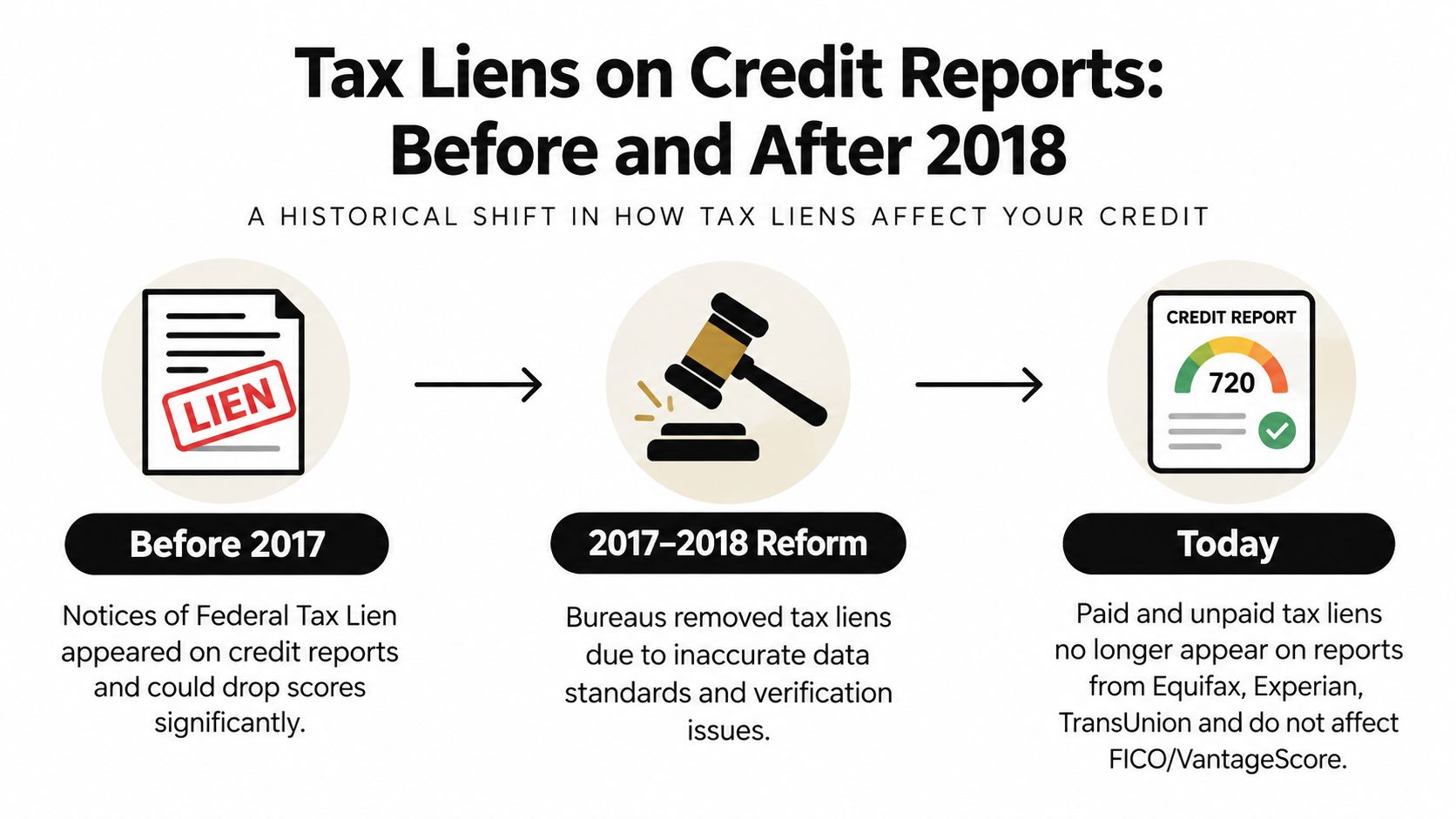
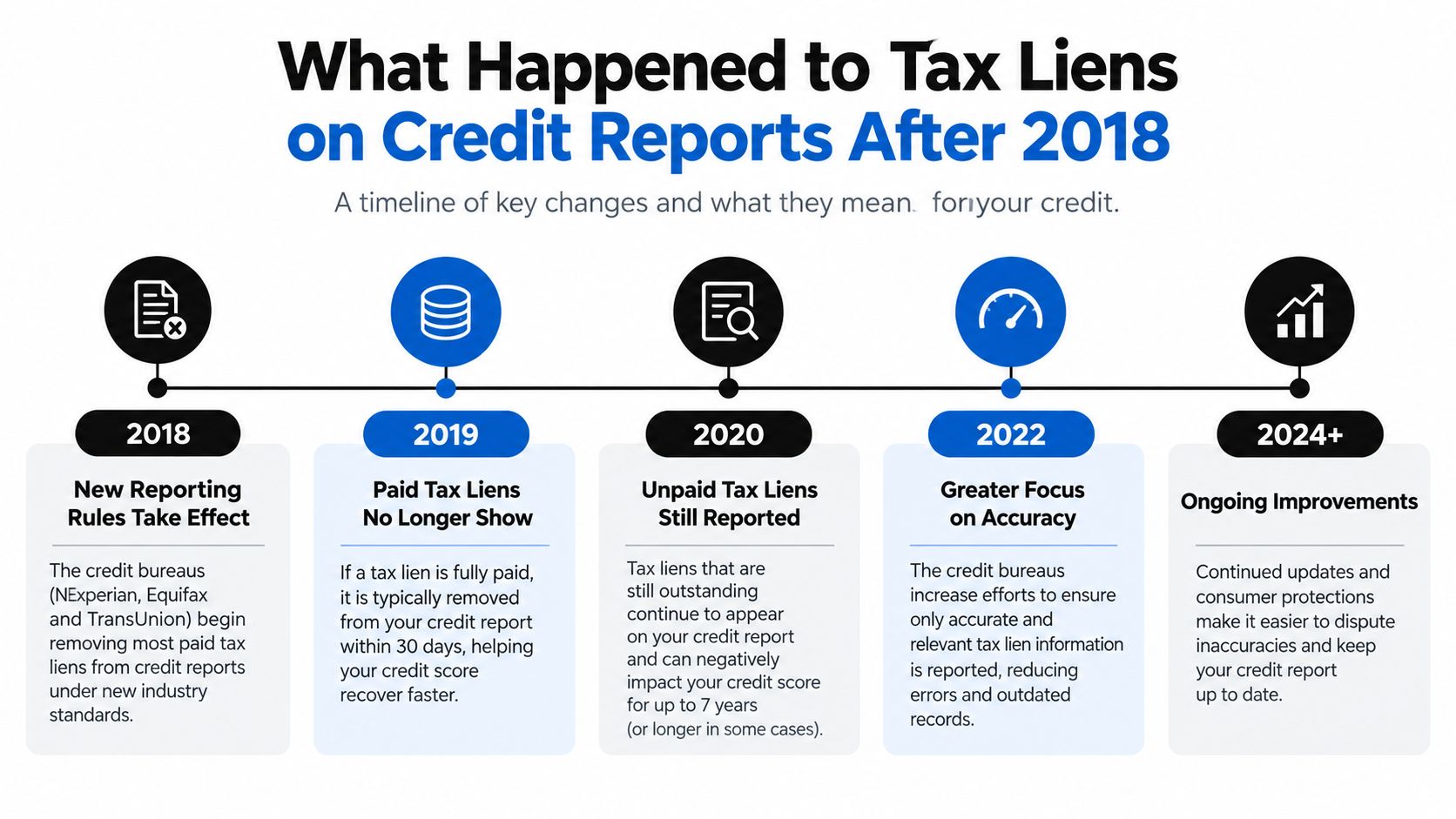
A business owner can pull a credit score, see nothing alarming, and still hit a wall during a mortgage or commercial loan review because of a filed tax lien. That confusion grew after 2018, when the major credit bureaus stopped including tax liens on standard consumer credit reports.
Before and after the reporting change
Before that change, tax liens could appear on consumer credit reports and weigh on scoring models. After the change, the reporting channel changed. The lien itself did not.
That distinction matters. A credit report is one window into your financial life. A filed lien is a legal claim tied to public records and property rights. Closing one window does not remove what is sitting outside the house.
Removal from reports did not erase the lien itself
A filed federal tax lien can still create financing trouble even if it no longer appears on a standard bureau report. Mortgage lenders, banks, title companies, and other underwriters may still find it through public-record searches, title work, tax transcripts, or document requests.
That is the point many borrowers miss. They hear "tax liens are no longer on credit reports" and translate that into "lenders will not care." Lenders often care a great deal. The score question and the approval question are different questions.
A simple way to frame it helps. Post-2018, the lien usually stopped acting like a weight inside the score formula. It can still act like a roadblock in underwriting. A clean FICO score may tell a lender you pay revolving and installment debt well. It does not tell the lender whether the government has a recorded claim that affects repayment risk, title, or available equity.
If you want a plain-language explanation of what a lien is and how it attaches as a legal claim, this BatchData tax lien guide is a useful companion. If you are dealing with an existing filing, this overview on how to remove a tax lien explains the relief side in practical terms.
Why old advice still causes confusion
A lot of older tax and credit content was written when lien reporting rules were different. The article may still rank in search results. The date may be easy to miss. So readers end up combining old credit-report rules with current lending practices and getting the wrong conclusion.
The clean way to say it is this: after 2018, tax liens generally stopped being standard credit-report items, but they did not stop being legally significant events.
That is why a borrower can say, "My score looks fine," and still get extra conditions, delays, or a denial once the lender reviews public records.
Federal vs State Liens Levies and Collections Compared
Tax problems get flattened into one bucket far too often. A federal tax lien is not the same thing as a state tax lien. A levy is not the same thing as a lien. And neither is automatically the same as a standard collection account.
Which Tax Actions Show Up Where
| Enforcement Action | Appears on Credit Report | Visible in Public Record Review | Typical Score Impact |
|---|---|---|---|
| Federal tax debt by itself | No, not by itself based on current standard bureau reporting rules | Not necessarily from the debt alone | No direct score impact by itself |
| Filed federal tax lien | Not on standard major bureau reports after the reporting changes discussed above | Yes, often visible through public record review | Usually no direct score impact through current standard reports, but can affect approvals |
| State tax lien | May depend on the specific filing and how a reviewer searches records | Often yes if filed as a public record | Can create financing problems even where score impact is limited or absent |
| Tax levy | Usually does not show up on a credit report by itself | The financial effects may still become obvious in account review or document requests | Usually no direct score impact by itself |
| Debt turned into a standard collection account | Can be reported like other collections if it enters that channel | Sometimes, depending on the path | Can affect scores because collection tradelines are part of ordinary credit reporting |
The words matter because the consequences differ
A lien is a legal claim against property. It's about securing the government's interest.
A levy is a seizure tool. It's about taking funds or property to satisfy the debt.
That difference matters because recent consumer guidance says unpaid tax debt alone does not appear on the major credit bureaus, and a levy by itself usually does not show up on a credit report or directly change a credit score. The score issue tends to arise only if a lien is filed or if the debt ends up in a standard collection account that can be reported like other collections (The Credit People explanation of levy versus reporting).
Federal and state issues are similar, but not identical
Federal and state tax agencies both use liens and collection tools, but the filing practices, public-record footprints, and resolution procedures can differ. If you're trying to sort out a state filing rather than an IRS one, this primer on what is a state tax lien gives that side of the picture.
For a borrower, the practical question is not “Is this all bad?” The practical question is “What type of tax action is this, and who can see it?”
- If it's only unpaid tax debt: focus on resolution and cash flow.
- If it's a filed lien: treat it as an underwriting issue too.
- If it's a levy: focus on immediate operational damage and account access.
- If another collector reports it as a normal collection account: now you may have a direct credit-file problem as well.
Indirect Ways Tax Problems Can Still Hurt Your Credit
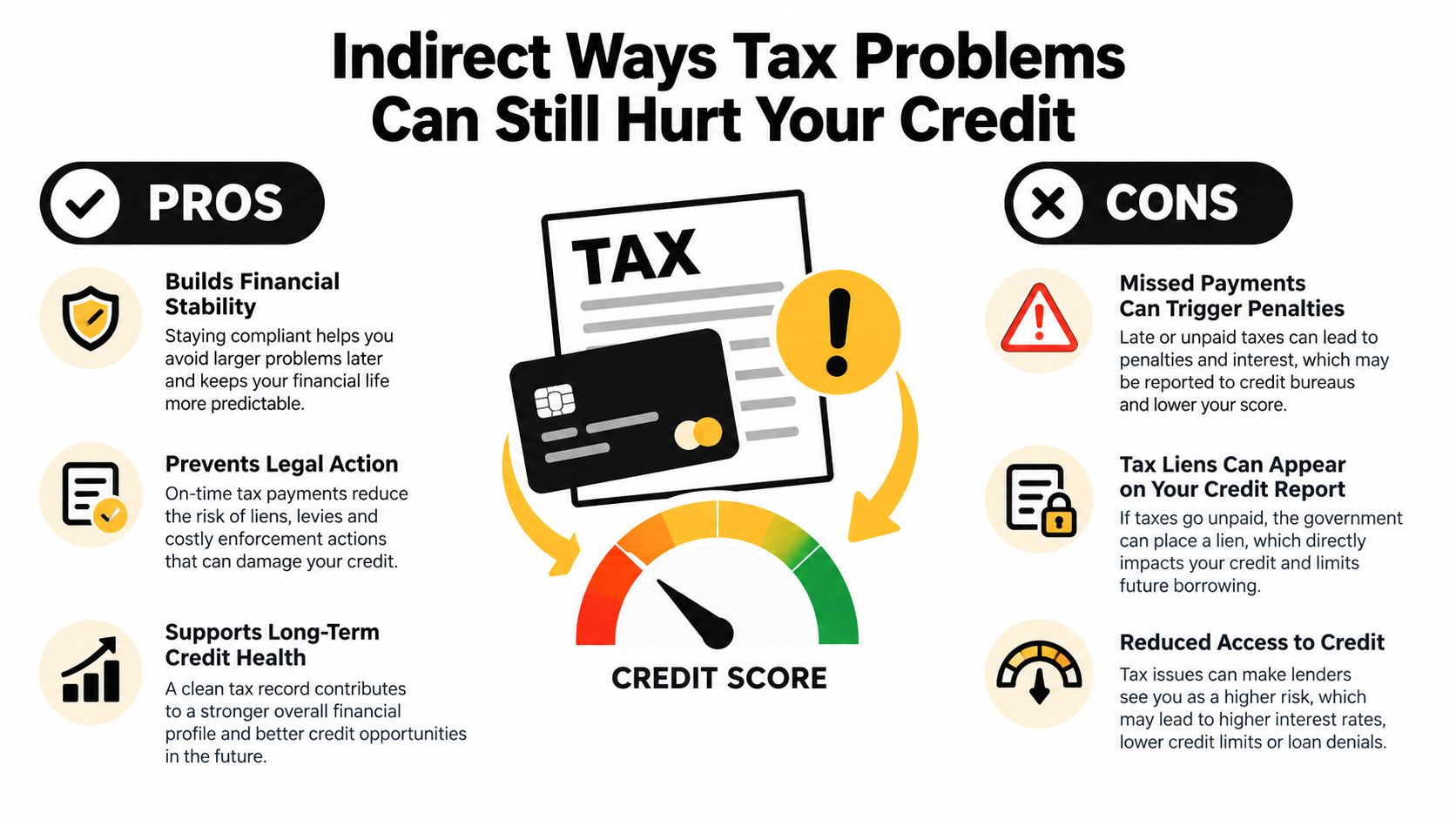
A taxpayer can be technically correct in saying, “The IRS debt isn't on my report,” and still end up with a weaker score a few months later. That happens through indirect damage.
Cash flow is where the trouble often starts
Most credit scores respond to ordinary consumer credit behavior. So if tax payments, garnishments, or business cash shortages cause you to miss credit card, auto loan, mortgage, or line-of-credit payments, those missed payments can affect your credit in the usual way.
That's common with self-employed clients. A sole proprietor underestimates quarterly taxes, uses credit cards to float expenses, then diverts available cash to stop IRS collection pressure. The tax debt itself doesn't create the score drop. The late card payment does.
Another example is payroll tax trouble. A business owner trying to keep payroll current may use personal credit more aggressively while catching up on tax deposits or negotiating with the IRS. Again, the score impact comes from the regular accounts that do report.
Common indirect pathways
These are the channels I'd watch first:
- Missed revolving payments: Tax stress often leads people to pay the IRS and delay cards, or the reverse. Either choice can create pressure somewhere else.
- Higher utilization: Even if every card stays current, rising balances can weaken a credit profile.
- Business-to-person spillover: Owners sometimes use personal borrowing to plug business tax holes.
- Bankruptcy decisions: Some taxpayers file bankruptcy hoping it will solve the tax issue, but the bankruptcy filing has its own credit consequences whether or not it fully addresses the taxes.
Early warning signs to catch fast
If you're borrowing from one obligation to satisfy another, the credit issue may be about to move from theoretical to visible.
Watch for these warning signs before a late payment posts:
- You're paying minimums only on personal cards because tax notices are consuming the rest.
- You're floating payroll or vendors while trying to get compliant with federal or state deposits.
- You're taking cash advances or balance transfers to buy time on tax debt.
- You're considering bankruptcy without first sorting out whether the tax debt is dischargeable or whether a payment structure would preserve more options.
Indirect credit damage is often more preventable than people think. It starts with seeing the sequence early.
How Lenders Find Tax Debt Even When Your Score Looks Fine
Underwriters don't stop at the score. That's the central point most borrowers learn too late.
A lender reviews more than bureau data
A mortgage lender may review tax returns, transcripts, bank statements, payoff documentation, letters of explanation, and public-record results. A business lender may ask for similar financial documents plus entity returns, operating statements, and evidence of tax compliance. Landlords and some employers may also run background or public-record checks separate from a standard score pull.
That's why a borrower can say, truthfully, “My score is good,” and still hear, “We need to resolve this tax issue before approval.”
What tends to trigger delays
The lender's concern isn't always the tax debt by itself. It's often one of these practical underwriting questions:
- Is there a filed lien that clouds the transaction
- Will the borrower have enough verified funds after payoff requirements
- Is there an active payment arrangement, and is it documented
- Did the borrower disclose the issue early, or did it appear late during review
- Does the tax problem signal broader instability in income or recordkeeping
For self-employed borrowers, documentation can be especially important. This self-employed mortgage tax guide gives a useful overview of the tax-return side of mortgage review, which helps explain why unresolved tax issues tend to surface in underwriting.
Timing matters as much as the underlying problem
A manageable tax issue can still wreck a closing if it appears at the wrong moment. Real estate professionals and wealth advisors often get blindsided not because the debt is impossible to solve, but because no one checked for filing status, payoff needs, or subordination requirements early enough.
If a federal lien has been filed, understanding the notice itself is critical. This explanation of the Notice of Federal Tax Lien helps borrowers and advisors identify what they're dealing with before a lender raises it.
The score tells you how the bureaus see you. Underwriting asks how the whole file looks when a human being reviews risk.
If you need to resolve the tax side quickly so a deal can move, one option is to work with counsel who handles IRS controversy and closing-related tax issues. Tax Attorney Stephen A Weisberg offers a free tax debt analysis for taxpayers and professionals trying to identify whether a lien, payment issue, or IRS filing problem is likely to interfere with financing.
Your Action Plan to Protect Credit and Resolve Tax Debt
A common mistake happens right before a loan application. A business owner sees a decent credit score and assumes the tax problem can wait. Then underwriting pulls public records, finds a filed lien, and the issue shifts from "Will this hurt my FICO score?" to "Will this loan close at all?"
That is why the first job is diagnosis. Credit scoring and underwriting are two different filters. One measures reported credit behavior. The other checks for legal claims, payment obligations, and anything else that could interfere with repayment or collateral.
Start with the filing question
Begin with a simple question: are you dealing with an unpaid tax balance, a filed lien, or both?
That distinction drives the strategy. An unpaid balance may sit outside your credit reports and still need attention. A filed lien can create trouble even if your score looks fine, because lenders, title companies, and underwriters may find it through public records searches.
Check state tax agencies too. Federal and state collection files do not always match, and a borrower can clear one problem while another stays on the record.
Protect the accounts that do affect score
While you sort out the tax side, protect the credit accounts that still feed your score every month. That usually means staying current on mortgages, auto loans, credit cards, and business lines that report.
Three practical rules help:
- Keep regular accounts current. Late payments on ordinary credit accounts often do more immediate score damage than the tax debt itself.
- Do not create new credit problems while solving the tax problem. Cash-flow pressure can lead to missed card payments, maxed-out lines, or collections that do report.
- Save every document tied to a payment arrangement. Underwriters rely on written proof, account transcripts, and formal agreements, not phone call summaries.
Match the solution to the specific obstacle
Tax resolution works a lot like fixing a leak. You get a different tool depending on whether the problem is the pipe, the valve, or the water pressure.
If cash flow is the problem, an installment agreement or another structured resolution may be the right fit. If the issue is a filed lien blocking a refinance, sale, or loan approval, the analysis usually turns to release, withdrawal, discharge, subordination, or timing around closing. If you are comparing those repayment and settlement paths, this guide on how to settle tax debt with IRS explains the main options in plain English.
When to bring in a tax attorney
Bring in tax counsel early if a transaction has a deadline or if the facts are unclear. Tax debt cases become harder when a CPA, loan officer, title company, and borrower are all working from different assumptions about what was filed and what has to be cleared.
That is especially true in four situations:
- A closing date is approaching and underwriting or title has already raised tax questions.
- You do not know whether a lien was filed or what still appears in public records.
- You need a transaction-specific answer, not just a general payment plan.
- Several advisors are involved and someone needs to coordinate the tax piece with the financing timeline.
Tax Attorney Stephen A Weisberg helps individuals, business owners, and professional advisors sort out whether the problem is a balance due, a public-record filing, a collection issue, or a closing obstacle. He offers a free analysis focused on what is blocking progress, so you can address the tax issue before it spreads into financing delays or lost options. Visit Tax Attorney Stephen A Weisberg to learn more.


