Does Offer in Compromise Work? the 2026 Truth
Does offer in compromise work for your IRS debt? Discover real 2026 approval rates, strict eligibility rules, and better alternatives before you apply.

In this article
- What IRS Offer in Compromise Approval Rates Actually Show
- Approval depends on financial and procedural fit
- How the IRS Calculates Your Reasonable Collection Potential
- Start with asset equity
- Then examine income and allowable expenses
- Use the calculation before filing
- Strict Eligibility Rules and Common Application Pitfalls
- Compliance comes before persuasion
- Why Most Tax Debt Relief Companies Mislead Taxpayers
- Warning signs worth taking seriously
- Better Alternatives When You Do Not Qualify for an OIC
- Match the remedy to the financial problem
- How Bankruptcy and Major Transactions Affect Tax Debt
- Sequence matters
- Requesting a Free Tax Debt Analysis Before You Commit
- Prepare the right records
Yes, an Offer in Compromise works and can legally settle tax debt for pennies on the dollar, but it is a highly selective mathematical formula, not a blanket discount program, with recent IRS data showing an approval rate of only about 14%.
That answer cuts through most tax relief advertising. An OIC can reduce an overwhelming IRS balance, but the IRS doesn't approve an offer because your debt feels unfair, your business failed, or your circumstances are emotionally compelling. The agency looks at what it believes it can collect from your income, assets, and allowable expenses, then compares that figure with the amount you propose to pay.
If the numbers don't support a settlement, a polished application won't rescue the case. Before you pay a large retainer or submit Form 656, determine whether your financial facts fit the program.
What IRS Offer in Compromise Approval Rates Actually Show
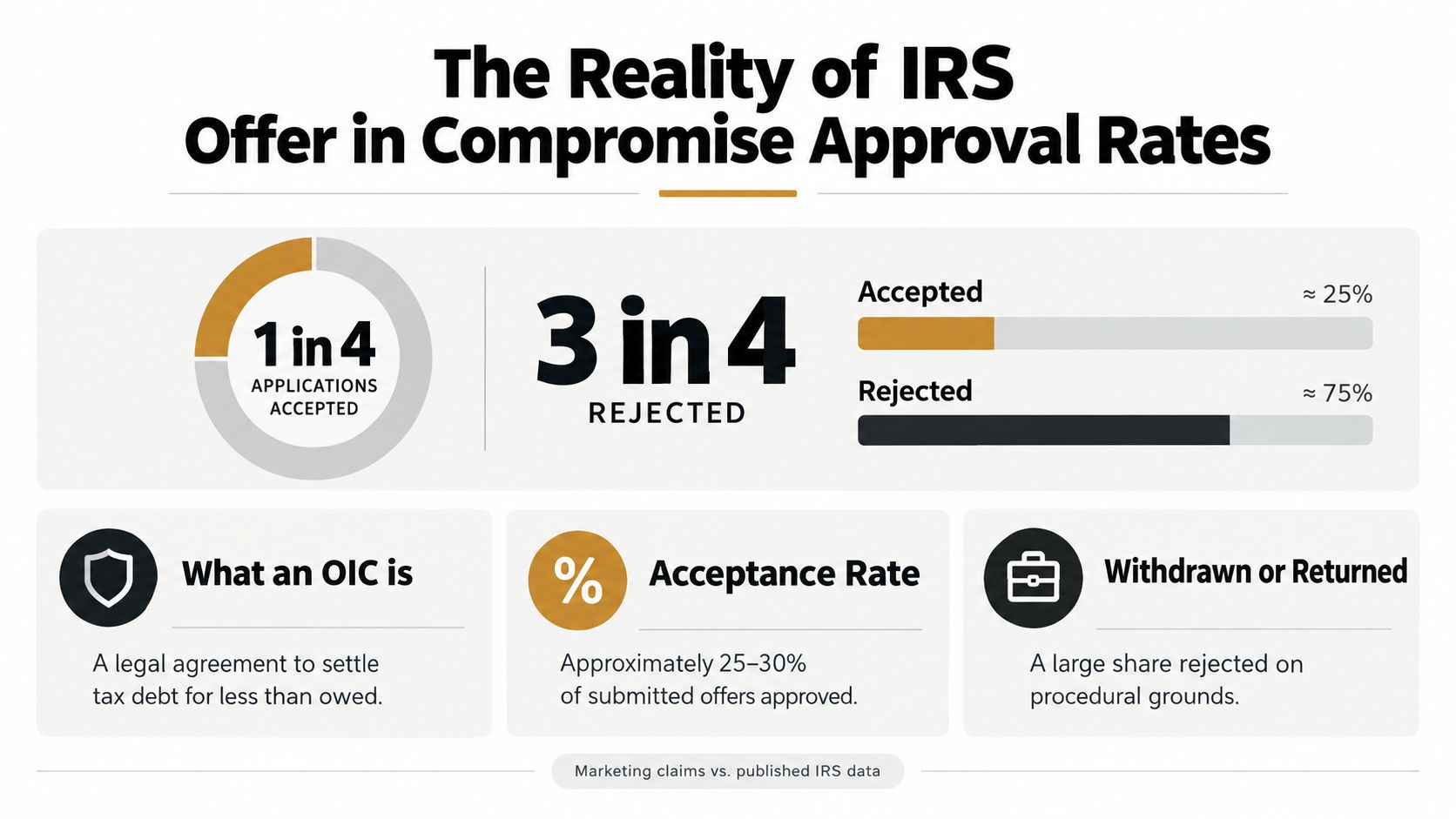
An Offer in Compromise lets a taxpayer settle federal tax debt for less than the full balance owed. That legal remedy is genuine, but tax relief advertising often presents it as though a large reduction is routine. The important question is whether your finances support the offer, not whether a sales representative promises pennies-on-the-dollar relief. The IRS accepts only a minority of submitted offers.
In fiscal year 2025, taxpayers submitted 38,797 offers, and the IRS accepted 5,464, producing an approval rate of about 14.1%. The accepted offers represented $98.1 million in compromised tax liabilities, according to the IRS collections activity data. The answer to Does Offer in Compromise work? is yes. The approval data show that it is selective, not common.
Approval depends on financial and procedural fit
Demand for the program remains strong. Submissions in fiscal year 2025 were almost 30% higher than in prior years cited in agency and news reporting, while accepted offers remained far below the roughly 12,700 accepted in fiscal year 2023. That gap should make taxpayers question high-pressure promises that treat an OIC like a standard discount.
Earlier periods show the same basic pattern. The Taxpayer Advocate Service reported that the IRS accepted fewer than half of submitted offers each year, with acceptance rates around 40% in earlier periods and about 43.7% at the peak in 2013. A Government Accountability Office review of the OIC program found measurable results while also identifying concerns involving case inventories, management, and timeliness.
An OIC is a legitimate settlement tool, not a guaranteed rescue. Approval turns on whether the proposed amount reflects the IRS's Reasonable Collection Potential, or whether exceptional circumstances support a different outcome. A compelling hardship story cannot replace accurate financial documentation and a defensible calculation.
Practical rule: Ask whether your documented finances support an offer below what the IRS could collect through normal enforcement. Do that analysis before paying a large retainer or submitting Form 656.
For a broader explanation of settlement options, review this guide to tax debt settlements. Use it for context, then obtain a case-specific analysis before accepting a sales pitch.
How the IRS Calculates Your Reasonable Collection Potential
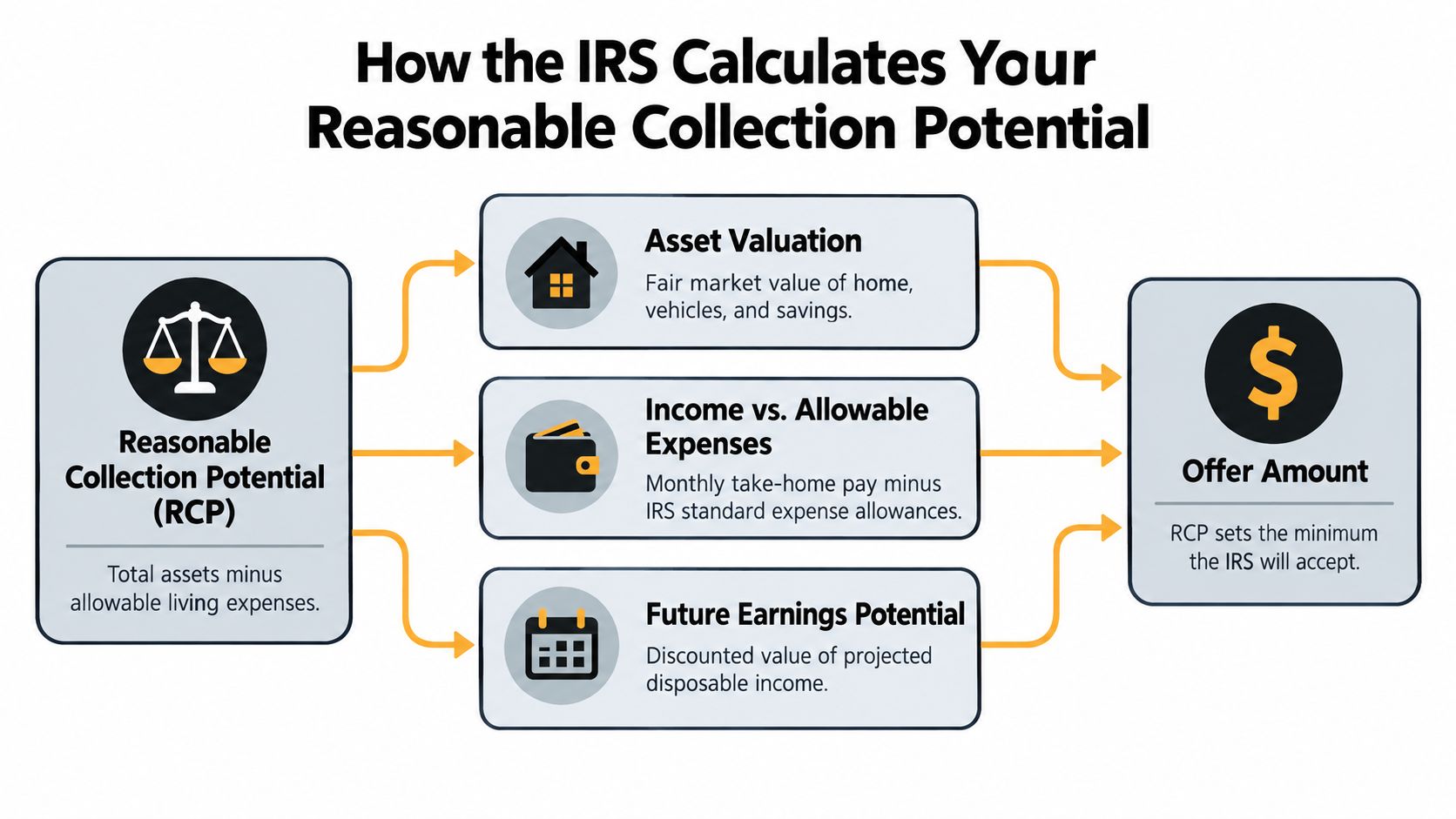
The IRS doesn't start with your total tax debt and choose a discount. It calculates Reasonable Collection Potential, commonly called RCP, to estimate what it could collect from you. Your offer generally needs to meet or exceed that figure unless a special effective tax administration argument applies.
Think of RCP as a financial stress test. The IRS examines your property and available equity, then considers the income it believes remains after allowable living expenses. The resulting calculation gives the agency a measure of your collection capacity. A large tax balance alone doesn't create eligibility.
Start with asset equity
The first question is what your assets could contribute. The IRS reviews items such as real estate, vehicles, bank accounts, investments, and retirement interests. It doesn't merely accept the value you prefer to report. The analysis considers fair market value, ownership, secured debt, and the equity available for collection.
A home with substantial equity can make an OIC impossible even when monthly cash flow is strained. The same problem can arise with savings, business assets, or other property that a taxpayer has overlooked because the asset isn't easy to sell. Hiding or undervaluing property is not a strategy. It creates a credibility problem and can undermine the entire submission.
Then examine income and allowable expenses
The IRS compares income with expenses it considers allowable under its collection standards. The relevant question isn't whether your household spends every dollar it earns. It's whether the agency recognizes those expenses when determining how much disposable income remains.
That distinction can produce an uncomfortable result. A taxpayer may feel unable to pay because of private school tuition, luxury vehicle payments, large unsecured debts, or other expenses that the IRS won't fully recognize. By contrast, documented necessary living costs may reduce the income component of RCP.
The IRS explanation of Offer in Compromise requirements confirms that acceptance depends on whether your reasonable collection potential is at least the offer amount after the agency analyzes income, asset equity, and allowable expenses.
Use the calculation before filing
Before submitting an offer, gather current financial records and identify the assumptions that drive the result. A useful preliminary review asks:
- Assets: What does each major asset reasonably sell for, and what debt or ownership interest reduces available equity?
- Income: What income is regular, seasonal, self-employed, or likely to continue?
- Expenses: Which costs are necessary and likely to fit IRS standards?
- Future capacity: How much disposable income could the IRS expect to collect over the applicable period?
Form 433-A (OIC) or Form 433-B (OIC) is not clerical paperwork. These forms translate your life into the RCP calculation. A detailed explanation of IRS Form 433-A OIC can help you understand why incomplete or unsupported figures create serious problems.
Strict Eligibility Rules and Common Application Pitfalls
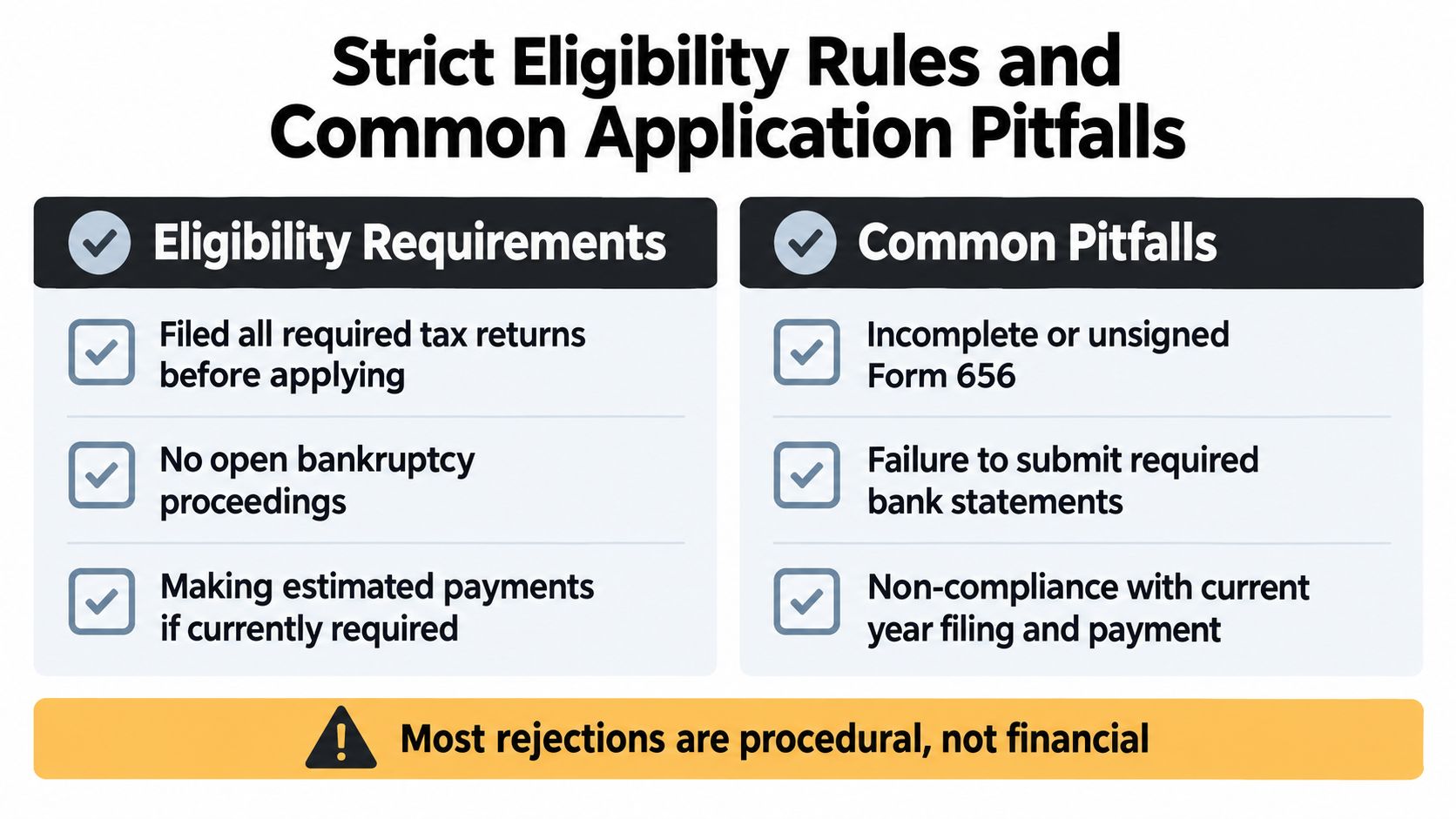
A mathematically plausible offer can still fail at the compliance gate. The IRS expects taxpayers to have filed all required returns and to remain current with obligations that arise while the offer is being considered. Employers must also keep current with required federal tax deposits.
That means you should fix compliance problems before treating an OIC as a solution. An unfiled return, missed estimated payment, or delinquent business deposit can make the application premature. The IRS isn't required to overlook these defects because your long-term finances look difficult.
Compliance comes before persuasion
Review your status in a deliberate order:
- Confirm filing compliance. Make sure every required federal tax return has been filed and processed.
- Check current-year obligations. Verify that required estimated tax payments are being made.
- Review business deposits. Employers should confirm that current federal tax deposits are up to date.
- Identify bankruptcy issues. The IRS generally won't process an OIC while the taxpayer is in open bankruptcy.
- Reconcile the financial package. Bank statements, returns, payroll records, and forms should tell the same story.
The application must also be complete and internally consistent. Missing signatures, unexplained deposits, unsupported expense figures, or incomplete asset information can cause the IRS to return or reject the submission before the financial argument receives meaningful attention.
A taxpayer should never assume that a large debt creates eligibility. The IRS cares about current compliance and collection potential, not the size of the balance by itself. Taxpayers dealing with uncertain filing history can review guidance on how to qualify for an Offer in Compromise, then verify the requirements against their own records.
A clean application can't fix bad RCP math, and good RCP math can't excuse missing compliance requirements.
The practical recommendation is straightforward. Pull your IRS account transcripts, list every missing return, confirm current payment obligations, and resolve procedural defects before paying anyone to prepare an offer. That sequence prevents you from spending money on a case that wasn't ready to be filed.
Why Most Tax Debt Relief Companies Mislead Taxpayers
The phrase “pennies on the dollar” is not automatically false. An accepted OIC can settle tax debt for less than the full balance. The misleading part is presenting that outcome as if it were available to anyone who calls, regardless of income, assets, compliance history, or RCP.
Aggressive tax relief companies often sell the result before analyzing the facts. They may use a large advertised debt reduction to create urgency, request a substantial upfront payment, and postpone the actual financial review until after the contract is signed. That reverses the proper order of tax controversy work.
A responsible professional should first determine whether an OIC is mathematically viable. If the taxpayer has enough equity or disposable income to satisfy the IRS's collection potential, the correct advice may be an installment agreement, penalty relief, or another collection strategy. Selling an OIC anyway isn't advocacy. It's expensive misdirection.
Warning signs worth taking seriously
Walk away from any provider that:
- Guarantees acceptance: No honest representative can promise the IRS will approve an offer before reviewing the financial evidence.
- Avoids the numbers: Ask for the proposed RCP analysis, including asset values, liabilities, income, and allowable expenses.
- Demands a large retainer first: The fee structure should be clear, and the provider should explain what work occurs before additional representation fees are charged.
- Uses only emotional qualification: Financial hardship matters only when it fits the legal and administrative standards governing the program.
- Won't identify alternatives: A genuine analysis should tell you when an OIC isn't the right tool.
For a broader comparison of providers and approaches, this resource on best tax debt relief can help consumers evaluate the industry more critically. Don't confuse a polished website or a compelling television advertisement with a conclusion about your case.
The right question to ask is not, “How much can you save me?” Ask, “What does the IRS believe it can collect, and what documents support that conclusion?” If the representative can't answer, don't hand over your money.
Taxpayers should also review warnings about tax companies' promises of an Offer in Compromise. A free or low-cost preliminary analysis is usually more valuable than a high-pressure promise made before anyone has examined your transcripts and financial statements.
Better Alternatives When You Do Not Qualify for an OIC
An OIC isn't the only way to resolve IRS debt, and it often isn't the most practical one. If your RCP is too high, forcing an offer won't make the IRS accept it. The better approach is to match the remedy to the actual problem, whether that problem is cash flow, penalties, temporary hardship, or business payroll exposure.
An installment agreement may be appropriate when you can pay over time but can't satisfy the balance immediately. The debt generally remains in place while you make the required payments, so the plan must fit your budget and collection circumstances. A payment plan isn't glamorous, but a realistic arrangement can stop a deteriorating situation from becoming more expensive and disruptive.
A partial payment installment agreement may be worth examining when the taxpayer can't pay the full liability before the IRS's collection period ends. Eligibility depends on detailed financial analysis and continued compliance. It isn't a substitute for RCP review, but it can be a more credible path than submitting an offer the numbers don't support.
Match the remedy to the financial problem
| Resolution Method | Best Used When | Impact on Debt Balance |
|---|---|---|
| Offer in Compromise | Documented RCP is lower than the full liability, or special circumstances support settlement | May legally settle the debt for less than owed if accepted |
| Installment Agreement | Cash flow supports regular payments but not immediate full payment | Usually spreads payment without automatically reducing the underlying tax |
| Partial Payment Installment Agreement | The taxpayer can't pay the full liability through available resources and income | May leave part of the balance unpaid under the agreement's terms |
| Penalty Abatement | Penalties resulted from reasonable cause or another recognized basis | Can reduce penalties, while the underlying tax and interest require separate analysis |
| Currently Not Collectible review | Necessary living costs consume available income and assets aren't reasonably collectible | May pause active collection, but it doesn't by itself erase the liability |
Penalty abatement deserves particular attention. Taxpayers sometimes focus so intensely on settlement that they overlook penalties that may be removable under the applicable rules. Gather records explaining illness, disaster, reliance on incorrect professional advice, or other facts that affected filing or payment, but don't assume a narrative alone will succeed.
Business owners need a separate review when payroll tax debt is involved. The IRS may assess personal liability against individuals it identifies as responsible for collecting and paying trust fund taxes. That issue can continue even when the business itself has limited assets, so owners should not treat a company payment plan as a complete personal solution.
If business debt also raises broader restructuring questions, this discussion of a bankruptcy alternative for businesses provides useful context. Bankruptcy and tax resolution overlap, but neither should be chosen without reviewing the tax character of each liability.
How Bankruptcy and Major Transactions Affect Tax Debt
Bankruptcy can change the legal collection picture, but it doesn't automatically make an OIC available. The IRS generally won't process an offer while the taxpayer is in an open bankruptcy proceeding. Filing first without coordinating the tax strategy can therefore interrupt the resolution path you intended to pursue.
Tax debt also needs to be separated by type and tax period. Income tax liabilities and trust fund payroll liabilities don't receive identical treatment, and the outcome can depend on filing history, timing, priority rules, and the specific bankruptcy chapter. A Chapter 7 analysis isn't interchangeable with a Chapter 13 analysis, and neither analysis replaces a review of the IRS account transcripts.
Sequence matters
A taxpayer considering bankruptcy should answer these questions before filing:
- Which liabilities are income taxes? Determine the tax years, assessment dates, return filing dates, and any dispute over the balance.
- Which liabilities involve payroll withholding? Trust fund exposure can create personal consequences that require separate advice.
- Is an OIC pending or contemplated? An open bankruptcy can prevent the IRS from processing it.
- Are liens recorded? A federal tax lien may affect title, refinancing, sale proceeds, and the ability to close a transaction.
- Who else is involved? Spouses, business partners, buyers, lenders, and divorce counsel may all need accurate information.
Unresolved tax debt can delay a real estate closing when title, payoff, or lien issues remain unresolved. It can complicate mortgage underwriting and reduce the flexibility available in a divorce settlement. A business sale can also require careful allocation of proceeds and confirmation of which liabilities remain with the entity or follow an owner personally.
Don't schedule the bankruptcy, closing, refinance, or final settlement first and investigate the IRS balance afterward. Tax sequencing is part of the transaction.
The right professional team may include a tax attorney, bankruptcy attorney, family law attorney, CPA, realtor, or lender, depending on the matter. Their roles differ. The person negotiating with the IRS should have the transcripts, lien information, financial records, and transaction timeline early enough to identify conflicts before they become closing-day emergencies.
Requesting a Free Tax Debt Analysis Before You Commit
Don't begin by sending Form 656 because an advertisement told you to. Begin with a tax debt analysis that answers three questions: what you owe, what the IRS can collect, and which resolution option fits your facts.
A serious review should examine IRS account transcripts, filed returns, notices, bank records, pay information, business financial statements, assets, liabilities, and the dates that affect the collection statute. It should also identify missing filings, current compliance problems, lien issues, and whether an OIC calculation is even plausible.
Prepare the right records
Before speaking with a tax attorney or other representative, assemble:
- IRS notices and transcripts: Include every notice, balance statement, and account record you can obtain.
- Filing history: List filed and unfiled returns for both personal and business accounts.
- Income evidence: Gather pay statements, profit and loss records, contracts, and recent bank activity.
- Asset information: Document real estate, vehicles, accounts, investments, retirement interests, and loans.
- Expense records: Separate necessary household and business costs from discretionary spending.
- Collection history: Note levies, liens, payment plans, prior offers, and conversations with the IRS.
Then ask direct questions. What is the estimated RCP? Which assets drive it? Which expenses may not be allowed? Is an installment agreement more realistic? Could penalty abatement help? What happens if the offer is rejected? A provider who refuses to discuss those questions before demanding a major fee isn't giving you meaningful advice.
A free analysis doesn't guarantee an OIC, and it shouldn't. Its value is that it identifies the viable path before you commit to expensive representation. Sometimes the result will be an offer. Sometimes it will be a payment arrangement, penalty strategy, bankruptcy coordination, or a recommendation to correct compliance first.
The W Tax Group's approach, led by Tax Attorney Stephen A Weisberg, starts with a free Tax Debt Analysis to determine whether and how the firm can help before charging clients to resolve their IRS issues. That is the standard you should demand from anyone reviewing serious tax debt: facts first, RCP math second, and a recommendation only after the evidence is clear.
Tax Attorney Stephen A Weisberg offers a free Tax Debt Analysis to review your IRS records, financial position, and realistic resolution options before you commit to costly representation. If you want a candid assessment of whether an Offer in Compromise makes sense, visit Tax Attorney Stephen A Weisberg and request the analysis.


