Does IRS Garnish Wages and How Can You Stop It
Does IRS garnish wages? Yes, but it's called a levy. Learn the exact process the IRS follows, your rights, and how you can stop it from happening.
In this article
- Understanding the IRS Wage Levy
- IRS Levy vs Standard Garnishment At a Glance
- The Step-by-Step IRS Wage Levy Process
- Step 1: The First Bill (Notice and Demand for Payment)
- Step 2: A Flurry of Reminder Notices
- Step 3: The Final Warning (Final Notice of Intent to Levy)
- Step 4: Your Employer Gets the Levy Notice
- How Much of Your Paycheck the IRS Can Legally Take
- Calculating Your Exempt Amount
- How Different Scenarios Affect Your Paycheck
- What Happens at Your Job When the IRS Issues a Wage Levy?
- Your Employer's Legal Duty
- How They Calculate and Send the Money
- Can My Boss Fire Me for This?
- Proven Strategies to Stop an IRS Wage Levy
- Negotiate an Installment Agreement
- Settle for Less With an Offer in Compromise
- Declare Currently Not Collectible Status
- Other Powerful Avenues for Relief
- Taking Control Before the IRS Takes Your Paycheck
- You Don't Have to Face the IRS by Yourself
- Answering Your Top Questions About IRS Levies
- What's the Difference Between a Levy and a Lien?
- How Long Does an IRS Wage Levy Last?
- Can the IRS Go After My Social Security or Retirement Money?
Yes, the IRS can absolutely take money directly from your paycheck to cover an unpaid tax debt. While most people call this "wage garnishment," the IRS has its own, more powerful term: a wage levy.
This isn't just a matter of semantics. The difference in terminology highlights a massive difference in legal power.
Understanding the IRS Wage Levy
Think about what happens when a credit card company or a personal lender wants to garnish your wages. They have to jump through several legal hoops. First, they must sue you, then they have to win a judgment in court, and only then can they get a judge's permission to take a portion of your paycheck. The court acts as a crucial middleman.
The IRS, however, plays by a completely different set of rules.
As a federal agency, Congress has given the IRS extraordinary collection powers. It doesn't need to ask a court for permission. This administrative power allows the IRS to act unilaterally, sending a legal demand straight to your employer to divert a chunk of your earnings to them. It’s a much faster and more aggressive process.
The real takeaway here is the source of authority. A normal creditor has to ask a court for the right to garnish your wages. The IRS has the built-in legal authority to simply tell your employer to send them the money.
This is precisely why an IRS notice can't be put on the back burner. The path from a tax bill to a wage levy is much shorter and has far fewer obstacles than the one for a typical civil debt.
IRS Levy vs Standard Garnishment At a Glance
To really bring this concept home, let's put the two processes side-by-side. The comparison makes it crystal clear why an IRS wage levy is such a serious financial threat.
Here's a look at the key differences between a powerful IRS wage levy and a typical court-ordered creditor garnishment.
| Feature | IRS Wage Levy | Creditor Garnishment |
|---|---|---|
| Legal Authority | Administrative; no court order needed. | Judicial; requires a court-ordered judgment. |
| Initiation | IRS sends a notice (Form 668-W) directly to the employer. | The creditor's attorney serves a writ of garnishment to the employer after a judgment. |
| Amount Taken | Calculated based on a specific IRS formula (Publication 1494), leaving only a legally exempt amount. This can often be much more than 25%. | Capped by federal law, typically at 25% of your disposable earnings. |
| Dispute Process | Handled through IRS administrative channels, like the Collection Due Process hearing. | Disputed through the court system that issued the original judgment. |
Seeing it laid out like this really highlights the seriousness of the situation. A wage levy isn't something that happens out of the blue; it's the final step after a series of ignored notices.
You can learn more about the specific warnings you'll receive by reading our guide on what is a levy notice and how to properly respond. The IRS has significant power, but you also have rights and options to resolve your tax issue long before your wages are on the line.
The Step-by-Step IRS Wage Levy Process
An IRS wage levy is a serious situation, but let’s be clear: it never happens out of the blue. The IRS is legally required to follow a specific, multi-step process that gives you plenty of warning and multiple chances to act. Think of it like a series of alarms, each one getting louder, signaling that it's time to deal with the problem before your paycheck shrinks.
Ignoring these early warnings is the single biggest reason a taxpayer ends up with their wages seized. Understanding the timeline is key to preventing it.
Step 1: The First Bill (Notice and Demand for Payment)
The journey doesn't start with a threat. It starts quietly, with a simple bill. After the IRS determines you owe tax, they’ll mail you a Notice and Demand for Payment.
This first letter just lays out how much you owe and asks you to pay it. That’s it. At this point, a levy isn't even on the table, and you have a wide open door to resolve the debt without any drama.
Step 2: A Flurry of Reminder Notices
If that first bill goes unanswered, the IRS won’t jump straight to seizing your income. Instead, their system will automatically send out a series of follow-up letters, usually a few weeks apart. These are just escalating reminders about your tax debt.
You might see notices like the CP501, CP503, or CP504 in your mailbox. While the tone of these letters gets a bit more serious with each one, their goal is still just to get you to pay up or contact them to work something out.
This timeline shows how the IRS moves from a simple notice to taking your wages—all without ever needing to go to court.
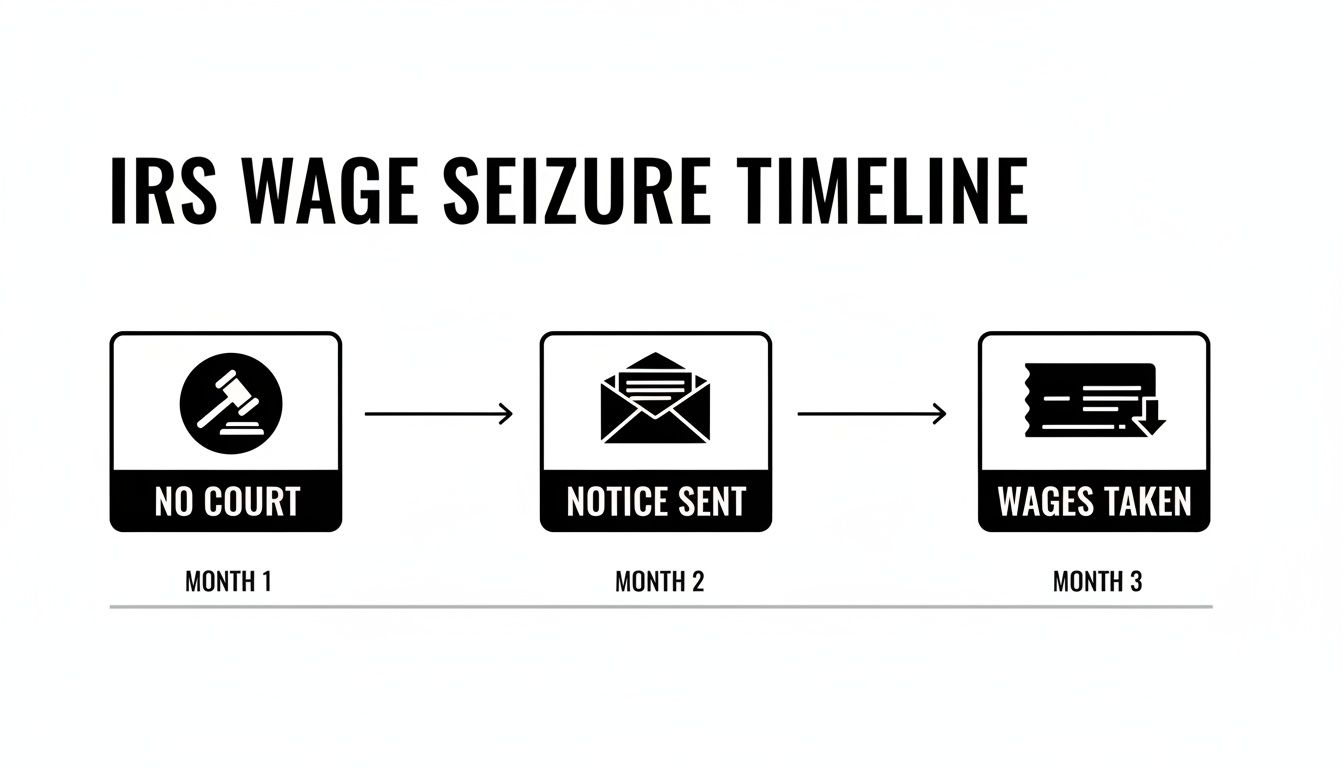 As you can see, the power to levy is an administrative one. That’s why paying close attention to these official notices is so incredibly important. They are the only warnings you'll get.
Step 3: The Final Warning (Final Notice of Intent to Levy)
This is the letter you cannot ignore. After the reminders have failed, the IRS will send a Final Notice of Intent to Levy and Notice of Your Right to a Hearing. This is the big one, often arriving as a Letter 1058 or CP90.
This isn't just another reminder—it's a legal checkpoint. It officially tells you that the IRS is preparing to seize your assets, including your paycheck, if you don't resolve the debt or request a hearing within 30 days.
This 30-day window is your last clear chance to formally challenge the levy and negotiate an alternative before it hits your employer. Missing this deadline strips away many of your options and puts your income in immediate danger.
Once those 30 days are up and they haven't heard from you, the IRS is legally free to move forward.
Step 4: Your Employer Gets the Levy Notice
If you miss the 30-day deadline, the IRS makes its move. They will send Form 668-W, the "Notice of Levy on Wages, Salary, and Other Income," directly to your employer.
This is a legally binding order. Your employer has no choice but to follow it. They will calculate the part of your pay that isn't exempt and start sending that money directly to the IRS every single payday. This continues until the debt is fully paid or you get the IRS to formally release the levy. You can find more in-depth guides on the Wage Levy Process and how to stop it.
How Much of Your Paycheck the IRS Can Legally Take
When you get hit with an IRS wage levy, the first question that pops into your head is usually, "How much am I actually going to have left?" It's a critical question, and the answer isn't what most people expect.
If you’re familiar with wage garnishments from private creditors like credit card companies, you've probably heard of the 25% cap. Forget that rule. The IRS doesn't play by it.
Instead, the IRS has far greater power. They calculate a specific portion of your paycheck that is protected—what they call the "exempt amount"—and they take everything else. Every single dollar above that line goes straight to them.
Calculating Your Exempt Amount
So, how is this exempt amount figured out? It’s not just a random number. Your employer uses the tables in IRS Publication 1494 to determine what part of your pay is shielded from the levy.
The calculation boils down to a few key details about your life:
- Your Tax Filing Status: Are you single, married filing jointly, or head of household?
- Number of Dependents: How many qualifying dependents do you claim?
- Pay Frequency: Do you get paid weekly, bi-weekly, or monthly?
It’s pretty straightforward: the more dependents you have, the more of your income is protected. The idea is to leave you with a baseline amount of money to cover basic living expenses, but as you'll see, "basic" is the operative word.

This formula is precisely why the thought of an IRS wage levy is so terrifying. While the IRS has to leave you something, the amount they can take is often massive and can throw your finances into chaos overnight if you aren't ready.
How Different Scenarios Affect Your Paycheck
Let's look at how this plays out in the real world. Imagine two different people who both get paid bi-weekly.
Example 1: The Single Filer
- Meet John. He's single with no dependents. Based on the 2024 IRS exemption tables, his protected bi-weekly amount is just $557.69. If his take-home pay is $1,500, the IRS will seize $942.31 from every single paycheck.
Example 2: The Head of Household
- Now, let's look at Maria. She's a head of household with two kids. Her protected bi-weekly amount is $1,269.23. If she also takes home $1,500, the IRS can only take $230.77 per check.
The difference is stark. Maria gets to keep more than double what John does, all because her family size gives her a larger exemption. For a deeper look at these calculations, check out our guide on the inside of the IRS wage levy formula.
The amount the IRS takes isn’t a fixed percentage—it’s everything left over after your specific exemption is applied. This is why two people with the same income can have vastly different amounts seized by a levy.
The IRS simply isn't bound by the same rules as other creditors. The Consumer Credit Protection Act (CCPA) limits most garnishments to 25%, but that doesn't apply here. The IRS takes what it's owed, leaving you only with the legally defined exempt amount. To put it in perspective, a taxpayer with four dependents and a higher income could have a monthly protected amount of $4,100.01—anything earned above that is fair game for the levy.
What Happens at Your Job When the IRS Issues a Wage Levy?
So, you’ve received the final notices from the IRS, and the 30-day clock has run out. What’s next? The IRS’s next move brings someone else into the picture: your employer. They go from being the source of your paycheck to being a legally required collection agent for the government. It’s a fast, direct process with almost no wiggle room.
It kicks off when a formal-looking envelope lands in your company’s HR or payroll department. This isn't junk mail. It's Form 668-W, the "Notice of Levy on Wages, Salary, and Other Income." Think of this as a legal order, not a request. Your employer must act on it immediately.
And they will. An employer who ignores an IRS wage levy can be held personally responsible for your entire tax debt, plus some hefty penalties. They have no choice but to comply.
Your Employer's Legal Duty
The moment that form arrives, your employer has a specific to-do list. Their first step is to give you a piece of that Form 668-W, which includes a Statement of Exemptions and Filing Status. It's on you to fill this out and get it back to them right away.
This is a critical step because this form determines how much, if any, of your paycheck is protected from the levy. If you don't return it, they have to use the default calculation: "married filing separately with zero dependents." This is the worst-case scenario, as it protects the smallest possible amount of your income.
It's important to remember your employer is just following orders here. They aren't judging you or taking the IRS's side. They are simply complying with a legally binding demand from a federal agency to avoid getting into deep financial trouble themselves.
Keep this in mind. Your fight is with the IRS, not with the person in your payroll department who is now stuck in the middle.
How They Calculate and Send the Money
Once they have your exemption info (or the default), your payroll team will follow a strict formula for every single paycheck until the levy is lifted.
- Calculate Take-Home Pay: They start with your gross wages and subtract any pre-tax deductions like health insurance or 401(k) contributions.
- Figure Out Your Exempt Amount: They then turn to the tables in IRS Publication 1494. This tells them exactly how much of your pay is legally protected based on your filing status, dependents, and how often you get paid.
- Subtract and Send: Finally, they subtract that protected amount from your take-home pay. Every last penny left over is what gets sent directly to the IRS.
This isn't a one-time thing. It’s a continuous levy that hits every single paycheck until the debt is fully paid or the IRS officially tells your employer to stop.
Can My Boss Fire Me for This?
It’s a natural thing to worry about, but the answer is a clear no. Federal law—specifically 15 U.S.C. § 1674(a)—protects you here. It makes it illegal for an employer to fire someone because their wages are being garnished for a single debt. Since an IRS levy is usually for one consolidated tax bill, you’re covered.
While it feels incredibly personal, the IRS even has internal policies designed to prevent their collection actions from costing someone their job. Their own manual instructs agents to consider these factors before issuing a levy. In fact, if you look at the data on wage garnishment statistics and laws in the U.S., you'll see that very large companies (5,000+ employees) handle these all the time. For them, it's just another administrative task.
Proven Strategies to Stop an IRS Wage Levy

It’s a gut-wrenching feeling to see a huge chunk of your paycheck vanish before it ever hits your bank account. But an IRS wage levy isn't a permanent sentence, even if it’s already started. You have real, powerful options to stop it and get back on solid financial ground.
The secret is to stop ignoring the problem and re-engage with the IRS. You need to give them a viable alternative for collecting what you owe. Let's walk through the most common and effective ways to get a levy released.
Negotiate an Installment Agreement
The most straightforward way to halt a wage levy is by setting up a formal payment plan, officially known as an Installment Agreement (IA). When you agree to make consistent monthly payments, you're giving the IRS a reliable collection method. This makes the aggressive levy unnecessary in their eyes.
Think of it this way: the IRS uses a levy as a last resort when they think you’re not cooperating. An IA is you stepping up with a structured, proactive solution. Once the IRS approves your plan, they will immediately notify your employer to release the levy.
This is the go-to strategy for anyone who can realistically afford to pay their tax debt over time. You’ll need to be current on all your tax filings and provide some financial details to land on a monthly payment that works for everyone.
Settle for Less With an Offer in Compromise
But what if the tax debt is so overwhelming you could never pay it all off? For that, you might explore an Offer in Compromise (OIC). This is a formal deal with the IRS to settle your tax liability for a lower amount than what you originally owed.
Getting an OIC approved isn’t easy. You have to prove that paying the full amount would cause you significant economic hardship. The IRS will take a hard look at your complete financial picture, including:
- Ability to pay: Your current income compared to your necessary living expenses.
- Income potential: What your earning prospects look like down the road.
- Asset equity: The value of things you own, like cars, real estate, or investments.
If the IRS accepts your offer, the wage levy will be released as soon as you fulfill the initial payment terms. It’s a demanding process, but for those who qualify, it’s a legitimate path to a fresh start.
Declare Currently Not Collectible Status
Sometimes, things are so tough that you can’t afford any monthly payment, no matter how small. If you're facing extreme financial distress—meaning you can’t even cover your basic living expenses—you may qualify for Currently Not Collectible (CNC) status.
When the IRS grants you CNC status, they agree to temporarily pause all collection efforts, including wage levies. They’re essentially hitting the pause button on your account, acknowledging you simply don't have the ability to pay right now.
This isn’t a get-out-of-jail-free card. The IRS will periodically review your finances, and if your income improves, they can restart collections. However, for someone in a true crisis, CNC provides immediate and vital relief, stopping the levy and giving you breathing room to get back on your feet.
Other Powerful Avenues for Relief
Beyond negotiating a solution directly, a few legal pathways can stop a wage levy in its tracks. These tend to be more complex and are often best navigated with professional help.
1. Filing a Timely Appeal: After you receive the "Final Notice of Intent to Levy," you have a 30-day window to request a Collection Due Process (CDP) hearing. Filing this appeal triggers an immediate, legally required hold on any levy action. Your case goes to the IRS Independent Office of Appeals, giving you a formal chance to dispute the levy and propose other solutions.
2. Filing for Bankruptcy: The moment you file for bankruptcy, a powerful protection called an automatic stay kicks in. This is a court order that instantly halts most creditors—including the IRS—from any collection activity. An active wage levy must stop cold. While bankruptcy is a major decision with lasting effects, it's an incredibly effective tool for stopping a levy immediately.
Figuring out the right move can be a lot to handle. For a deeper dive, you can read this guide on how to stop an IRS wage garnishment and protect your income. Every strategy has different requirements, and the best one for you will depend entirely on your unique situation.
Taking Control Before the IRS Takes Your Paycheck
Here's the most important thing to understand: an IRS wage levy is a very big deal, but it's almost always avoidable. Think of it as the final, drastic step the IRS takes after a long series of unanswered letters and ignored warnings.
Hoping the problem will just go away is the worst thing you can do. Each notice you ignore is another option that vanishes, another door that closes.
The secret to stopping a levy before it starts? Talk to them. The IRS, at its core, is a massive collections agency. When you owe them money, they simply want to see a credible plan for how you're going to pay it back. Giving them that plan puts you back in the driver's seat.
You Don't Have to Face the IRS by Yourself
Sure, you can pick up the phone and call the IRS on your own. But trying to navigate that maze of rules, regulations, and hold music can be completely overwhelming, especially when you're already stressed out. This is where getting professional help can make all the difference.
An experienced tax pro does a lot more than just make calls for you. They become your advocate and your strategist.
- They'll diagnose the problem: First, they'll dig into your tax debt, review every notice the IRS has sent, and get a clear picture of your financial situation to figure out the best move.
- They'll explain your choices: They can cut through the legal jargon and explain, in plain English, whether an Installment Agreement or an Offer in Compromise makes more sense for you.
- They'll be your representative: A qualified pro can speak directly to the IRS on your behalf, taking on the burden of negotiations and making sure every form is filed perfectly and on time.
Getting a professional to look at your tax debt is the single most powerful move you can make. It stops you from being a victim of the process and makes you an active player in finding a solution.
This is all part of taking back control. For example, a simple but effective strategy is keeping meticulous records for tax season, which is easier than ever by using a receipt scanner for taxes.
Ultimately, dealing with tax debt is about protecting your ability to earn a living and getting your peace of mind back. Getting expert help ensures you’re not leaving any options on the table and gives you the best shot at stopping a wage levy before it ever has a chance to start.
Answering Your Top Questions About IRS Levies
When you're dealing with tax debt, a flood of urgent questions can come to mind. Let's clear up some of the most common worries people have when they're staring down the barrel of an IRS wage levy.
What's the Difference Between a Levy and a Lien?
This is probably the single most important thing to get straight. People mix these two up all the time, but they are worlds apart in what they actually do.
Think of a lien as the IRS putting a public "dibs" on your property—your house, your car, you name it. It's a legal claim that basically tells the world, "Hey, we get paid first if this person sells this asset." A lien doesn't take your stuff; it just secures the government's place in line.
A levy is the action. It's the IRS actually reaching out and taking your property to pay off the debt.
To put it simply: A lien secures the government's interest in your property. A levy is when they actually seize that property, whether it's money from your bank account or a chunk of your paycheck.
How Long Does an IRS Wage Levy Last?
An IRS wage levy isn't a one-and-done deal. It’s continuous. Once your employer gets that notice, they are legally required to start taking money out of every single paycheck until the IRS tells them to stop.
The levy keeps going until one of three things happens:
- You pay off the entire tax debt, including all the penalties and interest that have piled up.
- You work out a deal with the IRS to get the levy released, like setting up an installment agreement.
- The statute of limitations for collecting the tax debt expires, which is known as the Collection Statute Expiration Date (CSED).
It won't just go away on its own after a few pay periods. You have to take action to make it stop.
Can the IRS Go After My Social Security or Retirement Money?
Unfortunately, yes. The IRS has the power to take federal payments and retirement funds, although there are specific rules they have to follow. For Social Security, they can take up to 15% of your monthly benefits right off the top through the Federal Payment Levy Program.
Your retirement savings, like a 401(k) or an IRA, are also on the table. A levy on a retirement account is usually a one-time event, where they seize the available funds up to the amount you owe. Protecting these nest eggs is critical and requires you to act fast.
Facing an IRS levy is incredibly stressful, but you don’t have to go through it by yourself. Attorney Stephen A Weisberg provides a free, no-obligation Tax Debt Analysis to review your specific case and walk you through the best ways to resolve it. Discover how you can protect your income by visiting https://weisberg.tax today.


