Does bankruptcy clear irs debt? Key outcomes and timelines
Discover does bankruptcy clear irs debt: compare Chapter 7 and Chapter 13 outcomes, timing, exemptions, and relief steps.

In this article
- Does Bankruptcy Clear IRS Debt?
- IRS Debt Discharge At A Glance
- Discharge Eligible Taxes
- Common Scenarios
- When IRS Debts Are Dischargeable
- Priority Versus Nonpriority Debts
- Tests To Discharge IRS Debt
- Comparing International Rules
- Real-World Examples
- Additional Scenarios
- Key Takeaways
- Chapter 7 Impact On IRS Debt
- Understanding Timing Requirements
- Lifecycle Of A Case
- Common Pitfalls And Tips
- Next Steps After Chapter 7
- Chapter 13 Impact On IRS Debt
- Creating Your Repayment Plan
- Payment Schedule And Discharge
- Tips For Negotiating With Trustee
- Example Negotiation Scenario
- Next Steps After Plan Completion
- Exceptions Preventing Tax Discharge
- Nonpriority Taxes Overview
- Case Study
- Liens And Penalties
- Criminal Tax Debts And Restitution
- Planning For Surviving Balances
- Steps After Bankruptcy To Handle IRS Debt
- Reviewing Your Discharge Order
- Confirming IRS Records
- Setting Up Payment Alternatives
- Protecting Your Credit
- Maintaining Ongoing Compliance
- Frequently Asked Questions
- Understanding Nondischargeable Taxes
Does Bankruptcy Clear IRS Debt?
It’s not a simple yes or no. Under Chapter 7, older federal income taxes can disappear if you pass a few key hurdles. But recent assessments, payroll withholdings, liens and any debts tied to fraud or evasion will stick around.
IRS Debt Discharge At A Glance
Before you dive into the details, here’s a quick overview of the most common IRS scenarios and whether they can vanish under bankruptcy. Think of this as a road map—you’ll see the big picture first, then we’ll unpack each rule step by step.
| Scenario | Discharge Possible | Key Conditions |
|---|---|---|
| Income Taxes Older Than 3 Years | Yes | Return filed on time, assessed >240 days before filing, no fraud |
| Recent Federal Income Assessments | No | Debt is less than 3 years old |
| Payroll And Trust Fund Taxes | No | Statutorily nondischargeable |
| IRS Tax Liens | No | Liens stay attached to property |
| Fraudulent Tax Liabilities | No | Willful misconduct or false returns |
Use this chart as your compass. Below, we’ll explore how each rule works in real-life Chapter 7 and Chapter 13 scenarios.
Tip: Double-check that your returns were filed on time. Even a few days late can knock you out of eligibility.
Discharge Eligible Taxes
Imagine your old tax bill as an overhung batch of laundry—you wracked up those 2019 taxes but filed by April 15, 2020, and the IRS didn’t assess them until mid-2021. If it’s been at least 240 days since that assessment and there’s no hint of fraud or evasion, Chapter 7 can wipe it clean.
On the flip side, anything assessed or due within the last three years stays on your ledger in Chapter 7. That includes recent income taxes, plus payroll and trust fund obligations—they never disappear here.
Common Scenarios
- Older 2019 Return: Eligible under Chapter 7 if filed by April 2020, assessed more than 240 days before bankruptcy.
- 2022 Tax Bill: Too fresh for Chapter 7, but you can fold it into a Chapter 13 repayment plan.
- Unpaid Payroll Withholding: Always survives—think of it as a red-line category.
- Federal Tax Lien Filed: Acts like an anchor on your property title until you satisfy or release it.
For tailored advice and to see exactly which debts you can clear, book a free Tax Debt Analysis with Attorney Stephen A. Weisberg. He’ll help chart your path forward.
When IRS Debts Are Dischargeable
Imagine IRS obligations lining up like guests waiting at a club entrance. Some get in immediately because they hold a VIP pass—those are priority tax claims—while others must wait in the general admission line and might never make it inside.
Under Section 507(a)(8) of the Bankruptcy Code, recent income taxes and trust fund liabilities take precedence over ordinary creditors. If your debt falls into the general admission category, it could vanish—but only if it clears a few strict tests.
Priority Versus Nonpriority Debts
Priority claims include:
- Income Taxes from the last 2 to 3 years
- Trust Fund Taxes like payroll withholdings
Nonpriority debts usually cover older income taxes that meet precise criteria for discharge.
- Priority claims are paid before other unsecured debts
- Nonpriority older taxes can be wiped out if they pass timing and conduct rules
- VAT, payroll taxes, and liens never disappear in bankruptcy
This split explains why newer or specialized IRS liabilities stick around, even after you file.
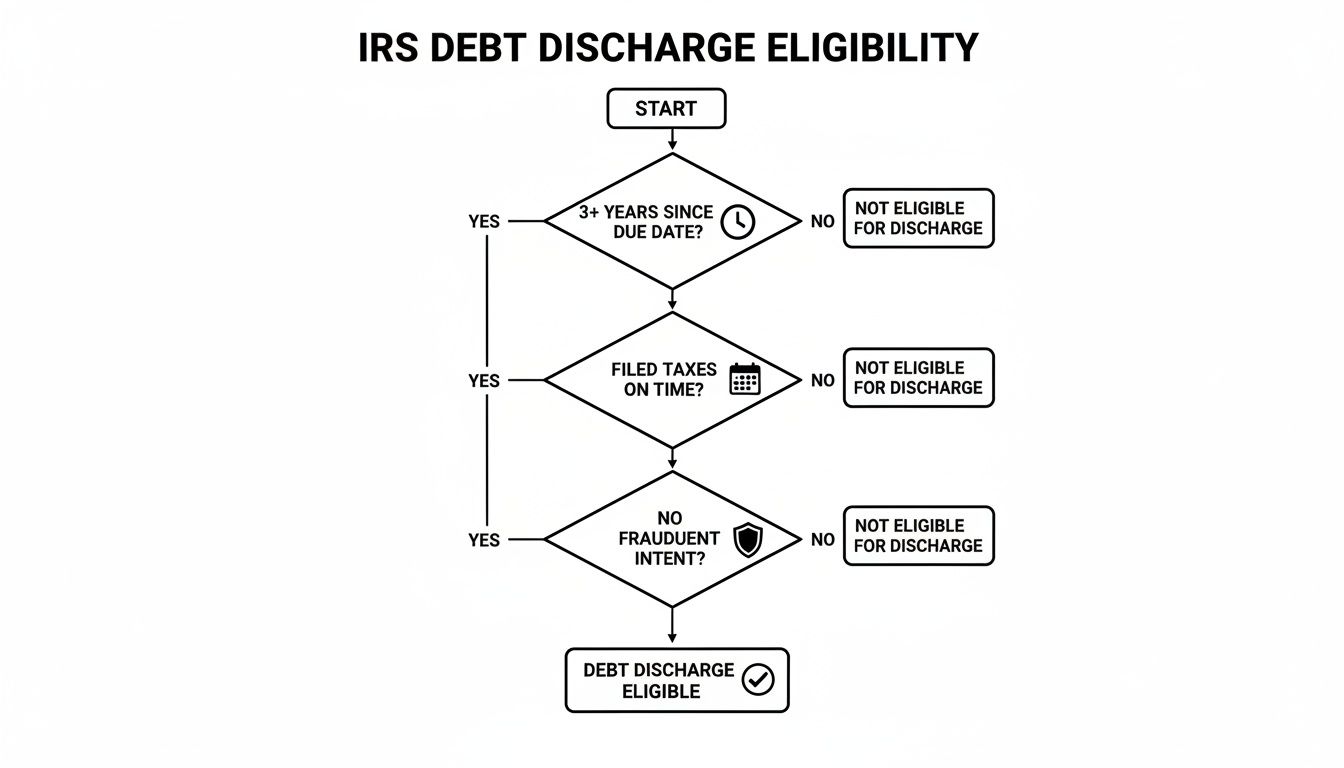
Tests To Discharge IRS Debt
Think of these as three security gates you must clear:
- Return Timing: Your return was due at least 3 years before your bankruptcy filing.
- Assessment Age: The IRS assessed the tax at least 240 days prior.
- Conduct Test: No fraud, evasion, or willful misconduct on your part.
If you breeze through all three gates under Chapter 7, the IRS bill—principal, penalties, and interest—can be wiped out. Slip up at any point, and that debt stays with you.
The chart below walks you through each decision point:
Comparing International Rules
In some countries, VAT or payroll taxes can drop off after a set number of years. Others treat all tax claims as one big priority class, ignoring conduct tests altogether. These variations highlight why U.S. filers must pay close attention to timing and honesty requirements.
Learn more about IRS collection statute expiration dates in our detailed guide.
Real-World Examples
Consider these scenarios:
| Scenario | Dischargeable | Reason |
|---|---|---|
| 2019 Income Tax (filed on time) | Yes | Meets timing, assessment, no fraud |
| 2022 Payroll Withholding | No | Trust fund tax is nondischargeable |
- Example 1: You filed your 2019 return on April 15, 2020; IRS assessed it June 2021. All three tests? Check. Chapter 7 wipes it out.
- Example 2: Withholding taxes from 2022 never budge—they’re statutory nondischargeable trust fund obligations.
Additional Scenarios
- State income taxes generally follow the federal three-year rule but often need separate proof of timely filing.
- IRS liens on your property can stick around until the lien is formally released.
- Penalties tied to fraudulent or negligent returns remain nondischargeable in all cases.
Mapping each obligation against these rules gives you a clear roadmap to what will—and won’t—vanish.
Key Takeaways
Clearing IRS debt in bankruptcy boils down to timing and honest reporting. File returns on schedule, steer clear of misconduct, and older income taxes just might disappear under Chapter 7.
Key Insight – Older income taxes with proper assessment timing can vanish in Chapter 7.
Feeling overwhelmed? Schedule your free Tax Debt Analysis with Attorney Stephen A. Weisberg today.
Chapter 7 Impact On IRS Debt

When you file Chapter 7, certain older income taxes can vanish, giving you a fresh start.
At the same time, recent assessments and IRS liens tend to stick around.
This guide walks you through the crucial tests, deadlines, and proof you’ll need to qualify.
Key Eligibility Criteria
- Satisfy Means Test
- Pass Income Thresholds
- File Returns On Time
- Assessment Older Than 240 Days
Understanding Timing Requirements
Think of timing rules as traffic signals for discharging tax debt. Your return must be due at least three years before the bankruptcy filing. After the IRS performs an assessment, you need to wait 240 days before those taxes can even be considered.
Missing any of these windows means your tax liability stays.
- Late Return Fails Timing
- Fraud Inquiry Stops Discharge
- Recent Assessment Blocks Erasure
Lifecycle Of A Case
The moment you file, an automatic stay halts most IRS collection moves. During the 60-day meeting with the trustee, you’ll review assets and claims. If there are no objections, expect your discharge about four to six months after filing.
After discharge, the IRS cannot pursue you for personal liability on wiped taxes.
| Type | Dischargeable | Notes |
|---|---|---|
| Older Income Taxes | Yes | Meets all timing tests |
| Recent Assessment | No | Blocks discharge window |
| IRS Liens | No | Remain on property until resolved |
Liens stay attached to your property until you pay off the tax or secure a release. You might be interested in our guide on removing tax liens to learn release procedures.
Consulting an attorney ensures accurate filings and avoids costly errors.
Common Pitfalls And Tips
Filing incomplete returns or missing deadlines will derail your plan. Keep precise records to prove you filed on time.
Use certified mail or electronic confirmations to document submissions. Remember, the 240-day window is unforgiving.
Key Takeaway Older tax debts with proper proof can vanish under Chapter 7.
Payroll taxes, trust fund taxes, and penalties tied to fraud or evasion are never dischargeable. Plan for those separately.
- Track Filing Dates Immediately
- Archive IRS Notices Securely
- Verify Assessment Dates Early
Next Steps After Chapter 7
Once your discharge order arrives, request a certified copy from the court. Reach out to the IRS to confirm erased debts now show a zero balance.
If any nondischargeable balances remain, set up a payment plan or an offer in compromise. For tailored guidance, book a free Tax Debt Analysis with Attorney Weisberg. This service pinpoints exactly which IRS obligations you can wipe away.
- Confirm Return Dates
- Check Assessment Timing
- Document Everything
- Monitor Liens Status
Chapter 7 can clear federal income taxes older than three years, but you must meet every deadline and proof requirement. Every situation is unique—seek professional advice early to maximize your discharge potential.
Chapter 13 Impact On IRS Debt

Imagine plotting a road trip: you wouldn’t try to drive across the country in one day, right? A Chapter 13 repayment plan works the same way for IRS debt. You stretch your payments over three to five years, avoiding a massive lump sum and keeping the IRS on the sidelines until you’re back on firm ground.
During this journey, recent tax bills demand full attention while older balances can slip off your ledger at the finish line. But beware—liens and trust fund taxes are like toll booths; they stick around until you pay them in full.
- Plan Duration: 3–5 years of monthly payments
- Priority Taxes: Paid in full as they’re assessed
- Nonpriority Taxes: Discharged once the plan ends
- Liens & Trust Funds: Remain until separately resolved
Creating Your Repayment Plan
Once you file for Chapter 13, your first task is listing every IRS claim accurately. The trustee then tallies up:
- Priority Federal Income Taxes (with penalties and interest)
- Secured Debts (mortgage, auto loans)
- Unsecured Debts (credit cards, older nonpriority taxes)
From there, you propose a monthly payment that covers those categories in order. This approach satisfies the IRS’s priority status first and lets leftover funds chip away at everything else. Getting these numbers right up front avoids objections at your confirmation hearing.
Key Insight
“Older nonpriority IRS balances can exit your debt portfolio once you meet plan terms.”
Payment Schedule And Discharge
Here’s how debts typically line up:
| Tax Category | Age of Debt | Treatment |
|---|---|---|
| Recent Federal Taxes | Less Than 3 Years | Paid in full through plan |
| Nonpriority Taxes | Over 240 Months | Discharged at plan completion |
| Trust Fund Withholdings | Any Age | Fully repaid; nondischargeable |
Case Study
Maria owes $8,000 for 2022 and $6,500 from a 2011 assessment. She pays $200 per month for five years on the 2022 balance. Once the 2011 debt hits its sixth anniversary, that $6,500 vanishes.
Tips For Negotiating With Trustee
- Gather pay stubs and bank statements before your meeting.
- Document any sudden drop in income (letter from employer, invoices).
- Adjust your budget to show spikes in living expenses.
- File a plan modification quickly if your situation changes.
Example Negotiation Scenario
Sarah, a freelance marketer, had a big client pay late. Faced with a reduced cash flow, she handed her trustee bank statements and asked to lower her monthly payment from $400 to $350. The trustee greenlit the adjustment within weeks, keeping her plan on track.
“Proactive updates to your trustee can safeguard your plan confirmation.”
Next Steps After Plan Completion
When your last payment posts, request a certified discharge order from the bankruptcy court. Then:
- Obtain and store your certified discharge order.
- Check your IRS transcripts—discharged balances should read zero.
- Keep tax returns, notices, and plan documents organized for five years.
Think of this like gardening: consistent care prevents weeds from popping up. For deeper insight on calculating payments, check out our IRS Payment Plan Calculator Guide for Best Options.
Exceptions Preventing Tax Discharge
Filing for bankruptcy doesn’t sweep every IRS debt off your slate. Some obligations simply won’t budge, whether you choose Chapter 7 or Chapter 13.
Picture these exceptions as unbreakable chains on your account. You need to know exactly which links won’t unlock.
Many taxpayers expect all federal taxes to disappear. Yet the tax code draws clear boundaries around what can and can’t be wiped clean.
We’ll walk through five core exceptions that survive bankruptcy, no matter how old the debt or how precise your returns.
Nonpriority Taxes Overview
Payroll taxes—the amounts withheld from paychecks for Social Security and Medicare—are 100% nondischargeable. Even if your business files for Chapter 7, those withholdings stay on the hook.
Trust fund taxes act like a tar pit: the government holds you personally responsible for every dollar you collected but never sent along. For detailed rules on these penalties, see our article on trust fund recovery penalties.
If the IRS finds that you filed a false return or willfully evaded your taxes, the resulting assessments remain intact. Intentional misstatements aren’t forgiven by bankruptcy.
Case Study
A neighborhood bakery withheld 12,000 in payroll taxes but redirected the money to cover rent. When the IRS audited, it reclassified that shortfall as trust fund tax.
The owner filed Chapter 7 in 2023. Older income-tax balances vanished, but the 12,000 trust fund debt resurfaced and stayed.
Liens And Penalties
Tax liens are like anchors that grip your property title. Even after discharge, the lien stays attached to your home, vehicle, or commercial real estate.
Civil-fraud penalties work the same way. Fines for deliberate omissions and false statements remain due once you emerge from bankruptcy.
- Tax Liens on real estate survive discharge
- Interest continues to accrue until full payment
- Negligence Penalties and additions are nondischargeable
Penalties for negligence or fraud can balloon your debt. A 5,000 understatement penalty might pick up a 75% addition, leaving you far above the original figure—and bankruptcy won’t erase those extra charges.
Criminal Tax Debts And Restitution
Court-ordered fines for criminal tax violations run on a separate track. An IRS restitution order issued by a judge survives bankruptcy without exception.
You can’t derail these debts with a Chapter 7 or Chapter 13 filing. Even long-standing tax liabilities tied to a criminal judgment are exempt from discharge.
“Criminal restitution orders travel on their own track and never merge with bankruptcy discharge.”
Planning For Surviving Balances
When you ask “Does bankruptcy clear IRS debt?”, remember these chains stay steel. You’ll need a strategy to tackle them once your case closes.
Start by mapping each liability in a simple worksheet. Track deadlines, amounts, and the specific reason each debt survives.
| Tax Type | Dischargeable | Survival Reason |
|---|---|---|
| Payroll Withholding Taxes | No | Trust fund category |
| Trust Fund Amounts | No | Personal liability exception |
| IRS Liens | No | Title remains encumbered |
| Fraud Penalties | No | Misconduct rule |
| Criminal Restitution | No | Court-ordered outside Code |
Key Takeaway
Payroll, trust fund, liens, and fraud penalties survive bankruptcy regardless of chapter.
Checklist for Surviving Debts:
- Review payroll tax filings and deposits
- Search county records for existing liens
- Identify any fraud or evasion flags on returns
- Consult an attorney before filing to clarify exceptions
Steps After Bankruptcy To Handle IRS Debt
Once the bankruptcy court grants your discharge, you’ve cleared a major hurdle. Now it’s time to turn your attention to the IRS and make sure their records reflect your relief.
First things first, head back to the clerk’s office and grab a certified copy of the discharge order. This legal document proves which tax debts are wiped out, and you’ll need it as you deal with the IRS.
Reviewing Your Discharge Order
Before you contact anybody, open up that discharge order and double-check the details. You’re looking for your case number, filing date, and the exact list of taxes the court has discharged.
Bullet-proof your verification with these checks:
- Case Number and Dates: Make sure they match your paperwork and any IRS references.
- List of Discharged Taxes: Confirm the correct tax years and amounts against IRS notices.
- Signatures and Seals: You need the judge’s signature and court seal for full validation.
Once everything aligns, you’re ready to ask the IRS for proof of your new zero balances.
Confirming IRS Records
In most cases, the IRS won’t automatically update your account. So you’ll want to request an “Account Transcript” for each tax year you discharged.
Here’s how to close the loop:
- Obtain a transcript online using the IRS Get Transcript tool.
- Compare each line item to your discharge order.
- File an administrative claim with the bankruptcy court if the IRS still shows a balance.
Keep both digital and paper copies of these transcripts. They’re your strongest evidence if anything goes sideways.
Setting Up Payment Alternatives
Not every IRS bill disappears in bankruptcy. Trust fund taxes, recent assessments, and existing liens often survive discharge. If you spot any non-dischargeable balances, you’ll need a plan B.
| Payment Option | Key Feature | Typical Savings |
|---|---|---|
| Installment Agreement | Flexible monthly payments based on income | N/A |
| Offer in Compromise | Settles debt for less than owed amount | 40–60% reduction |
| Partial Pay Agreement | Lower monthly payments without full compromise | Varies by circumstance |
To get started:
- Use Form 9465 for an Installment Agreement.
- Fill out Form 656 if you’re aiming for an Offer in Compromise.
After you’ve confirmed IRS updates, don’t forget to clean up your own books. Zero out the discharged debts in your personal and business ledgers, and remove them from any credit report entries.
Protecting Your Credit
A bankruptcy and IRS discharge can linger on your credit file for up to 10 years. But you’re not helpless.
Monitor your free annual credit report to catch mistakes early. Then focus on rebuilding by sticking to a simple budget and making on-time payments for the next 12–24 months.
“Professional oversight can simplify post-discharge steps and prevent costly missteps.”
If you’re wondering, “does bankruptcy clear IRS debt?” these are the steps you follow—but getting expert advice can keep you on track. Schedule a free Tax Debt Analysis with Attorney Stephen A. Weisberg to map out your next moves.
Maintaining Ongoing Compliance
Staying organized now means fewer headaches later. Keep your mailing address and bank details up to date so you never miss an IRS notice.
- Update your address with the IRS within 60 days of moving.
- Check your transcripts annually to spot any unexpected changes.
- Review your withholding allowances to avoid future underpayment penalties.
- File every new tax return on time to stay eligible for relief down the road.
With these simple habits, you’ll sidestep surprises and fully benefit from your discharge.
Frequently Asked Questions
Many folks ask whether bankruptcy can wipe out IRS debts—and which tax bills truly disappear. In this FAQ, we tackle your top concerns about discharge rules, liens, and the taxes that stick around.
- How Old Must Tax Debt Be To Qualify For Discharge?
- Will Bankruptcy Remove An IRS Tax Lien On My Home?
- Can I Discharge Payroll Or Trust Fund Taxes?
- What Happens If I File Chapter 13 But Fall Behind On Plan Payments?
How Old Must Tax Debt Be To Qualify For Discharge?
To erase federal income taxes in Chapter 7, your debt has to pass three strict timing tests.
- The return was due (including extensions) at least three years ago
- The IRS assessed the tax more than 240 days before you filed bankruptcy
Will Bankruptcy Remove An IRS Tax Lien On My Home?
Bankruptcy discharge wipes out your personal obligation—but it does not strip liens off your property title. You’ll still see the IRS lien on your home until you either:
- Negotiate a lien release with the IRS
- Wait for the IRS to lift the lien after the tax debt is paid
Understanding Nondischargeable Taxes
Can I Discharge Payroll Or Trust Fund Taxes?
Unfortunately, payroll taxes and trust fund taxes (withheld from employees) survive bankruptcy every time. Both Chapter 7 and Chapter 13 leave these obligations intact.
What Happens If I File Chapter 13 But Fall Behind On Plan Payments?
Missing payments in a Chapter 13 plan can lead to case dismissal—or a forced conversion to Chapter 7. To avoid that pitfall:
- Reach out to your trustee the moment you spot trouble
- Explore a plan modification or other workout options
“Late payments can derail your entire plan. Stay proactive and keep your trustee informed.”
Use these insights to weigh your filing options and map out your next steps today.
For personalized guidance, Schedule a Free Tax Debt Analysis with Attorney Stephen A. Weisberg.


