Do Federal Tax Liens Expire? Business Guide
Do federal tax liens expire - Wondering if federal tax liens expire? Learn the truth about IRS lien duration, renewal, and how they affect your business in

In this article
- Do Federal Tax Liens Expire
- The real issue is the clock, not the notice
- How the CSED Clock Works and When It Changed
- Why older files still matter
- Events That Pause, Restart, or Extend the Expiration Clock
- The most common tolling events
- Why businesses get blindsided
- How to Verify Your Federal Tax Lien Status
- What to gather first
- Where to check beyond the IRS
- Lien Release, Subordination, and Discharge Options
- Release, subordination, and discharge do different jobs
- When the right answer is not waiting
- What to Do If Your Lien Persists Past the Expected CSED
- Three practical responses
- Frequently Asked Questions About Federal Tax Lien Expiration
- Is a tax lien the same thing as a levy
- Can a released lien still show up in records
- Does resolving a federal lien fix a state tax lien too
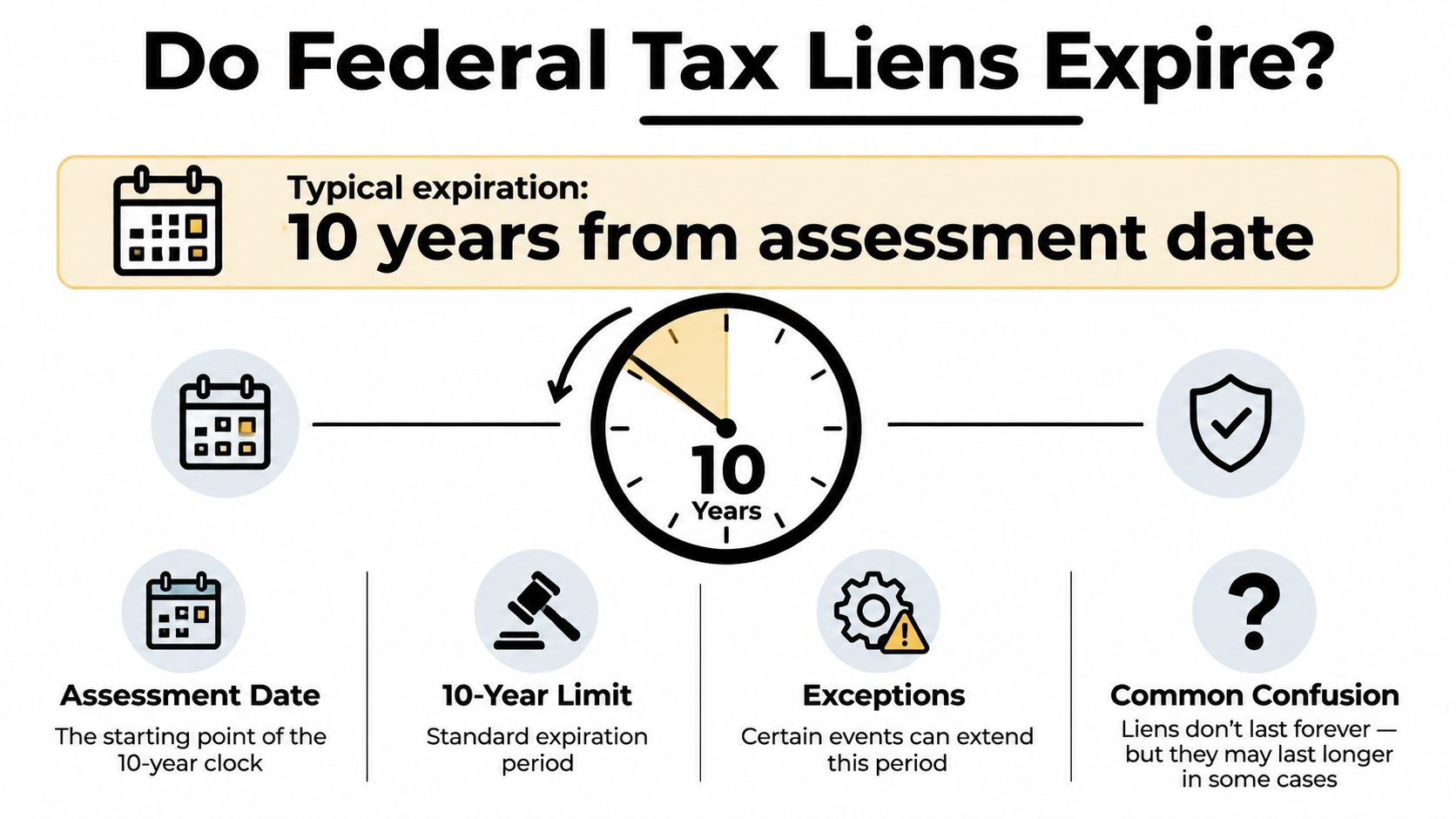
Federal tax liens generally expire after 10 years and 30 days from the assessment date, but that clock can pause or stretch when the taxpayer triggers a tolling event. Most Notices of Federal Tax Lien filed after December 1982 self-release 30 days after the date 10 years after assessment if the IRS doesn't timely refile them.
The advice most business owners hear is too simple. A lien doesn't just sit there for a decade and vanish on a fixed date, because the Collection Statute Expiration Date, or CSED, is the control point, and the CSED can move when the case changes. That is why a payroll tax case, an installment agreement, a bankruptcy filing, or an offer in compromise can make the answer very different from the one-line version people repeat online.
Do Federal Tax Liens Expire
Yes, federal tax liens generally expire, but only if you are talking about the IRS's collection window, not the date the notice first appeared in the public record. The IRS manual treats the collection period as generally running 10 years from assessment, and most NFTLs filed after December 1982 self-release 30 days after the date 10 years after assessment if the IRS does not timely refile them. That is the clean rule, and it is the one people usually hear first.
The problem is that the rule is rarely that clean in an actual case. A lien can remain effective while the underlying tax is still collectible, and the expiration date can shift because of events the taxpayer thought were ordinary attempts to deal with the debt, not actions that affected the deadline.
The real issue is the clock, not the notice
A tax lien is a claim against property, but the expiration question turns on whether the underlying tax is still enforceable. The IRS says the lien continues until the liability is satisfied or becomes unenforceable because the CSED has passed, and that practical timeline often runs about 10 years and 30 days unless something suspends or extends it. That is the rule that matters in practice.
Practical rule: do not ask only whether the lien is old. Ask whether the assessment date and every tolling event still leave time on the CSED.
Business owners get caught when they focus on the filing date of the notice instead of the assessment date. That mistake comes up often in payroll tax cases and in files where the IRS has already been talking with the taxpayer about payment options. A lien can look stale on paper while the collection period is still alive underneath it.
For a closer explanation of how the IRS measures the collection deadline, see this Collection Statute Expiration Date explanation, which is useful when you are comparing the notice date to the assessment date.
The takeaway is simple. Expiration is real, but automatic expiration is not guaranteed. If the IRS refiles the notice, or if the CSED was suspended, the lien can survive longer than most taxpayers expect.
How the CSED Clock Works and When It Changed
The CSED is the IRS's internal expiration date for collection, and it starts from the assessment date, not the tax year, due date, or filing date. That point matters because two taxpayers with the same tax year can have very different collection end dates once the IRS records the liability and anything later affects the clock. The IRS manual treats that assessment date as the anchor for collection, not the calendar year in which the tax arose.
Historically, the rule was not always 10 years. A title-underwriting reference explains that the Federal Omnibus Reconciliation Act of 1990, effective November 5, 1990, extended federal tax liens from 6 years to 10 years, and the refiling window from 6 years and 30 days to 10 years and 30 days from assessment. That change is why older liens can follow a different pattern.
Why older files still matter
A lien assessed before the 1990 change can carry a different analysis than a newer one. That does not mean every old case is still collectible. It means you cannot assume the same expiration rule applies to every file just because the balance looks old. Business owners with older trust fund or income tax liabilities need the assessment history, not a guess.
The modern system is a two-stage framework. First comes the initial 10-year collection period. Then comes the possibility of refiling, which can keep the notice effective for up to an additional 10 years when the IRS acts in time. The practical effect is that the lien may stay enforceable much longer than the headline answer suggests.
A simple example helps. If the IRS assessed a business tax in 2018 and nothing paused the clock, the CSED would usually land around 2028, and the notice would generally self-release about 30 days later if not refiled. If that same owner entered an installment agreement or bankruptcy, the end date could move.
The mistake I see most often is treating the CSED as a fixed date printed on a notice. It is not. It is a computed deadline that depends on the transcript and the full collection history.
That is why the right question is not just “When was the lien filed?” It is “What is the assessment date, and what happened after it?”
Events That Pause, Restart, or Extend the Expiration Clock
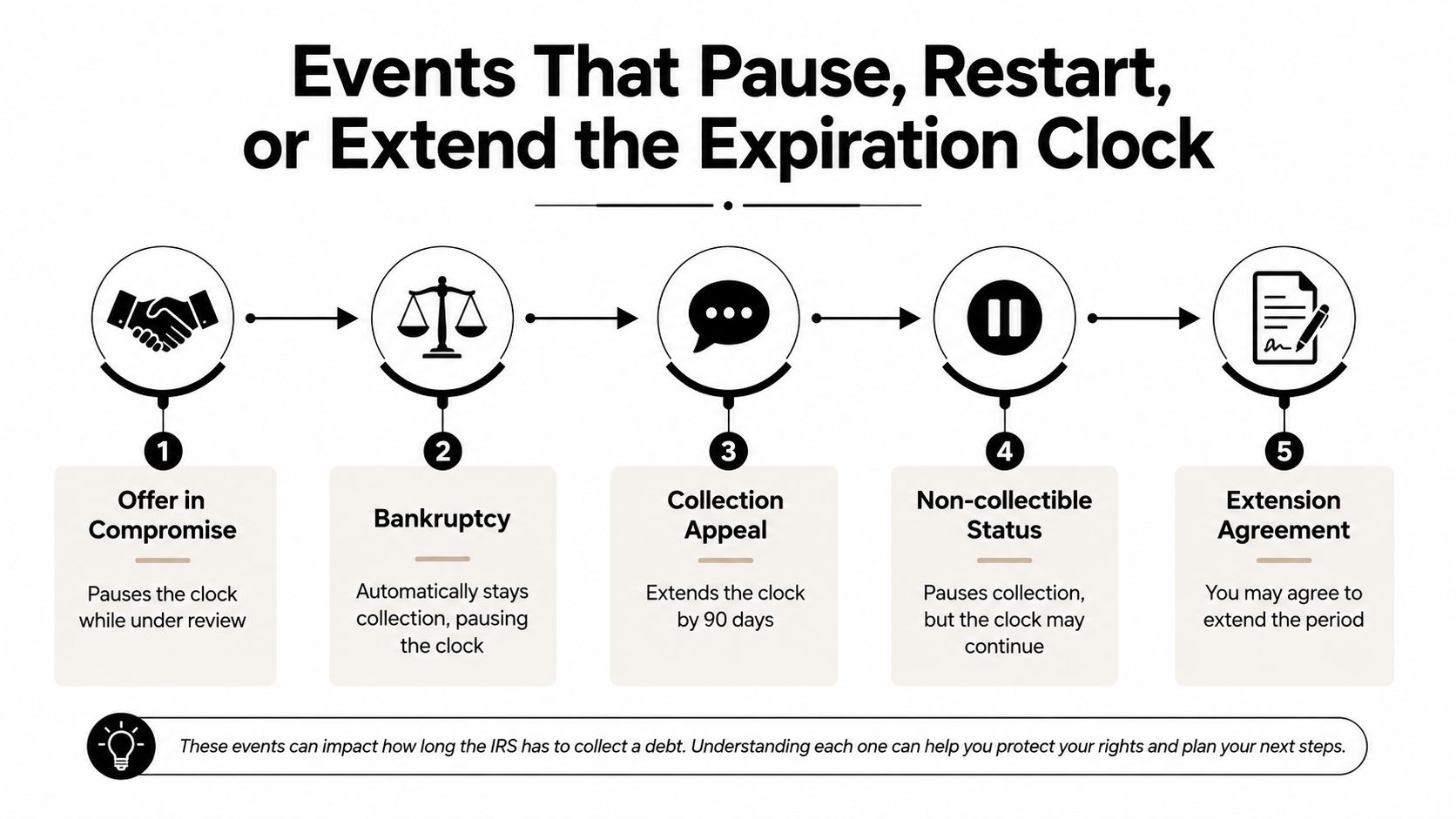
The CSED does not always run in a straight line. In practice, the clock can stop while the IRS processes a request, then pick up again later, and some events add time at the end instead of freezing the period. That is why owners who only know the assessment year often misjudge how much time is left.
The most common tolling events
Installment agreements can change the expiration date because the collection period may be suspended while the IRS processes the request and during related collection activity pauses. I see business owners assume the account is safe once payments start, but the request itself can alter the deadline before the first draft ever clears.
Offers in compromise are another common trap. While the IRS considers the offer, the CSED is suspended, and that suspension can continue after a rejection in certain situations. For a taxpayer who spent months pursuing a settlement instead of paying the balance, that delay can matter more than the monthly payment amount ever did.
Bankruptcy follows a different rule set. The automatic stay stops collection activity, and IRS guidance allows the CSED to be suspended during the case and for time afterward. In a payroll tax case, that pause can be long enough to change the expiration date in a way that is not obvious from the original notice.
Collection hearings and court proceedings also affect the clock. A taxpayer may file a protest or petition to challenge the collection action, but the time spent in those proceedings can still change the collection window. That is one reason a transcript matters more than memory, especially where a Notice of Federal Tax Lien has already been filed.
Practical insight: if you changed the case, the deadline probably changed too.
Why businesses get blindsided
Business owners usually make these choices under pressure. They enter an installment agreement because payroll deposits are already behind, or they submit an offer in compromise to stop a levy notice. Those decisions may be reasonable, but they can keep the lien alive longer than expected.
The IRS manual describes the rules, but it does not replace a case-by-case review of the transcript and collection history. In practice, the date that matters is rarely the date a business owner remembers from a notice or a phone call. It is the date that remains after every suspension, extension, and pending request is accounted for.
The important point is not that these events are bad. It is that they change timing. If your company has used any of these tools, recalculate the lien expiration date before you assume the debt has aged out.
How to Verify Your Federal Tax Lien Status
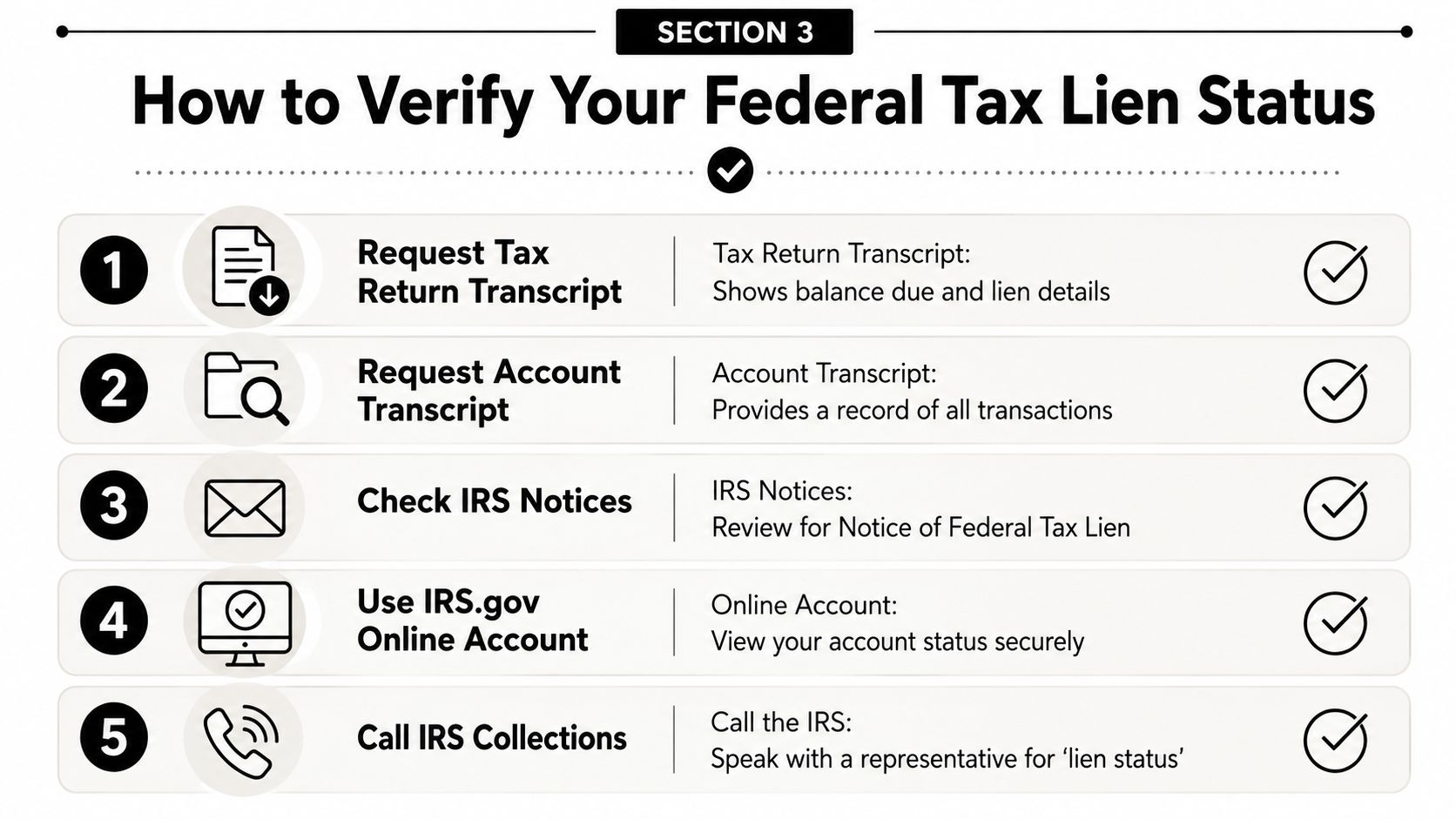
The IRS transcript is the starting point because that is where the assessment and collection history live. A tax return transcript and an account transcript can show the original assessment date, later transactions, payment activity, and lien-related entries, which is why transcript review is more reliable than trying to reconstruct the case from notices alone. If you're working through the paperwork yourself, the IRS online account and transcript requests are the first place to look.
What to gather first
Start with the documents that show the chain of events:
- Tax account transcript, because it shows transactions tied to the liability.
- Tax return transcript, because it helps confirm what was filed and when.
- IRS notices, especially anything labeled as a Notice of Federal Tax Lien.
- Recorded county or state filings, if the lien was filed locally.
- Any prior installment agreement, bankruptcy, or offer in compromise records.
The IRS does not print the true expiration date on a routine notice. You have to assemble it from the transcript and the case history. That is why a transcript that looks simple on first glance can be misleading if the taxpayer left out a tolling event.
For a practical walkthrough of the lien notice itself and how it functions, this IRS lien notice guide is a useful reference: Notice of Federal Tax Lien guide.
Where to check beyond the IRS
Credit reports and county recording offices matter because a lien can appear in more than one place. If a federal lien was recorded locally, the public record may remain visible even after the IRS has taken action on the underlying tax debt. That doesn't mean the lien is still legally enforceable, but it does mean the paper trail can outlast the collection right.
If the transcript and the public record don't match, trust the transcript for the collection timeline and investigate the recording separately.
Before calling the IRS, collect your transcripts, copies of all lien notices, dates of any negotiations, bankruptcy papers if there were any, and the names of any IRS employees or collection officers you dealt with. That package gives a tax professional enough information to compare the stated timeline against the actual one and spot errors quickly.
Lien Release, Subordination, and Discharge Options
A federal tax lien does not leave only through expiration. In real cases, business owners usually need a faster path because a lender, buyer, or title company will not wait for the CSED to run. The IRS gives three different remedies, and each one solves a different problem.
Release, subordination, and discharge do different jobs
A lien release removes the lien when the tax is paid in full, when the CSED has passed and the IRS has not refiled the notice, or in limited situations where the IRS decides release will help collection. It is the cleanest result, but it is often the slowest one to obtain.
A subordination does not remove the lien. It lets another creditor move ahead of the IRS lien in priority, which can make refinancing or a working-capital loan possible. That can be the right move when a business has commercial real estate equity but cannot close because the IRS lien sits in the way.
A discharge removes the lien from a specific property while the lien stays attached to other assets. That matters when a taxpayer needs to sell one asset and use the proceeds to address the debt or protect the rest of the business.
For owners comparing those options with a sale process, how to sell a property with liens gives a useful overview of the title issues that can slow a transaction down.
When the right answer is not waiting
A multi-member LLC trying to refinance commercial property usually cannot afford to hope the lien expires on its own. In that situation, subordination may help the deal move while the lien remains in place, and discharge may work if only one parcel needs to be cleared. The right choice depends on the property, the lender's requirements, and the IRS's conditions.
The IRS still has to approve the request, and the taxpayer has to show that the conditions are met. That is why the IRS lien removal guide at remove tax lien IRS guide is useful before anyone submits paperwork. It helps separate the path for removing a lien from the path for merely changing its priority or lifting it from one asset.
Rule of thumb: if a transaction is blocked today, expiration may be the wrong plan. A release, subordination, or discharge request may solve the practical problem faster.
A business owner who needs financing should treat these tools as separate legal paths, not synonyms. They solve different problems, and choosing the wrong one delays the deal.
What to Do If Your Lien Persists Past the Expected CSED
If the lien is still active after the date you expected, do not assume the IRS is right, and do not assume the transcript is wrong. The practical next step is to make the IRS show its work in writing. Ask for the CSED calculation, then compare each date on the account with your own records. That is often the only way to find out whether the government credited a tolling event you overlooked or left the case open after the collection period should have ended.
Three practical responses
Request the written timeline. Ask the IRS to identify the assessment date, the tolling events it relied on, and the expiration date it calculated. Once you have that timeline, you can compare it against transcripts, filed returns, bankruptcy records, installment agreement documents, and any other event that may have paused the clock.
Challenge an incorrect collection posture. If the IRS kept the lien in place after the actual CSED, the taxpayer may have grounds to dispute the continued collection action through the available legal channels. A lien does not become harmless just because it is old. If the liability is no longer enforceable, the file needs to reflect that.
Get specialized help when payroll tax is involved. Trust Fund Recovery Penalty cases are different from ordinary income tax cases because they can create personal exposure for owners and responsible persons. That changes the CSED analysis in real terms, especially where the business has had multiple periods of nonpayment, partial payments, or collection activity tied to employment taxes.
For taxpayers weighing settlement options alongside lien issues, this guide on how to settle tax debt with IRS helps frame the trade-offs before you file anything or agree to a payment plan.
A lien that persists past the expected CSED is more than a paperwork nuisance. It can block financing, cloud title, and keep pressure on the business even after the collection period should be over. The right response is to pin down the dates, compare them to the transcript, and challenge the file if the math does not support continued collection.
Frequently Asked Questions About Federal Tax Lien Expiration
Is a tax lien the same thing as a levy
No. A lien is the IRS's legal claim against property, while a levy is the actual seizure of money or property. A lien can sit in the background without a levy ever happening, and the two actions don't use the same practical enforcement steps.
Can a released lien still show up in records
Yes, a released lien can still leave a public or credit record trail for a while, even though the IRS has ended its collection claim. That is why you need to distinguish between the legal status of the lien and the visibility of the old filing. If the record is stale, the correction path is different from the tax collection path.
Does resolving a federal lien fix a state tax lien too
Not automatically. Federal and state tax liens are separate claims, and clearing one does not resolve the other. If both exist, each one needs its own review and, in many cases, its own release or settlement process.
Tax Attorney Stephen A Weisberg helps individuals, business owners, and professionals work through IRS lien problems, CSED questions, payroll tax exposure, and settlement options with a practical case review. If you want a direct assessment of whether your lien expires, or whether the clock was paused, visit Tax Attorney Stephen A Weisberg to request a free tax debt analysis.


