How to Dispute IRS Debt: A Step-by-Step Guide for 2026
Received an IRS notice? Learn how to dispute IRS debt effectively. Our guide covers grounds, appeals, negotiation, and when to hire a tax attorney. Act now.
In this article
- That IRS Notice Arrived Now What
- Start with the notice, not the panic
- What to do in the first hour
- First Step Verify the IRS Debt Is Accurate
- Read the notice for what it actually says
- Reconcile the IRS numbers against your own records
- Decide which lane you're in
- Gather Your Evidence and Documentation
- Build the file before you contact the IRS
- What belongs in the file
- Organize it so someone else can follow it
- Formal Dispute and Administrative Appeal Options
- Timing controls the quality of your options
- Comparison of IRS Dispute and Appeal Options
- Which path fits which problem
- What actually works
- Negotiating a Resolution for Valid Debt
- The main resolution tracks
- What the IRS is actually testing
- Set expectations correctly
- Common Pitfalls and When to Hire a Tax Attorney
- The mistakes that cost taxpayers leverage
- When hiring a tax attorney makes sense
An IRS notice usually lands at the worst time. You open the envelope, see a balance due, maybe a deadline, maybe language about liens or levy action, and your first instinct is to solve the whole problem immediately.
That instinct causes a lot of expensive mistakes.
When people say they need to dispute IRS debt, they often mean one of two very different things. Either the IRS is wrong about the amount, or the amount is correct and the actual problem is that paying it would cause damage the taxpayer can't absorb. Those are not the same case. They don't use the same facts, the same forms, or the same strategy.
Analysis has to come first. If you skip that step and rush into a payment plan when the balance is wrong, you can lock yourself into dealing with a liability that should have been challenged. If you file an appeal when the debt is correct, you can waste precious time while collection deadlines keep moving.
That IRS Notice Arrived Now What
A common scenario looks like this. A business owner gets a notice showing tax due, interest, and penalties. A wage earner gets a CP14 and assumes the IRS must be right. An independent contractor sees a collection letter and starts calling tax relief companies before checking whether a return was processed correctly. In each version, the fear is real, but the first move should be the same.
Stop and answer one question: Is this a dispute, or is this a collection problem?

Start with the notice, not the panic
If the IRS is wrong, you need to preserve your challenge rights. If the IRS is right, you need to preserve your payment and collection options. Those paths can overlap, but they begin with different analysis.
Practical rule: Never call the issue "tax debt" until you've confirmed whether it is actually a valid assessed debt.
IRS debt problems are not rare edge cases. The federal tax gap, meaning tax owed but not paid on time, was estimated at a gross $688 billion for 2021 according to this IRS tax gap discussion. That figure includes individual, corporate, and employment tax issues. In plain English, a large number of taxpayers end up somewhere inside the IRS assessment and collection system.
What to do in the first hour
Pull out the notice and identify four things:
- Notice type: Is it a bill, a proposed change, an audit result, or a collection warning?
- Tax year involved: Many people focus on the amount and miss the year.
- Response deadline: Deadlines determine your advantage.
- IRS claim: Is the IRS saying you underreported income, failed to file, failed to pay, or ignored a prior notice?
If you need a practical overview of how to handle IRS correspondence without making the problem worse, this guide on responding to IRS letters is a useful starting point.
The key is to avoid random action. Don't send money just to make the letter go away. Don't file forms you don't understand. Don't hire the first company that promises to "settle" the debt before anyone has checked whether the debt is correct.
First Step Verify the IRS Debt Is Accurate
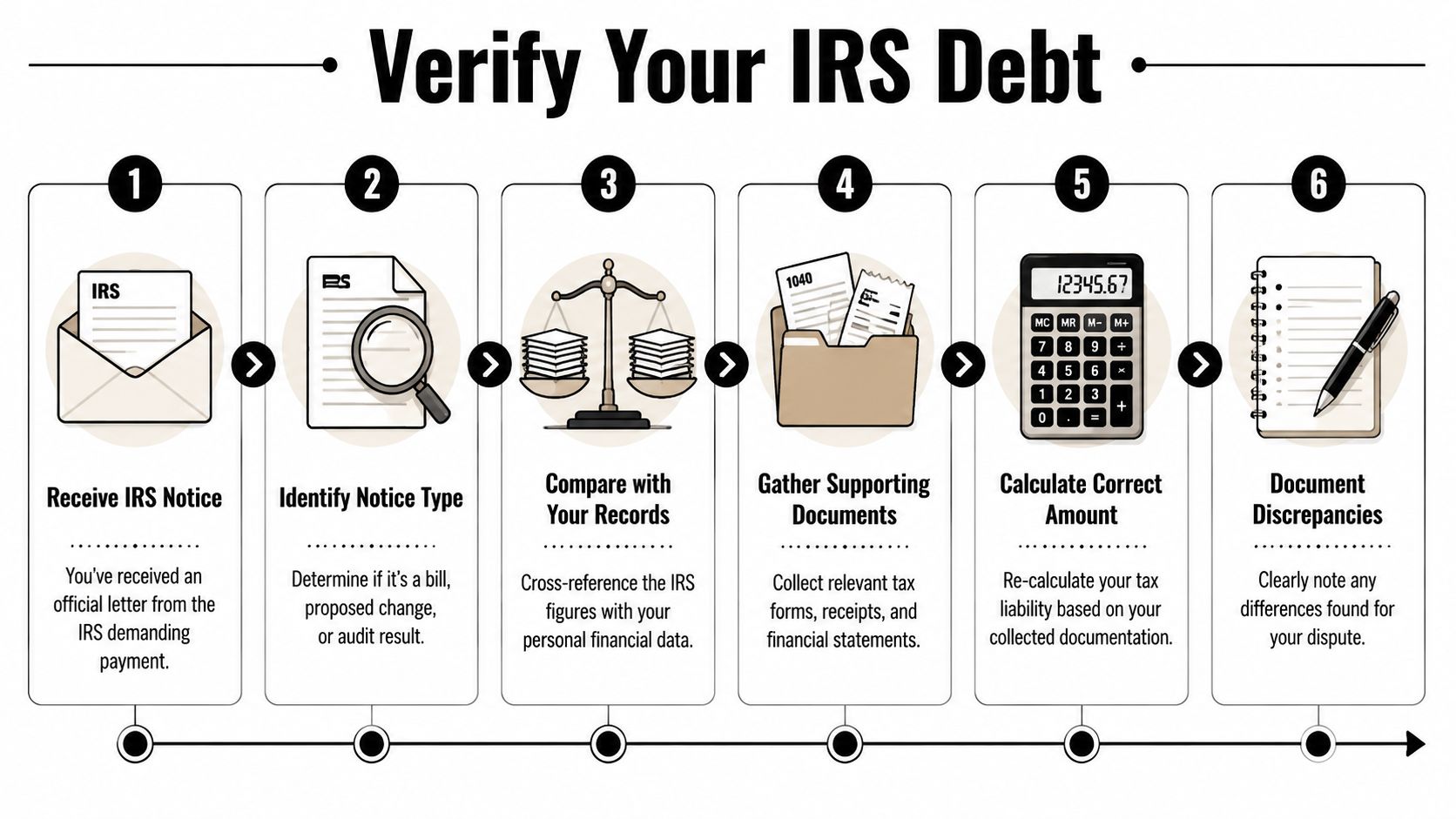
Before you argue with the IRS, verify what happened on the account. That means reading the notice closely and comparing it against your return, your payment records, and the source documents behind the return.
Read the notice for what it actually says
A CP14 is generally a bill. A proposed change notice usually means the IRS thinks your return should be adjusted. A levy notice signals a collection stage, not an argument about arithmetic. Those distinctions matter because they tell you whether you should be preparing a factual rebuttal, a procedural appeal, or a financial disclosure package.
If you disagree with the amount on a CP14, USA.gov's IRS dispute guidance says you can call the number on the notice. For collection notices, you may have only 30 days to request a Collection Due Process hearing using Form 12153 to preserve your rights.
Reconcile the IRS numbers against your own records
Many taxpayers commonly take shortcuts. They remember roughly what they earned, assume a payment was applied, or trust tax software output without checking the account history. That isn't enough.
Use a reconciliation method. Match the IRS figures to your filed return, then to your W-2s, 1099s, estimated tax payments, withholding, prior credits, and any amended return activity. If your bookkeeping is messy, reviewing some practical key account reconciliation examples can help you think through how to match entries, trace discrepancies, and document a clean explanation.
Look for issues like these:
- Income mismatch: A 1099 was duplicated, reported under the wrong taxpayer, or never belonged on your return.
- Payment mismatch: You paid, but the payment posted to the wrong year or under the wrong identification number.
- Processing issue: The IRS hasn't credited an amended return or prior submission.
- Return gap: The IRS filed a substitute position because it believes you didn't file or filed late.
When the numbers don't match, write down the exact line item, the exact amount in question, and the document that proves your position. General disagreement doesn't move a case.
Decide which lane you're in
At the end of this review, you want a simple answer.
| Outcome | What it means | Next move |
|---|---|---|
| The IRS amount is wrong | You have a true dispute | Prepare evidence and choose the right challenge procedure |
| The IRS amount is right | You have a collection problem | Shift to resolution options based on ability to pay |
| You can't tell yet | The file is incomplete | Get transcripts, notices, returns, and payment records before acting |
One more point matters here. Sometimes the issue isn't whether the IRS balance exists, but whether the government still has time to collect it. That's a different analysis from disputing the amount itself. For background on that timing question, see this discussion of the statute of limitations on IRS debt.
Gather Your Evidence and Documentation
A good IRS case file is not a pile of papers. It's an organized narrative backed by records. Whether you're disputing the amount or proving you can't pay it in full, your documents need to tell one coherent story.
Build the file before you contact the IRS
A practical tax resolution workflow starts with collecting prior-year returns, bank statements, pay stubs, receipts, and liability schedules, then organizing them by year and topic so you can support the specific relief you're requesting, as described in this overview of tax resolution preparation. In practice, disorganized records slow the case and make the taxpayer look less credible.
That credibility point matters more than people think. IRS personnel are used to hearing broad claims. What changes the conversation is a file that matches dates, amounts, and explanations.
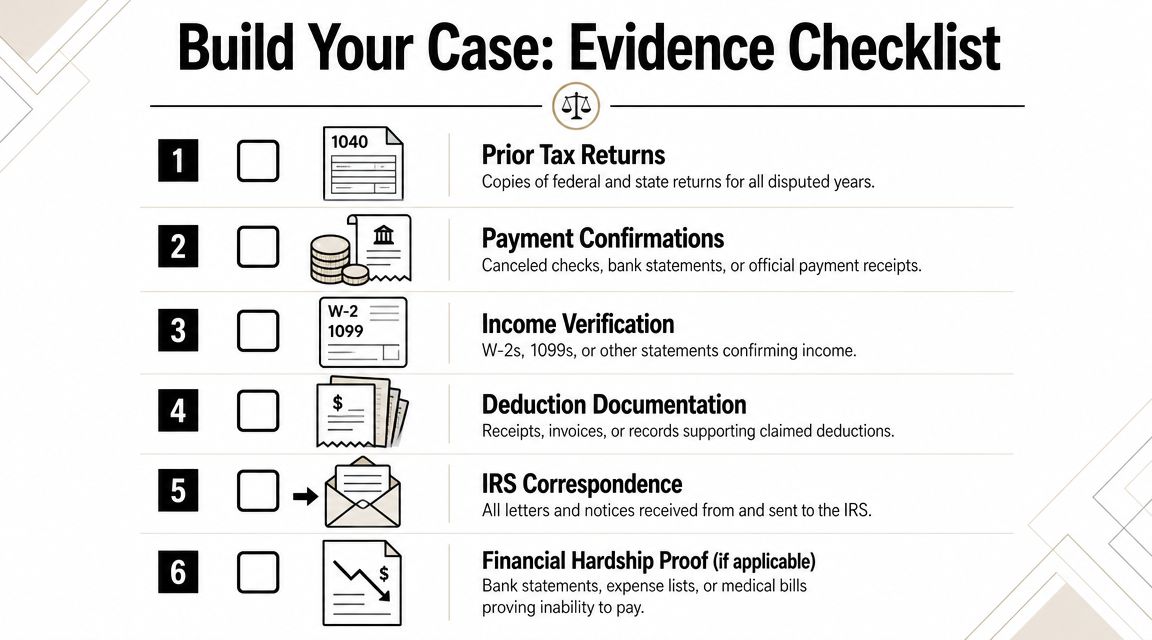
What belongs in the file
If you're challenging the amount, focus on proof of accuracy. If you're resolving a valid debt, focus on proof of financial condition.
- Prior tax returns: Include filed returns for every year tied to the issue, plus amended returns if any were submitted.
- Payment proof: Use canceled checks, EFT confirmations, account transcripts, or bank records showing what was paid and when.
- Income documents: Gather W-2s, 1099s, K-1s, payroll summaries, and business books that support the numbers you reported.
- Deduction support: Save receipts, invoices, mileage logs, and statements that show why a deduction or credit was proper.
- IRS correspondence: Keep every notice, fax confirmation, certified mail receipt, and prior response in one timeline.
- Hardship records: For collection resolution, include bank statements, pay stubs, rent or mortgage records, medical bills, insurance costs, and business operating expenses.
Organize it so someone else can follow it
The best setup is usually by year, then by category within each year. Name digital files in plain language. For example: "2022 IRS Notice," "2022 Bank Statement March," "2022 1099-NEC Client A," "2022 Estimated Payment April."
If your receipts and expense support are scattered across email, paper files, and phone photos, a structured approach to digital expense management for taxes can make the assembly process much faster.
A weak case often isn't weak on the facts. It's weak because nobody can prove the facts in a way the IRS can review efficiently.
For business owners, include profit and loss statements and a current balance sheet if affordability is part of the case. For payroll tax matters, separate trust fund issues, tax deposits, and owner draws clearly. Mixing those categories creates avoidable confusion.
Formal Dispute and Administrative Appeal Options
When the IRS is wrong, you need a procedure that fits the type of error and the stage of the case. Some disputes belong in Appeals. Some belong in reconsideration. Some are really collection-rights cases triggered by a notice deadline.
Timing controls the quality of your options
IRS appeal procedure is technical. IRS guidance summarized in this explanation of how to file an appeal with the IRS says a taxpayer generally requests Appeals by filing a written protest and sending it to the IRS address on the notice, not directly to the Independent Office of Appeals. For most collection disputes, Form 12153 is generally used for Collection Due Process, and the request is generally due within 30 days of the notice. For many exam cases at $25,000 or less, a small-case request may work, while disputes above $25,000 typically require a formal written protest.
Miss the deadline, send the protest to the wrong place, or make vague arguments, and the case gets harder immediately.
Comparison of IRS Dispute and Appeal Options
| Appeal Option | Best For | Key Form/Process | Critical Deadline |
|---|---|---|---|
| Collection Due Process hearing | A collection notice where you need to preserve formal review rights | Form 12153 sent to the IRS address on the notice | Generally due within 30 days of the notice |
| Equivalent hearing | A collection notice where the CDP deadline was missed | Collection hearing request after the CDP window | Later than the CDP window, but with reduced procedural protection |
| Appeals protest in an exam case | Audit or examination disagreement where the IRS amount is wrong | Small-case request for many disputes at $25,000 or less, formal written protest for disputes over $25,000 | Follow the deadline stated in the IRS notice |
| Audit reconsideration | A prior assessment that may be wrong because the IRS didn't consider material information | Written submission with supporting records | Depends on posture of the account and collection status |
| Collection Appeals Program | A narrower challenge to certain collection actions | CAP procedures through collection channels | Very time-sensitive and tied to the collection action |
Which path fits which problem
Collection Due Process is often the right tool when the immediate threat is collection action and you need to preserve rights connected to that action. It is procedural and deadline-sensitive.
Equivalent hearings can still be useful if the taxpayer missed the formal window, but they are not the same as a timely CDP request. If rights were available and the taxpayer let them expire, the advantage changes.
Exam Appeals are for cases where the IRS got the tax wrong. The protest has to identify what the IRS did wrong factually or legally. "I disagree" is not a protest. "The IRS included income from a 1099 issued in error, and attached records show it was corrected" is the start of one.
Audit reconsideration can help when the taxpayer has real information the IRS didn't consider before making the assessment. This often comes up when returns were filed late, notices went to an old address, or the taxpayer failed to respond during the audit window.
What actually works
Good appeal files are specific. They identify the notice, the year, the adjustment, the disputed issue, and the supporting documents. They also avoid unnecessary arguments. You don't improve a tax case by sending the IRS a life story.
The IRS will listen to a narrow, documented argument long before it responds well to a broad emotional one.
Negotiating a Resolution for Valid Debt
A good resolution starts after one conclusion is settled. The tax is correct.
At that point, this is no longer a dispute strategy. It is a collection strategy, and the right move depends on what the taxpayer can document, what the IRS can collect, and whether the case can stay compliant from now on. That distinction matters. Taxpayers waste time and money when they keep arguing about liability after the fundamental issue is affordability.
The IRS does settle valid debt in the right cases. In FY 2024, taxpayers submitted 33,591 Offers in Compromise, and the IRS accepted 7,199 of them for a total of $163.4 million, according to the agency's collections activities statistics. The point is not that everyone qualifies. The point is that resolution programs are real, but they are evidence-driven.
The main resolution tracks
An installment agreement works when the taxpayer can pay over time. A key question is not whether a monthly number can be proposed. It is whether that number can be paid month after month without default. A plan that looks good on paper but fails in a few months makes the case worse, not better.
An Offer in Compromise is a collection analysis. The IRS reviews income, allowable expenses, assets, equity, and future collection potential. If the numbers show the government can collect in full over the remaining statute, the offer will not solve the problem. If you want a closer look at how that program works, this guide to an IRS Offer in Compromise explains the standards in more detail.
A penalty abatement request addresses the penalty layer of the balance, not the underlying tax. In some cases, that adjustment changes the posture of the file enough to make payment terms more realistic. In others, it helps only at the margins. The facts decide that.
Currently Not Collectible status fits cases where paying the IRS would interfere with basic living expenses. It can stop active collection pressure for a period of time, but interest and penalties can continue, and the account will be reviewed again.
What the IRS is actually testing
Collection cases are won or lost on proof. The IRS is trying to determine whether the financial picture is accurate, complete, and stable enough to support the resolution requested.
That review centers on a few practical questions:
- Current compliance: Are all required returns filed, and are current taxes being paid?
- Actual cash flow: After allowable living expenses, is there money available each month?
- Assets and equity: What can be borrowed against, sold, or reached?
- Consistency across records: Do the bank statements, pay records, tax filings, and financial forms match?
- Future risk: If the taxpayer is self-employed or operating a business, will the same problem recur next quarter?
For business cases, that last point carries real weight. The IRS has little interest in approving a resolution if new payroll tax debt or new estimated tax debt is going to appear immediately after the agreement is signed.
Set expectations correctly
A valid debt case is solved by accurate financial disclosure, disciplined follow-through, and a resolution the taxpayer can keep.
Analysis before action is paramount. I have seen taxpayers push for an offer because they heard it was the cheapest option, when the file supported a clean installment agreement. I have also seen the reverse, where a taxpayer agreed to payments that were never sustainable because no one tested the budget against real records first. Both mistakes cost time, credibility, and money.
A structured review helps sort that out. Attorney Stephen A. Weisberg offers a free tax debt analysis designed to determine whether a case involves a true dispute, a collection problem, or both before representation begins.
Labels do not resolve IRS debt. Verified income, necessary expenses, assets, liabilities, filing status, and timing do.
Common Pitfalls and When to Hire a Tax Attorney
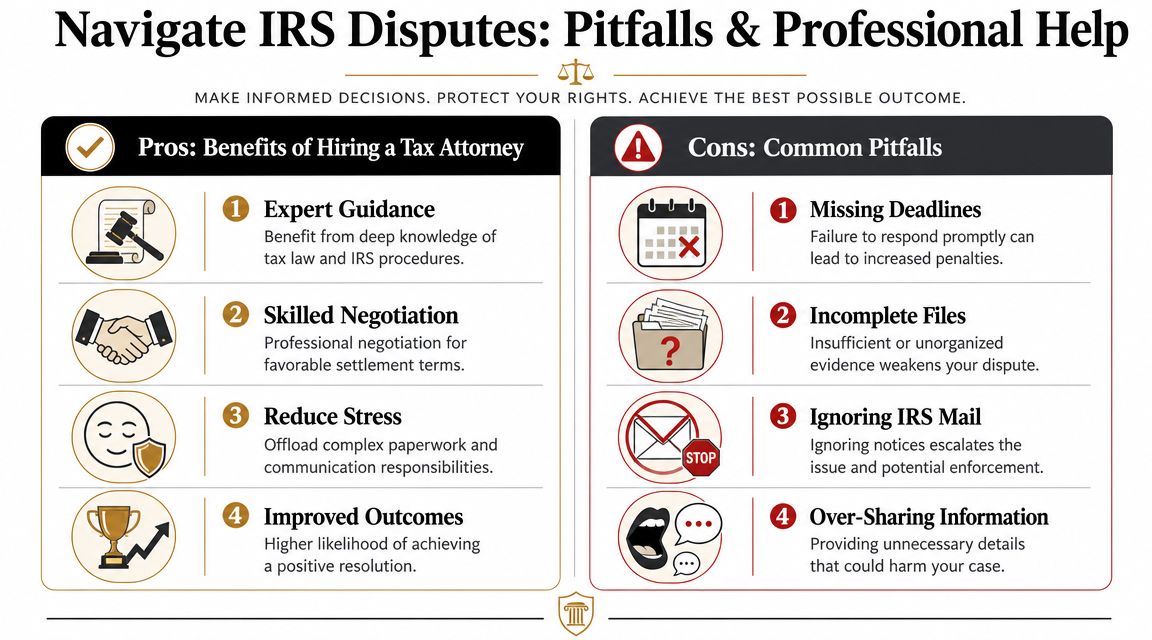
Most self-inflicted IRS damage comes from four habits. Ignoring notices. Missing deadlines. Sending incomplete financials. Talking before thinking.
The mistakes that cost taxpayers leverage
The first mistake is treating every IRS balance as a settlement case. If the debt should be challenged, moving straight into collections paperwork can box you into the wrong lane.
The second mistake is procedural sloppiness. A protest sent to the wrong office, a hearing request sent after the deadline, or a packet with missing records can delay review or derail it completely.
The third mistake is trusting sales claims from tax relief firms. The Federal Trade Commission warns consumers to avoid firms that guarantee results or demand large upfront fees, and explains that only the IRS or state comptroller decides what relief a taxpayer qualifies for in this guidance on tax relief companies. The same guidance points taxpayers toward official help such as Low Income Taxpayer Clinics and the Taxpayer Advocate Service.
When hiring a tax attorney makes sense
Some cases are still manageable without counsel. Many are not.
Consider bringing in a tax attorney when:
- The debt is large enough to affect major financial decisions: refinancing, a sale, a divorce, or business continuity.
- Payroll tax issues are involved: especially when trust fund exposure may affect owners or responsible persons.
- The facts are mixed: part audit problem, part collections problem, part missing return problem.
- You received a levy notice, summons, or appeal rights notice: timing and framing matter.
- You need privilege-sensitive advice: especially if statements could create risk.
- The business keeps accruing new debt: old debt is hard enough. New noncompliance makes resolution much harder.
A good attorney doesn't just "negotiate." A good attorney diagnoses the case, preserves rights, narrows the issues, and keeps the taxpayer from making admissions or submissions that hurt later.
If you're weighing whether the case has crossed that line, this article on when to hire a tax attorney lays out the decision points clearly.
The right time to get help is usually before the deadline passes, not after the IRS has already acted.
The practical takeaway is simple. If you want to dispute IRS debt, first determine whether you're really disputing the debt at all. That single distinction changes everything that follows.
If you're dealing with IRS debt and need a clear analysis before taking action, Attorney Stephen A Weisberg offers a practical starting point. He represents individuals, businesses, and owners in IRS disputes, collections, audits, and tax debt matters, and his approach begins with understanding whether the problem is a true dispute, a collection issue, or both.


