Discharge of Lien: What It Does and Does Not
A discharge of lien clears one property, not the tax debt. See the double-value test, Form 14135, and the 45-day IRS timeline.

In this article
- What a Discharge of Lien Actually Clears
- How Common This Problem Is
- Discharge Versus Release Withdrawal and Subordination
- Which Lien Document the Closing Actually Needs
- The Other Three Papers
- When the IRS Will Discharge One Property
- The Double Value Test
- Statutory Routes to a Certificate of Discharge
- Request the Certificate and Assemble the Closing Package
- The Seven Filing Steps
- What Goes in the Closing Package
- Limits to State Out Loud at Closing
- Timelines and State Lien Rules
- A Backward Schedule That Works
- Federal Paper Does Not Clear State Liens
- Sale Refinance and No-Value Examples
- The Seller Who Keeps a Second Parcel
- The Owner Who Is Not Selling
- The Short Sale With No Equity
- Decide Whether Discharge Solves the Closing
You've got a buyer, a signed contract, and a closing date circled on the calendar. Then the title company sends the commitment and there's a Notice of Federal Tax Lien sitting in the exceptions. The buyer won't take the house with the IRS attached to it, the lender won't fund behind it, and you don't have enough equity to pay the whole tax bill at the table. That's the exact stalled closing a discharge of lien is built to fix.
What a Discharge of Lien Actually Clears
Say you're selling one house but you own other property, and you still owe the IRS more than this sale will produce. A discharge of lien is a certificate that removes the federal tax lien from one named piece of real or personal property so that asset can be sold, refinanced, or transferred. It clears the title to that property only.
Each lien release applies to a single property. The buyer gets a clean key to this one door. Every other door you own stays locked by the same lien.
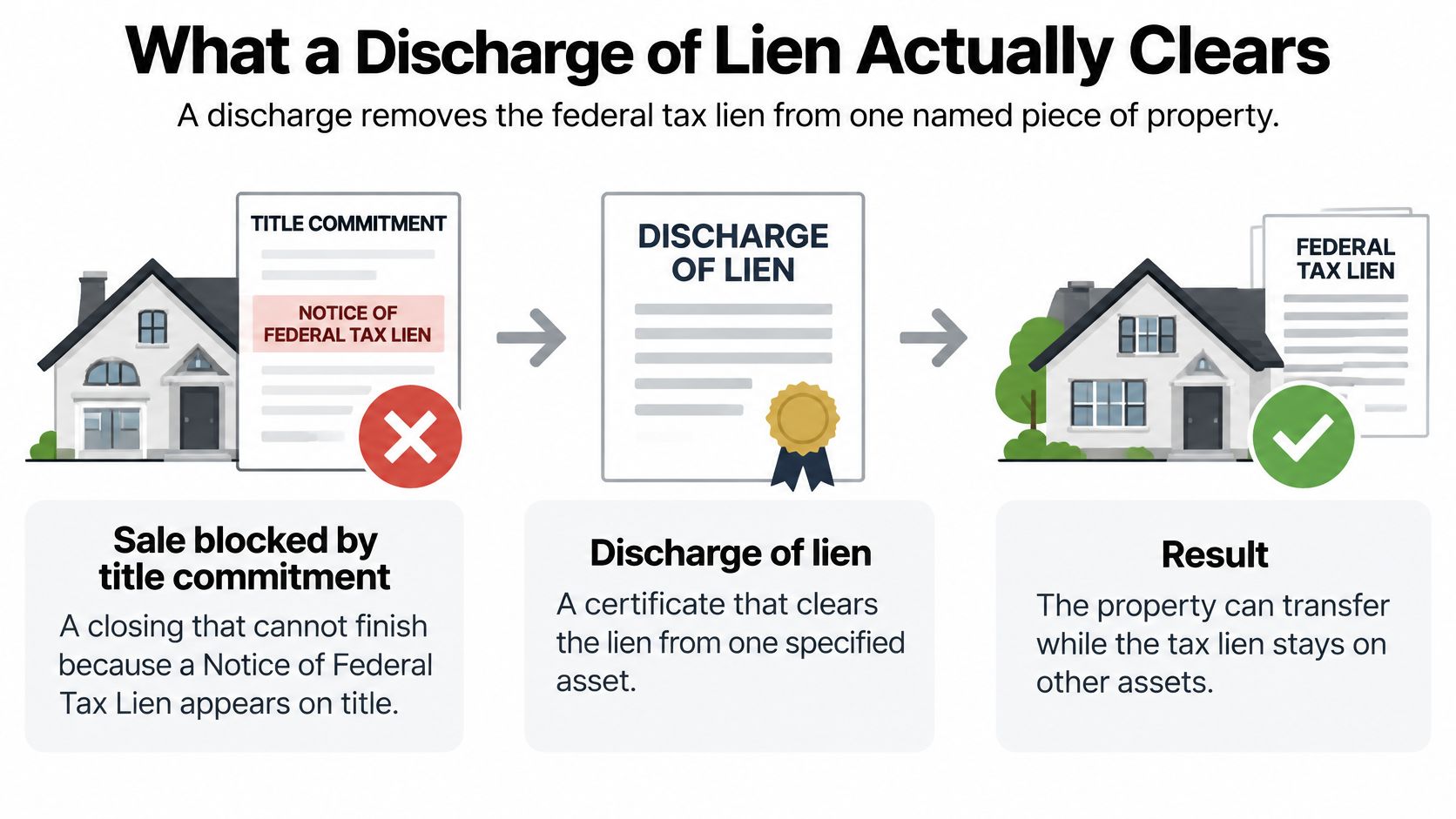
What stays in place matters just as much. The unpaid tax stays owed. Penalties can keep accruing, the public notice stays on record, and the lien stays attached to every other asset you own. Reading the certificate as debt forgiveness is the mistake that surprises sellers the morning after closing.
How Common This Problem Is
This isn't a rare closing problem. The IRS recorded 196,996 notices of federal tax lien filed in fiscal year 2024, according to its official Table 27 on delinquent collection activities, a count tracked in the annual federal tax lien filing data. Any one of those notices can stop a sale cold if nobody deals with it before the title commitment is final.
You really face three decisions. First, which of the four lien tools fits your deal. Second, whether the property you'll keep is valuable enough to satisfy the IRS. Third, which form to file and how far ahead of closing to file it.
Practical rule: Ask what the certificate clears, not what you hope it clears. It clears one property for one transaction. It doesn't clear you.
Discharge Versus Release Withdrawal and Subordination
Closing agents use four similar sounding words for four different papers. Asking for the wrong one wastes weeks and still leaves the title company unable to insure the deal.
Which Lien Document the Closing Actually Needs
| Remedy | What it changes | Debt after | Typical use |
|---|---|---|---|
| Discharge | Lien removed from the named property only | Balance, notice, and other assets remain | Sale or transfer of one asset |
| Release | Lien extinguished on all taxpayer property | Liability paid, bonded, or unenforceable | Full payoff or expired lien |
| Withdrawal | Public notice pulled in limited cases | Underlying liability remains | Record cleanup, not a payoff |
| Subordination | New lender takes priority over the tax lien | Lien stays on the property | Refinance or new financing |
A discharge under Internal Revenue Code section 6325(b) lifts the United States' lien only from the property named in the certificate. IRS Publication 1468 states that a certificate of discharge removes the federal lien only from the specifically described property and does not extinguish the underlying liability, release other property, or terminate the Notice of Federal Tax Lien. Sellers, buyers, lenders, and title professionals get tripped up when they assume it creates a broad, permanent release.
The Other Three Papers
A release under section 6325(a) is the broad one. It extinguishes the lien against all of your property, usually after you've paid in full, posted an acceptable bond, or the lien is no longer enforceable. If you haven't done one of those things, you're probably not getting a release, no matter how nicely you ask.
Withdrawal pulls the public notice from the records in limited cases. People treat it like a wipeout of the debt, and it's not. It mainly helps your record and credit profile, while the liability underneath remains collectible. It also helps to keep liens straight from levies, since a lien secures a claim while a levy takes property, a distinction explained in this guide to a lien versus levy.
Subordination doesn't remove anything. It lets a new lender step ahead of the tax lien in priority so refinance money can fund. The lien stays on the property, just in second place behind the new mortgage.
One risk belongs only to discharge. If you later reacquire the discharged property, the lien can attach again. That matters in family transfers and buybacks where the same person ends up back on title.
So match the paper to the deal. For a conveyance of one parcel, request a certificate of discharge, Form 669-A, applied for on Form 14135. For a new first mortgage on a house you'll keep, that's a subordination request, not this certificate. Discharge is a title solution for one transaction, not a resolution of the liability.
When the IRS Will Discharge One Property
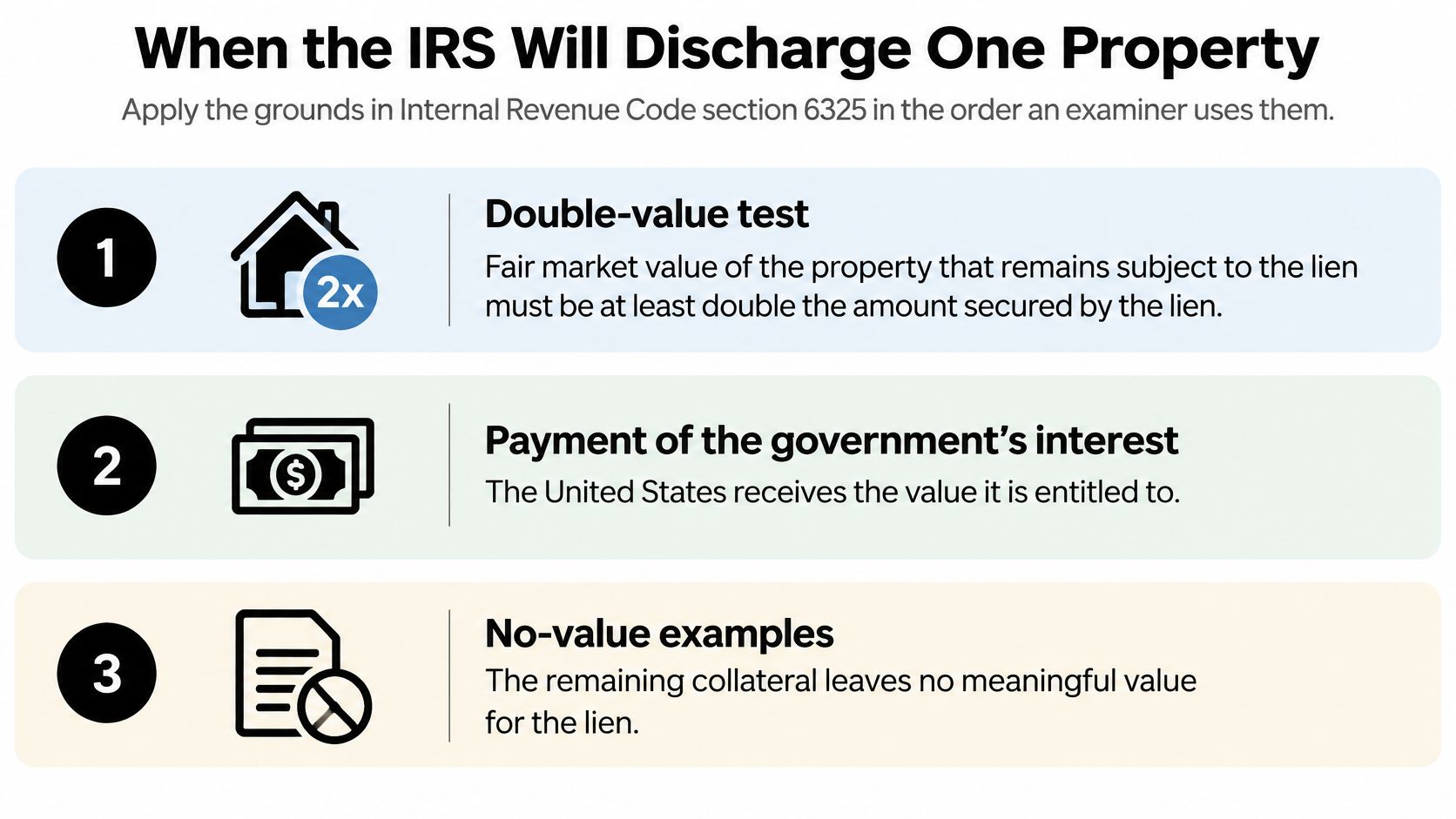
A home sale can be ready to close while a federal tax lien still clouds title. The IRS may discharge the lien from that specific property if the transaction meets one of the grounds in Internal Revenue Code section 6325. The debt usually remains; the certificate clears the described property from the lien.
The Double Value Test
The first route is the double-value test. Under Internal Revenue Code § 6325, the fair market value of the property remaining subject to the lien must be at least twice the unpaid tax liability secured by the lien plus any higher-priority liens on that property.
For example, if the federal tax lien secures $100,000 and senior liens total $50,000, the remaining property generally must have a fair market value of at least $300,000. That is twice the combined $150,000. The IRS may discharge the property being sold if the required value remains in the other property.
Statutory Routes to a Certificate of Discharge
| Ground | What must be shown | Money result | Worked marker |
|---|---|---|---|
| Double-value test | Remaining property worth at least twice the tax plus senior liens | Full tax need not be paid if the test holds | $100,000 tax + $50,000 senior liens needs $300,000 FMV |
| Payment of the interest | The United States is paid its interest in the named property | Agreed amount paid at closing or placed in escrow | Sale proceeds allocated to the IRS |
| No-value interest | Senior claims leave no value for the lien to reach | Often no cash to the IRS | Mortgages consume all equity |
| Bond or deposit | A bond or deposit equal to the United States' interest | Funds posted instead of a payoff | Certificate can issue while money is held |
Under the payment route, the IRS discharges the property when it receives an amount equal to its interest in that property. The payment may come from the sale proceeds, with the amount shown on the settlement statement. If senior mortgages consume all the equity, the IRS may have no valuable interest in the property to collect against.
A bond or deposit can stand in for payment of the government's interest. It allows the transaction to proceed while the funds secure that interest. The certificate must describe the property precisely, whether it is real estate or personal property.
For the double-value test, compare the value of the property that will remain subject to the lien with twice the tax debt plus senior liens on that property. If it falls short, the other statutory grounds may fit better. State-law mechanic's liens follow separate rules; Form 14135 does not resolve them. IRS guidance calls for an application on Form 14135, with the certificate issued on Form 669-A.
Request the Certificate and Assemble the Closing Package
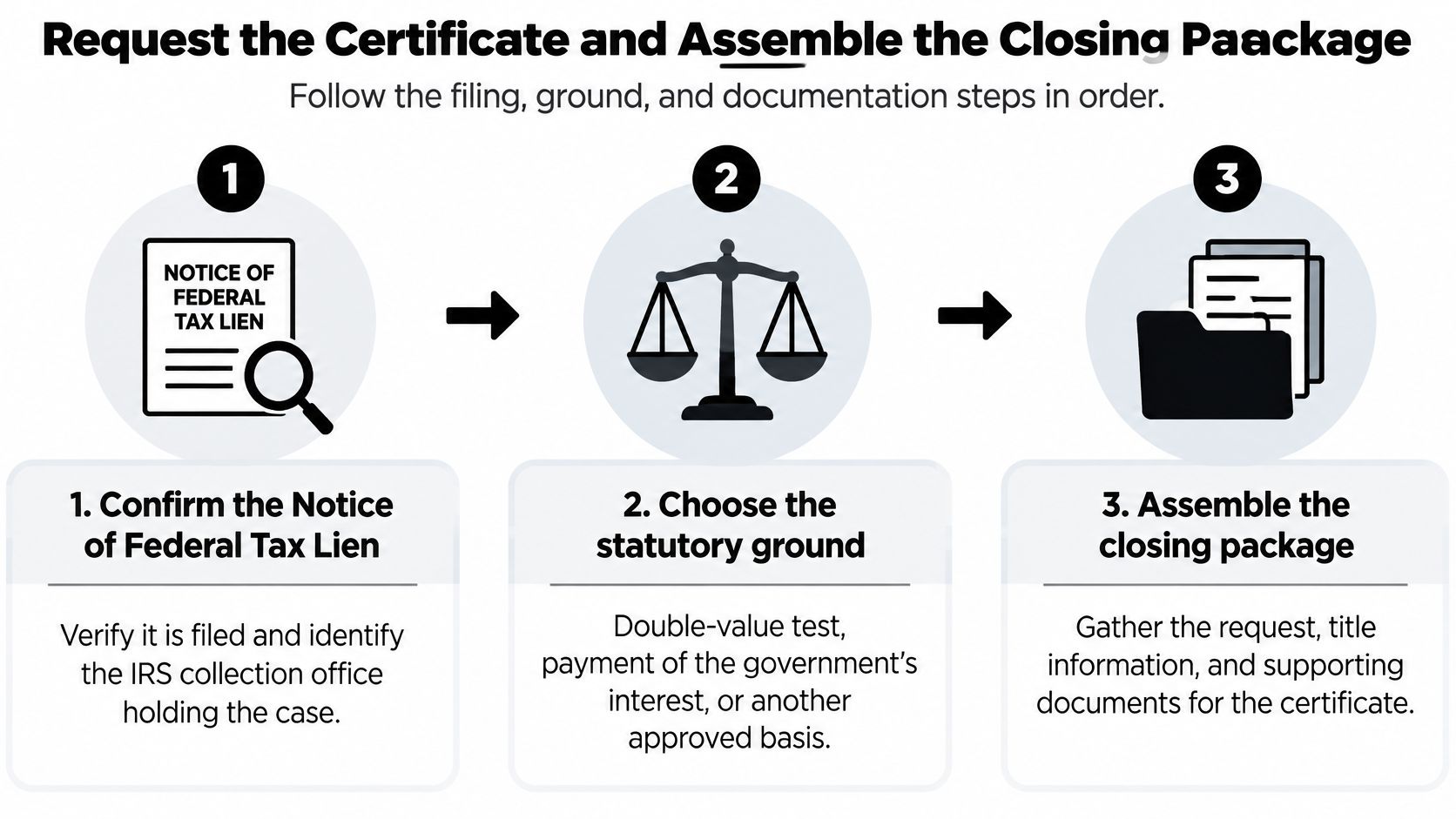
A buyer is ready to close, but the title company still needs proof that the specific parcel can transfer free of the federal tax lien. The closing package gives the IRS the facts to decide whether to issue that property-specific certificate. It does not erase the tax debt.
The Seven Filing Steps
- Confirm the notice is filed: Verify that a Notice of Federal Tax Lien is recorded and identify the IRS collection office handling the case.
- Choose the statutory ground: The application can rely on the double-value test, payment of the government's interest, a no-value interest, or a deposit or bond. The documents should support the ground you select.
- Complete Form 14135: Submit the signed Application for Certificate of Discharge of Property from Federal Tax Lien with all requested information.
- Attach supporting documents: Include records of ownership, value, competing liens, and the planned transaction, as described in IRS Publication 783.
- File early: Submit the application to the responsible collection official at least 45 days before the certificate is needed. The purchase agreement should allow time for IRS review.
- Respond to questions: The IRS may ask for more information, such as an appraisal, title report, or draft settlement statement. Prompt replies help keep the application moving.
- Record the certificate: If approved, the IRS issues Form 669-A. Record it where the lien notice was filed so the title company can verify that the specified property has been discharged.
IRS Publication 783 recommends submitting Form 14135 and its supporting documents at least 45 days before the certificate is needed. A discharge under section 6325(b) clears the specified property from the federal lien. The underlying tax liability remains, and the IRS may continue collection against other property and assess tax and penalties.
What Goes in the Closing Package
The package should let the IRS examiner and title underwriter check the property, the lien priority, and the proposed transfer without having to guess.
- Form 14135: The signed application identifying the taxpayer, lien, property, and statutory ground.
- Legal description: Use the description that identifies the parcel in the deed. A street address alone may not identify it precisely enough.
- Title commitment: Include a current report of mortgages, judgments, and other senior liens, with their balances.
- Valuation: Provide an appraisal or other acceptable valuation for the property being discharged and, when relevant, property that will remain subject to the lien.
- Transaction documents: Identify the buyer or lender and include the purchase agreement or other documents describing the transfer.
- Draft settlement statement: Show any amount proposed for payment to the United States or held in escrow.
The IRS discharge regulations require a written application to the responsible collection official. The IRS may request information about ownership, value, competing liens, and the proposed disposition. Form 14135 also addresses the double-value standard for property that remains subject to the lien, as well as a deposit or bond as another option. For a sale, the IRS may require payment representing its interest, evidence that the taxpayer has transferred title, and a final settlement statement.
A BC home purchase closing timeline shows how a real estate transaction can require lead time for title and financing conditions. For an IRS discharge, the 45-day filing guidance in Publication 783 is the key date to build around. Put enough flexibility in the purchase agreement to account for IRS review.
Limits to State Out Loud at Closing
Make sure everyone understands what the certificate does and does not accomplish:
- Other property stays encumbered: The discharge applies only to the property described in the certificate.
- The tax debt remains: The IRS can continue collection against other assets and assess tax and penalties.
- Sale proceeds may remain reachable: Discharging the parcel does not necessarily remove the federal claim from proceeds.
- Reacquisition can create risk: If the taxpayer later buys or receives the property back, the lien may attach again.
A closing agent needs a certificate that identifies the parcel accurately. If the legal description does not match the property being insured, the title company may not be able to rely on it.
Timelines and State Lien Rules
Work backward from the closing date, not forward from today. The 45 day lead for Form 14135 is the anchor, and everything else stacks in front of it.
A Backward Schedule That Works
- Closing date: The day the certificate must already be issued and recordable.
- Minus 45 days: Your complete application is in the collection official's hands by this date at the latest.
- Before that: Order the appraisal and title report early enough that both are finished, reviewed, and attached before you file.
- Buffer time: Leave room for IRS follow-up questions, because a thin file generates them and response time isn't fixed.
Since the IRS can take longer when the file is incomplete, put an extension or contingency clause in the purchase agreement. If the certificate isn't issued by the scheduled date, the contract should say what happens next instead of putting everyone in breach.
Federal Paper Does Not Clear State Liens
A federal certificate covers only the federal lien. State tax liens, state tax warrants, and judgment liens are filed and released under separate state statutes with their own forms and recording offices. If you're not sure how the state version works, read up on what a state tax lien is before you assume one certificate clears everything.
Before accepting a title commitment, pull each record from the office that holds it. Check the county recorder for the federal notice and judgment liens, the state filing office for state tax liens and warrants, and the county records again for mechanic's liens, which follow state discharge statutes and aren't the IRS certificate. A clean federal file with an unnoticed state warrant still kills a closing.
Sale Refinance and No-Value Examples
Abstract tests get clearer when you attach them to actual deals. Each of these sellers owed the IRS money. Each needed a different paper.

The Seller Who Keeps a Second Parcel
Say a seller owes $100,000 secured by the lien and is selling a house while keeping a second parcel. Senior liens on what remains are $50,000, and that parcel appraises at $300,000 or more. That clears the double-value scale, so the house can transfer without paying the entire tax at closing. If you're in this spot, it's worth reading how a sale can still work when there's an IRS lien on the home before you assume the deal is dead.
The next morning, the seller still owes the balance. The lien still sits on the parcel they kept, and penalties keep accruing until the debt is dealt with separately.
The Owner Who Is Not Selling
Now picture an owner who wants to refinance and stay put. The new lender will fund only if it holds first priority. That file is subordination, full stop in practical terms. Sending Form 14135 as if it were a payoff won't give the lender a first lien position, because discharge removes the lien from property being conveyed, and nothing here is being conveyed.
The next morning, the lien is still on the house, just behind the new mortgage. The owner has better loan terms and the same tax debt.
The Short Sale With No Equity
In the third deal, the mortgages add up to more than the sale price. After senior claims, the government's interest is worth nothing. The certificate can issue without a cash slice to the IRS that the settlement statement can't pay.
The next morning, the seller still owes the remaining tax. No equity in the house never meant no liability for the person.
A partial conveyance works the same way. If a large parcel is split and only one described lot is sold, only that lot is discharged. The parent parcel stays under the lien, and if the seller later buys the discharged lot back, the lien can come with it.
Before anyone drafts a deed on your deal, label your contract. Is it double-value, pay the interest, no-value, or subordination? That one label decides which form you file, what you prove, and what the title company should demand.
Decide Whether Discharge Solves the Closing
Use a discharge of lien when one identified asset must be sold or transferred and the remaining balance can stay open under the federal lien. Don't use it to erase the debt, clear every property, or give a lender priority. Those are payoff, release, and subordination problems, and each has its own paper. If your real goal is getting the lien gone entirely, compare your options for how to remove a tax lien before you file the wrong request.
Before promising a clear title date, pull the IRS account transcript and any state transcripts. We obtain our clients' IRS and state transcripts to review the history of the debt, including every penalty, every payment, and how long until it is written off. After reviewing the transcripts, we identify the most immediate threats, which are levies, garnishments and liens, because those are what derail closings. Owing more than $5,000 to the IRS is a listed situation in which an attorney is needed for IRS tax matters, and a filed Form 2848 power of attorney moves IRS contact to your representative so you're not negotiating from the closing table.
Handle the sale mechanics and the tax problem as two tracks. General seller resources on the steps to sell your home from Jacky Levi, Vancouver Realtor, can help you sequence listing, offers, and closing prep. The remaining balance still needs its own resolution, whether that's a payment plan or a collection status, and that separate work is what keeps unpaid tax from attaching to the next asset you buy.
If a federal tax lien is blocking your sale, refinance, or transfer, get the certificate question and the remaining balance reviewed together before you promise anyone a closing date. Visit Tax Attorney Stephen A Weisberg to request a Tax Debt Analysis and find out whether a discharge, a subordination, or a full resolution is the right move for your deal.


